About SIP


   SIP
The Basics
 Jonas Borjesson


                   @borjessonjonas
NOTE
●   This version has been adapted to be viewed
    without transitions.
●   Go to aboutsip.com to download the original
    version.
●   Also be sure to check out vimeo.com/aboutsip
    for any recorded presentations.


                                          @borjessonjonas
This is SIP!


               @borjessonjonas
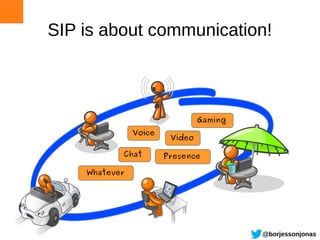
SIP is about communication!


                                Gaming
               Voice
                        Video

           Chat        Presence

    Whatever


                                         @borjessonjonas
SIP is about sessions
●   A session represents a p2p relationship
    between two SIP endpoints.
●   SIP helps you:
    ●   Setup sessions.
    ●   Negotiate what you want to do with the session
    ●   Tear down sessions
●   Session can be anything
    ●   Voice/video/gaming/your own whatever
    ●   SIP only helps you establish and manage the
        session, you decide what to do!

                                                  @borjessonjonas
SIP is about finding your friends
                 ●   Before you can “call” your
                     friends (establish a session),
                     you must find them!
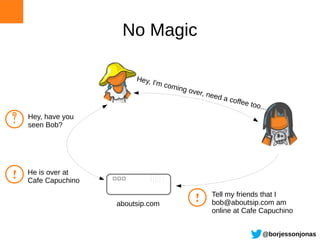
●   No magic though... you need to tell someone
    where you are...

                                                  a
                                         t o g et
                                  W en t
                                  coffee


                                   /Bob

                                                      @borjessonjonas
No Magic

                          Hey, I
                                'm   comin
                                          g ove
                                               r, nee
                                                     d   a coff
                                                                  ee too
                                                                        .   ..
?   Hey, have you
    seen Bob?


!   He is over at
    Cafe Capuchino


                     aboutsip.com
                                             !     Tell my friends that I
                                                   bob@aboutsip.com am
                                                   online at Cafe Capuchino


                                                                            @borjessonjonas
Basic User Scenario
                              Proxy


INVITE sip:bob@aboutsip.com
                                      INVITE sip:bob@192.168.0.100


      180 Ringing                             180 Ringing


                                                200 OK
          200 OK


          ACK
                                                ACK


                              audio


                                                              @borjessonjonas
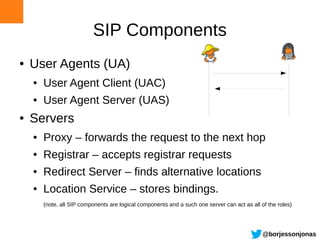
SIP Components
●   User Agents (UA)
    ●   User Agent Client (UAC)
    ●   User Agent Server (UAS)
●   Servers
    ●   Proxy – forwards the request to the next hop
    ●   Registrar – accepts registrar requests
    ●   Redirect Server – finds alternative locations
    ●   Location Service – stores bindings.
        (note, all SIP components are logical components and a such one server can act as all of the roles)


                                                                                               @borjessonjonas
SIP Messages
●   Request/Response model
    ●   UAC sends the request, UAS responds
●   Requests starts with a request line
    ●   INVITE sip:alice@example.com SIP/2.0
●   Methods
    ●   INVITE, ACK, BYE, CANCEL, REGISTER, OPTIONS
    ●   And many more...


                                                 @borjessonjonas
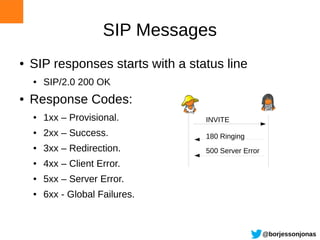
SIP Messages
●   SIP responses starts with a status line
    ●   SIP/2.0 200 OK
●   Response Codes:
    ●   1xx – Provisional.         INVITE
    ●   2xx – Success.             180 Ringing
    ●   3xx – Redirection.         500 Server Error
    ●   4xx – Client Error.
    ●   5xx – Server Error.
    ●   6xx - Global Failures.


                                                      @borjessonjonas
INVITE Request

INVITE sip:bob@aboutsip.com SIP/2.0
To: <sip:bob@aboutsip.com>
From: <sip:alice@aboutsip.com>;tag=987lkajsdf89au
Call-ID: lkjasdf90989lkj
CSeq: 1 INVITE
Content-Type: application/sdp
Content-Length: 450
Record-Route: <sip:192.168.1.52:5060;transport=tcp;lr>
Via: SIP/2.0/TCP 192.168.0.122:5060;branch=xxx;rport
...
Contact: <sip:192.168.0.122:3156;transport=TCP>


                                              @borjessonjonas
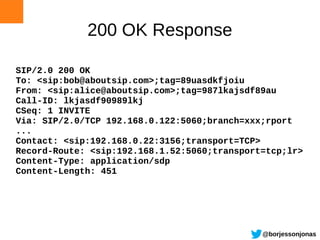
200 OK Response

SIP/2.0 200 OK
To: <sip:bob@aboutsip.com>;tag=89uasdkfjoiu
From: <sip:alice@aboutsip.com>;tag=987lkajsdf89au
Call-ID: lkjasdf90989lkj
CSeq: 1 INVITE
Via: SIP/2.0/TCP 192.168.0.122:5060;branch=xxx;rport
...
Contact: <sip:192.168.0.22:3156;transport=TCP>
Record-Route: <sip:192.168.1.52:5060;transport=tcp;lr>
Content-Type: application/sdp
Content-Length: 451


                                              @borjessonjonas
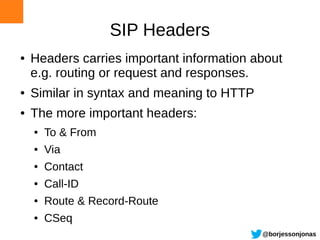
SIP Headers
●   Headers carries important information about
    e.g. routing or request and responses.
●   Similar in syntax and meaning to HTTP
●   The more important headers:
    ●   To & From
    ●   Via
    ●   Contact
    ●   Call-ID
    ●   Route & Record-Route
    ●   CSeq
                                            @borjessonjonas
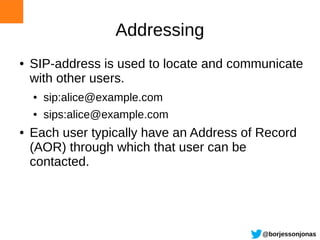
Addressing
●   SIP-address is used to locate and communicate
    with other users.
    ●   sip:alice@example.com
    ●   sips:alice@example.com
●   Each user typically have an Address of Record
    (AOR) through which that user can be
    contacted.


                                           @borjessonjonas
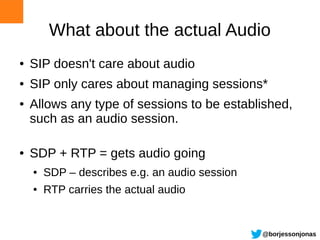
What about the actual Audio
●   SIP doesn't care about audio
●   SIP only cares about managing sessions*
●   Allows any type of sessions to be established,
    such as an audio session.

●   SDP + RTP = gets audio going
    ●   SDP – describes e.g. an audio session
    ●   RTP carries the actual audio


                                                @borjessonjonas
Summary
●   SIP != VoIP
●   SIP can do VoIP but is so much more
●   SIP actually doesn't care about audio at all
●   SIP helps you route messages through the
    network.
●   SIP helps to locate your friends.


                                              @borjessonjonas
More presentations and material
        at aboutsip.com

           Thanks!


                                  @borjessonjonas

SIP - The Basics

  • 1.
    About SIP SIP The Basics Jonas Borjesson @borjessonjonas
  • 2.
    NOTE ● This version has been adapted to be viewed without transitions. ● Go to aboutsip.com to download the original version. ● Also be sure to check out vimeo.com/aboutsip for any recorded presentations. @borjessonjonas
  • 3.
    This is SIP! @borjessonjonas
  • 4.
    SIP is aboutcommunication! Gaming Voice Video Chat Presence Whatever @borjessonjonas
  • 5.
    SIP is aboutsessions ● A session represents a p2p relationship between two SIP endpoints. ● SIP helps you: ● Setup sessions. ● Negotiate what you want to do with the session ● Tear down sessions ● Session can be anything ● Voice/video/gaming/your own whatever ● SIP only helps you establish and manage the session, you decide what to do! @borjessonjonas
  • 6.
    SIP is aboutfinding your friends ● Before you can “call” your friends (establish a session), you must find them! ● No magic though... you need to tell someone where you are... a t o g et W en t coffee /Bob @borjessonjonas
  • 7.
    No Magic Hey, I 'm comin g ove r, nee d a coff ee too . .. ? Hey, have you seen Bob? ! He is over at Cafe Capuchino aboutsip.com ! Tell my friends that I bob@aboutsip.com am online at Cafe Capuchino @borjessonjonas
  • 8.
    Basic User Scenario Proxy INVITE sip:bob@aboutsip.com INVITE sip:bob@192.168.0.100 180 Ringing 180 Ringing 200 OK 200 OK ACK ACK audio @borjessonjonas
  • 9.
    SIP Components ● User Agents (UA) ● User Agent Client (UAC) ● User Agent Server (UAS) ● Servers ● Proxy – forwards the request to the next hop ● Registrar – accepts registrar requests ● Redirect Server – finds alternative locations ● Location Service – stores bindings. (note, all SIP components are logical components and a such one server can act as all of the roles) @borjessonjonas
  • 10.
    SIP Messages ● Request/Response model ● UAC sends the request, UAS responds ● Requests starts with a request line ● INVITE sip:alice@example.com SIP/2.0 ● Methods ● INVITE, ACK, BYE, CANCEL, REGISTER, OPTIONS ● And many more... @borjessonjonas
  • 11.
    SIP Messages ● SIP responses starts with a status line ● SIP/2.0 200 OK ● Response Codes: ● 1xx – Provisional. INVITE ● 2xx – Success. 180 Ringing ● 3xx – Redirection. 500 Server Error ● 4xx – Client Error. ● 5xx – Server Error. ● 6xx - Global Failures. @borjessonjonas
  • 12.
    INVITE Request INVITE sip:bob@aboutsip.comSIP/2.0 To: <sip:bob@aboutsip.com> From: <sip:alice@aboutsip.com>;tag=987lkajsdf89au Call-ID: lkjasdf90989lkj CSeq: 1 INVITE Content-Type: application/sdp Content-Length: 450 Record-Route: <sip:192.168.1.52:5060;transport=tcp;lr> Via: SIP/2.0/TCP 192.168.0.122:5060;branch=xxx;rport ... Contact: <sip:192.168.0.122:3156;transport=TCP> @borjessonjonas
  • 13.
    200 OK Response SIP/2.0200 OK To: <sip:bob@aboutsip.com>;tag=89uasdkfjoiu From: <sip:alice@aboutsip.com>;tag=987lkajsdf89au Call-ID: lkjasdf90989lkj CSeq: 1 INVITE Via: SIP/2.0/TCP 192.168.0.122:5060;branch=xxx;rport ... Contact: <sip:192.168.0.22:3156;transport=TCP> Record-Route: <sip:192.168.1.52:5060;transport=tcp;lr> Content-Type: application/sdp Content-Length: 451 @borjessonjonas
  • 14.
    SIP Headers ● Headers carries important information about e.g. routing or request and responses. ● Similar in syntax and meaning to HTTP ● The more important headers: ● To & From ● Via ● Contact ● Call-ID ● Route & Record-Route ● CSeq @borjessonjonas
  • 15.
    Addressing ● SIP-address is used to locate and communicate with other users. ● sip:alice@example.com ● sips:alice@example.com ● Each user typically have an Address of Record (AOR) through which that user can be contacted. @borjessonjonas
  • 16.
    What about theactual Audio ● SIP doesn't care about audio ● SIP only cares about managing sessions* ● Allows any type of sessions to be established, such as an audio session. ● SDP + RTP = gets audio going ● SDP – describes e.g. an audio session ● RTP carries the actual audio @borjessonjonas
  • 17.
    Summary ● SIP != VoIP ● SIP can do VoIP but is so much more ● SIP actually doesn't care about audio at all ● SIP helps you route messages through the network. ● SIP helps to locate your friends. @borjessonjonas
  • 18.
    More presentations andmaterial at aboutsip.com Thanks! @borjessonjonas