
voipSecurity
Ridhvesh Shethwala – 15mcei27
Outlines
Introduction
What is Voip.?
How Voip works.?
Protocol used in Voip
Security attack on Voip system
How we can prevent it.?
Conclusion
Reference
Network Features PSTN (Voice) VoIP (Voice)
Switch Circuit Switched Packet Switched
Connection Connection Oriented Connection Oriented
Bit Rate Fixed and low<=64kb/s Standard Bit Rate
Bursts Nonexistent
Error tolerance User error control Self error Control
Info resending Can not (real time) It Can
Delay Must be low and stable Very Less Delay
What is voip.?
VoIP (Voice Over Internet Protocol) is an IP network
based voice transmission technology, instead of the
traditional analog telephone line, it allows people to
make telephone calls through broadband internet
connections.
In other words, just installing network telephone
software on the PCs at each end, people can talk
through to each other through the IP network.
With the development of network technology,
network IP telephony grew from PC-PC to IP-PSTN,
PSTN-IP, PSTN- PSTN and IP-IP, etc.
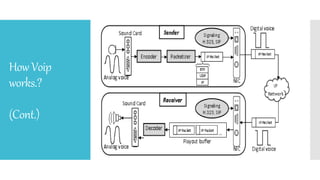
How Voip
works.?
Analog Signal
Converting Analog to Digital Signal
Compress
Encode
Packetization
Transmitted through IP Network
Decode
Decompress
Converting Digital to Analog Signal
HowVoip
works.?
(Cont.)
Protocolusedin
Voip.
RTP
SIP
MGCP
H.323
RTP
Real-TimeTransport Protocol (RTP) is an internet
standard protocol, used to transfer real time data, such
as audio and video. It can be used for IP telephony.
RTP includes two parts: data and control.The control
part is called RealTime Control Protocol (RTCP).
VoIP uses protocols such as real-time protocol (RTP)
and H.323 to deliver packets over the internet.
It provides support for real-time applications, includes
timing reconstruction, loss detection, security and
content identification.
RTP
(Cont.)
RTP Header contains information of the payload, such as
the source address, size, encoding type, etc.
To transfer RTP packet on the network, we need to use User
Datagram Protocol (UDP) to create a UDP header.To
transfer UDP packet over IP network, we also need to create
an IP header.
RTP Data structure RTP Data in IP packet
RTP
(Cont.)
RTP FEATURES:-
To provide end-to-end delivery service for real time data,
such as audio and video.
RTP uses time stamps and sequence numbers to implement
reliable delivery, flow control and congestion control.
RTP is only a protocol framework, it is open to new
multimedia software.
RTP and RTCP provide functionalities to deliver real time
data. RTP and RTCP aren’t responsible for synchronization,
or something like it which is the higher level task.
RTCP
RealTime Control Protocol carries control information,
which is used to manage the QoS.
It provides supports for applications such as real-time
conference.
The supports include source identification, multicast-
to-unicast translator, and different media streams
synchronization.
There are five types of RTCP packets:-
I. RR: Receive Report
II. SR: Sender Report.
III. SDES: Source Description Items.
IV. BYE: used to indicate that participation is finished.
V. APP: application specified functions.
H.323
H.323 is a set of protocols for voice, video, and data
conferencing over packet-based networks such as the
Internet.
The H.323 protocol stack is designed to operate above
the transport layer of the underlying network.
H.323 can be used on top of any packet-based network
transport like Ethernet,TCP/UDP/IP, ATM, and Frame
Relay to provide real-time multimedia communication.
H.323 uses the Internet Protocol (IP) for inter-network
conferencing.
H.323
(cont.)
Scope of H.323
Point-to-point and multipoint conferencing support:
Inter-network interoperability:
Heterogeneous client capabilities
Audio and video codecs:
Management and accounting support:
Security:
Supplementary services
H.323
(CONT.)
Authentication under H.323 can be either symmetric
encryption- based or subscription-based.
For symmetric encryption-based authentication, prior
contact between the communicating entities is not
required because the protocol uses Diffie-Hellman key-
exchange to generate a shared secret identity between
the two entities.
With reference to the H.235 recommendation, a
subscription-based authentication requires a prior
shared secret identity, and there are three variations of
this:
 Password-based with symmetric encryption,
 Password-based with hashing, and
 Certificate-based with signatures
MGCP
Media Gateway Control Protocol (MGCP) is a
protocol used for controllingVoice over IP (VoIP)
Gateways from external call control elements.
MGCP is the emerging protocol that is receiving wide
interest from both the voice and data industries.
MGCP is a protocol for controlling media gateways
from call agents. It superseded the Simple Gateway
Control Protocol (SGCP) .
In aVoIP system, MGCP can be used with SIP or H.323.
SIP or H.323 will provide the call control functionality
and MGCP can be used to manage media
establishment in media gateways.
MGCP
(cont.)
Characteristics of MGCP:
-- A master/slave protocol.
-- Assumes limited intelligence at the edge (endpoints)
and intelligence at the core (call agent).
-- between call agents and media gateways.
-- Differs from SIP and H.323 which are peer-to-peer
protocols.
-- Interoperates with SIP and H.323.
MGCP
(cont.)
MGCP provides:
 Call preservation—calls are maintained during failover
and failback
 Dial plan simplification—no dial peer configuration is
required on the gateway
 Hook flash transfer
 Tone on hold
 MGCP supports encryption of voice traffic.
 MGCP supports Q Interface Signalling Protocol (QSIG)
functionality.
SIP
The Session Initiation Protocol is a text-based
signaling communications protocol, which is used to
creation, management and terminations of each
session.
It is responsible for smooth transmission of data
packets over the network. It considers the request
made by the user to make a call and then establishes
connection between two or multiple users.When the
call is complete, it destroys the session.
SIP
(CONT.)
SIP can be used for two party (unicast) or multi party
(multicast) sessions. It works in along with other
application layer protocols that identify and carry the
session media.
The protocol itself provides reliability and does not
depend onTCP for reliability. Also, it depends on the
Session Description Protocol (SDP) which is
responsible for the negotiation for the codec
identification
SIP
(CONT.)
SIP Messages:-
 REGISTER – Registers a user with a SIP server
 INVITE – Used to invite to participate in a Call session
 ACK – Acknowledge an INVITE request
 CANCEL – Cancel a pending request
 OPTIONS – Lists the information about the capabilities
of the caller
 BYE –Terminates a connection
SIP
(CONT.)
Services Provided by the SIP
 Locate User
 Session Establishment
 Session Setup Negotiation
 Modify Session
 Teardown/End Session
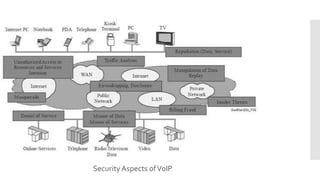
Security Aspects ofVoIP
Security
Aspectsin
VoIP
Server authentication:
SinceVoIP users typically communicate with each
other through someVoIP infrastructure that involves
servers (gatekeepers, multicast units, gateways), users
need to know if they are talking with the proper server
and/or with the correct service provider.This applies to
both fixed and mobile users.
Security
Aspectsin
VoIP
(cont.)
Voice confidentiality
This is realized through encryption of the voice packets
and protects against eavesdropping. In general, the
media packets of multimedia applications are
encrypted as well as voice data. Advanced protection
of media packets also includes authentication/integrity
protection of the payloads.
Security
Aspectsin
VoIP
(cont.)
Call authorization:
This is the decision-making process to determine if
the user/terminal is actually permitted to use a service
feature or a network resource (QoS, bandwidth, codec,
etc.). Most often authentication and authorization
functions are used together to make an access control
decision. Authentication and authorization help to
thwart attacks like masquerade, misuse and fraud,
manipulation and denial-of-service.
Security
Aspectsin
VoIP
(cont.)
Key Management:
 This includes not only all tasks that are necessary for
securely distributing keying material to users and
servers, but also tasks like updating expired keys and
replacing lost keys. Key management may be a
separate task from theVoIP application (password
provisioning) or may be integrated with signalling when
security profiles with security capabilities are being
dynamically negotiated and session-based keys are to
be distributed.
Security
Aspectsin
VoIP
(cont.)
Masquerading:
A masquerade is the pretense of an entity to be
another entity. Masquerading can lead to charging
fraud, breach of privacy, and breach of integrity. This
attack can be carried out by hijacking a link after
authentication has been performed, or by
eavesdropping and subsequent replaying of
authentication information. Using a masquerade
attack, an attacker can gain unauthorized access to
VoIP services. An attacker can steal the identity of a
real user and obtain access by masquerading as the
real user.
Security
Aspectsin
VoIP
(cont.)
Eavesdropping:
Eavesdropping attacks describe a method by which an
attacker is able to monitor the entire signaling and/or
data stream between two or moreVoIP endpoints, but
cannot or does not alter the data itself.
Security
Aspectsin
VoIP
(cont.)
Interception and Modification:
These classes of attacks describe a method by which
an attacker can see the entire signaling and data
stream between two endpoints, and can also modify
the traffic as an intermediary in the conversation.
Security
Aspectsin
VoIP
(cont.)
Denial of Service:
A denial of service (DoS) attack is an attack that is
conducted to deliberately cause loss of availability of a
service. We identify DoS attacks at several levels;
transport-level, server level, signaling level.
Transport level: An IP-level DoS attack may be carried
out by flooding a target, e.g. by ping of death or Smurf
attack.
Server level: Servers may be rendered unusable by
modifying stored information in order to prevent
authorized users from accessing the service.
Security
Aspectsin
VoIP
(cont.)
Misrepresentation:
The term misrepresentation is generically used to
mean false or misleading communication.
Misrepresentation includes the delivery of information
which is false as to the identity, authority or rights of
another party or false as to the content of information
communicated.
Security
Solutionin
VoIP
 Confidentiality: Confidentiality can be achieved
by using different encryptions techniques, which
provide user authentication. For ex: a hash record key
with a shared secret is used between the parties to
prevent malicious users from call monitoring. Such
measures should be taken to get confidentiality.
Integrity: To protect the source of data we use
Integrity that provides user authentication. It is used
for origin integrity, and without integrity control, any
non-trusted system has the ability to modify the
different contents without any notice.
Security
Solutionin
VoIP
(cont.)
HTTP Digest Authentication:
SIP uses HTTP Digest Authentication method to
authenticate data, such as password. HTTP Digest
authentication offers one-way message authentication
and replay protection, but it doesn’t protect message
integrity and confidentiality.
By transmitting an MD5 or SHA-1 digest of the secret
password and a random challenge string, HTTP Digest
can protect password.
Although HTTP digest authentication has the
advantage that the identity of the user is encrypted,
and transmitted in cipher text, but if the password is
short or weak, by intercepting the hash value, the
password can be decrypted easily.
Security
Solutionin
VoIP
(cont.)
S/MIME:
(Secure/Multi-Purpose Internet Mail Extension)
 MIME bodies are inserted into SIP messages. MIME
defines mechanisms for integrity protection and
encryption of the MIME contents.
SIP can use S/MIME to enable mechanisms like public
key distribution, authentication and integrity
protection, confidentiality of SIP signaling data.
S/MIME relies heavily on the certification of the end
user.
Moreover self certification is vulnerable to man-in-the-
middle attack, so either the certificates from known
public certification authorities (CAs) or private CAs
should be used, so the S/MIME mechanism is seriously
limited.
Security
Solutionin
VoIP
(cont.)
Firewall
Firewalls are usually used to protect trusted network
from un-trusted network. Firewalls usually work on IP
andTCP/UDP layer, it determines what types of traffic
is allowed and which system are allowed to
communicate. Firewall doesn’t monitor the application
layer. Since SIP needs to open ports dynamically, this
enhances the complexity of firewall, as the firewall
must open and close ports dynamically.
Security
Solutionin
VoIP
(cont.)
Some OtherWaysTo Protect:-
To prevent message alteration established secured
communication channel between communicating
parties.To prevent media alteration and degradation
use SRTP protocol.
Use secured devices for communication and switching
of voice as well as data.
Use Strong authentication and password at device
level.
Change defaults passwords and enable SIP
authentication. Use the devices which support SRTP
cipher technique.
Security
Solutionin
VoIP
(cont.)
UseVLAN with 802.1x in internet to split data and
voice traffic.
DisableTelnet in the phone configuration, allow only
to administrators.To avoid message tampering and
voice pharming attack use encrypted transmitted data
using encryption mechanisms like IPsec,TLS and
S/MIME.
Security
Solutionin
VoIP
(cont.)
 for a secure session inVOIP we should take
following measures:
 Use and maintain anti-virus and anti-spyware programs.
 Do not open unknown attachments of mails which have
unknown or fake IDs.
 Verify the authenticity and security of downloaded files
and new software. Configure your web browser(s)
properly by enabling/disabling the necessary cookies.
 Active firewall session in your network and always place
your back-up securely.
 Create strong passwords and change them regularly
and do not disclose such information publicly.
Conclusion
VoIP system is low cost and less configuration than
PSTN Network.VoIP is EmergingTechnology and
contain some loop hopes so there are some attacks can
possible on it. As in futureVoIP Replace the PSTN
system it need better security. Using some of Secure
protocols like SRTP and some advance Encryption
standards, using firewall, end-to-end encryption we
can make it secure.
References
Cisco, “Overview of the Session Initiation Protocol”, September,
(2002)
David Gurle, Olivier Hersent, “MediaGateway to Media Controller
Protocols”,August,(2003).
 Rohit Dhamankar Intrusion Prevention: The Future ofVoIP Security
White paper (2010)
 PorterT “Threats toVoIP CommunicationSystems, Syngress Force
EmergingThreat Analysis” ,pg. 3-25. (2006).
Mark Collier,ChiefTechnologyOfficer Secure Logix Corporation,
"BasicVulnerability Issues for SIP Security.pdf”,1 March (2005).
VoIP Security and PrivacyThreat Taxonomy "Public Release 1.0
24 October 2005" (access 29 Jan 2012)
Voip security

Voip security

  • 1.
  • 2.
    Outlines Introduction What is Voip.? HowVoip works.? Protocol used in Voip Security attack on Voip system How we can prevent it.? Conclusion Reference
  • 3.
    Network Features PSTN(Voice) VoIP (Voice) Switch Circuit Switched Packet Switched Connection Connection Oriented Connection Oriented Bit Rate Fixed and low<=64kb/s Standard Bit Rate Bursts Nonexistent Error tolerance User error control Self error Control Info resending Can not (real time) It Can Delay Must be low and stable Very Less Delay
  • 4.
    What is voip.? VoIP(Voice Over Internet Protocol) is an IP network based voice transmission technology, instead of the traditional analog telephone line, it allows people to make telephone calls through broadband internet connections. In other words, just installing network telephone software on the PCs at each end, people can talk through to each other through the IP network. With the development of network technology, network IP telephony grew from PC-PC to IP-PSTN, PSTN-IP, PSTN- PSTN and IP-IP, etc.
  • 6.
    How Voip works.? Analog Signal ConvertingAnalog to Digital Signal Compress Encode Packetization Transmitted through IP Network Decode Decompress Converting Digital to Analog Signal
  • 7.
  • 8.
  • 9.
    RTP Real-TimeTransport Protocol (RTP)is an internet standard protocol, used to transfer real time data, such as audio and video. It can be used for IP telephony. RTP includes two parts: data and control.The control part is called RealTime Control Protocol (RTCP). VoIP uses protocols such as real-time protocol (RTP) and H.323 to deliver packets over the internet. It provides support for real-time applications, includes timing reconstruction, loss detection, security and content identification.
  • 10.
    RTP (Cont.) RTP Header containsinformation of the payload, such as the source address, size, encoding type, etc. To transfer RTP packet on the network, we need to use User Datagram Protocol (UDP) to create a UDP header.To transfer UDP packet over IP network, we also need to create an IP header. RTP Data structure RTP Data in IP packet
  • 11.
    RTP (Cont.) RTP FEATURES:- To provideend-to-end delivery service for real time data, such as audio and video. RTP uses time stamps and sequence numbers to implement reliable delivery, flow control and congestion control. RTP is only a protocol framework, it is open to new multimedia software. RTP and RTCP provide functionalities to deliver real time data. RTP and RTCP aren’t responsible for synchronization, or something like it which is the higher level task.
  • 12.
    RTCP RealTime Control Protocolcarries control information, which is used to manage the QoS. It provides supports for applications such as real-time conference. The supports include source identification, multicast- to-unicast translator, and different media streams synchronization. There are five types of RTCP packets:- I. RR: Receive Report II. SR: Sender Report. III. SDES: Source Description Items. IV. BYE: used to indicate that participation is finished. V. APP: application specified functions.
  • 13.
    H.323 H.323 is aset of protocols for voice, video, and data conferencing over packet-based networks such as the Internet. The H.323 protocol stack is designed to operate above the transport layer of the underlying network. H.323 can be used on top of any packet-based network transport like Ethernet,TCP/UDP/IP, ATM, and Frame Relay to provide real-time multimedia communication. H.323 uses the Internet Protocol (IP) for inter-network conferencing.
  • 14.
    H.323 (cont.) Scope of H.323 Point-to-pointand multipoint conferencing support: Inter-network interoperability: Heterogeneous client capabilities Audio and video codecs: Management and accounting support: Security: Supplementary services
  • 16.
    H.323 (CONT.) Authentication under H.323can be either symmetric encryption- based or subscription-based. For symmetric encryption-based authentication, prior contact between the communicating entities is not required because the protocol uses Diffie-Hellman key- exchange to generate a shared secret identity between the two entities. With reference to the H.235 recommendation, a subscription-based authentication requires a prior shared secret identity, and there are three variations of this:  Password-based with symmetric encryption,  Password-based with hashing, and  Certificate-based with signatures
  • 17.
    MGCP Media Gateway ControlProtocol (MGCP) is a protocol used for controllingVoice over IP (VoIP) Gateways from external call control elements. MGCP is the emerging protocol that is receiving wide interest from both the voice and data industries. MGCP is a protocol for controlling media gateways from call agents. It superseded the Simple Gateway Control Protocol (SGCP) . In aVoIP system, MGCP can be used with SIP or H.323. SIP or H.323 will provide the call control functionality and MGCP can be used to manage media establishment in media gateways.
  • 18.
    MGCP (cont.) Characteristics of MGCP: --A master/slave protocol. -- Assumes limited intelligence at the edge (endpoints) and intelligence at the core (call agent). -- between call agents and media gateways. -- Differs from SIP and H.323 which are peer-to-peer protocols. -- Interoperates with SIP and H.323.
  • 20.
    MGCP (cont.) MGCP provides:  Callpreservation—calls are maintained during failover and failback  Dial plan simplification—no dial peer configuration is required on the gateway  Hook flash transfer  Tone on hold  MGCP supports encryption of voice traffic.  MGCP supports Q Interface Signalling Protocol (QSIG) functionality.
  • 21.
    SIP The Session InitiationProtocol is a text-based signaling communications protocol, which is used to creation, management and terminations of each session. It is responsible for smooth transmission of data packets over the network. It considers the request made by the user to make a call and then establishes connection between two or multiple users.When the call is complete, it destroys the session.
  • 22.
    SIP (CONT.) SIP can beused for two party (unicast) or multi party (multicast) sessions. It works in along with other application layer protocols that identify and carry the session media. The protocol itself provides reliability and does not depend onTCP for reliability. Also, it depends on the Session Description Protocol (SDP) which is responsible for the negotiation for the codec identification
  • 24.
    SIP (CONT.) SIP Messages:-  REGISTER– Registers a user with a SIP server  INVITE – Used to invite to participate in a Call session  ACK – Acknowledge an INVITE request  CANCEL – Cancel a pending request  OPTIONS – Lists the information about the capabilities of the caller  BYE –Terminates a connection
  • 26.
    SIP (CONT.) Services Provided bythe SIP  Locate User  Session Establishment  Session Setup Negotiation  Modify Session  Teardown/End Session
  • 27.
  • 28.
    Security Aspectsin VoIP Server authentication: SinceVoIP userstypically communicate with each other through someVoIP infrastructure that involves servers (gatekeepers, multicast units, gateways), users need to know if they are talking with the proper server and/or with the correct service provider.This applies to both fixed and mobile users.
  • 29.
    Security Aspectsin VoIP (cont.) Voice confidentiality This isrealized through encryption of the voice packets and protects against eavesdropping. In general, the media packets of multimedia applications are encrypted as well as voice data. Advanced protection of media packets also includes authentication/integrity protection of the payloads.
  • 30.
    Security Aspectsin VoIP (cont.) Call authorization: This isthe decision-making process to determine if the user/terminal is actually permitted to use a service feature or a network resource (QoS, bandwidth, codec, etc.). Most often authentication and authorization functions are used together to make an access control decision. Authentication and authorization help to thwart attacks like masquerade, misuse and fraud, manipulation and denial-of-service.
  • 31.
    Security Aspectsin VoIP (cont.) Key Management:  Thisincludes not only all tasks that are necessary for securely distributing keying material to users and servers, but also tasks like updating expired keys and replacing lost keys. Key management may be a separate task from theVoIP application (password provisioning) or may be integrated with signalling when security profiles with security capabilities are being dynamically negotiated and session-based keys are to be distributed.
  • 32.
    Security Aspectsin VoIP (cont.) Masquerading: A masquerade isthe pretense of an entity to be another entity. Masquerading can lead to charging fraud, breach of privacy, and breach of integrity. This attack can be carried out by hijacking a link after authentication has been performed, or by eavesdropping and subsequent replaying of authentication information. Using a masquerade attack, an attacker can gain unauthorized access to VoIP services. An attacker can steal the identity of a real user and obtain access by masquerading as the real user.
  • 33.
    Security Aspectsin VoIP (cont.) Eavesdropping: Eavesdropping attacks describea method by which an attacker is able to monitor the entire signaling and/or data stream between two or moreVoIP endpoints, but cannot or does not alter the data itself.
  • 34.
    Security Aspectsin VoIP (cont.) Interception and Modification: Theseclasses of attacks describe a method by which an attacker can see the entire signaling and data stream between two endpoints, and can also modify the traffic as an intermediary in the conversation.
  • 35.
    Security Aspectsin VoIP (cont.) Denial of Service: Adenial of service (DoS) attack is an attack that is conducted to deliberately cause loss of availability of a service. We identify DoS attacks at several levels; transport-level, server level, signaling level. Transport level: An IP-level DoS attack may be carried out by flooding a target, e.g. by ping of death or Smurf attack. Server level: Servers may be rendered unusable by modifying stored information in order to prevent authorized users from accessing the service.
  • 36.
    Security Aspectsin VoIP (cont.) Misrepresentation: The term misrepresentationis generically used to mean false or misleading communication. Misrepresentation includes the delivery of information which is false as to the identity, authority or rights of another party or false as to the content of information communicated.
  • 37.
    Security Solutionin VoIP  Confidentiality: Confidentialitycan be achieved by using different encryptions techniques, which provide user authentication. For ex: a hash record key with a shared secret is used between the parties to prevent malicious users from call monitoring. Such measures should be taken to get confidentiality. Integrity: To protect the source of data we use Integrity that provides user authentication. It is used for origin integrity, and without integrity control, any non-trusted system has the ability to modify the different contents without any notice.
  • 38.
    Security Solutionin VoIP (cont.) HTTP Digest Authentication: SIPuses HTTP Digest Authentication method to authenticate data, such as password. HTTP Digest authentication offers one-way message authentication and replay protection, but it doesn’t protect message integrity and confidentiality. By transmitting an MD5 or SHA-1 digest of the secret password and a random challenge string, HTTP Digest can protect password. Although HTTP digest authentication has the advantage that the identity of the user is encrypted, and transmitted in cipher text, but if the password is short or weak, by intercepting the hash value, the password can be decrypted easily.
  • 39.
    Security Solutionin VoIP (cont.) S/MIME: (Secure/Multi-Purpose Internet MailExtension)  MIME bodies are inserted into SIP messages. MIME defines mechanisms for integrity protection and encryption of the MIME contents. SIP can use S/MIME to enable mechanisms like public key distribution, authentication and integrity protection, confidentiality of SIP signaling data. S/MIME relies heavily on the certification of the end user. Moreover self certification is vulnerable to man-in-the- middle attack, so either the certificates from known public certification authorities (CAs) or private CAs should be used, so the S/MIME mechanism is seriously limited.
  • 40.
    Security Solutionin VoIP (cont.) Firewall Firewalls are usuallyused to protect trusted network from un-trusted network. Firewalls usually work on IP andTCP/UDP layer, it determines what types of traffic is allowed and which system are allowed to communicate. Firewall doesn’t monitor the application layer. Since SIP needs to open ports dynamically, this enhances the complexity of firewall, as the firewall must open and close ports dynamically.
  • 41.
    Security Solutionin VoIP (cont.) Some OtherWaysTo Protect:- Toprevent message alteration established secured communication channel between communicating parties.To prevent media alteration and degradation use SRTP protocol. Use secured devices for communication and switching of voice as well as data. Use Strong authentication and password at device level. Change defaults passwords and enable SIP authentication. Use the devices which support SRTP cipher technique.
  • 42.
    Security Solutionin VoIP (cont.) UseVLAN with 802.1xin internet to split data and voice traffic. DisableTelnet in the phone configuration, allow only to administrators.To avoid message tampering and voice pharming attack use encrypted transmitted data using encryption mechanisms like IPsec,TLS and S/MIME.
  • 43.
    Security Solutionin VoIP (cont.)  for asecure session inVOIP we should take following measures:  Use and maintain anti-virus and anti-spyware programs.  Do not open unknown attachments of mails which have unknown or fake IDs.  Verify the authenticity and security of downloaded files and new software. Configure your web browser(s) properly by enabling/disabling the necessary cookies.  Active firewall session in your network and always place your back-up securely.  Create strong passwords and change them regularly and do not disclose such information publicly.
  • 44.
    Conclusion VoIP system islow cost and less configuration than PSTN Network.VoIP is EmergingTechnology and contain some loop hopes so there are some attacks can possible on it. As in futureVoIP Replace the PSTN system it need better security. Using some of Secure protocols like SRTP and some advance Encryption standards, using firewall, end-to-end encryption we can make it secure.
  • 45.
    References Cisco, “Overview ofthe Session Initiation Protocol”, September, (2002) David Gurle, Olivier Hersent, “MediaGateway to Media Controller Protocols”,August,(2003).  Rohit Dhamankar Intrusion Prevention: The Future ofVoIP Security White paper (2010)  PorterT “Threats toVoIP CommunicationSystems, Syngress Force EmergingThreat Analysis” ,pg. 3-25. (2006). Mark Collier,ChiefTechnologyOfficer Secure Logix Corporation, "BasicVulnerability Issues for SIP Security.pdf”,1 March (2005). VoIP Security and PrivacyThreat Taxonomy "Public Release 1.0 24 October 2005" (access 29 Jan 2012)