CARCINOMA LARYNX
BY
DR TARIQUE AHMED MAKA
REGISTRAR IN ENT
CARCINOMA LARYNX
PATIENT’S PROFILE
 NAME XYZ
 AGE 65 yrs
 SEX Male
 RESIDENCE Kotla Arab Ali Khan
 DATE OF ADMISSION Jan 2014
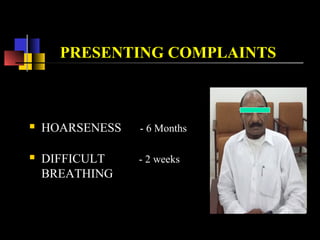
PRESENTING COMPLAINTS
 HOARSENESS - 6 Months
 DIFFICULT - 2 weeks
BREATHING
HISTORY OF PRESENT ILLNESS
 Hoarseness of voice
 Insidious onset and progressive
 Breathing Difficulty
 Inspiratory stridor
 Past history
 Personal history
25 cigarettes a day
 Family history
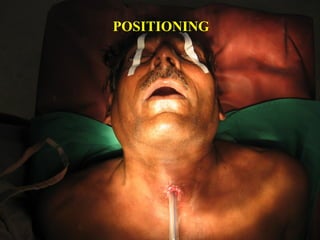
 Drug history
 Socioeconomic history
Not Contributory
GENERAL PHYSICAL EXAMINATION
 PULSE 98 bpm
 BLOOD PRESSURE 130/80 mm of Hg
 TEMPERATURE 98.2 ˚
F
 RESPIRATORY RATE 28 breaths/min
EXAMINATION (contd)
 PALLOR
 CYANOSIS
 CLUBBING
 JAUNDICE
 OEDEMA
 KOILONYCHIA
 THYROID Not enlarged
 JVP Not raised
 LYMPH NODES Not palpable
ABSENT
ENT EXAMINATION
 THROAT
No abnormality found in oral cavity
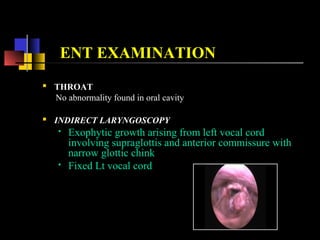
 INDIRECT LARYNGOSCOPY
 Exophytic growth arising from left vocal cord
involving supraglottis and anterior commissure with
narrow glottic chink
 Fixed Lt vocal cord
ENT EXAMINATION
 THROAT
No abnormality found in oral
cavity
 EARS
 NOSE Normal
 NECK
UNREMARKABLE
SYSTEMIC EXAMINATION
 Cardiovascular system
 Respiratory system
 Gastrointestinal system
 Central nervous system
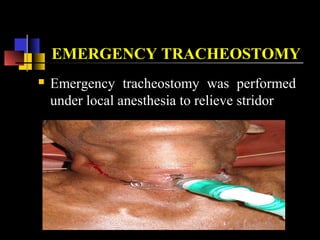
EMERGENCY TRACHEOSTOMY
 Emergency tracheostomy was performed
under local anesthesia to relieve stridor
Normal study
INVESTGATIONS
 Blood complete picture
 Haemoglobin: 13g/dl
 Platelets: 291x109
/L
 X Ray Neck Lat view
 X Ray Chest PA
 USG Neck
 USG Abdomen
Narrowed airway in
supraglottis & glottis
NORMAL
INVESTIGATIONS (contd)
 ECG ,2-D echo
 Serum urea & electrolytes
 PT, PTTK
 LFTs
 Blood Glucose levels
 Hepatitis Profile
INVESTIGATIONS (contd)
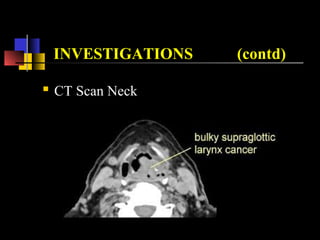
 CT Scan Neck
PROVISIONAL DIAGNOSIS
 Growth larynx
 Direct laryngoscopy and biopsy under GA
planned
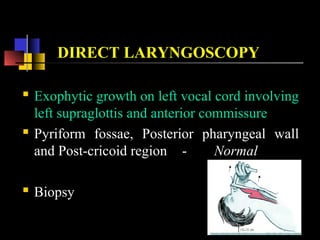
DIRECT LARYNGOSCOPY
 Exophytic growth on left vocal cord involving
left supraglottis and anterior commissure
 Pyriform fossae, Posterior pharyngeal wall
and Post-cricoid region - Normal
 Biopsy
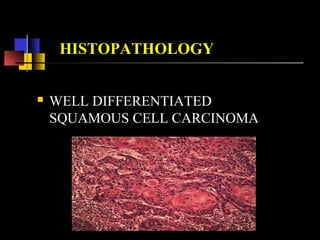
HISTOPATHOLOGY
 WELL DIFFERENTIATED
SQUAMOUS CELL CARCINOMA
DIAGNOSIS
WELL DIFFERENTIATED SQUAMOUS
CELL CARCINOMA LARYNX
STAGE (iii) T3 N0 M0
DECISION
TOTAL LARYNGECTOMY FOLLOWED
BY RADIOTHERAPY
MANAGEMENT
 PRE-OP WORK UP
 Counseling

Details of the nature and severity of the disease

Treatment options available

Specific risk of surgery and GA

Understanding the total laryngectomy state & life
style after surgery
 Informed written consent
 Pre-anesthesia assessment: ASA-II
 2 Unit RCC arranged
OPERATIVE STEPS
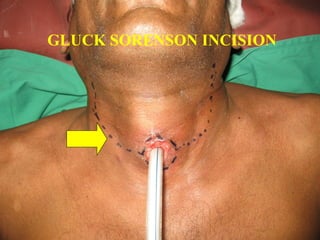
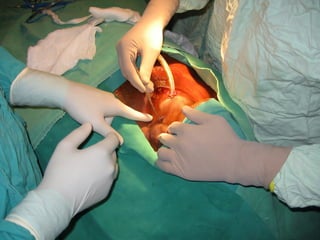
GLUCK SORENSON INCISION
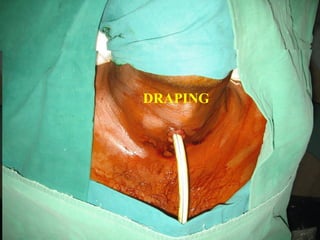
DRAPING
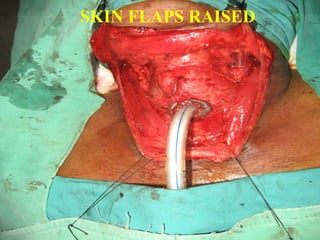
SKIN FLAPS RAISED
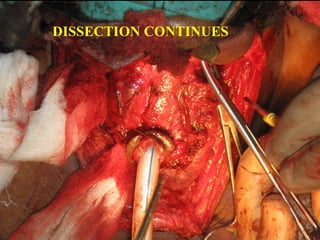
DISSECTION CONTINUES
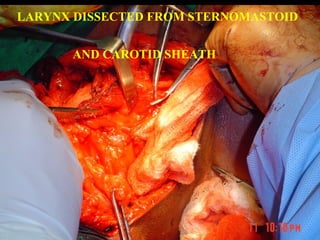
LARYNX DISSECTED FROM STERNOMASTOID
AND CAROTID SHEATH
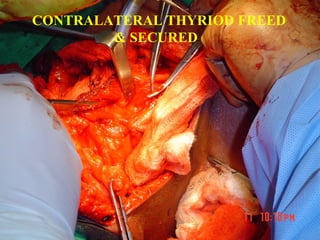
CONTRALATERAL THYRIOD FREED
& SECURED
STRAP MUSCLES SECTIONED
& LARYNX MOBILIZED
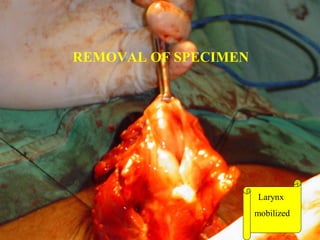
REMOVAL OF SPECIMEN
Larynx
mobilized
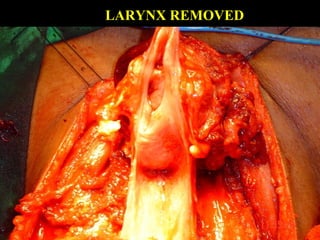
LARYNX REMOVED
NASOGASTRIC TUBE PASSED
Neopharyn
The Resected
Specimen
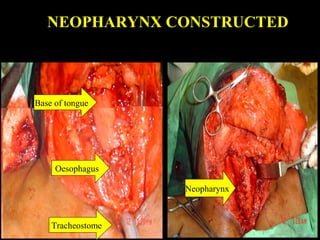
NEOPHARYNX CONSTRUCTED
Base of tongue
Oesophagus
Tracheostome
Neopharynx
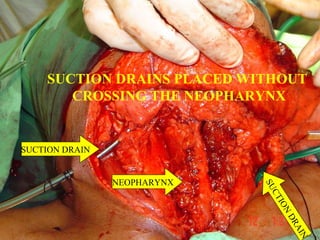
SUCTION DRAINS PLACED WITHOUT
CROSSING THE NEOPHARYNX
SUCTION DRAIN
SUCTION
DRAIN
NEOPHARYNX
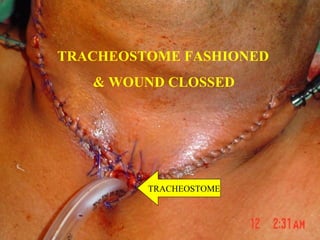
TRACHEOSTOME FASHIONED
& WOUND CLOSSED
TRACHEOSTOME
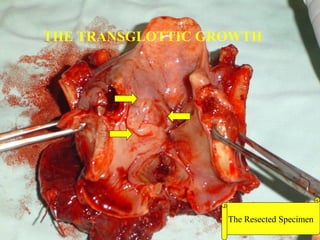
THE TRANSGLOTTIC GROWTH
The Resected Specimen
POST OP MANAGEMENT
 Tracheostomy care
 Antibiotics :
 Inj ceftriaxone 1g I/V 12 hourly (ATD)
 Inj metronidazole 500mg I/V 8 hourly
 Inj coamoxiclav 1.2g I/V 8 hourly (ATD)
 Inj Diclofenac Sodium 75mg I/M 12 hourly
 Omeprazole infusion 40mg I/V HS
 Intra venous fluids
RECOVERY
 1st
Post operative day

Folley catheter removed

Patient mobilized
 3rd
Post op day

Neck drains removed

N/G feed started with clear water
 7th
Post op day

Neck stitches removed
 10th
Post op day

Oral sips started with clear water
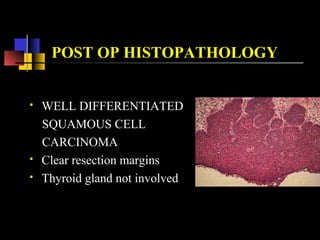
POST OP HISTOPATHOLOGY
 WELL DIFFERENTIATED
SQUAMOUS CELL
CARCINOMA
 Clear resection margins
 Thyroid gland not involved
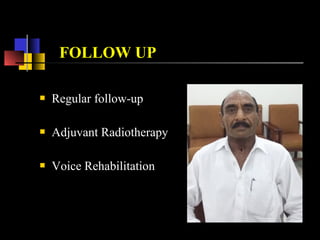
 Regular follow-up
 Adjuvant Radiotherapy
 Voice Rehabilitation Healthy stoma
FOLLOW UP
Healthy stoma
CARCINOMA LARYNX
CASE DISCUSSION
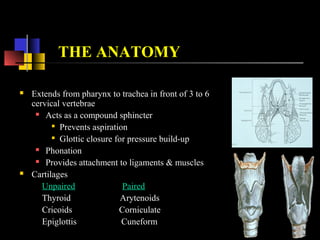
THE ANATOMY
 Extends from pharynx to trachea in front of 3 to 6
cervical vertebrae
 Acts as a compound sphincter

Prevents aspiration

Glottic closure for pressure build-up
 Phonation
 Provides attachment to ligaments & muscles
 Cartilages
Unpaired Paired
Thyroid Arytenoids
Cricoids Corniculate
Epiglottis Cuneform
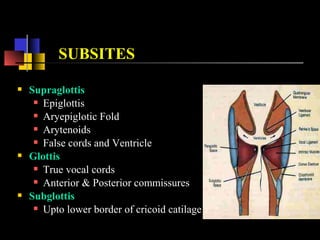
 Supraglottis
 Epiglottis
 Aryepiglotic Fold
 Arytenoids
 False cords and Ventricle
 Glottis
 True vocal cords
 Anterior & Posterior commissures
 Subglottis
 Upto lower border of cricoid catilage
SUBSITES
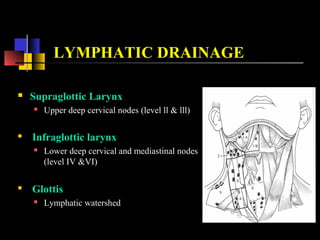
LYMPHATIC DRAINAGE
 Supraglottic Larynx
 Upper deep cervical nodes (level ll & lll)

Infraglottic larynx
 Lower deep cervical and mediastinal nodes
(level IV &VI)

Glottis
 Lymphatic watershed
EPIDEMIOLOGY
 6th
commonest cancer world wide.
 Incidence in UK is 1% of all malignancies
 Male & female ratio 4:1
 Peak incidence 55 to 65 years
 Laryngeal cancer is approximately 4/100,000
 Incidence in females has increased in the western world
 Wide prevalence
 Mean age at presentation 40-70 years
 Male Female ratio 10:1
 Incidence in India 10/10,000
 Incidence in Pakistan 8.6/10,000
REGIONAL STATISTICS
AETIOLOGY
 Tobacco and alcohol
 Benzopyrine and other hydrocarbons
 Alcohol and smoking increases the risk 15 folds
 Previous radiation to neck for benign
lesions
 Genetic factor
 Occupational exposure
 Asbestos,mustard gas and petroleum products
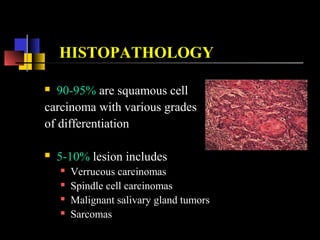
HISTOPATHOLOGY
 90-95% are squamous cell
carcinoma with various grades
of differentiation
 5-10% lesion includes
 Verrucous carcinomas
 Spindle cell carcinomas
 Malignant salivary gland tumors
 Sarcomas
SUPRAGLOTTIC CARCINOMA
 Less frequent than the glottic cancer
 Spreads locally and invades
adjoining areas
 Nodal metastasis occurs early
 Symptoms
 Hoarseness, throat pain, dysphagia, neck nodes,
referred pain in ear, wt loss, and respiratory obstruction
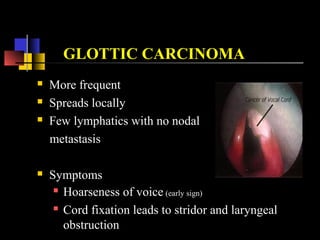
GLOTTIC CARCINOMA
 More frequent
 Spreads locally
 Few lymphatics with no nodal
metastasis
 Symptoms
 Hoarseness of voice (early sign)
 Cord fixation leads to stridor and laryngeal
obstruction
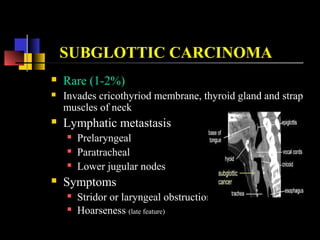
SUBGLOTTIC CARCINOMA
 Rare (1-2%)
 Invades cricothyriod membrane, thyroid gland and strap
muscles of neck
 Lymphatic metastasis
 Prelaryngeal
 Paratracheal
 Lower jugular nodes
 Symptoms
 Stridor or laryngeal obstruction
 Hoarseness (late feature)
DIAGNOSIS
 History
 Indirect laryngoscopy
 Examination of neck
 Soft tissue x-ray of neck
 CT & tomography
 Direct laryngoscopy & biopsy - confirms
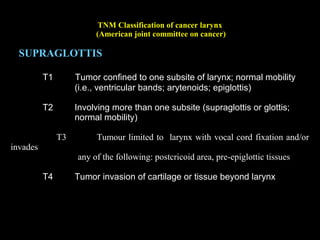
TNM Classification of cancer larynx
(American joint committee on cancer)
SUPRAGLOTTIS
T1 Tumor confined to one subsite of larynx; normal mobility
(i.e., ventricular bands; arytenoids; epiglottis)
T2 Involving more than one subsite (supraglottis or glottis;
normal mobility)
T3 Tumour limited to larynx with vocal cord fixation and/or
invades
any of the following: postcricoid area, pre-epiglottic tissues
T4 Tumor invasion of cartilage or tissue beyond larynx
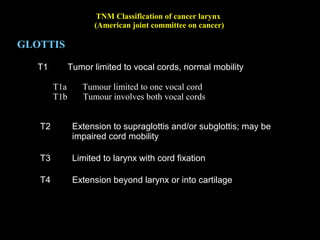
TNM Classification of cancer larynx
(American joint committee on cancer)
GLOTTIS
T1 Tumor limited to vocal cords, normal mobility
T1a Tumour limited to one vocal cord
T1b Tumour involves both vocal cords
T2 Extension to supraglottis and/or subglottis; may be
impaired cord mobility
T3 Limited to larynx with cord fixation
T4 Extension beyond larynx or into cartilage
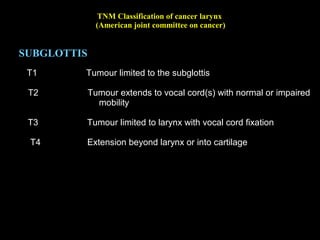
TNM Classification of cancer larynx
(American joint committee on cancer)
SUBGLOTTIS
T1 Tumour limited to the subglottis
T2 Tumour extends to vocal cord(s) with normal or impaired
mobility
T3 Tumour limited to larynx with vocal cord fixation
T4 Extension beyond larynx or into cartilage
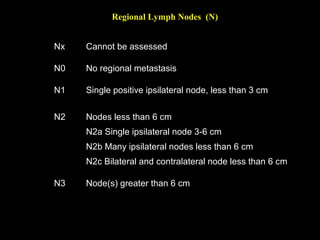
Regional Lymph Nodes (N)
Nx Cannot be assessed
N0 No regional metastasis
N1 Single positive ipsilateral node, less than 3 cm
N2 Nodes less than 6 cm
N2a Single ipsilateral node 3-6 cm
N2b Many ipsilateral nodes less than 6 cm
N2c Bilateral and contralateral node less than 6 cm
N3 Node(s) greater than 6 cm
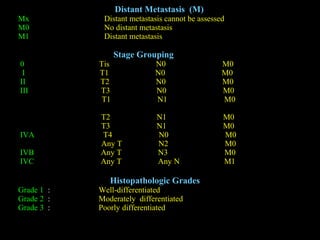
Distant Metastasis (M)
Mx Distant metastasis cannot be assessed
M0 No distant metastasis
M1 Distant metastasis
Stage Grouping
0 Tis N0 M0
I T1 N0 M0
II T2 N0 M0
III T3 N0 M0
T1 N1 M0
T2 N1 M0
T3 N1 M0
IVA T4 N0 M0
Any T N2 M0
IVB Any T N3 M0
IVC Any T Any N M1
Histopathologic Grades
Grade 1 : Well-differentiated
Grade 2 : Moderately differentiated
Grade 3 : Poorly differentiated
TREATMENT OPTIONS
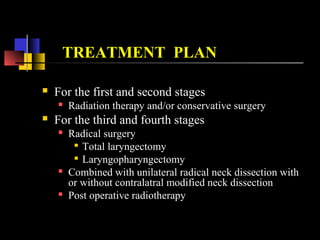
TREATMENT PLAN
 For the first and second stages
 Radiation therapy and/or conservative surgery
 For the third and fourth stages
 Radical surgery

Total laryngectomy

Laryngopharyngectomy
 Combined with unilateral radical neck dissection with
or without contralatral modified neck dissection
 Post operative radiotherapy
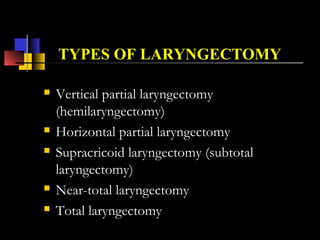
TYPES OF LARYNGECTOMY
 Vertical partial laryngectomy
(hemilaryngectomy)
 Horizontal partial laryngectomy
 Supracricoid laryngectomy (subtotal
laryngectomy)
 Near-total laryngectomy
 Total laryngectomy
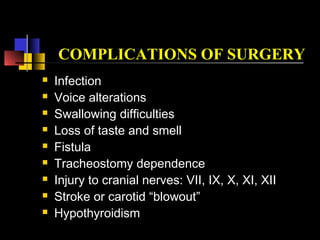
COMPLICATIONS OF SURGERY
 Infection
 Voice alterations
 Swallowing difficulties
 Loss of taste and smell
 Fistula
 Tracheostomy dependence
 Injury to cranial nerves: VII, IX, X, XI, XII
 Stroke or carotid “blowout”
 Hypothyroidism
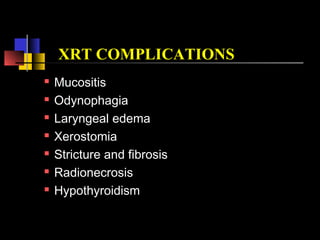
XRT COMPLICATIONS
 Mucositis
 Odynophagia
 Laryngeal edema
 Xerostomia
 Stricture and fibrosis
 Radionecrosis
 Hypothyroidism
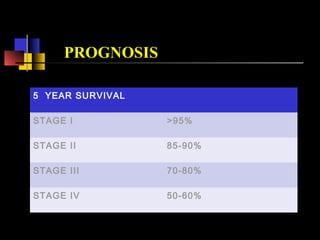
PROGNOSIS
5 YEAR SURVIVAL
STAGE I >95%
STAGE II 85-90%
STAGE III 70-80%
STAGE IV 50-60%
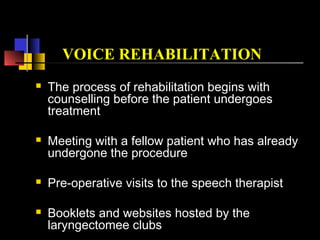
VOICE REHABILITATION
 The process of rehabilitation begins with
counselling before the patient undergoes
treatment
 Meeting with a fellow patient who has already
undergone the procedure
 Pre-operative visits to the speech therapist
 Booklets and websites hosted by the
laryngectomee clubs
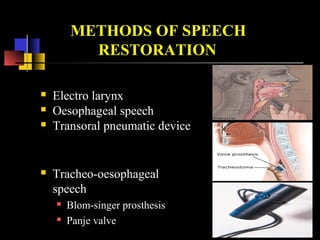
METHODS OF SPEECH
RESTORATION
 Electro larynx
 Oesophageal speech
 Transoral pneumatic device
 Tracheo-oesophageal
speech
 Blom-singer prosthesis
 Panje valve
ELECTRO LARYNX
OTHER METHODS OF
COMMUNICATION
 Lip reading classes for attendants
 Sign language classes for patient and
attendants
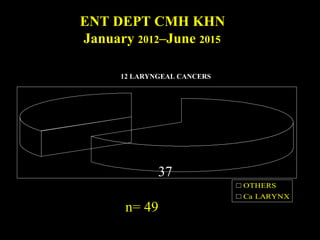
OTHERS
Ca LARYNX
n= 49
37
12 LARYNGEAL CANCERS
ENT DEPT
January 2012–June 2015
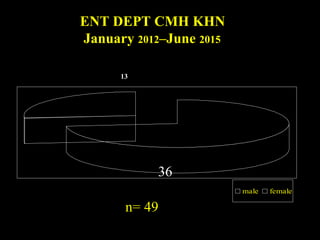
male female
n= 49
36
13
ENT DEPT
January 2012–June 2015
0
2
4
6
8
10
12
14
16
18
20
Mandibulectomy & Neck
Dissection
Maxillectomy Laryngectomy Parotidectomy Neck Dissection Glossectomy & Neck
Dissection
Laryngo-Pharyngo-
Esophagectomy
Extended Radical
Mastoidectomy
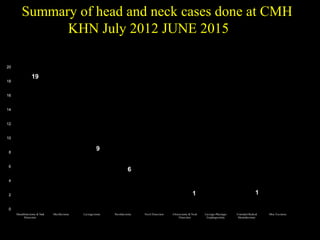
Misc Excisions
19
11
9
6
12
1 3 1
9
Summary of head and neck cases done at ENT Dept
July 2012 JUNE 2015
Current thought for laryngeal cancer is
organ sparing therapy for voice
preservation.Radiation therapy is ideal for
this and works well for early stages of the
disease.Surgical therapy has also evolved
organ sparing techniques.However,the older
proven technique of total
laryngectomy is still a primary
modality for advanced laryngeal cancers.
CONCLUSION
Nutting CM, Robinson M, Birchall M. Survival from '
laryngeal cancer in England and Wales up to 2001. British
Journal of Cancer 2008; 99(5uppl 1): S38-9.
Lauder E. The laryngectomee and the artificial larynx—a second look.
J Speech Hear Disord 1970;35:62–5.
list MA, Ritter-Sterr CA , Baker TM et ai. Longitudinal assemsment of quility of life
in laryngeal cancer patients 1996; 18: 1-10
Cancer research UK website, accessed Oct 5, 2009
Silver SE . Surgery for of the larnyx and related structures, 2nd
edn. Philadelphia: WB
Saunders 1996
REFERENCES
DEPARTMENT OF ENT,
HEAD AND NECK SURGERY
Carcinoma larynx ppt

Carcinoma larynx ppt

  • 2.
    CARCINOMA LARYNX BY DR TARIQUEAHMED MAKA REGISTRAR IN ENT
  • 3.
  • 4.
    PATIENT’S PROFILE  NAMEXYZ  AGE 65 yrs  SEX Male  RESIDENCE Kotla Arab Ali Khan  DATE OF ADMISSION Jan 2014
  • 5.
    PRESENTING COMPLAINTS  HOARSENESS- 6 Months  DIFFICULT - 2 weeks BREATHING
  • 6.
    HISTORY OF PRESENTILLNESS  Hoarseness of voice  Insidious onset and progressive  Breathing Difficulty  Inspiratory stridor
  • 7.
     Past history Personal history 25 cigarettes a day  Family history  Drug history  Socioeconomic history Not Contributory
  • 8.
    GENERAL PHYSICAL EXAMINATION PULSE 98 bpm  BLOOD PRESSURE 130/80 mm of Hg  TEMPERATURE 98.2 ˚ F  RESPIRATORY RATE 28 breaths/min
  • 9.
    EXAMINATION (contd)  PALLOR CYANOSIS  CLUBBING  JAUNDICE  OEDEMA  KOILONYCHIA  THYROID Not enlarged  JVP Not raised  LYMPH NODES Not palpable ABSENT
  • 10.
    ENT EXAMINATION  THROAT Noabnormality found in oral cavity  INDIRECT LARYNGOSCOPY  Exophytic growth arising from left vocal cord involving supraglottis and anterior commissure with narrow glottic chink  Fixed Lt vocal cord
  • 11.
    ENT EXAMINATION  THROAT Noabnormality found in oral cavity  EARS  NOSE Normal  NECK
  • 12.
    UNREMARKABLE SYSTEMIC EXAMINATION  Cardiovascularsystem  Respiratory system  Gastrointestinal system  Central nervous system
  • 13.
    EMERGENCY TRACHEOSTOMY  Emergencytracheostomy was performed under local anesthesia to relieve stridor
  • 14.
    Normal study INVESTGATIONS  Bloodcomplete picture  Haemoglobin: 13g/dl  Platelets: 291x109 /L  X Ray Neck Lat view  X Ray Chest PA  USG Neck  USG Abdomen Narrowed airway in supraglottis & glottis
  • 15.
    NORMAL INVESTIGATIONS (contd)  ECG,2-D echo  Serum urea & electrolytes  PT, PTTK  LFTs  Blood Glucose levels  Hepatitis Profile
  • 16.
  • 17.
    PROVISIONAL DIAGNOSIS  Growthlarynx  Direct laryngoscopy and biopsy under GA planned
  • 18.
    DIRECT LARYNGOSCOPY  Exophyticgrowth on left vocal cord involving left supraglottis and anterior commissure  Pyriform fossae, Posterior pharyngeal wall and Post-cricoid region - Normal  Biopsy
  • 19.
  • 20.
    DIAGNOSIS WELL DIFFERENTIATED SQUAMOUS CELLCARCINOMA LARYNX STAGE (iii) T3 N0 M0
  • 21.
  • 22.
    MANAGEMENT  PRE-OP WORKUP  Counseling  Details of the nature and severity of the disease  Treatment options available  Specific risk of surgery and GA  Understanding the total laryngectomy state & life style after surgery  Informed written consent  Pre-anesthesia assessment: ASA-II  2 Unit RCC arranged
  • 23.
  • 24.
  • 25.
  • 27.
  • 28.
  • 29.
    LARYNX DISSECTED FROMSTERNOMASTOID AND CAROTID SHEATH
  • 30.
  • 31.
    STRAP MUSCLES SECTIONED &LARYNX MOBILIZED
  • 32.
  • 33.
  • 34.
  • 35.
    Neopharyn The Resected Specimen NEOPHARYNX CONSTRUCTED Baseof tongue Oesophagus Tracheostome Neopharynx
  • 36.
    SUCTION DRAINS PLACEDWITHOUT CROSSING THE NEOPHARYNX SUCTION DRAIN SUCTION DRAIN NEOPHARYNX
  • 37.
    TRACHEOSTOME FASHIONED & WOUNDCLOSSED TRACHEOSTOME
  • 38.
    THE TRANSGLOTTIC GROWTH TheResected Specimen
  • 39.
    POST OP MANAGEMENT Tracheostomy care  Antibiotics :  Inj ceftriaxone 1g I/V 12 hourly (ATD)  Inj metronidazole 500mg I/V 8 hourly  Inj coamoxiclav 1.2g I/V 8 hourly (ATD)  Inj Diclofenac Sodium 75mg I/M 12 hourly  Omeprazole infusion 40mg I/V HS  Intra venous fluids
  • 40.
    RECOVERY  1st Post operativeday  Folley catheter removed  Patient mobilized  3rd Post op day  Neck drains removed  N/G feed started with clear water  7th Post op day  Neck stitches removed  10th Post op day  Oral sips started with clear water
  • 41.
    POST OP HISTOPATHOLOGY WELL DIFFERENTIATED SQUAMOUS CELL CARCINOMA  Clear resection margins  Thyroid gland not involved
  • 42.
     Regular follow-up Adjuvant Radiotherapy  Voice Rehabilitation Healthy stoma FOLLOW UP Healthy stoma
  • 43.
  • 44.
    THE ANATOMY  Extendsfrom pharynx to trachea in front of 3 to 6 cervical vertebrae  Acts as a compound sphincter  Prevents aspiration  Glottic closure for pressure build-up  Phonation  Provides attachment to ligaments & muscles  Cartilages Unpaired Paired Thyroid Arytenoids Cricoids Corniculate Epiglottis Cuneform
  • 45.
     Supraglottis  Epiglottis Aryepiglotic Fold  Arytenoids  False cords and Ventricle  Glottis  True vocal cords  Anterior & Posterior commissures  Subglottis  Upto lower border of cricoid catilage SUBSITES
  • 46.
    LYMPHATIC DRAINAGE  SupraglotticLarynx  Upper deep cervical nodes (level ll & lll)  Infraglottic larynx  Lower deep cervical and mediastinal nodes (level IV &VI)  Glottis  Lymphatic watershed
  • 47.
    EPIDEMIOLOGY  6th commonest cancerworld wide.  Incidence in UK is 1% of all malignancies  Male & female ratio 4:1  Peak incidence 55 to 65 years  Laryngeal cancer is approximately 4/100,000  Incidence in females has increased in the western world
  • 48.
     Wide prevalence Mean age at presentation 40-70 years  Male Female ratio 10:1  Incidence in India 10/10,000  Incidence in Pakistan 8.6/10,000 REGIONAL STATISTICS
  • 49.
    AETIOLOGY  Tobacco andalcohol  Benzopyrine and other hydrocarbons  Alcohol and smoking increases the risk 15 folds  Previous radiation to neck for benign lesions  Genetic factor  Occupational exposure  Asbestos,mustard gas and petroleum products
  • 50.
    HISTOPATHOLOGY  90-95% aresquamous cell carcinoma with various grades of differentiation  5-10% lesion includes  Verrucous carcinomas  Spindle cell carcinomas  Malignant salivary gland tumors  Sarcomas
  • 51.
    SUPRAGLOTTIC CARCINOMA  Lessfrequent than the glottic cancer  Spreads locally and invades adjoining areas  Nodal metastasis occurs early  Symptoms  Hoarseness, throat pain, dysphagia, neck nodes, referred pain in ear, wt loss, and respiratory obstruction
  • 52.
    GLOTTIC CARCINOMA  Morefrequent  Spreads locally  Few lymphatics with no nodal metastasis  Symptoms  Hoarseness of voice (early sign)  Cord fixation leads to stridor and laryngeal obstruction
  • 53.
    SUBGLOTTIC CARCINOMA  Rare(1-2%)  Invades cricothyriod membrane, thyroid gland and strap muscles of neck  Lymphatic metastasis  Prelaryngeal  Paratracheal  Lower jugular nodes  Symptoms  Stridor or laryngeal obstruction  Hoarseness (late feature)
  • 54.
    DIAGNOSIS  History  Indirectlaryngoscopy  Examination of neck  Soft tissue x-ray of neck  CT & tomography  Direct laryngoscopy & biopsy - confirms
  • 55.
    TNM Classification ofcancer larynx (American joint committee on cancer) SUPRAGLOTTIS T1 Tumor confined to one subsite of larynx; normal mobility (i.e., ventricular bands; arytenoids; epiglottis) T2 Involving more than one subsite (supraglottis or glottis; normal mobility) T3 Tumour limited to larynx with vocal cord fixation and/or invades any of the following: postcricoid area, pre-epiglottic tissues T4 Tumor invasion of cartilage or tissue beyond larynx
  • 56.
    TNM Classification ofcancer larynx (American joint committee on cancer) GLOTTIS T1 Tumor limited to vocal cords, normal mobility T1a Tumour limited to one vocal cord T1b Tumour involves both vocal cords T2 Extension to supraglottis and/or subglottis; may be impaired cord mobility T3 Limited to larynx with cord fixation T4 Extension beyond larynx or into cartilage
  • 57.
    TNM Classification ofcancer larynx (American joint committee on cancer) SUBGLOTTIS T1 Tumour limited to the subglottis T2 Tumour extends to vocal cord(s) with normal or impaired mobility T3 Tumour limited to larynx with vocal cord fixation T4 Extension beyond larynx or into cartilage
  • 58.
    Regional Lymph Nodes(N) Nx Cannot be assessed N0 No regional metastasis N1 Single positive ipsilateral node, less than 3 cm N2 Nodes less than 6 cm N2a Single ipsilateral node 3-6 cm N2b Many ipsilateral nodes less than 6 cm N2c Bilateral and contralateral node less than 6 cm N3 Node(s) greater than 6 cm
  • 59.
    Distant Metastasis (M) MxDistant metastasis cannot be assessed M0 No distant metastasis M1 Distant metastasis Stage Grouping 0 Tis N0 M0 I T1 N0 M0 II T2 N0 M0 III T3 N0 M0 T1 N1 M0 T2 N1 M0 T3 N1 M0 IVA T4 N0 M0 Any T N2 M0 IVB Any T N3 M0 IVC Any T Any N M1 Histopathologic Grades Grade 1 : Well-differentiated Grade 2 : Moderately differentiated Grade 3 : Poorly differentiated
  • 60.
  • 61.
    TREATMENT PLAN  Forthe first and second stages  Radiation therapy and/or conservative surgery  For the third and fourth stages  Radical surgery  Total laryngectomy  Laryngopharyngectomy  Combined with unilateral radical neck dissection with or without contralatral modified neck dissection  Post operative radiotherapy
  • 62.
    TYPES OF LARYNGECTOMY Vertical partial laryngectomy (hemilaryngectomy)  Horizontal partial laryngectomy  Supracricoid laryngectomy (subtotal laryngectomy)  Near-total laryngectomy  Total laryngectomy
  • 63.
    COMPLICATIONS OF SURGERY Infection  Voice alterations  Swallowing difficulties  Loss of taste and smell  Fistula  Tracheostomy dependence  Injury to cranial nerves: VII, IX, X, XI, XII  Stroke or carotid “blowout”  Hypothyroidism
  • 64.
    XRT COMPLICATIONS  Mucositis Odynophagia  Laryngeal edema  Xerostomia  Stricture and fibrosis  Radionecrosis  Hypothyroidism
  • 65.
    PROGNOSIS 5 YEAR SURVIVAL STAGEI >95% STAGE II 85-90% STAGE III 70-80% STAGE IV 50-60%
  • 66.
    VOICE REHABILITATION  Theprocess of rehabilitation begins with counselling before the patient undergoes treatment  Meeting with a fellow patient who has already undergone the procedure  Pre-operative visits to the speech therapist  Booklets and websites hosted by the laryngectomee clubs
  • 67.
    METHODS OF SPEECH RESTORATION Electro larynx  Oesophageal speech  Transoral pneumatic device  Tracheo-oesophageal speech  Blom-singer prosthesis  Panje valve
  • 68.
  • 69.
    OTHER METHODS OF COMMUNICATION Lip reading classes for attendants  Sign language classes for patient and attendants
  • 70.
    OTHERS Ca LARYNX n= 49 37 12LARYNGEAL CANCERS ENT DEPT January 2012–June 2015
  • 71.
    male female n= 49 36 13 ENTDEPT January 2012–June 2015
  • 72.
    0 2 4 6 8 10 12 14 16 18 20 Mandibulectomy & Neck Dissection MaxillectomyLaryngectomy Parotidectomy Neck Dissection Glossectomy & Neck Dissection Laryngo-Pharyngo- Esophagectomy Extended Radical Mastoidectomy Misc Excisions 19 11 9 6 12 1 3 1 9 Summary of head and neck cases done at ENT Dept July 2012 JUNE 2015
  • 73.
    Current thought forlaryngeal cancer is organ sparing therapy for voice preservation.Radiation therapy is ideal for this and works well for early stages of the disease.Surgical therapy has also evolved organ sparing techniques.However,the older proven technique of total laryngectomy is still a primary modality for advanced laryngeal cancers. CONCLUSION
  • 74.
    Nutting CM, RobinsonM, Birchall M. Survival from ' laryngeal cancer in England and Wales up to 2001. British Journal of Cancer 2008; 99(5uppl 1): S38-9. Lauder E. The laryngectomee and the artificial larynx—a second look. J Speech Hear Disord 1970;35:62–5. list MA, Ritter-Sterr CA , Baker TM et ai. Longitudinal assemsment of quility of life in laryngeal cancer patients 1996; 18: 1-10 Cancer research UK website, accessed Oct 5, 2009 Silver SE . Surgery for of the larnyx and related structures, 2nd edn. Philadelphia: WB Saunders 1996 REFERENCES
  • 75.
    DEPARTMENT OF ENT, HEADAND NECK SURGERY

Editor's Notes

  • #3 Worthy commandant, respected seniors and my fellow colleagues, I Dr Tariq Ahmed, from the dept of ENT and head and neck surgery,
  • #4 , will be presenting a case of Carcinoma larynx, managed at ENT dept,
  • #5 My patient 65 yrs old pensioner Havildar , resident of kotla arab ali khan tahsil kharian, presented in ENT OPD
  • #6 with comlpaints of hoarseness of voice for the last 6 months and respiratory difficulty for the last 2 weeks
  • #7 Initially the hoarseness was insidious and was associated with an irritation in throat latter it became progressive. For the last two weeks he was also having a respiratory difficulty which was associated with a noisy breathing on exertion. There was no history of pain, dysphagia, hemoptysis or weight-loss.
  • #8 He was a chronic smoker for the last 40 years, His past, family and drug histories were not contributory
  • #9 On examination, my patient was an elderly male with stable vitals, sitting anxiously on bed as he could not lie down due to difficulty in breathing
  • #10 while rest of his GPE was unremarkable
  • #11 On Indirect & Fibreoptic laryngoscopy, an exophytic growth was seen on left vocal cord involving anterior commissure and supraglottis with narrow glottic chink . left vocal cord was fixed
  • #12 Neck nodes were not palpable and Rest of the ENT examination did not reveal any abnormality
  • #13 His Systemic examination was also unremarkable
  • #14 Due to stridor , emergency tracheostomy was done under local anaesthesia
  • #15 In the meantime, patient was thoroughly investigated. His x-ray neck lat view showed narrowing of airway at supraglottic
  • #16 Rest of investigations were within normal limits
  • #17 Ct scan of neck showed left voal cord & supra glottic growth
  • #18 On the basis of history and clinical examination a provisional diagnosis of growth larynx, probably malignant, was made. Direct laryngoscopy and biopsy under general anaesthesia was planned to obtain a tissue diagnosis.
  • #19 On direct laryngoscopy an exophytic growth of the left vocal cord was seen involving entire its length and anterior commisure extending up to supraglottis . left vocal cord was fixed and right vocal cord was mobile and intact .biopsy was taken for tissue diagnosis
  • #20 His histopath report revealed well differentiated squamous cell carcinoma
  • #21 A final diagnosis of well differentiated squamous cell carcinoma larynx was made and tumour was classified as T3 N0 MO
  • #22 The case was discussed in ENT Dept and Total Laryngectomy followed by adjuvant Radiotherapy was planned.
  • #23 A counselling session was arranged in which the patient and the attendants were told about the nature of the disease, the treatment options available with their merits and demerits and the possible risks involved in the surgery Special emphasis was given on understanding the total laryngetomy state and life style after the surgery
  • #24 patient was prepared for surgery
  • #25 Gluck sorenson incision was marked
  • #26 Patient was draped under asceptic measures
  • #27 an incision was made, and
  • #28 sub platysmal flaps were elevated
  • #29 Dissection continued
  • #30 Larynx was separated from sternomastoid muscle and carotid sheath
  • #31 Contra lateral thyroid freed and secured
  • #32 Infra hyoid muscle were ressected and larynx moblised
  • #33 Ressection continued upward
  • #34 Larynx was removed
  • #35 Nasogastric feeding tube passed
  • #36 And neopharynx reconstruted in three layers
  • #37 Radivac suction drains were placed on both sides
  • #38 Wound closed in layers and tracheostome fashioned
  • #39 This was the ressected specimen of larynx and sent for histopath studies
  • #40 Post operatively patient was nursed in the ITC
  • #41 He had a smooth post operative recovery, and was discharged on 7th post op day
  • #42 His post op histopath report confirmed the diagnosis with clear resection margins
  • #43 The patient is on regular monthly follow up and he has received adjuvant radiotherapy. His speaking skills are progressively improving
  • #44 Now the case discussion
  • #45 The larynx is a hollow muscular organ that provides a passage for respiration, prevents aspiration, produces sound and allows stabilization of thorax.
  • #46 Larynx has three subsites
  • #47 Lymphatic drainage of larynx is to deep cervical lymph nodes level ii, iii & iv
  • #48 carcinoma larynx make up 6% of all body cancers. in western world It usually presents between the ages of 50 to 70 years and is four times more common in male
  • #49 our regional data shows its wide prevalence & is ten times more common in male
  • #50 Etiology of carcinoma larynx is multifactorial. Smoking, taking alcohol & exposure to radiation in the past is a recognized risk factor, while a positive family history of ca larynx points towards genetic factors.
  • #51 On the basis of histology ,more then 90% are sq cell ca with various grades
  • #52 Supra glottic carcinoma is less frequent then glottic cancer that spreads locally with early nodal mets
  • #53 glottic carcinoma is more common and spreads locally with few lymphatic mets
  • #54 Sub glottic carcinoma is a rare upto 2 %
  • #60 Although there are many staging systems in practice, but mostly tumour staging is carried out with AJCC(american joint committee on cancer) and UICC (uninion of international cancer control) is based on TNM classification system
  • #61 The management of laryngeal cancer depends on the stage of tumour at presentation. However a variety of other factors are also involved in decision making including the the pateints age, comorbidities, treating multidisciplinary team and importantly the wishes of the pt
  • #62 Treatment of choice For 1st & 2nd stages is radiotherapy and conservatie surgery ,for 3rd & 4th stages total laryngectomy is the mainstay of treatment , usually combined with post- operative radio therapy of residual disease.
  • #63 These are types of laryngectomy
  • #64 These are complications of surgery
  • #65 These are complications of radiotherapy.
  • #66 Prognosis depends on the tumour stage
  • #67 The process of rehabilitation begins with counselling before the patient undergoes treatment. A meeting with a fellow patient who has already undergone the procedure helps the patient to understand post laryngectomy life style and problems.
  • #68 There are three methods of speech restoration after laryngectomy. Oesohageal speech, tracheo-oesophageal puncture and artificial electro larynx devices.
  • #69 artificial electro larynx devices.
  • #70 If the patient can not be helped by any of these methods then other methods of communication can be acquired like Lip reading classes for attendants or Sign language classes for both patient and attendants.
  • #71 In our set up Total 49 cases of head & neck cancer were reported in last two and half years Total 12 cases of ca larynx were diagnosed ,out of them ten were operated here rest two were declared unfit for ga and reffered for radiotherapy
  • #74 I would conclude by saying that Current thought for laryngeal cancer is organ sparing therapy for voice preservation. Radiation therapy is ideal for this and works well for early stages of the disease. Surgical therapy has also evolved organ sparing techniques. However, the older proven technique of total laryngectomy is still a primary modality for advanced laryngeal cancers