VMworld 2004
How to Justify the Transition
of Your Intel Server
Environment From Physical to
Virtual
David M. Kent
Infrastructure Architect
CNA IT
NOTICE
The purpose of this presentation is to provide general information, rather than advice or
opinion, that is accurate to the best of the speaker’s knowledge as of the date of this
presentation. Accordingly, this presentation should not be viewed as a substitute for the
guidance and recommendations of a retained professional. In addition, CNA may not
necessarily endorse any coverages, systems, processes or protocols addressed herein unless
such coverages, systems, processes or protocols are produced or created by CNA.
Any references to non-CNA websites are provided solely for convenience and CNA disclaims
any responsibility with respect thereto. Further, to the extent this presentation contains any
descriptions of products available under CNA policies or programs, please note that all
products may not be available in all states and any questions of coverage, exclusions or
limitations are ultimately governed and controlled by the express terms and conditions of the
relevant insurance policies.
As used herein, “CNA” refers to CNA Financial Corporation, along with its subsidiaries and
affiliates. CNA is a service mark registered with the U.S. Patent and Trademark Office.
Copyright © 2004 Continental Casualty Company. All rights reserved.
Agenda
• About CNA
• How are we structured?
• Intel server environment
• What was our business case
• Project data
• Project results
• Risks identified
• Current state
• Next steps
• Summary
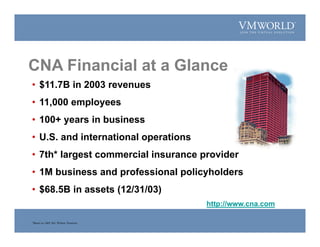
CNA Financial at a Glance
• $11.7B in 2003 revenues
• 11,000 employees
• 100+ years in business
• U.S. and international operations
• 7th* largest commercial insurance provider
• 1M business and professional policyholders
• $68.5B in assets (12/31/03)
http://www.cna.com
*Based on 2003 Net Written Premium
How are we structured?
• Solutions and Architecture
 Infrastructure and Security Architecture
• Infrastructure
 Intel Server Engineering
• BAP – Business Area Partner
 Maps business value to IT projects
• Finance
 Financial review of projects
Intel Server Environment
• 1200 Intel based servers
All running Windows Server
• No Linux
• Novell recently decommissioned
All single purpose servers
Average utilization ~10%
12 new servers / month
• 9 engineers for ~133:1 ratio
• 11,000 employees for ~9:1 ratio
What is our Business Case?
• Save Money!
 Lower TCO by 66%
 5yr Cost Avoidance CBA returns > $2M
• Improve flexibility in the Intel
environment
 Significantly reduce provisioning time
 Increase Agility in Environment
 Enable new DR capabilities
 Enable workload management / capacity on demand
 Consolidation is simplified with VMWare “Physical to
Virtual” tool (P2V)
Project Data (Objectives)
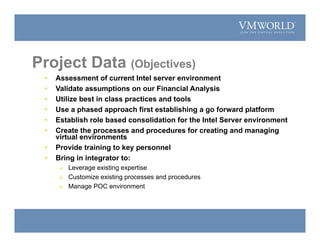
• Assessment of current Intel server environment
• Validate assumptions on our Financial Analysis
• Utilize best in class practices and tools
• Use a phased approach first establishing a go forward platform
• Establish role based consolidation for the Intel Server environment
• Create the processes and procedures for creating and managing
virtual environments
• Provide training to key personnel
• Bring in integrator to:
 Leverage existing expertise
 Customize existing processes and procedures
 Manage POC environment
Project Data (Selecting an Integrator)
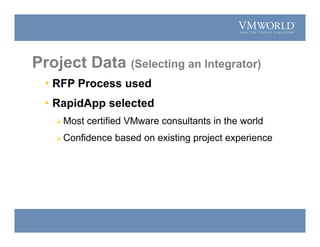
• RFP Process used
• RapidApp selected
Most certified VMware consultants in the world
Confidence based on existing project experience
Business Case (Assumptions)
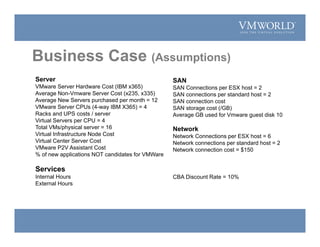
Server
VMware Server Hardware Cost (IBM x365)
Average Non-Vmware Server Cost (x235, x335)
Average New Servers purchased per month = 12
VMware Server CPUs (4-way IBM X365) = 4
Racks and UPS costs / server
Virtual Servers per CPU = 4
Total VMs/physical server = 16
Virtual Infrastructure Node Cost
Virtual Center Server Cost
VMware P2V Assistant Cost
% of new applications NOT candidates for VMWare
Services
Internal Hours
External Hours
SAN
SAN Connections per ESX host = 2
SAN connections per standard host = 2
SAN connection cost
SAN storage cost (/GB)
Average GB used for Vmware guest disk 10
Network
Network Connections per ESX host = 6
Network connections per standard host = 2
Network connection cost = $150
CBA Discount Rate = 10%
Business Case (Financial Summary)
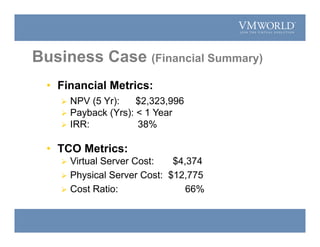
• Financial Metrics:
 NPV (5 Yr): $2,323,996
 Payback (Yrs): < 1 Year
 IRR: 38%
• TCO Metrics:
 Virtual Server Cost: $4,374
 Physical Server Cost: $12,775
 Cost Ratio: 66%
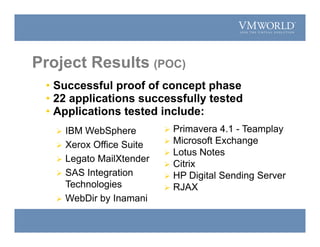
Project Results (POC)
 IBM WebSphere
 Xerox Office Suite
 Legato MailXtender
 SAS Integration
Technologies
 WebDir by Inamani
 Primavera 4.1 - Teamplay
 Microsoft Exchange
 Lotus Notes
 Citrix
 HP Digital Sending Server
 RJAX
• Successful proof of concept phase
• 22 applications successfully tested
• Applications tested include:
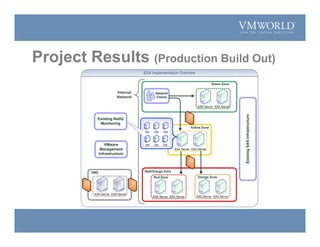
Project Results (Production Build Out)
• Impact: Potential resistance from IT and business people to sourcing their applications on
this platform could make benefits difficult to achieve. Capacity management processes need
to be developed and refined.
• Risk Response Strategy: (1) Educate business users and solutions leads on the superior
service options associated with the platform and associated business benefits (2) Refine and
leverage processes being used within the mainframe and UNIX communities for capacity
management and financial planning
• Mitigation Strategy: Develop training efforts for solution leads, architects and engineers on
the full range of capability within the platform. Perform demonstrations of how work loads
can be managed, migrated and moved to respond to operational requirements. Capture
success stories externally and internally.
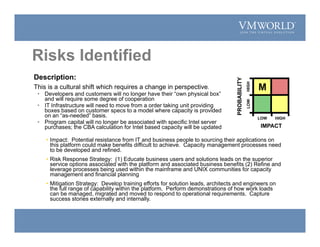
Description:
This is a cultural shift which requires a change in perspective.
• Developers and customers will no longer have their “own physical box”
and will require some degree of cooperation
• IT Infrastructure will need to move from a order taking unit providing
boxes based on customer specs to a model where capacity is provided
on an “as-needed” basis.
• Program capital will no longer be associated with specific Intel server
purchases; the CBA calculation for Intel based capacity will be updated
M
PROBABILITY
IMPACT
LOW HIGH
LOWHIGH
Risks Identified
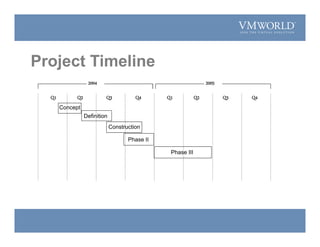
Project Timeline
Q1 Q2 Q3 Q4 Q1 Q2 Q3 Q4
2004 2005
Concept
Definition
Phase II
Construction
Phase III
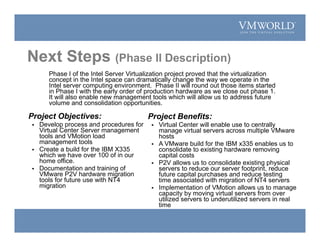
Project Objectives:
 Develop process and procedures for
Virtual Center Server management
tools and VMotion load
management tools
 Create a build for the IBM X335
which we have over 100 of in our
home office.
 Documentation and training of
VMware P2V hardware migration
tools for future use with NT4
migration
Project Benefits:
 Virtual Center will enable use to centrally
manage virtual servers across multiple VMware
hosts
 A VMware build for the IBM x335 enables us to
consolidate to existing hardware removing
capital costs
 P2V allows us to consolidate existing physical
servers to reduce our server footprint, reduce
future capital purchases and reduce testing
time associated with migration of NT4 servers
 Implementation of VMotion allows us to manage
capacity by moving virtual servers from over
utilized servers to underutilized servers in real
time
Phase I of the Intel Server Virtualization project proved that the virtualization
concept in the Intel space can dramatically change the way we operate in the
Intel server computing environment. Phase II will round out those items started
in Phase I with the early order of production hardware as we close out phase 1.
It will also enable new management tools which will allow us to address future
volume and consolidation opportunities.
Next Steps (Phase II Description)
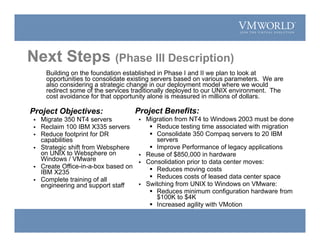
Project Objectives:
 Migrate 350 NT4 servers
 Reclaim 100 IBM X335 servers
 Reduce footprint for DR
capabilities
 Strategic shift from Websphere
on UNIX to Websphere on
Windows / VMware
 Create Office-in-a-box based on
IBM X235
 Complete training of all
engineering and support staff
Project Benefits:
 Migration from NT4 to Windows 2003 must be done
 Reduce testing time associated with migration
 Consolidate 350 Compaq servers to 20 IBM
servers
 Improve Performance of legacy applications
 Reuse of $850,000 in hardware
 Consolidation prior to data center moves:
 Reduces moving costs
 Reduces costs of leased data center space
 Switching from UNIX to Windows on VMware:
 Reduces minimum configuration hardware from
$100K to $4K
 Increased agility with VMotion
Building on the foundation established in Phase I and II we plan to look at
opportunities to consolidate existing servers based on various parameters. We are
also considering a strategic change in our deployment model where we would
redirect some of the services traditionally deployed to our UNIX environment. The
cost avoidance for that opportunity alone is measured in millions of dollars.
Next Steps (Phase III Description)
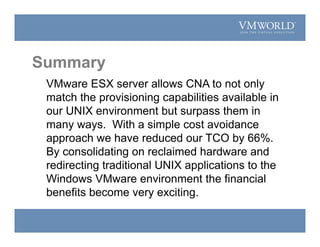
Summary
VMware ESX server allows CNA to not only
match the provisioning capabilities available in
our UNIX environment but surpass them in
many ways. With a simple cost avoidance
approach we have reduced our TCO by 66%.
By consolidating on reclaimed hardware and
redirecting traditional UNIX applications to the
Windows VMware environment the financial
benefits become very exciting.

VMWorld 2004 - Justifying the transition from Physical to Virtual

  • 1.
    VMworld 2004 How toJustify the Transition of Your Intel Server Environment From Physical to Virtual David M. Kent Infrastructure Architect CNA IT
  • 2.
    NOTICE The purpose ofthis presentation is to provide general information, rather than advice or opinion, that is accurate to the best of the speaker’s knowledge as of the date of this presentation. Accordingly, this presentation should not be viewed as a substitute for the guidance and recommendations of a retained professional. In addition, CNA may not necessarily endorse any coverages, systems, processes or protocols addressed herein unless such coverages, systems, processes or protocols are produced or created by CNA. Any references to non-CNA websites are provided solely for convenience and CNA disclaims any responsibility with respect thereto. Further, to the extent this presentation contains any descriptions of products available under CNA policies or programs, please note that all products may not be available in all states and any questions of coverage, exclusions or limitations are ultimately governed and controlled by the express terms and conditions of the relevant insurance policies. As used herein, “CNA” refers to CNA Financial Corporation, along with its subsidiaries and affiliates. CNA is a service mark registered with the U.S. Patent and Trademark Office. Copyright © 2004 Continental Casualty Company. All rights reserved.
  • 3.
    Agenda • About CNA •How are we structured? • Intel server environment • What was our business case • Project data • Project results • Risks identified • Current state • Next steps • Summary
  • 4.
    CNA Financial ata Glance • $11.7B in 2003 revenues • 11,000 employees • 100+ years in business • U.S. and international operations • 7th* largest commercial insurance provider • 1M business and professional policyholders • $68.5B in assets (12/31/03) http://www.cna.com *Based on 2003 Net Written Premium
  • 5.
    How are westructured? • Solutions and Architecture  Infrastructure and Security Architecture • Infrastructure  Intel Server Engineering • BAP – Business Area Partner  Maps business value to IT projects • Finance  Financial review of projects
  • 6.
    Intel Server Environment •1200 Intel based servers All running Windows Server • No Linux • Novell recently decommissioned All single purpose servers Average utilization ~10% 12 new servers / month • 9 engineers for ~133:1 ratio • 11,000 employees for ~9:1 ratio
  • 7.
    What is ourBusiness Case? • Save Money!  Lower TCO by 66%  5yr Cost Avoidance CBA returns > $2M • Improve flexibility in the Intel environment  Significantly reduce provisioning time  Increase Agility in Environment  Enable new DR capabilities  Enable workload management / capacity on demand  Consolidation is simplified with VMWare “Physical to Virtual” tool (P2V)
  • 8.
    Project Data (Objectives) •Assessment of current Intel server environment • Validate assumptions on our Financial Analysis • Utilize best in class practices and tools • Use a phased approach first establishing a go forward platform • Establish role based consolidation for the Intel Server environment • Create the processes and procedures for creating and managing virtual environments • Provide training to key personnel • Bring in integrator to:  Leverage existing expertise  Customize existing processes and procedures  Manage POC environment
  • 9.
    Project Data (Selectingan Integrator) • RFP Process used • RapidApp selected Most certified VMware consultants in the world Confidence based on existing project experience
  • 10.
    Business Case (Assumptions) Server VMwareServer Hardware Cost (IBM x365) Average Non-Vmware Server Cost (x235, x335) Average New Servers purchased per month = 12 VMware Server CPUs (4-way IBM X365) = 4 Racks and UPS costs / server Virtual Servers per CPU = 4 Total VMs/physical server = 16 Virtual Infrastructure Node Cost Virtual Center Server Cost VMware P2V Assistant Cost % of new applications NOT candidates for VMWare Services Internal Hours External Hours SAN SAN Connections per ESX host = 2 SAN connections per standard host = 2 SAN connection cost SAN storage cost (/GB) Average GB used for Vmware guest disk 10 Network Network Connections per ESX host = 6 Network connections per standard host = 2 Network connection cost = $150 CBA Discount Rate = 10%
  • 11.
    Business Case (FinancialSummary) • Financial Metrics:  NPV (5 Yr): $2,323,996  Payback (Yrs): < 1 Year  IRR: 38% • TCO Metrics:  Virtual Server Cost: $4,374  Physical Server Cost: $12,775  Cost Ratio: 66%
  • 12.
    Project Results (POC) IBM WebSphere  Xerox Office Suite  Legato MailXtender  SAS Integration Technologies  WebDir by Inamani  Primavera 4.1 - Teamplay  Microsoft Exchange  Lotus Notes  Citrix  HP Digital Sending Server  RJAX • Successful proof of concept phase • 22 applications successfully tested • Applications tested include:
  • 13.
  • 14.
    • Impact: Potentialresistance from IT and business people to sourcing their applications on this platform could make benefits difficult to achieve. Capacity management processes need to be developed and refined. • Risk Response Strategy: (1) Educate business users and solutions leads on the superior service options associated with the platform and associated business benefits (2) Refine and leverage processes being used within the mainframe and UNIX communities for capacity management and financial planning • Mitigation Strategy: Develop training efforts for solution leads, architects and engineers on the full range of capability within the platform. Perform demonstrations of how work loads can be managed, migrated and moved to respond to operational requirements. Capture success stories externally and internally. Description: This is a cultural shift which requires a change in perspective. • Developers and customers will no longer have their “own physical box” and will require some degree of cooperation • IT Infrastructure will need to move from a order taking unit providing boxes based on customer specs to a model where capacity is provided on an “as-needed” basis. • Program capital will no longer be associated with specific Intel server purchases; the CBA calculation for Intel based capacity will be updated M PROBABILITY IMPACT LOW HIGH LOWHIGH Risks Identified
  • 15.
    Project Timeline Q1 Q2Q3 Q4 Q1 Q2 Q3 Q4 2004 2005 Concept Definition Phase II Construction Phase III
  • 16.
    Project Objectives:  Developprocess and procedures for Virtual Center Server management tools and VMotion load management tools  Create a build for the IBM X335 which we have over 100 of in our home office.  Documentation and training of VMware P2V hardware migration tools for future use with NT4 migration Project Benefits:  Virtual Center will enable use to centrally manage virtual servers across multiple VMware hosts  A VMware build for the IBM x335 enables us to consolidate to existing hardware removing capital costs  P2V allows us to consolidate existing physical servers to reduce our server footprint, reduce future capital purchases and reduce testing time associated with migration of NT4 servers  Implementation of VMotion allows us to manage capacity by moving virtual servers from over utilized servers to underutilized servers in real time Phase I of the Intel Server Virtualization project proved that the virtualization concept in the Intel space can dramatically change the way we operate in the Intel server computing environment. Phase II will round out those items started in Phase I with the early order of production hardware as we close out phase 1. It will also enable new management tools which will allow us to address future volume and consolidation opportunities. Next Steps (Phase II Description)
  • 17.
    Project Objectives:  Migrate350 NT4 servers  Reclaim 100 IBM X335 servers  Reduce footprint for DR capabilities  Strategic shift from Websphere on UNIX to Websphere on Windows / VMware  Create Office-in-a-box based on IBM X235  Complete training of all engineering and support staff Project Benefits:  Migration from NT4 to Windows 2003 must be done  Reduce testing time associated with migration  Consolidate 350 Compaq servers to 20 IBM servers  Improve Performance of legacy applications  Reuse of $850,000 in hardware  Consolidation prior to data center moves:  Reduces moving costs  Reduces costs of leased data center space  Switching from UNIX to Windows on VMware:  Reduces minimum configuration hardware from $100K to $4K  Increased agility with VMotion Building on the foundation established in Phase I and II we plan to look at opportunities to consolidate existing servers based on various parameters. We are also considering a strategic change in our deployment model where we would redirect some of the services traditionally deployed to our UNIX environment. The cost avoidance for that opportunity alone is measured in millions of dollars. Next Steps (Phase III Description)
  • 18.
    Summary VMware ESX serverallows CNA to not only match the provisioning capabilities available in our UNIX environment but surpass them in many ways. With a simple cost avoidance approach we have reduced our TCO by 66%. By consolidating on reclaimed hardware and redirecting traditional UNIX applications to the Windows VMware environment the financial benefits become very exciting.