CMOS Delay
Dr. Ahmed Youssef
COE 360
Principles of VLSI
Design
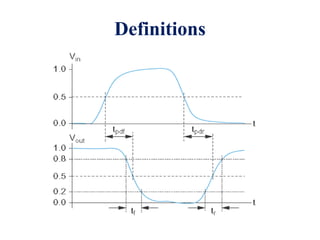
Definitions
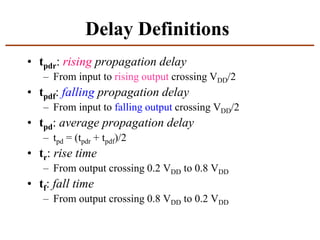
Delay Definitions
• tpdr: rising propagation delay
– From input to rising output crossing VDD/2
• tpdf: falling propagation delay
– From input to falling output crossing VDD/2
• tpd: average propagation delay
– tpd = (tpdr + tpdf)/2
• tr: rise time
– From output crossing 0.2 VDD to 0.8 VDD
• tf: fall time
– From output crossing 0.8 VDD to 0.2 VDD
Delay Definitions
• tcdr: rising contamination delay
– From input to rising output crossing VDD/2
• tcdf: falling contamination delay
– From input to falling output crossing VDD/2
• tcd: average contamination delay
– tpd = (tcdr + tcdf)/2
Definitions
Propagation Delay – Time from last input
change until last output change.
Contamination Delay – Time from first input
change until first output change.
Best-case (contamination) delay can be substantially
less than propagation delay.
Definitions
• A timing analyzer computes the arrival times, i.e.,
the latest time at which each node in a block of
logic will switch.
• The nodes are classified as inputs, outputs, and
internal nodes.
Definitions
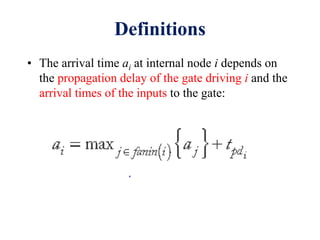
• The arrival time ai at internal node i depends on
the propagation delay of the gate driving i and the
arrival times of the inputs to the gate:
Definitions
• The slack is the difference between the required and
arrival times.
• Positive slack means that the circuit meets timing.
• Negative slack means that the circuit is not fast enough.
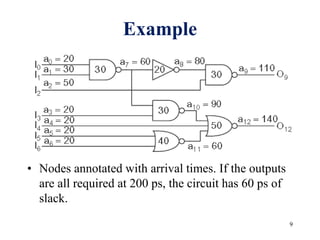
Example
• Nodes annotated with arrival times. If the outputs
are all required at 200 ps, the circuit has 60 ps of
slack.
9
Delay Estimation
11
11
11
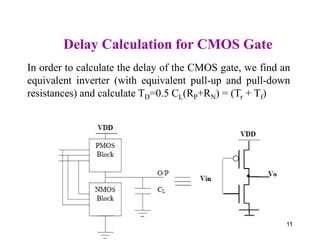
Delay Calculation for CMOS Gate
In order to calculate the delay of the CMOS gate, we find an
equivalent inverter (with equivalent pull-up and pull-down
resistances) and calculate TD=0.5 CL(RP+RN) = (Tr + Tf)
Delay Calculation for CMOS Gate
Where Tr and Tf of the equivalent
inverter = worst case Tr and Tf of the
gate
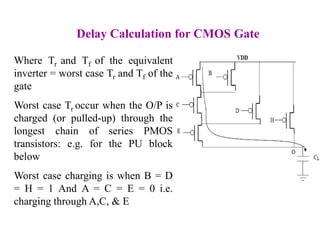
Worst case Tr occur when the O/P is
charged (or pulled-up) through the
longest chain of series PMOS
transistors: e.g. for the PU block
below
Worst case charging is when B = D
= H = 1 And A = C = E = 0 i.e.
charging through A,C, & E
Delay Calculation for CMOS Gate
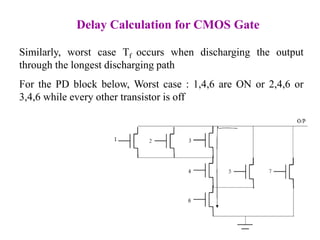
Similarly, worst case Tf occurs when discharging the output
through the longest discharging path
For the PD block below, Worst case : 1,4,6 are ON or 2,4,6 or
3,4,6 while every other transistor is off
Delay Calculation for CMOS Gate
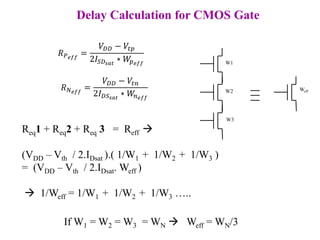
𝑅𝑃𝑒𝑓𝑓
=
𝑉𝐷𝐷 − 𝑉𝑡𝑝
2𝐼𝑆𝐷𝑠𝑎𝑡
∗ 𝑊
𝑝𝑒𝑓𝑓
𝑅𝑁𝑒𝑓𝑓
=
𝑉𝐷𝐷 − 𝑉𝑡𝑛
2𝐼𝐷𝑆𝑠𝑎𝑡
∗ 𝑊
𝑛𝑒𝑓𝑓
Req1 + Req2 + Req 3 = Reff 
(VDD – Vth / 2.IDsat ).( 1/W1 + 1/W2 + 1/W3 )
= (VDD – Vth / 2.IDsat. Weff )
 1/Weff = 1/W1 + 1/W2 + 1/W3 …..
W1
W2
W3
Weff
If W1 = W2 = W3 = WN  Weff = WN/3
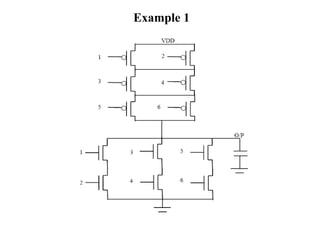
Example 1
Calculate the maximum frequency of operation of an
AOI 222 CMOS gate with a 100 fF load, assuming
that all NMOS transistor are 9 μm wide and 1 μm
long. All PMOS transistors are 10/1 μm use the 1 μm
technology ISDsat = 200 μA/μm , VtN = | VtP | = 0.8V ,
VDD = 5V
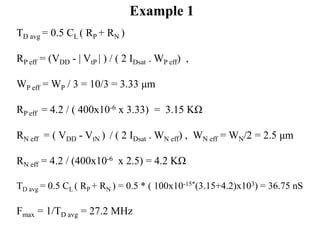
Example 1
TD avg = 0.5 CL ( RP + RN )
RP eff = (VDD - | VtP | ) / ( 2 IDsat . WP eff) ,
WP eff = WP / 3 = 10/3 = 3.33 μm
RP eff = 4.2 / ( 400x10-6 x 3.33) = 3.15 KΩ
RN eff = ( VDD - VtN ) / ( 2 IDsat . WN eff) , WN eff = WN/2 = 2.5 μm
RN eff = 4.2 / (400x10-6 x 2.5) = 4.2 KΩ
TD avg = 0.5 CL ( RP + RN ) = 0.5 * ( 100x10-15*(3.15+4.2)x103) = 36.75 nS
Fmax = 1/TD avg = 27.2 MHz
Example 1
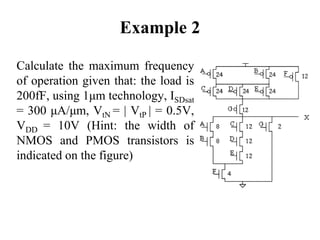
Example 2
Calculate the maximum frequency
of operation given that: the load is
200fF, using 1μm technology, ISDsat
= 300 μA/μm, VtN = | VtP | = 0.5V,
VDD = 10V (Hint: the width of
NMOS and PMOS transistors is
indicated on the figure)
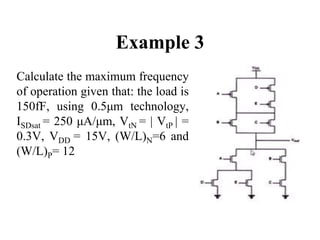
Example 3
Calculate the maximum frequency
of operation given that: the load is
150fF, using 0.5μm technology,
ISDsat = 250 μA/μm, VtN = | VtP | =
0.3V, VDD = 15V, (W/L)N=6 and
(W/L)P= 12

4-CMOS-Delay.pptx

  • 1.
    CMOS Delay Dr. AhmedYoussef COE 360 Principles of VLSI Design
  • 2.
  • 3.
    Delay Definitions • tpdr:rising propagation delay – From input to rising output crossing VDD/2 • tpdf: falling propagation delay – From input to falling output crossing VDD/2 • tpd: average propagation delay – tpd = (tpdr + tpdf)/2 • tr: rise time – From output crossing 0.2 VDD to 0.8 VDD • tf: fall time – From output crossing 0.8 VDD to 0.2 VDD
  • 4.
    Delay Definitions • tcdr:rising contamination delay – From input to rising output crossing VDD/2 • tcdf: falling contamination delay – From input to falling output crossing VDD/2 • tcd: average contamination delay – tpd = (tcdr + tcdf)/2
  • 5.
    Definitions Propagation Delay –Time from last input change until last output change. Contamination Delay – Time from first input change until first output change. Best-case (contamination) delay can be substantially less than propagation delay.
  • 6.
    Definitions • A timinganalyzer computes the arrival times, i.e., the latest time at which each node in a block of logic will switch. • The nodes are classified as inputs, outputs, and internal nodes.
  • 7.
    Definitions • The arrivaltime ai at internal node i depends on the propagation delay of the gate driving i and the arrival times of the inputs to the gate:
  • 8.
    Definitions • The slackis the difference between the required and arrival times. • Positive slack means that the circuit meets timing. • Negative slack means that the circuit is not fast enough.
  • 9.
    Example • Nodes annotatedwith arrival times. If the outputs are all required at 200 ps, the circuit has 60 ps of slack. 9
  • 10.
  • 11.
    11 11 11 Delay Calculation forCMOS Gate In order to calculate the delay of the CMOS gate, we find an equivalent inverter (with equivalent pull-up and pull-down resistances) and calculate TD=0.5 CL(RP+RN) = (Tr + Tf)
  • 12.
    Delay Calculation forCMOS Gate Where Tr and Tf of the equivalent inverter = worst case Tr and Tf of the gate Worst case Tr occur when the O/P is charged (or pulled-up) through the longest chain of series PMOS transistors: e.g. for the PU block below Worst case charging is when B = D = H = 1 And A = C = E = 0 i.e. charging through A,C, & E
  • 13.
    Delay Calculation forCMOS Gate Similarly, worst case Tf occurs when discharging the output through the longest discharging path For the PD block below, Worst case : 1,4,6 are ON or 2,4,6 or 3,4,6 while every other transistor is off
  • 14.
    Delay Calculation forCMOS Gate 𝑅𝑃𝑒𝑓𝑓 = 𝑉𝐷𝐷 − 𝑉𝑡𝑝 2𝐼𝑆𝐷𝑠𝑎𝑡 ∗ 𝑊 𝑝𝑒𝑓𝑓 𝑅𝑁𝑒𝑓𝑓 = 𝑉𝐷𝐷 − 𝑉𝑡𝑛 2𝐼𝐷𝑆𝑠𝑎𝑡 ∗ 𝑊 𝑛𝑒𝑓𝑓 Req1 + Req2 + Req 3 = Reff  (VDD – Vth / 2.IDsat ).( 1/W1 + 1/W2 + 1/W3 ) = (VDD – Vth / 2.IDsat. Weff )  1/Weff = 1/W1 + 1/W2 + 1/W3 ….. W1 W2 W3 Weff If W1 = W2 = W3 = WN  Weff = WN/3
  • 15.
    Example 1 Calculate themaximum frequency of operation of an AOI 222 CMOS gate with a 100 fF load, assuming that all NMOS transistor are 9 μm wide and 1 μm long. All PMOS transistors are 10/1 μm use the 1 μm technology ISDsat = 200 μA/μm , VtN = | VtP | = 0.8V , VDD = 5V
  • 16.
  • 17.
    TD avg =0.5 CL ( RP + RN ) RP eff = (VDD - | VtP | ) / ( 2 IDsat . WP eff) , WP eff = WP / 3 = 10/3 = 3.33 μm RP eff = 4.2 / ( 400x10-6 x 3.33) = 3.15 KΩ RN eff = ( VDD - VtN ) / ( 2 IDsat . WN eff) , WN eff = WN/2 = 2.5 μm RN eff = 4.2 / (400x10-6 x 2.5) = 4.2 KΩ TD avg = 0.5 CL ( RP + RN ) = 0.5 * ( 100x10-15*(3.15+4.2)x103) = 36.75 nS Fmax = 1/TD avg = 27.2 MHz Example 1
  • 18.
    Example 2 Calculate themaximum frequency of operation given that: the load is 200fF, using 1μm technology, ISDsat = 300 μA/μm, VtN = | VtP | = 0.5V, VDD = 10V (Hint: the width of NMOS and PMOS transistors is indicated on the figure)
  • 19.
    Example 3 Calculate themaximum frequency of operation given that: the load is 150fF, using 0.5μm technology, ISDsat = 250 μA/μm, VtN = | VtP | = 0.3V, VDD = 15V, (W/L)N=6 and (W/L)P= 12