A PRESENTATION ON
Presented By:
Ramanjit Bhatti
INTRODUCTION
 The word "vitamin" comes from the Latin word “vita”,
means "life".
 Vitamins are organic components in food that are
needed in very small amounts for growth and for
maintaining good health.
 Everybody must eat a certain amount of vitamins to
stay healthy.
 Vitamins are chemicals found in very small amounts in
many different foods.
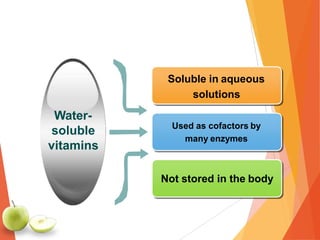
Used as cofactors by
many enzymes
Soluble in aqueous
solutions
Not stored in the body
Water-
soluble
vitamins
A
K
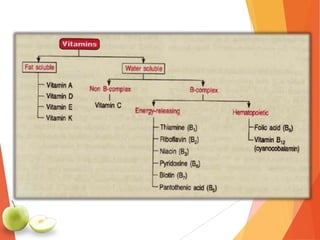
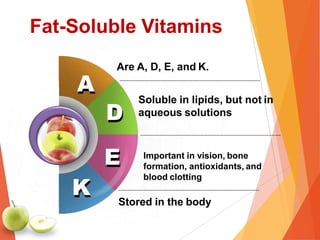
Are A, D, E, and K.
Soluble in lipids, but not in
aqueous solutions
Important in vision, bone
formation, antioxidants, and
blood clotting
D
E
Stored in the body
Fat-Soluble Vitamins
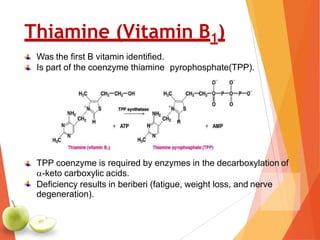
Thiamine (Vitamin B1)
Was the first B vitamin identified.
Is part of the coenzyme thiamine pyrophosphate(TPP).
TPP coenzyme is required by enzymes in the decarboxylation of
-keto carboxylic acids.
Deficiency results in beriberi (fatigue, weight loss, and nerve
degeneration).
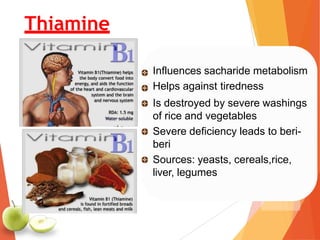
Influences sacharide metabolism
Helps against tiredness
Is destroyed by severe washings
of rice and vegetables
Severe deficiency leads to beri-
beri
Sources: yeasts, cereals,rice,
liver, legumes
Thiamine
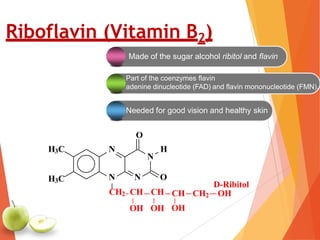
Riboflavin (Vitamin B2)
0
30%
55%
Made of the sugar alcohol ribitol and flavin
Part of the coenzymes flavin
adenine dinucleotide (FAD) and flavin mononucleotide (FMN).
N
N
H
H3C
H3C N N O
CH2 CH CH
OH OH
Needed for good vision and healthy skin
D
O
.Description of the contents
D-Ribitol
CH CH2 OH
OH
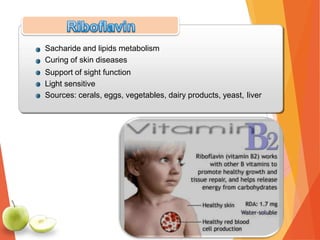
Sacharide and lipids metabolism
Curing of skin diseases
Support of sight function
Light sensitive
Sources: cerals, eggs, vegetables, dairy products, yeast, liver
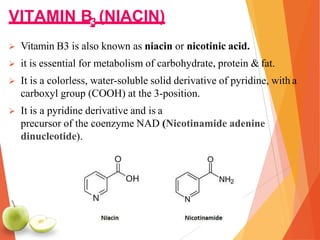
VITAMIN B3 (NIACIN)
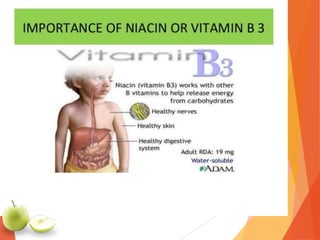
 Vitamin B3 is also known as niacin or nicotinic acid.
 it is essential for metabolism of carbohydrate, protein & fat.
 It is a colorless, water-soluble solid derivative of pyridine, with a
carboxyl group (COOH) at the 3-position.
 It is a pyridine derivative and is a
precursor of the coenzyme NAD (Nicotinamide adenine
dinucleotide).
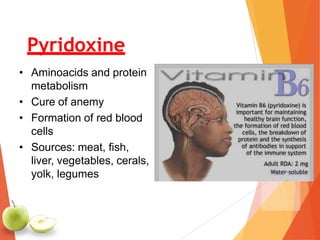
Pyridoxine
• Aminoacids and protein
metabolism
• Cure of anemy
• Formation of red blood
cells
• Sources: meat, fish,
liver, vegetables, cerals,
yolk, legumes
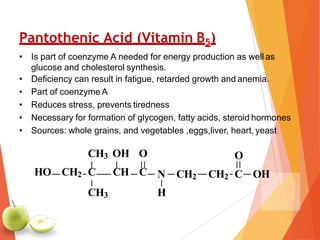
Pantothenic Acid (Vitamin B5)
• Is part of coenzyme A needed for energy production as well as
glucose and cholesterol synthesis.
• Deficiency can result in fatigue, retarded growth and anemia.
• Part of coenzyme A
• Reduces stress, prevents tiredness
• Necessary for formation of glycogen, fatty acids, steroid hormones
• Sources: whole grains, and vegetables ,eggs,liver, heart, yeast
O
N CH2 CH2 C OH
H
CH3 OH O
HO CH2 C CH C
CH3
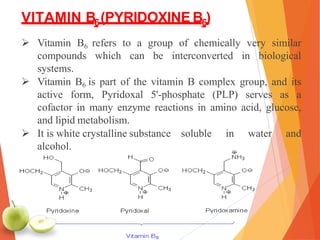
VITAMIN B6(PYRIDOXINE B6)
 Vitamin B6 refers to a group of chemically very similar
compounds which can be interconverted in biological
systems.
 Vitamin B6 is part of the vitamin B complex group, and its
active form, Pyridoxal 5'-phosphate (PLP) serves as a
cofactor in many enzyme reactions in amino acid, glucose,
and lipid metabolism.
 It is white crystalline substance soluble in water and
alcohol.
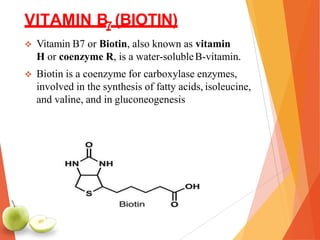
VITAMIN B7 (BIOTIN)
 Vitamin B7 or Biotin, also known as vitamin
H or coenzyme R, is a water-solubleB-vitamin.
 Biotin is a coenzyme for carboxylase enzymes,
involved in the synthesis of fatty acids, isoleucine,
and valine, and in gluconeogenesis
FUNCTIONS OF VITAMIN B7
sufficient intake of vitamin B7 (biotin) is important as it helps the body to-
•convert food into glucose, which is used to produce energy
•produce fatty acids and amino acids (the building blocks of protein)
•activate protein/amino acid metabolism in the hair roots and fingernail cells.
The European Food Safety Authority (EFSA), which provides scientific
advice to assist policy makers, has confirmed that clear health benefits have
been established for the dietary intake of biotin (vitamin B7) in contributing to:
•normal macronutrient metabolism;
•normal energy yielding metabolism;
•the maintenance of normal skin and mucous membranes;
•the normal function of the nervous system;
•the maintenance of normal hair;
•normal psychological functions.
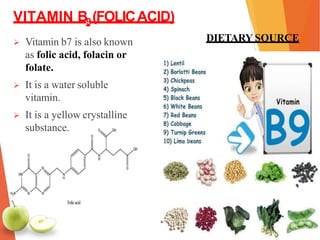
VITAMIN B9(FOLICACID)
 Vitamin b7 is also known
as folic acid, folacin or
folate.
 It is a water soluble
vitamin.
 It is a yellow crystalline
substance.
DIETARY SOURCE
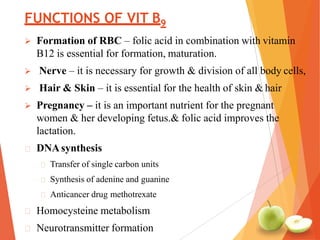
FUNCTIONS OF VIT B9
 Formation of RBC – folic acid in combination with vitamin
B12 is essential for formation, maturation.
 Nerve – it is necessary for growth & division of all body cells,
 Hair & Skin – it is essential for the health of skin & hair
 Pregnancy – it is an important nutrient for the pregnant
women & her developing fetus.& folic acid improves the
lactation.
 DNAsynthesis
 Transfer of single carbon units
 Synthesis of adenine and guanine
 Anticancer drug methotrexate
 Homocysteine metabolism
 Neurotransmitter formation
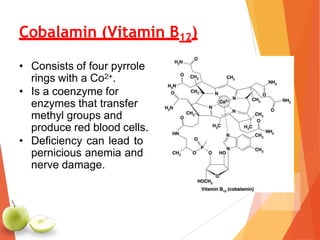
Cobalamin (Vitamin B12)
• Consists of four pyrrole
rings with a Co2+.
• Is a coenzyme for
enzymes that transfer
methyl groups and
produce red blood cells.
• Deficiency can lead to
pernicious anemia and
nerve damage.
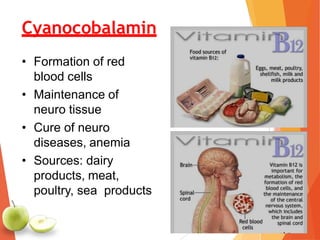
Cyanocobalamin
• Formation of red
blood cells
• Maintenance of
neuro tissue
• Cure of neuro
diseases, anemia
• Sources: dairy
products, meat,
poultry, sea products
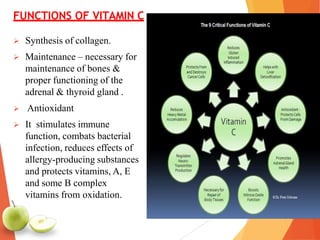
FUNCTIONS OF VITAMIN C
 Synthesis of collagen.
 Maintenance – necessary for
maintenance of bones &
proper functioning of the
adrenal & thyroid gland .
 Antioxidant
 It stimulates immune
function, combats bacterial
infection, reduces effects of
allergy-producing substances
and protects vitamins, A, E
and some B complex
vitamins from oxidation.
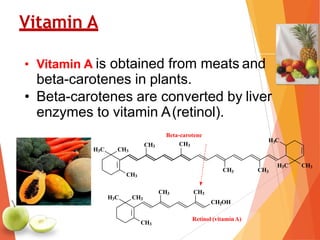
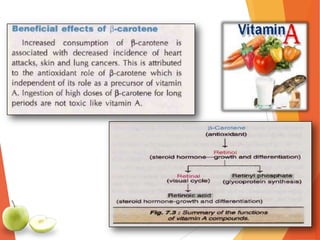
Vitamin A
• Vitamin A is obtained from meats and
beta-carotenes in plants.
• Beta-carotenes are converted by liver
enzymes to vitamin A(retinol).
H3C CH3
CH3
CH3
CH3 CH3
H3C CH3
3
H C
CH3 CH3
2
CH OH
H3C CH3
CH3
Beta-carotene
CH3
Retinol (vitaminA)
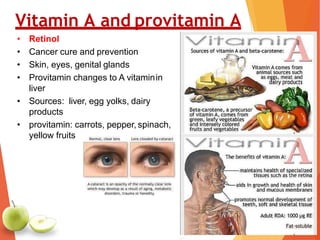
Vitamin A and provitamin A
• Retinol
• Cancer cure and prevention
• Skin, eyes, genital glands
• Provitamin changes to A vitaminin
liver
• Sources: liver, egg yolks, dairy
products
• provitamin: carrots, pepper, spinach,
yellow fruits
Vitamin D
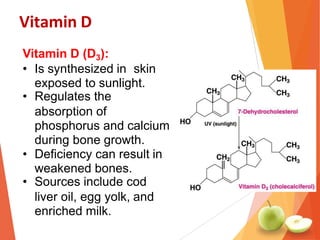
Vitamin D (D3):
• Is synthesized in skin
exposed to sunlight.
• Regulates the
absorption of
phosphorus and calcium
during bone growth.
• Deficiency can result in
weakened bones.
• Sources include cod
liver oil, egg yolk, and
enriched milk.
Vitamin D
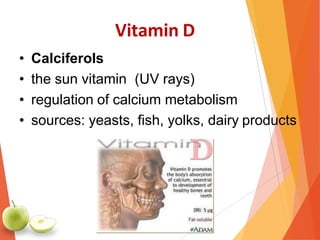
• Calciferols
• the sun vitamin (UV rays)
• regulation of calcium metabolism
• sources: yeasts, fish, yolks, dairy products
Vitamin E
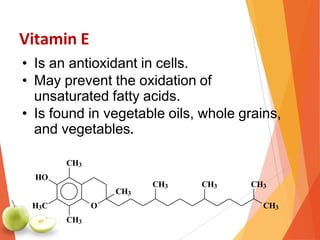
• Is an antioxidant in cells.
• May prevent the oxidation of
unsaturated fatty acids.
• Is found in vegetable oils, whole grains,
and vegetables.
O
CH3
HO
H3C
CH3
CH3
CH3
CH3 CH3 CH3
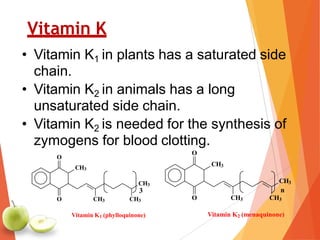
Vitamin K
• Vitamin K1 in plants has a saturated side
chain.
• Vitamin K2 in animals has a long
unsaturated side chain.
• Vitamin K2 is needed for the synthesis of
zymogens for blood clotting.
3
CH3
O
O CH3
CH3
n
CH3
Vitamin K2 (menaquinone)
CH3
CH3
O
O CH3 CH3
Vitamin K1 (phylloquinone)
vitamins.pdf

vitamins.pdf

  • 1.
    A PRESENTATION ON PresentedBy: Ramanjit Bhatti
  • 2.
    INTRODUCTION  The word"vitamin" comes from the Latin word “vita”, means "life".  Vitamins are organic components in food that are needed in very small amounts for growth and for maintaining good health.  Everybody must eat a certain amount of vitamins to stay healthy.  Vitamins are chemicals found in very small amounts in many different foods.
  • 4.
    Used as cofactorsby many enzymes Soluble in aqueous solutions Not stored in the body Water- soluble vitamins
  • 5.
    A K Are A, D,E, and K. Soluble in lipids, but not in aqueous solutions Important in vision, bone formation, antioxidants, and blood clotting D E Stored in the body Fat-Soluble Vitamins
  • 6.
    Thiamine (Vitamin B1) Wasthe first B vitamin identified. Is part of the coenzyme thiamine pyrophosphate(TPP). TPP coenzyme is required by enzymes in the decarboxylation of -keto carboxylic acids. Deficiency results in beriberi (fatigue, weight loss, and nerve degeneration).
  • 7.
    Influences sacharide metabolism Helpsagainst tiredness Is destroyed by severe washings of rice and vegetables Severe deficiency leads to beri- beri Sources: yeasts, cereals,rice, liver, legumes Thiamine
  • 8.
    Riboflavin (Vitamin B2) 0 30% 55% Madeof the sugar alcohol ribitol and flavin Part of the coenzymes flavin adenine dinucleotide (FAD) and flavin mononucleotide (FMN). N N H H3C H3C N N O CH2 CH CH OH OH Needed for good vision and healthy skin D O .Description of the contents D-Ribitol CH CH2 OH OH
  • 9.
    Sacharide and lipidsmetabolism Curing of skin diseases Support of sight function Light sensitive Sources: cerals, eggs, vegetables, dairy products, yeast, liver
  • 10.
    VITAMIN B3 (NIACIN) Vitamin B3 is also known as niacin or nicotinic acid.  it is essential for metabolism of carbohydrate, protein & fat.  It is a colorless, water-soluble solid derivative of pyridine, with a carboxyl group (COOH) at the 3-position.  It is a pyridine derivative and is a precursor of the coenzyme NAD (Nicotinamide adenine dinucleotide).
  • 12.
    Pyridoxine • Aminoacids andprotein metabolism • Cure of anemy • Formation of red blood cells • Sources: meat, fish, liver, vegetables, cerals, yolk, legumes
  • 13.
    Pantothenic Acid (VitaminB5) • Is part of coenzyme A needed for energy production as well as glucose and cholesterol synthesis. • Deficiency can result in fatigue, retarded growth and anemia. • Part of coenzyme A • Reduces stress, prevents tiredness • Necessary for formation of glycogen, fatty acids, steroid hormones • Sources: whole grains, and vegetables ,eggs,liver, heart, yeast O N CH2 CH2 C OH H CH3 OH O HO CH2 C CH C CH3
  • 14.
    VITAMIN B6(PYRIDOXINE B6) Vitamin B6 refers to a group of chemically very similar compounds which can be interconverted in biological systems.  Vitamin B6 is part of the vitamin B complex group, and its active form, Pyridoxal 5'-phosphate (PLP) serves as a cofactor in many enzyme reactions in amino acid, glucose, and lipid metabolism.  It is white crystalline substance soluble in water and alcohol.
  • 15.
    VITAMIN B7 (BIOTIN) Vitamin B7 or Biotin, also known as vitamin H or coenzyme R, is a water-solubleB-vitamin.  Biotin is a coenzyme for carboxylase enzymes, involved in the synthesis of fatty acids, isoleucine, and valine, and in gluconeogenesis
  • 16.
    FUNCTIONS OF VITAMINB7 sufficient intake of vitamin B7 (biotin) is important as it helps the body to- •convert food into glucose, which is used to produce energy •produce fatty acids and amino acids (the building blocks of protein) •activate protein/amino acid metabolism in the hair roots and fingernail cells. The European Food Safety Authority (EFSA), which provides scientific advice to assist policy makers, has confirmed that clear health benefits have been established for the dietary intake of biotin (vitamin B7) in contributing to: •normal macronutrient metabolism; •normal energy yielding metabolism; •the maintenance of normal skin and mucous membranes; •the normal function of the nervous system; •the maintenance of normal hair; •normal psychological functions.
  • 17.
    VITAMIN B9(FOLICACID)  Vitaminb7 is also known as folic acid, folacin or folate.  It is a water soluble vitamin.  It is a yellow crystalline substance. DIETARY SOURCE
  • 18.
    FUNCTIONS OF VITB9  Formation of RBC – folic acid in combination with vitamin B12 is essential for formation, maturation.  Nerve – it is necessary for growth & division of all body cells,  Hair & Skin – it is essential for the health of skin & hair  Pregnancy – it is an important nutrient for the pregnant women & her developing fetus.& folic acid improves the lactation.  DNAsynthesis  Transfer of single carbon units  Synthesis of adenine and guanine  Anticancer drug methotrexate  Homocysteine metabolism  Neurotransmitter formation
  • 19.
    Cobalamin (Vitamin B12) •Consists of four pyrrole rings with a Co2+. • Is a coenzyme for enzymes that transfer methyl groups and produce red blood cells. • Deficiency can lead to pernicious anemia and nerve damage.
  • 20.
    Cyanocobalamin • Formation ofred blood cells • Maintenance of neuro tissue • Cure of neuro diseases, anemia • Sources: dairy products, meat, poultry, sea products
  • 22.
    FUNCTIONS OF VITAMINC  Synthesis of collagen.  Maintenance – necessary for maintenance of bones & proper functioning of the adrenal & thyroid gland .  Antioxidant  It stimulates immune function, combats bacterial infection, reduces effects of allergy-producing substances and protects vitamins, A, E and some B complex vitamins from oxidation.
  • 23.
    Vitamin A • VitaminA is obtained from meats and beta-carotenes in plants. • Beta-carotenes are converted by liver enzymes to vitamin A(retinol). H3C CH3 CH3 CH3 CH3 CH3 H3C CH3 3 H C CH3 CH3 2 CH OH H3C CH3 CH3 Beta-carotene CH3 Retinol (vitaminA)
  • 24.
    Vitamin A andprovitamin A • Retinol • Cancer cure and prevention • Skin, eyes, genital glands • Provitamin changes to A vitaminin liver • Sources: liver, egg yolks, dairy products • provitamin: carrots, pepper, spinach, yellow fruits
  • 26.
    Vitamin D Vitamin D(D3): • Is synthesized in skin exposed to sunlight. • Regulates the absorption of phosphorus and calcium during bone growth. • Deficiency can result in weakened bones. • Sources include cod liver oil, egg yolk, and enriched milk.
  • 27.
    Vitamin D • Calciferols •the sun vitamin (UV rays) • regulation of calcium metabolism • sources: yeasts, fish, yolks, dairy products
  • 28.
    Vitamin E • Isan antioxidant in cells. • May prevent the oxidation of unsaturated fatty acids. • Is found in vegetable oils, whole grains, and vegetables. O CH3 HO H3C CH3 CH3 CH3 CH3 CH3 CH3
  • 29.
    Vitamin K • VitaminK1 in plants has a saturated side chain. • Vitamin K2 in animals has a long unsaturated side chain. • Vitamin K2 is needed for the synthesis of zymogens for blood clotting. 3 CH3 O O CH3 CH3 n CH3 Vitamin K2 (menaquinone) CH3 CH3 O O CH3 CH3 Vitamin K1 (phylloquinone)