Topic - Vitamins
Guided by :- Dr.
Ashok shakya sir
About vitamins
• What are vitamins?
- vitamins are essential nutrients required by our
body to maintain normal functions...
- they are not synthesized in our body but we must
obtain them from external source likes foods and
suppliments...
Classification
Fat soluble Water soluble
Stored in liver and fatty tissues.... Stored in limit amount in body and move
in blood...
Not excreted from body, thus their excess
cause toxicity....
Excreted from body through urine thus
they don't create toxicity
They include - vitamin A, D, E & K They include - vitamin B & C...
Sources:-
 animal fats
 vegetable oils
 dairy foods
 fish oils
Sources :-
 fruit & vegetables
 grains
 milk
 dairy foods
Fat soluble vitamins
Vitamin A ( Retinol )
Functions
• Vision :- generate RHODOPSIN pigment for
retina so that person can see in dim light &
maintain surface lining of eye.
• Bone growth
• Reproduction
• Cell division and differentiation
• Regulate immune system
RDA :- 700/900 mcg ( Women/men )
Deficiency :-
 Night blindness
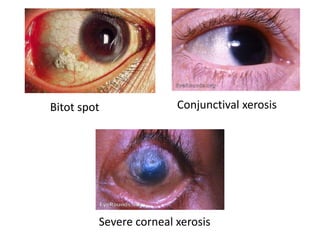
 Conjunctival xerosis
 Bitot spot
 Corneal xerosis
Plant source Animal source
Carrot
Broccoli
Sweet potato
Spinach
Pumpkin etc..
Egg
Meat
Milk
Cod liver oil
Fish liver oils
etc..
 Orange and yellow colour plants are rich in vitamin A .....
 BETA - CAROTENE ( precursor of Vit A ) is present in green
plants, act as antioxidants…
Bitot spot Conjunctival xerosis
Severe corneal xerosis
Cause of deficiency
malabsorption syndromes
mineral oil laxative abuse
malnutrition
Treatment of deficiency
Vitamin A suppliments
Toxicity :-
 scaly skin
 nausea
 diarrhea
 headache
 papilledema
 hepatosplenomegaly
Cracked fingernails
Vitamin D ( Calciferol )
Fuctions:-
• Maintain calcium & phosphate level
• Bone and teeth growth
• Regulate insulin level
• Influence expression of gene that are involved in
cancer development.
RDA :- 15 mcg
Deficiency:
Rickets
Osteomalacia
Osteoporosis
Sources:-
• Sunlight
• Food:- animal origin (
fatty fish like catfish &
salmon, liver, egg
yolk, butter, cheese )
 Our body make Vit D when exposed to
sunlight..
• vitamin D-3, found in
animal fats
• vitamin D-2, found in
plants, such as mushrooms
Rickets
Osteoporosis
Cause
malnutrition
fat malabsorption syndromes
decreased exposure to the sun
liver disease
chronic renal failure.
Treatment
 Vitamin D supplementation
 adequate sunlight exposure.
Toxicity
• hypercalcemia
• calcification of soft tissues
• kidney stones
• bone demineralization
Vitamin E ( Tocoferol)
Functions
• Antioxidant
• Immune booster
• Red blood cell maker
• Vasodilator
• Blood thinner
• Cell communication facilitator
• Gene expression coordinator
RDA :- 15 mg
Deficiency :-
 chronic pancreatitis
 cholestasis
 cystic fibrosis
Sources
• Wheat germ oil
• sunflower seeds and oil
• almonds
• hazelnuts
• peanuts
• spinach
• broccoli
• kiwi fruit
• mango
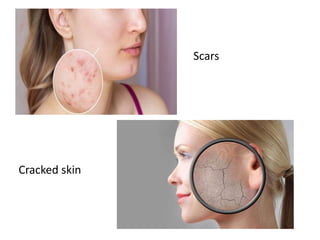
Scars
Cracked skin
Vitamin K ( Phytonadione )
Functions :-
 Blood clotting
 lower the risk of heart disease
 enhance bone health
 reduce the buildup of calcium in the blood
RDA :- 90/120 mcg ( women/men )
Deficiency :-
 bleeding
 poor bone development
 osteoporosis
 increased risk of cardiovascular disease...
Sources
 kale
 liver
 spinach
 parsley
 butter
 egg yolks
 Vitamin K-1 (phylloquinone),
present in green, leafy
vegetables and some other
plant sources
 Vitamin K-2 (menaquinones),
present in animal sources and
fermented foods
Water soluble vitamins
Vitamin B complex
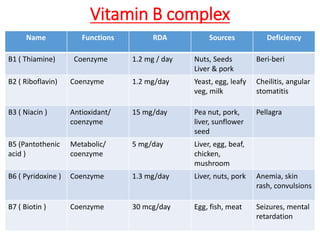
Name Functions RDA Sources Deficiency
B1 ( Thiamine) Coenzyme 1.2 mg / day Nuts, Seeds
Liver & pork
Beri-beri
B2 ( Riboflavin) Coenzyme 1.2 mg/day Yeast, egg, leafy
veg, milk
Cheilitis, angular
stomatitis
B3 ( Niacin ) Antioxidant/
coenzyme
15 mg/day Pea nut, pork,
liver, sunflower
seed
Pellagra
B5 (Pantothenic
acid )
Metabolic/
coenzyme
5 mg/day Liver, egg, beaf,
chicken,
mushroom
B6 ( Pyridoxine ) Coenzyme 1.3 mg/day Liver, nuts, pork Anemia, skin
rash, convulsions
B7 ( Biotin ) Coenzyme 30 mcg/day Egg, fish, meat Seizures, mental
retardation
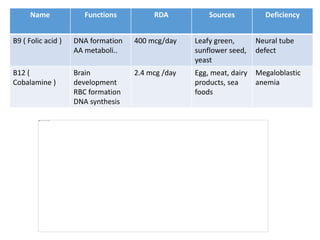
Name Functions RDA Sources Deficiency
B9 ( Folic acid ) DNA formation
AA metaboli..
400 mcg/day Leafy green,
sunflower seed,
yeast
Neural tube
defect
B12 (
Cobalamine )
Brain
development
RBC formation
DNA synthesis
2.4 mcg /day Egg, meat, dairy
products, sea
foods
Megaloblastic
anemia
Vitamin C ( Ascorbic acid )
Functions
 Antioxidant defenses
 Collagen formation
 Immune function
RDA :- 120 mcg/day
Deficiency :- scurvy
Toxicity :- when >3g
• diarrhea
• nausea
• abdominal cramps
Sources
 Citrus (oranges, kiwi, lemon,
grapefruit)
 Bell peppers.
 Strawberries.
 Tomatoes.
 Cruciferous vegetables
(broccoli, Brussels sprouts,
cabbage, cauliflower)
 White potatoes.
Bleeding gums
vitamin ppt.pptx
vitamin ppt.pptx

vitamin ppt.pptx

  • 1.
    Topic - Vitamins Guidedby :- Dr. Ashok shakya sir
  • 2.
    About vitamins • Whatare vitamins? - vitamins are essential nutrients required by our body to maintain normal functions... - they are not synthesized in our body but we must obtain them from external source likes foods and suppliments...
  • 3.
    Classification Fat soluble Watersoluble Stored in liver and fatty tissues.... Stored in limit amount in body and move in blood... Not excreted from body, thus their excess cause toxicity.... Excreted from body through urine thus they don't create toxicity They include - vitamin A, D, E & K They include - vitamin B & C... Sources:-  animal fats  vegetable oils  dairy foods  fish oils Sources :-  fruit & vegetables  grains  milk  dairy foods
  • 4.
  • 5.
    Vitamin A (Retinol ) Functions • Vision :- generate RHODOPSIN pigment for retina so that person can see in dim light & maintain surface lining of eye. • Bone growth • Reproduction • Cell division and differentiation • Regulate immune system RDA :- 700/900 mcg ( Women/men ) Deficiency :-  Night blindness  Conjunctival xerosis  Bitot spot  Corneal xerosis Plant source Animal source Carrot Broccoli Sweet potato Spinach Pumpkin etc.. Egg Meat Milk Cod liver oil Fish liver oils etc..  Orange and yellow colour plants are rich in vitamin A .....  BETA - CAROTENE ( precursor of Vit A ) is present in green plants, act as antioxidants…
  • 6.
    Bitot spot Conjunctivalxerosis Severe corneal xerosis
  • 7.
    Cause of deficiency malabsorptionsyndromes mineral oil laxative abuse malnutrition Treatment of deficiency Vitamin A suppliments Toxicity :-  scaly skin  nausea  diarrhea  headache  papilledema  hepatosplenomegaly Cracked fingernails
  • 8.
    Vitamin D (Calciferol ) Fuctions:- • Maintain calcium & phosphate level • Bone and teeth growth • Regulate insulin level • Influence expression of gene that are involved in cancer development. RDA :- 15 mcg Deficiency: Rickets Osteomalacia Osteoporosis Sources:- • Sunlight • Food:- animal origin ( fatty fish like catfish & salmon, liver, egg yolk, butter, cheese )  Our body make Vit D when exposed to sunlight.. • vitamin D-3, found in animal fats • vitamin D-2, found in plants, such as mushrooms
  • 9.
  • 10.
    Cause malnutrition fat malabsorption syndromes decreasedexposure to the sun liver disease chronic renal failure. Treatment  Vitamin D supplementation  adequate sunlight exposure. Toxicity • hypercalcemia • calcification of soft tissues • kidney stones • bone demineralization
  • 11.
    Vitamin E (Tocoferol) Functions • Antioxidant • Immune booster • Red blood cell maker • Vasodilator • Blood thinner • Cell communication facilitator • Gene expression coordinator RDA :- 15 mg Deficiency :-  chronic pancreatitis  cholestasis  cystic fibrosis Sources • Wheat germ oil • sunflower seeds and oil • almonds • hazelnuts • peanuts • spinach • broccoli • kiwi fruit • mango
  • 12.
  • 13.
    Vitamin K (Phytonadione ) Functions :-  Blood clotting  lower the risk of heart disease  enhance bone health  reduce the buildup of calcium in the blood RDA :- 90/120 mcg ( women/men ) Deficiency :-  bleeding  poor bone development  osteoporosis  increased risk of cardiovascular disease... Sources  kale  liver  spinach  parsley  butter  egg yolks  Vitamin K-1 (phylloquinone), present in green, leafy vegetables and some other plant sources  Vitamin K-2 (menaquinones), present in animal sources and fermented foods
  • 14.
  • 15.
    Vitamin B complex NameFunctions RDA Sources Deficiency B1 ( Thiamine) Coenzyme 1.2 mg / day Nuts, Seeds Liver & pork Beri-beri B2 ( Riboflavin) Coenzyme 1.2 mg/day Yeast, egg, leafy veg, milk Cheilitis, angular stomatitis B3 ( Niacin ) Antioxidant/ coenzyme 15 mg/day Pea nut, pork, liver, sunflower seed Pellagra B5 (Pantothenic acid ) Metabolic/ coenzyme 5 mg/day Liver, egg, beaf, chicken, mushroom B6 ( Pyridoxine ) Coenzyme 1.3 mg/day Liver, nuts, pork Anemia, skin rash, convulsions B7 ( Biotin ) Coenzyme 30 mcg/day Egg, fish, meat Seizures, mental retardation
  • 16.
    Name Functions RDASources Deficiency B9 ( Folic acid ) DNA formation AA metaboli.. 400 mcg/day Leafy green, sunflower seed, yeast Neural tube defect B12 ( Cobalamine ) Brain development RBC formation DNA synthesis 2.4 mcg /day Egg, meat, dairy products, sea foods Megaloblastic anemia
  • 17.
    Vitamin C (Ascorbic acid ) Functions  Antioxidant defenses  Collagen formation  Immune function RDA :- 120 mcg/day Deficiency :- scurvy Toxicity :- when >3g • diarrhea • nausea • abdominal cramps Sources  Citrus (oranges, kiwi, lemon, grapefruit)  Bell peppers.  Strawberries.  Tomatoes.  Cruciferous vegetables (broccoli, Brussels sprouts, cabbage, cauliflower)  White potatoes.
  • 18.