Vitamin C and common cold
Done by:
Eman AL-Zawwad
Common cold
 What Is common cold?
The common cold is viral infections a group of symptoms in the upper
respiratory tract caused by a large number of different viruses.
 Symptoms:
A tickling in the nose , frequent sneezing, chills and runny nose, a
scratchy throat, fatigue, a light headache and lots of thick mucus.
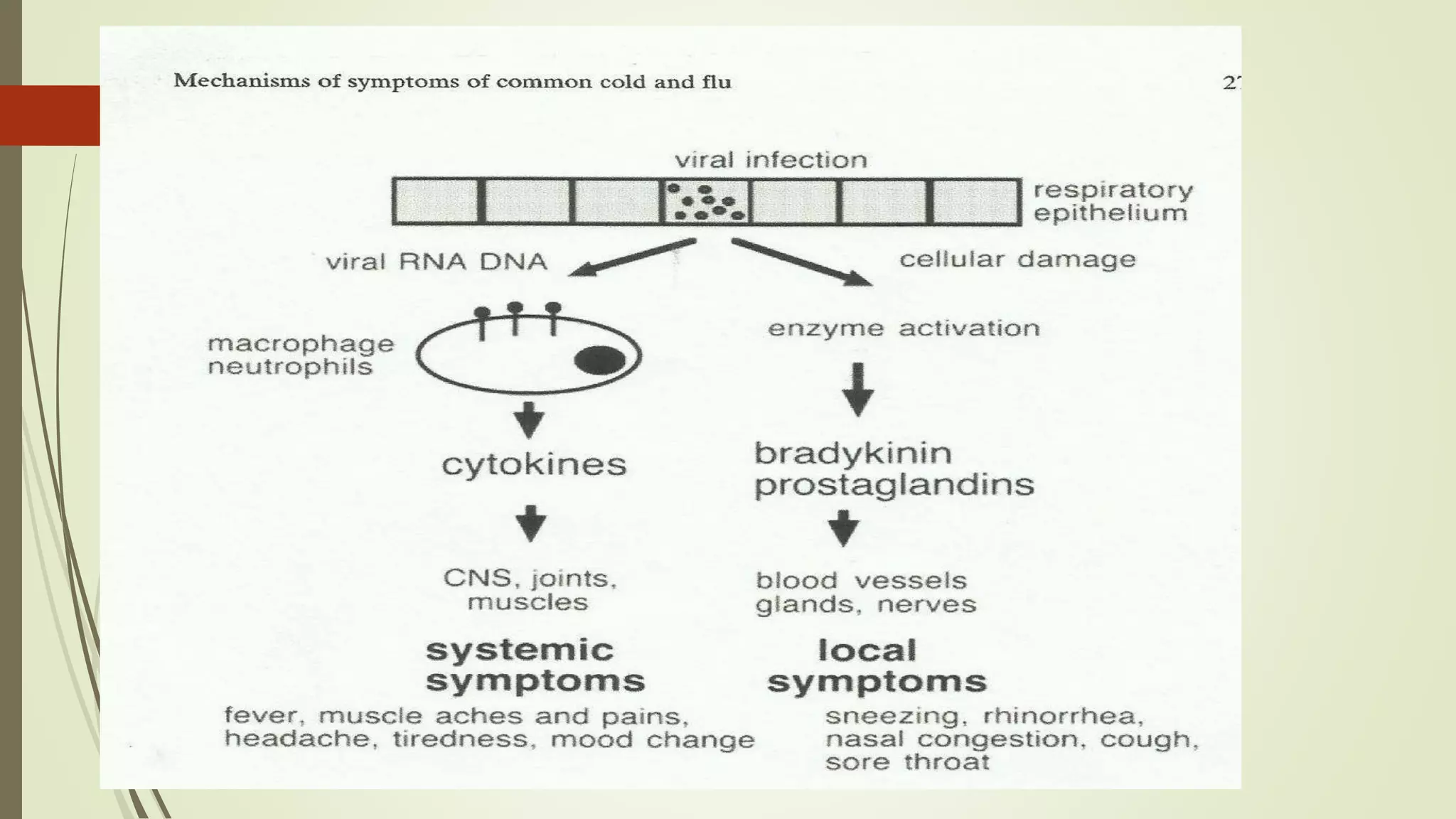
Mechanism of symptoms of common cold.
 First- Mechanism that cause local symptoms associated with local
inflammation of the airway (sore throat, sneezing, rhinorrhea, nasal
congestion, sinus pain, watery eyes and cough).
 Second- Mechanism that cause systemic symptoms associated with
release of cytokines from leukocytes (headache, chilliness, fever,
psychological effects, mood changes, loss of appetite and muscle aches
and pains)
 Picture
Causes:
 More than 200 different viruses are known to cause the common cold.
The most common cold viruses include:
 Rhinoviruses :
Causing 60% - 80% of the adult patients with common cold (most active in
early fall, spring and winter)
 Respiratory syncytial viruses:
The World Health Organization estimates that RSV causes 64 million
infections and 160 000 deaths annually. It affects mostly infants and
children
Responsible for 10% of colds (most active in winter and early spring)
 Para-influenza viruses:
Affect infants, most children by 5 years of ages
Transmission of these viruses:
 Direct contact human to human, hand to mouth, hand to eyes
 Aerosols
 Contaminated surface
Prevention
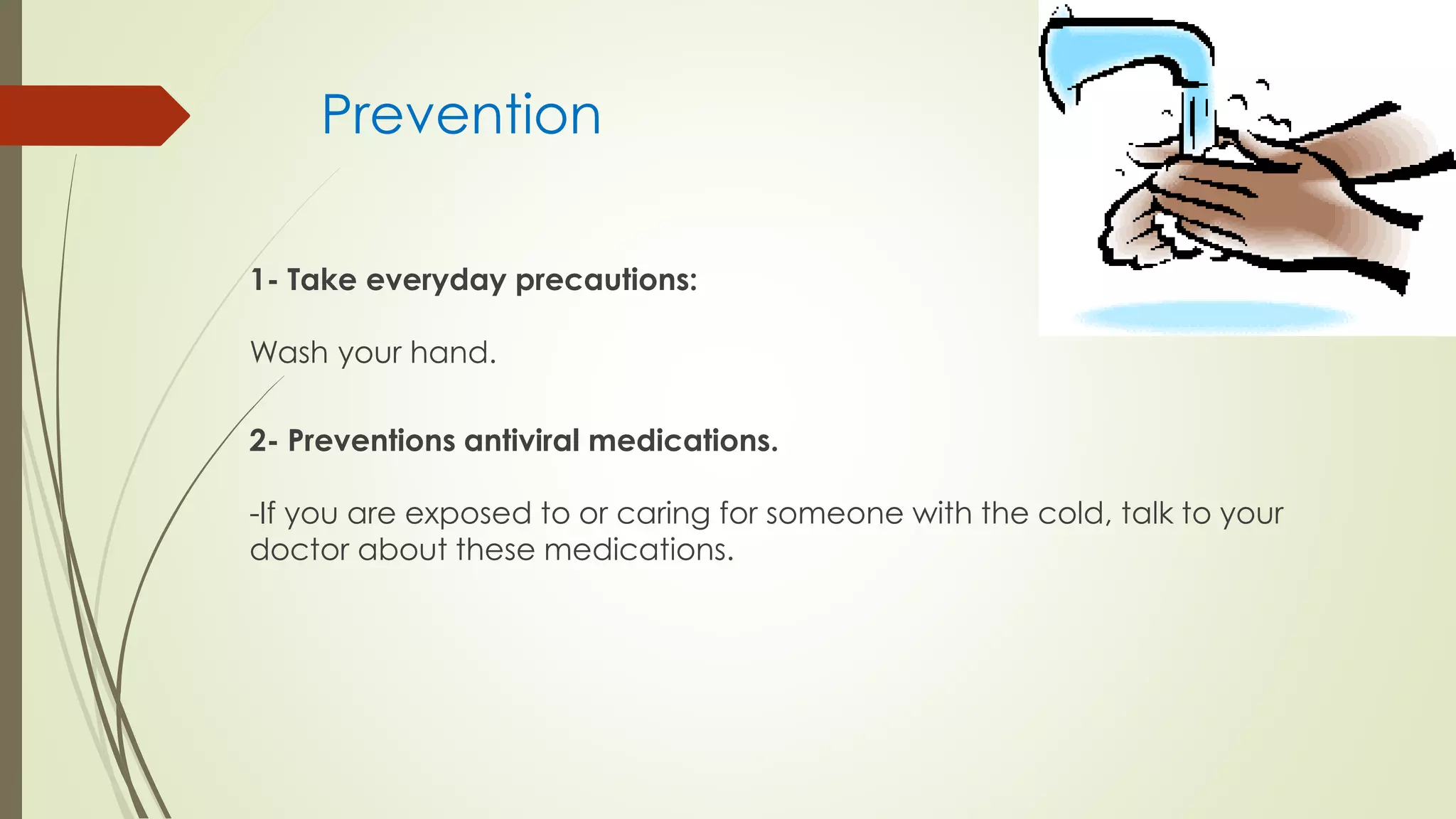
1- Take everyday precautions:
Wash your hand.
2- Preventions antiviral medications.
-If you are exposed to or caring for someone with the cold, talk to your
doctor about these medications.
Treatment:
 Symptomatic treatment if it caused by Rhinoviruses and para-
influenza viruses (Over-the-counter medications may relieve some
cold symptoms)
 antibiotics?
 Antibiotics are used to treat bacterial infections. Antibiotics are not
effective against viral infections like the cold. However, prolonged
illness or illness that seems to get better but then gets worse might
be a sign of bacterial infection or allergy . Therefore, you need to
talk to your doctor if you believe that you need antibiotics.
Is there any way to treat the cold or its
symptoms without medication?
 Vitamin C supplementation
Vitamin c
 It is an essential water-solube vitamin.
 known as Ascorbic acid and Dehydroascorbic acid
 Most animals are able to synthesize vitamin c
 However; Human, other primates, guinea pigs, fruit bats,
few birds and fish are unable to synthesize it
 Because human are missing L-gulonolactone oxidase
enzyme , they can’t .
Functions
 Antioxidant capability ‘’ destroy superoxide radicals &
other free radicals before they damage DNA & lipids –
regenerate active antioxidant from vitamin E-
 Reducing agent ‘’ donate electrons to metal ions such as
ferric iron(Fe+3) and facilitate its absorption in the GI tract.
 Synthesis of neurotransmitters, collagen, carnitine &
tyrosine
 Enhancement of immune system
Mechanism
 The mechanisms whereby vitamin C affects the immune system
are poorly understood. It affects functions of phagocytes,
proliferation of T lymphocytes, production of interferon and gene
expression of monocyte adhesion molecules.
 A number of studies have found that vitamin C levels are
decreased in plasma, leucocytes and in urine during various
infections, including the common cold and pneumonia.
 These findings support the notion that oxidants generated during
infections react with vitamin C, and the vitamin could thereby
protect the host against the potential harm done by the oxidants.
(Harri Hemila, 2003)
Vitamin c deficiency
 Scurvy
 Impaired wound healing
 Skin hemorrhages
 Gum lesions
RDA
 Men: 90 mg/day
 Women: 75 mg/day
 Smokers need an additional 35 mg/ day
Study 1
Title: Summary of ‘Vitamin C for preventing and treating the common cold.
Author: Andrea Milne.
Evid.-Based Child Health, a Cochrane review journal, Published in this issue of
EBCH,2008.
Objectives:
The purpose was to determine whether oral doses of 0.2 g/day or more of
vitamin C reduces the incidence, duration, or severity of the common cold
when used either as continuous prophylaxis, or after the onset of symptoms
Method
 Researchers evaluated two groups:
 Treatment group and placebo group (vitamin C of at least 0.2
g/day vs a placebo)
 participants of any age or gender.
 They measure:
1- Incidence of colds: was the proportion of participants
experiencing one or more colds during the study period.
2- Duration : was the mean number of days of illness.
3- Severity was assessed as: 1) days confined indoors, or off work,
or off school per episode and; 2) symptom severity scores.
Results
 1- Effect on Common Cold Incidence
No convincing reduction in common cold incidence in prophylaxis
trials was found. However, when researchers include marathon
runners, skiers and soldiers, they found significant benefit from vitamin
C supplementation. Also, Researchers stated that vitamin C was an
essential nutrient and all trial participants had regular intake of this
substance at some level.
Results
 2-Effect on Common Cold Duration and Severity – Prophylaxis Trials.
 In patients of all ages, regular vitamin C supplementation resulted in a statistically
significant reduction in the duration of respiratory episodes that occurred during the
prophylactic supplementation period. Estimates suggested that long-term
supplementation might result in an average reduction of annual common cold
morbidity from 12 to 11 days per year for adults. For children 12 years or younger,
they may experience an average reduction of 28 to 24 days per year. Regular
vitamin C prophylaxis also led to some decrease in severity when measured as days
indoors, but the effect was ambiguous on severity scales.
Results
 3- Effect on Common Cold Duration and Severity – Therapeutic Trials.
Participants who took a 3-day supplementation schedule or less found no effect.
Whereas, participants who took at least 5 days of vitamin C supplementation found
a reduction in ‘days spent in doors per subject by 25% and found that colds were
0.73 days shorter.
 strength of the study:
Samples were from different age and gender.
Conclusion
 None of the trials that reported on adverse effects found
evidence that vitamin C might be harmful in the doses that
were tested
 Regular vitamin C supplementation reduces duration and
severity of common cold during the prophylactic
supplementation period and therapeutic period for ordinary
population, however , it doesn’t decrease incidence.
 Vitamin c decreases incidence for people under sever acute
physical stress.
Study 2
 Title: The Effectiveness of Vitamin C in Preventing and Relieving the Symptoms of
Virus-induced Respiratory Infections
 Authors: H. Clay Gorton, and Kelly Jarvis
 Journal of Manipulative and Physiological Therapeutics,JMPT,1999
 Objective:
To study the effect of mega-dose Vitamin C in preventing and relieving cold and flu
symptoms in a test group compared with a control group.
Method
Subjects:
control group : 463 students ranging in age from 18 to 32 years .
Experimental or test group: 252 students ranging in age from 18 to 30 years.
Method:
Researchers tracked the number of reports of cold and flu symptoms
among the 1991 test population and compared it with the reports of like
symptoms among the 1990 control population. Participants in the control
population reporting symptoms were treated with pain relievers and
decongestants, however; those in the test population reporting symptoms
were treated with hourly doses of 1000 mg of Vitamin C for the first 6 hours and
then 3 times daily. Also, those not reporting symptoms in the test group were
also administered 1000-mg doses 3 times daily.
Results:
The reported flu and cold symptoms in the test group decreased 85%
compared with the control group after the administration of megados
Vitamin C.
 Limitation:
No children was included in both studies.
 Strength:
Large sample size
Conclusion:
Vitamin C in mega-doses administered before or after the appearance of
cold and flu symptoms relieved and prevented the symptoms in the test
population compared with the Control group.
Relevance to the field(s) of nutrition and
exercise science
 Vitamin C enhances immune system to decrease symptoms
of common cold
 Vitamin C deceases incidence of cold in people who are
under acute physical stress.
Conclusions:
 Regular vitamin C supplementation reduces duration and
severity of common cold during the prophylactic
supplementation period and therapeutic period for ordinary
population, however , it doesn’t decrease incidence.
 Vitamin c decreases incidence for people under sever acute
physical stress.
 Vitamin C in mega-doses before or after the appearance of
cold helps in reliving cold symptoms.
References
 Bredbenner, C., Moe, G., Beshgetoor, D., & Berning, J. (2009). Wardlaw's
perspectives in nutrition (8th ed). Dubuque, IA: McGraw-Hill.
 Mechanisms of symptoms of common cold and flu. (2009). In R. Eccles & O.
Weber (Eds.),Common cold (pp. 23-45). Basel: Birkhäuser.
 Milne, A. (2008). Summary of ‘Vitamin C for preventing and treating the
common cold’. EVIDENCE-BASED CHILD HEALTH: A COCHRANE REVIEW
JOURNAL, 3(3), 721-722.
 Gorton, H., & Jarvis, K. (1999). The effectiveness of vitamin C in
preventing and relieving the symptoms of virus-induced respiratory
infections. Journal of Manipulative and Physiological Therapeutics, 22(8),
530-533.
Vitamin c and Common Cold (1)

Vitamin c and Common Cold (1)

  • 1.
    Vitamin C andcommon cold Done by: Eman AL-Zawwad
  • 2.
    Common cold  WhatIs common cold? The common cold is viral infections a group of symptoms in the upper respiratory tract caused by a large number of different viruses.  Symptoms: A tickling in the nose , frequent sneezing, chills and runny nose, a scratchy throat, fatigue, a light headache and lots of thick mucus.
  • 3.
    Mechanism of symptomsof common cold.  First- Mechanism that cause local symptoms associated with local inflammation of the airway (sore throat, sneezing, rhinorrhea, nasal congestion, sinus pain, watery eyes and cough).  Second- Mechanism that cause systemic symptoms associated with release of cytokines from leukocytes (headache, chilliness, fever, psychological effects, mood changes, loss of appetite and muscle aches and pains)
  • 4.
  • 5.
    Causes:  More than200 different viruses are known to cause the common cold. The most common cold viruses include:  Rhinoviruses : Causing 60% - 80% of the adult patients with common cold (most active in early fall, spring and winter)  Respiratory syncytial viruses: The World Health Organization estimates that RSV causes 64 million infections and 160 000 deaths annually. It affects mostly infants and children Responsible for 10% of colds (most active in winter and early spring)  Para-influenza viruses: Affect infants, most children by 5 years of ages
  • 6.
    Transmission of theseviruses:  Direct contact human to human, hand to mouth, hand to eyes  Aerosols  Contaminated surface
  • 7.
    Prevention 1- Take everydayprecautions: Wash your hand. 2- Preventions antiviral medications. -If you are exposed to or caring for someone with the cold, talk to your doctor about these medications.
  • 8.
    Treatment:  Symptomatic treatmentif it caused by Rhinoviruses and para- influenza viruses (Over-the-counter medications may relieve some cold symptoms)  antibiotics?  Antibiotics are used to treat bacterial infections. Antibiotics are not effective against viral infections like the cold. However, prolonged illness or illness that seems to get better but then gets worse might be a sign of bacterial infection or allergy . Therefore, you need to talk to your doctor if you believe that you need antibiotics.
  • 9.
    Is there anyway to treat the cold or its symptoms without medication?  Vitamin C supplementation
  • 10.
    Vitamin c  Itis an essential water-solube vitamin.  known as Ascorbic acid and Dehydroascorbic acid  Most animals are able to synthesize vitamin c  However; Human, other primates, guinea pigs, fruit bats, few birds and fish are unable to synthesize it  Because human are missing L-gulonolactone oxidase enzyme , they can’t .
  • 11.
    Functions  Antioxidant capability‘’ destroy superoxide radicals & other free radicals before they damage DNA & lipids – regenerate active antioxidant from vitamin E-  Reducing agent ‘’ donate electrons to metal ions such as ferric iron(Fe+3) and facilitate its absorption in the GI tract.  Synthesis of neurotransmitters, collagen, carnitine & tyrosine  Enhancement of immune system
  • 12.
    Mechanism  The mechanismswhereby vitamin C affects the immune system are poorly understood. It affects functions of phagocytes, proliferation of T lymphocytes, production of interferon and gene expression of monocyte adhesion molecules.  A number of studies have found that vitamin C levels are decreased in plasma, leucocytes and in urine during various infections, including the common cold and pneumonia.  These findings support the notion that oxidants generated during infections react with vitamin C, and the vitamin could thereby protect the host against the potential harm done by the oxidants. (Harri Hemila, 2003)
  • 13.
    Vitamin c deficiency Scurvy  Impaired wound healing  Skin hemorrhages  Gum lesions
  • 14.
    RDA  Men: 90mg/day  Women: 75 mg/day  Smokers need an additional 35 mg/ day
  • 15.
    Study 1 Title: Summaryof ‘Vitamin C for preventing and treating the common cold. Author: Andrea Milne. Evid.-Based Child Health, a Cochrane review journal, Published in this issue of EBCH,2008. Objectives: The purpose was to determine whether oral doses of 0.2 g/day or more of vitamin C reduces the incidence, duration, or severity of the common cold when used either as continuous prophylaxis, or after the onset of symptoms
  • 16.
    Method  Researchers evaluatedtwo groups:  Treatment group and placebo group (vitamin C of at least 0.2 g/day vs a placebo)  participants of any age or gender.  They measure: 1- Incidence of colds: was the proportion of participants experiencing one or more colds during the study period. 2- Duration : was the mean number of days of illness. 3- Severity was assessed as: 1) days confined indoors, or off work, or off school per episode and; 2) symptom severity scores.
  • 17.
    Results  1- Effecton Common Cold Incidence No convincing reduction in common cold incidence in prophylaxis trials was found. However, when researchers include marathon runners, skiers and soldiers, they found significant benefit from vitamin C supplementation. Also, Researchers stated that vitamin C was an essential nutrient and all trial participants had regular intake of this substance at some level.
  • 18.
    Results  2-Effect onCommon Cold Duration and Severity – Prophylaxis Trials.  In patients of all ages, regular vitamin C supplementation resulted in a statistically significant reduction in the duration of respiratory episodes that occurred during the prophylactic supplementation period. Estimates suggested that long-term supplementation might result in an average reduction of annual common cold morbidity from 12 to 11 days per year for adults. For children 12 years or younger, they may experience an average reduction of 28 to 24 days per year. Regular vitamin C prophylaxis also led to some decrease in severity when measured as days indoors, but the effect was ambiguous on severity scales.
  • 19.
    Results  3- Effecton Common Cold Duration and Severity – Therapeutic Trials. Participants who took a 3-day supplementation schedule or less found no effect. Whereas, participants who took at least 5 days of vitamin C supplementation found a reduction in ‘days spent in doors per subject by 25% and found that colds were 0.73 days shorter.  strength of the study: Samples were from different age and gender.
  • 20.
    Conclusion  None ofthe trials that reported on adverse effects found evidence that vitamin C might be harmful in the doses that were tested  Regular vitamin C supplementation reduces duration and severity of common cold during the prophylactic supplementation period and therapeutic period for ordinary population, however , it doesn’t decrease incidence.  Vitamin c decreases incidence for people under sever acute physical stress.
  • 21.
    Study 2  Title:The Effectiveness of Vitamin C in Preventing and Relieving the Symptoms of Virus-induced Respiratory Infections  Authors: H. Clay Gorton, and Kelly Jarvis  Journal of Manipulative and Physiological Therapeutics,JMPT,1999  Objective: To study the effect of mega-dose Vitamin C in preventing and relieving cold and flu symptoms in a test group compared with a control group.
  • 22.
    Method Subjects: control group :463 students ranging in age from 18 to 32 years . Experimental or test group: 252 students ranging in age from 18 to 30 years. Method: Researchers tracked the number of reports of cold and flu symptoms among the 1991 test population and compared it with the reports of like symptoms among the 1990 control population. Participants in the control population reporting symptoms were treated with pain relievers and decongestants, however; those in the test population reporting symptoms were treated with hourly doses of 1000 mg of Vitamin C for the first 6 hours and then 3 times daily. Also, those not reporting symptoms in the test group were also administered 1000-mg doses 3 times daily.
  • 23.
    Results: The reported fluand cold symptoms in the test group decreased 85% compared with the control group after the administration of megados Vitamin C.
  • 24.
     Limitation: No childrenwas included in both studies.  Strength: Large sample size
  • 25.
    Conclusion: Vitamin C inmega-doses administered before or after the appearance of cold and flu symptoms relieved and prevented the symptoms in the test population compared with the Control group.
  • 26.
    Relevance to thefield(s) of nutrition and exercise science  Vitamin C enhances immune system to decrease symptoms of common cold  Vitamin C deceases incidence of cold in people who are under acute physical stress.
  • 27.
    Conclusions:  Regular vitaminC supplementation reduces duration and severity of common cold during the prophylactic supplementation period and therapeutic period for ordinary population, however , it doesn’t decrease incidence.  Vitamin c decreases incidence for people under sever acute physical stress.  Vitamin C in mega-doses before or after the appearance of cold helps in reliving cold symptoms.
  • 28.
    References  Bredbenner, C.,Moe, G., Beshgetoor, D., & Berning, J. (2009). Wardlaw's perspectives in nutrition (8th ed). Dubuque, IA: McGraw-Hill.  Mechanisms of symptoms of common cold and flu. (2009). In R. Eccles & O. Weber (Eds.),Common cold (pp. 23-45). Basel: Birkhäuser.  Milne, A. (2008). Summary of ‘Vitamin C for preventing and treating the common cold’. EVIDENCE-BASED CHILD HEALTH: A COCHRANE REVIEW JOURNAL, 3(3), 721-722.  Gorton, H., & Jarvis, K. (1999). The effectiveness of vitamin C in preventing and relieving the symptoms of virus-induced respiratory infections. Journal of Manipulative and Physiological Therapeutics, 22(8), 530-533.