Made by : Group From 464 to 469
Under the Supervision of : Dr. Remon
Rafat
Made by :
Rowana Amr Mahmoud El Kassar
467
• The “common cold” is the most prevalent
disease affecting humans and is defined
by the expression of symptoms/signs
(primarily nasal, nasopharyngeal).
• Although they are typically considered to
be self-limiting and of short duration, these
infections in the young, elderly, and
immunocompromised can have significant
complications, with high morbidity and
excess mortality
• Consistent with an underlying virus
infection:
• The occurrence of the common cold shows clear
seasonality. In temperate regions of the northern
hemisphere, the frequency of respiratory infections
increases rapidly in the autumn, remains fairly high
throughout the winter, and decreases again in the spring.
• In tropical areas, most colds arise during the rainy
season.
• The incidence of upper respiratory infections is inversely
proportional to age.
• On average, the youngest children have 6–8 and adults
2–4 colds per year.
Climate
Immune
Status
Nutrition and
Vit.Deficiency
Nasal
Obstruction
Chronic
Infection
Virology :
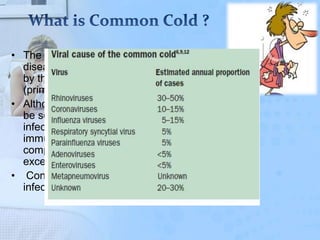
Rhinoviruses is described as being responsible for 50-60% of
acute viral upper respiratory illnesses and coronavirus for
about 10-20% .
More than 100 serotypes, strains and isolates of RV have been
isolated from humans. Two human RV species have been
described: Human rhinovirus(HRV) A and B. Eighteen serotypes and
2 subtypes (HRV 1A and 1B) belong to HRV A. Five serotypes are
assigned to HRV B and 82
serotypes are not yet assigned to a species including bovine
rhinoviruses (BRV) 1–3.
Rhinoviruses (RV) are
members of the order
Picornavirales, family
Picornaviridae, genus:
Enterovirus.
RV are non-enveloped
viruses with an icosahedral
symmetry. The virus is small
and has a diameter of
approximately 30 nm. Four
capsid proteins, VP1–4 have
been described
• In talking , sneezing and coughing
innumerable infected droplets are
sprayed out which fall to the ground
at distances of 0.9-0.8m
Droplet and
Dust
• Droplet nuclie are small droplets which
evaporate as they fall and shrink to less
than 0.1mm in diameter.
• In this form they remain suspended in the
air as mist and drift on the air currents for
as long a 2 days.
Droplet
Nuclie :
• Kissing , touching Contminated
Objects.
Contact :
Virus
Edema and
Hyperemia of
CT
Infiltration of
inflammatory
cells
Cytokines as:
IL-6 and
Bradykinin
Systemic and
Local
Sympyoms
Antibodies :
IgA
Prevent
Reinfection
and reduce
Symptoms
The course of a cold may be described in
four stages :
After a short incubation period of 1–4 days
Prodromal
Stage
Early
reaction
and
Irritation
Venous
Stasis and
Secondary
infection
Resolution
 The cranial nerves that supply
sensory nerves to the nose and throat
such as the maxillary and ophthalmic
divisions of the trigeminal nerves are
important pathways for generating
the symptoms of URTI , whereas the
airways below the larynx are
innervated by the vagus nerves
that mediate cough.
Nasal
discharge
and
obstruction
Sneezing Coughing
Sore
Throat
:
• Nasopharyngitis and pharyngitis
• Sinusitis
• Otitis media and mastoditis
• Lymphadenitis
• Tonsillitis
• Lower respiratory complications : bronchitis ,
pneumonia and asthma.
• Gastroenteritis : is rarer except in infants.
Made by :
Roweina Tarek Mohamed
469
Common Cold Flu
1) Etiology Self-limited syndrome
Mild upper respiratory viral
illness
caused by:
Rhinovirus (50%)
Coronavirus (15%)
Adenovirus, enterovirus,
Parainfluenza (15%)
A contagious, viral infectious
disease of the upper respiratory
system caused by:
Influenza Virus
2)Transmission Through droplets or by
inhalation
Mostly by inhalation: coughing,
sneezing
3) Duration 3-7 days More than 1 week
4) Symptoms Milder
sore or “scratchy” throat,
+/- low grade fever,
nasal obstruction, rhinorrhea,
sneezing, cough
Worse
Fever (39°C or above), body
aches, extreme tiredness, dry
cough
more common, headache, sore
throat, chills, tiredness
Common Cold Flu
5) Frequency Children 7-8 colds/year
Adults 3-4 colds/year
Once a year
6)
Complications
No serious complications
• Secondary bacterial
infection
• Lower respiratory tract
diseases
• Acute otitis media
• Eustachian tube
dysfunction
May have serious complications
• Pneumonia
• Bacterial infections
May be fatal in
• Elderly
• Immunocompromised
• Chronically ill patients (DM,
kidney diseases, long lasting
disorders in heart and lungs)
Common Cold Flu
7) Treatment No antibiotics
1) Acetaminophen
2) Antihistamine and/or decongestant
3) Adequate fluid intake
4) Avoid smoking, alcohol & caffeine
Flu Vaccine:
 Flu vaccine is the best way to prevent influenza, it gives
effective immunity throughout the flu season
The vaccine should be given to:
Acute Bacterial Rhinosinusitis
Streptococcus Pneumoniae,
Haemophilus Influenzae,
Moraxella Catarrhalis, β-hemolytic streptococci
and Pseudomonas Aeruginosa
1) Etiology
Nasal congestion, purulent nasal drip, postnasal
discharge, headache, facial pain or pressure,
olfactory disturbance, dental pain, fever
2) Symptoms
1. Environmental exposures (air pollution,
irritants, smoke particles)
2. Anatomical factors (nasal polyps, septal
deviatons, choanal obstruction)
3. Ciliary impairment (impaired mucociliary
clearance)
4. Anxiety and depression
3)
Predisposing
Factors
Acute Bacterial Rhinosinusitis
4) Clinical
Picture
1) Erythematous swollen turbinates
2) Nasal crusts
3) Purulent secretions on the floor of nose or the
back of the throat
4) Children may have middle ear effusion
5)
Investigations
1) Nasal endoscopy
2) Cultures by direct sinus aspiration rather than
nasopharyngeal swab
3) Plain Sinus X-ray is useful in supporting the
diagnosis
Acute Bacterial Rhinosinusitis
6) Treatment
Penicillins (amoxicillin, amoxicillin/clavulanate)
and Cephalosporins (cefpodoxime proxetil,
cefuroxime axetil and cefdinir) are recommended
as first-line treatment
Failure to respond to antimicrobial therapy after 72
h should prompt either a switch to a different
antimicrobial agent or a re-evaluation of the
patient
Made by :
Rowan Salah Mohamed
(464)
Identification
of ascorbic
acid. (1932)
Recipients of
vitamin C
enjoyed
better health.
The amount
of
respiratory
tract
infections
was 20%
less.
In 1970, Linus Pauling claimed that the daily
intake of 1-2 gm of Vitamin C will lead to a 45%
reduction in the incidence of colds.
Vitamin C is better than any other drug used to
treat the common cold.
The amount taken should be large.
Complete protection is provided with 4 to 10
grams daily.
Anti-
studies
Pro-
studies
Enhancing
T-cell
proliferation
Production
of cytokines
lysing
infected
targets
Blocking
apoptosis of
T-cells
Maintain T-
cell
proliferation
 Vitamin C is generally well tolerated.
 Safe up to several grams per day.
 Safe doses of vitamin C are less than 1000mg
daily (better no more than 500 mg/d).
This upper limit may be related
to “tissue saturation”.
Recent Studies?
Six large
randomized trials
in western
countries
No effect of vitamin C on
common cold incidence
Randomized and
non-randomized
trials
Vitamin C does not have
significant prophylactic effect
The most recent
meta-analysis
11,350 subjects concurred the
same findings.
But regular
vitamin c
intake for
prophylaxis
(doses
greater than
200 mg/day )
Reduced the duration of
common cold symptoms, in
adults by 8% and by 14% in
children
Reduced the severity of the
symptoms during period of
infection.
Reduced the risk of a
common cold by half in
participants exposed to short
periods of extreme physical
or cold stress.
Vitamin C:
 May help reduce the duration but not the
incidence.
 Useful in persons who have low levels of the
nutrient to begin with.
 Showed greater benefits in children more
than adults.
 Considering the low cost and safety, patients
can decide for themselves whether vitamin C
is beneficial for them or not.
Made by :
Rowan Adel
465
First isolated by Albert Szent
Gyorgyi .
A water soluble vitamin that
has to be taken essentially in the
diet.
Dietary resources include:
Linus pauling
•Greater period of time.
•Well-controlled study.
•High doses of vitamin C.
•Statistically significant.
•Quantitavely less difference.
•Limitation: combined prophylactic daily dose &
therapeutic regimens.
No data on serious complications.
Some GIT symptoms (nausea, diarrhea,
abdominal cramps) perhaps due to osmotic effect
of unabsorbed vitamin C.
In 2013 , the results of a prospective cohort was
published :
“Ascorbic acid supplements and kidney stone
incidence among men: a prospective study.” .
It reported a “2-fold” increase in kidney stones
formation .
Made by :
Rwan Mostafa Nagy
466
•Protein synthesis
•Spermatogenesis
•Platelet reactivity
•Cellular immunity
• In vitro studies have suggested that zinc may induce
production of interferon.
• Zinc ions have human prostaglandin metabolic-
inhibiting properties at 0.01 to 0.1 mmol.
Inhibit rhinovirus
binding to
intracellular
adhesion
molecule 1
Inhibit proteolysis
during rhinovirus
cell cycle and block
facial and trigeminal
conduction
Immuno-modulatory
effect and
stabilizing cell
membrane
Oral zinc lozenges Vs Intranasal zinc
sprays
• These proposed theories of zinc’s action rely on the
assumption that ions from an orally dissolved lozenges will
migrate into the nasal sinuses.
• The researchers hypothesized that the delivery of ionic
zinc directly to the site of infection (nasal mucosa) should
be more effective than oral delivery where virus particles
are likely to initiate infection and symptom development so
intranasal zinc sprays were developed.
In Stanford university of medicine in California in 2007,
fourteen placebo-controlled studies were analyzed, 7
studies reported no effect of zinc as a treatment and 7
reported a positive effect.
Zinc treatment had no
effect on the severity
of common cold
symptoms in the first 3
days of treatment or
duration of cold
symptoms.
Subsequent study of the
antiviral effects of zinc
on rhinovirus in vitro
revealed that these
effects were quite
modest and that the
therapeutic index was
low.
A systematic review was made in 2012, identified 15
randomized controlled trials comparing zinc with placebo
we found that zinc (lozenges or syrup) is beneficial in
reducing the duration and severity of common cold when
taken within 24 hours of onset of symptoms.
• A higher proportion of participants
became asymptomatic in few days
with treatment with zinc.
• Zinc supplementation led to
reduction in the incidence of
common cold, decreased school
absence and decreased the risk of
antibiotic use when for at least five
months.
Limitations
• We could not find any trials conducted in low-
income countries.
• Also all the results include healthy
participants; so it cannot be applied to
immunocompromised or pregnant patients,
because neither group was included in the
study.
• It did not establish a microbiological
diagnosis of the common cold.
• It did not provide information on the
cumulative effect of the repeated use of zinc
or explore the possibility of development of
resistance.
We emphasize that we used only
short term zinc therapy for common
colds. Habitual or long term ingestion
of large doses of zinc may be
hazardous by causing imbalances in
levels of copper and possibly other
nutrients. We also avoided zinc
dosage greater than 150 mg/d, which
have been associated with adverse
effects.
• Bad taste, dry mouth and oral
irritation.
• Nausea, dizziness and drowsiness.
• Nasal tenderness, dry nose, epistaxis
and nasal burning.
• Some studies reported anosmia, or a
loss of sense of smell.
Although zinc has been evaluated in many clinical trials,
The results lend hesitancy to a recommendation for the
use of commercially-available zinc products. The
hesitancy does not imply that zinc may not be an
effective, but more data are necessary with attention
given to dosage form, dose acceptable palatability, and
virus type.
Conclusion
?
Made by :
Rawda Ahmed Bereikaa
468
High Incidence
Self limited
Symptomatic
Treatment
Pharmacologica
l therapy
Supportive
care
50%
15%
15%
5%
5%
10% Rhinovirus
Coronavirus
Influenza
RSV
Parainfluenza
Adeno, Entero
Conclusion ??
 Alpha Adrenergic agonists
are potent decongestants and
useful in promoting drainage
and preventing occlusion of
the sinuses as well as for the
relief of discomfort .
Rhinitis
medicamentos
a
• Antihistamines have not been
shown to reduce fully or abolish
the symptoms of cold , but they
can be effective in the allergic
patient who is often susceptible
to cold .
• First generations antihistamines
have achieved the most
favorable results in common
cold .
• They reduce rhinorrhea ,
sneezing and weight of nasal
secretions .
• The American college of chest physicians guidelines does not recommend
centrally acting cough suppressants for cough secondary to upper
respiratory tract infections .
Dextro-methorphan
• Provides a modest
clinical benefit . one of
the studies showed a
reduction in the
frequency and severity
of cough without
significant adverse
effects .
Codeine
• There is no evidence to
support the use of
codeine to relieve cough
caused by common cold.
Children
• Antibiotics do not appear to influence the
course of a cold and therefore should only be
used if complications develop such as middle
ear infection , sinusitis and tonsillitis .
21 %
60%
Antibiotics Resistance
Cost
• Heated humified air in the nostrils alleviate
symptoms due to RV infections . It is a cheap and
safe treatment for patients who find it helpful .
 A review of evidence suggests that taking large doses of
vitamin C after the onset of cold symptoms does not improve
the symptoms or shortens the duration of the cold.
 Only subjective relief .
Controversial
Large doses Side effects
In any case, no one with an adequate diet and a healthy immune system should take
zinc for prolonged periods, for the purpose of preventing colds dut to its side effects.
Zinc has been found to
inhibit RV replication
in vitro , but no proven
benefit has been shown
on virus activity or
immune modulation in
.vivo
Some clinical trials
found that the zinc
administrated within
24 hours of onset of
symtomps reduced the
duration and severity
of.the common cold
When administrated
for at least 5 months ,
zinc reduces the
incidence of colds .
Action Therapeut
ic
prophylac
tic
Supportive
care
Bed rest
Good
hydration
Steam
inhalation
Fruits and
vegetables
Hot
beverages
Hand
washing
Pharmacological
therapy
Analgesic and
antipyretic
Nasal
decongestant
Antihistamine
Antitussvie
No Antibiotic
Common cold

Common cold

  • 1.
    Made by :Group From 464 to 469 Under the Supervision of : Dr. Remon Rafat
  • 2.
    Made by : RowanaAmr Mahmoud El Kassar 467
  • 3.
    • The “commoncold” is the most prevalent disease affecting humans and is defined by the expression of symptoms/signs (primarily nasal, nasopharyngeal). • Although they are typically considered to be self-limiting and of short duration, these infections in the young, elderly, and immunocompromised can have significant complications, with high morbidity and excess mortality • Consistent with an underlying virus infection:
  • 4.
    • The occurrenceof the common cold shows clear seasonality. In temperate regions of the northern hemisphere, the frequency of respiratory infections increases rapidly in the autumn, remains fairly high throughout the winter, and decreases again in the spring. • In tropical areas, most colds arise during the rainy season. • The incidence of upper respiratory infections is inversely proportional to age. • On average, the youngest children have 6–8 and adults 2–4 colds per year.
  • 5.
  • 6.
    Virology : Rhinoviruses isdescribed as being responsible for 50-60% of acute viral upper respiratory illnesses and coronavirus for about 10-20% . More than 100 serotypes, strains and isolates of RV have been isolated from humans. Two human RV species have been described: Human rhinovirus(HRV) A and B. Eighteen serotypes and 2 subtypes (HRV 1A and 1B) belong to HRV A. Five serotypes are assigned to HRV B and 82 serotypes are not yet assigned to a species including bovine rhinoviruses (BRV) 1–3. Rhinoviruses (RV) are members of the order Picornavirales, family Picornaviridae, genus: Enterovirus. RV are non-enveloped viruses with an icosahedral symmetry. The virus is small and has a diameter of approximately 30 nm. Four capsid proteins, VP1–4 have been described
  • 7.
    • In talking, sneezing and coughing innumerable infected droplets are sprayed out which fall to the ground at distances of 0.9-0.8m Droplet and Dust • Droplet nuclie are small droplets which evaporate as they fall and shrink to less than 0.1mm in diameter. • In this form they remain suspended in the air as mist and drift on the air currents for as long a 2 days. Droplet Nuclie : • Kissing , touching Contminated Objects. Contact :
  • 8.
    Virus Edema and Hyperemia of CT Infiltrationof inflammatory cells Cytokines as: IL-6 and Bradykinin Systemic and Local Sympyoms Antibodies : IgA Prevent Reinfection and reduce Symptoms
  • 9.
    The course ofa cold may be described in four stages : After a short incubation period of 1–4 days Prodromal Stage Early reaction and Irritation Venous Stasis and Secondary infection Resolution
  • 10.
     The cranialnerves that supply sensory nerves to the nose and throat such as the maxillary and ophthalmic divisions of the trigeminal nerves are important pathways for generating the symptoms of URTI , whereas the airways below the larynx are innervated by the vagus nerves that mediate cough. Nasal discharge and obstruction Sneezing Coughing Sore Throat
  • 11.
    : • Nasopharyngitis andpharyngitis • Sinusitis • Otitis media and mastoditis • Lymphadenitis • Tonsillitis • Lower respiratory complications : bronchitis , pneumonia and asthma. • Gastroenteritis : is rarer except in infants.
  • 12.
    Made by : RoweinaTarek Mohamed 469
  • 13.
    Common Cold Flu 1)Etiology Self-limited syndrome Mild upper respiratory viral illness caused by: Rhinovirus (50%) Coronavirus (15%) Adenovirus, enterovirus, Parainfluenza (15%) A contagious, viral infectious disease of the upper respiratory system caused by: Influenza Virus 2)Transmission Through droplets or by inhalation Mostly by inhalation: coughing, sneezing 3) Duration 3-7 days More than 1 week 4) Symptoms Milder sore or “scratchy” throat, +/- low grade fever, nasal obstruction, rhinorrhea, sneezing, cough Worse Fever (39°C or above), body aches, extreme tiredness, dry cough more common, headache, sore throat, chills, tiredness
  • 14.
    Common Cold Flu 5)Frequency Children 7-8 colds/year Adults 3-4 colds/year Once a year 6) Complications No serious complications • Secondary bacterial infection • Lower respiratory tract diseases • Acute otitis media • Eustachian tube dysfunction May have serious complications • Pneumonia • Bacterial infections May be fatal in • Elderly • Immunocompromised • Chronically ill patients (DM, kidney diseases, long lasting disorders in heart and lungs)
  • 15.
    Common Cold Flu 7)Treatment No antibiotics 1) Acetaminophen 2) Antihistamine and/or decongestant 3) Adequate fluid intake 4) Avoid smoking, alcohol & caffeine
  • 16.
    Flu Vaccine:  Fluvaccine is the best way to prevent influenza, it gives effective immunity throughout the flu season The vaccine should be given to:
  • 17.
    Acute Bacterial Rhinosinusitis StreptococcusPneumoniae, Haemophilus Influenzae, Moraxella Catarrhalis, β-hemolytic streptococci and Pseudomonas Aeruginosa 1) Etiology Nasal congestion, purulent nasal drip, postnasal discharge, headache, facial pain or pressure, olfactory disturbance, dental pain, fever 2) Symptoms 1. Environmental exposures (air pollution, irritants, smoke particles) 2. Anatomical factors (nasal polyps, septal deviatons, choanal obstruction) 3. Ciliary impairment (impaired mucociliary clearance) 4. Anxiety and depression 3) Predisposing Factors
  • 18.
    Acute Bacterial Rhinosinusitis 4)Clinical Picture 1) Erythematous swollen turbinates 2) Nasal crusts 3) Purulent secretions on the floor of nose or the back of the throat 4) Children may have middle ear effusion 5) Investigations 1) Nasal endoscopy 2) Cultures by direct sinus aspiration rather than nasopharyngeal swab 3) Plain Sinus X-ray is useful in supporting the diagnosis
  • 19.
    Acute Bacterial Rhinosinusitis 6)Treatment Penicillins (amoxicillin, amoxicillin/clavulanate) and Cephalosporins (cefpodoxime proxetil, cefuroxime axetil and cefdinir) are recommended as first-line treatment Failure to respond to antimicrobial therapy after 72 h should prompt either a switch to a different antimicrobial agent or a re-evaluation of the patient
  • 20.
    Made by : RowanSalah Mohamed (464)
  • 21.
    Identification of ascorbic acid. (1932) Recipientsof vitamin C enjoyed better health. The amount of respiratory tract infections was 20% less.
  • 22.
    In 1970, LinusPauling claimed that the daily intake of 1-2 gm of Vitamin C will lead to a 45% reduction in the incidence of colds. Vitamin C is better than any other drug used to treat the common cold. The amount taken should be large. Complete protection is provided with 4 to 10 grams daily.
  • 23.
  • 24.
  • 25.
     Vitamin Cis generally well tolerated.  Safe up to several grams per day.  Safe doses of vitamin C are less than 1000mg daily (better no more than 500 mg/d). This upper limit may be related to “tissue saturation”.
  • 26.
    Recent Studies? Six large randomizedtrials in western countries No effect of vitamin C on common cold incidence Randomized and non-randomized trials Vitamin C does not have significant prophylactic effect The most recent meta-analysis 11,350 subjects concurred the same findings.
  • 27.
    But regular vitamin c intakefor prophylaxis (doses greater than 200 mg/day ) Reduced the duration of common cold symptoms, in adults by 8% and by 14% in children Reduced the severity of the symptoms during period of infection. Reduced the risk of a common cold by half in participants exposed to short periods of extreme physical or cold stress.
  • 28.
    Vitamin C:  Mayhelp reduce the duration but not the incidence.  Useful in persons who have low levels of the nutrient to begin with.  Showed greater benefits in children more than adults.  Considering the low cost and safety, patients can decide for themselves whether vitamin C is beneficial for them or not.
  • 29.
  • 30.
    First isolated byAlbert Szent Gyorgyi . A water soluble vitamin that has to be taken essentially in the diet. Dietary resources include:
  • 34.
  • 35.
    •Greater period oftime. •Well-controlled study. •High doses of vitamin C. •Statistically significant. •Quantitavely less difference. •Limitation: combined prophylactic daily dose & therapeutic regimens.
  • 38.
    No data onserious complications. Some GIT symptoms (nausea, diarrhea, abdominal cramps) perhaps due to osmotic effect of unabsorbed vitamin C. In 2013 , the results of a prospective cohort was published : “Ascorbic acid supplements and kidney stone incidence among men: a prospective study.” . It reported a “2-fold” increase in kidney stones formation .
  • 40.
    Made by : RwanMostafa Nagy 466
  • 41.
  • 42.
    • In vitrostudies have suggested that zinc may induce production of interferon. • Zinc ions have human prostaglandin metabolic- inhibiting properties at 0.01 to 0.1 mmol. Inhibit rhinovirus binding to intracellular adhesion molecule 1 Inhibit proteolysis during rhinovirus cell cycle and block facial and trigeminal conduction Immuno-modulatory effect and stabilizing cell membrane
  • 43.
    Oral zinc lozengesVs Intranasal zinc sprays • These proposed theories of zinc’s action rely on the assumption that ions from an orally dissolved lozenges will migrate into the nasal sinuses. • The researchers hypothesized that the delivery of ionic zinc directly to the site of infection (nasal mucosa) should be more effective than oral delivery where virus particles are likely to initiate infection and symptom development so intranasal zinc sprays were developed.
  • 44.
    In Stanford universityof medicine in California in 2007, fourteen placebo-controlled studies were analyzed, 7 studies reported no effect of zinc as a treatment and 7 reported a positive effect.
  • 45.
    Zinc treatment hadno effect on the severity of common cold symptoms in the first 3 days of treatment or duration of cold symptoms. Subsequent study of the antiviral effects of zinc on rhinovirus in vitro revealed that these effects were quite modest and that the therapeutic index was low.
  • 46.
    A systematic reviewwas made in 2012, identified 15 randomized controlled trials comparing zinc with placebo we found that zinc (lozenges or syrup) is beneficial in reducing the duration and severity of common cold when taken within 24 hours of onset of symptoms. • A higher proportion of participants became asymptomatic in few days with treatment with zinc. • Zinc supplementation led to reduction in the incidence of common cold, decreased school absence and decreased the risk of antibiotic use when for at least five months.
  • 47.
    Limitations • We couldnot find any trials conducted in low- income countries. • Also all the results include healthy participants; so it cannot be applied to immunocompromised or pregnant patients, because neither group was included in the study. • It did not establish a microbiological diagnosis of the common cold. • It did not provide information on the cumulative effect of the repeated use of zinc or explore the possibility of development of resistance. We emphasize that we used only short term zinc therapy for common colds. Habitual or long term ingestion of large doses of zinc may be hazardous by causing imbalances in levels of copper and possibly other nutrients. We also avoided zinc dosage greater than 150 mg/d, which have been associated with adverse effects.
  • 48.
    • Bad taste,dry mouth and oral irritation. • Nausea, dizziness and drowsiness. • Nasal tenderness, dry nose, epistaxis and nasal burning. • Some studies reported anosmia, or a loss of sense of smell.
  • 49.
    Although zinc hasbeen evaluated in many clinical trials, The results lend hesitancy to a recommendation for the use of commercially-available zinc products. The hesitancy does not imply that zinc may not be an effective, but more data are necessary with attention given to dosage form, dose acceptable palatability, and virus type. Conclusion ?
  • 50.
    Made by : RawdaAhmed Bereikaa 468
  • 51.
  • 52.
  • 53.
  • 54.
     Alpha Adrenergicagonists are potent decongestants and useful in promoting drainage and preventing occlusion of the sinuses as well as for the relief of discomfort . Rhinitis medicamentos a
  • 55.
    • Antihistamines havenot been shown to reduce fully or abolish the symptoms of cold , but they can be effective in the allergic patient who is often susceptible to cold . • First generations antihistamines have achieved the most favorable results in common cold . • They reduce rhinorrhea , sneezing and weight of nasal secretions .
  • 56.
    • The Americancollege of chest physicians guidelines does not recommend centrally acting cough suppressants for cough secondary to upper respiratory tract infections . Dextro-methorphan • Provides a modest clinical benefit . one of the studies showed a reduction in the frequency and severity of cough without significant adverse effects . Codeine • There is no evidence to support the use of codeine to relieve cough caused by common cold. Children
  • 57.
    • Antibiotics donot appear to influence the course of a cold and therefore should only be used if complications develop such as middle ear infection , sinusitis and tonsillitis . 21 % 60% Antibiotics Resistance Cost
  • 58.
    • Heated humifiedair in the nostrils alleviate symptoms due to RV infections . It is a cheap and safe treatment for patients who find it helpful .
  • 59.
     A reviewof evidence suggests that taking large doses of vitamin C after the onset of cold symptoms does not improve the symptoms or shortens the duration of the cold.  Only subjective relief . Controversial Large doses Side effects
  • 60.
    In any case,no one with an adequate diet and a healthy immune system should take zinc for prolonged periods, for the purpose of preventing colds dut to its side effects. Zinc has been found to inhibit RV replication in vitro , but no proven benefit has been shown on virus activity or immune modulation in .vivo Some clinical trials found that the zinc administrated within 24 hours of onset of symtomps reduced the duration and severity of.the common cold When administrated for at least 5 months , zinc reduces the incidence of colds . Action Therapeut ic prophylac tic
  • 61.
  • 62.

Editor's Notes

  • #24  One study showed that a regular prophylactic dose of 2 g/d was no more effective than one of 250 mg/d.3 This was proved wrong as most studies favored the effect of higher doses (more than 200 mg/d).4,6
  • #25 Adequate intake of vitamin C with other vitamins and micronutrients as zinc supports a Th1 cytokine-mediated immune response with sufficient production of pro-inflammatory cytokines, which maintain an effective immune response. These cells are capable of lysing infected targets by producing large quantities of cytokines and by helping B-cells to synthesize immunoglobulins to control inflammatory reactions.
  • #26 Side effects of vitamin C: GIT disturbance: nuasea, vomiting and diarrhea. Intake more than 2gm/d increases the risk of GIT manifestations. The intake should better not be more than 500 mgs of vitamin C at a time. The absorbed amount is largely excreted at single doses of 500mg and higher.
  • #28 The updated meta-analysis by Douglas et al. (2004) found that regular consumption of vitamin C in dosages of 200 mg daily or more reduced cold durations by 8% in adults and 13.5% in children. The Douglas et al. (2007) most recent meta-analysis reported similar findings. One possible explanation for the different study findings could be that the subjects living in military studies consumed relatively equal amounts of vitamin C on a daily basis, which one would not expect to find in studies involving the general population.
  • #29 Further study of the efficacy of vitamin C in the treatment and prophylaxis of the common cold is needed, specifically featuring a broad range and substantial number of subjects including children.
  • #31 Albert szent gyorgyi on right isolated vit c 1920s from adrenals “Nobel laureate in physiology and medicine”
  • #32 Carnitine is required for the transport and transfer of long chain fatty acids into mitochondria for energy production. Deficiency of AA affects this conversion and as a result cholesterol accumulates in the liver leading to hypercholesterolemia [28, 29], cholesterol gall stones
  • #33 number of neutrophil functions including increased chemotaxis, Tcell cell mediated/ chemotxishumoral increased particulate ingestion, enhanced lysozyme- mediated non-oxidative killing, protection against the toxic effects of superoxide anion radical Superoxide anion,
  • #35 Linus pauling on right initiated debate about vit c “double Nobel laureate in biochemistry and in peace” In book: 1 or 2 g /day,+ inc dose at stm onset in paper will dec “integrated morbidity” by 63%(severity +incidence) “1st fault” +diff interpretation of results +poorly controlled trials+ not knowing possible adverse effects from increasing the doses
  • #36 Statisticaly significant reduction in duration per episode/severity of stms  1000mg/day + 4000 mg/d on 1st 3 days. 3 months + "generalized constitutional symptoms Unceratin of effect is dt: prophyl. Dose or therapeutic or both  
  • #37 Anderson 2: Three prophylactic: 0.25, 1 , 2 g/day Two therpaeutic: 4, 8 g  One combined:1g/day, 4 g on 1st day.  less severity of stms Two placebo. Anderson III)  500 mg once weekly+ 1500 mg on 1st day +1000 mg on 3 following days  Made to test lower dose , different forms of AA supplements , nearly same effect with lower doses.AND "confirmed effect" of combination regimen rather than proph or therapeutic only.  
  • #38 Results were still controversial, therefor, need for re-analysis of published data Sy review was done repeatedly, latest version 2013 More trials needed therapeutically
  • #39 "found calcium oxalate to be the dominant component in 92.6%" Explanation: "Vitamin C is excreted in urine both in its unmetabolized form and as oxalate" "Because the risk associated with ascorbic acid may depend both on the dose and on the combination of nutrients with which the ascorbic acid is ingested, our findings should not be translated to dietary vitamin C" "Our findings need to be confirmed by other studies but may have important implications for the clinical advice given to kidney stone formers"
  • #40 In the light of the published results so far, we can generally recommend the patients to increase their regular dietary intake of vitamin C, putting in mind its availability in dietary sources and its impact on decreasing the duration of colds as well as the severity of symptoms. As for recommending its intake as supplements or in increased dietary intake after the onset of symptoms as a treatment option, it turns out that it is not beneficial in decreasing the duration of colds or the symptoms' severity although furthur research of this matter is higly recommended especially for its impact on children as well as for the differences of outcomes with different doses.