Visualizing the Variability of Gradients in
Uncertain 2D Scalar Field
Authors: Tobais Pfaffelmoser, Mihaela Mihai and Rudiger Westermann(TU Munich)
Presented by: Subhashis Hazarika,
The Ohio State University
Motivation
● Standard Deviation does not always give a rigorous analysis of
uncertainty, specially when we want to study the differential
quantities, like relative variability of data values at different points.
● To draw inference about the stability of geometric features in a
scalar field like contour shapes.
Contribution
● Derivation of gradient based uncertainty parameters on discrete grid
structures.
● Analytical expression of probability distribution describing gradient
magnitude and orientation variation.
● A visualization technique using color diffusion to indicate the stability of
the slope along gradient direction in 2D scalar fields.
● A family of colored glyphs to quantitatively depict the uncertainty in
orientation of iso-contours in 2D scalar fields.
Gradient Uncertainty
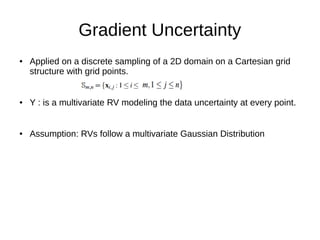
● Applied on a discrete sampling of a 2D domain on a Cartesian grid
structure with grid points.
● Y : is a multivariate RV modeling the data uncertainty at every point.
● Assumption: RVs follow a multivariate Gaussian Distribution
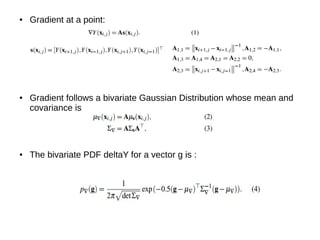
● Gradient at a point:
● Gradient follows a bivariate Gaussian Distribution whose mean and
covariance is
● The bivariate PDF deltaY for a vector g is :
Uncertainty in Derivative
● Choose the mean gradient direction as the direction along which to
determine the uncertainty in derivatives.
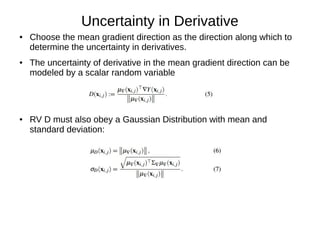
● The uncertainty of derivative in the mean gradient direction can be
modeled by a scalar random variable
● RV D must also obey a Gaussian Distribution with mean and
standard deviation:
Uncertainty in Orientation
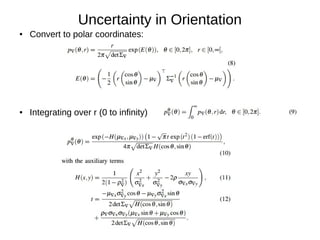
● Convert to polar coordinates:
● Integrating over r (0 to infinity)
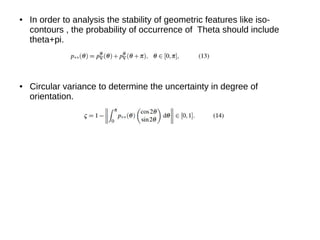
● In order to analysis the stability of geometric features like iso-
contours , the probability of occurrence of Theta should include
theta+pi.
● Circular variance to determine the uncertainty in degree of
orientation.
Visualization
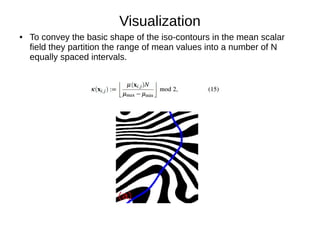
● To convey the basic shape of the iso-contours in the mean scalar
field they partition the range of mean values into a number of N
equally spaced intervals.
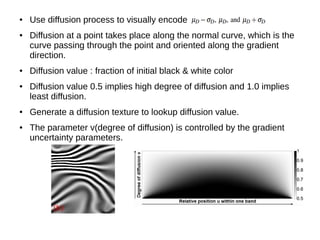
● Use diffusion process to visually encode
● Diffusion at a point takes place along the normal curve, which is the
curve passing through the point and oriented along the gradient
direction.
● Diffusion value : fraction of initial black & white color
● Diffusion value 0.5 implies high degree of diffusion and 1.0 implies
least diffusion.
● Generate a diffusion texture to lookup diffusion value.
● The parameter v(degree of diffusion) is controlled by the gradient
uncertainty parameters.
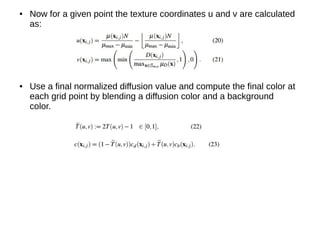
● Now for a given point the texture coordinates u and v are calculated
as:
● Use a final normalized diffusion value and compute the final color at
each grid point by blending a diffusion color and a background
color.
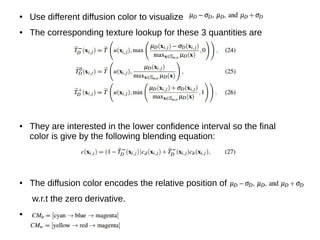
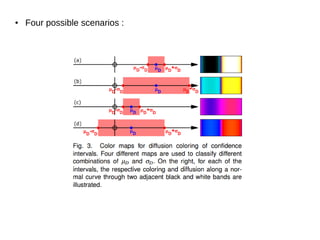
● Use different diffusion color to visualize
● The corresponding texture lookup for these 3 quantities are
● They are interested in the lower confidence interval so the final
color is give by the following blending equation:
● The diffusion color encodes the relative position of
w.r.t the zero derivative.
●
● Four possible scenarios :
Orientation Visualization
● Color of glyph is mapped to the circular variance [0,1] → [ green →
cyan → blue → magenta → red]
● To show individual distribution per glyph the transparency is
controlled at all off-center vertices.
●
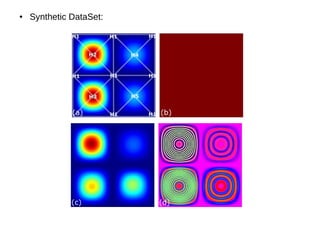
● Synthetic DataSet:
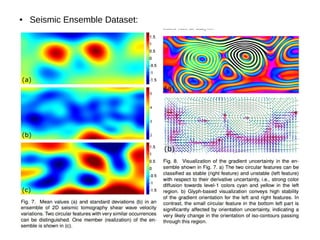
● Seismic Ensemble Dataset:

Visualizing the variability of gradient in uncertain 2d scalarfield

  • 1.
    Visualizing the Variabilityof Gradients in Uncertain 2D Scalar Field Authors: Tobais Pfaffelmoser, Mihaela Mihai and Rudiger Westermann(TU Munich) Presented by: Subhashis Hazarika, The Ohio State University
  • 2.
    Motivation ● Standard Deviationdoes not always give a rigorous analysis of uncertainty, specially when we want to study the differential quantities, like relative variability of data values at different points. ● To draw inference about the stability of geometric features in a scalar field like contour shapes.
  • 3.
    Contribution ● Derivation ofgradient based uncertainty parameters on discrete grid structures. ● Analytical expression of probability distribution describing gradient magnitude and orientation variation. ● A visualization technique using color diffusion to indicate the stability of the slope along gradient direction in 2D scalar fields. ● A family of colored glyphs to quantitatively depict the uncertainty in orientation of iso-contours in 2D scalar fields.
  • 4.
    Gradient Uncertainty ● Appliedon a discrete sampling of a 2D domain on a Cartesian grid structure with grid points. ● Y : is a multivariate RV modeling the data uncertainty at every point. ● Assumption: RVs follow a multivariate Gaussian Distribution
  • 5.
    ● Gradient ata point: ● Gradient follows a bivariate Gaussian Distribution whose mean and covariance is ● The bivariate PDF deltaY for a vector g is :
  • 6.
    Uncertainty in Derivative ●Choose the mean gradient direction as the direction along which to determine the uncertainty in derivatives. ● The uncertainty of derivative in the mean gradient direction can be modeled by a scalar random variable ● RV D must also obey a Gaussian Distribution with mean and standard deviation:
  • 7.
    Uncertainty in Orientation ●Convert to polar coordinates: ● Integrating over r (0 to infinity)
  • 8.
    ● In orderto analysis the stability of geometric features like iso- contours , the probability of occurrence of Theta should include theta+pi. ● Circular variance to determine the uncertainty in degree of orientation.
  • 9.
    Visualization ● To conveythe basic shape of the iso-contours in the mean scalar field they partition the range of mean values into a number of N equally spaced intervals.
  • 10.
    ● Use diffusionprocess to visually encode ● Diffusion at a point takes place along the normal curve, which is the curve passing through the point and oriented along the gradient direction. ● Diffusion value : fraction of initial black & white color ● Diffusion value 0.5 implies high degree of diffusion and 1.0 implies least diffusion. ● Generate a diffusion texture to lookup diffusion value. ● The parameter v(degree of diffusion) is controlled by the gradient uncertainty parameters.
  • 11.
    ● Now fora given point the texture coordinates u and v are calculated as: ● Use a final normalized diffusion value and compute the final color at each grid point by blending a diffusion color and a background color.
  • 12.
    ● Use differentdiffusion color to visualize ● The corresponding texture lookup for these 3 quantities are ● They are interested in the lower confidence interval so the final color is give by the following blending equation: ● The diffusion color encodes the relative position of w.r.t the zero derivative. ●
  • 13.
    ● Four possiblescenarios :
  • 14.
    Orientation Visualization ● Colorof glyph is mapped to the circular variance [0,1] → [ green → cyan → blue → magenta → red] ● To show individual distribution per glyph the transparency is controlled at all off-center vertices. ●
  • 15.
  • 16.