[course site]
Visualization
#DLUPC
Amaia Salvador
amaia.salvador@upc.edu
PhD Candidate
Universitat Politècnica de Catalunya
2
Visualization
● Learned weights
● Activations from data
● Gradient-based
● Optimization-based
● DeepDream
● Neural Style
3
Visualization
● Learned weights
● Activations from data
● Gradient-based
● Optimization-based
● DeepDream
● Neural Style
4
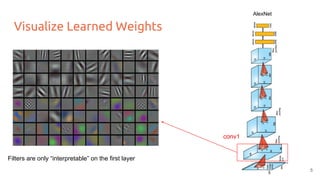
Visualize Learned Weights
AlexNet
conv1
Filters are only “interpretable” on the first layer
5
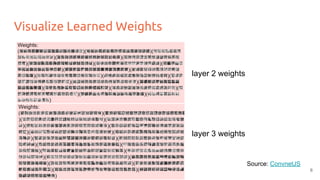
Visualize Learned Weights
layer 2 weights
layer 3 weights
Source: ConvnetJS
6
Visualization
● Learned weights
● Activations from data
● Gradient-based
● Optimization-based
● DeepDream
● Neural Style
7
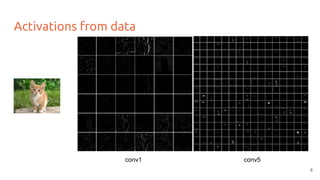
Activations from data
8
conv1 conv5
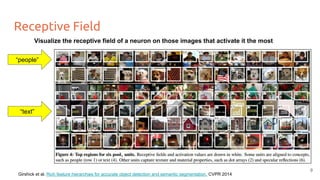
Receptive Field
Girshick et al. Rich feature hierarchies for accurate object detection and semantic segmentation. CVPR 2014
9
“people”
“text”
Visualize the receptive field of a neuron on those images that activate it the most
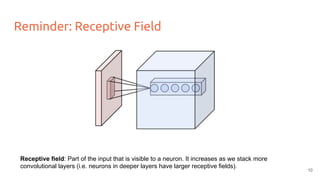
Reminder: Receptive Field
10
Receptive field: Part of the input that is visible to a neuron. It increases as we stack more
convolutional layers (i.e. neurons in deeper layers have larger receptive fields).
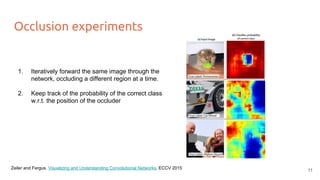
Occlusion experiments
1. Iteratively forward the same image through the
network, occluding a different region at a time.
2. Keep track of the probability of the correct class
w.r.t. the position of the occluder
Zeiler and Fergus. Visualizing and Understanding Convolutional Networks. ECCV 2015 11
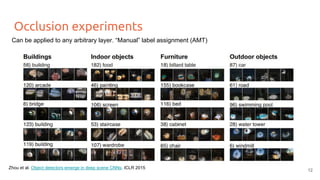
Occlusion experiments
12
Can be applied to any arbitrary layer. “Manual” label assignment (AMT)
Zhou et al. Object detectors emerge in deep scene CNNs. ICLR 2015
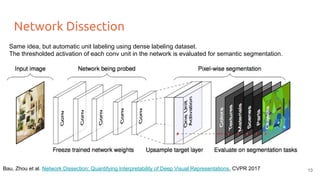
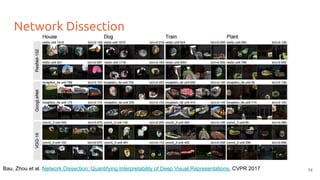
Network Dissection
Bau, Zhou et al. Network Dissection: Quantifying Interpretability of Deep Visual Representations. CVPR 2017 13
Same idea, but automatic unit labeling using dense labeling dataset.
The thresholded activation of each conv unit in the network is evaluated for semantic segmentation.
Network Dissection
Bau, Zhou et al. Network Dissection: Quantifying Interpretability of Deep Visual Representations. CVPR 2017 14
Visualization
● Learned weights
● Activations from data
● Gradient-based
● Optimization-based
● DeepDream
● Neural Style
15
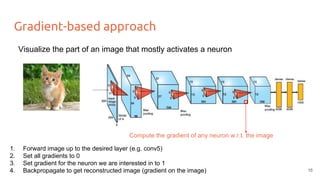
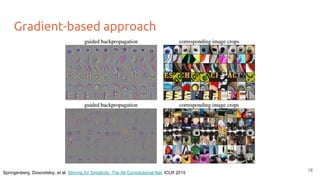
Gradient-based approach
Compute the gradient of any neuron w.r.t. the image
1. Forward image up to the desired layer (e.g. conv5)
2. Set all gradients to 0
3. Set gradient for the neuron we are interested in to 1
4. Backpropagate to get reconstructed image (gradient on the image)
Visualize the part of an image that mostly activates a neuron
16
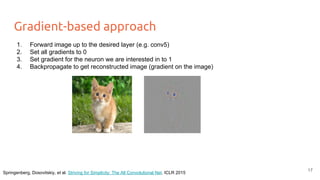
Gradient-based approach
1. Forward image up to the desired layer (e.g. conv5)
2. Set all gradients to 0
3. Set gradient for the neuron we are interested in to 1
4. Backpropagate to get reconstructed image (gradient on the image)
Springenberg, Dosovitskiy, et al. Striving for Simplicity: The All Convolutional Net. ICLR 2015
17
Gradient-based approach
Springenberg, Dosovitskiy, et al. Striving for Simplicity: The All Convolutional Net. ICLR 2015
18
Visualization
● Learned weights
● Activations from data
● Gradient-based
● Optimization-based
● DeepDream
● Neural Style
19
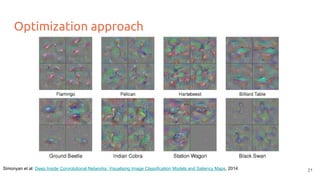
Optimization approach
Simonyan et al. Deep Inside Convolutional Networks: Visualising Image Classification Models and Saliency Maps, 2014
Obtain the image that maximizes a class score (or a neuron activation)
1. Forward random image
2. Set the gradient of the scores vector to be [0,0,0…,1,...,0,0]
3. Backprop to get gradient on the image
4. Update image (small step in the gradient direction)
5. Repeat
20
Optimization approach
Simonyan et al. Deep Inside Convolutional Networks: Visualising Image Classification Models and Saliency Maps, 2014 21
Visualization
● Learned weights
● Activations from data
● Gradient-based
● Optimization-based
● DeepDream
● Neural Style
22
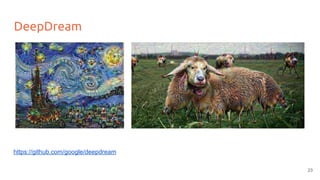
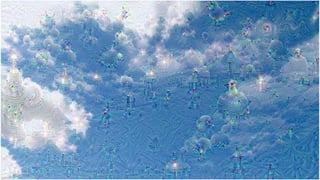
DeepDream
https://github.com/google/deepdream
23
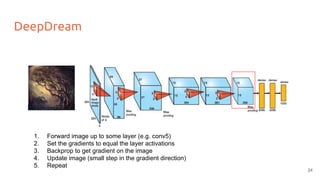
DeepDream
1. Forward image up to some layer (e.g. conv5)
2. Set the gradients to equal the layer activations
3. Backprop to get gradient on the image
4. Update image (small step in the gradient direction)
5. Repeat
24
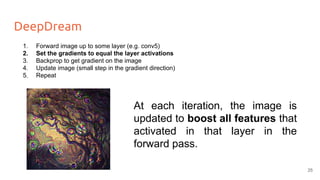
DeepDream
1. Forward image up to some layer (e.g. conv5)
2. Set the gradients to equal the layer activations
3. Backprop to get gradient on the image
4. Update image (small step in the gradient direction)
5. Repeat
At each iteration, the image is
updated to boost all features that
activated in that layer in the
forward pass.
25
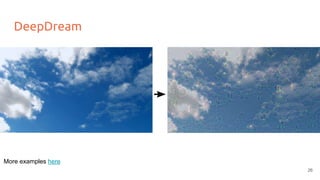
DeepDream
26
More examples here
Visualization
● Learned weights
● Activations from data
● Gradient-based
● Optimization-based
● DeepDream
● Neural Style
28
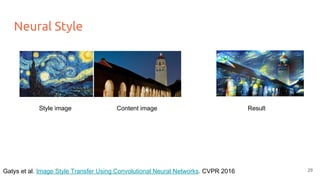
Neural Style
Style image Content image Result
29Gatys et al. Image Style Transfer Using Convolutional Neural Networks. CVPR 2016
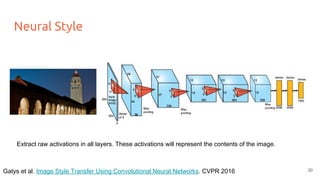
Neural Style
Extract raw activations in all layers. These activations will represent the contents of the image.
30Gatys et al. Image Style Transfer Using Convolutional Neural Networks. CVPR 2016
Neural Style
V =
● Activations are also extracted from the style image for all layers.
● Instead of the raw activations, gram matrices (G) are computed at each layer to represent the style.
E.g. at conv5 [13x13x256], reshape to:
169
256
...
G = VT
V
The Gram matrix G gives the
correlations between filter responses.
31
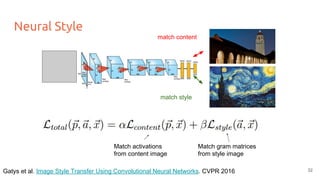
Neural Style
match content
match style
Match gram matrices
from style image
Match activations
from content image
32Gatys et al. Image Style Transfer Using Convolutional Neural Networks. CVPR 2016
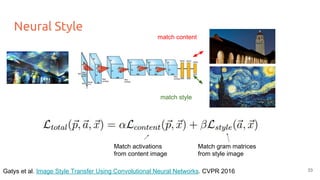
Neural Style
match content
match style
Match gram matrices
from style image
Match activations
from content image
33Gatys et al. Image Style Transfer Using Convolutional Neural Networks. CVPR 2016
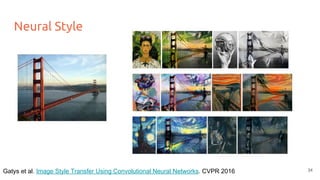
Neural Style
34Gatys et al. Image Style Transfer Using Convolutional Neural Networks. CVPR 2016
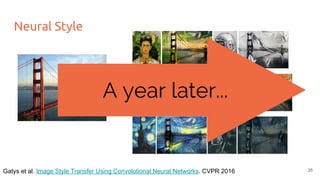
Neural Style
35Gatys et al. Image Style Transfer Using Convolutional Neural Networks. CVPR 2016
A year later...
36
Content Image Style Image Result
Luan et al. Deep Photo Style Transfer. arXiv Apr 2017
37
Content Image Style Image Result
Luan et al. Deep Photo Style Transfer. arXiv Apr 2017
Visualization
● Learned weights
● Activations from data
● Gradient-based
● Optimization-based
● DeepDream
● Neural Style
38
Resources
● ConvnetJS
● Deepvis toolbox
● DrawNet from MIT: Visualize strong activations & connections between units
● 3D Visualization of a Convolutional Neural Network
● Latest NeuralStyle in torch
● Keras examples:
○ Optimization-based visualization Example in Keras
○ DeepDream in Keras
○ NeuralStyle in Keras
● Picasso: visualization tool (supports keras models - use it in your projects !)
○ blog post to convince you here
39
Questions?
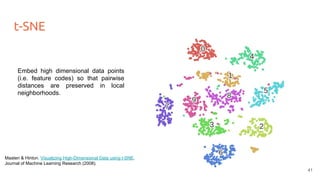
t-SNE
Embed high dimensional data points
(i.e. feature codes) so that pairwise
distances are preserved in local
neighborhoods.
Maaten & Hinton. Visualizing High-Dimensional Data using t-SNE.
Journal of Machine Learning Research (2008).
41
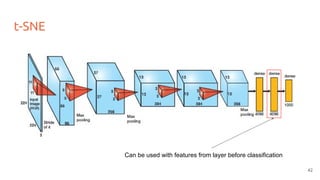
t-SNE
Can be used with features from layer before classification
42
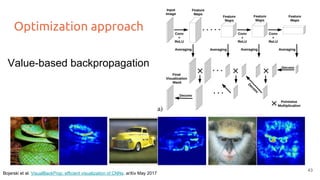
Optimization approach
Bojarski et al. VisualBackProp: efficient visualization of CNNs. arXiv May 2017
Value-based backpropagation
43

Visualization of Deep Learning Models (D1L6 2017 UPC Deep Learning for Computer Vision)

  • 1.
  • 2.
  • 3.
    Visualization ● Learned weights ●Activations from data ● Gradient-based ● Optimization-based ● DeepDream ● Neural Style 3
  • 4.
    Visualization ● Learned weights ●Activations from data ● Gradient-based ● Optimization-based ● DeepDream ● Neural Style 4
  • 5.
    Visualize Learned Weights AlexNet conv1 Filtersare only “interpretable” on the first layer 5
  • 6.
    Visualize Learned Weights layer2 weights layer 3 weights Source: ConvnetJS 6
  • 7.
    Visualization ● Learned weights ●Activations from data ● Gradient-based ● Optimization-based ● DeepDream ● Neural Style 7
  • 8.
  • 9.
    Receptive Field Girshick etal. Rich feature hierarchies for accurate object detection and semantic segmentation. CVPR 2014 9 “people” “text” Visualize the receptive field of a neuron on those images that activate it the most
  • 10.
    Reminder: Receptive Field 10 Receptivefield: Part of the input that is visible to a neuron. It increases as we stack more convolutional layers (i.e. neurons in deeper layers have larger receptive fields).
  • 11.
    Occlusion experiments 1. Iterativelyforward the same image through the network, occluding a different region at a time. 2. Keep track of the probability of the correct class w.r.t. the position of the occluder Zeiler and Fergus. Visualizing and Understanding Convolutional Networks. ECCV 2015 11
  • 12.
    Occlusion experiments 12 Can beapplied to any arbitrary layer. “Manual” label assignment (AMT) Zhou et al. Object detectors emerge in deep scene CNNs. ICLR 2015
  • 13.
    Network Dissection Bau, Zhouet al. Network Dissection: Quantifying Interpretability of Deep Visual Representations. CVPR 2017 13 Same idea, but automatic unit labeling using dense labeling dataset. The thresholded activation of each conv unit in the network is evaluated for semantic segmentation.
  • 14.
    Network Dissection Bau, Zhouet al. Network Dissection: Quantifying Interpretability of Deep Visual Representations. CVPR 2017 14
  • 15.
    Visualization ● Learned weights ●Activations from data ● Gradient-based ● Optimization-based ● DeepDream ● Neural Style 15
  • 16.
    Gradient-based approach Compute thegradient of any neuron w.r.t. the image 1. Forward image up to the desired layer (e.g. conv5) 2. Set all gradients to 0 3. Set gradient for the neuron we are interested in to 1 4. Backpropagate to get reconstructed image (gradient on the image) Visualize the part of an image that mostly activates a neuron 16
  • 17.
    Gradient-based approach 1. Forwardimage up to the desired layer (e.g. conv5) 2. Set all gradients to 0 3. Set gradient for the neuron we are interested in to 1 4. Backpropagate to get reconstructed image (gradient on the image) Springenberg, Dosovitskiy, et al. Striving for Simplicity: The All Convolutional Net. ICLR 2015 17
  • 18.
    Gradient-based approach Springenberg, Dosovitskiy,et al. Striving for Simplicity: The All Convolutional Net. ICLR 2015 18
  • 19.
    Visualization ● Learned weights ●Activations from data ● Gradient-based ● Optimization-based ● DeepDream ● Neural Style 19
  • 20.
    Optimization approach Simonyan etal. Deep Inside Convolutional Networks: Visualising Image Classification Models and Saliency Maps, 2014 Obtain the image that maximizes a class score (or a neuron activation) 1. Forward random image 2. Set the gradient of the scores vector to be [0,0,0…,1,...,0,0] 3. Backprop to get gradient on the image 4. Update image (small step in the gradient direction) 5. Repeat 20
  • 21.
    Optimization approach Simonyan etal. Deep Inside Convolutional Networks: Visualising Image Classification Models and Saliency Maps, 2014 21
  • 22.
    Visualization ● Learned weights ●Activations from data ● Gradient-based ● Optimization-based ● DeepDream ● Neural Style 22
  • 23.
  • 24.
    DeepDream 1. Forward imageup to some layer (e.g. conv5) 2. Set the gradients to equal the layer activations 3. Backprop to get gradient on the image 4. Update image (small step in the gradient direction) 5. Repeat 24
  • 25.
    DeepDream 1. Forward imageup to some layer (e.g. conv5) 2. Set the gradients to equal the layer activations 3. Backprop to get gradient on the image 4. Update image (small step in the gradient direction) 5. Repeat At each iteration, the image is updated to boost all features that activated in that layer in the forward pass. 25
  • 26.
  • 28.
    Visualization ● Learned weights ●Activations from data ● Gradient-based ● Optimization-based ● DeepDream ● Neural Style 28
  • 29.
    Neural Style Style imageContent image Result 29Gatys et al. Image Style Transfer Using Convolutional Neural Networks. CVPR 2016
  • 30.
    Neural Style Extract rawactivations in all layers. These activations will represent the contents of the image. 30Gatys et al. Image Style Transfer Using Convolutional Neural Networks. CVPR 2016
  • 31.
    Neural Style V = ●Activations are also extracted from the style image for all layers. ● Instead of the raw activations, gram matrices (G) are computed at each layer to represent the style. E.g. at conv5 [13x13x256], reshape to: 169 256 ... G = VT V The Gram matrix G gives the correlations between filter responses. 31
  • 32.
    Neural Style match content matchstyle Match gram matrices from style image Match activations from content image 32Gatys et al. Image Style Transfer Using Convolutional Neural Networks. CVPR 2016
  • 33.
    Neural Style match content matchstyle Match gram matrices from style image Match activations from content image 33Gatys et al. Image Style Transfer Using Convolutional Neural Networks. CVPR 2016
  • 34.
    Neural Style 34Gatys etal. Image Style Transfer Using Convolutional Neural Networks. CVPR 2016
  • 35.
    Neural Style 35Gatys etal. Image Style Transfer Using Convolutional Neural Networks. CVPR 2016 A year later...
  • 36.
    36 Content Image StyleImage Result Luan et al. Deep Photo Style Transfer. arXiv Apr 2017
  • 37.
    37 Content Image StyleImage Result Luan et al. Deep Photo Style Transfer. arXiv Apr 2017
  • 38.
    Visualization ● Learned weights ●Activations from data ● Gradient-based ● Optimization-based ● DeepDream ● Neural Style 38
  • 39.
    Resources ● ConvnetJS ● Deepvistoolbox ● DrawNet from MIT: Visualize strong activations & connections between units ● 3D Visualization of a Convolutional Neural Network ● Latest NeuralStyle in torch ● Keras examples: ○ Optimization-based visualization Example in Keras ○ DeepDream in Keras ○ NeuralStyle in Keras ● Picasso: visualization tool (supports keras models - use it in your projects !) ○ blog post to convince you here 39
  • 40.
  • 41.
    t-SNE Embed high dimensionaldata points (i.e. feature codes) so that pairwise distances are preserved in local neighborhoods. Maaten & Hinton. Visualizing High-Dimensional Data using t-SNE. Journal of Machine Learning Research (2008). 41
  • 42.
    t-SNE Can be usedwith features from layer before classification 42
  • 43.
    Optimization approach Bojarski etal. VisualBackProp: efficient visualization of CNNs. arXiv May 2017 Value-based backpropagation 43