VISUAL LITERACY “Learn to see, see to learn”
What is it? Group of vision-competences Ability to understand and produce/use visual messages  To think, learn and express oneself in terms of images  numerous definitions as the term is used within multiple disciplines
Is something learned Cultural specific but exsist visual images that are globally understood
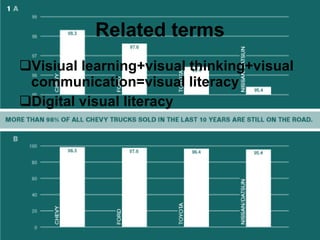
Related terms Visiual learning+visual thinking+visual communication=visual literacy Digital visual literacy
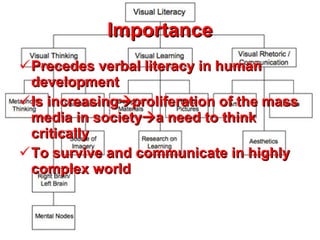
Importance Precedes verbal literacy in human development Is increasing  proliferation of the mass media in society  a need to think critically  To survive and communicate in highly complex world
Ability of visual literacy Reading visuals Interpreting visuals  Using/applying  Composing/creating
Visual text kind of langue makes its  meanings  with images or with meaningful patterns  to convey information   clip-art,  illustrations & diagrams, graphs, photographs and  manipulated  images structure of written text   (headline vs. body text);  tipe,   font  &  color of writing
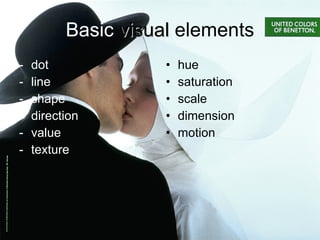
Basic  visual  elements dot line shape direction value texture hue saturation scale dimension motion
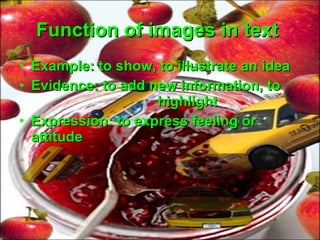
Function of images in text   Example: to show, to illustrate an idea Evidence: to add new information, to  highlight Expression: to express feeling or attitude
Using visuals within lessons/learning Enhances learning, makes it more sucessful Higher eficiency when written text is accompanied with visual text  Impact on memory
Conclusion The learned ability to interpret visual  messages accurately and to create them Importance of all literacies THE KEY: to think of ways to use the most effective tools for communication

Visual Literacy

  • 1.
    VISUAL LITERACY “Learnto see, see to learn”
  • 2.
    What is it?Group of vision-competences Ability to understand and produce/use visual messages To think, learn and express oneself in terms of images  numerous definitions as the term is used within multiple disciplines
  • 3.
    Is something learnedCultural specific but exsist visual images that are globally understood
  • 4.
    Related terms Visiuallearning+visual thinking+visual communication=visual literacy Digital visual literacy
  • 5.
    Importance Precedes verballiteracy in human development Is increasing  proliferation of the mass media in society  a need to think critically To survive and communicate in highly complex world
  • 6.
    Ability of visualliteracy Reading visuals Interpreting visuals Using/applying Composing/creating
  • 7.
    Visual text kindof langue makes its meanings with images or with meaningful patterns  to convey information clip-art, illustrations & diagrams, graphs, photographs and manipulated images structure of written text (headline vs. body text); tipe, font & color of writing
  • 8.
    Basic visual elements dot line shape direction value texture hue saturation scale dimension motion
  • 9.
    Function of imagesin text Example: to show, to illustrate an idea Evidence: to add new information, to highlight Expression: to express feeling or attitude
  • 10.
    Using visuals withinlessons/learning Enhances learning, makes it more sucessful Higher eficiency when written text is accompanied with visual text Impact on memory
  • 11.
    Conclusion The learnedability to interpret visual messages accurately and to create them Importance of all literacies THE KEY: to think of ways to use the most effective tools for communication