Overview I.  The Image II.  The Object III. In the Archives IV. Exercise
I. The Image
What’s in an image? I. The Image
Reading an Image Five Ws Who What  Where When Why I. The Image
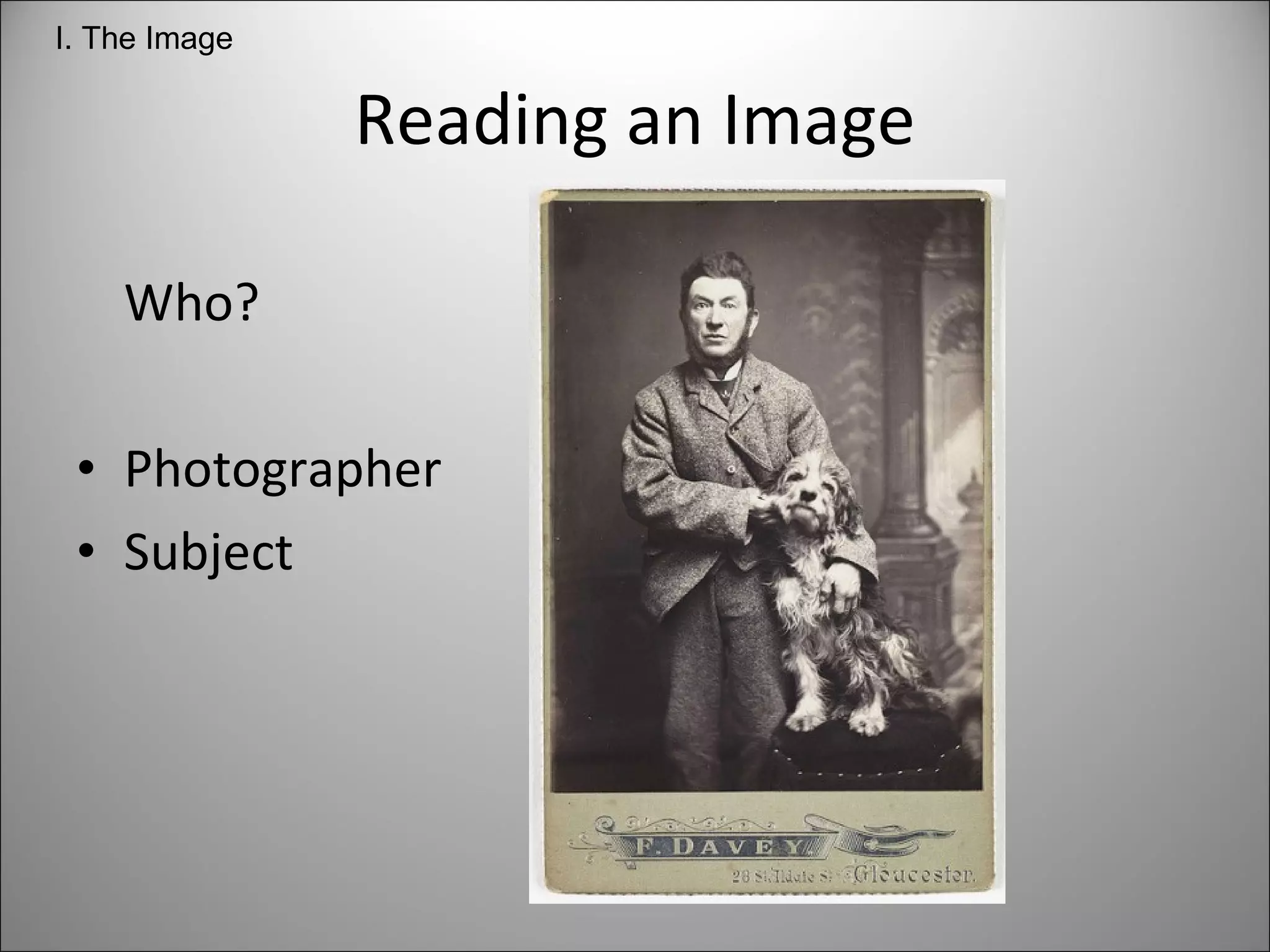
Reading an Image Who? Photographer Subject I. The Image
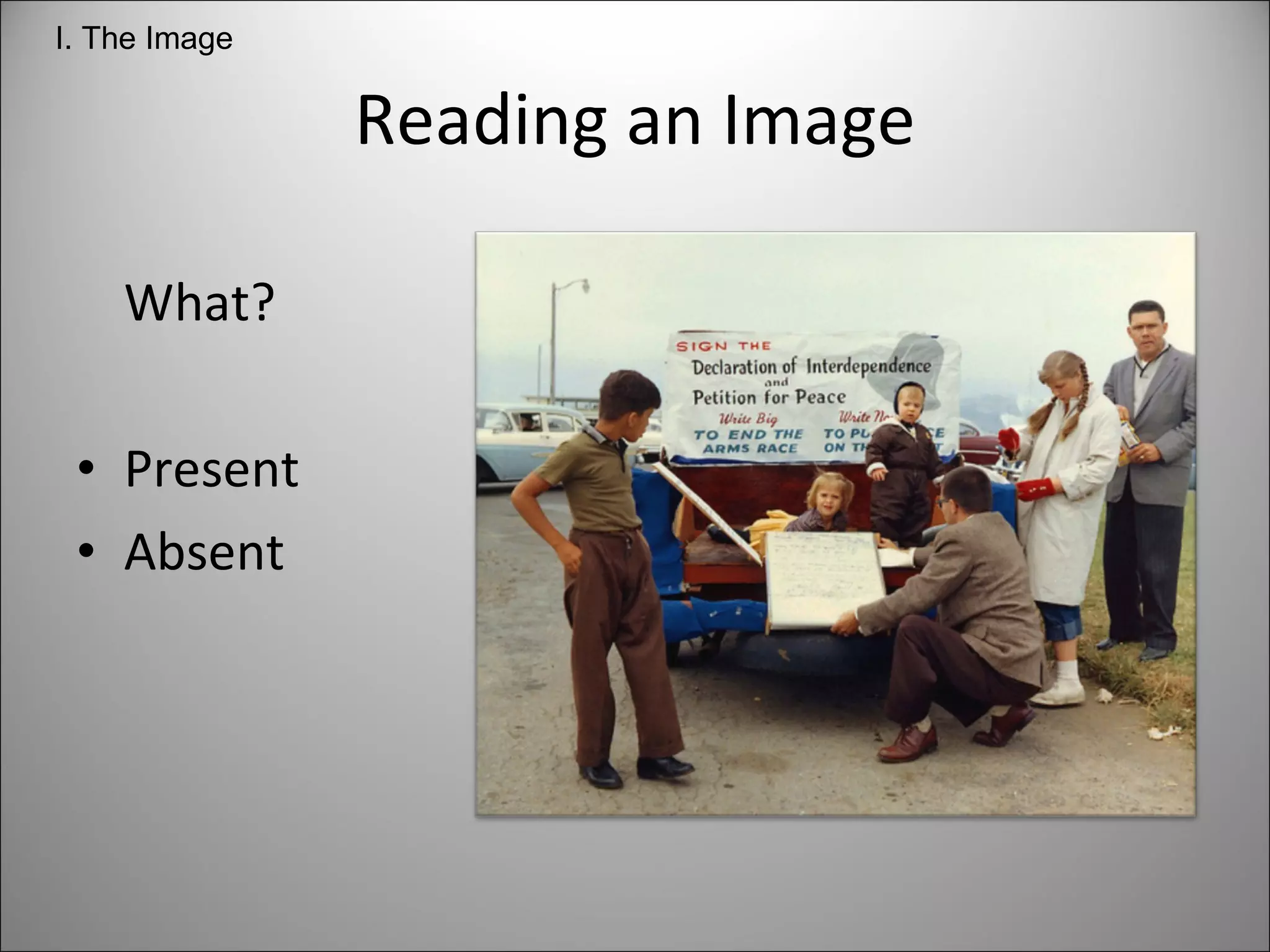
Reading an Image What? Present Absent I. The Image
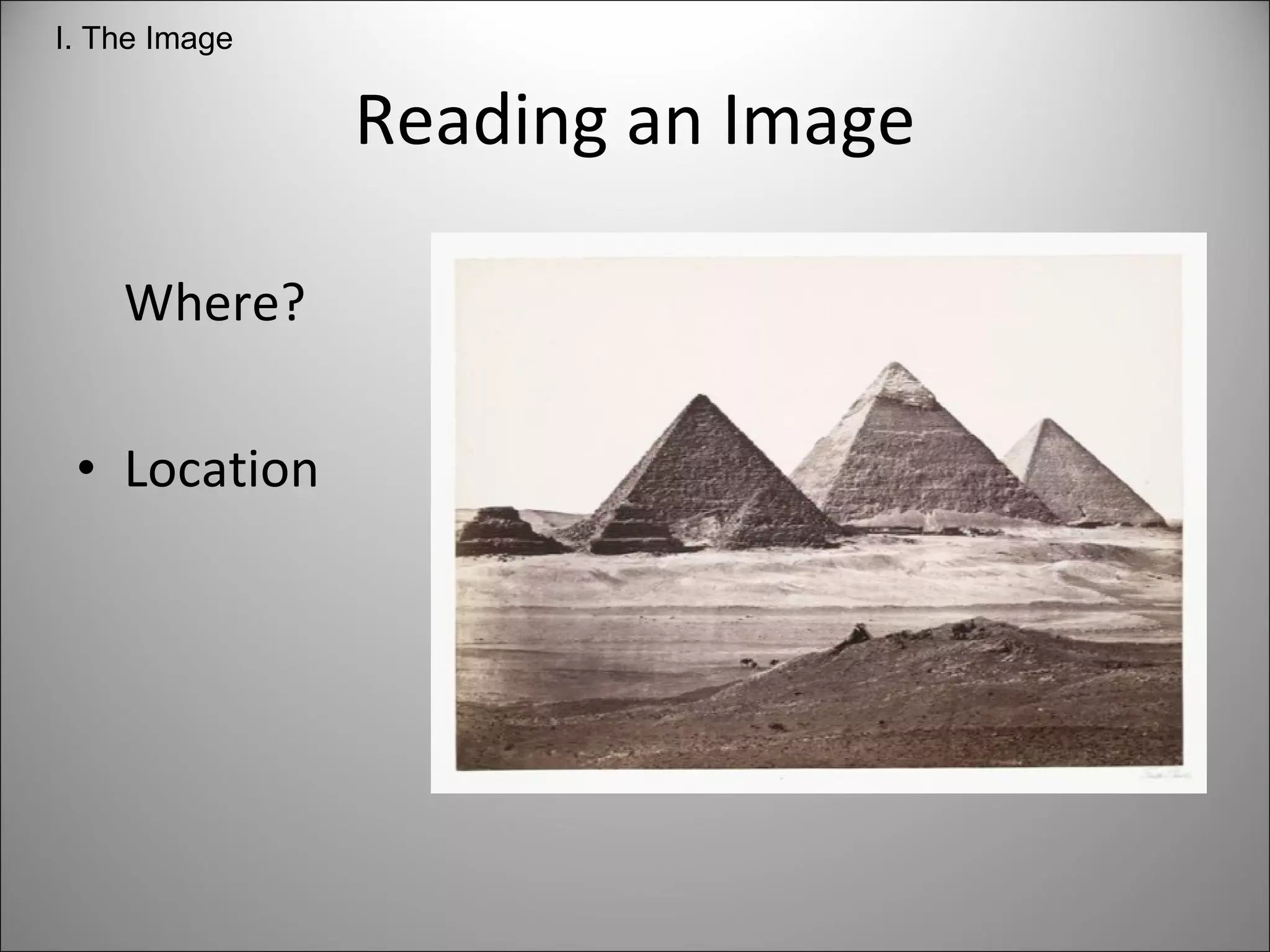
Reading an Image Where? Location I. The Image
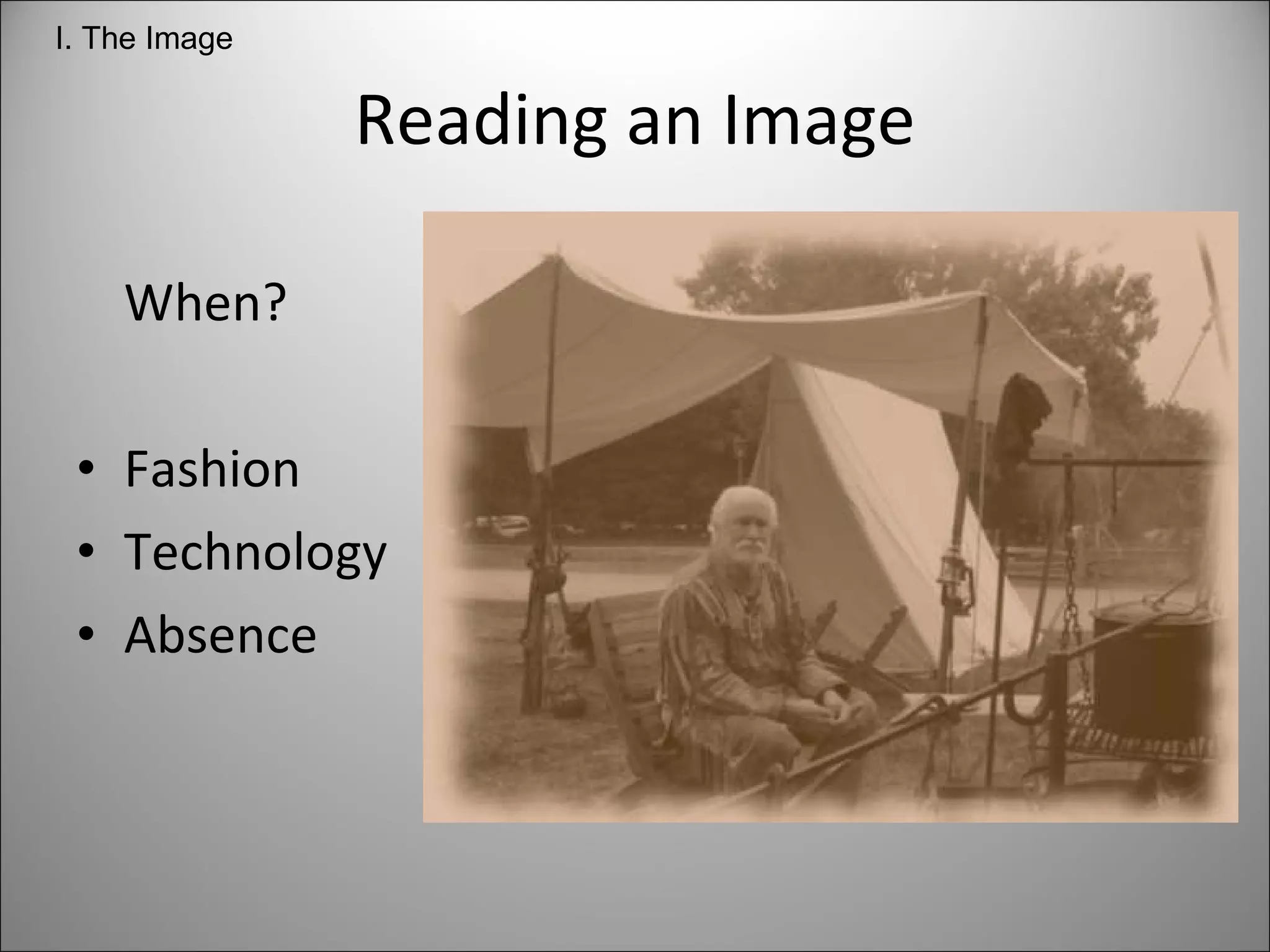
Reading an Image When? Fashion Technology Absence I. The Image
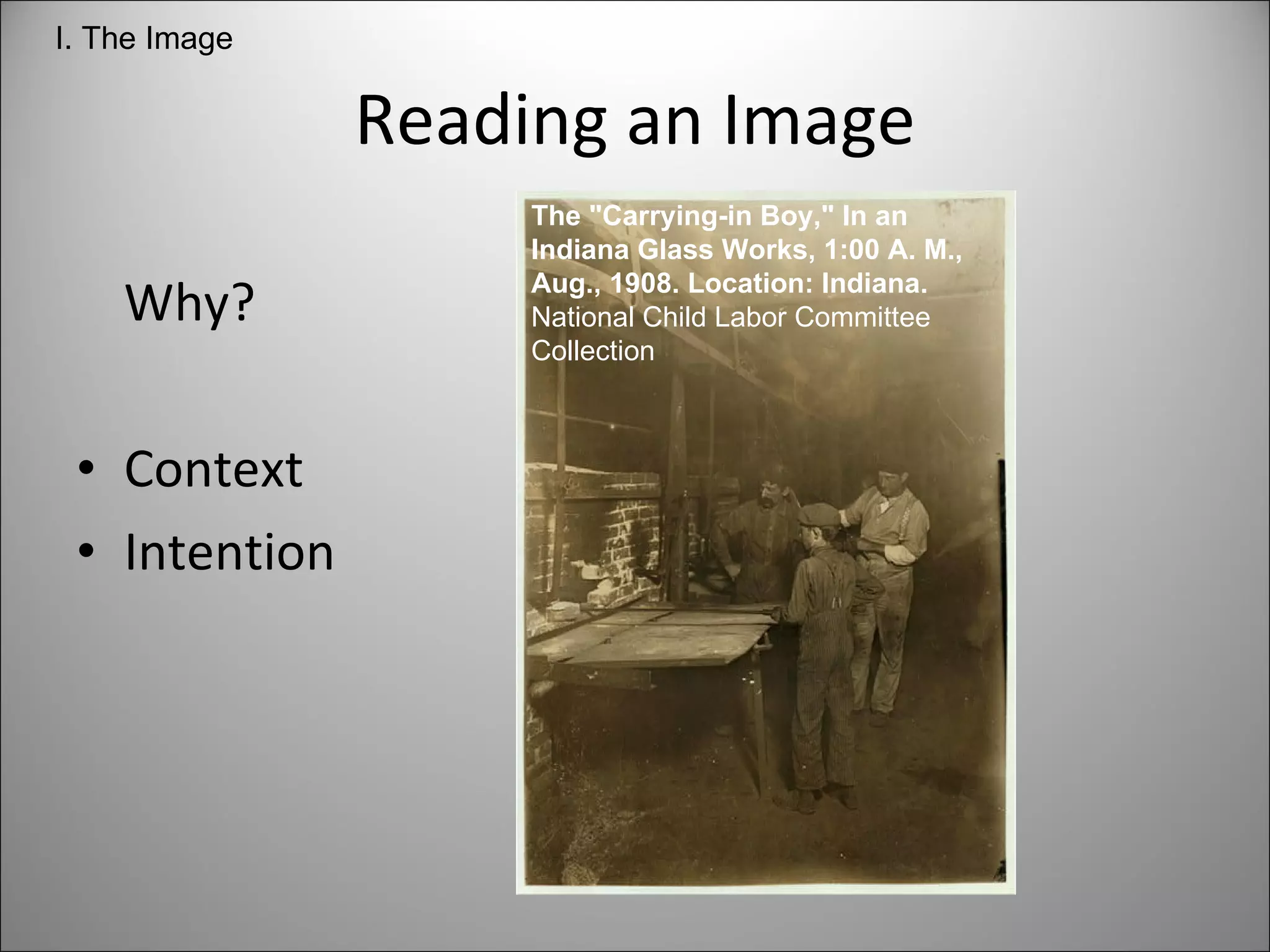
Reading an Image Why? Context Intention The "Carrying-in Boy," In an Indiana Glass Works, 1:00 A. M., Aug., 1908. Location: Indiana. National Child Labor Committee Collection  I. The Image
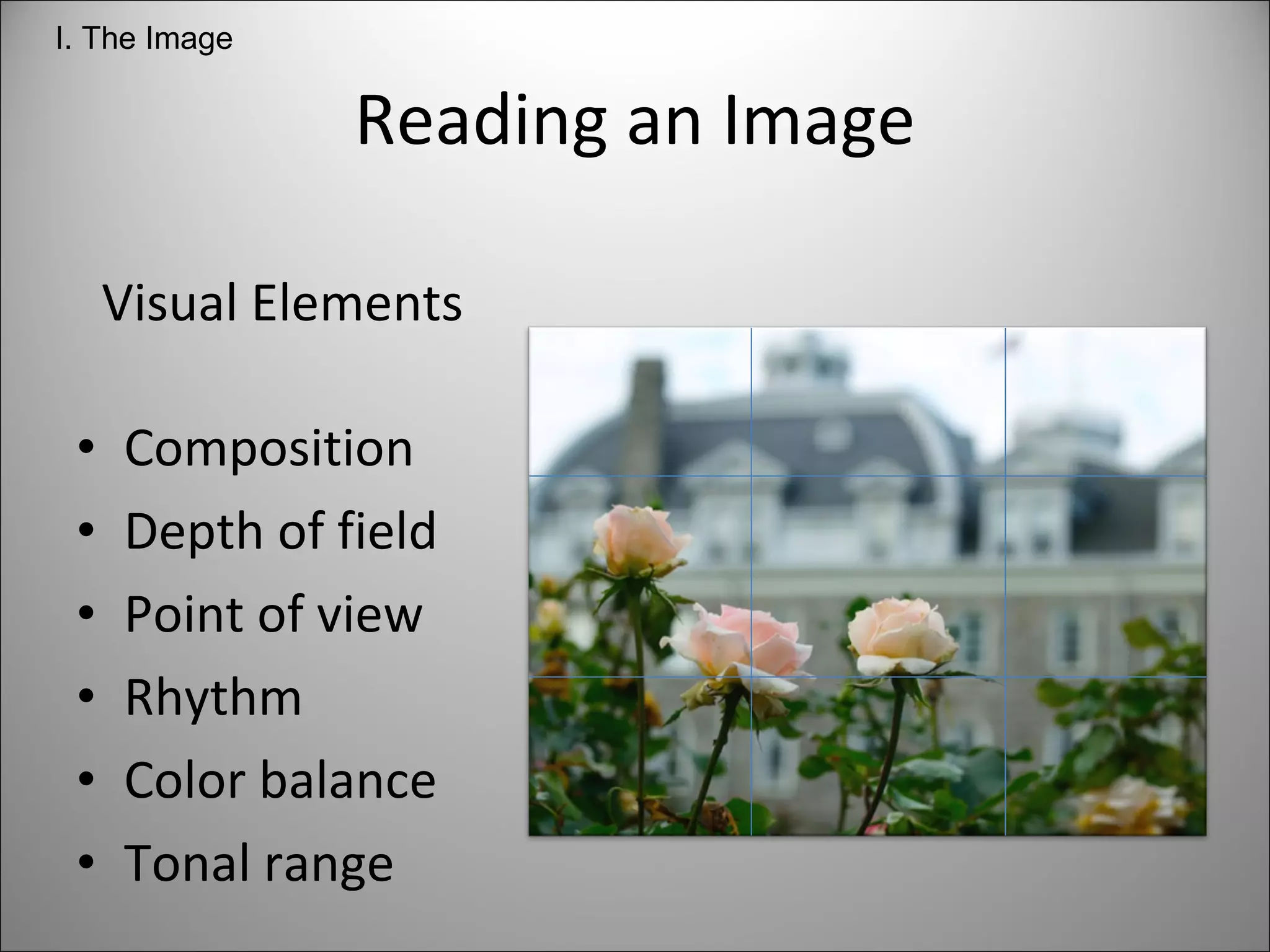
Reading an Image Visual Elements Composition Depth of field  Point of view  Rhythm  Color balance  Tonal range  I. The Image
 
II. The Object
Photo Basics II. The Object
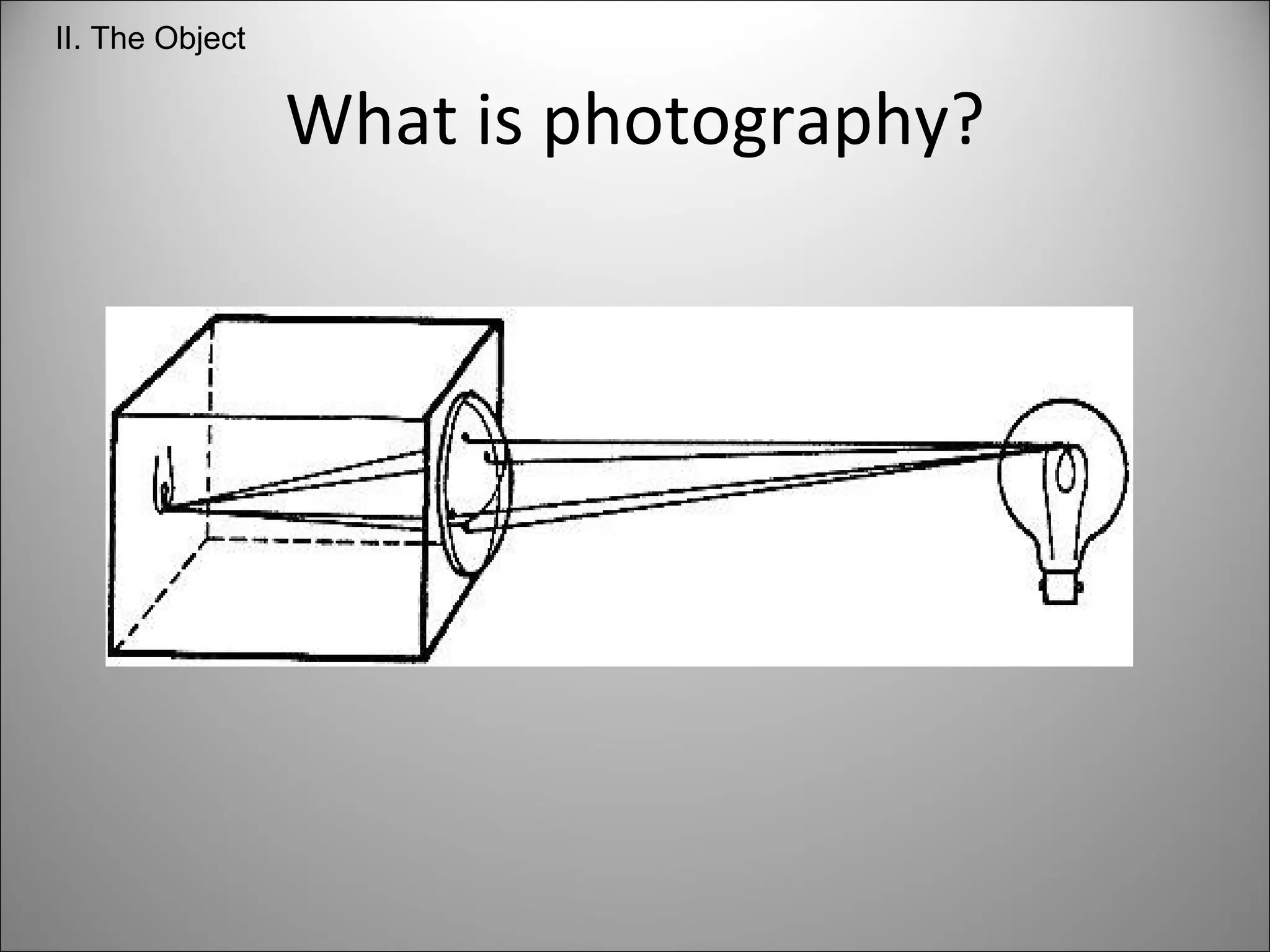
What is photography? II. The Object
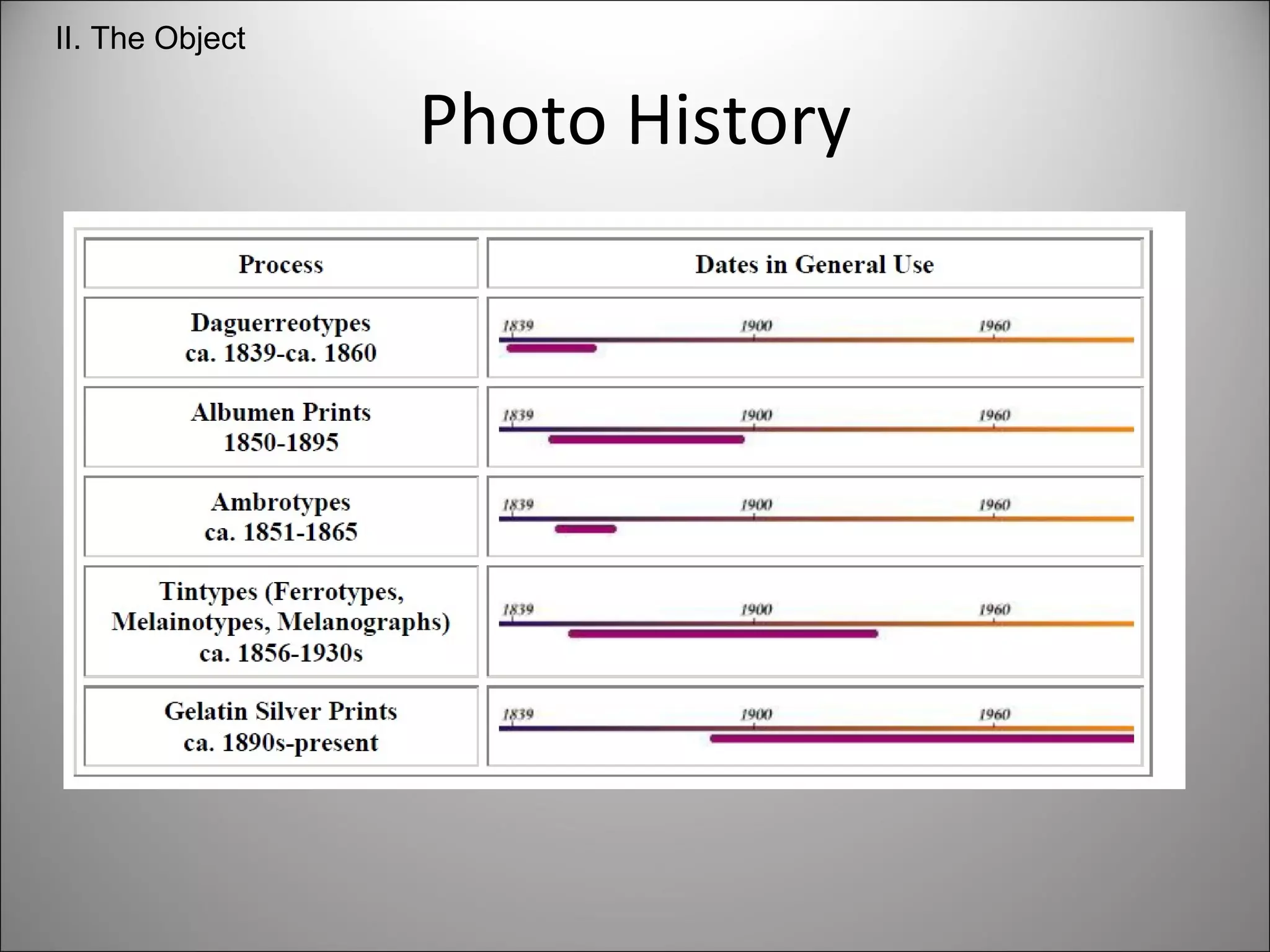
Photo History II. The Object
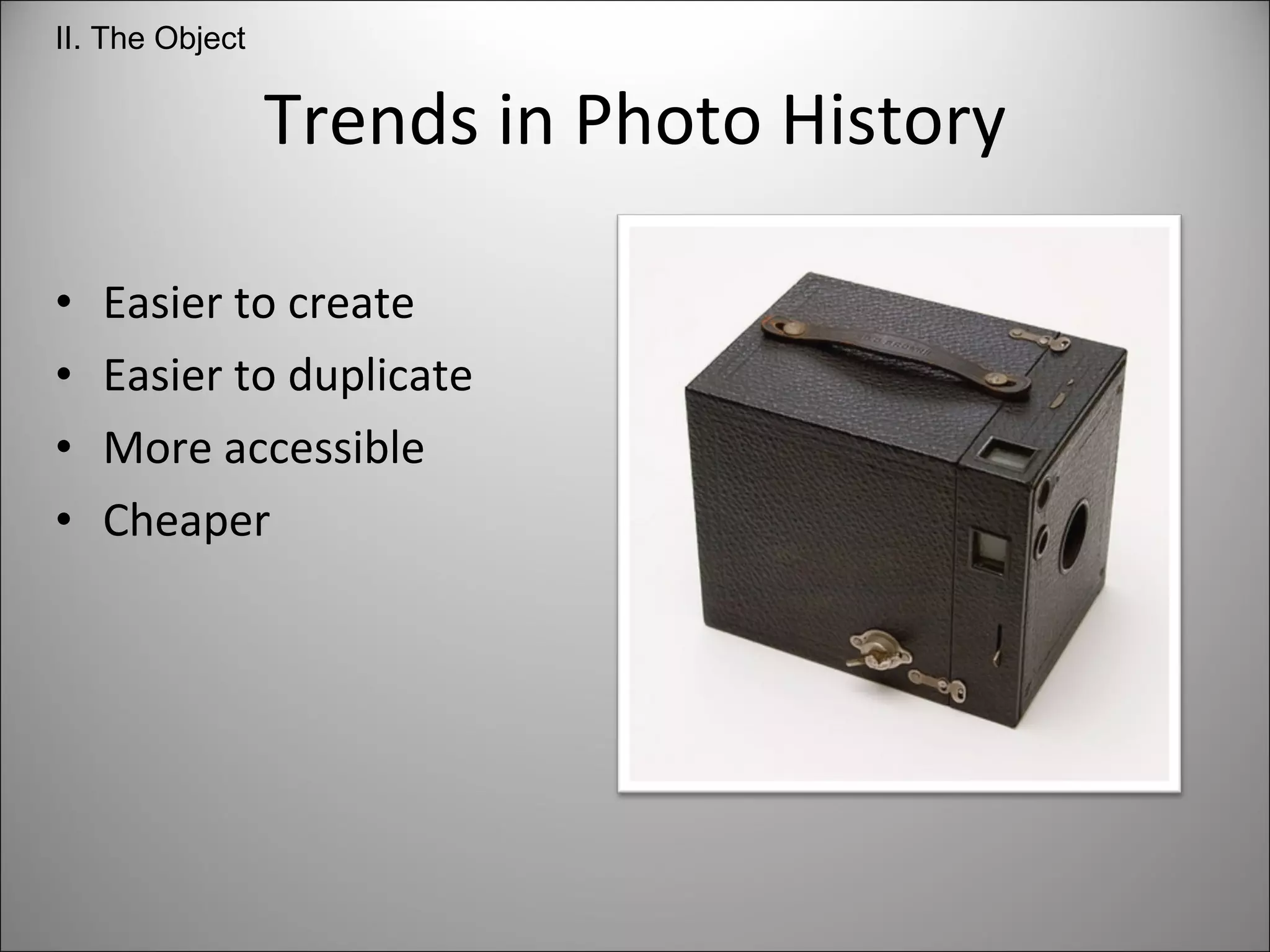
Trends in Photo History Easier to create Easier to duplicate More accessible  Cheaper II. The Object
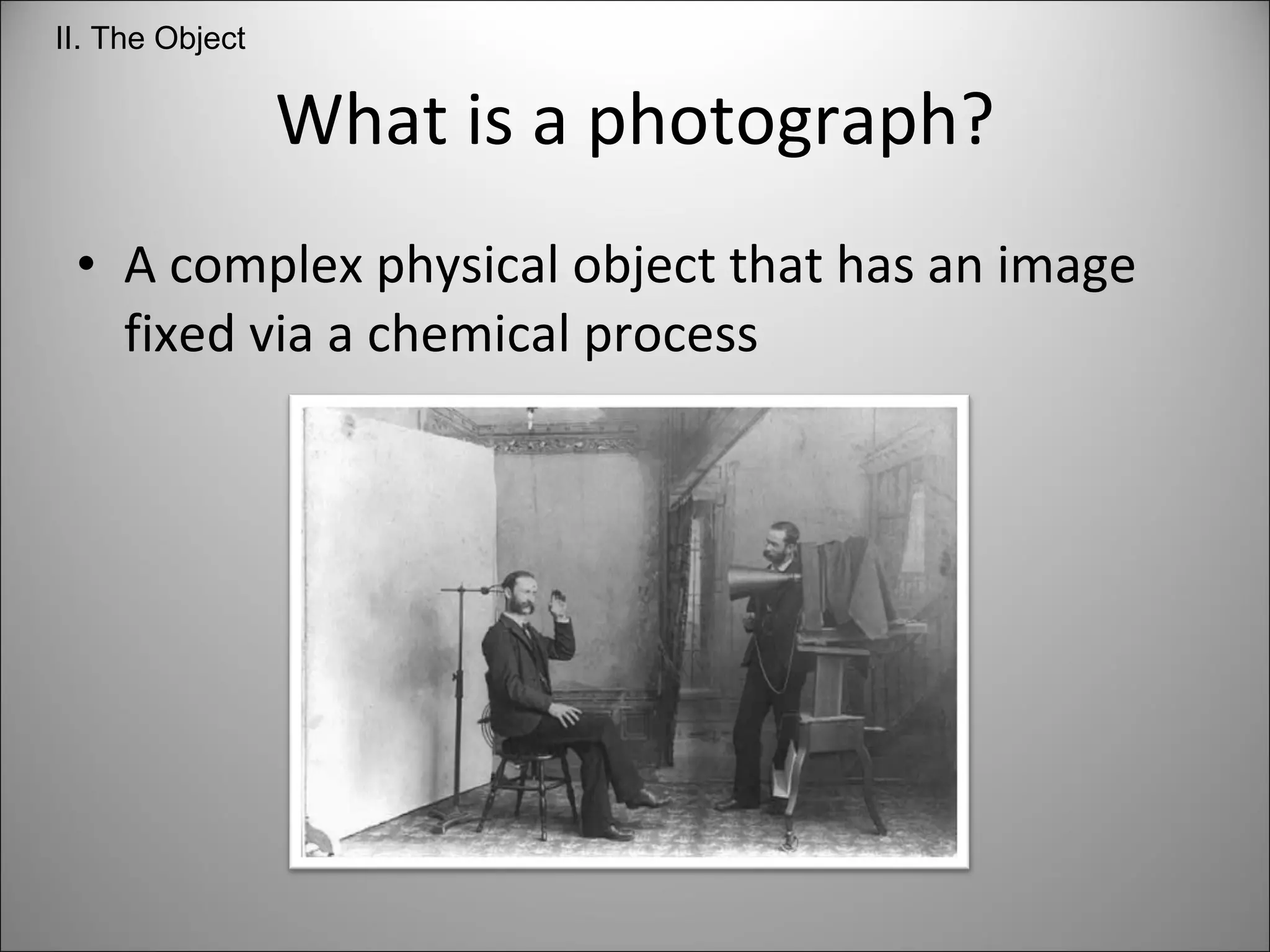
What is a photograph? A complex physical object that has an image fixed via a chemical process II. The Object
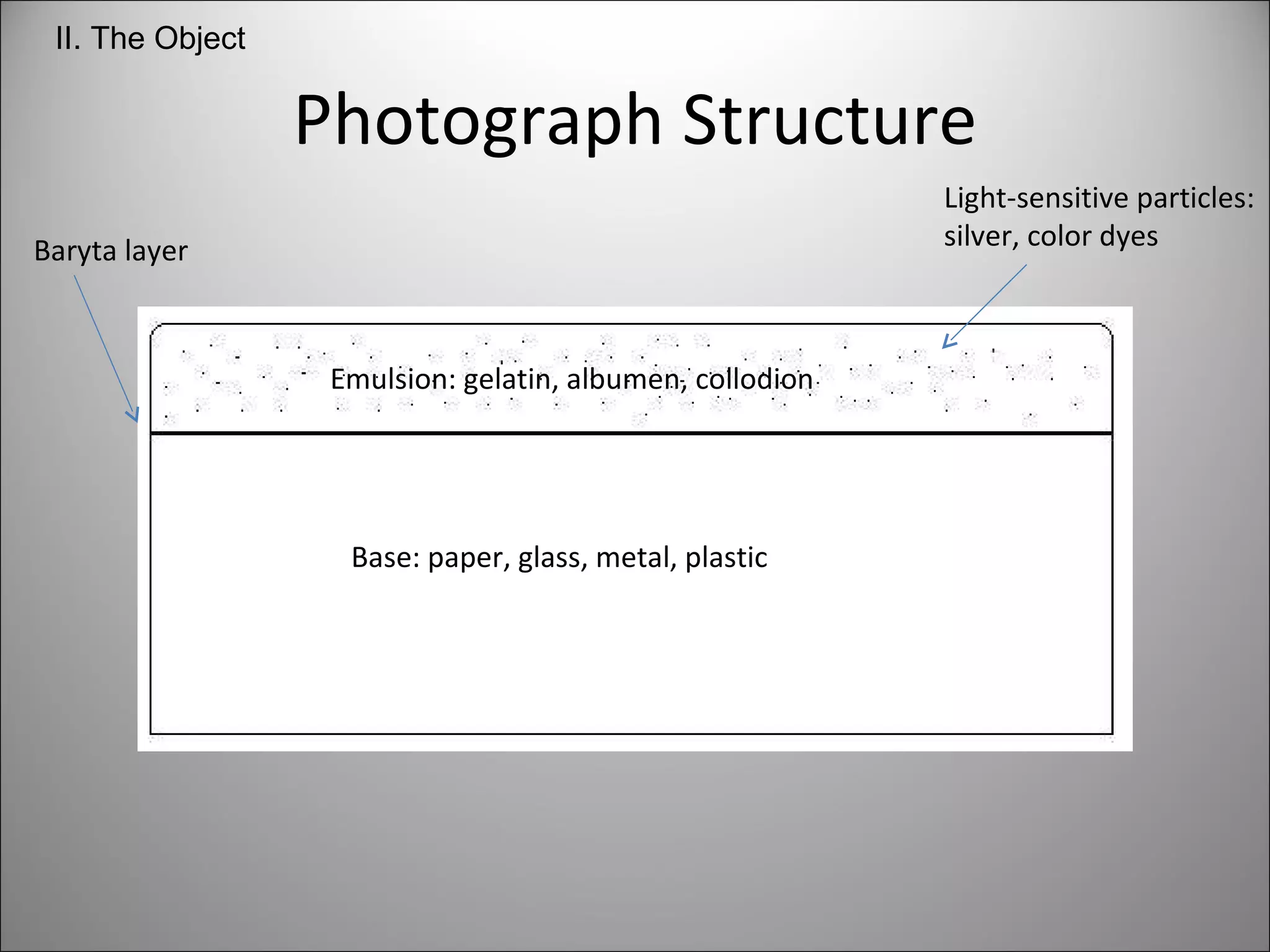
Photograph Structure Base: paper, glass, metal, plastic Light-sensitive particles: silver, color dyes Emulsion: gelatin, albumen, collodion Baryta layer II. The Object
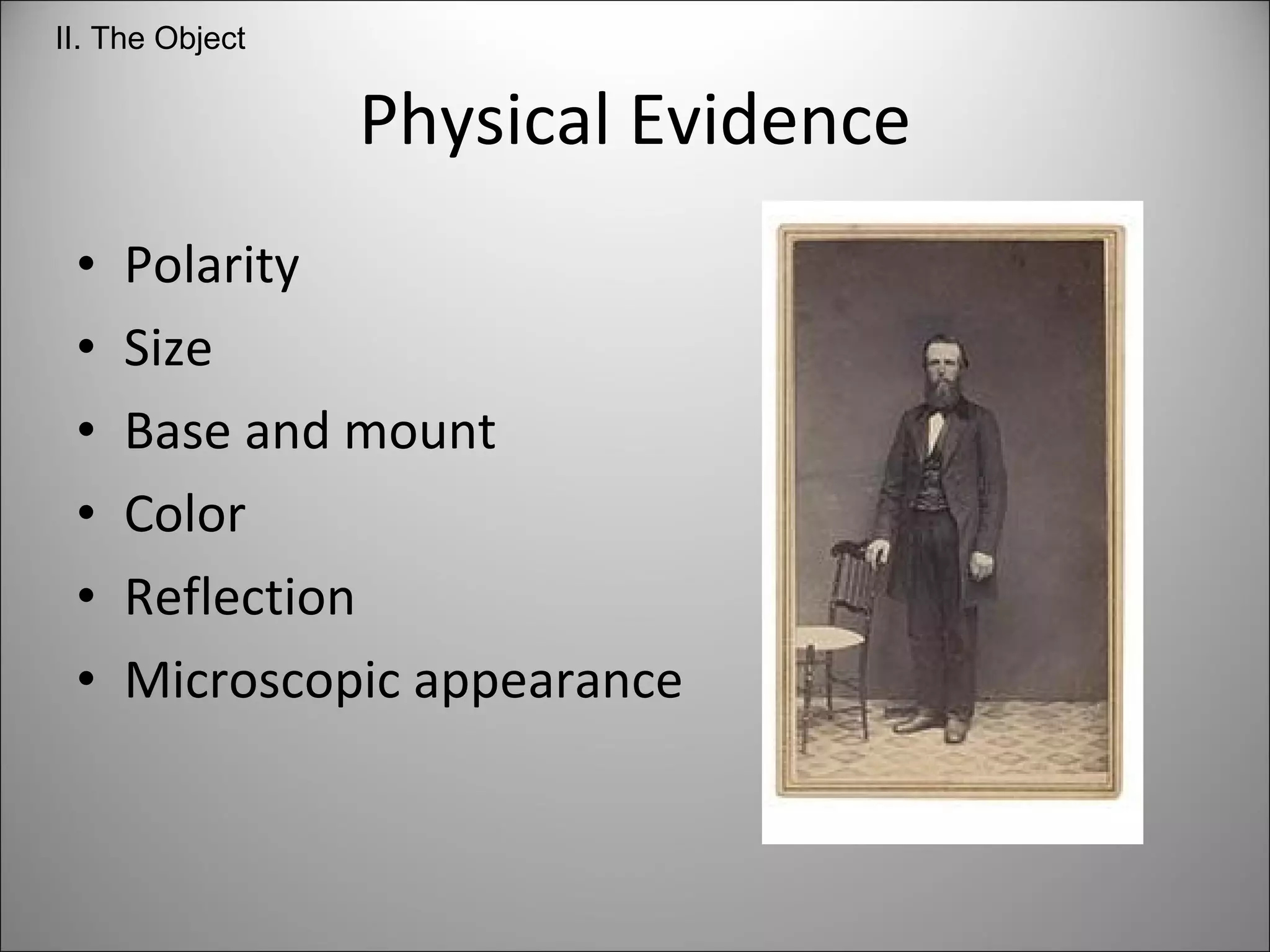
Physical Evidence Polarity Size  Base and mount Color Reflection Microscopic appearance II. The Object
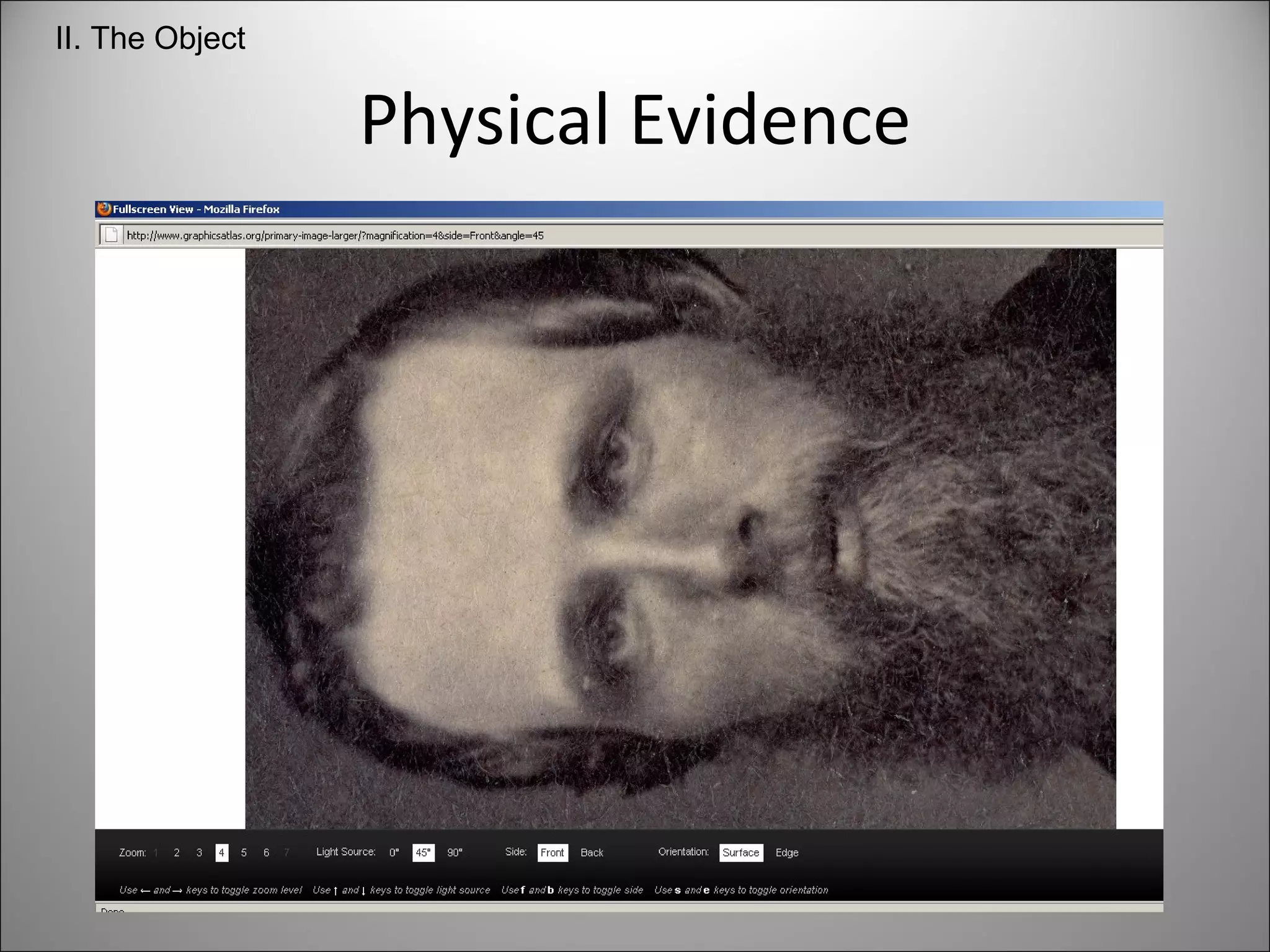
Physical Evidence II. The Object
Common Formats and Processes II. The Object
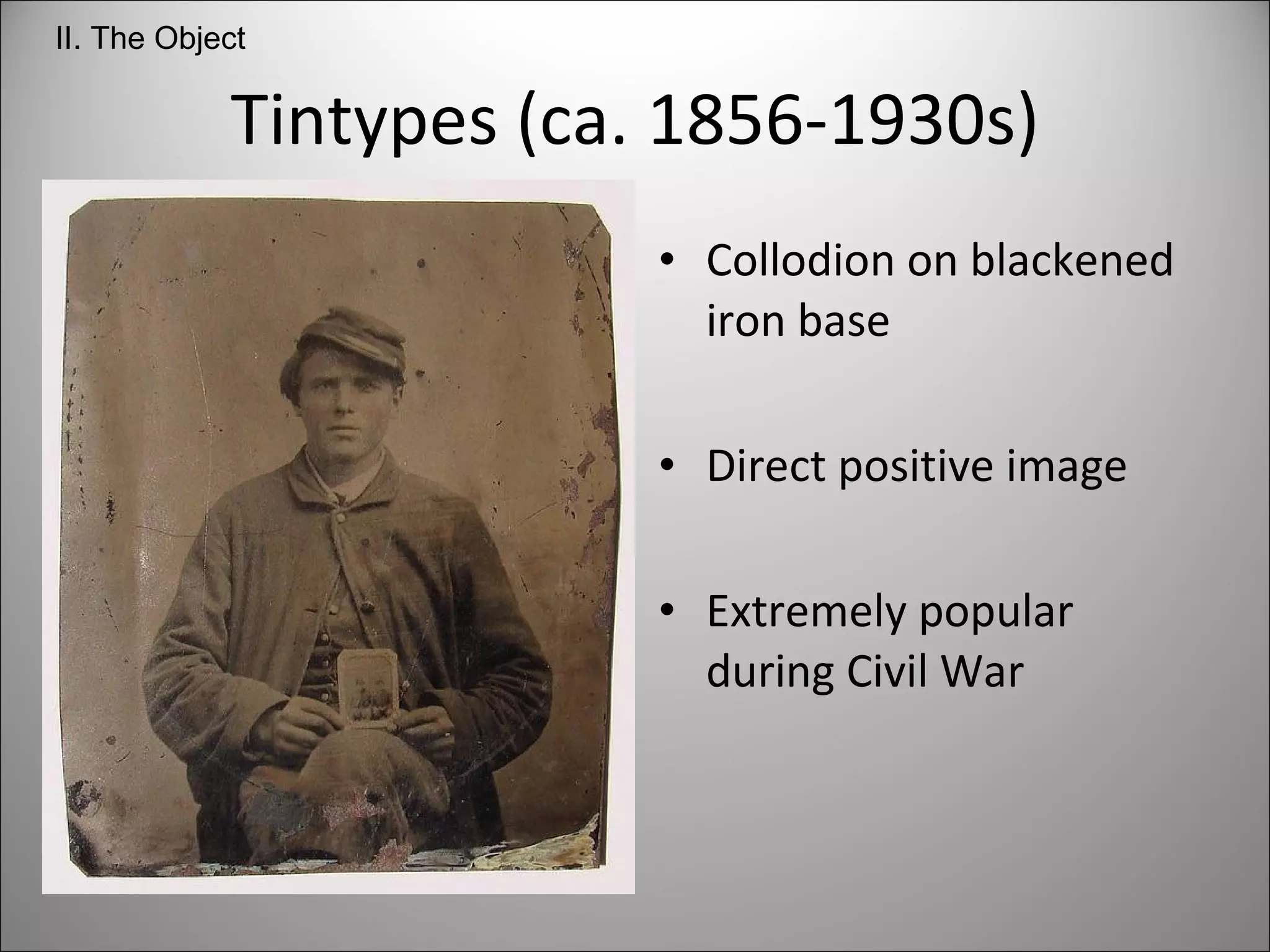
Tintypes (ca. 1856-1930s) Collodion on blackened iron base Direct positive image Extremely popular during Civil War II. The Object
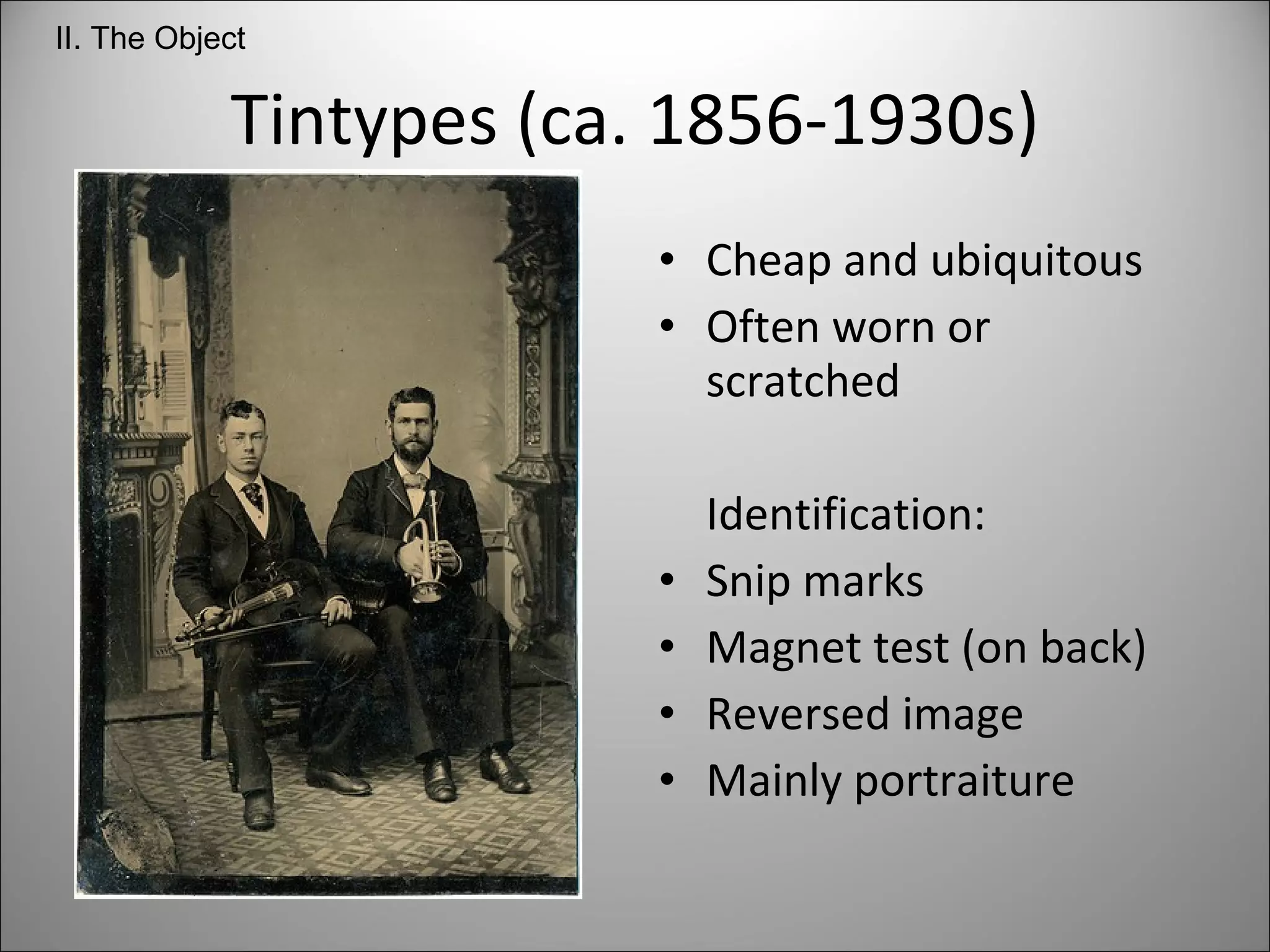
Tintypes (ca. 1856-1930s) Cheap and ubiquitous  Often worn or scratched Identification: Snip marks Magnet test (on back) Reversed image Mainly portraiture II. The Object
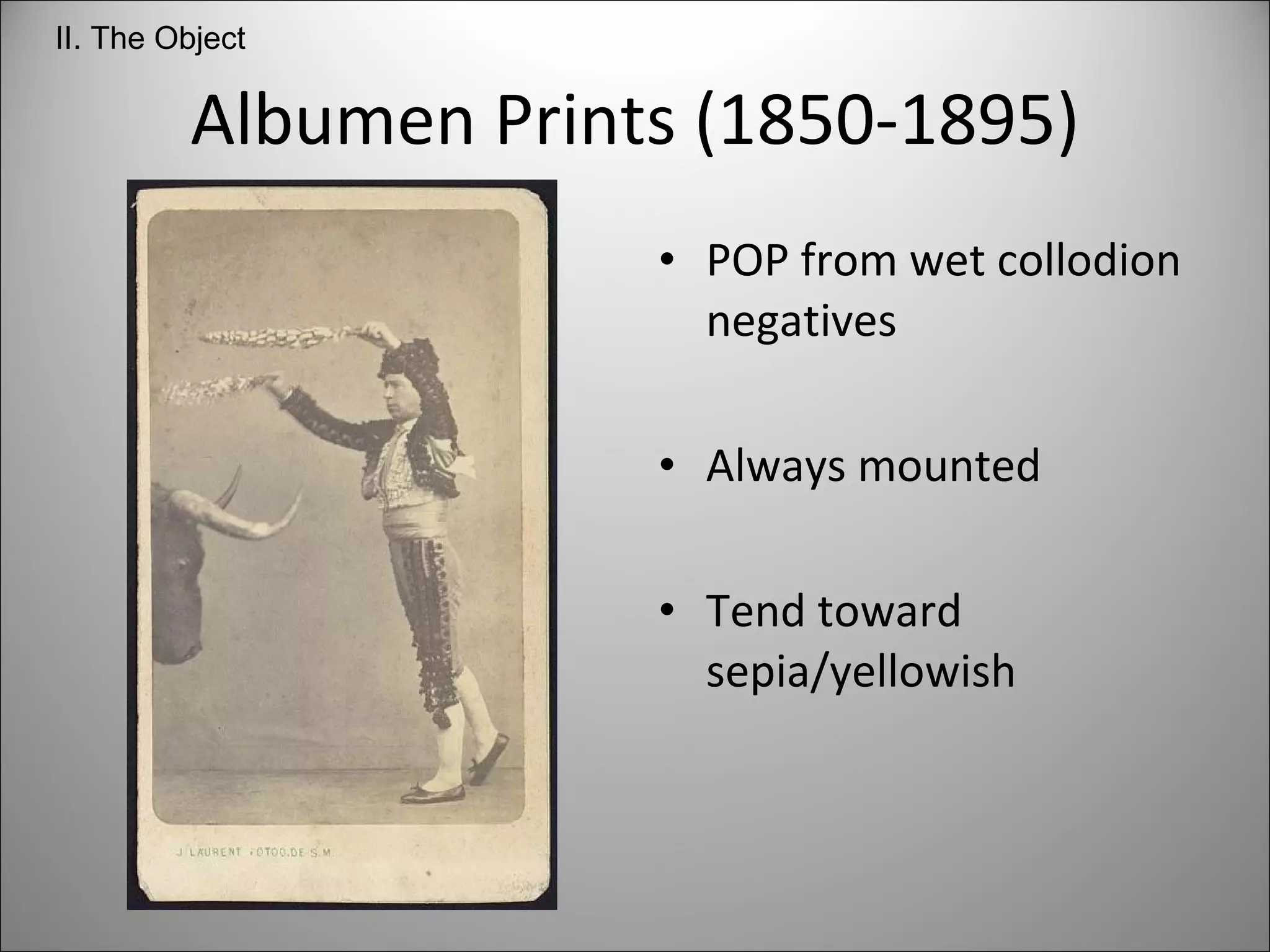
Albumen Prints (1850-1895) POP from wet collodion negatives Always mounted Tend toward sepia/yellowish II. The Object
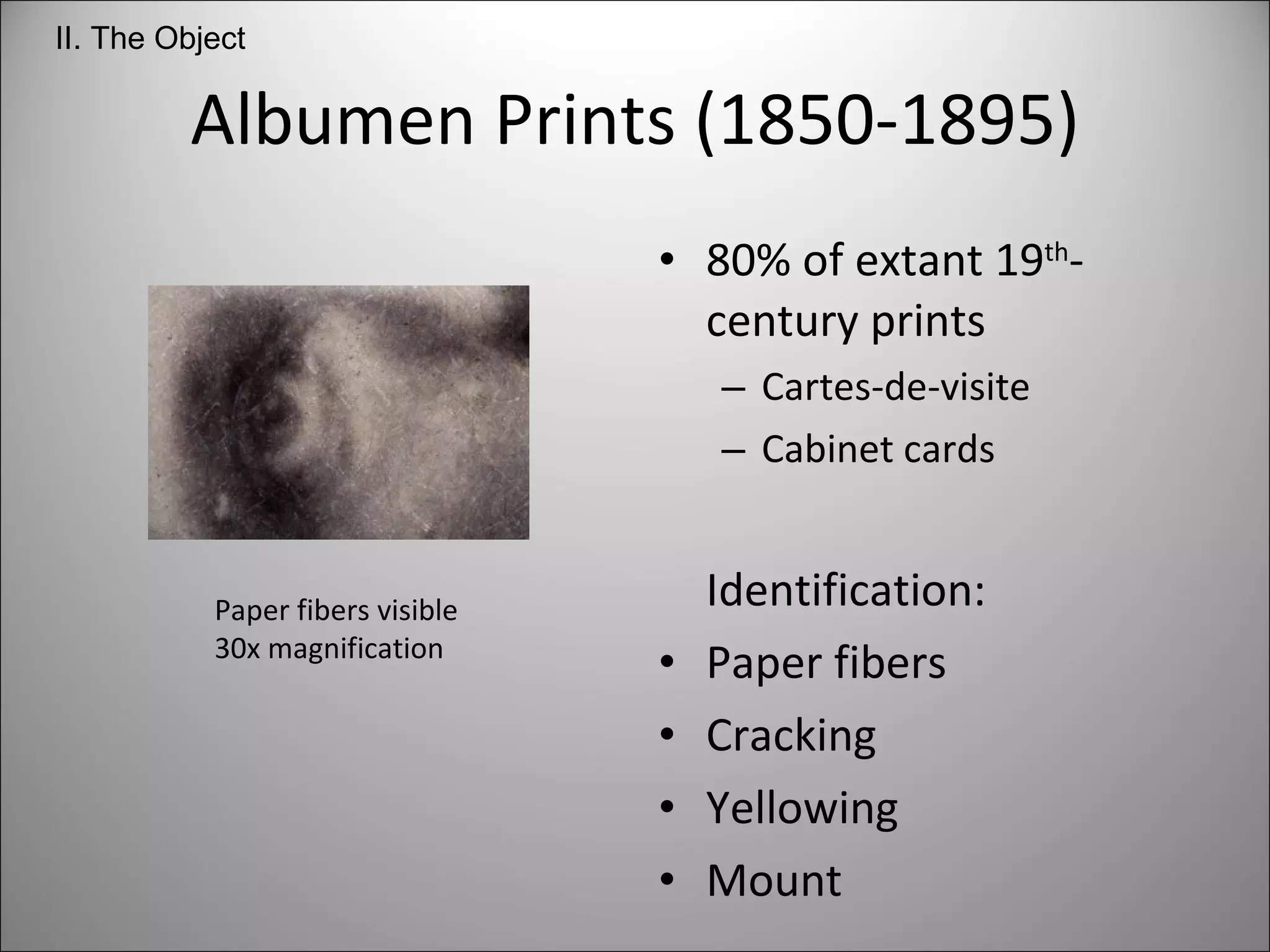
Albumen Prints (1850-1895) 80% of extant 19 th -century prints Cartes-de-visite Cabinet cards Identification: Paper fibers Cracking Yellowing Mount Paper fibers visible 30x magnification II. The Object
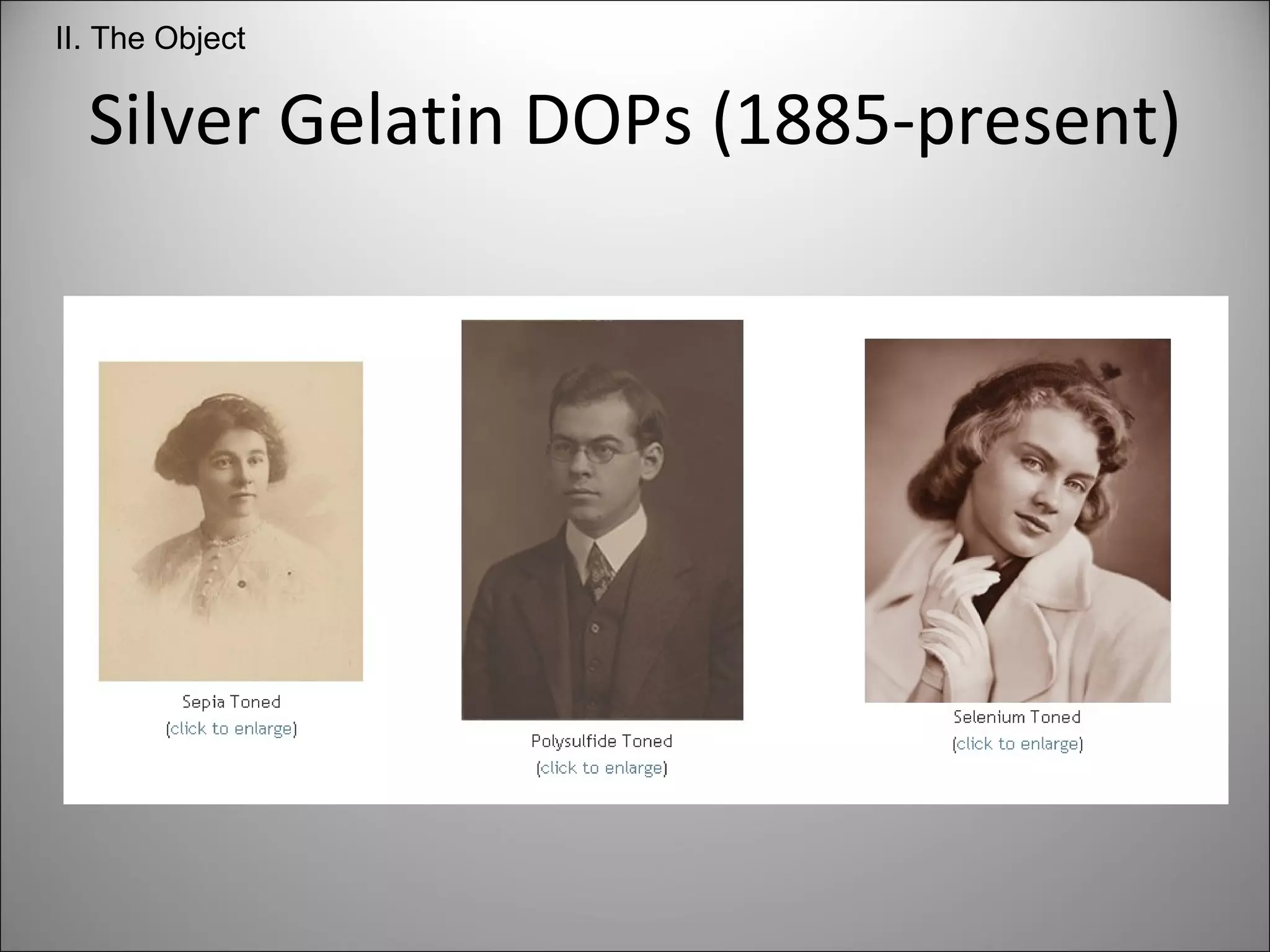
Silver Gelatin DOPs (1885-present) Dominant 20 th -century process Dozens of formats Identification: Neutral unless toned Baryta layer (no paper fibers visible) II. The Object
Silver Gelatin DOPs (1885-present) II. The Object
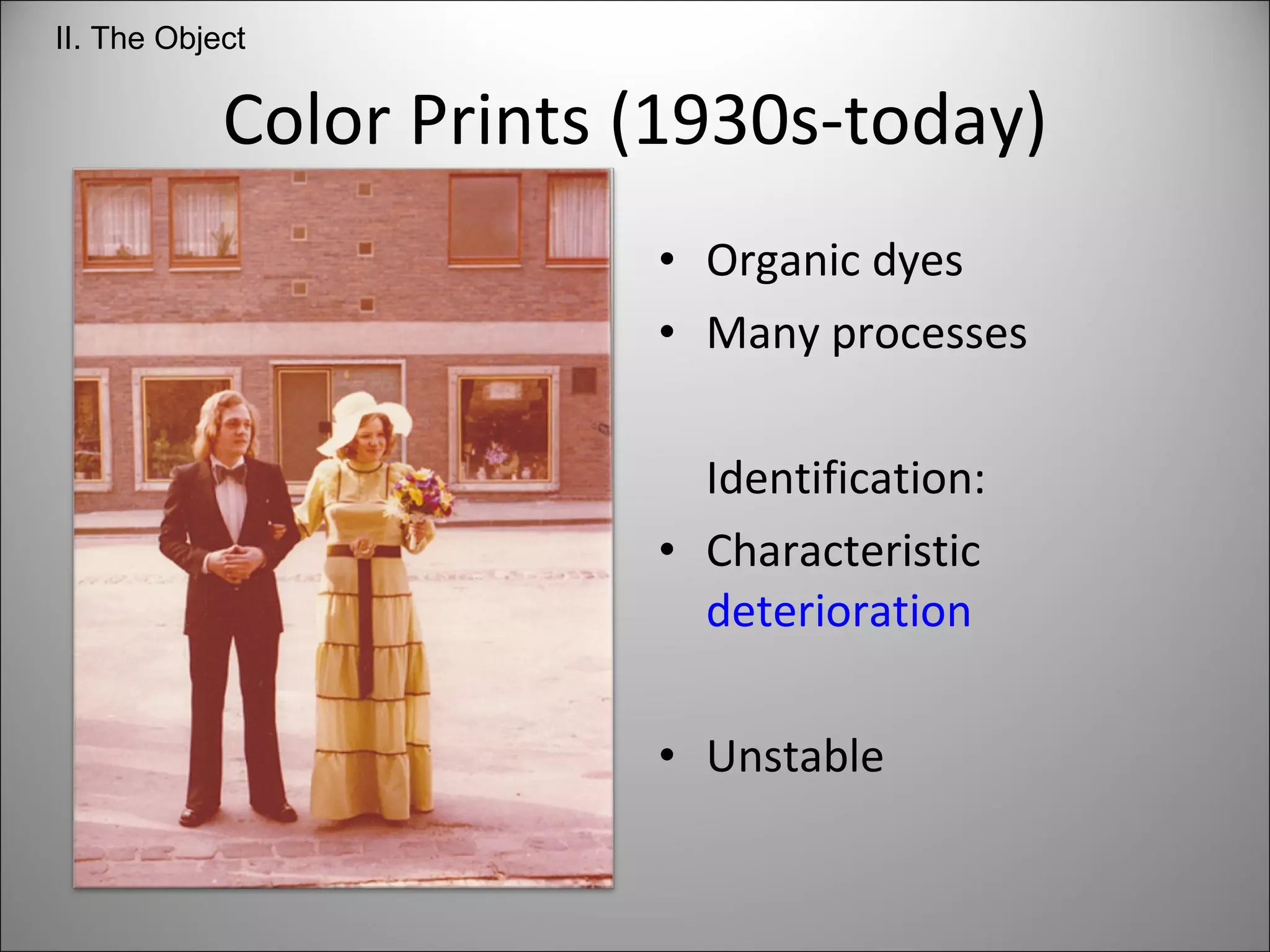
Color Prints (1930s-today) Organic dyes Many processes Identification: Characteristic  deterioration Unstable II. The Object
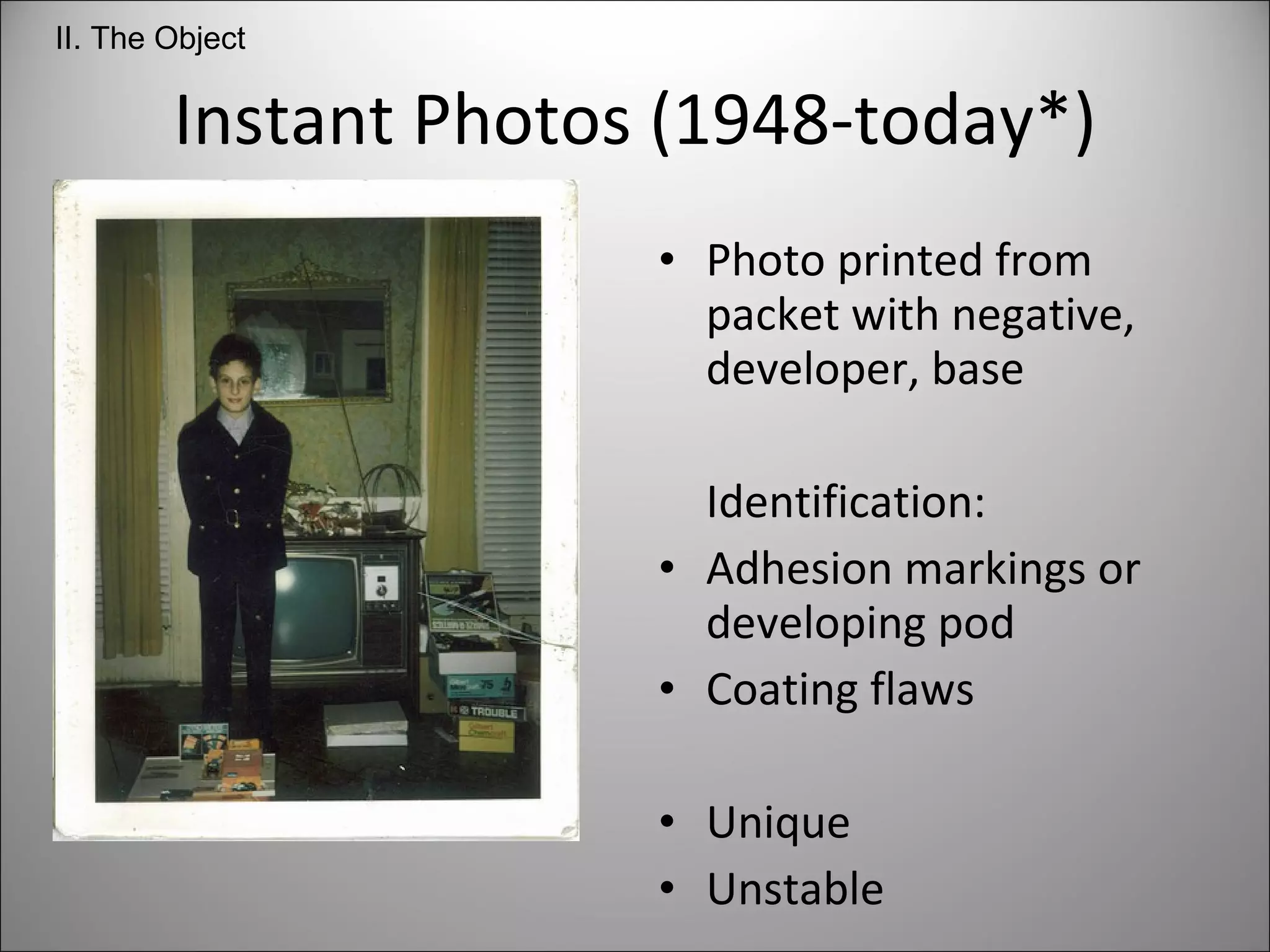
Instant Photos (1948-today*) Photo printed from packet with negative, developer, base Identification: Adhesion markings or developing pod Coating flaws Unique Unstable II. The Object
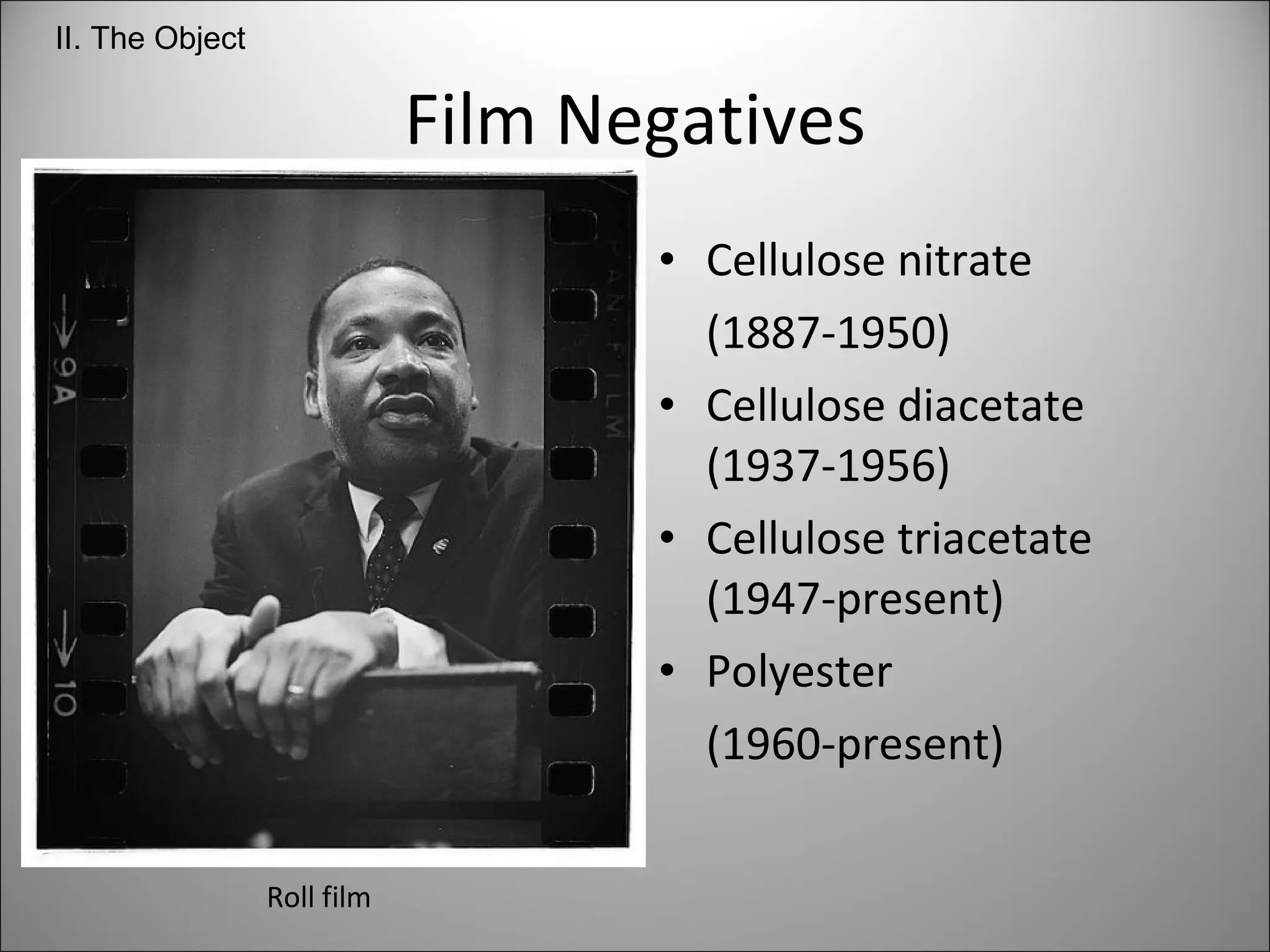
Film Negatives Cellulose nitrate  (1887-1950) Cellulose diacetate (1937-1956) Cellulose triacetate (1947-present) Polyester  (1960-present) Roll film II. The Object
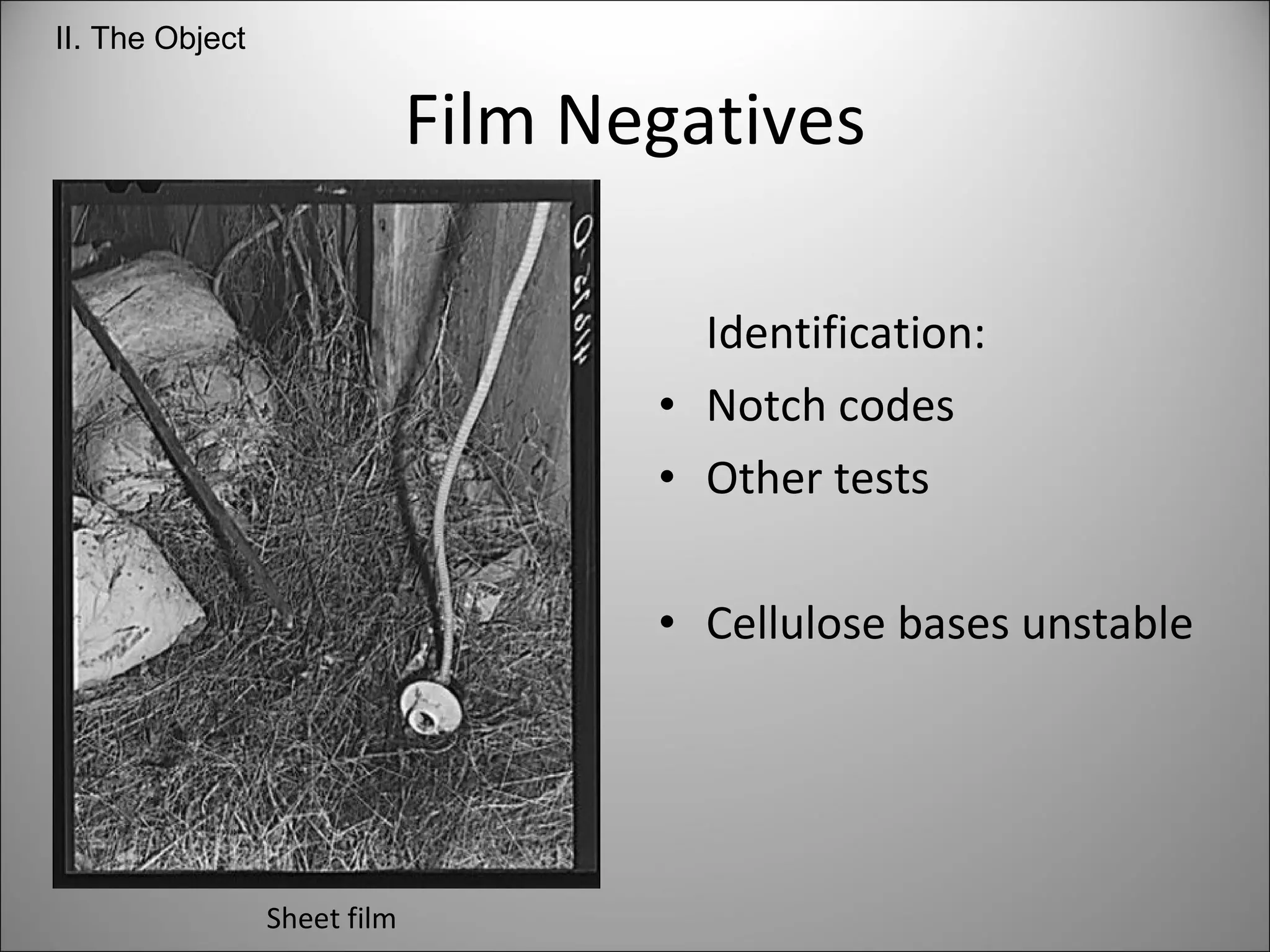
Film Negatives Identification: Notch codes Other tests Cellulose bases unstable Sheet film II. The Object
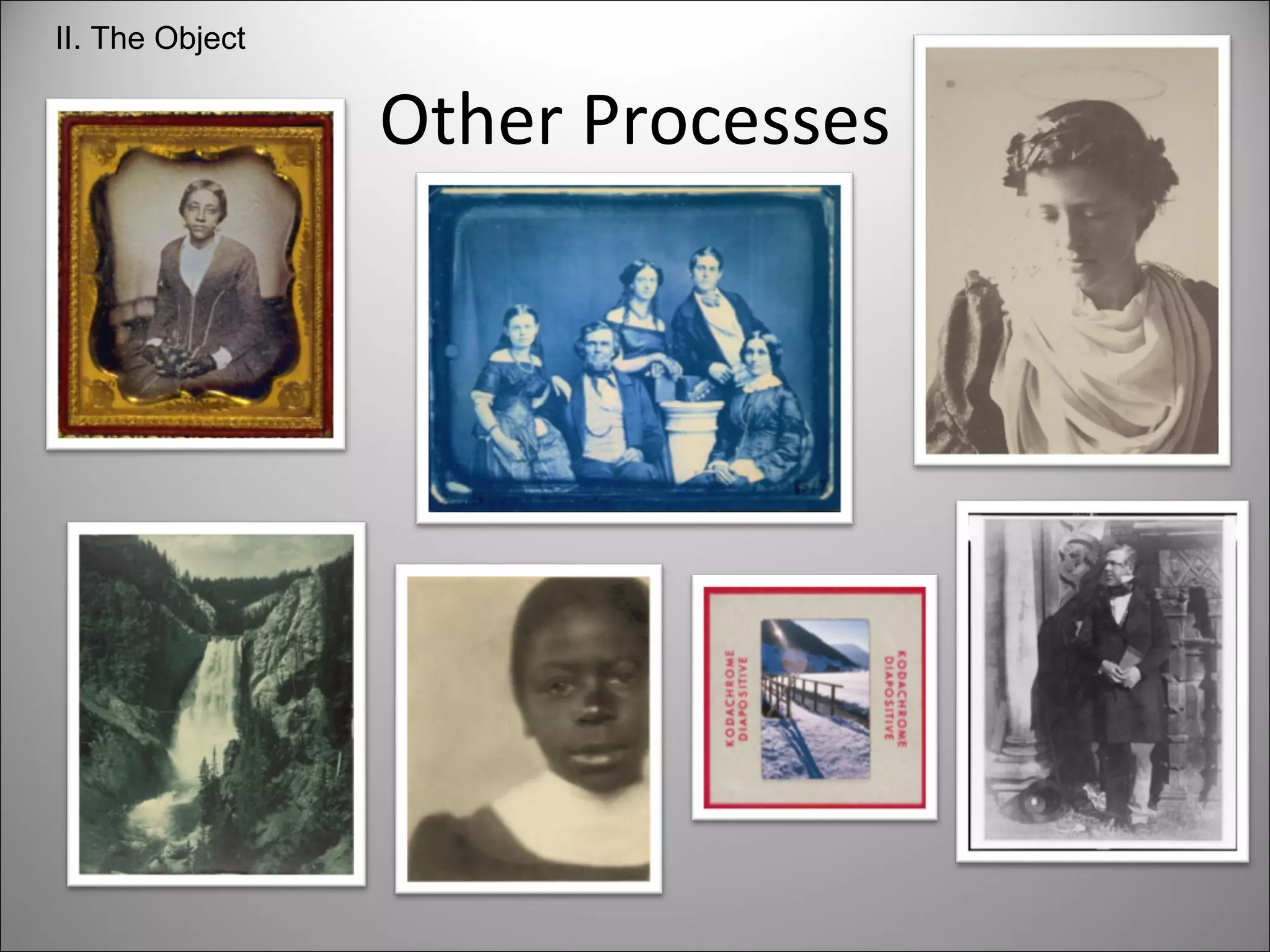
Other Processes II. The Object
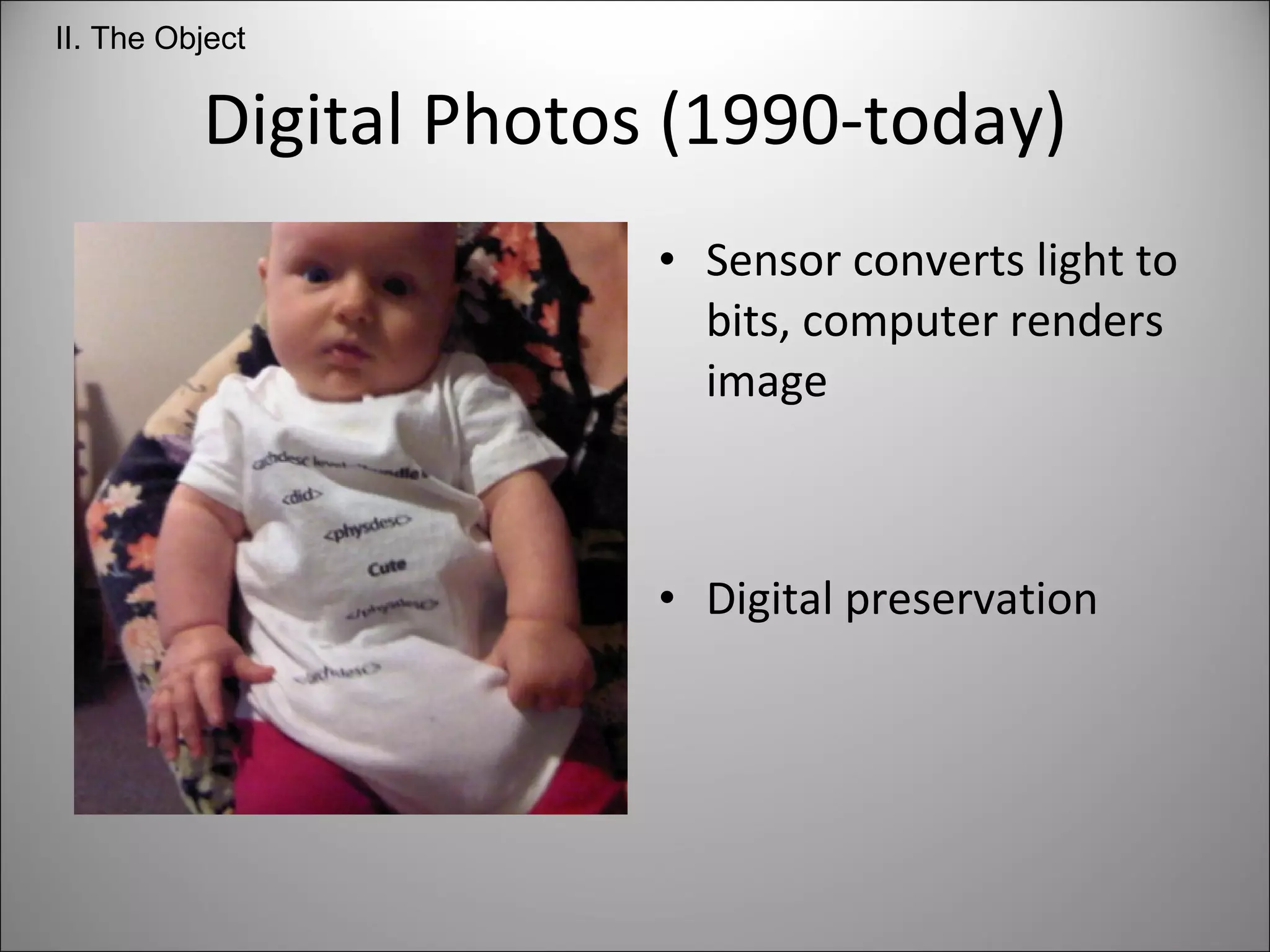
Digital Photos (1990-today) Sensor converts light to bits, computer renders image Digital preservation II. The Object
III. In the Archives
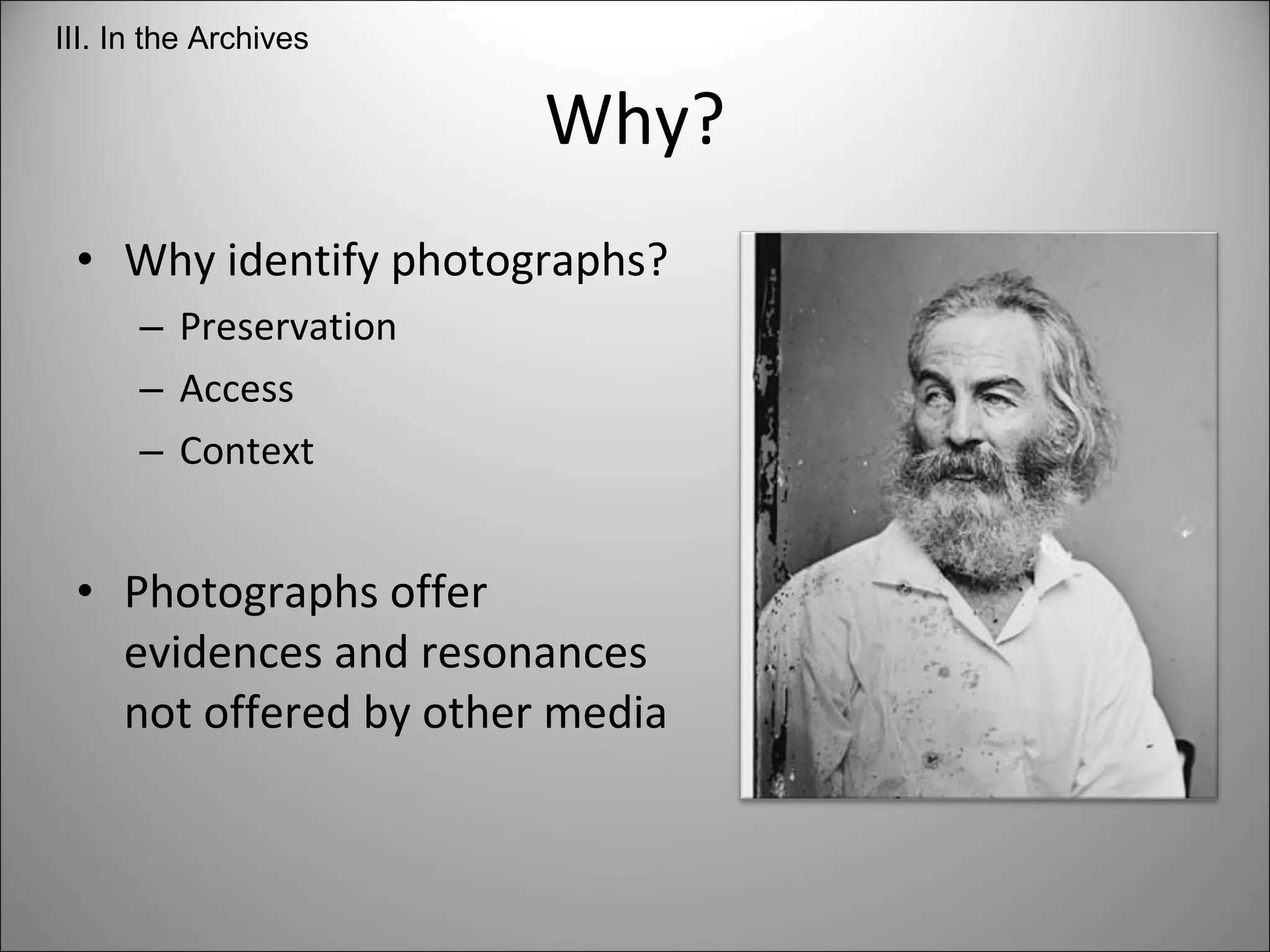
Why? Why identify photographs?  Preservation Access Context Photographs offer evidences and resonances not offered by other media III. In the Archives
Handling  Wear gloves Provide support Use only pencils Gently remove from housing Be aware of physical condition Create and follow handling policy Consider surrogates III. In the Archives
Paper (envelopes, four-flaps)  Cheaper, blocks light, breathable Viewing requires handling Plastic (polyester, polystyrene, etc. No PVC!) Viewing without handling Expensive, not for unstable items Must pass Photographic Activity Test (PAT) Housing III. In the Archives
Housing Boxes and folders PAT test Proper support for format (long edge down or flat) Ideally, separate photographs from other materials, and then by format (especially negatives!) Balance condition/format, use, resources  III. In the Archives
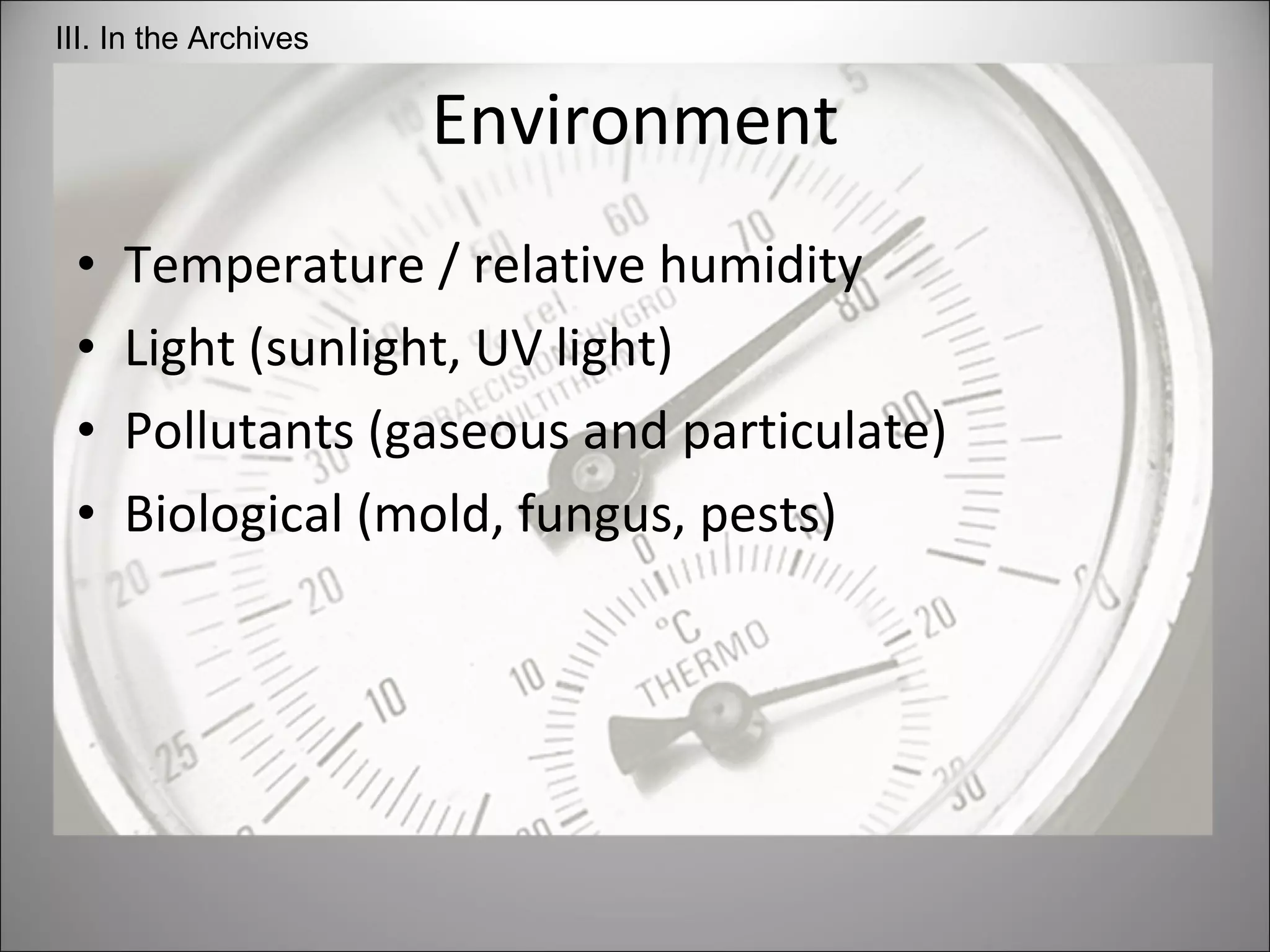
Environment Temperature / relative humidity Light (sunlight, UV light) Pollutants (gaseous and particulate) Biological (mold, fungus, pests) III. In the Archives
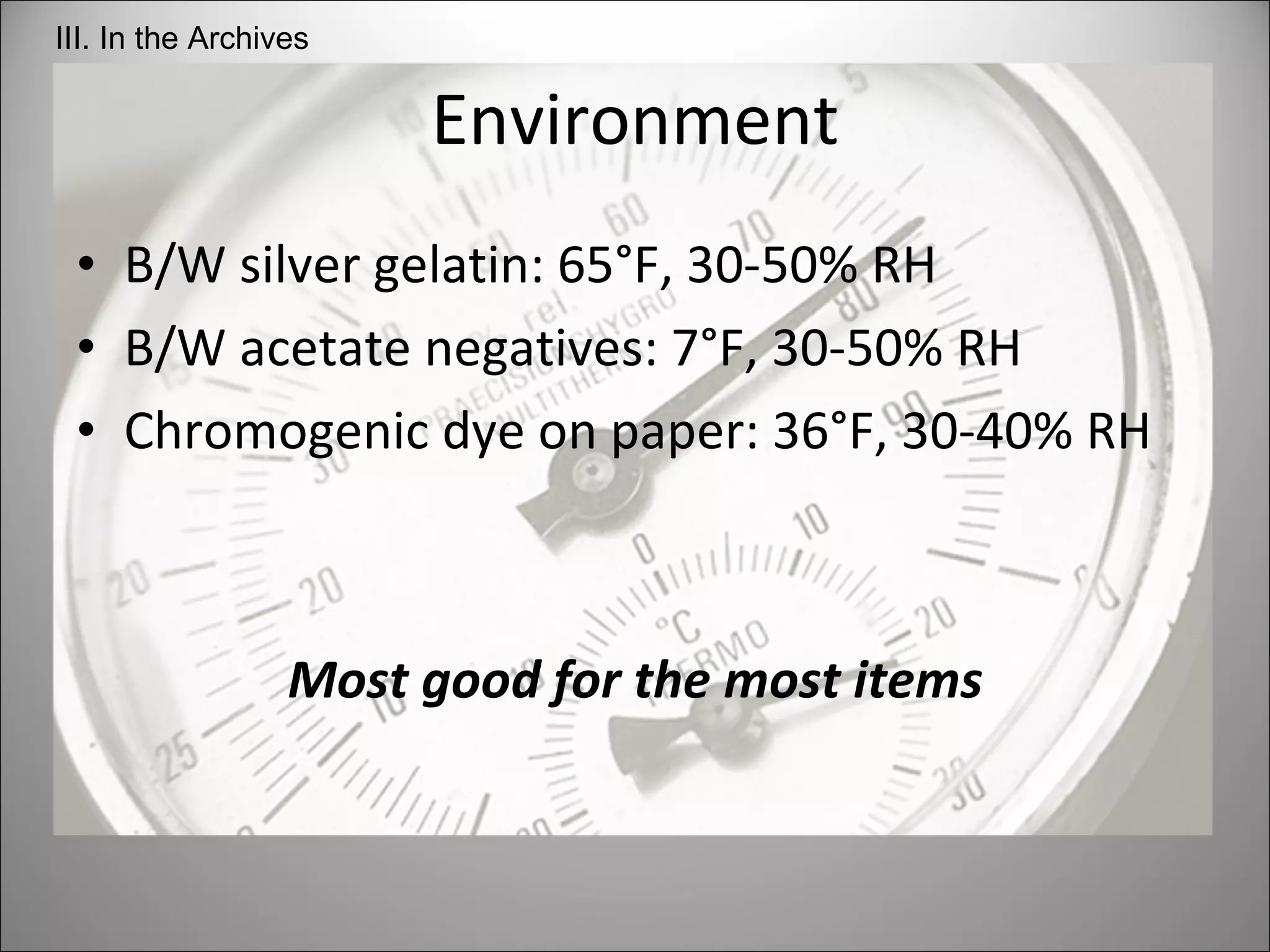
Environment B/W silver gelatin: 65°F, 30-50% RH B/W acetate negatives: 7°F, 30-50% RH Chromogenic dye on paper: 36°F, 30-40% RH Most good for the most items III. In the Archives
Selected Resources General Photographs: Archival Care and Management,  Ritzenthaler & Vogt-O'Connor   (2006) Care and Identification of 19th-Century Photographic Prints , Reilly (1986) SAA photo preservation workshop III. In the Archives
Selected Resources Cartes de Visite Cartes de Visite in Nineteenth Century Photography,  Darrah (1981) Fashion Dressed for the Photographer: Ordinary Americans and Fashion, 1840-1900 , Severa (1995) III. In the Archives
Selected Resources Gelatin silver A Guide to Fiber-Base Gelatin Silver Print Condition and Deterioration, Weaver (2008) Negatives The Acetate Negative Survey, Horvath (1987) III. In the Archives
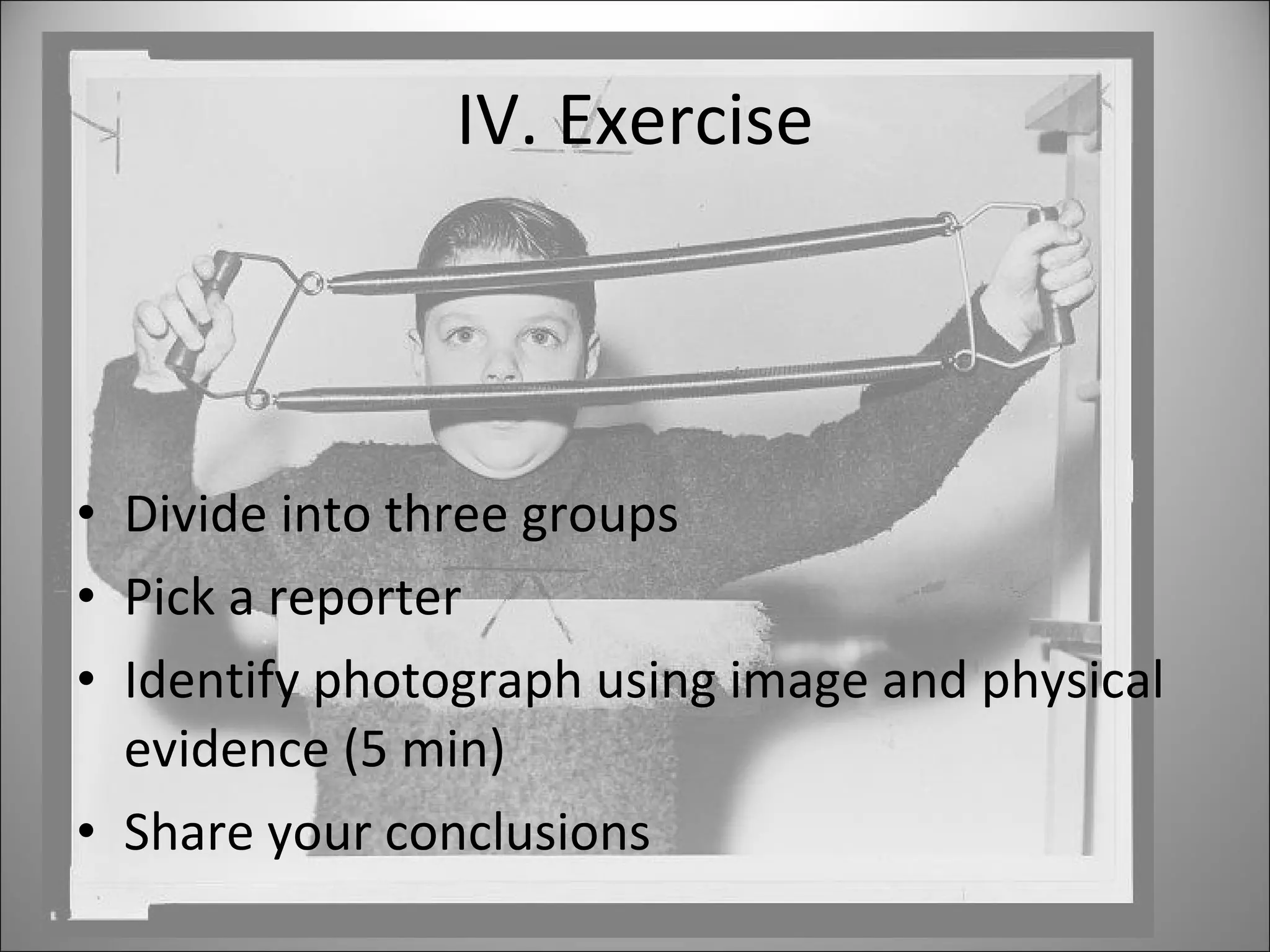
IV. Exercise Divide into three groups Pick a reporter Identify photograph using image and physical evidence (5 min) Share your conclusions
Group 1
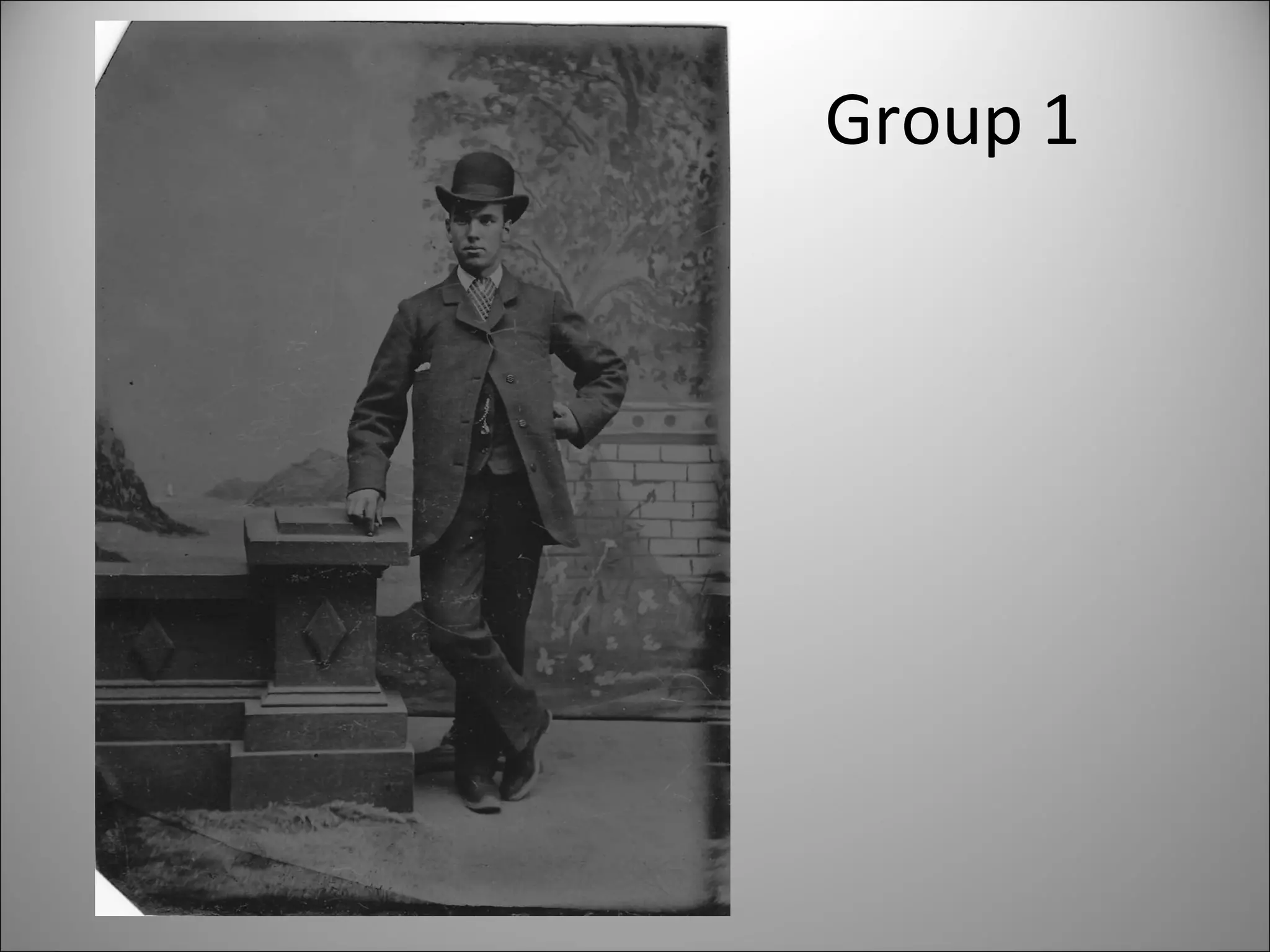
Group 1 Sixth-plate sized tintype, 1880s Magnet test, snip marks Image reversed – watch customarily on left Jacket, tie, and hat match  1880s   style
Group 2
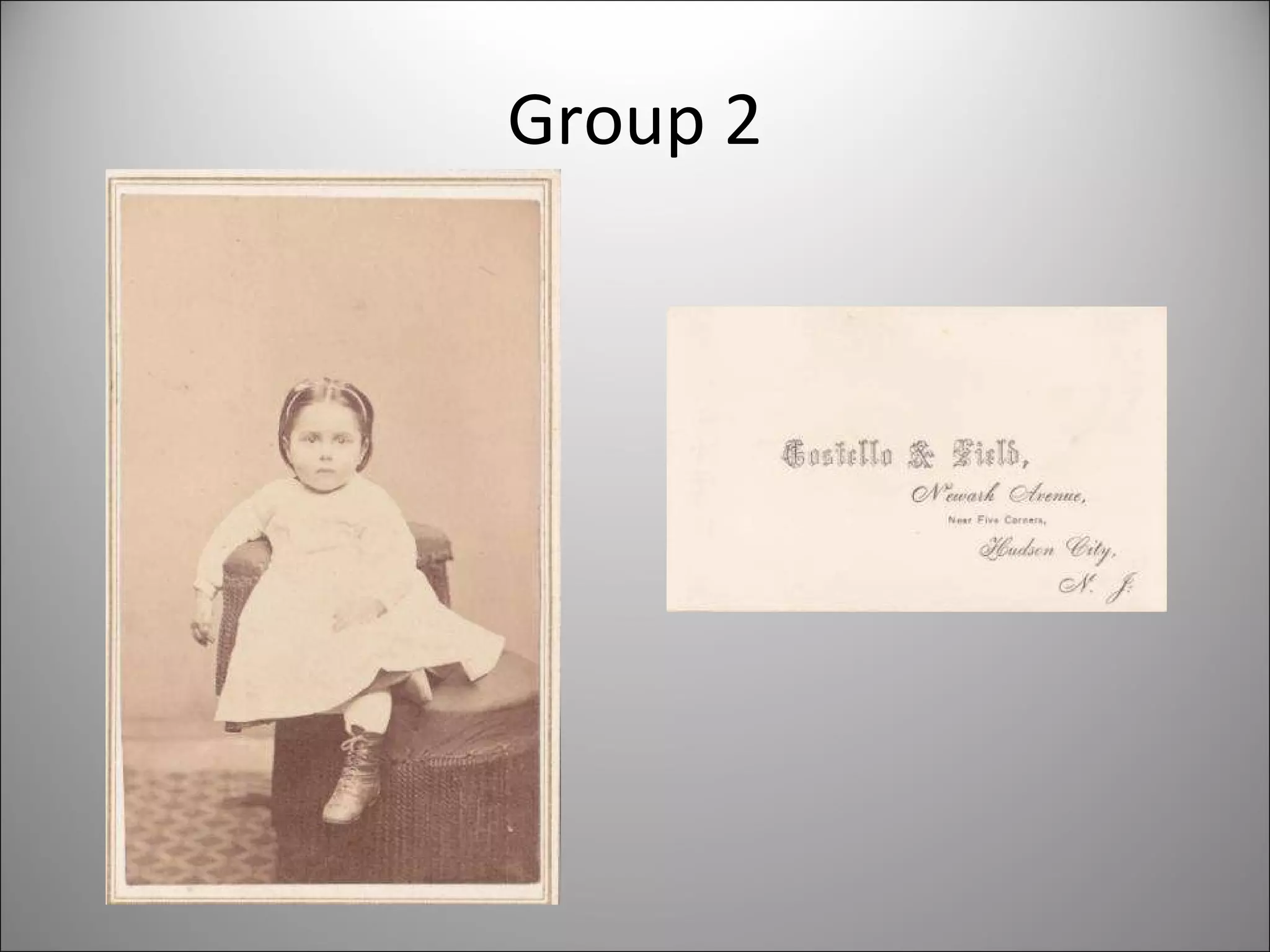
Group 2 Carte-de-visite, early 1870s Medium card stock, square corners (1869-1871) Borders, common 1861-1869 Imprint with length-wise large type (common 1870-1875) Shoes  probably 1865-1875  Photographers active in  1870s
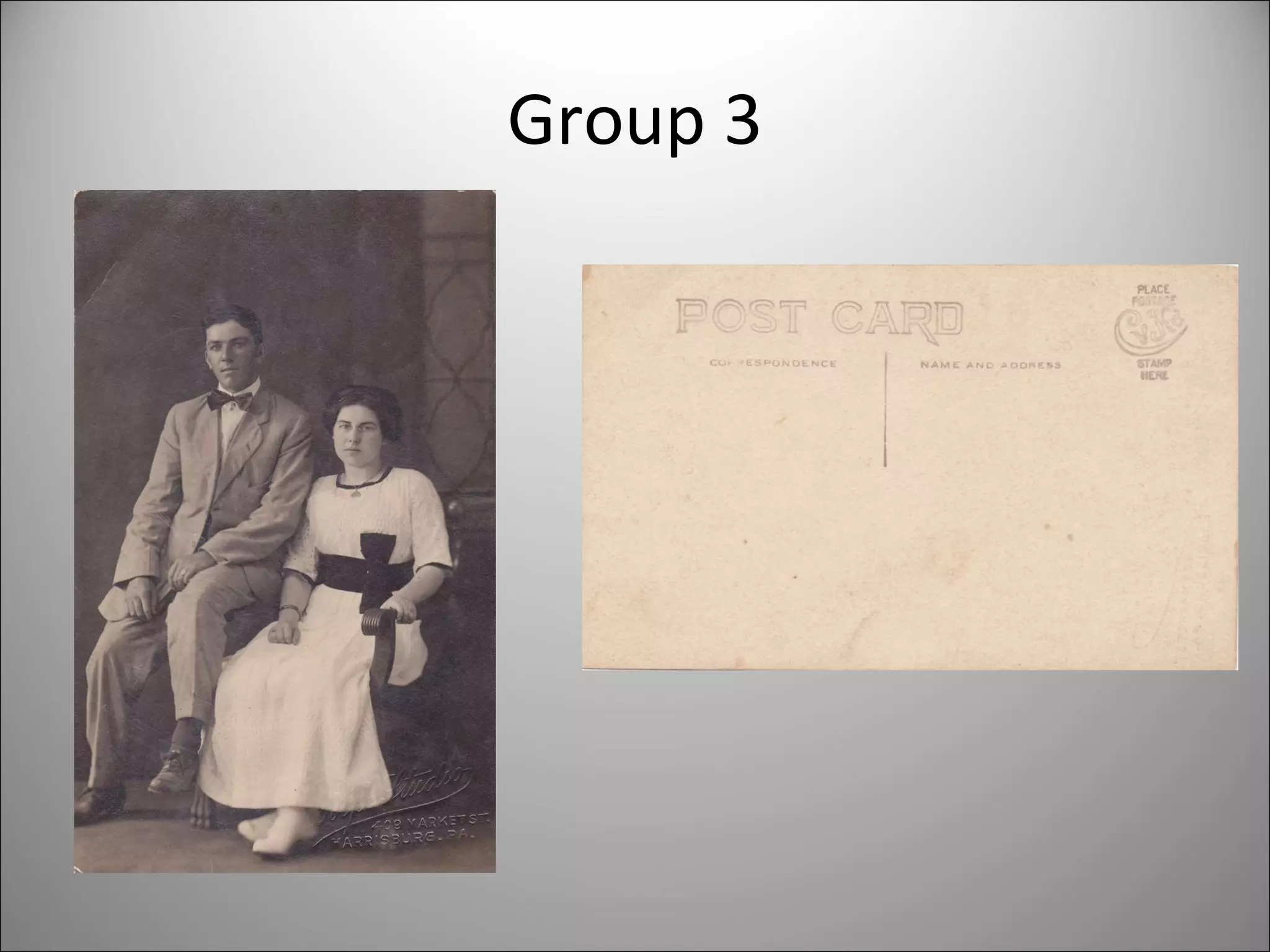
Group 3
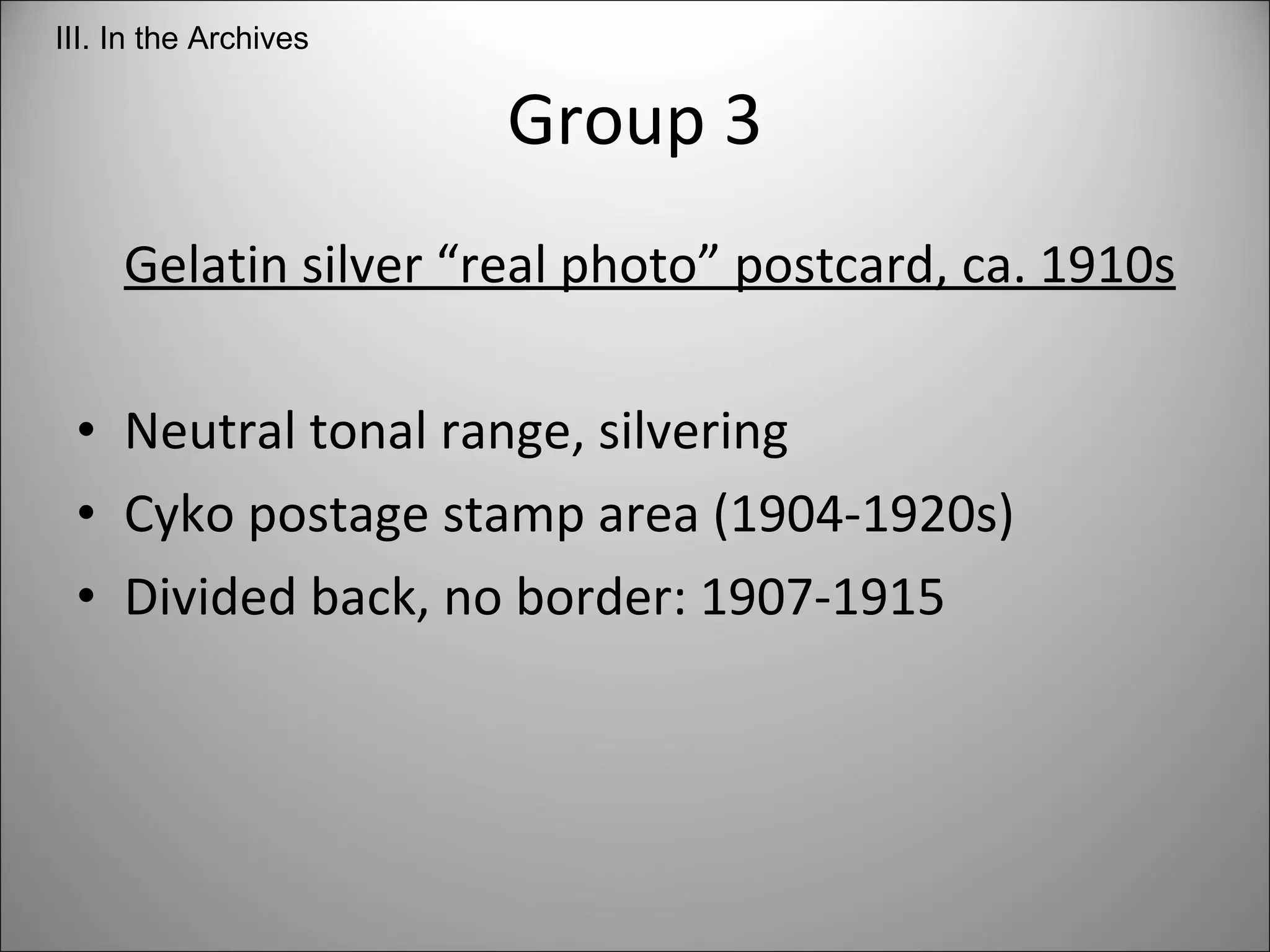
Group 3 Gelatin silver “real photo” postcard, ca. 1910s Neutral tonal range, silvering Cyko postage stamp area (1904-1920s) Divided back, no border: 1907-1915 III. In the Archives
Thank you!

What's In a Photograph?

  • 1.
  • 2.
    Overview I. The Image II. The Object III. In the Archives IV. Exercise
  • 3.
  • 4.
    What’s in animage? I. The Image
  • 5.
    Reading an ImageFive Ws Who What Where When Why I. The Image
  • 6.
    Reading an ImageWho? Photographer Subject I. The Image
  • 7.
    Reading an ImageWhat? Present Absent I. The Image
  • 8.
    Reading an ImageWhere? Location I. The Image
  • 9.
    Reading an ImageWhen? Fashion Technology Absence I. The Image
  • 10.
    Reading an ImageWhy? Context Intention The "Carrying-in Boy," In an Indiana Glass Works, 1:00 A. M., Aug., 1908. Location: Indiana. National Child Labor Committee Collection I. The Image
  • 11.
    Reading an ImageVisual Elements Composition Depth of field Point of view Rhythm Color balance Tonal range I. The Image
  • 12.
  • 13.
  • 14.
    Photo Basics II.The Object
  • 15.
    What is photography?II. The Object
  • 16.
  • 17.
    Trends in PhotoHistory Easier to create Easier to duplicate More accessible Cheaper II. The Object
  • 18.
    What is aphotograph? A complex physical object that has an image fixed via a chemical process II. The Object
  • 19.
    Photograph Structure Base:paper, glass, metal, plastic Light-sensitive particles: silver, color dyes Emulsion: gelatin, albumen, collodion Baryta layer II. The Object
  • 20.
    Physical Evidence PolaritySize Base and mount Color Reflection Microscopic appearance II. The Object
  • 21.
  • 22.
    Common Formats andProcesses II. The Object
  • 23.
    Tintypes (ca. 1856-1930s)Collodion on blackened iron base Direct positive image Extremely popular during Civil War II. The Object
  • 24.
    Tintypes (ca. 1856-1930s)Cheap and ubiquitous Often worn or scratched Identification: Snip marks Magnet test (on back) Reversed image Mainly portraiture II. The Object
  • 25.
    Albumen Prints (1850-1895)POP from wet collodion negatives Always mounted Tend toward sepia/yellowish II. The Object
  • 26.
    Albumen Prints (1850-1895)80% of extant 19 th -century prints Cartes-de-visite Cabinet cards Identification: Paper fibers Cracking Yellowing Mount Paper fibers visible 30x magnification II. The Object
  • 27.
    Silver Gelatin DOPs(1885-present) Dominant 20 th -century process Dozens of formats Identification: Neutral unless toned Baryta layer (no paper fibers visible) II. The Object
  • 28.
    Silver Gelatin DOPs(1885-present) II. The Object
  • 29.
    Color Prints (1930s-today)Organic dyes Many processes Identification: Characteristic deterioration Unstable II. The Object
  • 30.
    Instant Photos (1948-today*)Photo printed from packet with negative, developer, base Identification: Adhesion markings or developing pod Coating flaws Unique Unstable II. The Object
  • 31.
    Film Negatives Cellulosenitrate (1887-1950) Cellulose diacetate (1937-1956) Cellulose triacetate (1947-present) Polyester (1960-present) Roll film II. The Object
  • 32.
    Film Negatives Identification:Notch codes Other tests Cellulose bases unstable Sheet film II. The Object
  • 33.
  • 34.
    Digital Photos (1990-today)Sensor converts light to bits, computer renders image Digital preservation II. The Object
  • 35.
    III. In theArchives
  • 36.
    Why? Why identifyphotographs? Preservation Access Context Photographs offer evidences and resonances not offered by other media III. In the Archives
  • 37.
    Handling Weargloves Provide support Use only pencils Gently remove from housing Be aware of physical condition Create and follow handling policy Consider surrogates III. In the Archives
  • 38.
    Paper (envelopes, four-flaps) Cheaper, blocks light, breathable Viewing requires handling Plastic (polyester, polystyrene, etc. No PVC!) Viewing without handling Expensive, not for unstable items Must pass Photographic Activity Test (PAT) Housing III. In the Archives
  • 39.
    Housing Boxes andfolders PAT test Proper support for format (long edge down or flat) Ideally, separate photographs from other materials, and then by format (especially negatives!) Balance condition/format, use, resources III. In the Archives
  • 40.
    Environment Temperature /relative humidity Light (sunlight, UV light) Pollutants (gaseous and particulate) Biological (mold, fungus, pests) III. In the Archives
  • 41.
    Environment B/W silvergelatin: 65°F, 30-50% RH B/W acetate negatives: 7°F, 30-50% RH Chromogenic dye on paper: 36°F, 30-40% RH Most good for the most items III. In the Archives
  • 42.
    Selected Resources GeneralPhotographs: Archival Care and Management, Ritzenthaler & Vogt-O'Connor (2006) Care and Identification of 19th-Century Photographic Prints , Reilly (1986) SAA photo preservation workshop III. In the Archives
  • 43.
    Selected Resources Cartesde Visite Cartes de Visite in Nineteenth Century Photography, Darrah (1981) Fashion Dressed for the Photographer: Ordinary Americans and Fashion, 1840-1900 , Severa (1995) III. In the Archives
  • 44.
    Selected Resources Gelatinsilver A Guide to Fiber-Base Gelatin Silver Print Condition and Deterioration, Weaver (2008) Negatives The Acetate Negative Survey, Horvath (1987) III. In the Archives
  • 45.
    IV. Exercise Divideinto three groups Pick a reporter Identify photograph using image and physical evidence (5 min) Share your conclusions
  • 46.
  • 47.
    Group 1 Sixth-platesized tintype, 1880s Magnet test, snip marks Image reversed – watch customarily on left Jacket, tie, and hat match 1880s style
  • 48.
  • 49.
    Group 2 Carte-de-visite,early 1870s Medium card stock, square corners (1869-1871) Borders, common 1861-1869 Imprint with length-wise large type (common 1870-1875) Shoes probably 1865-1875 Photographers active in 1870s
  • 50.
  • 51.
    Group 3 Gelatinsilver “real photo” postcard, ca. 1910s Neutral tonal range, silvering Cyko postage stamp area (1904-1920s) Divided back, no border: 1907-1915 III. In the Archives
  • 52.

Editor's Notes

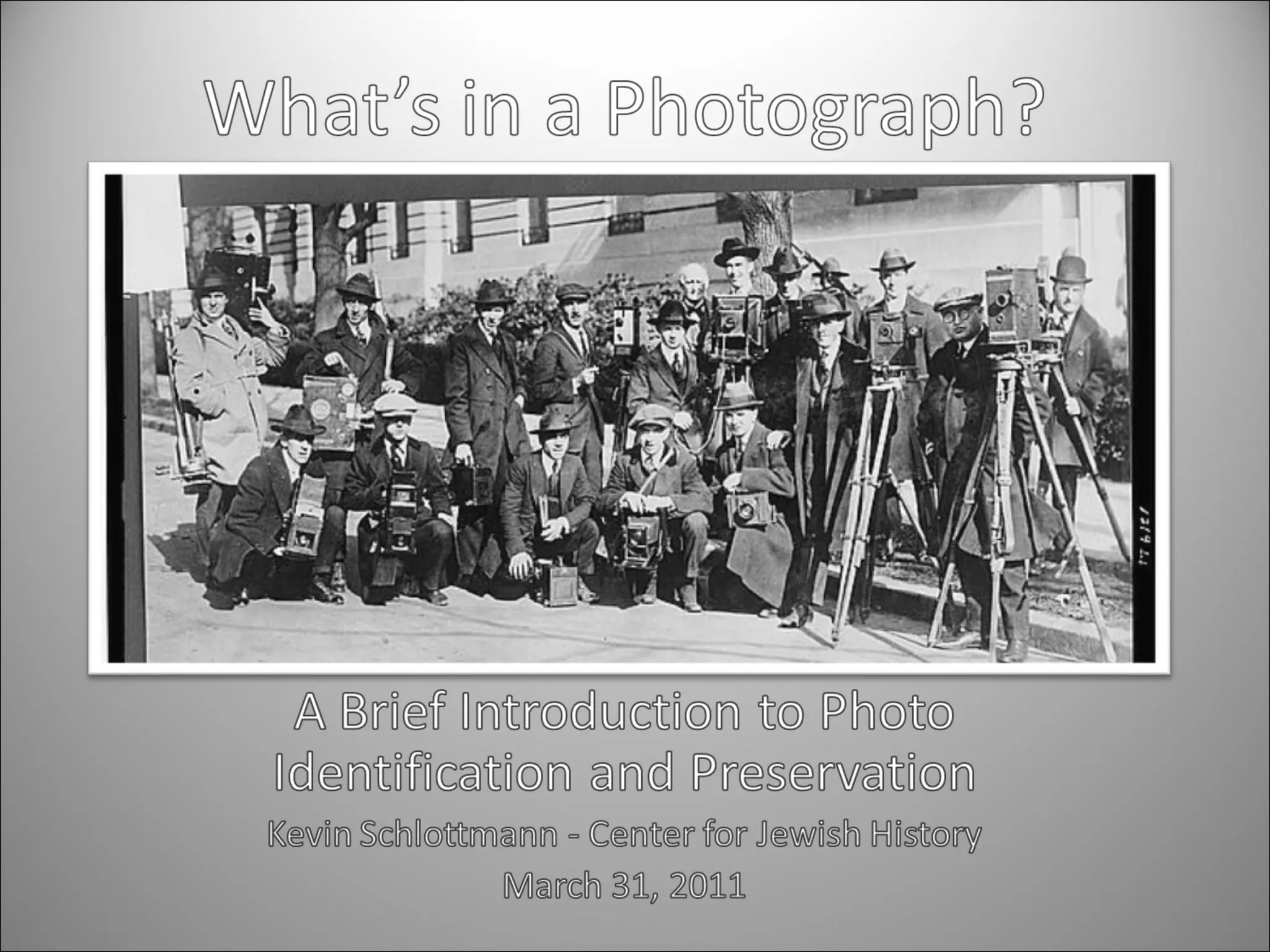
  • #2 [Group portrait of seventeen members of the White House News Photographers' Association, standing and squatting, facing front, with cameras] Digital ID: (b&w film copy neg.) cph 3c31921 http://hdl.loc.gov/loc.pnp/cph.3c31921 http://www.loc.gov/pictures/resource/cph.3c31921/
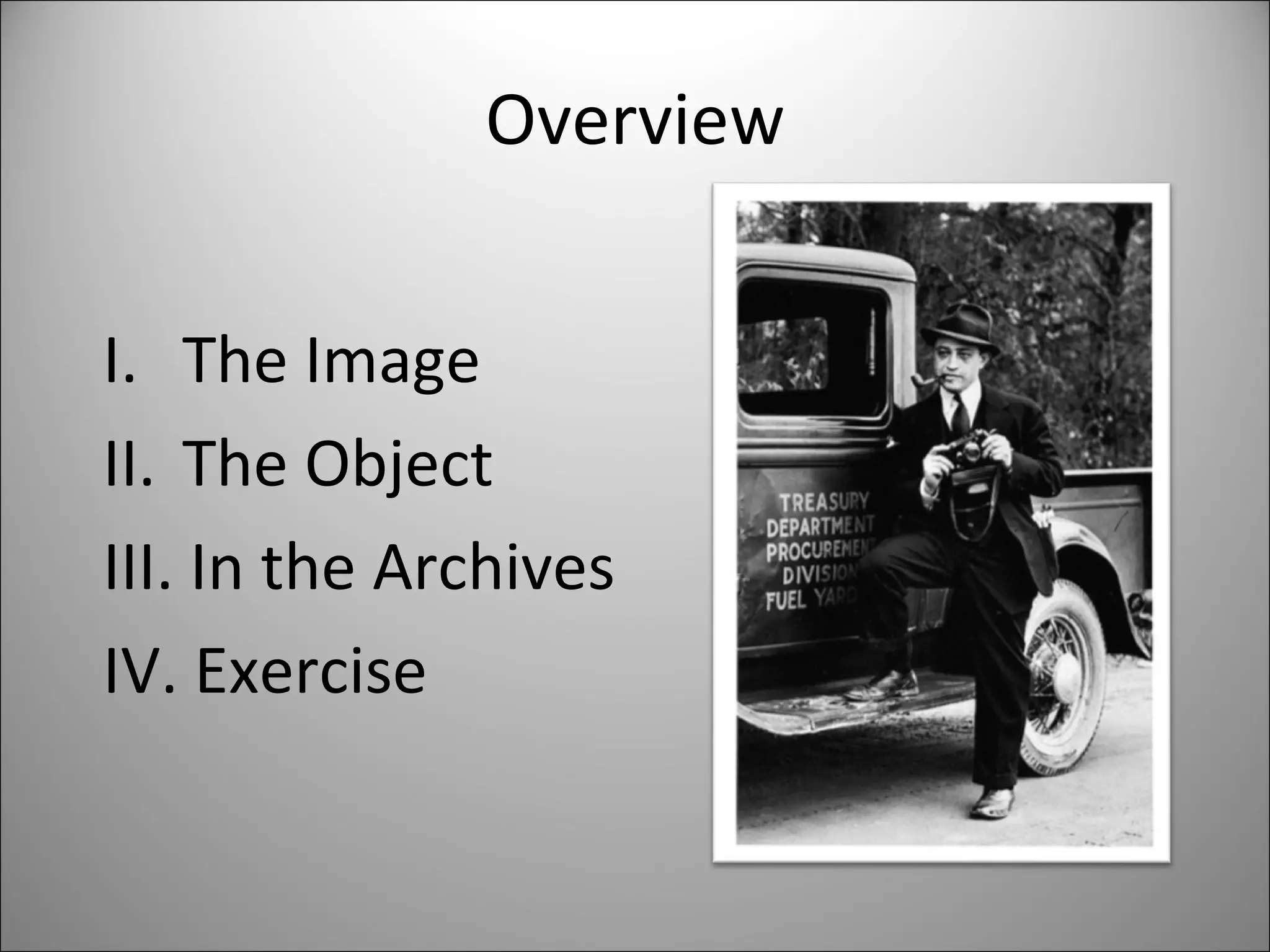
  • #3 Title: [Carl Mydans, Farm Security Administration photographer, full-length portrait, holding camera, standing with his foot on the running board of a Treasury Department Procurement Division Fuel Yard truck, Washington, D.C.] / photo by Carl Mydans. Creator(s): Mydans, Carl , photographer Date Created/Published: [ca. 1935] Medium: 1 photographic print : gelatin silver. http://www.loc.gov/pictures/item/98507850/
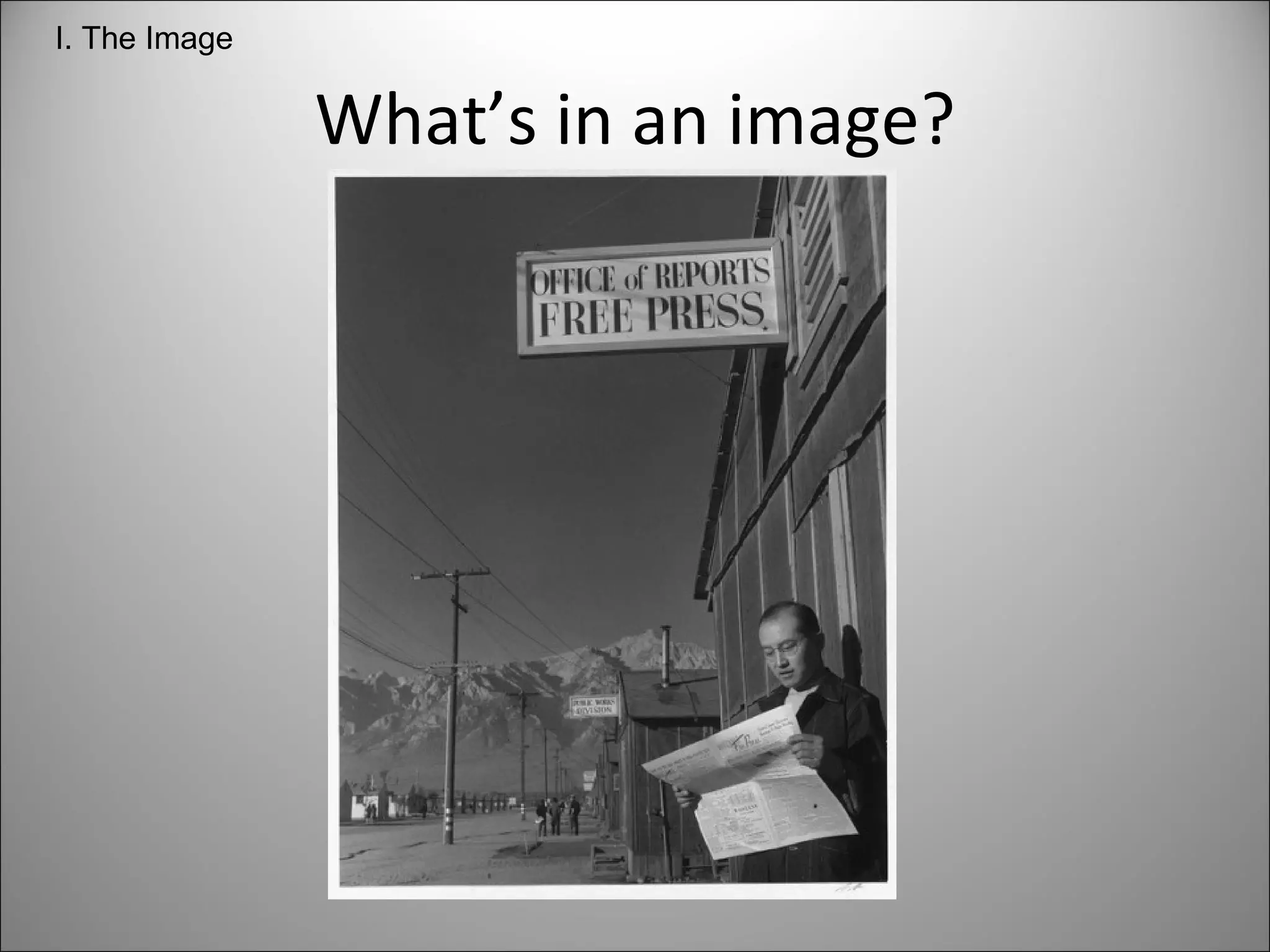
  • #5 http://www.flickr.com/photos/library_of_congress/4483939447/ Adams, Ansel, 1902-1984, photographer. Roy Takeno (editor) reading paper in front of office [1943] 1 photographic print : gelatin silver. 1 negative : safety film. Notes: Photo shows editor Roy Takeno reading a copy of the Manzanar Free Press in front of the newspaper office at the Manzanar War Relocation Center; with mountains in the background. Title transcribed from Ansel Adams' caption on verso of print. Original neg. no.: LC-A35-4-M-4. Gift; Ansel Adams; 1965-1968. Forms part of: Manzanar War Relocation Center photographs.
  • #6 http://www.flickr.com/photos/lwr/6208698/
  • #7 http://www.flickr.com/photos/nationalmediamuseum/3084038297 "A cabinet card portrait of John Owen, a sadler from Montgomeryshire, Wales, pictured with his dog, Blueman, taken at the studio of F. Davey, Gloucester, in about 1900.“
  • #8 http://www.flickr.com/photos/pip_r_lagenta/3137287437/ (On the flatbed are Annalisa Tripp (left) and Pip R. Lagenta. Kneeling behind the truck is Dale Tripp. The other people are passersby. The Marina in San Francisco, California, 1960.)
  • #9 http://digitalgallery.nypl.org/nypldigital/id?85260 NYPL Image ID: 85260 The pyramids of Geezeh (1862-1863) Image Title: The pyramids of Geezeh Creator: Frith, Francis -- Photographer Medium: Albumen prints
  • #10 http://www.flickr.com/photos/92947174@N00/214261992/
  • #11 http://www.loc.gov/pictures/item/ncl2004000111/PP/ The "Carrying-in Boy," In an Indiana Glass Works, 1:00 A. M., Aug., 1908. Location: Indiana. 1908 August. Medium: 1 photographic print. National Child Labor Committee Collection
  • #12 http://www.flickr.com/photos/cpurrin1/254286406
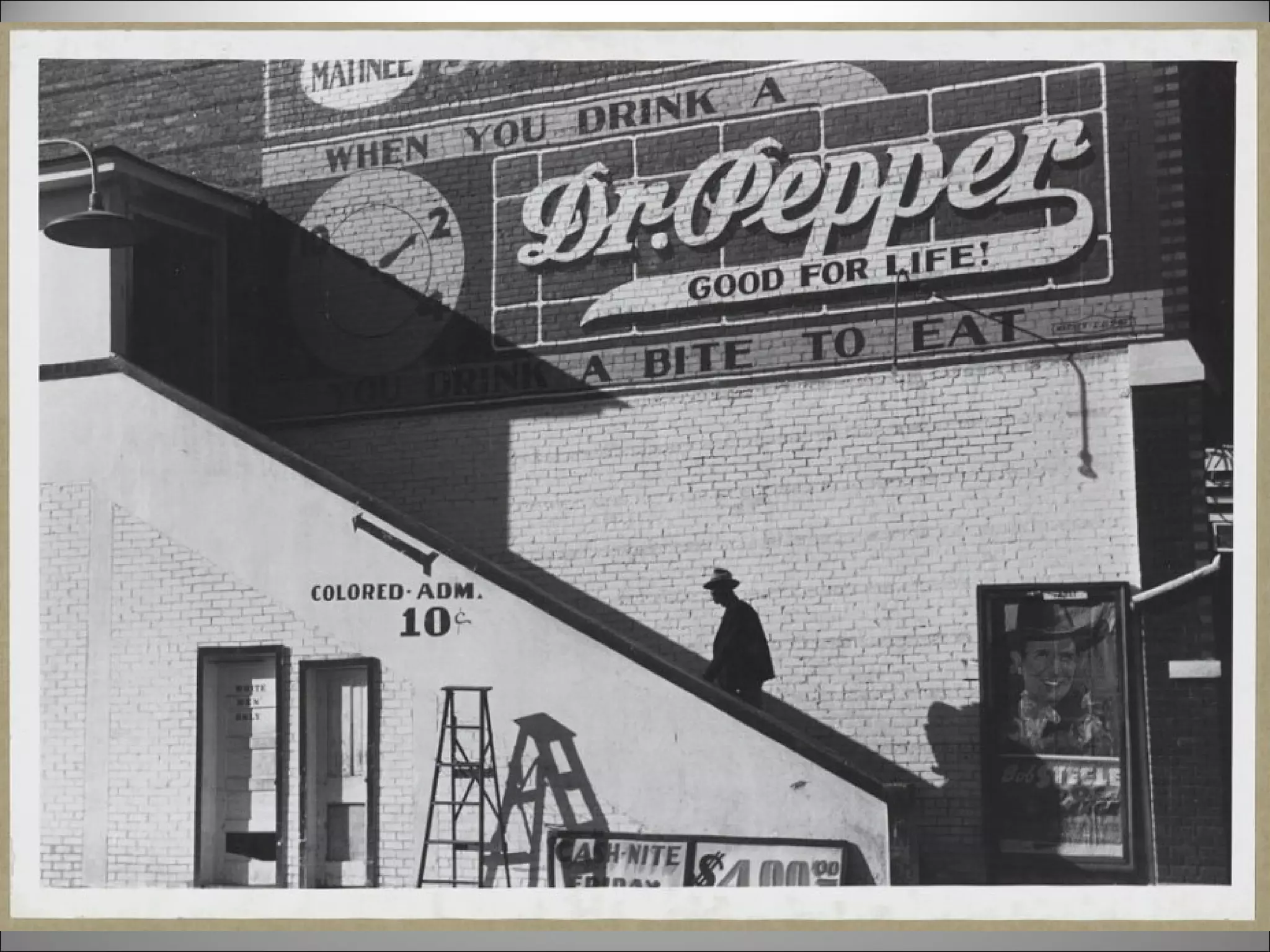
  • #13 Movie: Bob Steele, Feud of the Range (1939) Negro going in colored entrance of movie house on Saturday afternoon, Belzoni, Mississippi Delta, Mississippi (LOC) Wolcott, Marion Post, 1910-1990, photographer. Negro going in colored entrance of movie house on Saturday afternoon, Belzoni, Mississippi Delta, Mississippi 1939 Oct.? 1 negative : nitrate ; 35 mm.
  • #14 The physical object, the photograph
  • #16 Describe how light exposure changes object that is light-sensitive. Processes to fix image. Other processes (toning) to change tonal range and help stability. Original/unique vs print http://www.practicalphysics.org/go/print/Guidance_93.html%3Bjsessionid=alZLdQlAHb1?topic_id=2&guidance_id=1
  • #17 http://www.loc.gov/rr/print/coll/589_chronology.html
  • #18 http://www.flickr.com/photos/wscullin/1400909828/
  • #19 http://www.loc.gov/pictures/collection/cph/item/2004681684/resource/ [A photographer appears to be photographing himself in a photographic studio] / Wheeler, Berlin, Wis. Date Created/Published: c1893. Medium: 1 photographic print on cabinet card. Summary: A composite photograph showing a photographic studio interior. One man is seated on a stool near an adjustable clamp to hold his head steady during a long portrait exposure. The second man, standing next to a large view camera, looks like the person being photographed.
  • #21 http://www.graphicsatlas.org/compareprocesses/
  • #22 http://www.graphicsatlas.org/compareprocesses/
  • #24 http://www.loc.gov/pictures/resource/ppss.00158/ [Freeman Mason of Company K, 17th Vermont Infantry holding a tintype of his brother, Michael Mason, killed at Savage's Station, Virginia, in 1862] Digital ID: (digital file from original item, mat removed) ppss 00158 http://hdl.loc.gov/loc.pnp/ppss.00158 Reproduction Number: LC-DIG-ppmsca-27071 (digital file from original item)
  • #25 http://www.flickr.com/photos/jonlewisphotography/3085268486/
  • #26 http://www.loc.gov/pictures/item/2005677238/
  • #27 http://www.graphicsatlas.org/identification/?process_id=5 (compare processes) http://www.digitalsamplebook.com
  • #28 http://www.flickr.com/photos/ohiouniversitylibraries/3476347053/in/set-72157617257431295/ Mention Weaver: http://gawainweaver.com/images/uploads/Weaver_Guide_to_Gelatin_Silver.pdf
  • #29 http://www.graphicsatlas.org/compareprocesses/ Mention Weaver: http://gawainweaver.com/images/uploads/Weaver_Guide_to_Gelatin_Silver.pdf
  • #30 http://www.flickr.com/photos/kschlot1/4359176787/ Complex, and beyond the scope of an hour-long intro. See Ritzenthaler. http://www.graphicsatlas.org/identification/?process_id=88
  • #31 http://www.flickr.com/photos/badwsky/3251164379/ http://www.graphicsatlas.org/identification/?process_id=63
  • #32 http://www.loc.gov/pictures/resource/ppmsc.01269/
  • #33 http://www.loc.gov/pictures/resource/fsa.8c03262/
  • #34 Dag: http://www.loc.gov/pictures/resource/cph.3g03937/ Cyanotype: http://www.loc.gov/pictures/resource/cph.3g05214/ Platinum print: http://www.loc.gov/pictures/resource/ppmsca.03632/ Carbon print: http://loc.gov/pictures/resource/det.4a32175/ Calotype: http://www.loc.gov/pictures/resource/cph.3c21765/ Gum bichromate: http://loc.gov/pictures/resource/ppmsca.13700/ Slide: http://www.flickr.com/photos/nairolf_simon/5339816621/
  • #35 http://www.flickr.com/photos/kschlot1/5219203334
  • #37 Walt Whitman, 1860-1865? http://www.loc.gov/pictures/collection/brhc/item/brh2003003783/PP/
  • #38 http://www.flickr.com/photos/carowallis1/2314716161/sizes/m/in/photostream/
  • #39 http://www.flickr.com/photos/cgc/7080983/sizes/m/in/photostream/ Http://www.nedcc.org/resources/leaflets/4Storage_and_Handling/11StorageEnclosures.php See NEDCC pamphlet 4.11: Storage Enclosures for Photographic Materials
  • #40 http://www.flickr.com/photos/cgc/7080983/sizes/m/in/photostream/
  • #41 http://www.flickr.com/photos/cmatsuoka/3435792255/
  • #42 http://www.flickr.com/photos/cmatsuoka/3435792255/ (See ISO standards 18920 and 18911)
  • #46 http://www.loc.gov/pictures/collection/cph/item/2005681364/resource/