VISUAL PRINCIPLESPrepared By: Catherine T. Espinosa
VISUAL PRINCIPLESplay a vital role in education and training. In teaching, teachers have to be innovative in presenting lessons to students so that they will be clearly understood. In this regard, the use of visual aids in teaching help teachers delivers their lessons to the students in a more creative and innovative way.
The Role of Visuals in InstructionTo provide concrete referent for ideas		(what word or symbol denotes)Visuals are iconic, they have some resemblance to the thing they represent
The Role of Visuals in InstructionVisuals can also motivate learners by attracting their attention, holding their attention, and generating emotional responses.Visuals can simplify information that is difficult to understand.
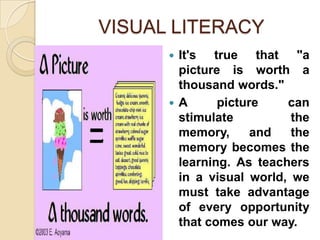
VISUAL LITERACYIt's true that "a picture is worth a thousand words."A picture can stimulate the memory, and the memory becomes the learning. As teachers in a visual world, we must take advantage of every opportunity that comes our way.
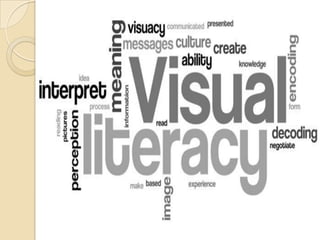
VISUAL LITERACYThe term literacy once was used only to refer to reading and writing of verbal information, today visual literacy refer to the learned ability to interpret visual messages accurately to create such messages.
VISUAL LITERACY includes such areas as facial expressions, body language, drawing, painting, sculpture, hand signs, street signs, international symbols, layout of the pictures and words in a textbook, the clarity of type fonts, computer images, student produced still pictures, sequences, movies or video, user friendly equipment design, critical analysis of television advertisements and many, many other things"
Visual Approaches of Visual Literacy Input Strategy - helping learners to “decode” or read, visuals proficiently by practicing visual analysis like (picture analysis and discussion of multimedia and video programs).
Visual Approaches of Visual Literacy2.  Output Strategy – helping learners to “encode” or write visuals to express themselves and communicate with others (through planning and producing photo and video presentations
Developmental Effects(Dwyer, 1978) “As a child gets older, he becomes more capable of attending selectively to those features of an instructional presentation that have the greatest potential for enhancing his learning of desired information.”
Cultural Effects  Different cultural groups may perceive visual materials in different ways.
Visual Preferences in selecting visual, teachers have to make appropriate choices between the sorts of visuals that are preferred and those that are most effective.The most important is, students develop their visual abilities by using them.
 Encoding: Creating VisualsOne skill nearly always included in visual education curricula is that of sequencing.  It is the ability to sequence or arrange ideas in logical order.  This is the extremely important factor in verbal literacy, especially in the ability to communicate in writing.
GOALS OF  VISUAL DESIGNEnsure legibilityThe goal of good visual design is to remove as many as obstacles as possible that might impede transmission of your message.
GOALS OF  VISUAL DESIGNReduce the effort required to interpret the message		As a designer you want to convey your message in such a way that viewers expend little effort making sense out of what they are setting and are free to use most of their mental for understanding the message itself.
GOALS OF  VISUAL DESIGNIncrease the viewer’s active engagement with the message		A major goal is to make your visual as appealing as possible – to get the viewers’ attention and to entice them into thinking about your message.  Choosing a style appropriate for your audience and using appealing color scheme also will help you gain and hold your audience.
GOALS OF  VISUAL DESIGNFocus attention on the most important parts of the message		Teachers, designers, and other who are create visual and verbal/visual displays face a series of design decisions about how to arrange the elements to achieve their goal.
GOALS OF  VISUAL DESIGNElements: Selecting and assembling the visual elements to incorporate into the display.Pattern: Choosing an underlying pattern for the elements of display.Arrangement: Arranging the individual elements within the underlying pattern.
PROCESSES OF VISUAL DESIGNElements	Includes the visual elements (choosing the type of visual), the verbal elements (lettering style and location), and the elements that add appeal (surprise, texture, interaction).
Visual ElementsRealistic visuals show the actual object under study. Using realistic can heighten the degree of realism.  Effective communication is always best served by the most realistic visuals available.Analogic  visuals convey a concept or topic showing something else and implying a similarity.
Visual ElementsOrganizational visual includes flowcharts, graphs, maps, schematics, and classification charts.
Verbal ElementsLetter Style	The style of the lettering should be consistent and should harmonize with the other elements of the visual.Number of Lettering Styles	A display or a series of related visuals, such as slide series should use not more than two different type styles, and these should harmonize with each other.  For good communication you should have to limit the number of variations (bold, italic, underline, size changes) to a maximum of four.
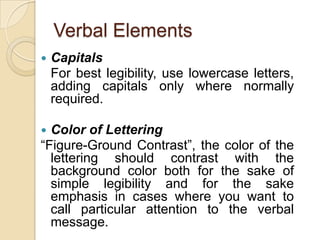
Verbal ElementsCapitals	For best legibility, use lowercase letters, adding capitals only where normally required.Color of Lettering“Figure-Ground Contrast”, the color of the lettering should contrast with the background color both for the sake of simple legibility and for the sake emphasis in cases where you want to call particular attention to the verbal message.
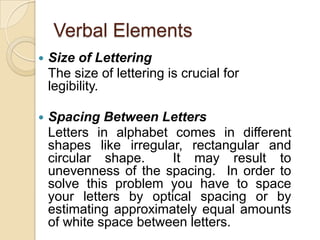
Verbal ElementsSize of Lettering	The size of lettering is crucial for legibility.Spacing Between Letters	Letters in alphabet comes in different shapes like irregular, rectangular and circular shape.  It may result to unevenness of the spacing.  In order to solve this problem you have to space your letters by optical spacing or by estimating approximately equal amounts of white space between letters.
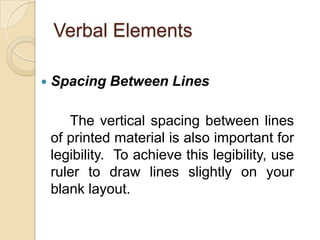
Verbal ElementsSpacing Between Lines		The vertical spacing between lines of printed material is also important for legibility.  To achieve this legibility, use ruler to draw lines slightly on your blank layout.
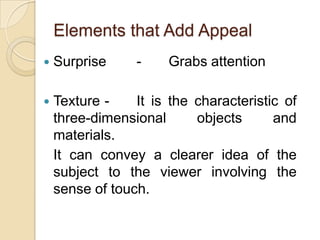
 Elements that Add AppealSurprise	-	Grabs attentionTexture	-	It is the characteristic of three-dimensional objects and materials.  	It can convey a clearer idea of the subject to the viewer involving the sense of touch.
Elements that Add AppealInteraction	 -	The R of the ASSURE model (require learner participation)                              applies to all forms of media.
"All of us are watchers – of television, of time clocks, of traffic on the freeway - but few of us are observers. Everyone is looking, not many are seeing."- Peter M. Leschak

Visual principles

  • 1.
    VISUAL PRINCIPLESPrepared By:Catherine T. Espinosa
  • 2.
    VISUAL PRINCIPLESplay avital role in education and training. In teaching, teachers have to be innovative in presenting lessons to students so that they will be clearly understood. In this regard, the use of visual aids in teaching help teachers delivers their lessons to the students in a more creative and innovative way.
  • 3.
    The Role ofVisuals in InstructionTo provide concrete referent for ideas (what word or symbol denotes)Visuals are iconic, they have some resemblance to the thing they represent
  • 4.
    The Role ofVisuals in InstructionVisuals can also motivate learners by attracting their attention, holding their attention, and generating emotional responses.Visuals can simplify information that is difficult to understand.
  • 6.
    VISUAL LITERACYIt's truethat "a picture is worth a thousand words."A picture can stimulate the memory, and the memory becomes the learning. As teachers in a visual world, we must take advantage of every opportunity that comes our way.
  • 7.
    VISUAL LITERACYThe termliteracy once was used only to refer to reading and writing of verbal information, today visual literacy refer to the learned ability to interpret visual messages accurately to create such messages.
  • 8.
    VISUAL LITERACY includessuch areas as facial expressions, body language, drawing, painting, sculpture, hand signs, street signs, international symbols, layout of the pictures and words in a textbook, the clarity of type fonts, computer images, student produced still pictures, sequences, movies or video, user friendly equipment design, critical analysis of television advertisements and many, many other things"
  • 9.
    Visual Approaches ofVisual Literacy Input Strategy - helping learners to “decode” or read, visuals proficiently by practicing visual analysis like (picture analysis and discussion of multimedia and video programs).
  • 10.
    Visual Approaches ofVisual Literacy2. Output Strategy – helping learners to “encode” or write visuals to express themselves and communicate with others (through planning and producing photo and video presentations
  • 11.
    Developmental Effects(Dwyer, 1978)“As a child gets older, he becomes more capable of attending selectively to those features of an instructional presentation that have the greatest potential for enhancing his learning of desired information.”
  • 12.
    Cultural Effects Different cultural groups may perceive visual materials in different ways.
  • 13.
    Visual Preferences inselecting visual, teachers have to make appropriate choices between the sorts of visuals that are preferred and those that are most effective.The most important is, students develop their visual abilities by using them.
  • 14.
     Encoding: Creating VisualsOneskill nearly always included in visual education curricula is that of sequencing. It is the ability to sequence or arrange ideas in logical order. This is the extremely important factor in verbal literacy, especially in the ability to communicate in writing.
  • 15.
    GOALS OF VISUAL DESIGNEnsure legibilityThe goal of good visual design is to remove as many as obstacles as possible that might impede transmission of your message.
  • 16.
    GOALS OF VISUAL DESIGNReduce the effort required to interpret the message As a designer you want to convey your message in such a way that viewers expend little effort making sense out of what they are setting and are free to use most of their mental for understanding the message itself.
  • 17.
    GOALS OF VISUAL DESIGNIncrease the viewer’s active engagement with the message A major goal is to make your visual as appealing as possible – to get the viewers’ attention and to entice them into thinking about your message. Choosing a style appropriate for your audience and using appealing color scheme also will help you gain and hold your audience.
  • 18.
    GOALS OF VISUAL DESIGNFocus attention on the most important parts of the message Teachers, designers, and other who are create visual and verbal/visual displays face a series of design decisions about how to arrange the elements to achieve their goal.
  • 19.
    GOALS OF VISUAL DESIGNElements: Selecting and assembling the visual elements to incorporate into the display.Pattern: Choosing an underlying pattern for the elements of display.Arrangement: Arranging the individual elements within the underlying pattern.
  • 20.
    PROCESSES OF VISUALDESIGNElements Includes the visual elements (choosing the type of visual), the verbal elements (lettering style and location), and the elements that add appeal (surprise, texture, interaction).
  • 21.
    Visual ElementsRealistic visualsshow the actual object under study. Using realistic can heighten the degree of realism. Effective communication is always best served by the most realistic visuals available.Analogic visuals convey a concept or topic showing something else and implying a similarity.
  • 22.
    Visual ElementsOrganizational visualincludes flowcharts, graphs, maps, schematics, and classification charts.
  • 23.
    Verbal ElementsLetter Style Thestyle of the lettering should be consistent and should harmonize with the other elements of the visual.Number of Lettering Styles A display or a series of related visuals, such as slide series should use not more than two different type styles, and these should harmonize with each other. For good communication you should have to limit the number of variations (bold, italic, underline, size changes) to a maximum of four.
  • 24.
    Verbal ElementsCapitals For bestlegibility, use lowercase letters, adding capitals only where normally required.Color of Lettering“Figure-Ground Contrast”, the color of the lettering should contrast with the background color both for the sake of simple legibility and for the sake emphasis in cases where you want to call particular attention to the verbal message.
  • 25.
    Verbal ElementsSize ofLettering The size of lettering is crucial for legibility.Spacing Between Letters Letters in alphabet comes in different shapes like irregular, rectangular and circular shape. It may result to unevenness of the spacing. In order to solve this problem you have to space your letters by optical spacing or by estimating approximately equal amounts of white space between letters.
  • 26.
    Verbal ElementsSpacing BetweenLines The vertical spacing between lines of printed material is also important for legibility. To achieve this legibility, use ruler to draw lines slightly on your blank layout.
  • 27.
     Elements that AddAppealSurprise - Grabs attentionTexture - It is the characteristic of three-dimensional objects and materials. It can convey a clearer idea of the subject to the viewer involving the sense of touch.
  • 28.
    Elements that AddAppealInteraction - The R of the ASSURE model (require learner participation) applies to all forms of media.
  • 29.
    "All of usare watchers – of television, of time clocks, of traffic on the freeway - but few of us are observers. Everyone is looking, not many are seeing."- Peter M. Leschak