Visual Literacy: Using Images to
Increase ComprehensionIncrease Comprehension
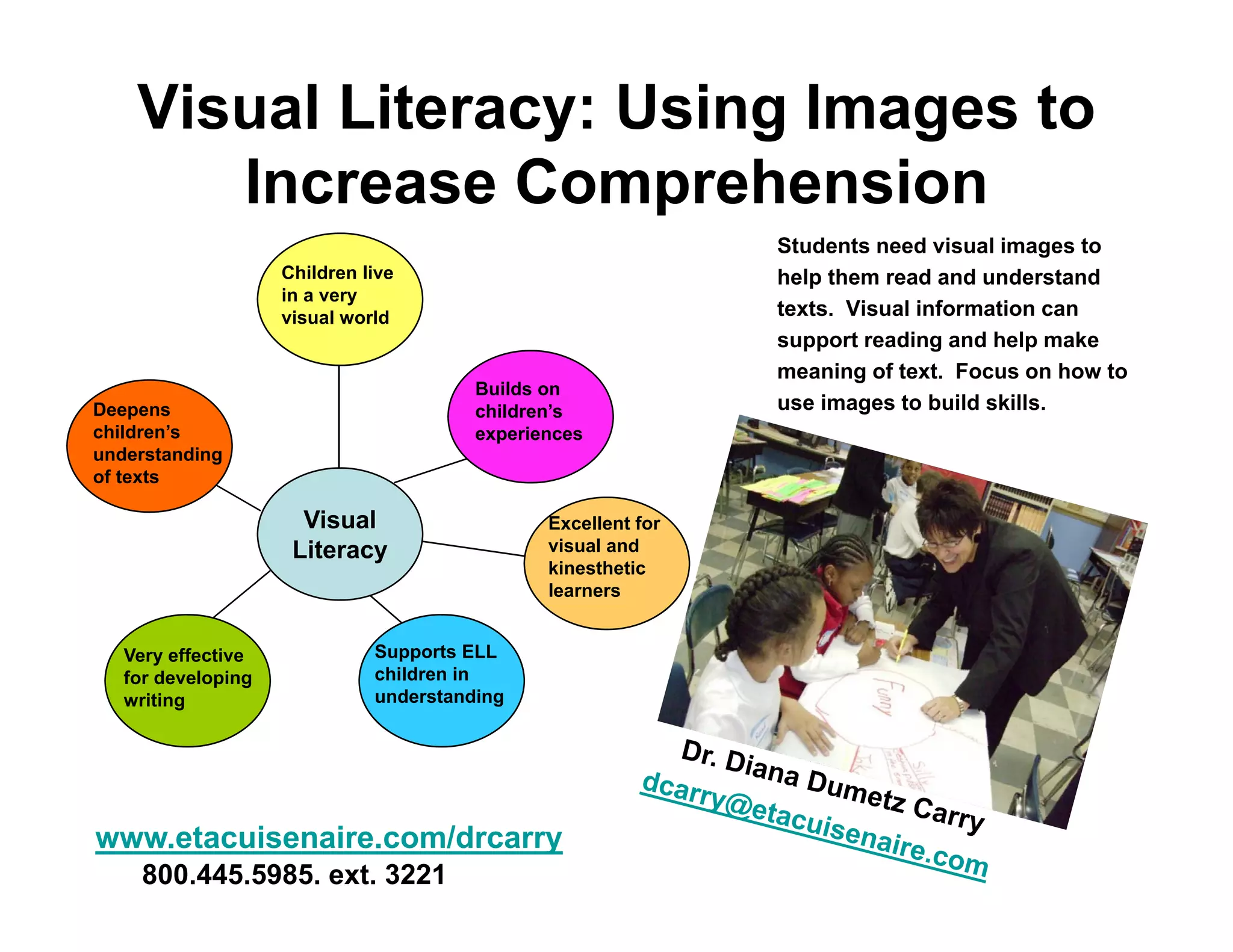
Students need visual images to
help them read and understandChildren live
in a very
texts. Visual information can
support reading and help make
meaning of text. Focus on how to
use images to build skills.
Builds on
children’s
in a very
visual world
Deepens
Visual
children s
experiences
Excellent for
Deepens
children’s
understanding
of texts
Literacy
Very effective
visual and
kinesthetic
learners
Supports ELLVery effective
for developing
writing
Supports ELL
children in
understanding
www.etacuisenaire.com/drcarry
800.445.5985. ext. 3221
Why Visual
Literacy?
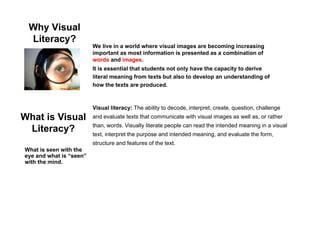
We live in a world where visual images are becoming increasing
It is essential that students not only have the capacity to derive
literal meaning from texts but also to develop an understanding of
We live in a world where visual images are becoming increasing
important as most information is presented as a combination of
words and images.
literal meaning from texts but also to develop an understanding of
how the texts are produced.
Visual literacy: The ability to decode interpret create question challenge
What is Visual
Literacy?
Visual literacy: The ability to decode, interpret, create, question, challenge
and evaluate texts that communicate with visual images as well as, or rather
than, words. Visually literate people can read the intended meaning in a visual
text, interpret the purpose and intended meaning, and evaluate the form,
structure and features of the text.
What is seen with the
eye and what is “seen”
with the mind.
Written and
Visual Language Reading and Viewing form a single Strand of
the English profile because visual texts, like written
texts, involve the use of language to make meaning.
Many of the skills and understandings relevant to the
study of written and visual language are the same
Examples of teaching skills through
visual literacy
study of written and visual language are the same.
Contextual Understandings
relevant to the study of both written and
visual texts:
• Exploring visual texts and the
context in which they occur.
visual texts:
• Texts can be based on either fact or fiction
• The use of language depends on shared cultural
understandings
• Teaching the codes, conventions
and structures of text to support
students’ constructing their own
texts.
• A text may have different meanings for different
people
Linguistic Structures and Features
texts.
• Using a series of strategies for
reading visual texts and
responding in writing/drawing common to both written and visual texts:
• Point of view
• Sequence in plot and sub-plot
• Narrative structures Expository structures
responding in writing/drawing
demonstrating understanding –
comprehension.
• Integrating visual and verbal
texts.
Visual Literacy
Give children powerful messages about
images, language, and literacy.
Students should learn to critically analyze the visual texts
d th i lt l t t di thand the socio-cultural contexts surrounding the
information.
To make meaning from images, the “reader” uses the
critical skills of exploration critique and reflectioncritical skills of exploration, critique, and reflection.
Re-composing Helps
Understanding
•Dynamic Vocabulary
•Comprehension
•Strategies for Expression and Voice
Understanding
• "Re-composing" means reading information in one form
and summarizing it in another form (such as a diagram or
table).
• If you ask students to re-compose the information, they
can no longer simply copy their source. They need to think
about what a paragraph means before they can summarize
it as a visual textit as a visual text.
• Re-composing is a key strategy in aiding comprehension.
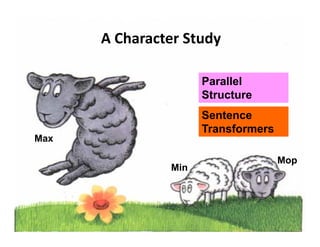
A Character Studyy
Parallel
Structure
Sentence
Transformers
MaxMax
Min
Mop
Min
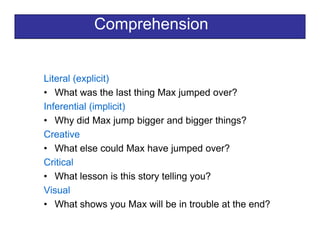
Comprehension
Literal (explicit)Literal (explicit)
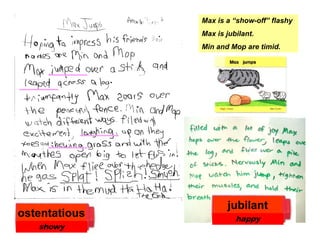
• What was the last thing Max jumped over?
Inferential (implicit)Inferential (implicit)
• Why did Max jump bigger and bigger things?
Creative
• What else could Max have jumped over?
Critical
• What lesson is this story telling you?
Visual
Wh t h M ill b i t bl t th d?• What shows you Max will be in trouble at the end?
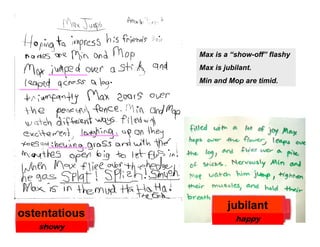
Max is a “show-off” flashy
Max is jubilant.
Min and Mop are timid..
j bil tjubilant
happy
ostentatious
showy
The Visual Text…
The visual text is the clearest way
to present information.
Comprehension
to present information.
To make meaning from
images, the “reader” uses
the critical skills of
• Summary
• Inference
• Perspective
exploration, critique, and
reflection.
What is seen with the eye
d h t i “ ” ith th
Charts, diagrams, cross
sections, and maps are a
few of the elements that
are as critical as the words
and what is “seen” with the
mind.
they supplement.
L f E i
Ethical Considerations
Layers of Experience
within a Discipline
Over Time
Trends
Patterns
Details
Relationships:
In, Between, Across
Disciplines
Perspectives
Disciplines
Issues / Themes
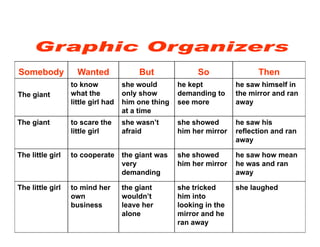
Somebody Wanted But So Theny
to know
what the
little girl had
she would
only show
him one thing
he kept
demanding to
see more
he saw himself in
the mirror and ran
away
The giant
at a time
The giant to scare the
little girl
she wasn’t
afraid
she showed
him her mirror
he saw his
reflection and ran
awayaway
The little girl to cooperate the giant was
very
d di
she showed
him her mirror
he saw how mean
he was and ran
demanding away
The little girl to mind her
own
the giant
wouldn’t
she tricked
him into
she laughed
business leave her
alone
looking in the
mirror and he
ran away
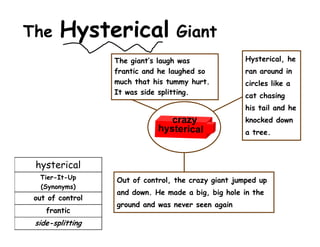
The Hysterical Giant
The giant’s laugh was
frantic and he laughed so
Hysterical, he
ran around in
much that his tummy hurt.
It was side splitting.
circles like a
cat chasing
his tail and hehis tail and he
knocked down
a tree.
crazy
hystericaly
Tier-It-Up
(Synonyms)
out of control
Out of control, the crazy giant jumped up
and down. He made a big, big hole in the
frantic
side-splitting
ground and was never seen again
Visuals can enhance and
accelerate classroom instruction for
using images to build skills.
Grandpa can ride a bicycle.
g g
Beyond belief , Grandpa can ride a bicycle veryeyo d be e , G a dpa bicycle very
quickly and happily around our little town .
Building Blocks of an Image…
Color-Coded Parts of
Speech
Manipulatives as
Visual Literacy Tools
It is essential that students not only have the Speech
(Humans process visuals 60,000 times
faster than text!)
Colors evoke predictable responses
It is essential that students not only have the
capacity to derive literal meaning from texts but
also to develop an understanding of how the texts
are produced.
Max is a “show-off” flashy
Max is jubilant.
Min and Mop are timidMin and Mop are timid.
.
j bil tjubilant
happy
ostentatious
showy
Visualizing is thinking
Most young readers can interpret ("read") diagrams and maps long before they can read the same
information in words and sentences.
• Support their reading with nonfiction books that cue the unfamiliar words with clear diagrams, not
just photographs.
Students can use a table to list all
• Older children who are "unable to read" may be merely waiting for you to provide them with
illustrated nonfiction.
Vis al literac Th bilit t d d i t tStudents can use a table to list all
the questions they aim to answer.
The table helps them to see how
much they have researched and
what still needs to be investigated
Visual literacy: The ability to decode, interpret,
create, question, challenge and evaluate texts that
communicate with visual images as well as, or
rather than, words. Visually literate people can
what still needs to be investigated.
Support students’ reading with
nonfiction books that cue the
f ili d ith l
, y p p
read, interpret the purpose and intended meaning,
and evaluate the form, structure and features of
the text. They can also use picture and word
i i ti d i t tunfamiliar words with clear
diagrams, not just photographs.
images in a creative and appropriate way to
express meaning…
Dr. Diana Dumetz Carryy
dcarry@etacuisenaire.com
800.445.5985. ext. 3221

Carry visual literacy

  • 1.
    Visual Literacy: UsingImages to Increase ComprehensionIncrease Comprehension Students need visual images to help them read and understandChildren live in a very texts. Visual information can support reading and help make meaning of text. Focus on how to use images to build skills. Builds on children’s in a very visual world Deepens Visual children s experiences Excellent for Deepens children’s understanding of texts Literacy Very effective visual and kinesthetic learners Supports ELLVery effective for developing writing Supports ELL children in understanding www.etacuisenaire.com/drcarry 800.445.5985. ext. 3221
  • 2.
    Why Visual Literacy? We livein a world where visual images are becoming increasing It is essential that students not only have the capacity to derive literal meaning from texts but also to develop an understanding of We live in a world where visual images are becoming increasing important as most information is presented as a combination of words and images. literal meaning from texts but also to develop an understanding of how the texts are produced. Visual literacy: The ability to decode interpret create question challenge What is Visual Literacy? Visual literacy: The ability to decode, interpret, create, question, challenge and evaluate texts that communicate with visual images as well as, or rather than, words. Visually literate people can read the intended meaning in a visual text, interpret the purpose and intended meaning, and evaluate the form, structure and features of the text. What is seen with the eye and what is “seen” with the mind.
  • 3.
    Written and Visual LanguageReading and Viewing form a single Strand of the English profile because visual texts, like written texts, involve the use of language to make meaning. Many of the skills and understandings relevant to the study of written and visual language are the same Examples of teaching skills through visual literacy study of written and visual language are the same. Contextual Understandings relevant to the study of both written and visual texts: • Exploring visual texts and the context in which they occur. visual texts: • Texts can be based on either fact or fiction • The use of language depends on shared cultural understandings • Teaching the codes, conventions and structures of text to support students’ constructing their own texts. • A text may have different meanings for different people Linguistic Structures and Features texts. • Using a series of strategies for reading visual texts and responding in writing/drawing common to both written and visual texts: • Point of view • Sequence in plot and sub-plot • Narrative structures Expository structures responding in writing/drawing demonstrating understanding – comprehension. • Integrating visual and verbal texts.
  • 4.
    Visual Literacy Give childrenpowerful messages about images, language, and literacy. Students should learn to critically analyze the visual texts d th i lt l t t di thand the socio-cultural contexts surrounding the information. To make meaning from images, the “reader” uses the critical skills of exploration critique and reflectioncritical skills of exploration, critique, and reflection. Re-composing Helps Understanding •Dynamic Vocabulary •Comprehension •Strategies for Expression and Voice Understanding • "Re-composing" means reading information in one form and summarizing it in another form (such as a diagram or table). • If you ask students to re-compose the information, they can no longer simply copy their source. They need to think about what a paragraph means before they can summarize it as a visual textit as a visual text. • Re-composing is a key strategy in aiding comprehension.
  • 5.
  • 6.
    Comprehension Literal (explicit)Literal (explicit) •What was the last thing Max jumped over? Inferential (implicit)Inferential (implicit) • Why did Max jump bigger and bigger things? Creative • What else could Max have jumped over? Critical • What lesson is this story telling you? Visual Wh t h M ill b i t bl t th d?• What shows you Max will be in trouble at the end?
  • 7.
    Max is a“show-off” flashy Max is jubilant. Min and Mop are timid.. j bil tjubilant happy ostentatious showy
  • 8.
    The Visual Text… Thevisual text is the clearest way to present information. Comprehension to present information. To make meaning from images, the “reader” uses the critical skills of • Summary • Inference • Perspective exploration, critique, and reflection. What is seen with the eye d h t i “ ” ith th Charts, diagrams, cross sections, and maps are a few of the elements that are as critical as the words and what is “seen” with the mind. they supplement. L f E i Ethical Considerations Layers of Experience within a Discipline Over Time Trends Patterns Details Relationships: In, Between, Across Disciplines Perspectives Disciplines Issues / Themes
  • 9.
    Somebody Wanted ButSo Theny to know what the little girl had she would only show him one thing he kept demanding to see more he saw himself in the mirror and ran away The giant at a time The giant to scare the little girl she wasn’t afraid she showed him her mirror he saw his reflection and ran awayaway The little girl to cooperate the giant was very d di she showed him her mirror he saw how mean he was and ran demanding away The little girl to mind her own the giant wouldn’t she tricked him into she laughed business leave her alone looking in the mirror and he ran away
  • 10.
    The Hysterical Giant Thegiant’s laugh was frantic and he laughed so Hysterical, he ran around in much that his tummy hurt. It was side splitting. circles like a cat chasing his tail and hehis tail and he knocked down a tree. crazy hystericaly Tier-It-Up (Synonyms) out of control Out of control, the crazy giant jumped up and down. He made a big, big hole in the frantic side-splitting ground and was never seen again
  • 11.
    Visuals can enhanceand accelerate classroom instruction for using images to build skills. Grandpa can ride a bicycle. g g Beyond belief , Grandpa can ride a bicycle veryeyo d be e , G a dpa bicycle very quickly and happily around our little town . Building Blocks of an Image… Color-Coded Parts of Speech Manipulatives as Visual Literacy Tools It is essential that students not only have the Speech (Humans process visuals 60,000 times faster than text!) Colors evoke predictable responses It is essential that students not only have the capacity to derive literal meaning from texts but also to develop an understanding of how the texts are produced.
  • 12.
    Max is a“show-off” flashy Max is jubilant. Min and Mop are timidMin and Mop are timid. . j bil tjubilant happy ostentatious showy
  • 13.
    Visualizing is thinking Mostyoung readers can interpret ("read") diagrams and maps long before they can read the same information in words and sentences. • Support their reading with nonfiction books that cue the unfamiliar words with clear diagrams, not just photographs. Students can use a table to list all • Older children who are "unable to read" may be merely waiting for you to provide them with illustrated nonfiction. Vis al literac Th bilit t d d i t tStudents can use a table to list all the questions they aim to answer. The table helps them to see how much they have researched and what still needs to be investigated Visual literacy: The ability to decode, interpret, create, question, challenge and evaluate texts that communicate with visual images as well as, or rather than, words. Visually literate people can what still needs to be investigated. Support students’ reading with nonfiction books that cue the f ili d ith l , y p p read, interpret the purpose and intended meaning, and evaluate the form, structure and features of the text. They can also use picture and word i i ti d i t tunfamiliar words with clear diagrams, not just photographs. images in a creative and appropriate way to express meaning… Dr. Diana Dumetz Carryy dcarry@etacuisenaire.com 800.445.5985. ext. 3221