Visual DictionaryBSCI 2300RuthMWF 11:00
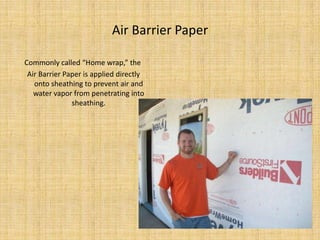
Air Barrier PaperCommonly called “Home wrap,” the Air Barrier Paper is applied directly onto sheathing to prevent air and water vapor from penetrating into sheathing.
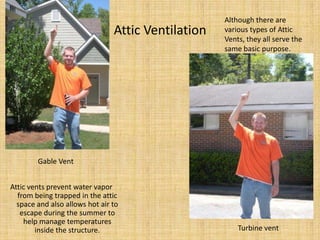
Attic VentilationAlthough there are various types of Attic Vents, they all serve the same basic purpose.Gable VentAttic vents prevent water vapor from being trapped in the attic space and also allows hot air to escape during the summer to help manage temperatures inside the structure. Turbine vent
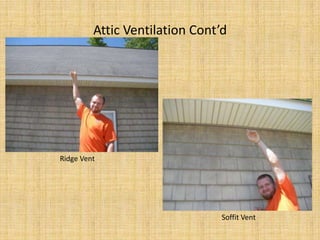
Attic Ventilation Cont’d Ridge VentSoffit Vent
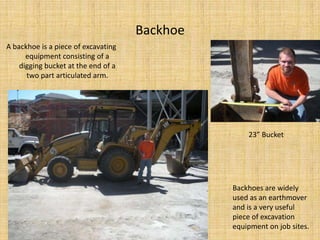
BackhoeA backhoe is a piece of excavating equipment consisting of a digging bucket at the end of a two part articulated arm.23” BucketBackhoes are widely used as an earthmover and is a very useful piece of excavation equipment on job sites.
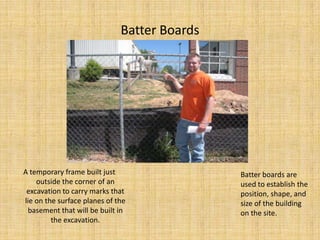
Batter BoardsA temporary frame built just outside the corner of an excavation to carry marks that lie on the surface planes of the basement that will be built in the excavation.Batter boards are used to establish the position, shape, and size of the building on the site.
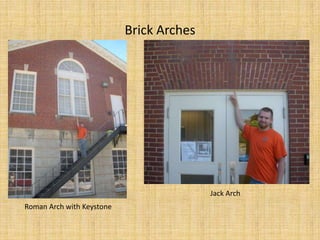
Brick ArchesJack ArchRoman Arch with Keystone
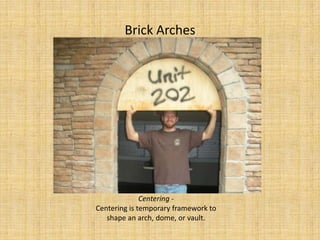
Brick ArchesCentering -Centering is temporary framework to shape an arch, dome, or vault.
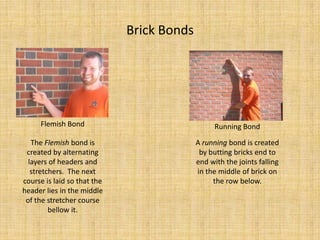
Brick BondsFlemish BondRunning BondThe Flemish bond is created by alternating layers of headers and stretchers.  The next course is laid so that the header lies in the middle of the stretcher course bellow it.A running bond is created by butting bricks end to end with the joints falling in the middle of brick on the row below.
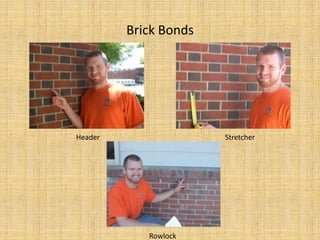
Brick BondsHeaderStretcherRowlock
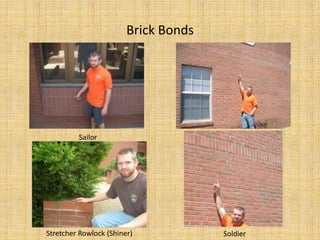
Brick BondsSailorStretcher Rowlock (Shiner)Soldier
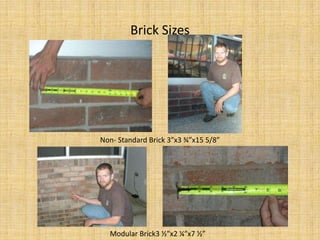
Brick SizesNon- Standard Brick 3”x3 ¾”x15 5/8”Modular Brick3 ½”x2 ¼”x7 ½”
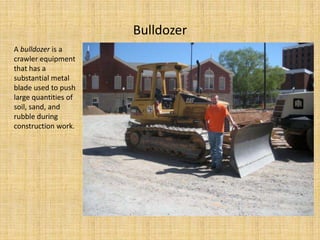
BulldozerA bulldozer is a crawler equipment that has a substantial metal blade used to push large quantities of soil, sand, and rubble during construction work.
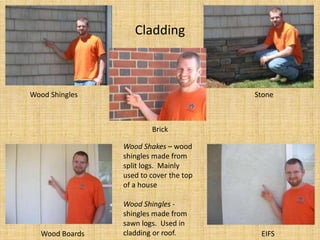
CladdingWood ShinglesStoneBrickWood Shakes – wood shingles made from split logs.  Mainly used to cover the top of a houseWood Shingles -  shingles made from sawn logs.  Used in cladding or roof.Wood BoardsEIFS
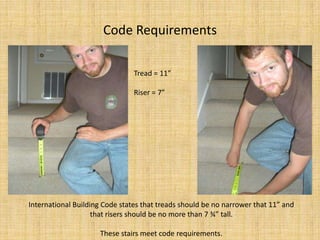
Code RequirementsTread = 11”Riser = 7”International Building Code states that treads should be no narrower that 11” and that risers should be no more than 7 ¾” tall.These stairs meet code requirements.
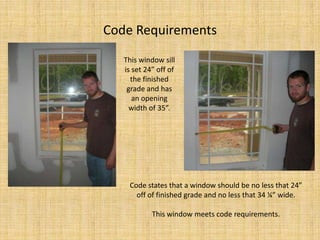
Code RequirementsThis window sill is set 24” off of the finished grade and has an opening width of 35”.Code states that a window should be no less that 24” off of finished grade and no less that 34 ¼” wide.  This window meets code requirements.
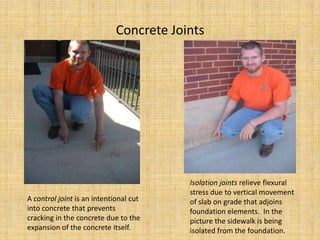
Concrete JointsIsolation joints relieve flexural stress due to vertical movement of slab on grade that adjoins foundation elements.  In the picture the sidewalk is being isolated from the foundation.A control joint is an intentional cut into concrete that prevents cracking in the concrete due to the expansion of the concrete itself.
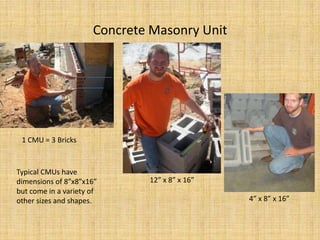
Concrete Masonry Unit1 CMU = 3 BricksTypical CMUs have dimensions of 8”x8”x16” but come in a variety of other sizes and shapes.12” x 8” x 16”4” x 8” x 16”
Decorative Concrete MasonryRibbed Split Face BlockSplit Block
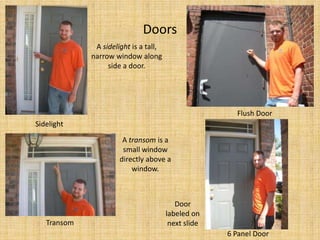
DoorsA sidelight is a tall, narrow window along side a door.Flush DoorSidelightA transom is a small window directly above a window.Door labeled on next slideTransom6 Panel Door
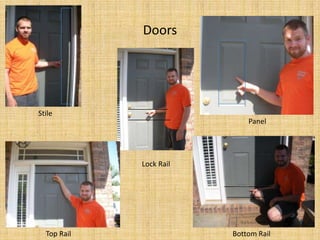
DoorsStilePanelLock RailTop Rail Bottom Rail
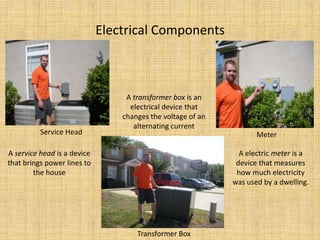
Electrical Components A transformer box is an electrical device that changes the voltage of an alternating currentService HeadMeterA service head is a device that brings power lines to the houseA electric meter is a device that measures how much electricity was used by a dwelling. Transformer Box
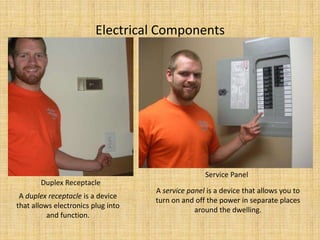
Electrical Components Service PanelDuplex ReceptacleA service panel is a device that allows you to turn on and off the power in separate places around the dwelling.A duplex receptacle is a device that allows electronics plug into and function.
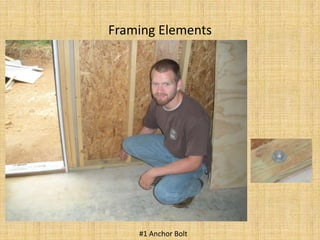
Framing Elements#1 Anchor Bolt
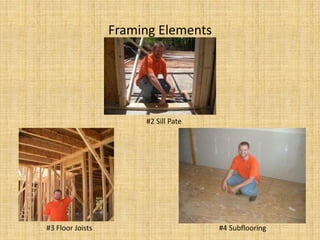
Framing Elements#2 Sill Pate#4 Subflooring#3 Floor Joists
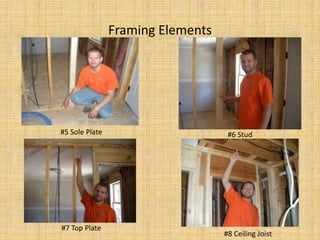
Framing Elements#5 Sole Plate#6 Stud#7 Top Plate#8 Ceiling Joist
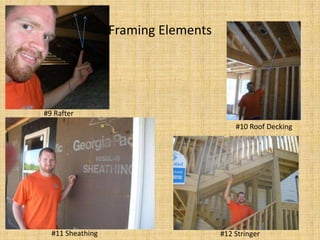
Framing Elements#9 Rafter#10 Roof Decking#11 Sheathing #12 Stringer
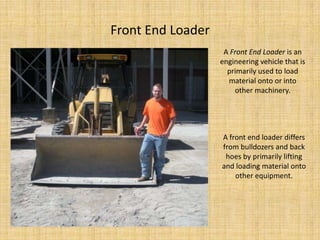
Front End LoaderA Front End Loader is an engineering vehicle that is primarily used to load material onto or into other machinery.A front end loader differs from bulldozers and back hoes by primarily lifting and loading material onto other equipment.
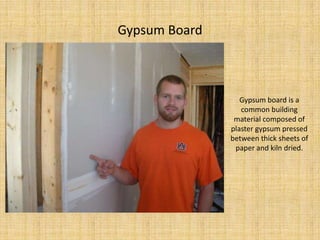
Gypsum BoardGypsum board is a common building material composed of plaster gypsum pressed between thick sheets of paper and kiln dried.
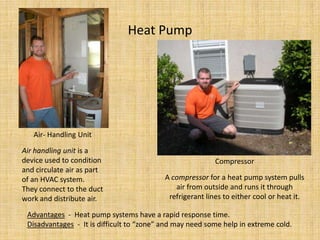
Heat PumpAir- Handling UnitAir handling unit is a device used to condition and circulate air as part of an HVAC system.  They connect to the duct work and distribute air.  CompressorA compressor for a heat pump system pulls air from outside and runs it through refrigerant lines to either cool or heat it.Advantages  -  Heat pump systems have a rapid response time.Disadvantages  -  It is difficult to “zone” and may need some help in extreme cold.
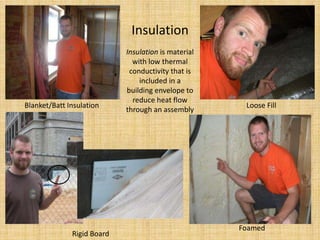
InsulationInsulation is material with low thermal conductivity that is included in a building envelope to reduce heat flow through an assemblyBlanket/Batt InsulationLoose FillFoamedRigid Board
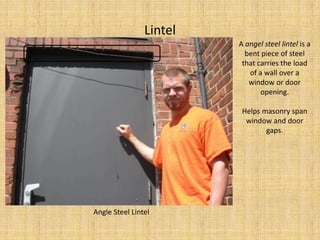
LintelA angel steel lintel is a bent piece of steel that carries the load of a wall over a window or door opening.  Helps masonry span window and door gaps.Angle Steel Lintel
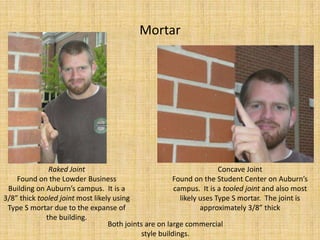
MortarRaked JointFound on the Lowder Business Building on Auburn’s campus.  It is a 3/8” thick tooled joint most likely using Type S mortar due to the expanse of the building.Concave JointFound on the Student Center on Auburn’s campus.  It is a tooled joint and also most likely uses Type S mortar.  The joint is approximately 3/8” thickBoth joints are on large commercial style buildings.
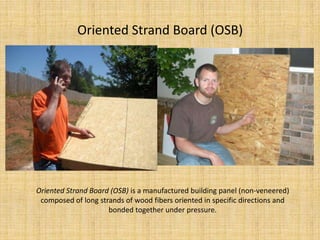
Oriented Strand Board (OSB)Oriented Strand Board (OSB) is a manufactured building panel (non-veneered) composed of long strands of wood fibers oriented in specific directions and bonded together under pressure.
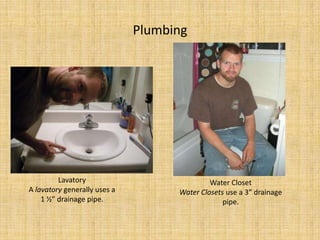
PlumbingLavatoryA lavatory generally uses a        1 ½” drainage pipe.Water ClosetWater Closets use a 3” drainage pipe.
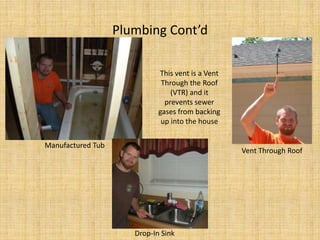
Plumbing Cont’dThis vent is a Vent Through the Roof (VTR) and it prevents sewer gases from backing up into the houseManufactured TubVent Through RoofDrop-In Sink
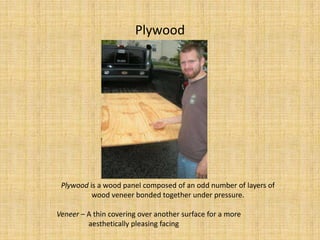
PlywoodPlywood is a wood panel composed of an odd number of layers of wood veneer bonded together under pressure.Veneer – A thin covering over another surface for a more                	aesthetically pleasing facing
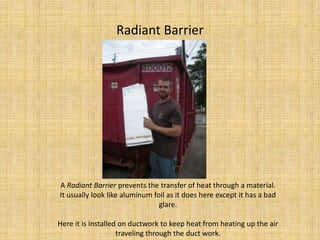
Radiant Barrier A Radiant Barrier prevents the transfer of heat through a material.  It usually look like aluminum foil as it does here except it has a bad glare.Here it is installed on ductwork to keep heat from heating up the air traveling through the duct work.
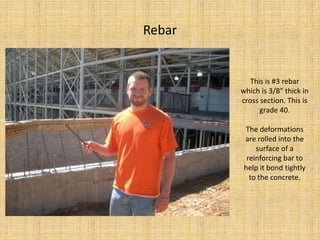
RebarThis is #3 rebar which is 3/8” thick in cross section. This is grade 40.The deformations are rolled into the surface of a reinforcing bar to help it bond tightly to the concrete.
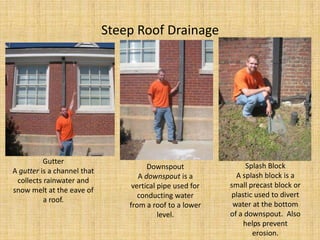
Steep Roof DrainageGutter A gutter is a channel that collects rainwater and snow melt at the eave of a roof.Splash BlockA splash block is a small precast block or plastic used to divert water at the bottom of a downspout.  Also helps prevent erosion.DownspoutA downspout is a vertical pipe used for conducting water from a roof to a lower level.
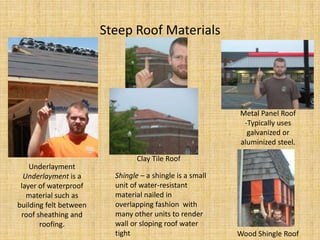
Steep Roof MaterialsMetal Panel Roof-Typically uses galvanized or aluminized steel.Clay Tile RoofUnderlaymentUnderlayment is a layer of waterproof material such as building felt between roof sheathing and roofing.Shingle – a shingle is a small   unit of water-resistant material nailed in overlapping fashion  with many other units to render wall or sloping roof water tightWood Shingle Roof
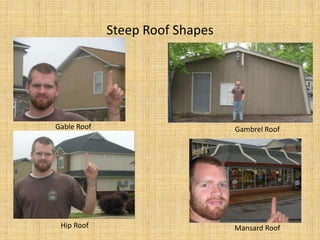
Steep Roof ShapesGable RoofGambrel RoofHip RoofMansard Roof
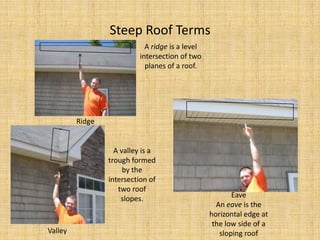
Steep Roof TermsA ridge is a level intersection of two planes of a roof.RidgeA valley is a trough formed by the intersection of two roof slopes.EaveAn eave is the horizontal edge at the low side of a sloping roofValley
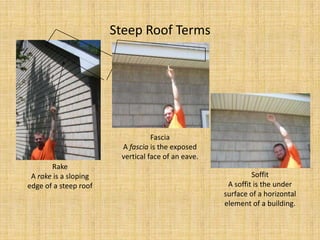
Steep Roof TermsFasciaA fascia is the exposed vertical face of an eave.RakeA rake is a sloping edge of a steep roofSoffitA soffit is the under surface of a horizontal element of a building.
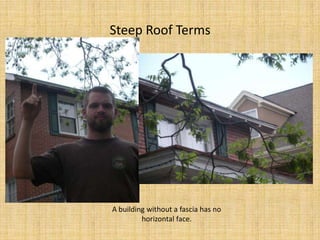
Steep Roof TermsA building without a fascia has no  horizontal face.
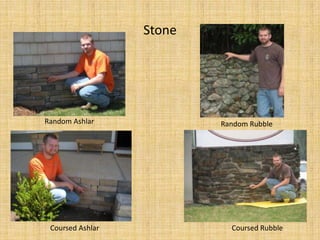
StoneRandom AshlarRandom RubbleCoursed AshlarCoursed Rubble
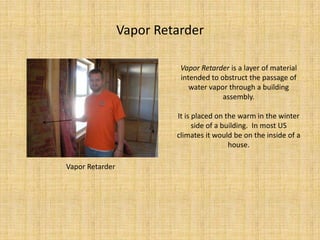
Vapor RetarderVaporRetarder is a layer of material intended to obstruct the passage of water vapor through a building assembly.  It is placed on the warm in the winter side of a building.  In most US climates it would be on the inside of a house.Vapor Retarder
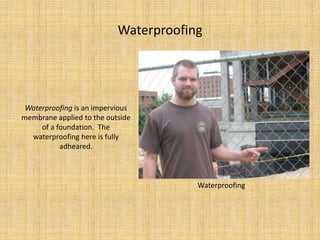
WaterproofingWaterproofing is an impervious membrane applied to the outside of a foundation.  The waterproofing here is fully adheared.Waterproofing
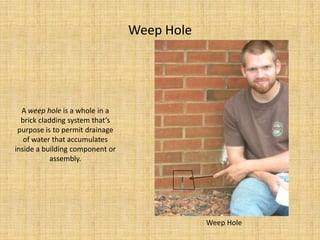
Weep HoleA weep hole is a whole in a brick cladding system that’s purpose is to permit drainage of water that accumulates inside a building component or assembly.Weep Hole
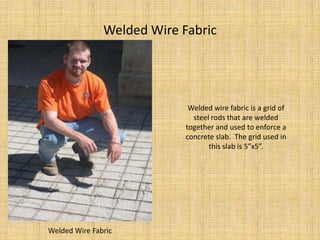
Welded Wire FabricWelded wire fabric is a grid of steel rods that are welded together and used to enforce a concrete slab.  The grid used in this slab is 5”x5”.Welded Wire Fabric
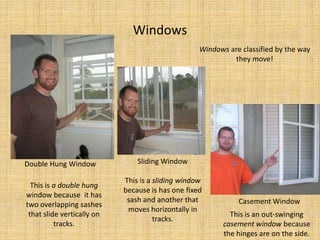
WindowsWindows are classified by the way they move! Sliding WindowThis is a sliding window because is has one fixed sash and another that moves horizontally in tracks.Double Hung WindowThis is a double hung window because  it has two overlapping sashes that slide vertically on tracks.Casement WindowThis is an out-swinging casement window because the hinges are on the side.

Visual dictionary

  • 1.
  • 2.
    Air Barrier PaperCommonlycalled “Home wrap,” the Air Barrier Paper is applied directly onto sheathing to prevent air and water vapor from penetrating into sheathing.
  • 3.
    Attic VentilationAlthough thereare various types of Attic Vents, they all serve the same basic purpose.Gable VentAttic vents prevent water vapor from being trapped in the attic space and also allows hot air to escape during the summer to help manage temperatures inside the structure. Turbine vent
  • 4.
    Attic Ventilation Cont’dRidge VentSoffit Vent
  • 5.
    BackhoeA backhoe isa piece of excavating equipment consisting of a digging bucket at the end of a two part articulated arm.23” BucketBackhoes are widely used as an earthmover and is a very useful piece of excavation equipment on job sites.
  • 6.
    Batter BoardsA temporaryframe built just outside the corner of an excavation to carry marks that lie on the surface planes of the basement that will be built in the excavation.Batter boards are used to establish the position, shape, and size of the building on the site.
  • 7.
    Brick ArchesJack ArchRomanArch with Keystone
  • 8.
    Brick ArchesCentering -Centeringis temporary framework to shape an arch, dome, or vault.
  • 9.
    Brick BondsFlemish BondRunningBondThe Flemish bond is created by alternating layers of headers and stretchers. The next course is laid so that the header lies in the middle of the stretcher course bellow it.A running bond is created by butting bricks end to end with the joints falling in the middle of brick on the row below.
  • 10.
  • 11.
  • 12.
    Brick SizesNon- StandardBrick 3”x3 ¾”x15 5/8”Modular Brick3 ½”x2 ¼”x7 ½”
  • 13.
    BulldozerA bulldozer isa crawler equipment that has a substantial metal blade used to push large quantities of soil, sand, and rubble during construction work.
  • 14.
    CladdingWood ShinglesStoneBrickWood Shakes– wood shingles made from split logs. Mainly used to cover the top of a houseWood Shingles - shingles made from sawn logs. Used in cladding or roof.Wood BoardsEIFS
  • 15.
    Code RequirementsTread =11”Riser = 7”International Building Code states that treads should be no narrower that 11” and that risers should be no more than 7 ¾” tall.These stairs meet code requirements.
  • 16.
    Code RequirementsThis windowsill is set 24” off of the finished grade and has an opening width of 35”.Code states that a window should be no less that 24” off of finished grade and no less that 34 ¼” wide. This window meets code requirements.
  • 17.
    Concrete JointsIsolation jointsrelieve flexural stress due to vertical movement of slab on grade that adjoins foundation elements. In the picture the sidewalk is being isolated from the foundation.A control joint is an intentional cut into concrete that prevents cracking in the concrete due to the expansion of the concrete itself.
  • 18.
    Concrete Masonry Unit1CMU = 3 BricksTypical CMUs have dimensions of 8”x8”x16” but come in a variety of other sizes and shapes.12” x 8” x 16”4” x 8” x 16”
  • 19.
    Decorative Concrete MasonryRibbedSplit Face BlockSplit Block
  • 20.
    DoorsA sidelight isa tall, narrow window along side a door.Flush DoorSidelightA transom is a small window directly above a window.Door labeled on next slideTransom6 Panel Door
  • 21.
  • 22.
    Electrical Components Atransformer box is an electrical device that changes the voltage of an alternating currentService HeadMeterA service head is a device that brings power lines to the houseA electric meter is a device that measures how much electricity was used by a dwelling. Transformer Box
  • 23.
    Electrical Components ServicePanelDuplex ReceptacleA service panel is a device that allows you to turn on and off the power in separate places around the dwelling.A duplex receptacle is a device that allows electronics plug into and function.
  • 24.
  • 25.
    Framing Elements#2 SillPate#4 Subflooring#3 Floor Joists
  • 26.
    Framing Elements#5 SolePlate#6 Stud#7 Top Plate#8 Ceiling Joist
  • 27.
    Framing Elements#9 Rafter#10Roof Decking#11 Sheathing #12 Stringer
  • 28.
    Front End LoaderAFront End Loader is an engineering vehicle that is primarily used to load material onto or into other machinery.A front end loader differs from bulldozers and back hoes by primarily lifting and loading material onto other equipment.
  • 29.
    Gypsum BoardGypsum boardis a common building material composed of plaster gypsum pressed between thick sheets of paper and kiln dried.
  • 30.
    Heat PumpAir- HandlingUnitAir handling unit is a device used to condition and circulate air as part of an HVAC system. They connect to the duct work and distribute air. CompressorA compressor for a heat pump system pulls air from outside and runs it through refrigerant lines to either cool or heat it.Advantages - Heat pump systems have a rapid response time.Disadvantages - It is difficult to “zone” and may need some help in extreme cold.
  • 31.
    InsulationInsulation is materialwith low thermal conductivity that is included in a building envelope to reduce heat flow through an assemblyBlanket/Batt InsulationLoose FillFoamedRigid Board
  • 32.
    LintelA angel steellintel is a bent piece of steel that carries the load of a wall over a window or door opening. Helps masonry span window and door gaps.Angle Steel Lintel
  • 33.
    MortarRaked JointFound onthe Lowder Business Building on Auburn’s campus. It is a 3/8” thick tooled joint most likely using Type S mortar due to the expanse of the building.Concave JointFound on the Student Center on Auburn’s campus. It is a tooled joint and also most likely uses Type S mortar. The joint is approximately 3/8” thickBoth joints are on large commercial style buildings.
  • 34.
    Oriented Strand Board(OSB)Oriented Strand Board (OSB) is a manufactured building panel (non-veneered) composed of long strands of wood fibers oriented in specific directions and bonded together under pressure.
  • 35.
    PlumbingLavatoryA lavatory generallyuses a 1 ½” drainage pipe.Water ClosetWater Closets use a 3” drainage pipe.
  • 36.
    Plumbing Cont’dThis ventis a Vent Through the Roof (VTR) and it prevents sewer gases from backing up into the houseManufactured TubVent Through RoofDrop-In Sink
  • 37.
    PlywoodPlywood is awood panel composed of an odd number of layers of wood veneer bonded together under pressure.Veneer – A thin covering over another surface for a more aesthetically pleasing facing
  • 38.
    Radiant Barrier ARadiant Barrier prevents the transfer of heat through a material. It usually look like aluminum foil as it does here except it has a bad glare.Here it is installed on ductwork to keep heat from heating up the air traveling through the duct work.
  • 39.
    RebarThis is #3rebar which is 3/8” thick in cross section. This is grade 40.The deformations are rolled into the surface of a reinforcing bar to help it bond tightly to the concrete.
  • 40.
    Steep Roof DrainageGutterA gutter is a channel that collects rainwater and snow melt at the eave of a roof.Splash BlockA splash block is a small precast block or plastic used to divert water at the bottom of a downspout. Also helps prevent erosion.DownspoutA downspout is a vertical pipe used for conducting water from a roof to a lower level.
  • 41.
    Steep Roof MaterialsMetalPanel Roof-Typically uses galvanized or aluminized steel.Clay Tile RoofUnderlaymentUnderlayment is a layer of waterproof material such as building felt between roof sheathing and roofing.Shingle – a shingle is a small unit of water-resistant material nailed in overlapping fashion with many other units to render wall or sloping roof water tightWood Shingle Roof
  • 42.
    Steep Roof ShapesGableRoofGambrel RoofHip RoofMansard Roof
  • 43.
    Steep Roof TermsAridge is a level intersection of two planes of a roof.RidgeA valley is a trough formed by the intersection of two roof slopes.EaveAn eave is the horizontal edge at the low side of a sloping roofValley
  • 44.
    Steep Roof TermsFasciaAfascia is the exposed vertical face of an eave.RakeA rake is a sloping edge of a steep roofSoffitA soffit is the under surface of a horizontal element of a building.
  • 45.
    Steep Roof TermsAbuilding without a fascia has no horizontal face.
  • 46.
  • 47.
    Vapor RetarderVaporRetarder isa layer of material intended to obstruct the passage of water vapor through a building assembly. It is placed on the warm in the winter side of a building. In most US climates it would be on the inside of a house.Vapor Retarder
  • 48.
    WaterproofingWaterproofing is animpervious membrane applied to the outside of a foundation. The waterproofing here is fully adheared.Waterproofing
  • 49.
    Weep HoleA weephole is a whole in a brick cladding system that’s purpose is to permit drainage of water that accumulates inside a building component or assembly.Weep Hole
  • 50.
    Welded Wire FabricWeldedwire fabric is a grid of steel rods that are welded together and used to enforce a concrete slab. The grid used in this slab is 5”x5”.Welded Wire Fabric
  • 51.
    WindowsWindows are classifiedby the way they move! Sliding WindowThis is a sliding window because is has one fixed sash and another that moves horizontally in tracks.Double Hung WindowThis is a double hung window because it has two overlapping sashes that slide vertically on tracks.Casement WindowThis is an out-swinging casement window because the hinges are on the side.