The 7 Elements of DesignThe 7 Elements of Design
 ValueValue
 LineLine
 ShapeShape
 FormForm
 ColorColor
 SpaceSpace
 TextureTexture
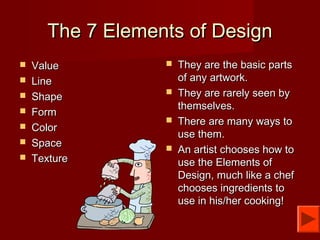
 They are the basic partsThey are the basic parts
of any artwork.of any artwork.
 They are rarely seen byThey are rarely seen by
themselves.themselves.
 There are many ways toThere are many ways to
use them.use them.
 An artist chooses how toAn artist chooses how to
use the Elements ofuse the Elements of
Design, much like a chefDesign, much like a chef
chooses ingredients tochooses ingredients to
use in his/her cooking!use in his/her cooking!
Let’s start with the Element ofLet’s start with the Element of
ValueValue
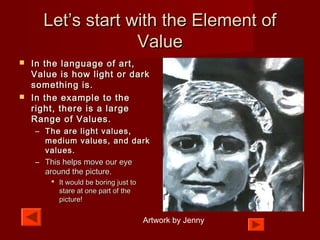
 In the language of art,In the language of art,
Value is how light or darkValue is how light or dark
something is.something is.
 In the example to theIn the example to the
right, there is a largeright, there is a large
Range of Values.Range of Values.
– The are light values,The are light values,
medium values, and darkmedium values, and dark
values.values.
– This helps move our eyeThis helps move our eye
around the picture.around the picture.
 It would be boring just toIt would be boring just to
stare at one part of thestare at one part of the
picture!picture!
Artwork by Jenny
Examples of ValueExamples of Value
 Look how Value isLook how Value is
used in these twoused in these two
works of art:works of art:
– George de La TourGeorge de La Tour
– Louise NevelsonLouise Nevelson
 Answer these questions:Answer these questions:
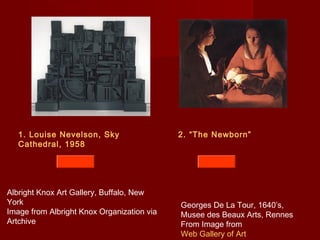
1.1. Which picture has a widerWhich picture has a wider
Range of ValuesRange of Values
(selection of lights,(selection of lights,
mediums, darks)?mediums, darks)?
2.2. Which picture uses ValueWhich picture uses Value
to give Emphasisto give Emphasis
(importance) in the(importance) in the
picture?picture?
2. “The Newborn”1. Louise Nevelson, Sky
Cathedral, 1958
Albright Knox Art Gallery, Buffalo, New
York
Image from Albright Knox Organization via
Artchive
Georges De La Tour, 1640’s,
Musee des Beaux Arts, Rennes
From Image from
Web Gallery of Art
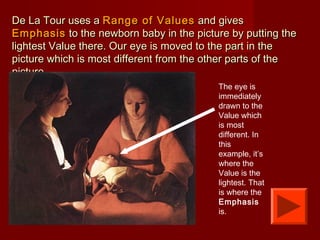
De La Tour uses aDe La Tour uses a Range of ValuesRange of Values and givesand gives
EmphasisEmphasis to the newborn baby in the picture by putting theto the newborn baby in the picture by putting the
lightest Value there. Our eye is moved to the part in thelightest Value there. Our eye is moved to the part in the
picture which is most different from the other parts of thepicture which is most different from the other parts of the
picture.picture.
The eye is
immediately
drawn to the
Value which
is most
different. In
this
example, it’s
where the
Value is the
lightest. That
is where the
Emphasis
is.
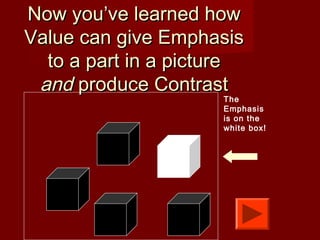
Now you’ve learned howNow you’ve learned how
Value can give EmphasisValue can give Emphasis
to a part in a pictureto a part in a picture
andand produce Contrastproduce Contrast
The
Emphasis
is on the
white box!
 Value can give theValue can give the
feeling of formfeeling of form
Look at the followingLook at the following
pictures by John Singerpictures by John Singer
SargentSargent
What else can the Element of
Value do?
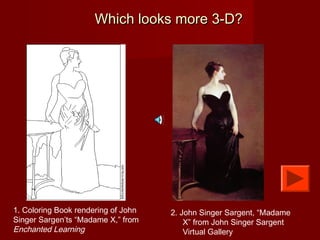
Which looks more 3-D?Which looks more 3-D?
1. Coloring Book rendering of John
Singer Sargen’ts “Madame X,” from
Enchanted Learning
2. John Singer Sargent, “Madame
X” from John Singer Sargent
Virtual Gallery
Some artists like to useSome artists like to use
dramatic valuedramatic value
 We callWe call dramatic valuedramatic value chiaroscurochiaroscuro
 It sounds like “Chee-r-o-scure-o”It sounds like “Chee-r-o-scure-o”
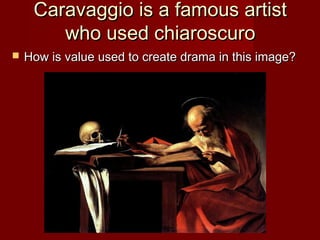
Caravaggio is a famous artistCaravaggio is a famous artist
who used chiaroscurowho used chiaroscuro
 How is value used to create drama in this image?How is value used to create drama in this image?
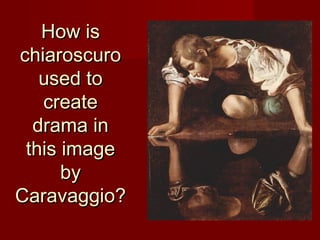
How isHow is
chiaroscurochiaroscuro
used toused to
createcreate
drama indrama in
this imagethis image
byby
Caravaggio?Caravaggio?
CONGRATULATIONS!!CONGRATULATIONS!!
 You now know what Value is and how itYou now know what Value is and how it
gives Form to an object.gives Form to an object.
 You have also seen how Value can giveYou have also seen how Value can give
Emphasis, or importance, to a particularEmphasis, or importance, to a particular
part in a picture.part in a picture.
We are going to create anWe are going to create an
artwork focusing on valueartwork focusing on value
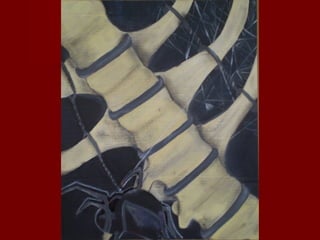
 Examine the next few images.Examine the next few images.
 Be prepared to discuss how value is usedBe prepared to discuss how value is used
in these pictures to show form andin these pictures to show form and
emphasis.emphasis.
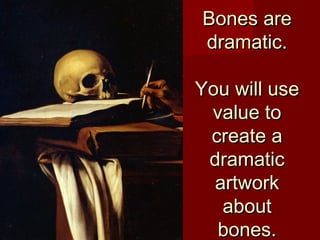
Bones areBones are
dramatic.dramatic.
You will useYou will use
value tovalue to
create acreate a
dramaticdramatic
artworkartwork
aboutabout
bones.bones.
Value in Art

Value in Art

  • 1.
    The 7 Elementsof DesignThe 7 Elements of Design  ValueValue  LineLine  ShapeShape  FormForm  ColorColor  SpaceSpace  TextureTexture  They are the basic partsThey are the basic parts of any artwork.of any artwork.  They are rarely seen byThey are rarely seen by themselves.themselves.  There are many ways toThere are many ways to use them.use them.  An artist chooses how toAn artist chooses how to use the Elements ofuse the Elements of Design, much like a chefDesign, much like a chef chooses ingredients tochooses ingredients to use in his/her cooking!use in his/her cooking!
  • 2.
    Let’s start withthe Element ofLet’s start with the Element of ValueValue  In the language of art,In the language of art, Value is how light or darkValue is how light or dark something is.something is.  In the example to theIn the example to the right, there is a largeright, there is a large Range of Values.Range of Values. – The are light values,The are light values, medium values, and darkmedium values, and dark values.values. – This helps move our eyeThis helps move our eye around the picture.around the picture.  It would be boring just toIt would be boring just to stare at one part of thestare at one part of the picture!picture! Artwork by Jenny
  • 3.
    Examples of ValueExamplesof Value  Look how Value isLook how Value is used in these twoused in these two works of art:works of art: – George de La TourGeorge de La Tour – Louise NevelsonLouise Nevelson  Answer these questions:Answer these questions: 1.1. Which picture has a widerWhich picture has a wider Range of ValuesRange of Values (selection of lights,(selection of lights, mediums, darks)?mediums, darks)? 2.2. Which picture uses ValueWhich picture uses Value to give Emphasisto give Emphasis (importance) in the(importance) in the picture?picture?
  • 4.
    2. “The Newborn”1.Louise Nevelson, Sky Cathedral, 1958 Albright Knox Art Gallery, Buffalo, New York Image from Albright Knox Organization via Artchive Georges De La Tour, 1640’s, Musee des Beaux Arts, Rennes From Image from Web Gallery of Art
  • 5.
    De La Touruses aDe La Tour uses a Range of ValuesRange of Values and givesand gives EmphasisEmphasis to the newborn baby in the picture by putting theto the newborn baby in the picture by putting the lightest Value there. Our eye is moved to the part in thelightest Value there. Our eye is moved to the part in the picture which is most different from the other parts of thepicture which is most different from the other parts of the picture.picture. The eye is immediately drawn to the Value which is most different. In this example, it’s where the Value is the lightest. That is where the Emphasis is.
  • 6.
    Now you’ve learnedhowNow you’ve learned how Value can give EmphasisValue can give Emphasis to a part in a pictureto a part in a picture andand produce Contrastproduce Contrast The Emphasis is on the white box!
  • 7.
     Value cangive theValue can give the feeling of formfeeling of form Look at the followingLook at the following pictures by John Singerpictures by John Singer SargentSargent What else can the Element of Value do?
  • 8.
    Which looks more3-D?Which looks more 3-D? 1. Coloring Book rendering of John Singer Sargen’ts “Madame X,” from Enchanted Learning 2. John Singer Sargent, “Madame X” from John Singer Sargent Virtual Gallery
  • 9.
    Some artists liketo useSome artists like to use dramatic valuedramatic value  We callWe call dramatic valuedramatic value chiaroscurochiaroscuro  It sounds like “Chee-r-o-scure-o”It sounds like “Chee-r-o-scure-o”
  • 10.
    Caravaggio is afamous artistCaravaggio is a famous artist who used chiaroscurowho used chiaroscuro  How is value used to create drama in this image?How is value used to create drama in this image?
  • 11.
    How isHow is chiaroscurochiaroscuro usedtoused to createcreate drama indrama in this imagethis image byby Caravaggio?Caravaggio?
  • 12.
    CONGRATULATIONS!!CONGRATULATIONS!!  You nowknow what Value is and how itYou now know what Value is and how it gives Form to an object.gives Form to an object.  You have also seen how Value can giveYou have also seen how Value can give Emphasis, or importance, to a particularEmphasis, or importance, to a particular part in a picture.part in a picture.
  • 13.
    We are goingto create anWe are going to create an artwork focusing on valueartwork focusing on value  Examine the next few images.Examine the next few images.  Be prepared to discuss how value is usedBe prepared to discuss how value is used in these pictures to show form andin these pictures to show form and emphasis.emphasis.
  • 14.
    Bones areBones are dramatic.dramatic. Youwill useYou will use value tovalue to create acreate a dramaticdramatic artworkartwork aboutabout bones.bones.

Editor's Notes

  • #2 Scaffolding
  • #4 Comparing similarities and differences
  • #6 Scaffolding
  • #7 Scaffolding
  • #8 Mathetics: scaffolding
  • #9 Comparing Similarities and Differences