ILLUSTRATION   ILLUSTRATION   ILLUSTRATION http://art.pppst.com/arthistory.html info on slides 45-56  by Amy Johnson
Cave Painting, Lascaux, France, 20,000 years old
Cave Painting, Lascaux, France  20,000 years old
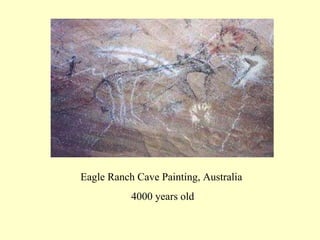
Eagle Ranch Cave Painting, Australia  4000 years old
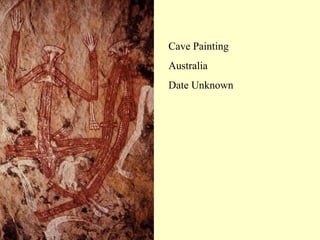
Cave Painting Australia Date Unknown
Petroglyphs Utah
Petroglyph, Utah Freemont Period 500AD – 1500AD
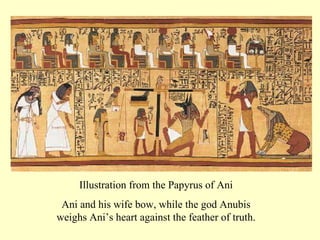
Illustration from the Papyrus of Ani Ani and his wife bow, while the god Anubis weighs Ani’s heart against the feather of truth.
Papyrus of Nany, a woman in her seventies, chantress of Amun-Re.  She holds her mouth and eyes in her hand, while her heart is weighed.
Medieval Illuminated Manuscripts “ Book of Kells” Four Gospels with Latin text Ireland, c. 800 AD
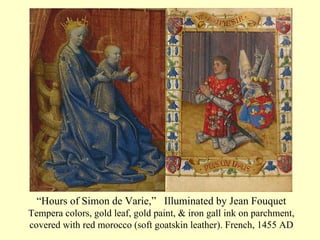
“ Hours of Simon de Varie,”  Illuminated by Jean Fouquet  Tempera colors, gold leaf, gold paint, & iron gall ink on parchment, covered with red morocco (soft goatskin leather). French, 1455 AD
“ Book of Hours,” 167 leaves of vellum Valencia, Spain, c. 1460
Breviary belonging to Mary Stuart, Queen of Scots Her notes can be seen in the margins Late 1400s AD
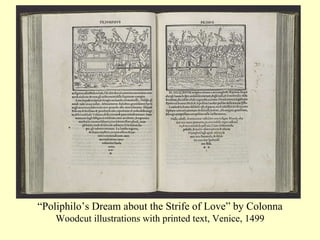
“ Poliphilo’s Dream about the Strife of Love” by Colonna  Woodcut illustrations with printed text, Venice, 1499
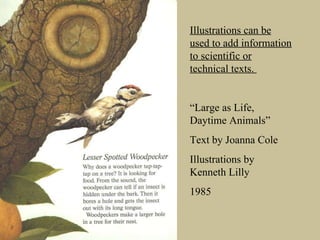
Illustrations can be used to add information to scientific or technical texts.  “ Large as Life, Daytime Animals”  Text by Joanna Cole Illustrations by Kenneth Lilly 1985
Photography and digital artwork is  often used to illustrate products. Text is frequently treated as a graphic  component, adding visual interest to illustrations, particularly in advertising.
Illustrations can be used to provide conceptual images. “ Effigia okeefeae,” related to the forbears of modern crocodiles. National Geographic, March 2007
Illustrations can add a great deal to Creative Writing . In the late 1800s, illustrators created images full of action for novels and historical fiction. “ On the Irrawaddy”  by G.A. Henty, 1896
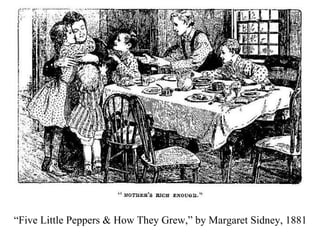
“ Five Little Peppers & How They Grew,” by Margaret Sidney, 1881
How do YOU illustrate? Follow a process of brainstorming steps Think of ideas Sketch at least 2 ideas. You ideas may vary by story, point of view, angle, characters etc. etc.  Pick your favorite idea Sketch it in pencil Paint, color, trace with dark pen etc.
Let’s look at some modern illustrations Think about the different ways in which the illustrator could have drawn the picture differently. How can you use their ideas to make your illustrations better?
The movie Ice Age features: a mammoth, a sabertooth, a squirrel Visual images are absorbed and understood all at once. and a sloth.
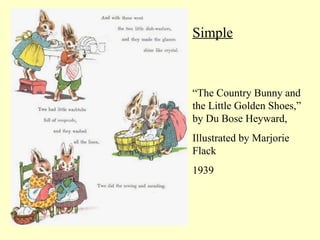
Simple “ The Country Bunny and the Little Golden Shoes,” by Du Bose Heyward, Illustrated by Marjorie Flack  1939
Elaboration An extension of what is written “ The Day Jimmy’s Boa Ate the Wash”  by Trinka Hakes Noble Illustration by Steven Kellogg 1980
Foretelling Hinting at an event which has not happened in the story yet “ Raggedy Ann and Andy and the Wishing Pebble”  Illustrated by Cathy Beylon 1987
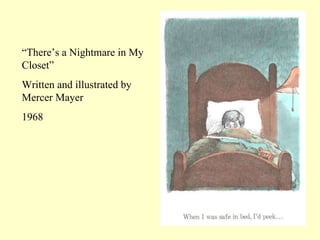
“ There’s a Nightmare in My Closet” Written and illustrated by Mercer Mayer 1968
 
 
Border Decorations Simple or elaborate, they tie the pages together as a whole.
Perspective   Visual interest can be added by varying the viewpoint.
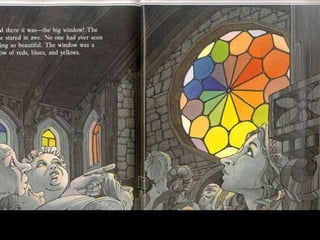
“ The Glassmakers of Gurven” Written by Marlys Boddy Illustrated by Joe Boddy
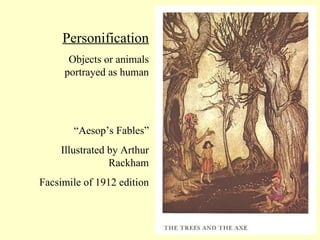
Personification Objects or animals portrayed as human “ Aesop’s Fables” Illustrated by Arthur Rackham Facsimile of 1912 edition
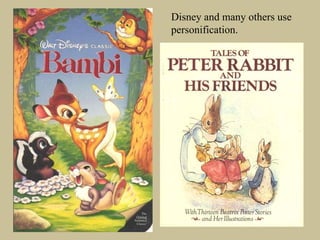
Disney and many others use personification.
Different art styles can work for the same story  By Daniel San Souci By Anne Rockwell
Line Art “ Where the Sidewalk Ends”  1987 Poems and Drawings by Shel Silverstein
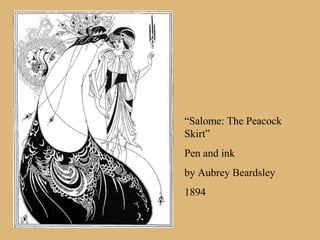
“ Salome: The Peacock Skirt” Pen and ink by Aubrey Beardsley 1894
Use bold shapes to create drama Pen and Ink “ Portrait of James McNeill Whistler” Aubrey Beardsley 1894
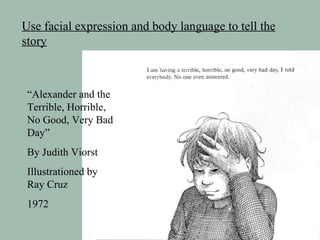
Use facial expression and body language to tell the story “ Alexander and the Terrible, Horrible, No Good, Very Bad Day” By Judith Viorst Illustrationed by  Ray Cruz 1972
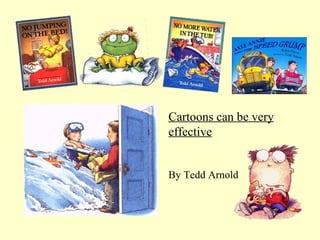
Cartoons can be very effective By Tedd Arnold
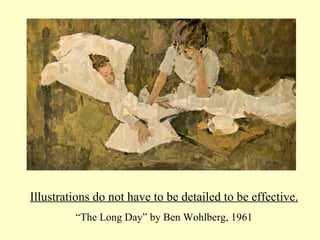
Illustrations do not have to be detailed to be effective. “ The Long Day” by Ben Wohlberg, 1961
Color creates mood “ Glassmakers of Gurven” Illustrated by Joe Boddy
“ First Snow” by John Gannam
Unusual composition adds interest Illustration for Pacific Mills By John Gannam
Some illustrations require no text at all. . . . . . . . . . . . . . .
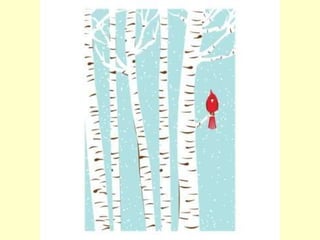
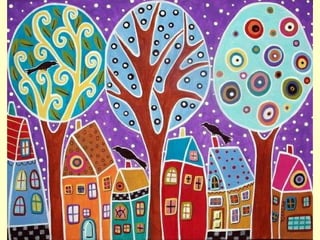
Your Project! Create Winter/Holiday Cards
Your Project Choices You can choose ONE of the following projects as inspiration. Inspiration means you want to create something similar idea and/or theme; NOT COPY.


Your Project: TO-DO Choose your winter card project packet Read  ALL  of the directions Complete 2 sketches on scratch paper Follow the directions in your packet When finished put all wet artwork on the drying rack, give all dry artwork to Ms. J. ** If you want to add/change directions for your project ask Ms. J. first. **

Illustration

  • 1.
    ILLUSTRATION ILLUSTRATION ILLUSTRATION http://art.pppst.com/arthistory.html info on slides 45-56 by Amy Johnson
  • 2.
    Cave Painting, Lascaux,France, 20,000 years old
  • 3.
    Cave Painting, Lascaux,France 20,000 years old
  • 4.
    Eagle Ranch CavePainting, Australia 4000 years old
  • 5.
  • 6.
  • 7.
    Petroglyph, Utah FreemontPeriod 500AD – 1500AD
  • 8.
    Illustration from thePapyrus of Ani Ani and his wife bow, while the god Anubis weighs Ani’s heart against the feather of truth.
  • 9.
    Papyrus of Nany,a woman in her seventies, chantress of Amun-Re. She holds her mouth and eyes in her hand, while her heart is weighed.
  • 10.
    Medieval Illuminated Manuscripts“ Book of Kells” Four Gospels with Latin text Ireland, c. 800 AD
  • 11.
    “ Hours ofSimon de Varie,” Illuminated by Jean Fouquet Tempera colors, gold leaf, gold paint, & iron gall ink on parchment, covered with red morocco (soft goatskin leather). French, 1455 AD
  • 12.
    “ Book ofHours,” 167 leaves of vellum Valencia, Spain, c. 1460
  • 13.
    Breviary belonging toMary Stuart, Queen of Scots Her notes can be seen in the margins Late 1400s AD
  • 14.
    “ Poliphilo’s Dreamabout the Strife of Love” by Colonna Woodcut illustrations with printed text, Venice, 1499
  • 15.
    Illustrations can beused to add information to scientific or technical texts. “ Large as Life, Daytime Animals” Text by Joanna Cole Illustrations by Kenneth Lilly 1985
  • 16.
    Photography and digitalartwork is often used to illustrate products. Text is frequently treated as a graphic component, adding visual interest to illustrations, particularly in advertising.
  • 17.
    Illustrations can beused to provide conceptual images. “ Effigia okeefeae,” related to the forbears of modern crocodiles. National Geographic, March 2007
  • 18.
    Illustrations can adda great deal to Creative Writing . In the late 1800s, illustrators created images full of action for novels and historical fiction. “ On the Irrawaddy” by G.A. Henty, 1896
  • 19.
    “ Five LittlePeppers & How They Grew,” by Margaret Sidney, 1881
  • 20.
    How do YOUillustrate? Follow a process of brainstorming steps Think of ideas Sketch at least 2 ideas. You ideas may vary by story, point of view, angle, characters etc. etc. Pick your favorite idea Sketch it in pencil Paint, color, trace with dark pen etc.
  • 21.
    Let’s look atsome modern illustrations Think about the different ways in which the illustrator could have drawn the picture differently. How can you use their ideas to make your illustrations better?
  • 22.
    The movie IceAge features: a mammoth, a sabertooth, a squirrel Visual images are absorbed and understood all at once. and a sloth.
  • 23.
    Simple “ TheCountry Bunny and the Little Golden Shoes,” by Du Bose Heyward, Illustrated by Marjorie Flack 1939
  • 24.
    Elaboration An extensionof what is written “ The Day Jimmy’s Boa Ate the Wash” by Trinka Hakes Noble Illustration by Steven Kellogg 1980
  • 25.
    Foretelling Hinting atan event which has not happened in the story yet “ Raggedy Ann and Andy and the Wishing Pebble” Illustrated by Cathy Beylon 1987
  • 26.
    “ There’s aNightmare in My Closet” Written and illustrated by Mercer Mayer 1968
  • 27.
  • 28.
  • 29.
    Border Decorations Simpleor elaborate, they tie the pages together as a whole.
  • 30.
    Perspective Visual interest can be added by varying the viewpoint.
  • 31.
    “ The Glassmakersof Gurven” Written by Marlys Boddy Illustrated by Joe Boddy
  • 32.
    Personification Objects oranimals portrayed as human “ Aesop’s Fables” Illustrated by Arthur Rackham Facsimile of 1912 edition
  • 33.
    Disney and manyothers use personification.
  • 34.
    Different art stylescan work for the same story By Daniel San Souci By Anne Rockwell
  • 35.
    Line Art “Where the Sidewalk Ends” 1987 Poems and Drawings by Shel Silverstein
  • 36.
    “ Salome: ThePeacock Skirt” Pen and ink by Aubrey Beardsley 1894
  • 37.
    Use bold shapesto create drama Pen and Ink “ Portrait of James McNeill Whistler” Aubrey Beardsley 1894
  • 38.
    Use facial expressionand body language to tell the story “ Alexander and the Terrible, Horrible, No Good, Very Bad Day” By Judith Viorst Illustrationed by Ray Cruz 1972
  • 39.
    Cartoons can bevery effective By Tedd Arnold
  • 40.
    Illustrations do nothave to be detailed to be effective. “ The Long Day” by Ben Wohlberg, 1961
  • 41.
    Color creates mood“ Glassmakers of Gurven” Illustrated by Joe Boddy
  • 42.
    “ First Snow”by John Gannam
  • 43.
    Unusual composition addsinterest Illustration for Pacific Mills By John Gannam
  • 44.
    Some illustrations requireno text at all. . . . . . . . . . . . . . .
  • 45.
    Your Project! CreateWinter/Holiday Cards
  • 46.
    Your Project ChoicesYou can choose ONE of the following projects as inspiration. Inspiration means you want to create something similar idea and/or theme; NOT COPY.
  • 47.
  • 48.
  • 49.
  • 50.
  • 51.
  • 52.
  • 53.
  • 54.
  • 55.
  • 56.
    Your Project: TO-DOChoose your winter card project packet Read ALL of the directions Complete 2 sketches on scratch paper Follow the directions in your packet When finished put all wet artwork on the drying rack, give all dry artwork to Ms. J. ** If you want to add/change directions for your project ask Ms. J. first. **

Editor's Notes

  • #2 First, let’s look at the history of symbol-making and the book.
  • #3 There is an old saying that “a picture is worth a thousand words.” This was certainly true for cultures that had no written language.
  • #4 Pictures served to tell the stories they felt were important to record.
  • #5 The stories recorded important events and personal stories
  • #6 Though we do not know for certain what the meaning of the early rock art was, it seems safe to assume that some served religious purposes.
  • #7 Early alphabets evolved from early pictograms, or pictures which represented things or ideas.
  • #8 Images incised into the rock surface are called petroglyphs.
  • #9 To ancient Egyptians, reaching the afterlife depended upon living a good life and having perfect burial arrangements. For important people who could afford it, a “Book of the Dead” was produced to help them make a successful transition to the afterlife.
  • #10 Egyptian artworks depended heavily on symbolic images.
  • #11 Sometime around 400 AD, the Greeks developed a simplified alphabet. Many Greeks and Romans were able to read, and the wealthy had libraries in their homes. Books were completely handmade, one at a time. Some of the books were lavishly lettered and decorated. These are called “Illuminated Manuscripts.”
  • #12 A “Book of Hours” was individually made for a lay people who was a very religious Christian. The book typically included a set of psalms which would be recited or sung,
  • #13 Vellum was made from the skins of calf, lamb or kid. It was used before paper became widely available.
  • #14 Breviaries were liturgical books containing public prayers, hymns, psalms and readings for everyday use, usually for priests.
  • #15 Paper had also been invented in China in 105 AD and had reached Europe through trade routes. By the 1400s when Gutenberg invented his press, paper was commonly used instead of parchment (vellum, made from goatskin).
  • #19 Illustrations add impact to creative writing.
  • #27 Continuous Narration is often used in children’s books because little text is needed.
  • #30 Book designers use specific fonts, colors, borders and other elements to visually tie all of the various parts into an integrated whole.
  • #31 Varying perspective requires imaginative reading of the text, and can keep the book visually interesting.
  • #32 Another perspective from the same book.
  • #36 Simple line drawings can be very effective and are often used as cartoons.
  • #37 Line art can also be elegant and dramatic.
  • #38 Switching to a dark background adds interest.
  • #41 Simplicity can be very effective.
  • #43 This piece uses color and diagonal lines to create a sense of motion and a dark, cold mood.
  • #45 Creating books with no text are a challenge to an artist.