CHAPTER
33D DESIGN ELEMENTS
Introduction
Form
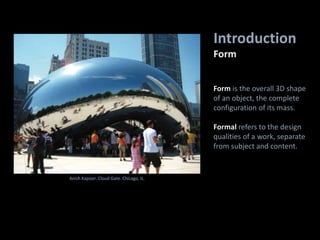
Anish Kapoor. Cloud Gate. Chicago, IL.
Form is the overall 3D shape
of an object, the complete
configuration of its mass.
Formal refers to the design
qualities of a work, separate
from subject and content.
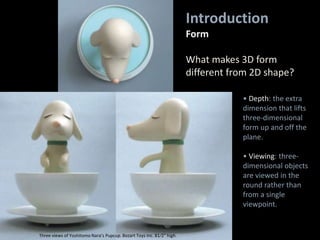
• Depth: the extra
dimension that lifts
three-dimensional
form up and off the
plane.
• Viewing: three-
dimensional objects
are viewed in the
round rather than
from a single
viewpoint.
Introduction
Form
What makes 3D form
different from 2D shape?
Three views of Yoshitomo Nara’s Pupcup. Bozart Toys Inc. 81⁄2" high.
Introduction
Form and Content
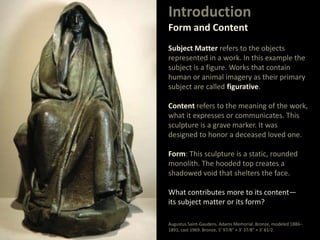
Subject Matter refers to the objects
represented in a work. In this example the
subject is a figure. Works that contain
human or animal imagery as their primary
subject are called figurative.
Content refers to the meaning of the work,
what it expresses or communicates. This
sculpture is a grave marker. It was
designed to honor a deceased loved one.
Form: This sculpture is a static, rounded
monolith. The hooded top creates a
shadowed void that shelters the face.
What contributes more to its content—
its subject matter or its form?
Augustus Saint-Gaudens. Adams Memorial. Bronze, modeled 1886–
1891, cast 1969. Bronze, 5' 97⁄8" × 3' 37⁄8" × 3' 81⁄2.
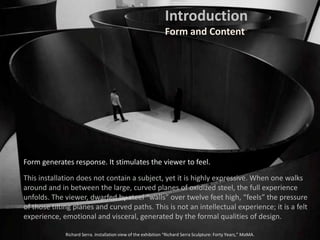
Form generates response. It stimulates the viewer to feel.
This installation does not contain a subject, yet it is highly expressive. When one walks
around and in between the large, curved planes of oxidized steel, the full experience
unfolds. The viewer, dwarfed by steel “walls” over twelve feet high, “feels” the pressure
of those tilting planes and curved paths. This is not an intellectual experience; it is a felt
experience, emotional and visceral, generated by the formal qualities of design.
Richard Serra. Installation view of the exhibition “Richard Serra Sculpture: Forty Years,” MoMA.
Introduction
Form and Content
• A form is a positive element.
• The space around and inside a form is negative space.
• 3D forms can be geometric or curvilinear, concave or
convex, static or dynamic, solid or spatial, etc.
• They can be designed for viewing in the round or be a
relief, which is a three-dimensional form designed for
viewing from a single, frontal viewpoint.
• 3D forms can be any combination of these aspects and
have numerous other properties as well.
Introduction
Aspects of 3D Form
Form
The Cube
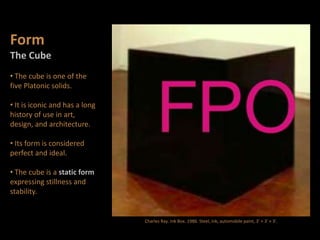
• The cube is one of the
five Platonic solids.
• It is iconic and has a long
history of use in art,
design, and architecture.
• Its form is considered
perfect and ideal.
• The cube is a static form
expressing stillness and
stability.
Charles Ray. Ink Box. 1986. Steel, ink, automobile paint, 3' × 3' × 3'.
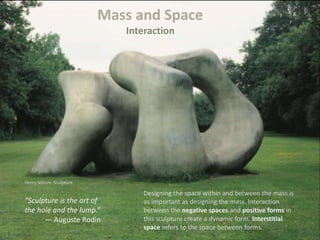
Designing the space within and between the mass is
as important as designing the mass. Interaction
between the negative spaces and positive forms in
this sculpture create a dynamic form. Interstitial
space refers to the space between forms.
Mass and Space
Interaction
Henry Moore. Sculpture.
“Sculpture is the art of
the hole and the lump.”
— Auguste Rodin
Mass and Space
Interaction
Mass and space exist in tandem and
continually interact with one
another.
Mass can…
•occupy space,
• define and shape space,
• activate space, and
• give meaning to space.
The soaring arches of this gothic
cathedral demonstrate how mass
can be formed to give shape and
meaning to an interior space.
Interior of Laon Cathedral (looking northeast),
Laon, France. Begun c. 1190
Louise Bourgeois. Maman. 2005. Bronze, stainless steel and marble, 10 meters high
In this thirty foot high outdoor sculpture a small amount of mass
delicately defines, shapes and activates a large interior space.
Mass and Space
Interaction
Line
A Point Set In Motion
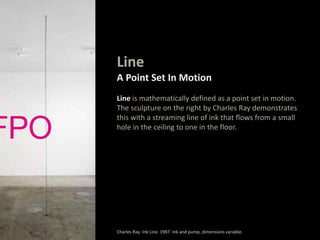
Line is mathematically defined as a point set in motion.
The sculpture on the right by Charles Ray demonstrates
this with a streaming line of ink that flows from a small
hole in the ceiling to one in the floor.
Charles Ray. Ink Line. 1987. Ink and pump, dimensions variable.
Line
A Point Set In Motion
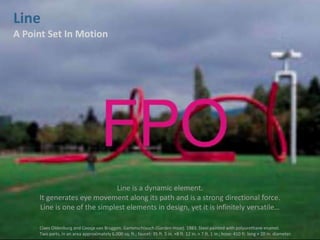
Line is a dynamic element.
It generates eye movement along its path and is a strong directional force.
Line is one of the simplest elements in design, yet it is infinitely versatile…
Claes Oldenburg and Coosje van Bruggen. Gartenschlauch (Garden Hose). 1983. Steel painted with polyurethane enamel.
Two parts, in an area approximately 6,000 sq. ft.; faucet: 35 ft. 5 in. ×8 ft. 12 in. × 7 ft. 1 in.; hose: 410 ft. long × 20 in. diameter.
Line
Gesture
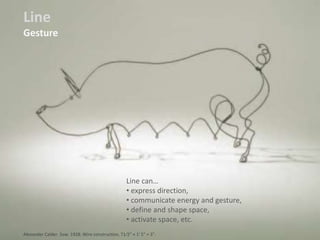
Line can…
• express direction,
• communicate energy and gesture,
• define and shape space,
• activate space, etc.
Alexander Calder. Sow. 1928. Wire construction, 71⁄2" × 1' 5" × 3".
Line
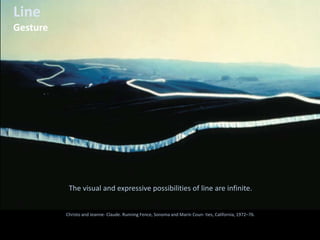
Gesture
The visual and expressive possibilities of line are infinite.
Christo and Jeanne- Claude. Running Fence, Sonoma and Marin Coun- ties, California, 1972–76.
Plane
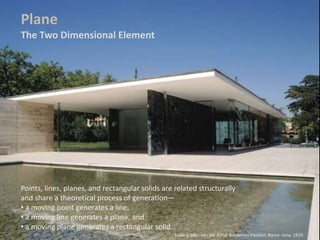
The Two Dimensional Element
Points, lines, planes, and rectangular solids are related structurally
and share a theoretical process of generation—
• a moving point generates a line,
• a moving line generates a plane, and
• a moving plane generates a rectangular solid.
Ludwig Mies van der Rohe. Barcelona Pavilion. Barce- lona. 1929.
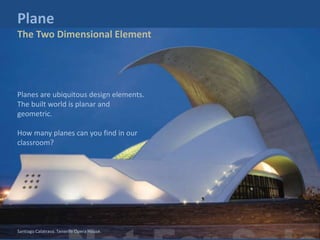
Planes are ubiquitous design elements.
The built world is planar and
geometric.
How many planes can you find in our
classroom?
Plane
The Two Dimensional Element
Santiago Calatrava. Tenerife Opera House.
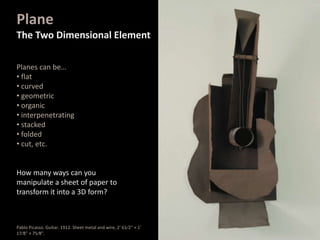
Planes can be…
• flat
• curved
• geometric
• organic
• interpenetrating
• stacked
• folded
• cut, etc.
How many ways can you
manipulate a sheet of paper to
transform it into a 3D form?
Plane
The Two Dimensional Element
Pablo Picasso. Guitar. 1912. Sheet metal and wire, 2' 61⁄2" × 1'
17⁄8" × 75⁄8".
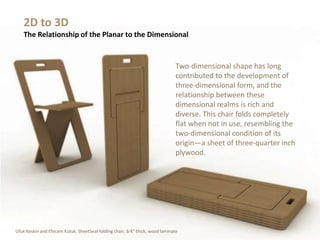
Two-dimensional shape has long
contributed to the development of
three-dimensional form, and the
relationship between these
dimensional realms is rich and
diverse. This chair folds completely
flat when not in use, resembling the
two-dimensional condition of its
origin—a sheet of three-quarter inch
plywood.
2D to 3D
The Relationship of the Planar to the Dimensional
Ufuk Keskin and Efecem Kutuk. SheetSeat folding chair, 3⁄4" thick, wood laminate
2D to 3D
The Relationship of the
Planar to the Dimensional
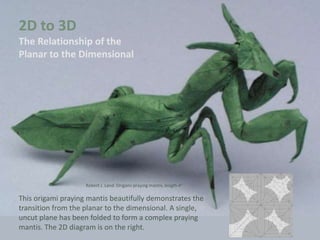
This origami praying mantis beautifully demonstrates the
transition from the planar to the dimensional. A single,
uncut plane has been folded to form a complex praying
mantis. The 2D diagram is on the right.
Robert J. Land. Origami praying mantis, length 4”
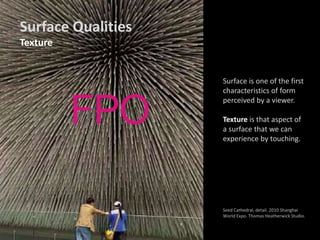
Surface is one of the first
characteristics of form
perceived by a viewer.
Texture is that aspect of
a surface that we can
experience by touching.
Seed Cathedral, detail. 2010 Shanghai
World Expo. Thomas Heatherwick Studio.
Surface Qualities
Texture
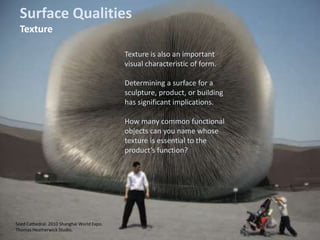
Seed Cathedral. 2010 Shanghai World Expo.
Thomas Heatherwick Studio.
Surface Qualities
Texture
Texture is also an important
visual characteristic of form.
Determining a surface for a
sculpture, product, or building
has significant implications.
How many common functional
objects can you name whose
texture is essential to the
product’s function?
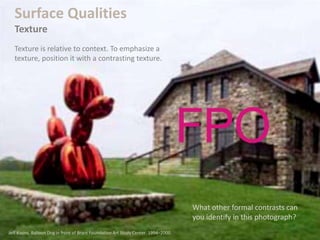
What other formal contrasts can
you identify in this photograph?
Surface Qualities
Texture
Texture is relative to context. To emphasize a
texture, position it with a contrasting texture.
Jeff Koons. Balloon Dog in front of Brant Foundation Art Study Center. 1994–2000.
Surface Qualities
Color
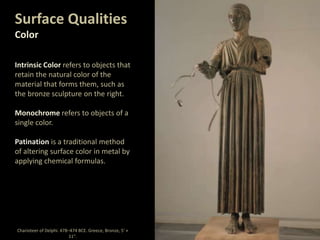
Intrinsic Color refers to objects that
retain the natural color of the
material that forms them, such as
the bronze sculpture on the right.
Monochrome refers to objects of a
single color.
Patination is a traditional method
of altering surface color in metal by
applying chemical formulas.
Charioteer of Delphi. 478–474 BCE. Greece, Bronze, 5' ×
11".
Applied Color refers to the application of color
to an object. Surfaces can be painted, coated,
glazed, enameled, oxidized, anodized,
galvanized, patinated, and so forth.
Polychrome refers to objects containing more
than one color.
Katharina Grosse. Atoms outside Eggs, detail. 2007. Acrylic on wall, floor and
Styrofoam on polyurethane on wood, 221⁄2” × 662⁄3” × 471⁄5”.
Image not yet available.
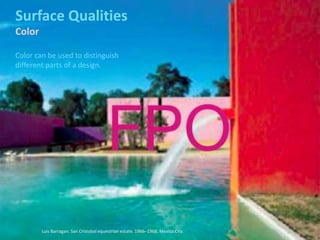
Luis Barragan. San Cristobal equestrian estate. 1966–1968. Mexico City.
Surface Qualities
Color
Color can be used to distinguish
different parts of a design.
Surface Qualities
Color
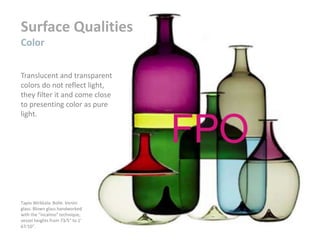
Translucent and transparent
colors do not reflect light,
they filter it and come close
to presenting color as pure
light.
Tapio Wirkkala. Bolle. Venini
glass. Blown glass handworked
with the “incalmo” technique,
vessel heights from 73⁄5" to 1'
67⁄10".
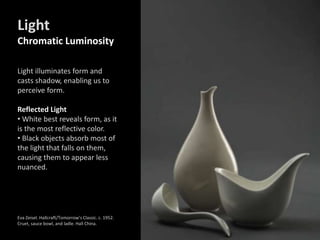
Light illuminates form and
casts shadow, enabling us to
perceive form.
Reflected Light
• White best reveals form, as it
is the most reflective color.
• Black objects absorb most of
the light that falls on them,
causing them to appear less
nuanced.
Eva Zeisel. Hallcraft/Tomorrow’s Classic. c. 1952.
Cruet, sauce bowl, and ladle. Hall China.
Light
Chromatic Luminosity
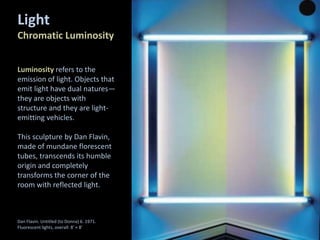
Luminosity refers to the
emission of light. Objects that
emit light have dual natures—
they are objects with
structure and they are light-
emitting vehicles.
This sculpture by Dan Flavin,
made of mundane florescent
tubes, transcends its humble
origin and completely
transforms the corner of the
room with reflected light.
Dan Flavin. Untitled (to Donna) 6. 1971.
Fluorescent lights, overall: 8' × 8'
Light
Chromatic Luminosity
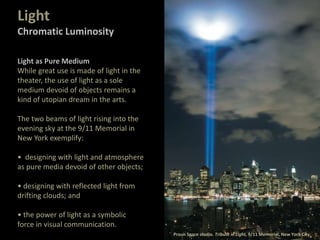
Light as Pure Medium
While great use is made of light in the
theater, the use of light as a sole
medium devoid of objects remains a
kind of utopian dream in the arts.
The two beams of light rising into the
evening sky at the 9/11 Memorial in
New York exemplify:
• designing with light and atmosphere
as pure media devoid of other objects;
• designing with reflected light from
drifting clouds; and
• the power of light as a symbolic
force in visual communication.
Proun Space studio. Tribute in Light, 9/11 Memorial, New York City.
Light
Chromatic Luminosity
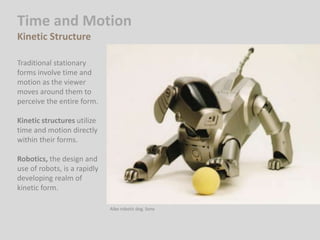
Time and Motion
Kinetic Structure
Traditional stationary
forms involve time and
motion as the viewer
moves around them to
perceive the entire form.
Kinetic structures utilize
time and motion directly
within their forms.
Robotics, the design and
use of robots, is a rapidly
developing realm of
kinetic form.
Aibo robotic dog. Sony
Time and Motion
Kinetic Structure
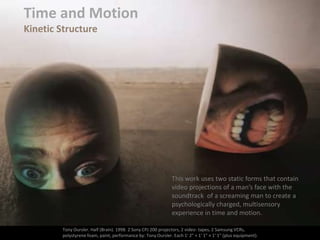
Tony Oursler. Half (Brain). 1998. 2 Sony CPJ 200 projectors, 2 video- tapes, 2 Samsung VCRs,
polystyrene foam, paint, performance by: Tony Oursler. Each 1' 2" × 1' 1" × 1' 1" (plus equipment).
This work uses two static forms that contain
video projections of a man’s face with the
soundtrack of a screaming man to create a
psychologically charged, multisensory
experience in time and motion.

3 d chapter 3 3d design elements

  • 1.
  • 2.
    Introduction Form Anish Kapoor. CloudGate. Chicago, IL. Form is the overall 3D shape of an object, the complete configuration of its mass. Formal refers to the design qualities of a work, separate from subject and content.
  • 3.
    • Depth: theextra dimension that lifts three-dimensional form up and off the plane. • Viewing: three- dimensional objects are viewed in the round rather than from a single viewpoint. Introduction Form What makes 3D form different from 2D shape? Three views of Yoshitomo Nara’s Pupcup. Bozart Toys Inc. 81⁄2" high.
  • 4.
    Introduction Form and Content SubjectMatter refers to the objects represented in a work. In this example the subject is a figure. Works that contain human or animal imagery as their primary subject are called figurative. Content refers to the meaning of the work, what it expresses or communicates. This sculpture is a grave marker. It was designed to honor a deceased loved one. Form: This sculpture is a static, rounded monolith. The hooded top creates a shadowed void that shelters the face. What contributes more to its content— its subject matter or its form? Augustus Saint-Gaudens. Adams Memorial. Bronze, modeled 1886– 1891, cast 1969. Bronze, 5' 97⁄8" × 3' 37⁄8" × 3' 81⁄2.
  • 5.
    Form generates response.It stimulates the viewer to feel. This installation does not contain a subject, yet it is highly expressive. When one walks around and in between the large, curved planes of oxidized steel, the full experience unfolds. The viewer, dwarfed by steel “walls” over twelve feet high, “feels” the pressure of those tilting planes and curved paths. This is not an intellectual experience; it is a felt experience, emotional and visceral, generated by the formal qualities of design. Richard Serra. Installation view of the exhibition “Richard Serra Sculpture: Forty Years,” MoMA. Introduction Form and Content
  • 6.
    • A formis a positive element. • The space around and inside a form is negative space. • 3D forms can be geometric or curvilinear, concave or convex, static or dynamic, solid or spatial, etc. • They can be designed for viewing in the round or be a relief, which is a three-dimensional form designed for viewing from a single, frontal viewpoint. • 3D forms can be any combination of these aspects and have numerous other properties as well. Introduction Aspects of 3D Form
  • 7.
    Form The Cube • Thecube is one of the five Platonic solids. • It is iconic and has a long history of use in art, design, and architecture. • Its form is considered perfect and ideal. • The cube is a static form expressing stillness and stability. Charles Ray. Ink Box. 1986. Steel, ink, automobile paint, 3' × 3' × 3'.
  • 8.
    Designing the spacewithin and between the mass is as important as designing the mass. Interaction between the negative spaces and positive forms in this sculpture create a dynamic form. Interstitial space refers to the space between forms. Mass and Space Interaction Henry Moore. Sculpture. “Sculpture is the art of the hole and the lump.” — Auguste Rodin
  • 9.
    Mass and Space Interaction Massand space exist in tandem and continually interact with one another. Mass can… •occupy space, • define and shape space, • activate space, and • give meaning to space. The soaring arches of this gothic cathedral demonstrate how mass can be formed to give shape and meaning to an interior space. Interior of Laon Cathedral (looking northeast), Laon, France. Begun c. 1190
  • 10.
    Louise Bourgeois. Maman.2005. Bronze, stainless steel and marble, 10 meters high In this thirty foot high outdoor sculpture a small amount of mass delicately defines, shapes and activates a large interior space. Mass and Space Interaction
  • 11.
    Line A Point SetIn Motion Line is mathematically defined as a point set in motion. The sculpture on the right by Charles Ray demonstrates this with a streaming line of ink that flows from a small hole in the ceiling to one in the floor. Charles Ray. Ink Line. 1987. Ink and pump, dimensions variable.
  • 12.
    Line A Point SetIn Motion Line is a dynamic element. It generates eye movement along its path and is a strong directional force. Line is one of the simplest elements in design, yet it is infinitely versatile… Claes Oldenburg and Coosje van Bruggen. Gartenschlauch (Garden Hose). 1983. Steel painted with polyurethane enamel. Two parts, in an area approximately 6,000 sq. ft.; faucet: 35 ft. 5 in. ×8 ft. 12 in. × 7 ft. 1 in.; hose: 410 ft. long × 20 in. diameter.
  • 13.
    Line Gesture Line can… • expressdirection, • communicate energy and gesture, • define and shape space, • activate space, etc. Alexander Calder. Sow. 1928. Wire construction, 71⁄2" × 1' 5" × 3".
  • 14.
    Line Gesture The visual andexpressive possibilities of line are infinite. Christo and Jeanne- Claude. Running Fence, Sonoma and Marin Coun- ties, California, 1972–76.
  • 15.
    Plane The Two DimensionalElement Points, lines, planes, and rectangular solids are related structurally and share a theoretical process of generation— • a moving point generates a line, • a moving line generates a plane, and • a moving plane generates a rectangular solid. Ludwig Mies van der Rohe. Barcelona Pavilion. Barce- lona. 1929.
  • 16.
    Planes are ubiquitousdesign elements. The built world is planar and geometric. How many planes can you find in our classroom? Plane The Two Dimensional Element Santiago Calatrava. Tenerife Opera House.
  • 17.
    Planes can be… •flat • curved • geometric • organic • interpenetrating • stacked • folded • cut, etc. How many ways can you manipulate a sheet of paper to transform it into a 3D form? Plane The Two Dimensional Element Pablo Picasso. Guitar. 1912. Sheet metal and wire, 2' 61⁄2" × 1' 17⁄8" × 75⁄8".
  • 18.
    Two-dimensional shape haslong contributed to the development of three-dimensional form, and the relationship between these dimensional realms is rich and diverse. This chair folds completely flat when not in use, resembling the two-dimensional condition of its origin—a sheet of three-quarter inch plywood. 2D to 3D The Relationship of the Planar to the Dimensional Ufuk Keskin and Efecem Kutuk. SheetSeat folding chair, 3⁄4" thick, wood laminate
  • 19.
    2D to 3D TheRelationship of the Planar to the Dimensional This origami praying mantis beautifully demonstrates the transition from the planar to the dimensional. A single, uncut plane has been folded to form a complex praying mantis. The 2D diagram is on the right. Robert J. Land. Origami praying mantis, length 4”
  • 20.
    Surface is oneof the first characteristics of form perceived by a viewer. Texture is that aspect of a surface that we can experience by touching. Seed Cathedral, detail. 2010 Shanghai World Expo. Thomas Heatherwick Studio. Surface Qualities Texture
  • 21.
    Seed Cathedral. 2010Shanghai World Expo. Thomas Heatherwick Studio. Surface Qualities Texture Texture is also an important visual characteristic of form. Determining a surface for a sculpture, product, or building has significant implications. How many common functional objects can you name whose texture is essential to the product’s function?
  • 22.
    What other formalcontrasts can you identify in this photograph? Surface Qualities Texture Texture is relative to context. To emphasize a texture, position it with a contrasting texture. Jeff Koons. Balloon Dog in front of Brant Foundation Art Study Center. 1994–2000.
  • 23.
    Surface Qualities Color Intrinsic Colorrefers to objects that retain the natural color of the material that forms them, such as the bronze sculpture on the right. Monochrome refers to objects of a single color. Patination is a traditional method of altering surface color in metal by applying chemical formulas. Charioteer of Delphi. 478–474 BCE. Greece, Bronze, 5' × 11".
  • 24.
    Applied Color refersto the application of color to an object. Surfaces can be painted, coated, glazed, enameled, oxidized, anodized, galvanized, patinated, and so forth. Polychrome refers to objects containing more than one color. Katharina Grosse. Atoms outside Eggs, detail. 2007. Acrylic on wall, floor and Styrofoam on polyurethane on wood, 221⁄2” × 662⁄3” × 471⁄5”. Image not yet available.
  • 25.
    Luis Barragan. SanCristobal equestrian estate. 1966–1968. Mexico City. Surface Qualities Color Color can be used to distinguish different parts of a design.
  • 26.
    Surface Qualities Color Translucent andtransparent colors do not reflect light, they filter it and come close to presenting color as pure light. Tapio Wirkkala. Bolle. Venini glass. Blown glass handworked with the “incalmo” technique, vessel heights from 73⁄5" to 1' 67⁄10".
  • 27.
    Light illuminates formand casts shadow, enabling us to perceive form. Reflected Light • White best reveals form, as it is the most reflective color. • Black objects absorb most of the light that falls on them, causing them to appear less nuanced. Eva Zeisel. Hallcraft/Tomorrow’s Classic. c. 1952. Cruet, sauce bowl, and ladle. Hall China. Light Chromatic Luminosity
  • 28.
    Luminosity refers tothe emission of light. Objects that emit light have dual natures— they are objects with structure and they are light- emitting vehicles. This sculpture by Dan Flavin, made of mundane florescent tubes, transcends its humble origin and completely transforms the corner of the room with reflected light. Dan Flavin. Untitled (to Donna) 6. 1971. Fluorescent lights, overall: 8' × 8' Light Chromatic Luminosity
  • 29.
    Light as PureMedium While great use is made of light in the theater, the use of light as a sole medium devoid of objects remains a kind of utopian dream in the arts. The two beams of light rising into the evening sky at the 9/11 Memorial in New York exemplify: • designing with light and atmosphere as pure media devoid of other objects; • designing with reflected light from drifting clouds; and • the power of light as a symbolic force in visual communication. Proun Space studio. Tribute in Light, 9/11 Memorial, New York City. Light Chromatic Luminosity
  • 30.
    Time and Motion KineticStructure Traditional stationary forms involve time and motion as the viewer moves around them to perceive the entire form. Kinetic structures utilize time and motion directly within their forms. Robotics, the design and use of robots, is a rapidly developing realm of kinetic form. Aibo robotic dog. Sony
  • 31.
    Time and Motion KineticStructure Tony Oursler. Half (Brain). 1998. 2 Sony CPJ 200 projectors, 2 video- tapes, 2 Samsung VCRs, polystyrene foam, paint, performance by: Tony Oursler. Each 1' 2" × 1' 1" × 1' 1" (plus equipment). This work uses two static forms that contain video projections of a man’s face with the soundtrack of a screaming man to create a psychologically charged, multisensory experience in time and motion.