VISION IMPAIRMENT SEMINARBy Laura Bucciarelli and Renee Irving
Included in this seminar:Adapting and modifying a specific topic/ unit of work for a child with impaired vision.Including a student who is blind in the classroom.
Information to assist you participate in this seminar can be found:“Special Education in contemporary society Textbook” by Gargiulo.  Pages 480-518 Vision Australia Contacts http://www.visionaustralia.org.au/info.aspx?page=534 Blind Citizens Australia Contacts http://www.bca.org.au/contacts.htmAssociation for the Blind  http://www.asnblind.org.au/
1.  ADAPTING AND MODIFYING A SPECIFIC TOPIC/UNIT OF WORK FOR A CHILD WITH IMPAIRED VISION
ACTIVITY ONEWatch the following video clip: http://www.teachers.tv/videos/2862What adaptations were made for Anna within the classroom in general? What adaptations were made for specific units of work? Make notes and discuss in the forum “Adaptations for Anna”	Pause slideshow and go to SPE3003 STUDY DESK to discuss your answers in forum.
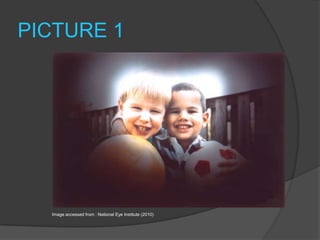
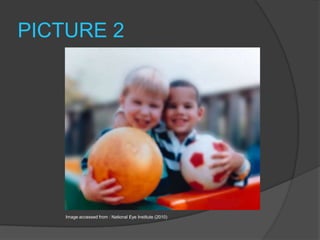
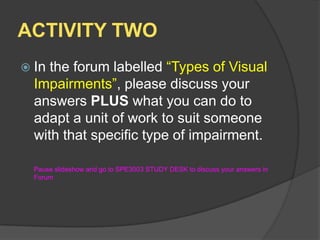
ACTIVITY TWOLook at the following picturesUsing your textbook, make note on which visual impairments you think is being depictedIn the forum labelled “Types of Visual Impairments”, please discuss your answers PLUS what you can do to adapt a unit of work to suit someone with that specific type of impairment.
PICTURE 1Image accessed from : National Eye Institute (2010)
PICTURE 2Image accessed from : National Eye Institute (2010)
PICTURE 3Image accessed from : National Eye Institute (2001)
ACTIVITY TWOIn the forum labelled “Types of Visual Impairments”, please discuss your answers PLUS what you can do to adapt a unit of work to suit someone with that specific type of impairment.	Pause slideshow and go to SPE3003 STUDY DESK to discuss your answers in Forum
2.INCLUDING A STUDENT WHO IS BLIND IN THE CLASSROOM :What does a teacher need to know and do?
Background on BlindnessBlindness is the absence of sight.No “typical” visual impairmentMany causes of blindnessCan occur familial or congenital Some forms can be cured or improvedEstimated 300,000 blind or visually impaired in Australia
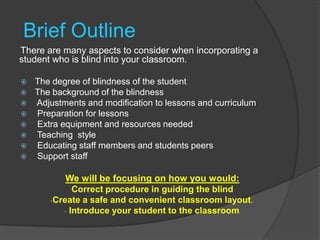
 Brief Outline There are many aspects to consider when incorporating a student who is blind into your classroom.The degree of blindness of the studentThe background of the blindness Adjustments and modification to lessons and curriculum  Preparation for lessons Extra equipment and resources needed Teaching  style  Educating staff members and students peers Support staffWe will be focusing on how you would: Correct procedure in guiding the blindCreate a safe and convenient classroom layout.
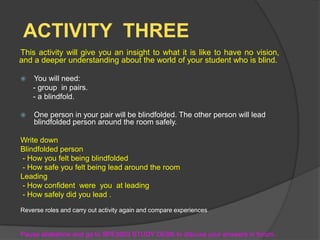
 Introduce your student to the classroom ACTIVITY  THREE This activity will give you an insight to what it is like to have no vision,    and a deeper understanding about the world of your student who is blind. You will need:      - group  in pairs.       - a blindfold.One person in your pair will be blindfolded. The other person will lead blindfolded person around the room safely.Write down Blindfolded person - How you felt being blindfolded  - How safe you felt being lead around the roomLeading  - How confident  were  you  at leading - How safely did you lead .Reverse roles and carry out activity again and compare experiencesPause slideshow and go to SPE3003 STUDY DESK to discuss your answers in forum.
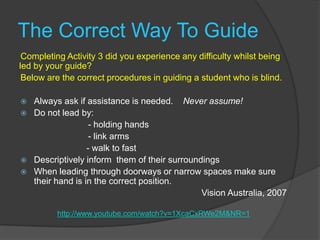
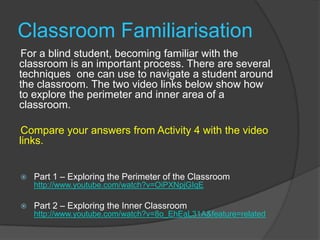
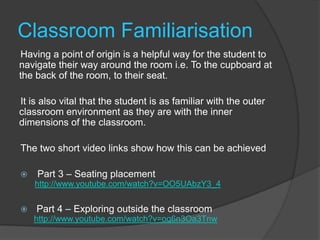
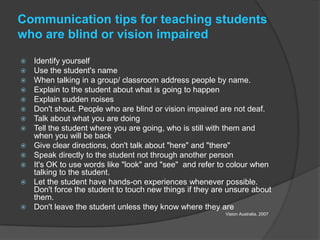
The Correct Way To GuideCompleting Activity 3 did you experience any difficulty whilst being led by your guide? Below are the correct procedures in guiding a student who is blind.Always ask if assistance is needed.    Never assume!Do not lead by:			  - holding hands 			  - link arms                           - walk to fastDescriptively inform  them of their surroundingsWhen leading through doorways or narrow spaces make sure their hand is in the correct position.  Vision Australia, 2007 http://www.youtube.com/watch?v=1XcaCxRWe2M&NR=1
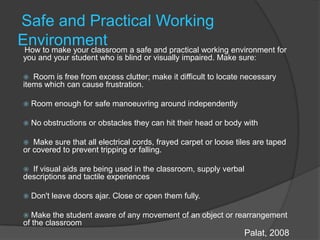
Safe and Practical Working EnvironmentHow to make your classroom a safe and practical working environment for you and your student who is blind or visually impaired. Make sure:  Room is free from excess clutter; make it difficult to locate necessary items which can cause frustration.
 Room enough for safe manoeuvring around independently
 No obstructions or obstacles they can hit their head or body with
  Make sure that all electrical cords, frayed carpet or loose tiles are taped or covered to prevent tripping or falling.
  If visual aids are being used in the classroom, supply verbal descriptions and tactile experiences
 Don't leave doors ajar. Close or open them fully.
 Make the student aware of any movement of an object or rearrangement of the classroom                                                              Palat, 2008
ACTIVITY  FOURYou have been allocated your class for the new year. In your class of 27, one of these students is visually impaired.  What procedures would you use to familiarise your student with their classroom.Write your ideas down, in point form, in the forum provided.Pause slideshow and go to SPE3003 STUDY DESK to discuss your answers in forum.

Vision Impairment Seminar

  • 1.
    VISION IMPAIRMENT SEMINARByLaura Bucciarelli and Renee Irving
  • 2.
    Included in thisseminar:Adapting and modifying a specific topic/ unit of work for a child with impaired vision.Including a student who is blind in the classroom.
  • 3.
    Information to assistyou participate in this seminar can be found:“Special Education in contemporary society Textbook” by Gargiulo. Pages 480-518 Vision Australia Contacts http://www.visionaustralia.org.au/info.aspx?page=534 Blind Citizens Australia Contacts http://www.bca.org.au/contacts.htmAssociation for the Blind http://www.asnblind.org.au/
  • 4.
    1. ADAPTINGAND MODIFYING A SPECIFIC TOPIC/UNIT OF WORK FOR A CHILD WITH IMPAIRED VISION
  • 5.
    ACTIVITY ONEWatch thefollowing video clip: http://www.teachers.tv/videos/2862What adaptations were made for Anna within the classroom in general? What adaptations were made for specific units of work? Make notes and discuss in the forum “Adaptations for Anna” Pause slideshow and go to SPE3003 STUDY DESK to discuss your answers in forum.
  • 6.
    ACTIVITY TWOLook atthe following picturesUsing your textbook, make note on which visual impairments you think is being depictedIn the forum labelled “Types of Visual Impairments”, please discuss your answers PLUS what you can do to adapt a unit of work to suit someone with that specific type of impairment.
  • 7.
    PICTURE 1Image accessedfrom : National Eye Institute (2010)
  • 8.
    PICTURE 2Image accessedfrom : National Eye Institute (2010)
  • 9.
    PICTURE 3Image accessedfrom : National Eye Institute (2001)
  • 10.
    ACTIVITY TWOIn theforum labelled “Types of Visual Impairments”, please discuss your answers PLUS what you can do to adapt a unit of work to suit someone with that specific type of impairment. Pause slideshow and go to SPE3003 STUDY DESK to discuss your answers in Forum
  • 11.
    2.INCLUDING A STUDENTWHO IS BLIND IN THE CLASSROOM :What does a teacher need to know and do?
  • 12.
    Background on BlindnessBlindnessis the absence of sight.No “typical” visual impairmentMany causes of blindnessCan occur familial or congenital Some forms can be cured or improvedEstimated 300,000 blind or visually impaired in Australia
  • 13.
    Brief OutlineThere are many aspects to consider when incorporating a student who is blind into your classroom.The degree of blindness of the studentThe background of the blindness Adjustments and modification to lessons and curriculum Preparation for lessons Extra equipment and resources needed Teaching style Educating staff members and students peers Support staffWe will be focusing on how you would: Correct procedure in guiding the blindCreate a safe and convenient classroom layout.
  • 14.
    Introduce yourstudent to the classroom ACTIVITY THREE This activity will give you an insight to what it is like to have no vision, and a deeper understanding about the world of your student who is blind. You will need: - group in pairs. - a blindfold.One person in your pair will be blindfolded. The other person will lead blindfolded person around the room safely.Write down Blindfolded person - How you felt being blindfolded - How safe you felt being lead around the roomLeading - How confident were you at leading - How safely did you lead .Reverse roles and carry out activity again and compare experiencesPause slideshow and go to SPE3003 STUDY DESK to discuss your answers in forum.
  • 15.
    The Correct WayTo GuideCompleting Activity 3 did you experience any difficulty whilst being led by your guide? Below are the correct procedures in guiding a student who is blind.Always ask if assistance is needed. Never assume!Do not lead by: - holding hands - link arms - walk to fastDescriptively inform them of their surroundingsWhen leading through doorways or narrow spaces make sure their hand is in the correct position. Vision Australia, 2007 http://www.youtube.com/watch?v=1XcaCxRWe2M&NR=1
  • 16.
    Safe and PracticalWorking EnvironmentHow to make your classroom a safe and practical working environment for you and your student who is blind or visually impaired. Make sure: Room is free from excess clutter; make it difficult to locate necessary items which can cause frustration.
  • 17.
    Room enoughfor safe manoeuvring around independently
  • 18.
    No obstructionsor obstacles they can hit their head or body with
  • 19.
    Makesure that all electrical cords, frayed carpet or loose tiles are taped or covered to prevent tripping or falling.
  • 20.
    Ifvisual aids are being used in the classroom, supply verbal descriptions and tactile experiences
  • 21.
    Don't leavedoors ajar. Close or open them fully.
  • 22.
    Make thestudent aware of any movement of an object or rearrangement of the classroom Palat, 2008
  • 23.
    ACTIVITY FOURYouhave been allocated your class for the new year. In your class of 27, one of these students is visually impaired. What procedures would you use to familiarise your student with their classroom.Write your ideas down, in point form, in the forum provided.Pause slideshow and go to SPE3003 STUDY DESK to discuss your answers in forum.

Editor's Notes

  • #13 Blindness is the absence of sight. The term may indicate a total loss of vision or may be applied in a modified manner to describe certain visual limitations, as in yellow colour blindness (tritanopia), word blindness (dyslexia) or focusing on objects (fixation) (Mosby, 1996 ; Gargiulo, 2006). Legal blindness is a visual acuity of 20/200 or less in the better eye with correction or a visual field that is no greater than 20 degrees (Gargiulo,2006)Vision impairment may result from a range of conditionsand hence, there is no "typical" vision impaired student. The impact of a vision impairment depends on the type, extent and timing of vision loss.There are many causes of blindness. Some forms of blindness can be cured or vision improved with medicines, surgery, and special equipment (Templeton, 2009). Blindness can either be familial (genetic) or congenital (acquired).There are numerous genetic conditionsthat are either associated with congenital blindness, eye abnormalities and/or progressive blindness. Many of these conditions are also associated with deafness (Assess DNA, 2010). The most common visual impairments affecting the school aged child include cataracts, macular degeneration, optic nerve atrophy, diabetic retinopathy, retinopathy of prematurityand glaucoma are come examples of genetic blindness, most of these are progressive (Mosby; Gargiulo, 2006). Acquired forms of blindness occur from injury to the eye(s) or head trauma which could be accidental i.e. sport, chemicals or work related. These acquired forms of blindness can also occur through automobile accidents, violence, illness or disease. (Assess DNA, 2010; ADCET, 2009).It is estimated that there are about 300,000 people who are blind or vision impaired in Australia (Vision Australia, 2007). 
  • #14 A point form outline of what a teacher has to consider when incorporating student who is blind into the classroom Knowing the degree of blindness of your student and causality of the blindness. This will allow you to make the appropriate and suitable adjustments to the curriculum for future lessons. A curriculum for blind children is no different than acurriculum for sighted children though more comprehensive. For every skill expectation of the sighted child, blind children must do more (Mani, 1998). An Individualised Education Plan (IEP) should be put in place before the start of school. The IEP determines the students current level of performance and development and assists in selecting and using appropriate instruments that address issues or concerns relevant to the needs of the student (Garliulo, 2006). Parents, student and teacher aid and/or extra support are informed and involved in all areas of the planning process. This is applicable to Special School and mainstream schools (Garliulo, 2006; Cheadle, 2005 & ADCET, 2009). Prepare as much information as possible and provide materials in accessible formats allowing the students to adapt the information to a format which is suitable for them. Place required book lists and course material orders early so there is sufficient time for them to be reproduced in audio or Braille, if required. Indicate compulsory texts in your reading list, noting important chapters if possible. Specifying the order of reading within a text is helpful as it can take many weeks to have a book reproduced into audio or Braille (ADCET, 2009). (Specifying the order of reading within a text is helpful as it can take many weeks to have a book reproduced into audio or Braille).Your teaching style will need to be ‘verbal’. You will have to be continually mindful of how to communicate information to students who cannot see what you are doing. All of your students will benefit if you read everything as you, or others, write it on the whiteboard or review it from a PowerPoint presentation or overhead projector [this will depend on the severity of blindness] (Cheadle, 2005). Even when you call on students for answers, say their names aloud. You can even occasionally rattle off several names, “Oh, I see that Jason, Sarah, Rachel, and Ryan have their hands up. Ryan, what is the answer?” Learning media needed for the student. Your students preferred method of reading or writing – print, Braille or both and tactual or auditory learning media (Garliulo, 2006 & Vision Australia, 2007) . An orientation with the student to classroom equipment such as seating placement, book shelves, resources or computers in order to minimise the anxiety likely to occur in an unfamiliar environment. This ensuresthe student will settle in and become well adjusted to their new environment. For extra support such as teacher aid or Braille teacher, the school will either have affiliations with a network of organisation or community organisations are available for the independent schools that are not government funded. Most current teachers have no idea how to deal with a student who uses Braille. Therefore, a teacher skilled in teaching Braille should be available to directly teach the visually impaired student, as well as assist the classteacher (Malburg, 2010). This means both teachers must work closely together in order to make this situation work well. This can happen, but it requires a lot of hard work. Most school systems do not allow for a Vision Impaired (VI) teacher to be available all day, so the schedule should be worked out in a way that meets the student's needs within the limits of the VI teacher (Malburg, 2010).
  • #15 This activity will give you an insight to what it is like to have no vision, and a deeper understanding about the world of your student who is blind.
  • #16 For correct methods of leading a blind person, please watch the following link.
  • #17 Visual Impairments such as blindness, affects the type of experiences the child has, ability to travel within the environment, and actual involvement in the immediate and secondary communities (Gargiulo, 2006).