Assistive Technology
Principles and Practice
CAROLYN JENKINS-HAIGLER
APT 507
FALL 2015
Learning Objectives
1. What is assistive technology and the
different levels of technology available;
2. Assistive technology theories;
3. Assistive Technology tools
2
Assistive Technology
(AT)
 How do you define AT?
 How do you think students define AT?
3
Assistive Technology
Device
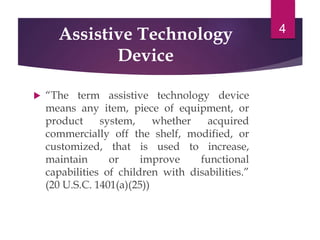
 “The term assistive technology device
means any item, piece of equipment, or
product system, whether acquired
commercially off the shelf, modified, or
customized, that is used to increase,
maintain or improve functional
capabilities of children with disabilities.”
(20 U.S.C. 1401(a)(25))
4
AT Simply Defined
 Any device, system, appliance or
tool which provides better access
to the full potential of a person
with a disability.
5
Si
Different Types of AT
 Aids for Daily Living
 Augmentative
Communication (or
Alternative)
 Computer Applications
 Environmental Control
 Home/Worksite
Modifications
 Prosthetics and Orthotics
 Seating and Positioning
 Vision Aids
 Sensory Aids for Hearing
Impairment
 Mobility Aids
 Vehicle Modifications
6
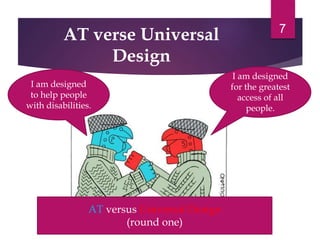
AT verse Universal
Design
7
I am designed
for the greatest
access of all
people.
I am designed
to help people
with disabilities.
AT versus Universal Design
(round one)
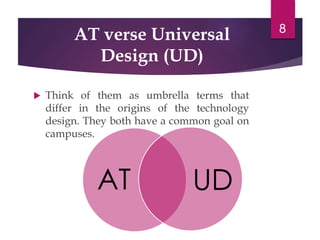
AT verse Universal
Design (UD)
 Think of them as umbrella terms that
differ in the origins of the technology
design. They both have a common goal on
campuses.
8
AT UD
Level of AT
 Low-tech AT- options are usually easy to use, have a
low cost and typically do not require a power source
 Mid-tech AT- are also easy to operate but typically
require a power source.
 High-tech AT- usually complex and programmable
and include items that require computers, and/or
electronics, to perform a function.
9
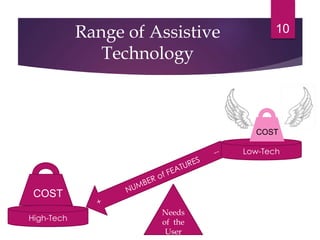
Range of Assistive
Technology
10
Needs
of the
User
High-Tech
Low-Tech
COST
COST

Assistive technology principles and practice

  • 1.
    Assistive Technology Principles andPractice CAROLYN JENKINS-HAIGLER APT 507 FALL 2015
  • 2.
    Learning Objectives 1. Whatis assistive technology and the different levels of technology available; 2. Assistive technology theories; 3. Assistive Technology tools 2
  • 3.
    Assistive Technology (AT)  Howdo you define AT?  How do you think students define AT? 3
  • 4.
    Assistive Technology Device  “Theterm assistive technology device means any item, piece of equipment, or product system, whether acquired commercially off the shelf, modified, or customized, that is used to increase, maintain or improve functional capabilities of children with disabilities.” (20 U.S.C. 1401(a)(25)) 4
  • 5.
    AT Simply Defined Any device, system, appliance or tool which provides better access to the full potential of a person with a disability. 5 Si
  • 6.
    Different Types ofAT  Aids for Daily Living  Augmentative Communication (or Alternative)  Computer Applications  Environmental Control  Home/Worksite Modifications  Prosthetics and Orthotics  Seating and Positioning  Vision Aids  Sensory Aids for Hearing Impairment  Mobility Aids  Vehicle Modifications 6
  • 7.
    AT verse Universal Design 7 Iam designed for the greatest access of all people. I am designed to help people with disabilities. AT versus Universal Design (round one)
  • 8.
    AT verse Universal Design(UD)  Think of them as umbrella terms that differ in the origins of the technology design. They both have a common goal on campuses. 8 AT UD
  • 9.
    Level of AT Low-tech AT- options are usually easy to use, have a low cost and typically do not require a power source  Mid-tech AT- are also easy to operate but typically require a power source.  High-tech AT- usually complex and programmable and include items that require computers, and/or electronics, to perform a function. 9
  • 10.
    Range of Assistive Technology 10 Needs ofthe User High-Tech Low-Tech COST COST