Outline
2
Optical WirelessCommunication (OWC)
Visible Light Communication:
Introduction
History
Motivation
VLC Applications
Advantages and Challenges
System
Topics of interest
2.
Optical Wireless Communication(OWC)
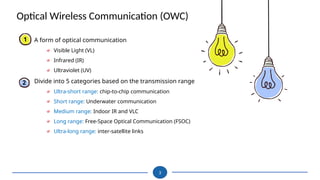
A form of optical communication
Visible Light (VL)
Infrared (IR)
Ultraviolet (UV)
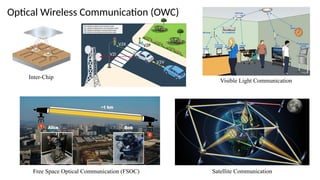
Divide into 5 categories based on the transmission range
Ultra-short range: chip-to-chip communication
Short range: Underwater communication
Medium range: Indoor IR and VLC
Long range: Free-Space Optical Communication (FSOC)
Ultra-long range: inter-satellite links
1
2
3
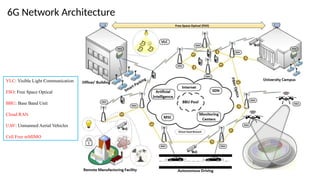
6G Network Architecture
VLC:Visible Light Communication
FSO: Free Space Optical
BBU: Base Band Unit
Cloud RAN
UAV: Unmanned Aerial Vehicles
Cell Free mMIMO
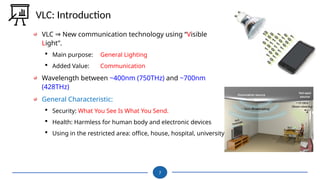
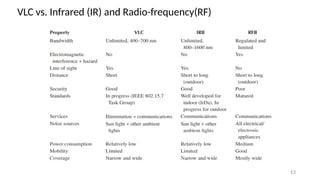
VLC New communicationtechnology using “
⇒ Visible
Light”.
Main purpose: General Lighting
Added Value: Communication
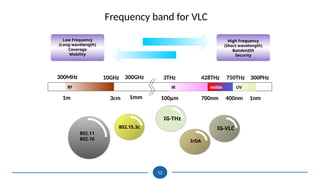
Wavelength between ~400nm (750THz) and ~700nm
(428THz)
General Characteristic:
Security: What You See Is What You Send.
Health: Harmless for human body and electronic devices
Using in the restricted area: office, house, hospital, university
7
VLC: Introduction
VLC: History -Photophone
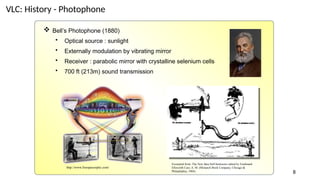
Bell’s Photophone (1880)
• Optical source : sunlight
• Externally modulation by vibrating mirror
• Receiver : parabolic mirror with crystalline selenium cells
• 700 ft (213m) sound transmission
Excerpted from: The New Idea Self-Instructor edited by Ferdinand
Ellsworth Cary, A. M. (Monarch Book Company, Chicago &
Philadelphia, 1904)
http://www.freespaceoptic.com/
8
9.
Visible Light Communication
9
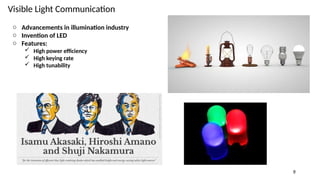
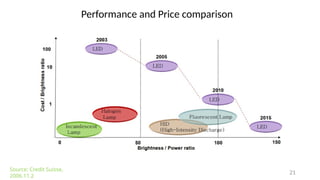
oAdvancements in illumination industry
o Invention of LED
o Features:
High power efficiency
High keying rate
High tunability
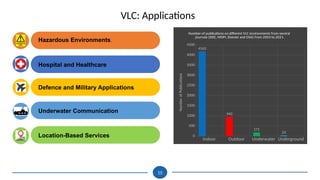
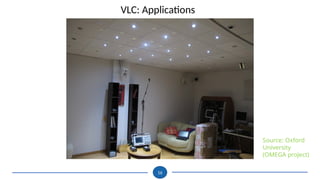
VLC: Applications
Hazardous Environments.
UnderwaterCommunication
Defence and Military Applications
Hospital and Healthcare
Location-Based Services
5
2
1
3
4
15
Indoor Outdoor Underwater Underground
0
500
1000
1500
2000
2500
3000
3500
4000
4500
4163
940
171
24
Number of publications on different VLC environments from several
journals (IEEE, MDPI, Elsevier and OSA) from 2003 to 2021.
Number
of
Publications
17
Greater availabilityof spectrum (400–800 THz)
Unlicensed spectrum
High data rate
Easy to implement
Low cost: Use of LED
Energy efficiency
Physical layer security
“ Top security levels are reached for VLC just by shutting doors and windows ”
No interference on RF signals
VLC: Advantages
17.
VLC: Challenges
Line-of-sightrequirement between Tx and Rx
o Limits its range
o Easily block
o Using RIS, Hybrid with WiFi
High path loss and limited coverage area
Interference
o Sensitivity to ambient light
o Interference between neighbor cells
Connectivity while moving (Limited mobility)
o Frequent Handovers
o Hybrid with WiFi
Extra constraints
o Eye safety constraints
o Illumination constraints
Uplink
o RF, IR
Dimming and No light
o Light modulation
Flickering
o Fluctuation of the light brightness
Transmission techniques
o Nonnegativity
o IM/DD
o Difficulty in implementation of more
complex modulations, like OFDM
Shadowing
LED Non-Linearity and Modulation BW
18.
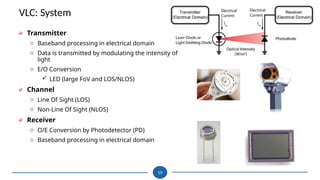
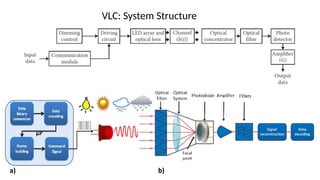
VLC: System
Transmitter
o Basebandprocessing in electrical domain
o Data is transmitted by modulating the intensity of
light
o E/O Conversion
LED (large FoV and LOS/NLOS)
Channel
o Line Of Sight (LOS)
o Non-Line Of Sight (NLOS)
Receiver
o O/E Conversion by Photodetector (PD)
o Baseband processing in electrical domain
19
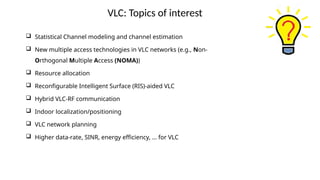
VLC: Topics ofinterest
Statistical Channel modeling and channel estimation
New multiple access technologies in VLC networks (e.g., Non-
Orthogonal Multiple Access (NOMA))
Resource allocation
Reconfigurable Intelligent Surface (RIS)-aided VLC
Hybrid VLC-RF communication
Indoor localization/positioning
VLC network planning
Higher data-rate, SINR, energy efficiency, … for VLC
Editor's Notes
#2 OWC is a form of optical communication in which unguided visible, infrared (IR), or ultraviolet (UV) light is used to carry a signal.
Medium range: Indoor IR and Visible Light (390–750 nm) Communications (VLC)
Long range: Free-Space Optical Communications (FSOC), operate at the near IR frequencies (750–1600 nm).
Generally used in short-range communication
#10 International Telecommunication Union (ITU)
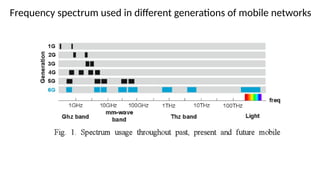
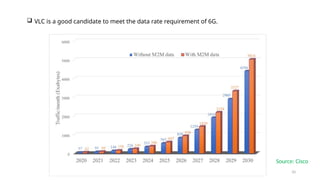
Global mobile data traffic forecast by ITU. Overall mobile data traffic is estimated to grow at an annual rate of around 55% in 2020–2030 to reach 607 exabytes (EB) in 2025 and 5, 016 EB in 2030. (Source: Cisco)
#11 IG-THz : contribution 15-07-0623-01, AT&T Labs discussed the Terahertz spectrum band which
covers 300 GHz to 10 THz.
802.15.3c: This mmWave WPAN will operate in the new and clear band including 57-64 GHz unlicensed band
The millimeter-wave WPAN will allow high coexistence (close physical spacing) with all other
microwave systems in the 802.15 family of WPANs
802.11: Wi-Fi, 2.4 GHz and 5 GHz, short range of 100 meters
802.16: WiMAX, outdoor range of around 50 km
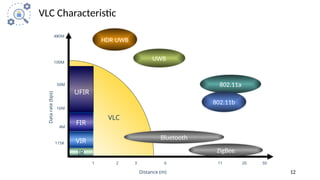
#12 802.11a, b 2.4 GHz , a=54 Mbps, b=11 Mbps
IR, VIR, FIR , UFIR
UWB , HDR UWB
#14 Hazardous Environments: Enabling data communications in environments where RF is potentially dangerous, such as oil & gas, petrochemicals and mining.
Hospital and Healthcare
Defence and Military Applications: Enabling high data rate wireless communication within military vehicles and aircraft.
Underwater Communication: Enabling communications between divers and/or remote operated vehicles.
Location-Based Services: Enabling navigation and tracking inside buildings.
Indoor broadband broadcasting in Hospital / Supermarket / University / Office
#16 Energy efficiency: LED consume very little power
#17 Line-of-sight requirement: It requires a direct LoS between the transmitter and the receiver, which limits its range and makes it unsuitable for outdoor communication
Limited mobility: VLC is not suitable for applications that require high mobility, as the communication signal can be disrupted by movement or changes in the environment.
Sensitivity to ambient light: VLC can be sensitive to ambient light, such as sunlight or fluorescent lighting.
Dimming: Control of the perceived light source brightness, according to the requirements of the user. Using dimmer circuits. Theoretically, the lower the light intensity, the smaller the communication range and the data communication rate.
Flickering: Fluctuation in the brightness of the light perceptible by humans, which may cause discomfort and health risks.
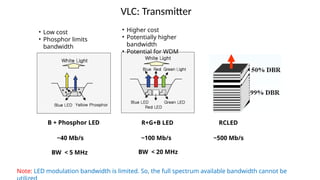
LED Modulation BW: The bandwidth available in visible light spectrum is around 300 THz. But, LED modulation bandwidth is limited (2–20 MHz) over which the frequency response is considered flat. So, the full spectrum available bandwidth cannot be utilized.
Dimming and No light: In scenarios where the light must be completely turned off (e.g., during sleep in residential environments or in light-sensitive applications), VLC cannot function since it relies on visible light as the carrier. Hybrid VLC-RF, infrared (IR) or low-intensity light invisible to humans can be employed for data transmission.
#22 What is orthogonal and non-orthogonal?
NOMA: refers to a method of multiple access in wireless communication where different devices are not separated in time or frequency.