International Research Journal of Engineering and Technology (IRJET) e-ISSN: 2395-0056
Volume: 09 Issue: 01 | Jan 2022 www.irjet.net p-ISSN: 2395-0072
© 2021, IRJET | Impact Factor value: 7.529 | ISO 9001:2008 Certified Journal | Page 649
Visible Light Communication Using LED's and LDR
Sushant Nemade1, Rutwik Lokur2
1,2Engineering Student, Department of Electronics & Telecommunication, Maharashtra Institute of Technology, Pune,
Maharashtra, India
---------------------------------------------------------------------***----------------------------------------------------------------------
Abstract -The possibility of noticeablelightcorrespondence
(Visible Light Communication) is introduced in this report. In
VLC, from the electromagnetic (EM) recurrence range the
noticeable light piece is utilized for data interchange which is
comparable to standard sorts of wi-fi verbal exchange
consisting of Bluetooth and wireless- fidelity (WiFi), wherein
information or data is communicatedovertheremote medium
utilizing radio recurrence (RF) signals. Via modulating the
force of light sources like LED is utilized as a transmitteranda
photosensitive indicator like LDR is utilized for demodulation
of the light motions toward convert once again into electrical
structure as a receiver. There is a significant requirement for
the advancement of unusual advances like VLC, to defeat the
issue looked by the traditional remote correspondence
framework. In this document, the primary transmission and
receiving protocol is mentioned.
Key Words: WiFi, RF signals, LDR, VLC, Modulation, EM
frequency.
1. INTRODUCTION
The current Wireless communication is susceptible to
interception but VLC makes it so that whenever the
Transmitter and receiver pair are in the Line of sight of each
other an uninterrupted and secure communication can take
place as we can use different frequencies to send data the
sheer number of frequencies at which the Lightwave can be
modulated which makes it very unique and in turn ensure
scalability.
1.1 Transmission protocol
The transmission protocol is designed such that it can send
4-bit data. It is written on ARM-based MCU and uses Pulse
Width Modulation at different frequenciesanddutycyclesto
represent 1 and 0. The data frame has a start-bitandensures
transmission of the data.
1.2 Receiving Protocol
After receiving the electrical signal back the data frame is
deciphered and various filtering is applied so that no false
data is received. Receiving is done on ARM-based MCU.
1.3 Input Capture Protocol
Input Capture Protocol helps us to know what is the
frequency of the input wave, itusessimplelogicofinterrupts
and counters to know what is the frequency of the input
square wave
1.4 Present Scenario
As compared to RF engineering, Optical Wireless
Communication (OWC) Engineeringhasa longhistory.In the
past for the dissemination of news, the natural form of
visible light was used for visual communication. Smoke
signals, beacon fires, lighthouses, and signal markers were
used by human beings to communicateacrosslongdistances
at light speed. Graham Bell has made his first experimental
setup of VLC in 1880, known as Photophone. VLC is a stream
of OWC. Also, OWC contains Ultra Violet (UV) and Infrared
(IR) communication. VLC is unique in nature than IR and UV
because the light sources used for illumination purposes are
also used for communication purposes using the same
visible light energy. In VLC, the intensity of the LED light
sources is modulated in such a way that light flicker is
imperceptible to the human eyes. The light signal is
demodulated back into electrical form by the photosensitive
detector which is called a VLC receiver. After the application
of continuous and constant current to LED light sources, it
emits a continuous stream of photons which is called visible
light. The transmitter transmits light at a differentfrequency
concerning up and down (digital 1 and 0) current is flowing
through a light source. The lightsourceoutputfrequencycan
be sensed by a photosensitive material like LDR but is
imperceptible to the human eyes. LEDs are semiconductor
devices and LED light sources can be used to transmit high-
speed data using this technique. Large data rates can be
achieved using higher intensity LED light sources. Low
power consumption and highly efficient LEDs are used to
replace all high-power consuming and inefficient light
sources like fluorescent tubes by various governments
worldwide.
International Research Journal of Engineering and Technology (IRJET) e-ISSN: 2395-0056
Volume: 09 Issue: 01 | Jan 2022 www.irjet.net p-ISSN: 2395-0072
© 2021, IRJET | Impact Factor value: 7.529 | ISO 9001:2008 Certified Journal | Page 650
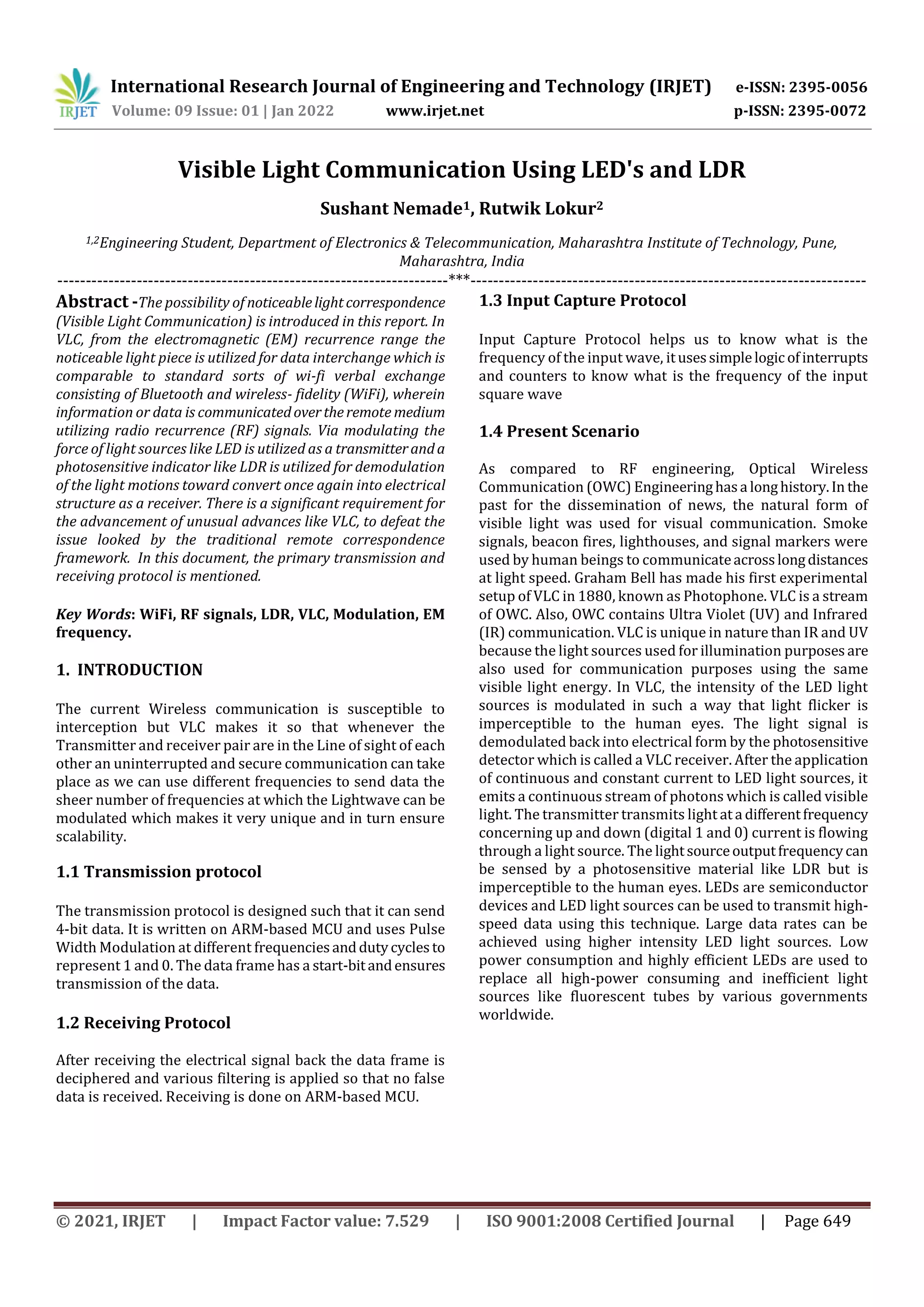
2. BLOCK DIAGRAM
Chart -1: Block Diagram of the System
2.1 Transmitter
Chart -2: Block Diagram of the Transmitter
The transmitter setup consists of a mixture of transmitting
node, microcontroller-board, PTN board, and the power
supply. The connection of power batteries to PTN board is
made using T-connector and further, it is connected to the
Transmitting node again using T-connector. The controller
board and transmitting node are connected using a 4-pin
cable
Chart -3: Algorithm of the Transmitter
2.2 Receiver
The Receiving setup is a mixture of microcontroller-board,
receiving node, and the power supply. The power battery is
connected to receiving node using a T connector. The
controller board and receiving node areconnectedusing a 4-
pin cable.
International Research Journal of Engineering and Technology (IRJET) e-ISSN: 2395-0056
Volume: 09 Issue: 01 | Jan 2022 www.irjet.net p-ISSN: 2395-0072
© 2021, IRJET | Impact Factor value: 7.529 | ISO 9001:2008 Certified Journal | Page 651
Chart -4: Block Diagram of the Receiver
Chart -5: Algorithm of the Receiver
2.3 Advantages
VLC has the following advantages over existing wireless
communication networks:
1. Capability: The visible light frequency spectrumis10000
times higher than the RF frequency spectrum. Also, the
visible light spectrum belongs to ISM (Industrial, Scientific,
and Medical) band which is unlicensedand cost-free.Nearby
1000x data density of RF can be achieved in VLC as RF
spread out and produces interferences in nearby while
visible light is inflexibleinlightingboundary.VLCsystem has
high device bandwidths, high-intensity optical output, and
low interference. This can be used to achievehighdata rates.
RF is invisible and makes network planning complicated.
With VLC capability is simple as the user needs a simple
setup with good signal power which can be correctly
observed.
2. Productivity: VLC requires fewer components thanradio
technology. It is a low-cost solution. Data transmission
requires negligible power using LED light sources and LED
light is efficient. In underwater communication, VLC works
well than RF transmission.UnderwaterRFcommunicationis
extremely difficult as the attenuation of signals is more.
3. Safety: The lifecycle in the universe is progressing with
experience to visible light. There is no knownmedical health
issue or protection about VLC. In VLC like RF
communication, complex antennas are not requiredfordata
transmission through the light from the light source. RF
antennas are hazardous in locations like chemical plants,
hospitals.
4. Security: Boundaries of communication in VLC are
restricted to the illumination regiononlyasvisiblelightdoes
not cross walls of the illuminated region. Control of the data
directly between transmitter and receiver is easy as we can
see the direction of the data moving. Like Bluetooth & Wi-Fi,
additional security is not essential such as pairingor passing
keys for RF interconnections.
3. CONCLUSION
This report describes how a VLC can be implemented cost-
effectively. It also summarizes various uses of VLC in daily
life. It discusses the data frame which was used to transmit
data also a brief description of various protocols is given we
believe that VLC will greatly enhance human life and will
result in the advancement of communication technology.
REFERENCES
[1] M. V. Bhalerao and S. S. Sonavane, "Visible light
communication: A smart way towards wireless
communication," 2014 International Conference on
Advances in Computing, Communications and
Informatics (ICACCI), New Delhi, 2014, pp.1370-1375.
DOI: 10.1109/ICACCI.2014.6968262
[2] Latif Ullah Khan, Visible light communication:
Applications, architecture, standardizationandresearch
challenges, Digital Communications and Networks,
Volume 3, Issue 2, 2017, Pages 78-88, ISSN 2352-8648
[3] Li, A. Pandharipande and F. M. J. Willems, "Two-Way
Visible Light Communication and Illumination with
LEDs," in IEEE TransactionsonCommunications,vol.65,
no. 2, pp. 740-750, Feb. 2017. DOI:
10.1109/TCOMM.2016.2626362
International Research Journal of Engineering and Technology (IRJET) e-ISSN: 2395-0056
Volume: 09 Issue: 01 | Jan 2022 www.irjet.net p-ISSN: 2395-0072
© 2021, IRJET | Impact Factor value: 7.529 | ISO 9001:2008 Certified Journal | Page 652
[4] L. Grobe et al., "High-speed visible light communication
systems," in IEEE CommunicationsMagazine,vol.51,no.
12, pp. 60-66, December 2013. DOI:
10.1109/MCOM.2013.6685758

Visible Light Communication Using LED's and LDR

  • 1.
    International Research Journalof Engineering and Technology (IRJET) e-ISSN: 2395-0056 Volume: 09 Issue: 01 | Jan 2022 www.irjet.net p-ISSN: 2395-0072 © 2021, IRJET | Impact Factor value: 7.529 | ISO 9001:2008 Certified Journal | Page 649 Visible Light Communication Using LED's and LDR Sushant Nemade1, Rutwik Lokur2 1,2Engineering Student, Department of Electronics & Telecommunication, Maharashtra Institute of Technology, Pune, Maharashtra, India ---------------------------------------------------------------------***---------------------------------------------------------------------- Abstract -The possibility of noticeablelightcorrespondence (Visible Light Communication) is introduced in this report. In VLC, from the electromagnetic (EM) recurrence range the noticeable light piece is utilized for data interchange which is comparable to standard sorts of wi-fi verbal exchange consisting of Bluetooth and wireless- fidelity (WiFi), wherein information or data is communicatedovertheremote medium utilizing radio recurrence (RF) signals. Via modulating the force of light sources like LED is utilized as a transmitteranda photosensitive indicator like LDR is utilized for demodulation of the light motions toward convert once again into electrical structure as a receiver. There is a significant requirement for the advancement of unusual advances like VLC, to defeat the issue looked by the traditional remote correspondence framework. In this document, the primary transmission and receiving protocol is mentioned. Key Words: WiFi, RF signals, LDR, VLC, Modulation, EM frequency. 1. INTRODUCTION The current Wireless communication is susceptible to interception but VLC makes it so that whenever the Transmitter and receiver pair are in the Line of sight of each other an uninterrupted and secure communication can take place as we can use different frequencies to send data the sheer number of frequencies at which the Lightwave can be modulated which makes it very unique and in turn ensure scalability. 1.1 Transmission protocol The transmission protocol is designed such that it can send 4-bit data. It is written on ARM-based MCU and uses Pulse Width Modulation at different frequenciesanddutycyclesto represent 1 and 0. The data frame has a start-bitandensures transmission of the data. 1.2 Receiving Protocol After receiving the electrical signal back the data frame is deciphered and various filtering is applied so that no false data is received. Receiving is done on ARM-based MCU. 1.3 Input Capture Protocol Input Capture Protocol helps us to know what is the frequency of the input wave, itusessimplelogicofinterrupts and counters to know what is the frequency of the input square wave 1.4 Present Scenario As compared to RF engineering, Optical Wireless Communication (OWC) Engineeringhasa longhistory.In the past for the dissemination of news, the natural form of visible light was used for visual communication. Smoke signals, beacon fires, lighthouses, and signal markers were used by human beings to communicateacrosslongdistances at light speed. Graham Bell has made his first experimental setup of VLC in 1880, known as Photophone. VLC is a stream of OWC. Also, OWC contains Ultra Violet (UV) and Infrared (IR) communication. VLC is unique in nature than IR and UV because the light sources used for illumination purposes are also used for communication purposes using the same visible light energy. In VLC, the intensity of the LED light sources is modulated in such a way that light flicker is imperceptible to the human eyes. The light signal is demodulated back into electrical form by the photosensitive detector which is called a VLC receiver. After the application of continuous and constant current to LED light sources, it emits a continuous stream of photons which is called visible light. The transmitter transmits light at a differentfrequency concerning up and down (digital 1 and 0) current is flowing through a light source. The lightsourceoutputfrequencycan be sensed by a photosensitive material like LDR but is imperceptible to the human eyes. LEDs are semiconductor devices and LED light sources can be used to transmit high- speed data using this technique. Large data rates can be achieved using higher intensity LED light sources. Low power consumption and highly efficient LEDs are used to replace all high-power consuming and inefficient light sources like fluorescent tubes by various governments worldwide.
  • 2.
    International Research Journalof Engineering and Technology (IRJET) e-ISSN: 2395-0056 Volume: 09 Issue: 01 | Jan 2022 www.irjet.net p-ISSN: 2395-0072 © 2021, IRJET | Impact Factor value: 7.529 | ISO 9001:2008 Certified Journal | Page 650 2. BLOCK DIAGRAM Chart -1: Block Diagram of the System 2.1 Transmitter Chart -2: Block Diagram of the Transmitter The transmitter setup consists of a mixture of transmitting node, microcontroller-board, PTN board, and the power supply. The connection of power batteries to PTN board is made using T-connector and further, it is connected to the Transmitting node again using T-connector. The controller board and transmitting node are connected using a 4-pin cable Chart -3: Algorithm of the Transmitter 2.2 Receiver The Receiving setup is a mixture of microcontroller-board, receiving node, and the power supply. The power battery is connected to receiving node using a T connector. The controller board and receiving node areconnectedusing a 4- pin cable.
  • 3.
    International Research Journalof Engineering and Technology (IRJET) e-ISSN: 2395-0056 Volume: 09 Issue: 01 | Jan 2022 www.irjet.net p-ISSN: 2395-0072 © 2021, IRJET | Impact Factor value: 7.529 | ISO 9001:2008 Certified Journal | Page 651 Chart -4: Block Diagram of the Receiver Chart -5: Algorithm of the Receiver 2.3 Advantages VLC has the following advantages over existing wireless communication networks: 1. Capability: The visible light frequency spectrumis10000 times higher than the RF frequency spectrum. Also, the visible light spectrum belongs to ISM (Industrial, Scientific, and Medical) band which is unlicensedand cost-free.Nearby 1000x data density of RF can be achieved in VLC as RF spread out and produces interferences in nearby while visible light is inflexibleinlightingboundary.VLCsystem has high device bandwidths, high-intensity optical output, and low interference. This can be used to achievehighdata rates. RF is invisible and makes network planning complicated. With VLC capability is simple as the user needs a simple setup with good signal power which can be correctly observed. 2. Productivity: VLC requires fewer components thanradio technology. It is a low-cost solution. Data transmission requires negligible power using LED light sources and LED light is efficient. In underwater communication, VLC works well than RF transmission.UnderwaterRFcommunicationis extremely difficult as the attenuation of signals is more. 3. Safety: The lifecycle in the universe is progressing with experience to visible light. There is no knownmedical health issue or protection about VLC. In VLC like RF communication, complex antennas are not requiredfordata transmission through the light from the light source. RF antennas are hazardous in locations like chemical plants, hospitals. 4. Security: Boundaries of communication in VLC are restricted to the illumination regiononlyasvisiblelightdoes not cross walls of the illuminated region. Control of the data directly between transmitter and receiver is easy as we can see the direction of the data moving. Like Bluetooth & Wi-Fi, additional security is not essential such as pairingor passing keys for RF interconnections. 3. CONCLUSION This report describes how a VLC can be implemented cost- effectively. It also summarizes various uses of VLC in daily life. It discusses the data frame which was used to transmit data also a brief description of various protocols is given we believe that VLC will greatly enhance human life and will result in the advancement of communication technology. REFERENCES [1] M. V. Bhalerao and S. S. Sonavane, "Visible light communication: A smart way towards wireless communication," 2014 International Conference on Advances in Computing, Communications and Informatics (ICACCI), New Delhi, 2014, pp.1370-1375. DOI: 10.1109/ICACCI.2014.6968262 [2] Latif Ullah Khan, Visible light communication: Applications, architecture, standardizationandresearch challenges, Digital Communications and Networks, Volume 3, Issue 2, 2017, Pages 78-88, ISSN 2352-8648 [3] Li, A. Pandharipande and F. M. J. Willems, "Two-Way Visible Light Communication and Illumination with LEDs," in IEEE TransactionsonCommunications,vol.65, no. 2, pp. 740-750, Feb. 2017. DOI: 10.1109/TCOMM.2016.2626362
  • 4.
    International Research Journalof Engineering and Technology (IRJET) e-ISSN: 2395-0056 Volume: 09 Issue: 01 | Jan 2022 www.irjet.net p-ISSN: 2395-0072 © 2021, IRJET | Impact Factor value: 7.529 | ISO 9001:2008 Certified Journal | Page 652 [4] L. Grobe et al., "High-speed visible light communication systems," in IEEE CommunicationsMagazine,vol.51,no. 12, pp. 60-66, December 2013. DOI: 10.1109/MCOM.2013.6685758