
Khulna University of Engineering & Technology 
Visible Light Communication: 
Opportunities, Challenges and 
the path to market. 
Written by: 
Aleksandar Jovicic, Junyi Li, and 
Tom Richardson 
Presented by: Shuvo Raj Paul 
Roll Number: 1003110 
9/27/2014 1
Contents 
 Introduction. 
 Visible light & its spectrum. 
 Motivation: Why visible light is used for communication 
purpose? 
 The VLC communication process based on intensity 
modulation. 
 LED modulation characteristics. 
 VLC link capacity for typical office desk-level illumination. 
 Integration with power line communication (PLC) for the VLC 
downlink. 
 Integration with the uplink technology such as Wi-Fi. 
 Conclusion. 
9/27/2014 2
What is 
“Visible Light Communication” ? 
The visible light communication (VLC) 
refers to the communication technology 
which utilizes the visible light source as a 
signal transmitter, the air as a transmission 
medium, and the appropriate photodiode as 
a signal receiving component. 
9/27/2014 3
Visible Light 
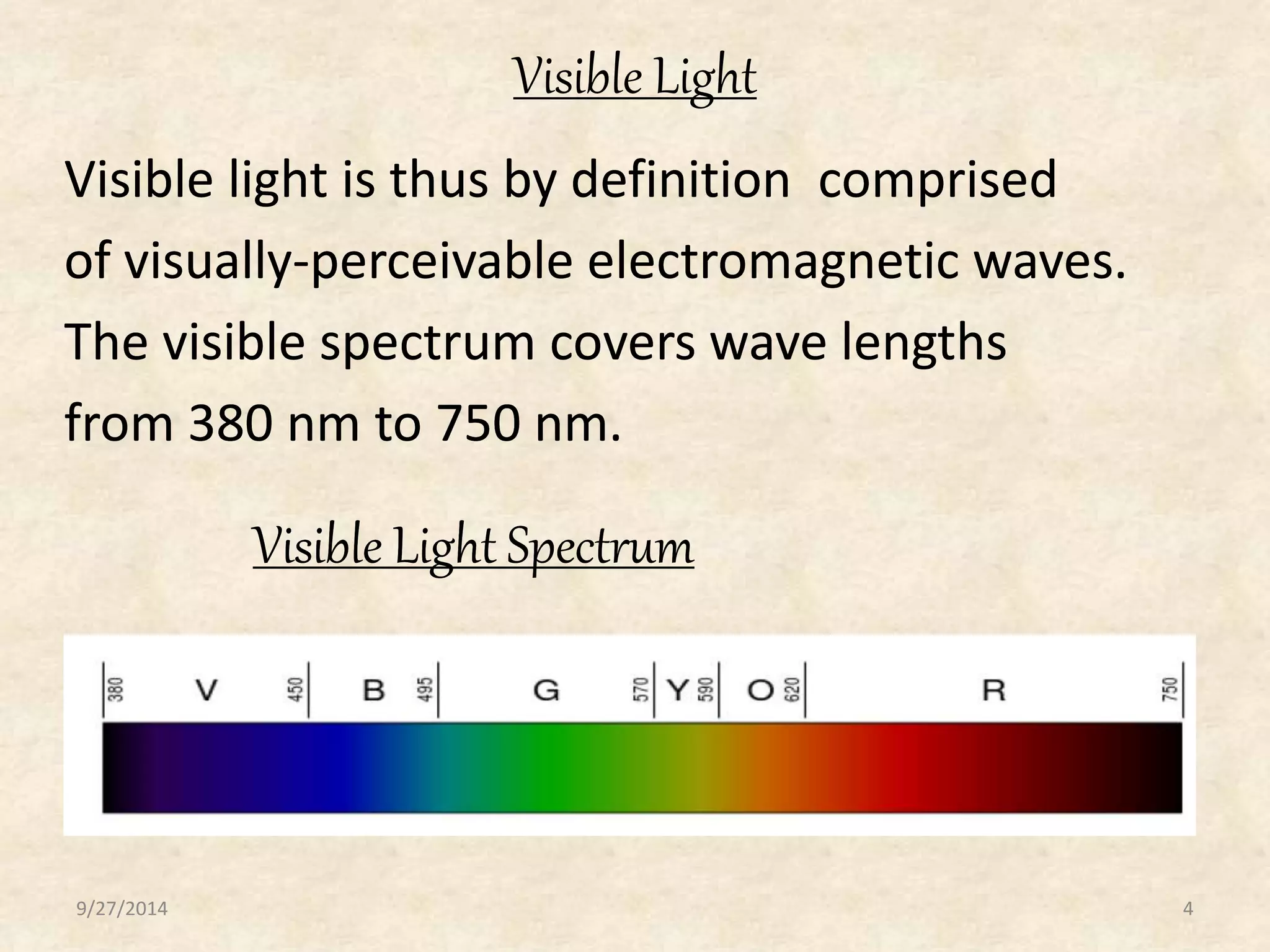
Visible light is thus by definition comprised 
of visually-perceivable electromagnetic waves. 
The visible spectrum covers wave lengths 
from 380 nm to 750 nm. 
Visible Light Spectrum 
9/27/2014 4
Why Visible light communication is needed ??? 
 The visible light spectrum is unlicensed & creates an 
opportunity for low-cost broadband communication. 
 VLC signals in adjacent rooms or apartment units would not 
interfere with each other & data security is ensured. 
 The front-end components of both transmitters and 
receivers are relatively simple and cheap devices. 
 The human eye cannot perceive the amplitude modulation 
of light as long as the frequency of modulation is above the 
so-called flicker fusion threshold. 
9/27/2014 5
THE VLC COMMUNICATION PROCESS BASED ON 
INTENSITY MODULATION 
Fig-1: The VLC radio transmitter and receiver based on 
intensity modulation/direct detection. 
9/27/2014 6
LED MODULATION CHARACTERISTICS: 
Fig-2: Frequency response of high-powered BRLUX-2670 LED & 
BRLUX-560 LED. 
9/27/2014 7
VLC link capacity for typical office desk-level illumination. 
“Typical office desk-level 
lighting is between 400 and 
1000 lux. At 600 lux the 
capacity of the link is around 
150 Mb/s.” 
Fig-3. VLC link capacity as a function of received illuminance 
in lux. 600 lux is typical office desk-level illumination. 
9/27/2014 8
INTEGRATION WITH POWER LINE 
COMMUNICATION (plc) FOR THE VLC DOWNLINK. 
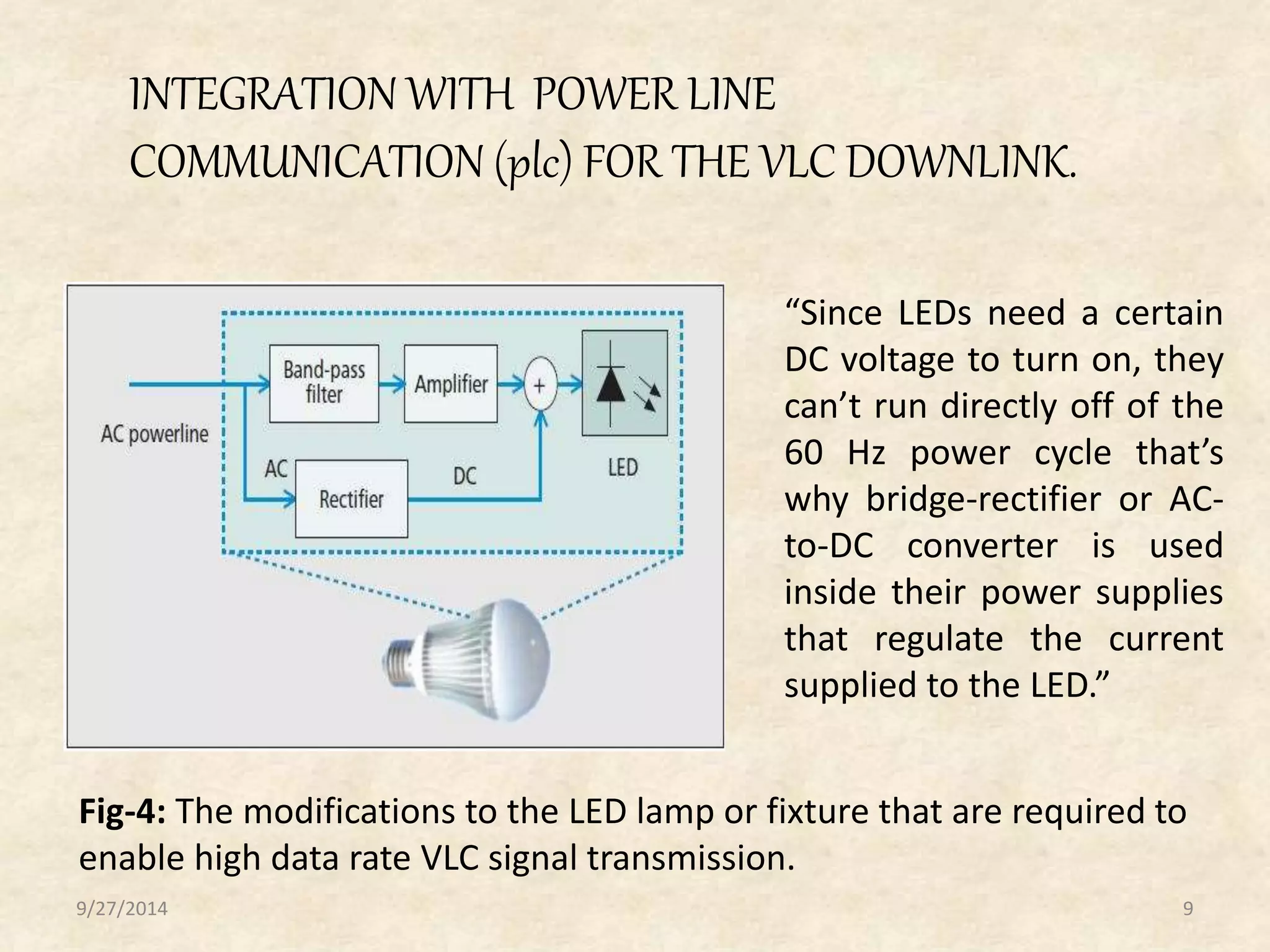
“Since LEDs need a certain 
DC voltage to turn on, they 
can’t run directly off of the 
60 Hz power cycle that’s 
why bridge-rectifier or AC-to- 
DC converter is used 
inside their power supplies 
that regulate the current 
supplied to the LED.” 
Fig-4: The modifications to the LED lamp or fixture that are required to 
enable high data rate VLC signal transmission. 
9/27/2014 9
INTEGRATION WITH THE UPLINK TECHNOLOGY 
SUCH AS Wi-Fi. 
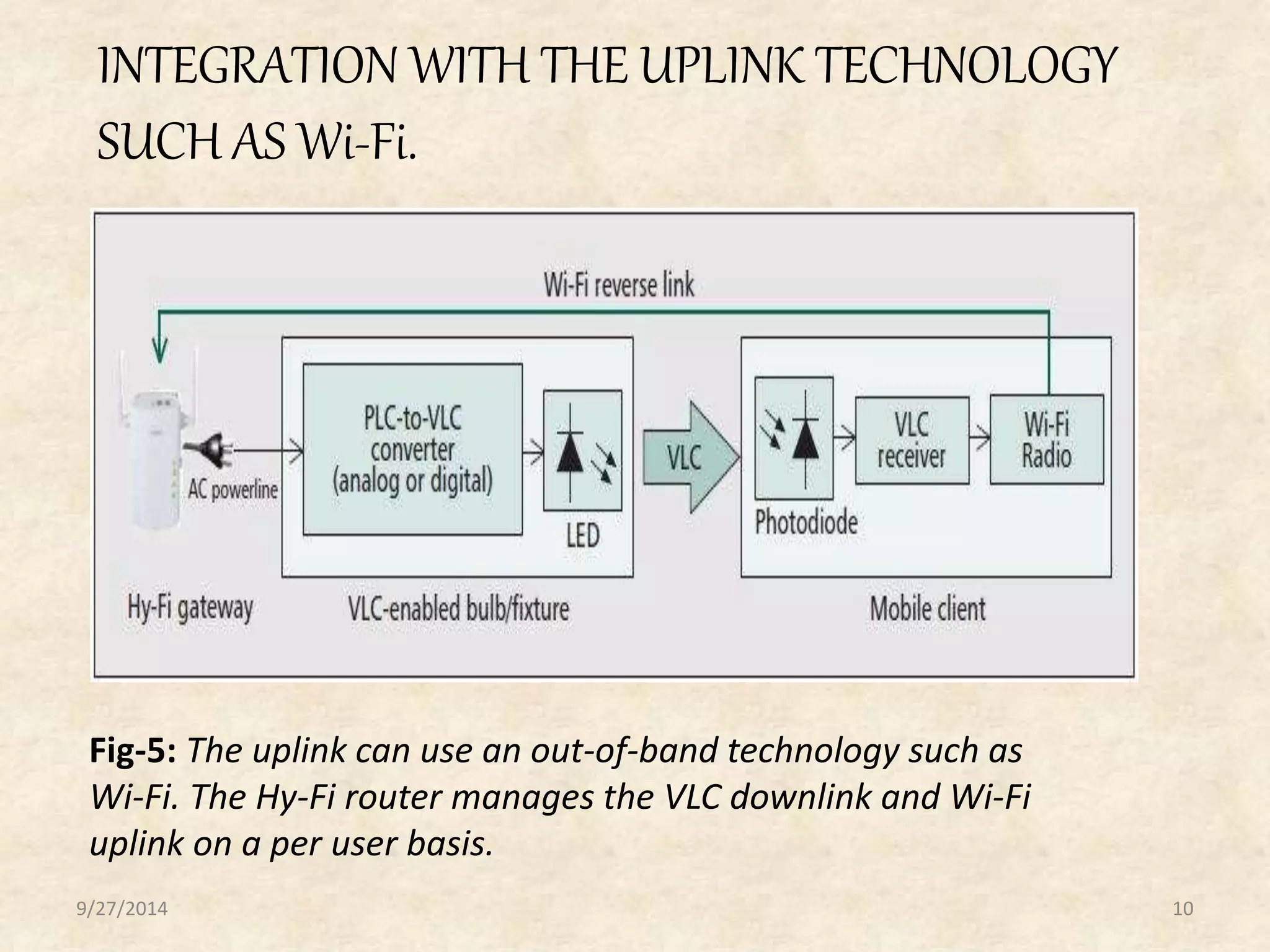
Fig-5: The uplink can use an out-of-band technology such as 
Wi-Fi. The Hy-Fi router manages the VLC downlink and Wi-Fi 
uplink on a per user basis. 
9/27/2014 10
CHALLENGES IN COMMERCIALIZATION 
OF VLC. 
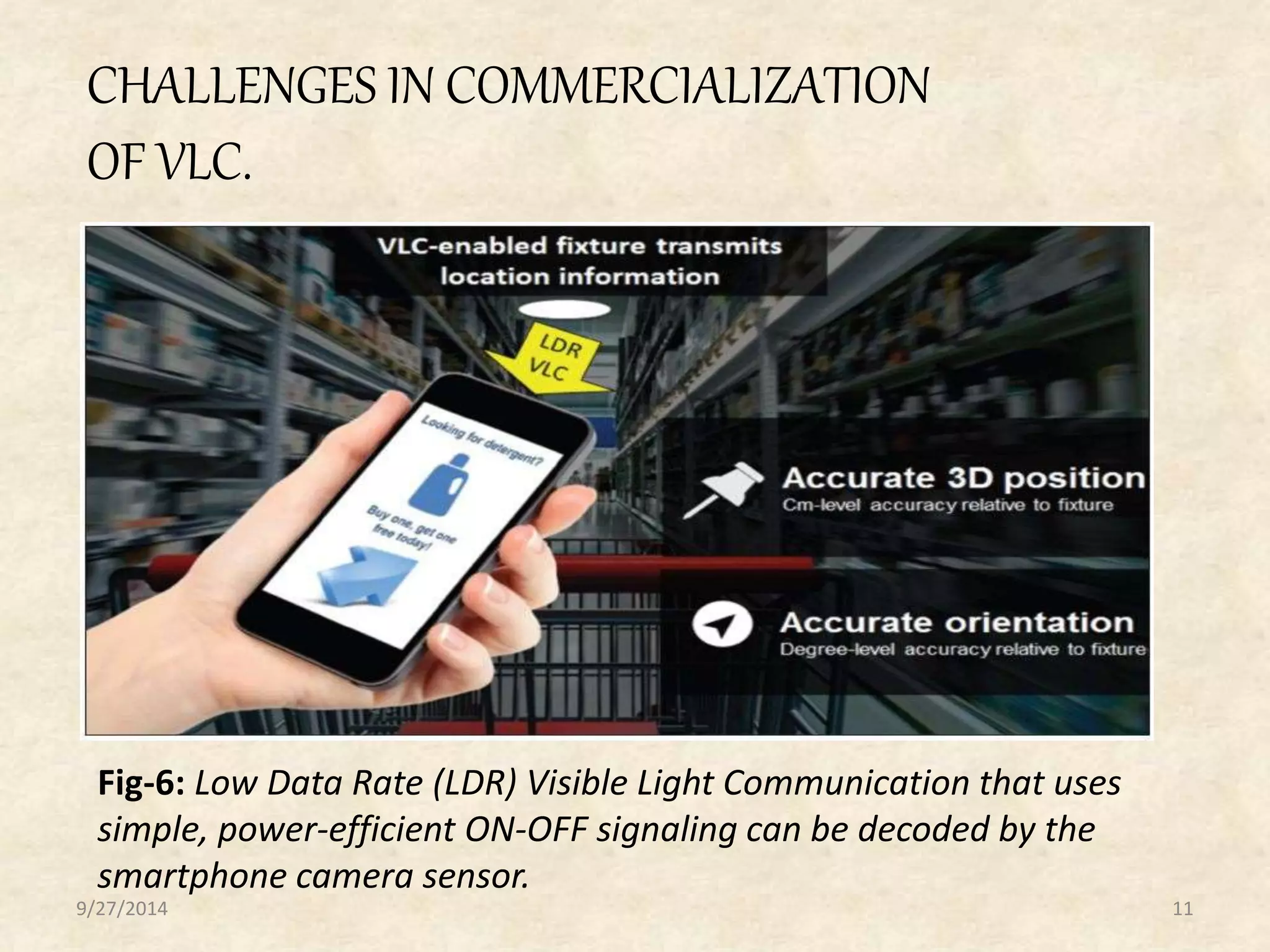
Fig-6: Low Data Rate (LDR) Visible Light Communication that uses 
simple, power-efficient ON-OFF signaling can be decoded by the 
smartphone camera sensor. 
9/27/2014 11
Conclusion 
Visible light communication can supplement radio 
frequency communication and improve wireless 
network performance wherever short range links 
are used such as in a home or office for downlink 
Internet access or for device-to device file transfers 
and video streaming. It requires no additional 
hardware in mobile devices. this use case is the 
most promising first step in the commercialization 
of VLC. 
9/27/2014 12
Thank you for 
your 
kind attention 
9/27/2014 13

Presentation on vlc

  • 1.
    Khulna University ofEngineering & Technology Visible Light Communication: Opportunities, Challenges and the path to market. Written by: Aleksandar Jovicic, Junyi Li, and Tom Richardson Presented by: Shuvo Raj Paul Roll Number: 1003110 9/27/2014 1
  • 2.
    Contents  Introduction.  Visible light & its spectrum.  Motivation: Why visible light is used for communication purpose?  The VLC communication process based on intensity modulation.  LED modulation characteristics.  VLC link capacity for typical office desk-level illumination.  Integration with power line communication (PLC) for the VLC downlink.  Integration with the uplink technology such as Wi-Fi.  Conclusion. 9/27/2014 2
  • 3.
    What is “VisibleLight Communication” ? The visible light communication (VLC) refers to the communication technology which utilizes the visible light source as a signal transmitter, the air as a transmission medium, and the appropriate photodiode as a signal receiving component. 9/27/2014 3
  • 4.
    Visible Light Visiblelight is thus by definition comprised of visually-perceivable electromagnetic waves. The visible spectrum covers wave lengths from 380 nm to 750 nm. Visible Light Spectrum 9/27/2014 4
  • 5.
    Why Visible lightcommunication is needed ???  The visible light spectrum is unlicensed & creates an opportunity for low-cost broadband communication.  VLC signals in adjacent rooms or apartment units would not interfere with each other & data security is ensured.  The front-end components of both transmitters and receivers are relatively simple and cheap devices.  The human eye cannot perceive the amplitude modulation of light as long as the frequency of modulation is above the so-called flicker fusion threshold. 9/27/2014 5
  • 6.
    THE VLC COMMUNICATIONPROCESS BASED ON INTENSITY MODULATION Fig-1: The VLC radio transmitter and receiver based on intensity modulation/direct detection. 9/27/2014 6
  • 7.
    LED MODULATION CHARACTERISTICS: Fig-2: Frequency response of high-powered BRLUX-2670 LED & BRLUX-560 LED. 9/27/2014 7
  • 8.
    VLC link capacityfor typical office desk-level illumination. “Typical office desk-level lighting is between 400 and 1000 lux. At 600 lux the capacity of the link is around 150 Mb/s.” Fig-3. VLC link capacity as a function of received illuminance in lux. 600 lux is typical office desk-level illumination. 9/27/2014 8
  • 9.
    INTEGRATION WITH POWERLINE COMMUNICATION (plc) FOR THE VLC DOWNLINK. “Since LEDs need a certain DC voltage to turn on, they can’t run directly off of the 60 Hz power cycle that’s why bridge-rectifier or AC-to- DC converter is used inside their power supplies that regulate the current supplied to the LED.” Fig-4: The modifications to the LED lamp or fixture that are required to enable high data rate VLC signal transmission. 9/27/2014 9
  • 10.
    INTEGRATION WITH THEUPLINK TECHNOLOGY SUCH AS Wi-Fi. Fig-5: The uplink can use an out-of-band technology such as Wi-Fi. The Hy-Fi router manages the VLC downlink and Wi-Fi uplink on a per user basis. 9/27/2014 10
  • 11.
    CHALLENGES IN COMMERCIALIZATION OF VLC. Fig-6: Low Data Rate (LDR) Visible Light Communication that uses simple, power-efficient ON-OFF signaling can be decoded by the smartphone camera sensor. 9/27/2014 11
  • 12.
    Conclusion Visible lightcommunication can supplement radio frequency communication and improve wireless network performance wherever short range links are used such as in a home or office for downlink Internet access or for device-to device file transfers and video streaming. It requires no additional hardware in mobile devices. this use case is the most promising first step in the commercialization of VLC. 9/27/2014 12
  • 13.
    Thank you for your kind attention 9/27/2014 13