LEAD 622
Visible Learning
What is Visible Learning?
According to John Hattie Visible Learning
and Teaching occurs when teachers see
learning through the eyes of students and
help them become their own teachers.
Nice book summary:
http://www.tdschools.org/wp-content/uploads/2013/08/The+Main+Idea+-+Visible+Lear
ning+for+Teachers+-+April+2013.pdf
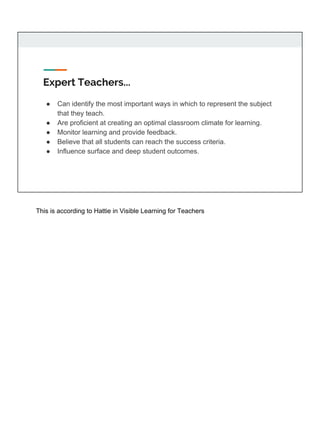
Expert Teachers...
● Can identify the most important ways in which to represent the subject
that they teach.
● Are proficient at creating an optimal classroom climate for learning.
● Monitor learning and provide feedback.
● Believe that all students can reach the success criteria.
● Influence surface and deep student outcomes.
This is according to Hattie in Visible Learning for Teachers
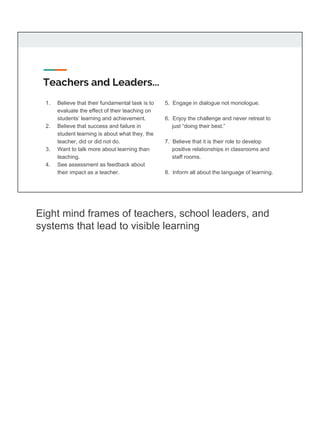
Teachers and Leaders...
1. Believe that their fundamental task is to
evaluate the effect of their teaching on
students’ learning and achievement.
2. Believe that success and failure in
student learning is about what they, the
teacher, did or did not do.
3. Want to talk more about learning than
teaching.
4. See assessment as feedback about
their impact as a teacher.
5. Engage in dialogue not monologue.
6. Enjoy the challenge and never retreat to
just “doing their best.”
7. Believe that it is their role to develop
positive relationships in classrooms and
staff rooms.
8. Inform all about the language of learning.
Eight mind frames of teachers, school leaders, and
systems that lead to visible learning
What Has Most Impact on Student Learning?
http://www.evidencebasedteaching.org.au/hatties-2017-updated-list/
Look at the list - anything surprise you?
What impact does this have on the role of EdTech in the classroom?
Teacher Credibility
http://www.evidencebasedteaching.org.au/teacher-credibility/
This is the credibility students see in the teacher. Not the credibility the teacher
believes he/she has… how does this relate to professional development?
Effective Professional Development
Badging/Gaming
Sometimes I feel like providing professional development to a school of teachers is
much like the cowboys in this video…
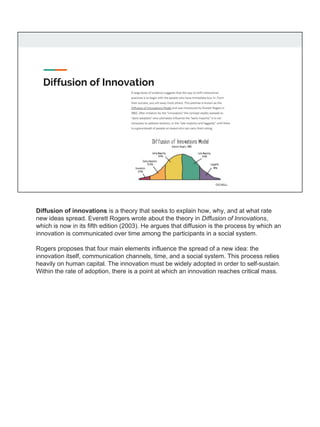
Diffusion of Innovation
Diffusion of innovations is a theory that seeks to explain how, why, and at what rate
new ideas spread. Everett Rogers wrote about the theory in Diffusion of Innovations,
which is now in its fifth edition (2003). He argues that diffusion is the process by which an
innovation is communicated over time among the participants in a social system.
Rogers proposes that four main elements influence the spread of a new idea: the
innovation itself, communication channels, time, and a social system. This process relies
heavily on human capital. The innovation must be widely adopted in order to self-sustain.
Within the rate of adoption, there is a point at which an innovation reaches critical mass.
Diffusion of Innovation
What Rogers model doesn’t show is the chasm between the early adopters and the
early majority. It’s easy to get innovators on board - they’ll jump on board with
anything that is new and has potential to make a difference. Once they work out the
bugs, early adopters will usually take on the innovation as well. They may need a little
training or support, and they’ll need to know WHY, but then they’re off and running…
But after that, moving the early majority is a tougher sale. It requires a solid plan,
which enforces the why, provides support for the onboarding, and may require some
negotiation as to what may be let go or modified in order to embrace the new idea.
Without the early majority, innovations don’t gain enough steam and often become a
passing fancy.
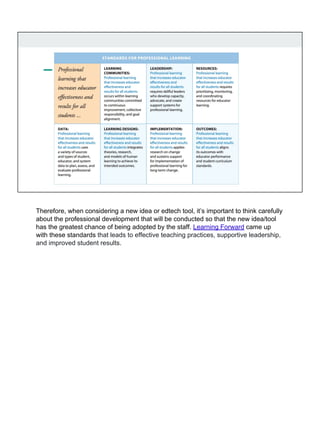
Therefore, when considering a new idea or edtech tool, it’s important to think carefully
about the professional development that will be conducted so that the new idea/tool
has the greatest chance of being adopted by the staff. Learning Forward came up
with these standards that leads to effective teaching practices, supportive leadership,
and improved student results.
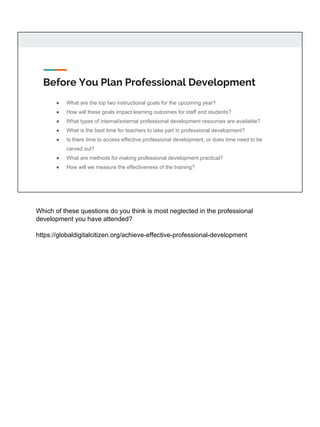
Before You Plan Professional Development
● What are the top two instructional goals for the upcoming year?
● How will these goals impact learning outcomes for staff and students?
● What types of internal/external professional development resources are available?
● What is the best time for teachers to take part in professional development?
● Is there time to access effective professional development, or does time need to be
carved out?
● What are methods for making professional development practical?
● How will we measure the effectiveness of the training?
Which of these questions do you think is most neglected in the professional
development you have attended?
https://globaldigitalcitizen.org/achieve-effective-professional-development
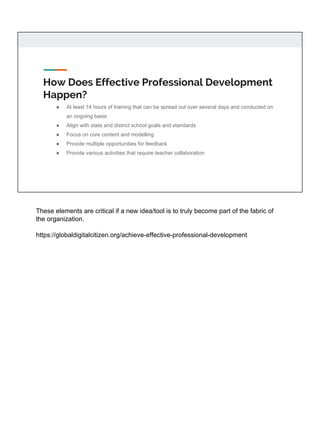
How Does Effective Professional Development
Happen?
● At least 14 hours of training that can be spread out over several days and conducted on
an ongoing basis
● Align with state and district school goals and standards
● Focus on core content and modelling
● Provide multiple opportunities for feedback
● Provide various activities that require teacher collaboration
These elements are critical if a new idea/tool is to truly become part of the fabric of
the organization.
https://globaldigitalcitizen.org/achieve-effective-professional-development
Features of Effective Professional
Development
Is Content Focused
Incorporates Active Learning
Supports Collaboration
Uses Models of Effective Practice
Provides Coaching and Expert Support
Offers Feedback and Reflection
Is of Sustained Duration
https://learningpolicyinstitute.org/product/effective-teacher-professional-development-r
eport
Most teachers only experience traditional, workshop-based
professional development, even though research shows it is
ineffective. Over 90 percent of teachers participate in workshop-style
training sessions during a school year (Darling-Hammond et al.,
2009).
Despite its prevalence, the workshop model’s track record for
changing teachers’ practice and student achievement is abysmal.
Short, one-shot workshops often don’t change teacher practice and
have no effect on student achievement (Yoon et al, 2007; Bush,
1984).
http://www.centerforpubliceducation.org/research/teaching-teachers-effective-professi
onal-development
The largest struggle for teachers is not learning new approaches to
teaching but implementing them.The reason traditional professional
development is ineffective is that it doesn't support teachers during the
stage of learning with the steepest learning curve: implementation.
In several case studies, even experienced teachers struggled with a new
instructional technique in the beginning (Ermeling, 2010; Joyce and
Showers, 1982). It takes, on average, 20 separate instances of practice,
before a teacher has mastered a new skill, with that number increasing
along with the complexity of the skill (Joyce and Showers, 2002).
http://www.centerforpubliceducation.org/research/teaching-teachers-effective-professi
onal-development
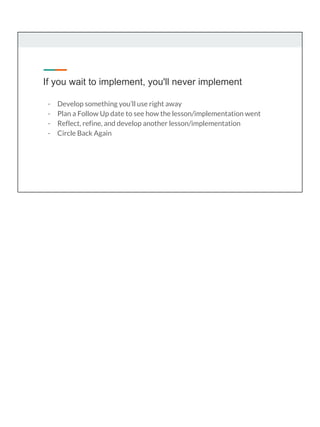
If you wait to implement, you'll never implement
- Develop something you’ll use right away
- Plan a Follow Up date to see how the lesson/implementation went
- Reflect, refine, and develop another lesson/implementation
- Circle Back Again
Can Digital Badging Help?
Alludo (https://www.alludolearning.com/demo/)
Choose This One
Take a few minutes and check out Alludo. How does Alludo attempt to address some
of the limitations of traditional professional development?
Click Here to Play
Play
Complete at least 2 activities, and read five others.
How could Alludo assist you with introducing and/or sustaining your EdTech initiative with teachers?

Visible Learning & Teacher Professional Development

  • 1.
  • 2.
  • 3.
    What is VisibleLearning? According to John Hattie Visible Learning and Teaching occurs when teachers see learning through the eyes of students and help them become their own teachers. Nice book summary: http://www.tdschools.org/wp-content/uploads/2013/08/The+Main+Idea+-+Visible+Lear ning+for+Teachers+-+April+2013.pdf
  • 4.
    Expert Teachers... ● Canidentify the most important ways in which to represent the subject that they teach. ● Are proficient at creating an optimal classroom climate for learning. ● Monitor learning and provide feedback. ● Believe that all students can reach the success criteria. ● Influence surface and deep student outcomes. This is according to Hattie in Visible Learning for Teachers
  • 5.
    Teachers and Leaders... 1.Believe that their fundamental task is to evaluate the effect of their teaching on students’ learning and achievement. 2. Believe that success and failure in student learning is about what they, the teacher, did or did not do. 3. Want to talk more about learning than teaching. 4. See assessment as feedback about their impact as a teacher. 5. Engage in dialogue not monologue. 6. Enjoy the challenge and never retreat to just “doing their best.” 7. Believe that it is their role to develop positive relationships in classrooms and staff rooms. 8. Inform all about the language of learning. Eight mind frames of teachers, school leaders, and systems that lead to visible learning
  • 6.
    What Has MostImpact on Student Learning? http://www.evidencebasedteaching.org.au/hatties-2017-updated-list/ Look at the list - anything surprise you? What impact does this have on the role of EdTech in the classroom?
  • 7.
    Teacher Credibility http://www.evidencebasedteaching.org.au/teacher-credibility/ This isthe credibility students see in the teacher. Not the credibility the teacher believes he/she has… how does this relate to professional development?
  • 8.
  • 9.
    Sometimes I feellike providing professional development to a school of teachers is much like the cowboys in this video…
  • 10.
    Diffusion of Innovation Diffusionof innovations is a theory that seeks to explain how, why, and at what rate new ideas spread. Everett Rogers wrote about the theory in Diffusion of Innovations, which is now in its fifth edition (2003). He argues that diffusion is the process by which an innovation is communicated over time among the participants in a social system. Rogers proposes that four main elements influence the spread of a new idea: the innovation itself, communication channels, time, and a social system. This process relies heavily on human capital. The innovation must be widely adopted in order to self-sustain. Within the rate of adoption, there is a point at which an innovation reaches critical mass.
  • 11.
    Diffusion of Innovation WhatRogers model doesn’t show is the chasm between the early adopters and the early majority. It’s easy to get innovators on board - they’ll jump on board with anything that is new and has potential to make a difference. Once they work out the bugs, early adopters will usually take on the innovation as well. They may need a little training or support, and they’ll need to know WHY, but then they’re off and running… But after that, moving the early majority is a tougher sale. It requires a solid plan, which enforces the why, provides support for the onboarding, and may require some negotiation as to what may be let go or modified in order to embrace the new idea. Without the early majority, innovations don’t gain enough steam and often become a passing fancy.
  • 12.
    Therefore, when consideringa new idea or edtech tool, it’s important to think carefully about the professional development that will be conducted so that the new idea/tool has the greatest chance of being adopted by the staff. Learning Forward came up with these standards that leads to effective teaching practices, supportive leadership, and improved student results.
  • 13.
    Before You PlanProfessional Development ● What are the top two instructional goals for the upcoming year? ● How will these goals impact learning outcomes for staff and students? ● What types of internal/external professional development resources are available? ● What is the best time for teachers to take part in professional development? ● Is there time to access effective professional development, or does time need to be carved out? ● What are methods for making professional development practical? ● How will we measure the effectiveness of the training? Which of these questions do you think is most neglected in the professional development you have attended? https://globaldigitalcitizen.org/achieve-effective-professional-development
  • 14.
    How Does EffectiveProfessional Development Happen? ● At least 14 hours of training that can be spread out over several days and conducted on an ongoing basis ● Align with state and district school goals and standards ● Focus on core content and modelling ● Provide multiple opportunities for feedback ● Provide various activities that require teacher collaboration These elements are critical if a new idea/tool is to truly become part of the fabric of the organization. https://globaldigitalcitizen.org/achieve-effective-professional-development
  • 15.
    Features of EffectiveProfessional Development Is Content Focused Incorporates Active Learning Supports Collaboration Uses Models of Effective Practice Provides Coaching and Expert Support Offers Feedback and Reflection Is of Sustained Duration https://learningpolicyinstitute.org/product/effective-teacher-professional-development-r eport
  • 16.
    Most teachers onlyexperience traditional, workshop-based professional development, even though research shows it is ineffective. Over 90 percent of teachers participate in workshop-style training sessions during a school year (Darling-Hammond et al., 2009). Despite its prevalence, the workshop model’s track record for changing teachers’ practice and student achievement is abysmal. Short, one-shot workshops often don’t change teacher practice and have no effect on student achievement (Yoon et al, 2007; Bush, 1984). http://www.centerforpubliceducation.org/research/teaching-teachers-effective-professi onal-development
  • 17.
    The largest strugglefor teachers is not learning new approaches to teaching but implementing them.The reason traditional professional development is ineffective is that it doesn't support teachers during the stage of learning with the steepest learning curve: implementation. In several case studies, even experienced teachers struggled with a new instructional technique in the beginning (Ermeling, 2010; Joyce and Showers, 1982). It takes, on average, 20 separate instances of practice, before a teacher has mastered a new skill, with that number increasing along with the complexity of the skill (Joyce and Showers, 2002). http://www.centerforpubliceducation.org/research/teaching-teachers-effective-professi onal-development
  • 18.
    If you waitto implement, you'll never implement - Develop something you’ll use right away - Plan a Follow Up date to see how the lesson/implementation went - Reflect, refine, and develop another lesson/implementation - Circle Back Again
  • 19.
  • 20.
    Alludo (https://www.alludolearning.com/demo/) Choose ThisOne Take a few minutes and check out Alludo. How does Alludo attempt to address some of the limitations of traditional professional development?
  • 21.
  • 22.
    Play Complete at least2 activities, and read five others. How could Alludo assist you with introducing and/or sustaining your EdTech initiative with teachers?