Working Smarter, Not HarderJames Nottingham    www.p4c.comwww.jamesnottingham.co.uk
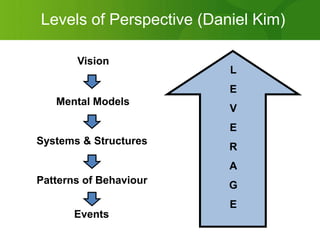
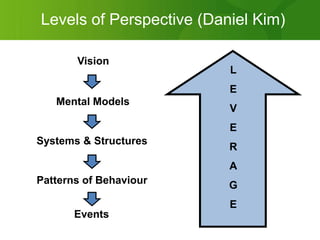
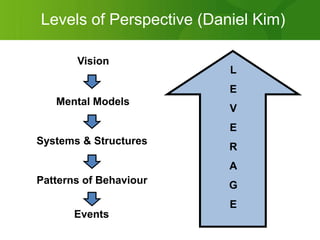
Levels of Perspective (Daniel Kim)VisionLEVERAGEMental ModelsSystems & StructuresPatterns of BehaviourEvents
What Are You Focusing On?"It's not what's happening to you now or what has happened in your past that determines who you become. Rather, it's your decisions about what to focus on, what things mean to you, and what you're going to do about them that will determine your ultimate destiny.”(Stephen Covey, 2004)
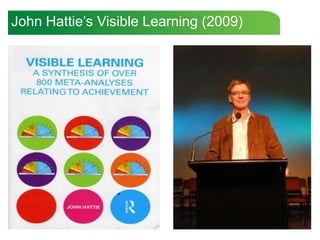
John Hattie’s Visible Learning (2009)
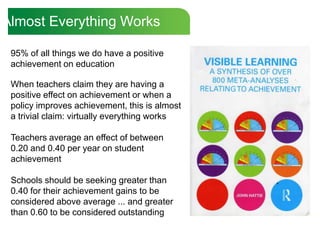
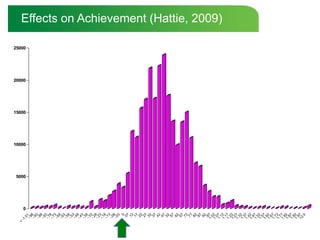
Almost Everything Works95% of all things we do have a positive achievement on educationWhen teachers claim they are having a positive effect on achievement or when a policy improves achievement, this is almost a trivial claim: virtually everything worksTeachers average an effect of between 0.20 and 0.40 per year on student achievementSchools should be seeking greater than 0.40 for their achievement gains to be considered above average ... and greater than 0.60 to be considered outstanding
   Effects on Achievement (Hattie, 2009)
Primary School Vision	At this school we provide a positive, caring, nurturing and stimulating environment inside and outside the classroom. Our children are encouraged to try new and different activities and to explore boundaries within safe limits. They have fun and enjoy working both independently and as part of a team.	We are open to the views and opinions of every member of our school community. We invite and value their ideas. We take time to listen and communicate with each other in a respectful and open manner. This creates a rich culture of quick, effective feedback. In this way everybody feels valued and we pull together to support each other. We recognise and praise each other’s achievements in an informal way. 	The right to learn is respected allowing every child, including our special needs and gifted and talented children, to develop to their full potential. Every member of our learning community sets achievable goals and receives regular and positive feedback. We have high expectations for behaviour and have a behaviour management system that creates a calm environment where issues are dealt with fairly and consistently.
Teaching and Learning VisionAt RMGS we create critical, reflective and independent learners for life through a learning community which provides a secure and challenging environment.  	We believe deep learning is facilitated through outstanding teaching and occurs when all learners are actively engaged in a variety of tasks, taking responsibility for their own learning and progress, collaborating and thinking with shared expectations of success. 	At RMGS through innovative learning strategies and positive relationships our students enjoy learning and achieve their full potential.
What are the ESSENTIAL CHARACTERISTICS that make our school outstanding? How can we best help and GUIDE our students in their learning? How can we CHALLENGE our students more, and encourage their parents to do the same? What ATTITUDES & SKILLS do we wish our students to possess by the time they leave our school? How can we best SHARE EXPERTISE and ideas with each other within and across the 3 areas? How can we make the most of our OPEN LANDSCAPE? What EVIDENCE should we gather to help us know how the students are progressing in every aspect of their learning? GREEN HAT THINKING – what could really make a difference to our school?
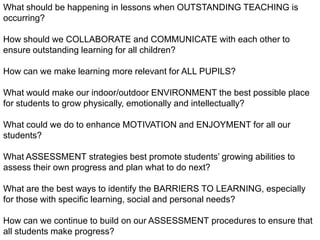
What should be happening in lessons when OUTSTANDING TEACHING is occurring? How should we COLLABORATE and COMMUNICATE with each other to ensure outstanding learning for all children? How can we make learning more relevant for ALL PUPILS? What would make our indoor/outdoor ENVIRONMENT the best possible place for students to grow physically, emotionally and intellectually? What could we do to enhance MOTIVATION and ENJOYMENT for all our students? What ASSESSMENT strategies best promote students’ growing abilities to assess their own progress and plan what to do next? What are the best ways to identify the BARRIERS TO LEARNING, especially for those with specific learning, social and personal needs? How can we continue to build on our ASSESSMENT procedures to ensure that all students make progress? What are the key skills, learning and teaching beliefs we each need as staff to ensure students leave us life-long INDEPENDENT LEARNERS?
Levels of Perspective (Daniel Kim)VisionLEVERAGEMental ModelsSystems & StructuresPatterns of BehaviourEvents
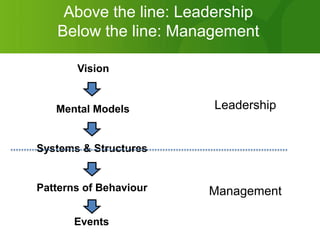
Above the line: Leadership Below the line: ManagementVisionLeadershipMental ModelsSystems & StructuresPatterns of BehaviourManagementEvents
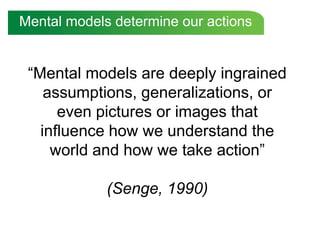
Mental models determine our actions“Mental models are deeply ingrained assumptions, generalizations, or even pictures or images that influence how we understand the world and how we take action”(Senge, 1990)
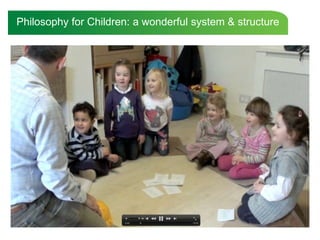
Philosophy for Children: a wonderful system & structure
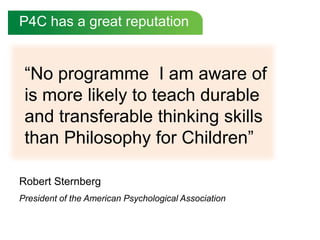
P4C has a great reputation“No programme  I am aware of is more likely to teach durable and transferable thinking skills than Philosophy for Children”Robert SternbergPresident of the American Psychological Association
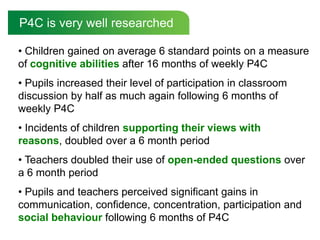
P4C is very well researched Children gained on average 6 standard points on a measure of cognitive abilities after 16 months of weekly P4C
 Pupils increased their level of participation in classroom discussion by half as much again following 6 months of weekly P4C
 Incidents of children supporting their views with reasons, doubled over a 6 month period
 Teachers doubled their use of open-ended questions over a 6 month period
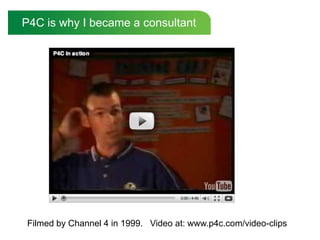
 Pupils and teachers perceived significant gains in communication, confidence, concentration, participation and social behaviour following 6 months of P4CP4C is why I became a consultantFilmed by Channel 4 in 1999.   Video at: www.p4c.com/video-clips
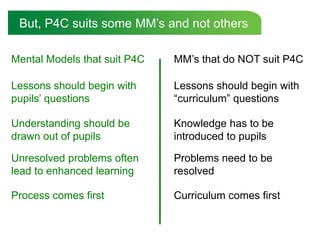
But, P4C suits some MM’s and not othersMental Models that suit P4CMM’s that do NOT suit P4CLessons should begin with pupils’ questionsLessons should begin with “curriculum” questionsUnderstanding should be drawn out of pupilsKnowledge has to be introduced to pupilsUnresolved problems often lead to enhanced learningProblems need to be resolvedProcess comes firstCurriculum comes first
Levels of Perspective (Daniel Kim)VisionLEVERAGEMental ModelsSystems & StructuresPatterns of BehaviourEvents
Some MM’s are wrong!
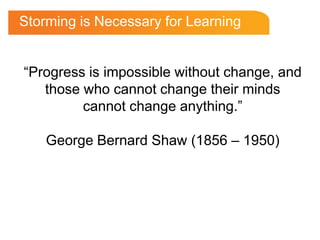
Storming is Necessary for Learning“Progress is impossible without change, and those who cannot change their minds cannot change anything.”George Bernard Shaw (1856 – 1950)
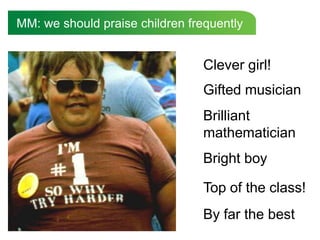
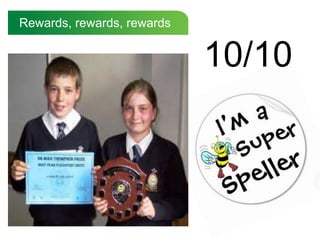
MM: we should praise children frequentlyClever girl!Gifted musicianBrilliant mathematicianBright boyTop of the class!By far the best
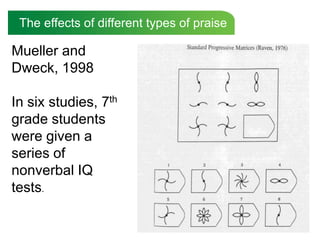
The effects of different types of praise Mueller and Dweck, 1998In six studies, 7th grade students were given a series of nonverbal IQ tests.
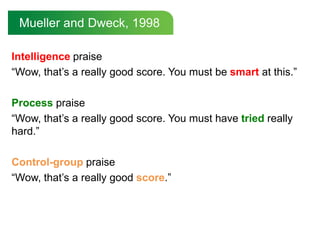
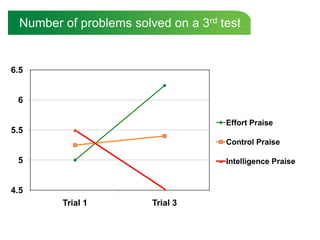
Mueller and Dweck, 1998Intelligence praise“Wow, that’s a really good score. You must be smart at this.” Process praise“Wow, that’s a really good score. You must have tried really hard.”Control-group praise“Wow, that’s a really good score.”

Working Smarter, Not Harder

  • 1.
    Working Smarter, NotHarderJames Nottingham www.p4c.comwww.jamesnottingham.co.uk
  • 2.
    Levels of Perspective(Daniel Kim)VisionLEVERAGEMental ModelsSystems & StructuresPatterns of BehaviourEvents
  • 7.
    What Are YouFocusing On?"It's not what's happening to you now or what has happened in your past that determines who you become. Rather, it's your decisions about what to focus on, what things mean to you, and what you're going to do about them that will determine your ultimate destiny.”(Stephen Covey, 2004)
  • 8.
  • 9.
    Almost Everything Works95%of all things we do have a positive achievement on educationWhen teachers claim they are having a positive effect on achievement or when a policy improves achievement, this is almost a trivial claim: virtually everything worksTeachers average an effect of between 0.20 and 0.40 per year on student achievementSchools should be seeking greater than 0.40 for their achievement gains to be considered above average ... and greater than 0.60 to be considered outstanding
  • 10.
    Effects on Achievement (Hattie, 2009)
  • 11.
    Primary School Vision Atthis school we provide a positive, caring, nurturing and stimulating environment inside and outside the classroom. Our children are encouraged to try new and different activities and to explore boundaries within safe limits. They have fun and enjoy working both independently and as part of a team. We are open to the views and opinions of every member of our school community. We invite and value their ideas. We take time to listen and communicate with each other in a respectful and open manner. This creates a rich culture of quick, effective feedback. In this way everybody feels valued and we pull together to support each other. We recognise and praise each other’s achievements in an informal way. The right to learn is respected allowing every child, including our special needs and gifted and talented children, to develop to their full potential. Every member of our learning community sets achievable goals and receives regular and positive feedback. We have high expectations for behaviour and have a behaviour management system that creates a calm environment where issues are dealt with fairly and consistently.
  • 12.
    Teaching and LearningVisionAt RMGS we create critical, reflective and independent learners for life through a learning community which provides a secure and challenging environment.   We believe deep learning is facilitated through outstanding teaching and occurs when all learners are actively engaged in a variety of tasks, taking responsibility for their own learning and progress, collaborating and thinking with shared expectations of success.  At RMGS through innovative learning strategies and positive relationships our students enjoy learning and achieve their full potential.
  • 13.
    What are theESSENTIAL CHARACTERISTICS that make our school outstanding? How can we best help and GUIDE our students in their learning? How can we CHALLENGE our students more, and encourage their parents to do the same? What ATTITUDES & SKILLS do we wish our students to possess by the time they leave our school? How can we best SHARE EXPERTISE and ideas with each other within and across the 3 areas? How can we make the most of our OPEN LANDSCAPE? What EVIDENCE should we gather to help us know how the students are progressing in every aspect of their learning? GREEN HAT THINKING – what could really make a difference to our school?
  • 14.
    What should behappening in lessons when OUTSTANDING TEACHING is occurring? How should we COLLABORATE and COMMUNICATE with each other to ensure outstanding learning for all children? How can we make learning more relevant for ALL PUPILS? What would make our indoor/outdoor ENVIRONMENT the best possible place for students to grow physically, emotionally and intellectually? What could we do to enhance MOTIVATION and ENJOYMENT for all our students? What ASSESSMENT strategies best promote students’ growing abilities to assess their own progress and plan what to do next? What are the best ways to identify the BARRIERS TO LEARNING, especially for those with specific learning, social and personal needs? How can we continue to build on our ASSESSMENT procedures to ensure that all students make progress? What are the key skills, learning and teaching beliefs we each need as staff to ensure students leave us life-long INDEPENDENT LEARNERS?
  • 15.
    Levels of Perspective(Daniel Kim)VisionLEVERAGEMental ModelsSystems & StructuresPatterns of BehaviourEvents
  • 16.
    Above the line:Leadership Below the line: ManagementVisionLeadershipMental ModelsSystems & StructuresPatterns of BehaviourManagementEvents
  • 17.
    Mental models determineour actions“Mental models are deeply ingrained assumptions, generalizations, or even pictures or images that influence how we understand the world and how we take action”(Senge, 1990)
  • 18.
    Philosophy for Children:a wonderful system & structure
  • 19.
    P4C has agreat reputation“No programme  I am aware of is more likely to teach durable and transferable thinking skills than Philosophy for Children”Robert SternbergPresident of the American Psychological Association
  • 20.
    P4C is verywell researched Children gained on average 6 standard points on a measure of cognitive abilities after 16 months of weekly P4C
  • 21.
    Pupils increasedtheir level of participation in classroom discussion by half as much again following 6 months of weekly P4C
  • 22.
    Incidents ofchildren supporting their views with reasons, doubled over a 6 month period
  • 23.
    Teachers doubledtheir use of open-ended questions over a 6 month period
  • 24.
    Pupils andteachers perceived significant gains in communication, confidence, concentration, participation and social behaviour following 6 months of P4CP4C is why I became a consultantFilmed by Channel 4 in 1999. Video at: www.p4c.com/video-clips
  • 25.
    But, P4C suitssome MM’s and not othersMental Models that suit P4CMM’s that do NOT suit P4CLessons should begin with pupils’ questionsLessons should begin with “curriculum” questionsUnderstanding should be drawn out of pupilsKnowledge has to be introduced to pupilsUnresolved problems often lead to enhanced learningProblems need to be resolvedProcess comes firstCurriculum comes first
  • 26.
    Levels of Perspective(Daniel Kim)VisionLEVERAGEMental ModelsSystems & StructuresPatterns of BehaviourEvents
  • 27.
  • 28.
    Storming is Necessaryfor Learning“Progress is impossible without change, and those who cannot change their minds cannot change anything.”George Bernard Shaw (1856 – 1950)
  • 29.
    MM: we shouldpraise children frequentlyClever girl!Gifted musicianBrilliant mathematicianBright boyTop of the class!By far the best
  • 30.
    The effects ofdifferent types of praise Mueller and Dweck, 1998In six studies, 7th grade students were given a series of nonverbal IQ tests.
  • 31.
    Mueller and Dweck,1998Intelligence praise“Wow, that’s a really good score. You must be smart at this.” Process praise“Wow, that’s a really good score. You must have tried really hard.”Control-group praise“Wow, that’s a really good score.”