VISCOMCOM 310 W7
OUTLINEWELCOMESYLLABUSBLOGCHAPTER 1-3CHAPTER 4ACTIVITYPUBLIC SERVICE PRINT ADS
SYLLABUSATTENDANCEPOSITIONING (hybrid, design for non designers, service)REQUIRED TEXTSASSIGNMENTS WRITTEN CREATIVE (e.g.)COURSE SCHEDULE
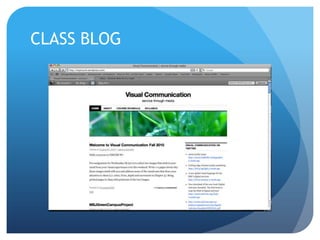
CLASS BLOG
CHAPTER 1: How we seeTwo premisesfromour text VisCom – Images w/MessagesImages have the most impact when they are rememberedImages and text rely on one another,	-and combined - they can provide compelling messages
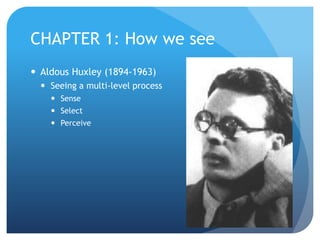
CHAPTER 1: How we seeAldous Huxley (1894-1963)Seeing a multi-level processSenseSelectPerceive
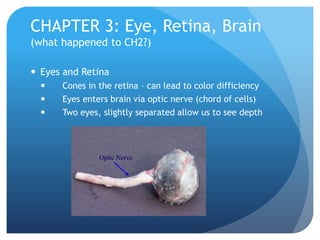
CHAPTER 3: Eye, Retina, Brain (what happened to CH2?)Eyes and Retina	Cones in the retina – can lead to color difficiency	Eyes enters brain via optic nerve (chord of cells)	Two eyes, slightly separated allow us to see depth
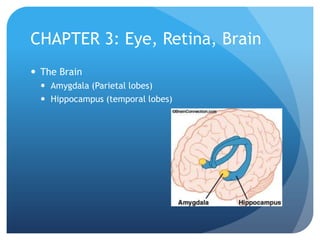
CHAPTER 3: Eye, Retina, BrainThe BrainAmygdala (Parietal lobes)Hippocampus (temporal lobes)
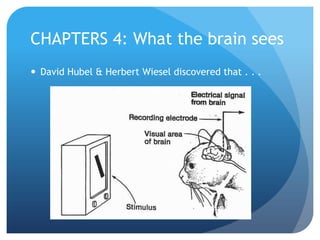
CHAPTERS 4: What the brain seesDavid Hubel & Herbert Wiesel discovered that . . .
Four visual cuesColorForm DepthMovement
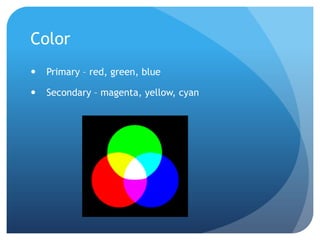
ColorPrimary – red, green, blueSecondary – magenta, yellow, cyan
Three ways of discussing colorObjective chroma (hue), value (amount of concentration)brightness (amount of light emitted)Comparative  - blood red, sky blueSubjective – range of emotional responses to colorwarm and cool colors (psychological distinctions)Light (soft and cheerful) and dark (harsh and moody)
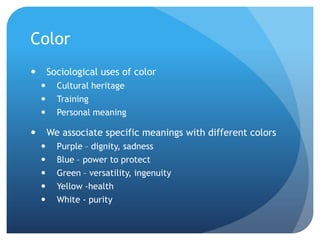
ColorSociological uses of colorCultural heritageTrainingPersonal meaningWe associate specific meanings with different colorsPurple – dignity, sadnessBlue – power to protectGreen – versatility, ingenuityYellow -healthWhite - purity
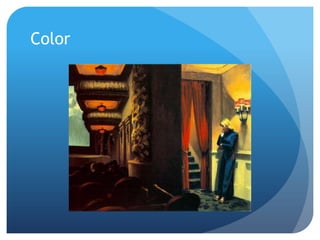
Color
FormDotsLinesShapes
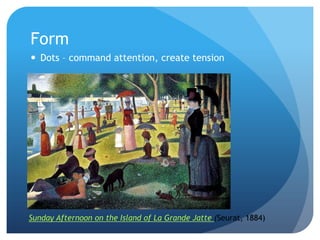
FormDots – command attention, create tensionSunday Afternoon on the Island of La Grande Jatte (Seurat, 1884)
FormLines – draw viewers attentionCurvy lines are playfulStraight lines – rigidThick lines – strongThin lines – delicate, timid
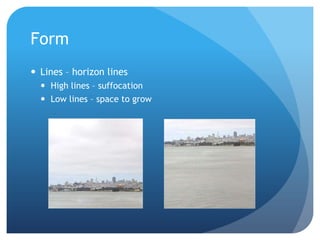
FormLines – horizon linesHigh lines – suffocationLow lines – space to grow
FormShapes - ParallelogramCircleTriangle
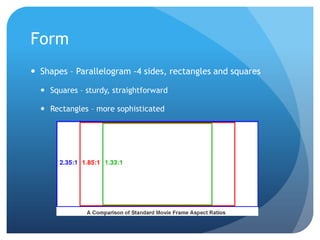
FormShapes – Parallelogram -4 sides, rectangles and squaresSquares – sturdy, straightforwardRectangles – more sophisticated
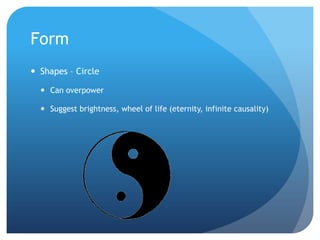
FormShapes – CircleCan overpower Suggest brightness, wheel of life (eternity, infinite causality)
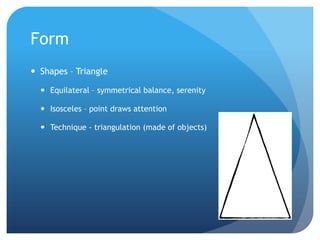
FormShapes – TriangleEquilateral – symmetrical balance, serenityIsosceles – point draws attentionTechnique - triangulation (made of objects)
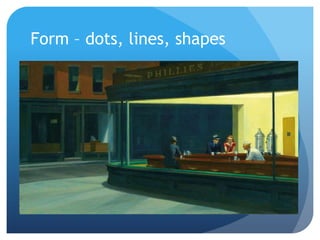
Form – dots, lines, shapes
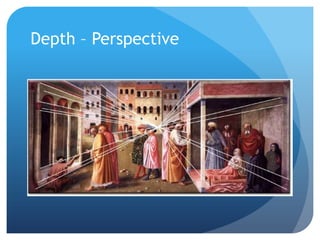
Depth – 8 depth cuesSpaceSizeColorLightingTextural gradients (patterned lines)InterpositionTimePerspective (illusionary, geometrical, conceptual)
Depth – Perspective
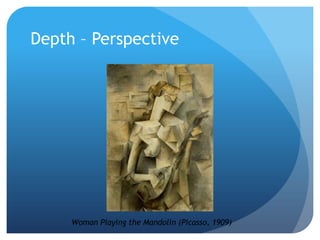
Depth – PerspectiveWoman Playing the Mandolin (Picasso, 1909)
Depth – MovementRealApparent (motion pictures)Graphic (rhythm)Implied (visual vibrations from high contrast lines)
ACTIVITY -ANALYZING AN IMAGE	make an inventory list of all objects in picture	notice composition (center, periphery)	study visual cues
PUBLIC SERVICE PRINT ADSWhy Bad Ads Happen to Good CausesStudied over 200 public service print ads 1990-2000Noted - % remembered seeing the adAssociated - % recalled name of advertiser or campaignRead Most - % read ½ or more of written material in ad
PUBLIC SERVICE PRINT ADS7 DESIGN PRINCIPLESCapture reader’s attention like a stop sign, direct it like a road mapMake an emotional connection before conveying infoWrite headlines that offer a reason to readUse pictures to attract and convinceMake text legibleTest, measureWhen everyone zigs, zag
HWK by 9/15Read Chapters 2-4Due Journal #2Play with the blog

VisCom mweek1

  • 1.
  • 2.
  • 3.
    SYLLABUSATTENDANCEPOSITIONING (hybrid, designfor non designers, service)REQUIRED TEXTSASSIGNMENTS WRITTEN CREATIVE (e.g.)COURSE SCHEDULE
  • 4.
  • 5.
    CHAPTER 1: Howwe seeTwo premisesfromour text VisCom – Images w/MessagesImages have the most impact when they are rememberedImages and text rely on one another, -and combined - they can provide compelling messages
  • 6.
    CHAPTER 1: Howwe seeAldous Huxley (1894-1963)Seeing a multi-level processSenseSelectPerceive
  • 7.
    CHAPTER 3: Eye,Retina, Brain (what happened to CH2?)Eyes and Retina Cones in the retina – can lead to color difficiency Eyes enters brain via optic nerve (chord of cells) Two eyes, slightly separated allow us to see depth
  • 8.
    CHAPTER 3: Eye,Retina, BrainThe BrainAmygdala (Parietal lobes)Hippocampus (temporal lobes)
  • 9.
    CHAPTERS 4: Whatthe brain seesDavid Hubel & Herbert Wiesel discovered that . . .
  • 10.
  • 11.
    ColorPrimary – red,green, blueSecondary – magenta, yellow, cyan
  • 12.
    Three ways ofdiscussing colorObjective chroma (hue), value (amount of concentration)brightness (amount of light emitted)Comparative - blood red, sky blueSubjective – range of emotional responses to colorwarm and cool colors (psychological distinctions)Light (soft and cheerful) and dark (harsh and moody)
  • 13.
    ColorSociological uses ofcolorCultural heritageTrainingPersonal meaningWe associate specific meanings with different colorsPurple – dignity, sadnessBlue – power to protectGreen – versatility, ingenuityYellow -healthWhite - purity
  • 14.
  • 15.
  • 16.
    FormDots – commandattention, create tensionSunday Afternoon on the Island of La Grande Jatte (Seurat, 1884)
  • 17.
    FormLines – drawviewers attentionCurvy lines are playfulStraight lines – rigidThick lines – strongThin lines – delicate, timid
  • 18.
    FormLines – horizonlinesHigh lines – suffocationLow lines – space to grow
  • 19.
  • 20.
    FormShapes – Parallelogram-4 sides, rectangles and squaresSquares – sturdy, straightforwardRectangles – more sophisticated
  • 21.
    FormShapes – CircleCanoverpower Suggest brightness, wheel of life (eternity, infinite causality)
  • 22.
    FormShapes – TriangleEquilateral– symmetrical balance, serenityIsosceles – point draws attentionTechnique - triangulation (made of objects)
  • 23.
    Form – dots,lines, shapes
  • 24.
    Depth – 8depth cuesSpaceSizeColorLightingTextural gradients (patterned lines)InterpositionTimePerspective (illusionary, geometrical, conceptual)
  • 25.
  • 26.
    Depth – PerspectiveWomanPlaying the Mandolin (Picasso, 1909)
  • 27.
    Depth – MovementRealApparent(motion pictures)Graphic (rhythm)Implied (visual vibrations from high contrast lines)
  • 28.
    ACTIVITY -ANALYZING ANIMAGE make an inventory list of all objects in picture notice composition (center, periphery) study visual cues
  • 29.
    PUBLIC SERVICE PRINTADSWhy Bad Ads Happen to Good CausesStudied over 200 public service print ads 1990-2000Noted - % remembered seeing the adAssociated - % recalled name of advertiser or campaignRead Most - % read ½ or more of written material in ad
  • 30.
    PUBLIC SERVICE PRINTADS7 DESIGN PRINCIPLESCapture reader’s attention like a stop sign, direct it like a road mapMake an emotional connection before conveying infoWrite headlines that offer a reason to readUse pictures to attract and convinceMake text legibleTest, measureWhen everyone zigs, zag
  • 31.
    HWK by 9/15ReadChapters 2-4Due Journal #2Play with the blog

Editor's Notes

  • #5 DEMO UPLOADING AN IMAGE
  • #7 We sense – light comes into our eyes (no mental processes occurring)Select – focus on particular element in our visual plane or field of vision (reasons for this – cues, etc)Perceive – we make sense of what we select – process info, we bring past knowledge with us, all past experience of seeing impacts our interpretation of new images
  • #9 Long term memoryImages are sent via two pathways to our brainsThrough parietal lobes passes to our amygdala – where we assign emotions to imagesthen sends it on to Hippocampi – where long term memory is stored and where we compare new visual messages to those previous for meaning and emotional value. The physiological explanation for how we form a subjective basis for interpreting visual data
  • #10 By connecting a microelectrode to a nerve cell in the visual cortex of a catSpecific cells in the brain respond to 4 kinds of visual stimulation –
  • #11 We look closely at each visual cue that our brains respond to gain insight into how to design compelling visual messages.
  • #12 Color constancy – colors look different depending on lighting conditions When colors under bright conditions they retain their hue, when change when it is dark. (red in the dark looks blue)
  • #26 Vanishing point
  • #27 Vanishing point
  • #28 Vanishing point
  • #29 AFTER THIS, THEN