Scholarship | Teaching | Service Robert Bodle
Research statement My research analyses the social and political implications of emerging forms of social media and ICTs for upholding and/or undermining democratic values, human rights, and human development.
Recent focus -the development, affordances, uses, constraints, and consequences of social media
Social Media Blogs – WordPress, blogger Microblogs – Twitter, Yammer Content-sharing sites – YouTube, Flickr Social network sites – Facebook, LinkedIn
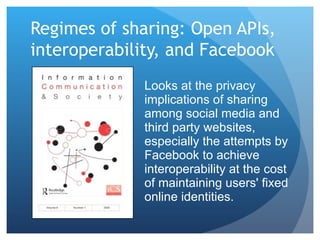
Regimes of sharing: Open APIs, interoperability, and Facebook  Looks at the privacy implications of sharing among social media and third party websites, especially the attempts by Facebook to achieve interoperability at the cost of maintaining users' fixed online identities.
Social Networks as International Platforms  [published in the Special Issue,  "Making the net work"  of the  Journal  of International Communication  16, 2 (August-September 2010). ] Research question -  “How can social network sites affirm and uphold a ‘people centered, inclusive and development-oriented information society’”  (WSIS, 2005)?
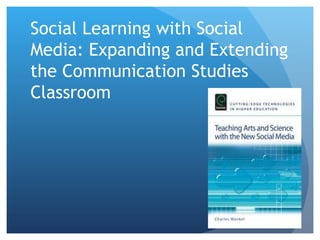
Social Learning with Social Media: Expanding and Extending the Communication Studies Classroom
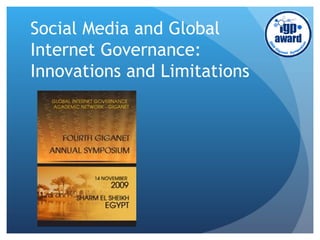
Social Media and Global Internet Governance: Innovations and Limitations
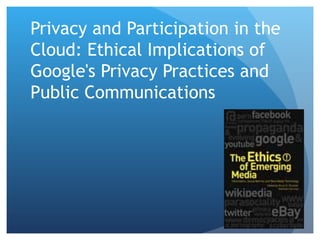
Privacy and Participation in the Cloud: Ethical Implications of Google's Privacy Practices and Public Communications
Teaching: Social Media, Social Change (course description) Social media have been recognized as important tools for distributed  reporting, raising awareness, enabling democratic participation, and  engaging a broader public sphere.  This class sets out to examine the opportunities and limitations of using  social media to support activism, advocacy, and civic engagement.  In addition, students will have opportunities to create their own  social media campaigns.
Service – Social Media Chair, Instructional Delivery Committee (2009-2011) Social media workshops Facilitator, Faculty Learning Communities (2007-2011) Blended Learning, iPod Touch in the Classroom, Second Life, Social Media
Service – (cont.) The Service Learning Program  at the Mount is based upon "service to others" and allows students the opportunity to apply classroom knowledge while volunteering their service in a variety of areas. Cincylight  campaign to promote a light rail system in Cincinnati Redwebzine  online news publication that shares "Stories of transformation in lives of prisoners and individuals re-entering society.” Our Daily Bread  soup kitchen and hospitality center computer lab volunteer.
Service – International Steering member and manager of social media for the UN-based Dynamic Coalition on  Internet Rights and Principles  (IRP), an initiative formed by people and institutions to establish an Internet Governance regime founded upon human rights under the United Nations' body the  Internet Governance  Forum  (IGF).
Scholarship | Teaching | Service Thank you. Robert Bodle

Bodle research

  • 1.
    Scholarship | Teaching| Service Robert Bodle
  • 2.
    Research statement Myresearch analyses the social and political implications of emerging forms of social media and ICTs for upholding and/or undermining democratic values, human rights, and human development.
  • 3.
    Recent focus -thedevelopment, affordances, uses, constraints, and consequences of social media
  • 4.
    Social Media Blogs– WordPress, blogger Microblogs – Twitter, Yammer Content-sharing sites – YouTube, Flickr Social network sites – Facebook, LinkedIn
  • 5.
    Regimes of sharing:Open APIs, interoperability, and Facebook Looks at the privacy implications of sharing among social media and third party websites, especially the attempts by Facebook to achieve interoperability at the cost of maintaining users' fixed online identities.
  • 6.
    Social Networks asInternational Platforms [published in the Special Issue, "Making the net work" of the Journal of International Communication 16, 2 (August-September 2010). ] Research question - “How can social network sites affirm and uphold a ‘people centered, inclusive and development-oriented information society’” (WSIS, 2005)?
  • 7.
    Social Learning withSocial Media: Expanding and Extending the Communication Studies Classroom
  • 8.
    Social Media andGlobal Internet Governance: Innovations and Limitations
  • 9.
    Privacy and Participationin the Cloud: Ethical Implications of Google's Privacy Practices and Public Communications
  • 10.
    Teaching: Social Media,Social Change (course description) Social media have been recognized as important tools for distributed reporting, raising awareness, enabling democratic participation, and engaging a broader public sphere. This class sets out to examine the opportunities and limitations of using social media to support activism, advocacy, and civic engagement. In addition, students will have opportunities to create their own social media campaigns.
  • 11.
    Service – SocialMedia Chair, Instructional Delivery Committee (2009-2011) Social media workshops Facilitator, Faculty Learning Communities (2007-2011) Blended Learning, iPod Touch in the Classroom, Second Life, Social Media
  • 12.
    Service – (cont.)The Service Learning Program at the Mount is based upon "service to others" and allows students the opportunity to apply classroom knowledge while volunteering their service in a variety of areas. Cincylight campaign to promote a light rail system in Cincinnati Redwebzine online news publication that shares "Stories of transformation in lives of prisoners and individuals re-entering society.” Our Daily Bread soup kitchen and hospitality center computer lab volunteer.
  • 13.
    Service – InternationalSteering member and manager of social media for the UN-based Dynamic Coalition on Internet Rights and Principles (IRP), an initiative formed by people and institutions to establish an Internet Governance regime founded upon human rights under the United Nations' body the Internet Governance Forum (IGF).
  • 14.
    Scholarship | Teaching| Service Thank you. Robert Bodle