ELEMENTS OF
        ARTS
1. LINES     6. SHAPE
2. TEXTURE
3. FORM
4. SPACE
5. COLOR
LINES
 Line is defined as a mark that spans a distance
 between two points (or the path of a moving
 point), taking any form along the way. As an art
 element, line pertains to the use of various
 marks, outlines and implied lines in artwork and
 design, most often used to define shape in two-
 dimensional work. Implied line is the path that the
 viewer's eye takes as it follows shapes, colors, and
 form along a path, but may not be continuous or
 physically connected, such as the line created by a
 dancer's arms, torso, and legs when performing an
 arabesque.
EXAMPLES OF LINES

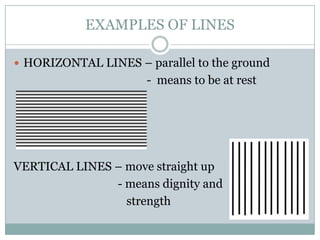
 HORIZONTAL LINES – parallel to the ground
                      - means to be at rest


VERTICAL LINES – move straight up
               - means dignity and
                 strength
EXAMPLES OF LINES

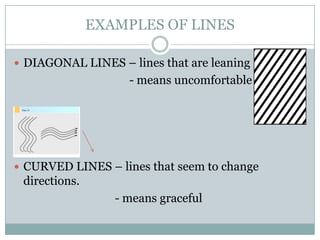
 DIAGONAL LINES – lines that are leaning
                    - means uncomfortable


 CURVED LINES – lines that seem to change
 directions.
                  - means graceful
EXAMPLES OF LINES

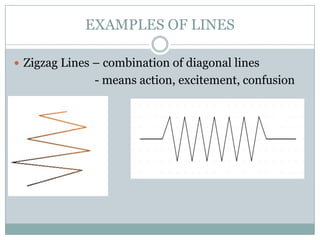
 Zigzag Lines – combination of diagonal lines
               - means action, excitement, confusion
TEXTURE
 Surface quality of an object
 The texture is the quality of a surface or the way any
 work of art is represented. Lines and shading can be
 used to create different textures as well. For
 example, if one is portraying certain fabrics, one
 needs to give the feeling of the right texture so that it
 closely resembles what the artist is trying to convey.
 It can be implied or real. What you can feel with your
 sense of touch.
KINDS OF TEXTURES

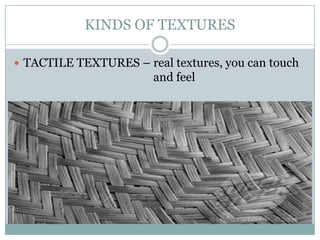
 TACTILE TEXTURES – real textures, you can touch
                       and feel
KINDS OF TEXTURES

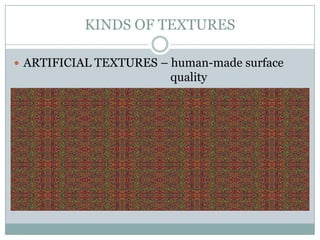
 ARTIFICIAL TEXTURES – human-made surface
                        quality
KINDS OF TEXTURES

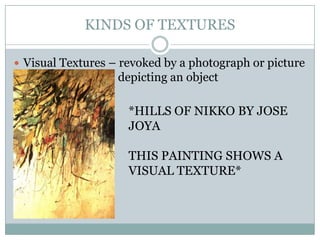
 Visual Textures – revoked by a photograph or picture
                   depicting an object

                     *HILLS OF NIKKO BY JOSE
                     JOYA

                     THIS PAINTING SHOWS A
                     VISUAL TEXTURE*
FORM
 Refers to an object with three dimension (
  height, width and depth )
 Form may be created by the forming of two or more
  shapes or as three-dimensional shape
  (cube, pyramid, sphere, cylinder, etc.). It may be
  enhanced by tone, texture and color. Form is
  considered three-dimensional showing height, width
  and depth. Examples of these are sculpture, theatre
  play and figurines.
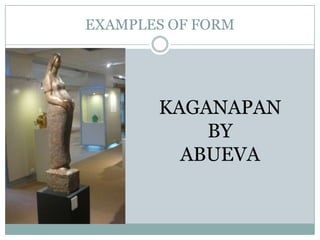
EXAMPLES OF FORM


       KAGANAPAN
           BY
         ABUEVA
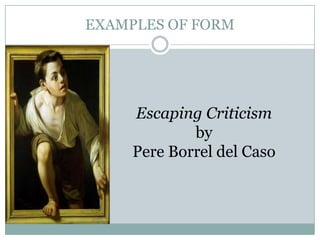
EXAMPLES OF FORM


     Escaping Criticism
             by
     Pere Borrel del Caso
SPACE
 Refers to the distance or area within the objects
 Space is the area provided for a particular purpose.
Space includes the background, foreground and
middle ground. Space refers to the distances or areas
around, between or within components of a piece.
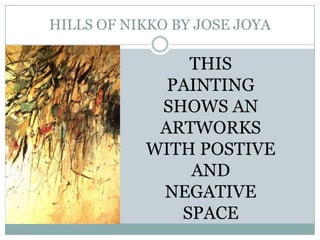
There are two types of space: positive and negative
space. Positive space refers to the space of a shape
representing the subject matter. Negative space
refers to the space around and between the subject
matter. Space is also defined as the distance between
identifiable points or planes in a work of art.
HILLS OF NIKKO BY JOSE JOYA

               THIS
             PAINTING
            SHOWS AN
            ARTWORKS
           WITH POSTIVE
               AND
            NEGATIVE
              SPACE
COLOR
 Derived from reflected light
 Color pertains to the use of hue in artwork and design.
 Defined as primary
 colors (red, yellow, blue) which cannot be mixed
 in pigment from other hues, secondary colors
 (green, orange, violet) which are directly mixed from
 combinations of primary colors. Further combinations of
 primary and secondary colors create tertiary (and more)
 hues. Tint and Shade are references to adding variations
 in Value; other tertiary colors are derived by mixing
 either a primary or secondary color with a neutral color.
PRIMARY COLORS

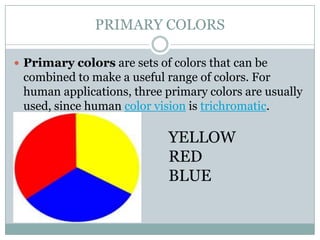
 Primary colors are sets of colors that can be
 combined to make a useful range of colors. For
 human applications, three primary colors are usually
 used, since human color vision is trichromatic.

                            YELLOW
                            RED
                            BLUE
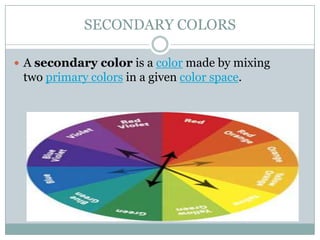
SECONDARY COLORS

 A secondary color is a color made by mixing
 two primary colors in a given color space.
COLOR HAS THREE PROPERTIES

 Hue – is the color’s name


 Value – is the property of color concerned with the
 lightness of darkness of a hue


 Intensity – is the brightness or dullness of a color
COMPLEMENTARY COLORS


Colors opposite to each
other on the color wheel

Red and Green are
complementary colors
MONOCHROMATIC COLOR SCHEME

Harmony of one color and its
 variations or different values of
 a single color.

A color scheme using dark
 blue, medium blue, light blue
 are monochromatic
ANALOGOUS COLORS


Colors that are side
by side on the color
wheel and share a
hue.
SHAPES
 Two – dimensional figure enclosed by a line.
 Shape pertains to the use of areas in two dimensional
 space that can be defined by edges, setting one flat
 specific space apart from another. Shapes can be
 geometric (e.g.:
 square, circle, triangle, hexagon, etc.) or organic
 (such as the shape of a
 puddle, blob, leaf, boomerang, etc.) Shapes are
 defined by other elements of art:
 Space, Line, Texture, Value, Color, Form.
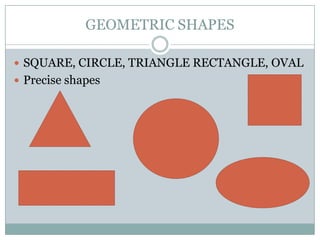
GEOMETRIC SHAPES

 SQUARE, CIRCLE, TRIANGLE RECTANGLE, OVAL
 Precise shapes
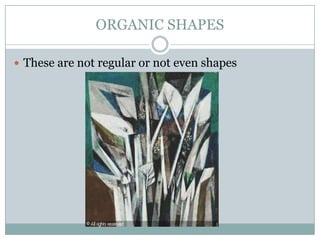
ORGANIC SHAPES

 These are not regular or not even shapes
THANKS
FOR
LISTENING
AND FOR YOUR
TIME!!!


Elements of arts

  • 1.
    ELEMENTS OF ARTS 1. LINES 6. SHAPE 2. TEXTURE 3. FORM 4. SPACE 5. COLOR
  • 2.
    LINES  Line isdefined as a mark that spans a distance between two points (or the path of a moving point), taking any form along the way. As an art element, line pertains to the use of various marks, outlines and implied lines in artwork and design, most often used to define shape in two- dimensional work. Implied line is the path that the viewer's eye takes as it follows shapes, colors, and form along a path, but may not be continuous or physically connected, such as the line created by a dancer's arms, torso, and legs when performing an arabesque.
  • 3.
    EXAMPLES OF LINES HORIZONTAL LINES – parallel to the ground - means to be at rest VERTICAL LINES – move straight up - means dignity and strength
  • 4.
    EXAMPLES OF LINES DIAGONAL LINES – lines that are leaning - means uncomfortable  CURVED LINES – lines that seem to change directions. - means graceful
  • 5.
    EXAMPLES OF LINES Zigzag Lines – combination of diagonal lines - means action, excitement, confusion
  • 6.
    TEXTURE  Surface qualityof an object  The texture is the quality of a surface or the way any work of art is represented. Lines and shading can be used to create different textures as well. For example, if one is portraying certain fabrics, one needs to give the feeling of the right texture so that it closely resembles what the artist is trying to convey. It can be implied or real. What you can feel with your sense of touch.
  • 7.
    KINDS OF TEXTURES TACTILE TEXTURES – real textures, you can touch and feel
  • 8.
    KINDS OF TEXTURES ARTIFICIAL TEXTURES – human-made surface quality
  • 9.
    KINDS OF TEXTURES Visual Textures – revoked by a photograph or picture depicting an object *HILLS OF NIKKO BY JOSE JOYA THIS PAINTING SHOWS A VISUAL TEXTURE*
  • 10.
    FORM  Refers toan object with three dimension ( height, width and depth )  Form may be created by the forming of two or more shapes or as three-dimensional shape (cube, pyramid, sphere, cylinder, etc.). It may be enhanced by tone, texture and color. Form is considered three-dimensional showing height, width and depth. Examples of these are sculpture, theatre play and figurines.
  • 11.
    EXAMPLES OF FORM KAGANAPAN BY ABUEVA
  • 12.
    EXAMPLES OF FORM Escaping Criticism by Pere Borrel del Caso
  • 13.
    SPACE Refers tothe distance or area within the objects Space is the area provided for a particular purpose. Space includes the background, foreground and middle ground. Space refers to the distances or areas around, between or within components of a piece. There are two types of space: positive and negative space. Positive space refers to the space of a shape representing the subject matter. Negative space refers to the space around and between the subject matter. Space is also defined as the distance between identifiable points or planes in a work of art.
  • 14.
    HILLS OF NIKKOBY JOSE JOYA THIS PAINTING SHOWS AN ARTWORKS WITH POSTIVE AND NEGATIVE SPACE
  • 15.
    COLOR  Derived fromreflected light  Color pertains to the use of hue in artwork and design. Defined as primary colors (red, yellow, blue) which cannot be mixed in pigment from other hues, secondary colors (green, orange, violet) which are directly mixed from combinations of primary colors. Further combinations of primary and secondary colors create tertiary (and more) hues. Tint and Shade are references to adding variations in Value; other tertiary colors are derived by mixing either a primary or secondary color with a neutral color.
  • 16.
    PRIMARY COLORS  Primarycolors are sets of colors that can be combined to make a useful range of colors. For human applications, three primary colors are usually used, since human color vision is trichromatic. YELLOW RED BLUE
  • 17.
    SECONDARY COLORS  Asecondary color is a color made by mixing two primary colors in a given color space.
  • 18.
    COLOR HAS THREEPROPERTIES  Hue – is the color’s name  Value – is the property of color concerned with the lightness of darkness of a hue  Intensity – is the brightness or dullness of a color
  • 19.
    COMPLEMENTARY COLORS Colors oppositeto each other on the color wheel Red and Green are complementary colors
  • 20.
    MONOCHROMATIC COLOR SCHEME Harmonyof one color and its variations or different values of a single color. A color scheme using dark blue, medium blue, light blue are monochromatic
  • 21.
    ANALOGOUS COLORS Colors thatare side by side on the color wheel and share a hue.
  • 22.
    SHAPES  Two –dimensional figure enclosed by a line.  Shape pertains to the use of areas in two dimensional space that can be defined by edges, setting one flat specific space apart from another. Shapes can be geometric (e.g.: square, circle, triangle, hexagon, etc.) or organic (such as the shape of a puddle, blob, leaf, boomerang, etc.) Shapes are defined by other elements of art: Space, Line, Texture, Value, Color, Form.
  • 23.
    GEOMETRIC SHAPES  SQUARE,CIRCLE, TRIANGLE RECTANGLE, OVAL  Precise shapes
  • 24.
    ORGANIC SHAPES  Theseare not regular or not even shapes
  • 26.