
Akhil Raj
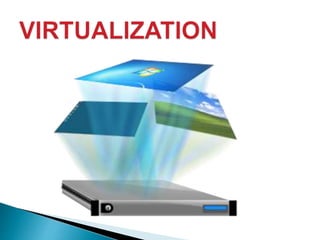
 Virtualization is one of the hardware reducing, cost
saving and energy saving technology that is rapidly
transforming the IT landscape and fundamentally
changing the way that people compute.
 With virtualization solutions you can reduce IT costs
while increasing the efficiency, utilization and
flexibility of their existing computer hardware.
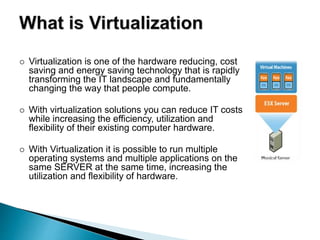
 With Virtualization it is possible to run multiple
operating systems and multiple applications on the
same SERVER at the same time, increasing the
utilization and flexibility of hardware.
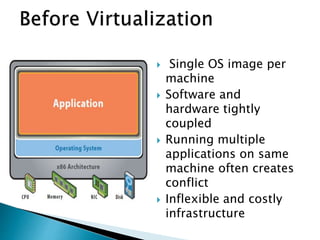
 Single OS image per
machine
 Software and
hardware tightly
coupled
 Running multiple
applications on same
machine often creates
conflict
 Inflexible and costly
infrastructure
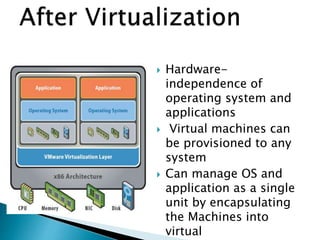
 Hardware-
independence of
operating system and
applications
 Virtual machines can
be provisioned to any
system
 Can manage OS and
application as a single
unit by encapsulating
the Machines into
virtual
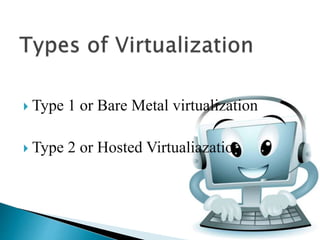
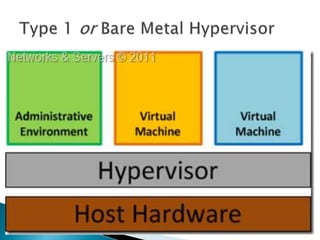
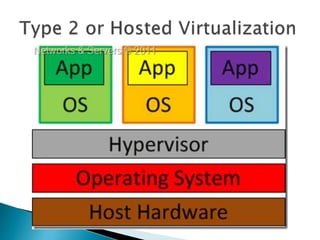
 Type 1 or Bare Metal virtualization
 Type 2 or Hosted Virtualiazation
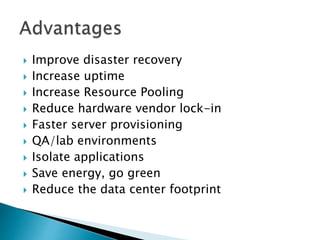
 Improve disaster recovery
 Increase uptime
 Increase Resource Pooling
 Reduce hardware vendor lock-in
 Faster server provisioning
 QA/lab environments
 Isolate applications
 Save energy, go green
 Reduce the data center footprint
 It is a paradigm in which information is
permanently stored in servers on the internet
and cached temporarily on clients that include
desktops,table computers,notebooks,Wall
computers,Handhelds entertainment centers
etc.
 It puts customers information and or
applications in a virtual “cloud” that can be
accessed through the web.
 Users do not have or need knowledge, control,
ownership in the computer infrastructure
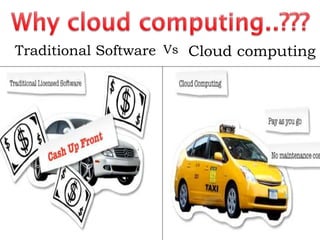
Traditional Software Cloud computingVs
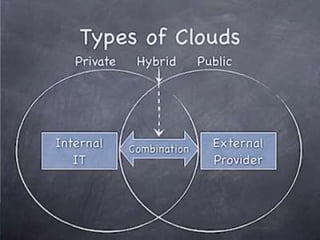
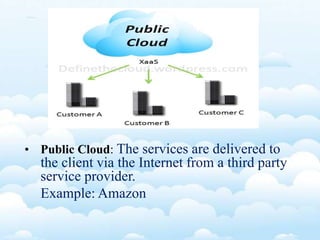
• Public Cloud: The services are delivered to
the client via the Internet from a third party
service provider.
Example: Amazon
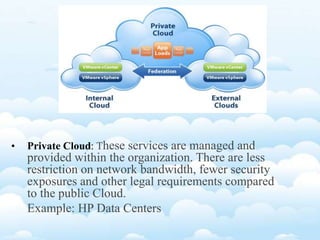
• Private Cloud: These services are managed and
provided within the organization. There are less
restriction on network bandwidth, fewer security
exposures and other legal requirements compared
to the public Cloud.
Example: HP Data Centers
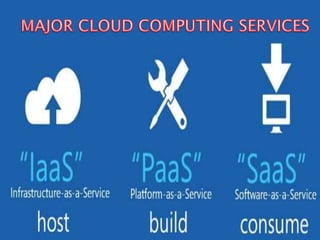
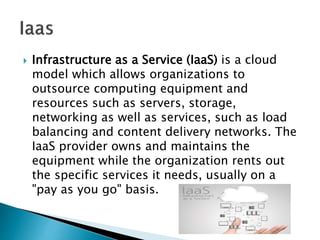
 Infrastructure as a Service (IaaS) is a cloud
model which allows organizations to
outsource computing equipment and
resources such as servers, storage,
networking as well as services, such as load
balancing and content delivery networks. The
IaaS provider owns and maintains the
equipment while the organization rents out
the specific services it needs, usually on a
"pay as you go" basis.
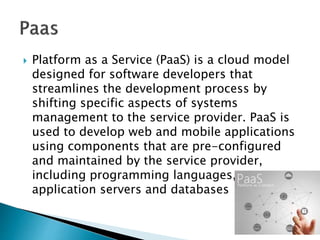
 Platform as a Service (PaaS) is a cloud model
designed for software developers that
streamlines the development process by
shifting specific aspects of systems
management to the service provider. PaaS is
used to develop web and mobile applications
using components that are pre-configured
and maintained by the service provider,
including programming languages,
application servers and databases
 Software as a Service (SaaS) is a cloud model
that delivers on-demand applications that are
hosted and managed by the service provider
and typically paid for on a subscription basis.
SaaS solutions offer a number of advantages
over on-premises deployments, including
minimal administration and maintenance,
anywhere access, and in many cases
improved communication and collaboration
 Hosted services are outsourced information
technology (IT) systems and functions. A
hosted service provider owns and oversees
infrastructure, software and administrative
tasks and makes the system available to
clients, usually over the Internet.
 Eg : gmail, google docs, quickbooks, skype,
Github etc
 On-demand self-service
 Broad network access
 Resource pooling
 Rapid elasticity
 Measured service
•Amazon
•Microsoft windows Azure
•Savvis
•Google App Engine
•Vmware cloud
•Rack space
•Go grid
CONCLUSION:
Finally ,cloud apps don’t eat up your valuable IT
resources
Thus cloud computing provide a super-computing power.
This cloud of computers extends beyond a single company or
enterprise.
The applications and data served by the cloud are available to
broad group of users, cross-enterprise and cross-platform
Virtualization & Cloud computing

Virtualization & Cloud computing

  • 1.
  • 3.
     Virtualization isone of the hardware reducing, cost saving and energy saving technology that is rapidly transforming the IT landscape and fundamentally changing the way that people compute.  With virtualization solutions you can reduce IT costs while increasing the efficiency, utilization and flexibility of their existing computer hardware.  With Virtualization it is possible to run multiple operating systems and multiple applications on the same SERVER at the same time, increasing the utilization and flexibility of hardware.
  • 4.
     Single OSimage per machine  Software and hardware tightly coupled  Running multiple applications on same machine often creates conflict  Inflexible and costly infrastructure
  • 5.
     Hardware- independence of operatingsystem and applications  Virtual machines can be provisioned to any system  Can manage OS and application as a single unit by encapsulating the Machines into virtual
  • 6.
     Type 1or Bare Metal virtualization  Type 2 or Hosted Virtualiazation
  • 9.
     Improve disasterrecovery  Increase uptime  Increase Resource Pooling  Reduce hardware vendor lock-in  Faster server provisioning  QA/lab environments  Isolate applications  Save energy, go green  Reduce the data center footprint
  • 12.
     It isa paradigm in which information is permanently stored in servers on the internet and cached temporarily on clients that include desktops,table computers,notebooks,Wall computers,Handhelds entertainment centers etc.  It puts customers information and or applications in a virtual “cloud” that can be accessed through the web.  Users do not have or need knowledge, control, ownership in the computer infrastructure
  • 13.
  • 15.
    • Public Cloud:The services are delivered to the client via the Internet from a third party service provider. Example: Amazon
  • 16.
    • Private Cloud:These services are managed and provided within the organization. There are less restriction on network bandwidth, fewer security exposures and other legal requirements compared to the public Cloud. Example: HP Data Centers
  • 18.
     Infrastructure asa Service (IaaS) is a cloud model which allows organizations to outsource computing equipment and resources such as servers, storage, networking as well as services, such as load balancing and content delivery networks. The IaaS provider owns and maintains the equipment while the organization rents out the specific services it needs, usually on a "pay as you go" basis.
  • 19.
     Platform asa Service (PaaS) is a cloud model designed for software developers that streamlines the development process by shifting specific aspects of systems management to the service provider. PaaS is used to develop web and mobile applications using components that are pre-configured and maintained by the service provider, including programming languages, application servers and databases
  • 20.
     Software asa Service (SaaS) is a cloud model that delivers on-demand applications that are hosted and managed by the service provider and typically paid for on a subscription basis. SaaS solutions offer a number of advantages over on-premises deployments, including minimal administration and maintenance, anywhere access, and in many cases improved communication and collaboration
  • 21.
     Hosted servicesare outsourced information technology (IT) systems and functions. A hosted service provider owns and oversees infrastructure, software and administrative tasks and makes the system available to clients, usually over the Internet.  Eg : gmail, google docs, quickbooks, skype, Github etc
  • 22.
     On-demand self-service Broad network access  Resource pooling  Rapid elasticity  Measured service
  • 23.
    •Amazon •Microsoft windows Azure •Savvis •GoogleApp Engine •Vmware cloud •Rack space •Go grid
  • 24.
    CONCLUSION: Finally ,cloud appsdon’t eat up your valuable IT resources Thus cloud computing provide a super-computing power. This cloud of computers extends beyond a single company or enterprise. The applications and data served by the cloud are available to broad group of users, cross-enterprise and cross-platform