U21Quiz_All
Lessons
Name: Mohamed Herms
Class: 3/2
What is Virtualization ?
virtualization is logically dividing a resource into multiple
components. One approach to this is through software used to
logically divide a computer or server into many virtual servers.
Virtualization components
1.Hardware:
A computer’s hardware is the physical components that make up
the computer system.
2.Software:
Software is the "brains" of our hardware, providing instructions
on how the hardware should operate.
Type 1 and Type 2 Hypervisor
Type 1 hypervisor :The Type 1 hypervisor sits directly between
the hardware and the virtual machine, which has its very own
operating system.
Examples: VMware ESXi & Microsoft Hyper-V
Type 2 hypervisor called a hosted hypervisor needs to be
installed on top of the
operating system.
Examples: Oracle VirtualBox & VMware Workstation Player
What is the cloud
The cloud is a way to use computing services over the Internet.
You've likely used it when searching online, streaming movies,
emailing, or sharing documents. Businesses and individuals use
the cloud to access applications, storage, and systems managed
by others, anytime and anywhere.
Why do we need server virtualization ?
Server virtualization offers significant benefits for organizations
by improving resource utilization, agility, disaster recovery, and
reducing costs and environmental impact.
Key Features of Cloud Computing:
Service-Based: Cloud services are easy to use and focus on
what the user needs, not how the technology works. They hide
complex details and work automatically.
Scalable and Elastic: These services can quickly adjust to the
user's needs, increasing or decreasing resources as required.
This flexibility is cost-effective and efficient.
Shared: Cloud services use shared resources to be more cost-
effective and efficient. Users benefit from shared infrastructure
and software but don't see the details.
Key Features of Cloud Computing:
Metered by Use: Users pay based on how much they use the
service. This can be through various plans like pay-as-you-go or
subscriptions, based on the service's usage.
Uses Internet Technologies: Cloud services are delivered using
common internet formats and protocols, like URLs and HTTP.
Examples include Google's Gmail and Amazon's online
shopping.
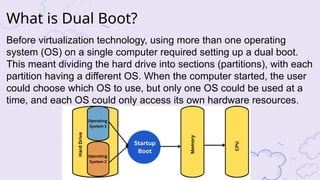
Before virtualization technology, using more than one operating
system (OS) on a single computer required setting up a dual boot.
This meant dividing the hard drive into sections (partitions), with each
partition having a different OS. When the computer started, the user
could choose which OS to use, but only one OS could be used at a
time, and each OS could only access its own hardware resources.
What is Dual Boot?
Data centers consume significant energy and generate e-waste.
Server virtualization offers a partial solution by consolidating
multiple physical servers onto fewer, more powerful machines.
This reduces overall energy consumption due to less hardware
requiring power and cooling. Additionally, it minimizes e-waste by
lowering the total number of servers needed.
Server virtualization is a valuable tool for reducing data center
pollution, but it's one piece of a broader sustainability puzzle.
Combining it with other eco-friendly practices is essential for a
greener future.
Virtualization reduces pollution
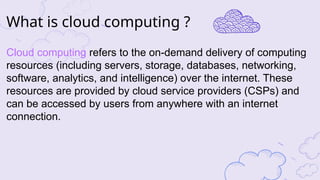
Cloud computing refers to the on-demand delivery of computing
resources (including servers, storage, databases, networking,
software, analytics, and intelligence) over the internet. These
resources are provided by cloud service providers (CSPs) and
can be accessed by users from anywhere with an internet
connection.
What is cloud computing ?
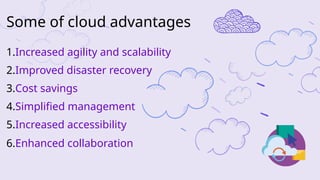
1.Increased agility and scalability
2.Improved disaster recovery
3.Cost savings
4.Simplified management
5.Increased accessibility
6.Enhanced collaboration
Some of cloud advantages
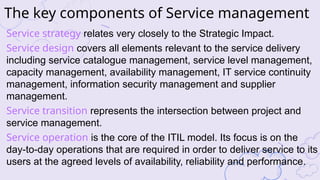
Service strategy relates very closely to the Strategic Impact.
Service design covers all elements relevant to the service delivery
including service catalogue management, service level management,
capacity management, availability management, IT service continuity
management, information security management and supplier
management.
Service transition represents the intersection between project and
service management.
Service operation is the core of the ITIL model. Its focus is on the
day-to-day operations that are required in order to deliver service to its
users at the agreed levels of availability, reliability and performance.
The key components of Service management
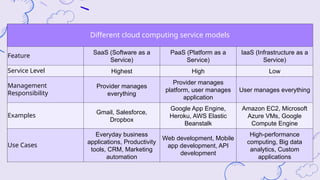
Different cloud computing service models
Feature
SaaS (Software as a
Service)
PaaS (Platform as a
Service)
IaaS (Infrastructure as a
Service)
Service Level Highest High Low
Management
Responsibility
Provider manages
everything
Provider manages
platform, user manages
application
User manages everything
Examples
Gmail, Salesforce,
Dropbox
Google App Engine,
Heroku, AWS Elastic
Beanstalk
Amazon EC2, Microsoft
Azure VMs, Google
Compute Engine
Use Cases
Everyday business
applications, Productivity
tools, CRM, Marketing
automation
Web development, Mobile
app development, API
development
High-performance
computing, Big data
analytics, Custom
applications
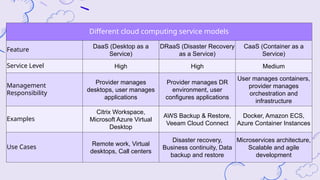
Different cloud computing service models
Feature
DaaS (Desktop as a
Service)
DRaaS (Disaster Recovery
as a Service)
CaaS (Container as a
Service)
Service Level High High Medium
Management
Responsibility
Provider manages
desktops, user manages
applications
Provider manages DR
environment, user
configures applications
User manages containers,
provider manages
orchestration and
infrastructure
Examples
Citrix Workspace,
Microsoft Azure Virtual
Desktop
AWS Backup & Restore,
Veeam Cloud Connect
Docker, Amazon ECS,
Azure Container Instances
Use Cases
Remote work, Virtual
desktops, Call centers
Disaster recovery,
Business continuity, Data
backup and restore
Microservices architecture,
Scalable and agile
development

U21Quiz_All Lessons_cloud-core-fundemntals.pptx

  • 1.
  • 2.
    What is Virtualization? virtualization is logically dividing a resource into multiple components. One approach to this is through software used to logically divide a computer or server into many virtual servers. Virtualization components 1.Hardware: A computer’s hardware is the physical components that make up the computer system. 2.Software: Software is the "brains" of our hardware, providing instructions on how the hardware should operate.
  • 3.
    Type 1 andType 2 Hypervisor Type 1 hypervisor :The Type 1 hypervisor sits directly between the hardware and the virtual machine, which has its very own operating system. Examples: VMware ESXi & Microsoft Hyper-V Type 2 hypervisor called a hosted hypervisor needs to be installed on top of the operating system. Examples: Oracle VirtualBox & VMware Workstation Player
  • 4.
    What is thecloud The cloud is a way to use computing services over the Internet. You've likely used it when searching online, streaming movies, emailing, or sharing documents. Businesses and individuals use the cloud to access applications, storage, and systems managed by others, anytime and anywhere.
  • 5.
    Why do weneed server virtualization ? Server virtualization offers significant benefits for organizations by improving resource utilization, agility, disaster recovery, and reducing costs and environmental impact.
  • 6.
    Key Features ofCloud Computing: Service-Based: Cloud services are easy to use and focus on what the user needs, not how the technology works. They hide complex details and work automatically. Scalable and Elastic: These services can quickly adjust to the user's needs, increasing or decreasing resources as required. This flexibility is cost-effective and efficient. Shared: Cloud services use shared resources to be more cost- effective and efficient. Users benefit from shared infrastructure and software but don't see the details.
  • 7.
    Key Features ofCloud Computing: Metered by Use: Users pay based on how much they use the service. This can be through various plans like pay-as-you-go or subscriptions, based on the service's usage. Uses Internet Technologies: Cloud services are delivered using common internet formats and protocols, like URLs and HTTP. Examples include Google's Gmail and Amazon's online shopping.
  • 8.
    Before virtualization technology,using more than one operating system (OS) on a single computer required setting up a dual boot. This meant dividing the hard drive into sections (partitions), with each partition having a different OS. When the computer started, the user could choose which OS to use, but only one OS could be used at a time, and each OS could only access its own hardware resources. What is Dual Boot?
  • 9.
    Data centers consumesignificant energy and generate e-waste. Server virtualization offers a partial solution by consolidating multiple physical servers onto fewer, more powerful machines. This reduces overall energy consumption due to less hardware requiring power and cooling. Additionally, it minimizes e-waste by lowering the total number of servers needed. Server virtualization is a valuable tool for reducing data center pollution, but it's one piece of a broader sustainability puzzle. Combining it with other eco-friendly practices is essential for a greener future. Virtualization reduces pollution
  • 10.
    Cloud computing refersto the on-demand delivery of computing resources (including servers, storage, databases, networking, software, analytics, and intelligence) over the internet. These resources are provided by cloud service providers (CSPs) and can be accessed by users from anywhere with an internet connection. What is cloud computing ?
  • 11.
    1.Increased agility andscalability 2.Improved disaster recovery 3.Cost savings 4.Simplified management 5.Increased accessibility 6.Enhanced collaboration Some of cloud advantages
  • 12.
    Service strategy relatesvery closely to the Strategic Impact. Service design covers all elements relevant to the service delivery including service catalogue management, service level management, capacity management, availability management, IT service continuity management, information security management and supplier management. Service transition represents the intersection between project and service management. Service operation is the core of the ITIL model. Its focus is on the day-to-day operations that are required in order to deliver service to its users at the agreed levels of availability, reliability and performance. The key components of Service management
  • 13.
    Different cloud computingservice models Feature SaaS (Software as a Service) PaaS (Platform as a Service) IaaS (Infrastructure as a Service) Service Level Highest High Low Management Responsibility Provider manages everything Provider manages platform, user manages application User manages everything Examples Gmail, Salesforce, Dropbox Google App Engine, Heroku, AWS Elastic Beanstalk Amazon EC2, Microsoft Azure VMs, Google Compute Engine Use Cases Everyday business applications, Productivity tools, CRM, Marketing automation Web development, Mobile app development, API development High-performance computing, Big data analytics, Custom applications
  • 14.
    Different cloud computingservice models Feature DaaS (Desktop as a Service) DRaaS (Disaster Recovery as a Service) CaaS (Container as a Service) Service Level High High Medium Management Responsibility Provider manages desktops, user manages applications Provider manages DR environment, user configures applications User manages containers, provider manages orchestration and infrastructure Examples Citrix Workspace, Microsoft Azure Virtual Desktop AWS Backup & Restore, Veeam Cloud Connect Docker, Amazon ECS, Azure Container Instances Use Cases Remote work, Virtual desktops, Call centers Disaster recovery, Business continuity, Data backup and restore Microservices architecture, Scalable and agile development