VIRTUAL PRIVATE NETWORKS (VPN)
Name = Aviansh nath
B.tech – 2 year ( I T )
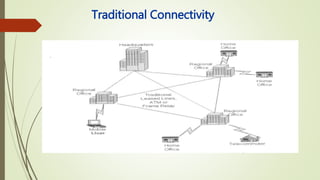
Traditional Connectivity
1. Virtual Private Network is a type of private network that
uses public telecommunication, such as the Internet,
instead of leased lines to communicate.
2. Became popular as more employees worked in remote
locations.
3. Terminologies to understand how VPNs work.
What is VPN?
Who uses VPN ?
 VPN’s can be found in homes, workplaces, or anywhere
else as long as an ISP (Internet Service Provider) is
available.
 VPN’s allow company employees who travel often or
who are outside their company headquarters to safely
and securely connect to their company’s Intranet
Private Networks
vs.
Virtual Private Networks
1. Employees can access the network (Intranet) from
remote locations.
2. Secured networks.
3. The Internet is used as the backbone for VPNs
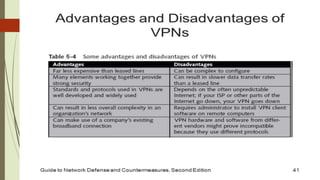
4. Saves cost tremendously from reduction of equipment
and maintenance costs.
5. Scalability
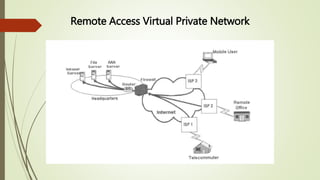
Remote Access Virtual Private Network
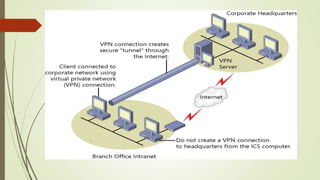
1. Two connections – one is made to the Internet and the
second is made to the VPN.
2. Datagrams – contains data, destination and source
information.
3. Firewalls – VPNs allow authorized users to pass through
the firewalls.
4. Protocols – protocols create the VPN tunnels.
Brief Overview of How it Works
1. Authentication – validates that the data was sent
from the sender.
2. Access control – limiting unauthorized users from
accessing the network.
3. Confidentiality – preventing the data to be read or
copied as the data is being transported.
4. Data Integrity – ensuring that the data has not been
altered
Four Critical Functions
Encryption
Encryption -- is a method of “scrambling” data
before transmitting it onto the Internet.
Public Key Encryption Technique
Digital signature – for authentication
Tunneling
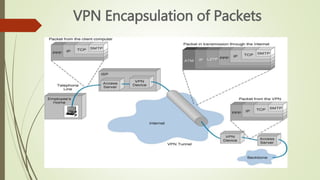
A virtual point-to-point connection
made through a public network. It transports
encapsulated datagrams.
Two types of end points:
 Remote Access
 Site-to-Site
In information technology, a protocol is the special set of rules that end points in a
telecommunication connection use when they communicate. Protocols specify
interactions between the communicating entities.
Protocols exist at several levels in a telecommunication connection. For example, there
are protocols for the data interchange at the hardware device level and protocols for data
interchange at the application program level.
What is protocol ?
The TCP/IP Internet protocols, a common example, consist of:
• Transmission Control Protocol (TCP), which uses a set of rules to
exchange messages with other Internet points at the information packet
level
• Internet Protocol (IP), which uses a set of rules to send and receive
messages at the Internet address level
• Additional protocols that include the Hypertext Transfer Protocol (HTTP)
and File Transfer Protocol (FTP), each with defined sets of rules to use with
corresponding programs elsewhere on the Internet
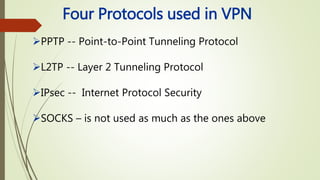
Four Protocols used in VPN
PPTP -- Point-to-Point Tunneling Protocol
L2TP -- Layer 2 Tunneling Protocol
IPsec -- Internet Protocol Security
SOCKS – is not used as much as the ones above
VPN Encapsulation of Packets
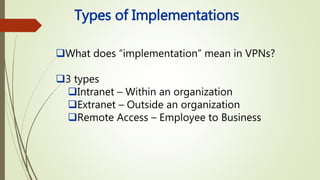
Types of Implementations
What does “implementation” mean in VPNs?
3 types
Intranet – Within an organization
Extranet – Outside an organization
Remote Access – Employee to Business
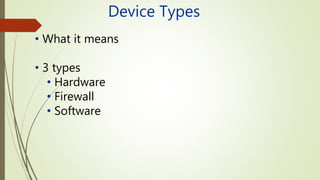
Device Types
• What it means
• 3 types
• Hardware
• Firewall
• Software
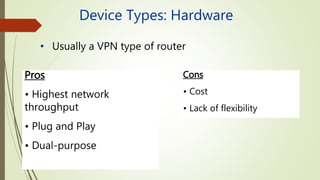
Device Types: Hardware
• Usually a VPN type of router
Pros
• Highest network
throughput
• Plug and Play
• Dual-purpose
Cons
• Cost
• Lack of flexibility
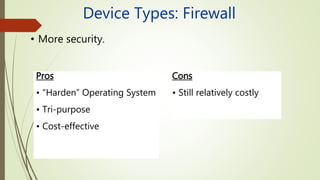
Device Types: Firewall
• More security.
Pros
• “Harden” Operating System
• Tri-purpose
• Cost-effective
Cons
• Still relatively costly
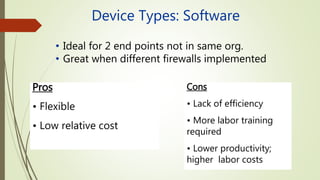
Device Types: Software
• Ideal for 2 end points not in same org.
• Great when different firewalls implemented
Pros
• Flexible
• Low relative cost
Cons
• Lack of efficiency
• More labor training
required
• Lower productivity;
higher labor costs
Virtual private networks (vpn)

Virtual private networks (vpn)

  • 1.
    VIRTUAL PRIVATE NETWORKS(VPN) Name = Aviansh nath B.tech – 2 year ( I T )
  • 2.
  • 3.
    1. Virtual PrivateNetwork is a type of private network that uses public telecommunication, such as the Internet, instead of leased lines to communicate. 2. Became popular as more employees worked in remote locations. 3. Terminologies to understand how VPNs work. What is VPN?
  • 4.
    Who uses VPN?  VPN’s can be found in homes, workplaces, or anywhere else as long as an ISP (Internet Service Provider) is available.  VPN’s allow company employees who travel often or who are outside their company headquarters to safely and securely connect to their company’s Intranet
  • 5.
    Private Networks vs. Virtual PrivateNetworks 1. Employees can access the network (Intranet) from remote locations. 2. Secured networks. 3. The Internet is used as the backbone for VPNs 4. Saves cost tremendously from reduction of equipment and maintenance costs. 5. Scalability
  • 6.
    Remote Access VirtualPrivate Network
  • 7.
    1. Two connections– one is made to the Internet and the second is made to the VPN. 2. Datagrams – contains data, destination and source information. 3. Firewalls – VPNs allow authorized users to pass through the firewalls. 4. Protocols – protocols create the VPN tunnels. Brief Overview of How it Works
  • 8.
    1. Authentication –validates that the data was sent from the sender. 2. Access control – limiting unauthorized users from accessing the network. 3. Confidentiality – preventing the data to be read or copied as the data is being transported. 4. Data Integrity – ensuring that the data has not been altered Four Critical Functions
  • 9.
    Encryption Encryption -- isa method of “scrambling” data before transmitting it onto the Internet. Public Key Encryption Technique Digital signature – for authentication
  • 10.
    Tunneling A virtual point-to-pointconnection made through a public network. It transports encapsulated datagrams. Two types of end points:  Remote Access  Site-to-Site
  • 12.
    In information technology,a protocol is the special set of rules that end points in a telecommunication connection use when they communicate. Protocols specify interactions between the communicating entities. Protocols exist at several levels in a telecommunication connection. For example, there are protocols for the data interchange at the hardware device level and protocols for data interchange at the application program level. What is protocol ? The TCP/IP Internet protocols, a common example, consist of: • Transmission Control Protocol (TCP), which uses a set of rules to exchange messages with other Internet points at the information packet level • Internet Protocol (IP), which uses a set of rules to send and receive messages at the Internet address level • Additional protocols that include the Hypertext Transfer Protocol (HTTP) and File Transfer Protocol (FTP), each with defined sets of rules to use with corresponding programs elsewhere on the Internet
  • 13.
    Four Protocols usedin VPN PPTP -- Point-to-Point Tunneling Protocol L2TP -- Layer 2 Tunneling Protocol IPsec -- Internet Protocol Security SOCKS – is not used as much as the ones above
  • 14.
  • 15.
    Types of Implementations Whatdoes “implementation” mean in VPNs? 3 types Intranet – Within an organization Extranet – Outside an organization Remote Access – Employee to Business
  • 16.
    Device Types • Whatit means • 3 types • Hardware • Firewall • Software
  • 17.
    Device Types: Hardware •Usually a VPN type of router Pros • Highest network throughput • Plug and Play • Dual-purpose Cons • Cost • Lack of flexibility
  • 18.
    Device Types: Firewall •More security. Pros • “Harden” Operating System • Tri-purpose • Cost-effective Cons • Still relatively costly
  • 19.
    Device Types: Software •Ideal for 2 end points not in same org. • Great when different firewalls implemented Pros • Flexible • Low relative cost Cons • Lack of efficiency • More labor training required • Lower productivity; higher labor costs