GCC
RTL & MACHINE DESCRIPTION
By Priyatham Bollimpalli
Little review of basics
What are the stages of a compiler?
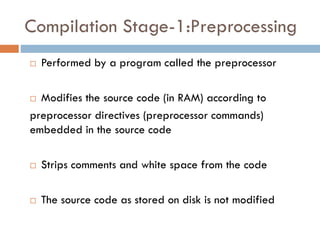
Compilation Stage-1:Preprocessing
 Performed by a program called the preprocessor
 Modifies the source code (in RAM) according to
preprocessor directives (preprocessor commands)
embedded in the source code
 Strips comments and white space from the code
 The source code as stored on disk is not modified
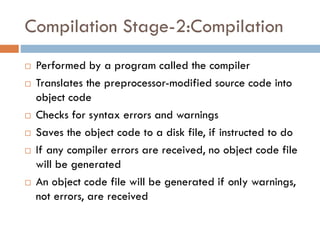
Compilation Stage-2:Compilation
 Performed by a program called the compiler
 Translates the preprocessor-modified source code into
object code
 Checks for syntax errors and warnings
 Saves the object code to a disk file, if instructed to do
 If any compiler errors are received, no object code file
will be generated
 An object code file will be generated if only warnings,
not errors, are received
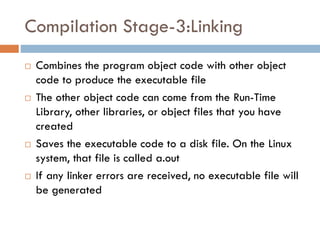
Compilation Stage-3:Linking
 Combines the program object code with other object
code to produce the executable file
 The other object code can come from the Run-Time
Library, other libraries, or object files that you have
created
 Saves the executable code to a disk file. On the Linux
system, that file is called a.out
 If any linker errors are received, no executable file will
be generated
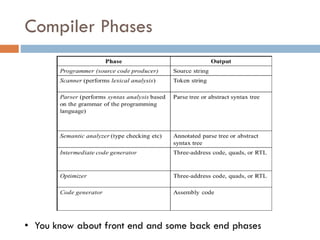
Compiler Phases
• You know about front end and some back end phases
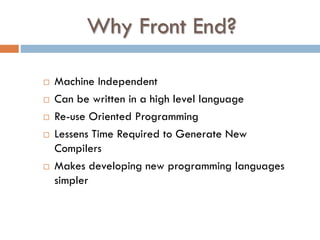
Why Front End?
 Machine Independent
 Can be written in a high level language
 Re-use Oriented Programming
 Lessens Time Required to Generate New
Compilers
 Makes developing new programming languages
simpler
After Front End?
 All language compilers
 Read source code
 Output assembly code
 Language compilers have different front ends
 Each front end parses input and produces an
abstract syntax tree
 AST is converted to a common middle-end format
 GENERIC or GIMPLE
 Next these are converted to RTL (Register Transfer
Language)
“Middle-End”
 GENERIC is an intermediate representation
language used as a "middle-end" while
compiling source code into executable binaries.
 A subset, called GIMPLE, is targeted by all the
front-ends of GCC
 The middle stage of GCC does all the code
analysis and optimization, working
independently of both the compiled language
and the target architecture, starting from the
GENERIC representation and expanding it to
Register Transfer Language.
Why “Middle-End”?
 In transforming the source code to GIMPLE,
complex expressions are split into a three
address code using temporary variables
 This is for simplifying the analysis and
optimization of imperative programs
 In GCC, RTL is generated from the GIMPLE
representation
 Important to know about RTL to get an idea of
how assembly code is generated from RTL with
the help of templates
RTL
 Register transfer language (RTL) : A Scheme-like
language based on virtual registers
 Sometimes, initial RTL is generated with hints
about the target machine
 RTL is refined through many (58) passes. Details at
http://gcc.gnu.org/onlinedocs/gccint/RTL-passes.html
 Final passes use target machine registers and
instructions
 From there, conversion to machine-specific
assembly language is very easy
An Example
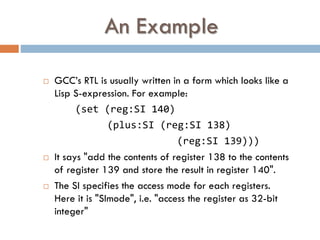
 GCC’s RTL is usually written in a form which looks like a
Lisp S-expression. For example:
(set (reg:SI 140)
(plus:SI (reg:SI 138)
(reg:SI 139)))
 It says "add the contents of register 138 to the contents
of register 139 and store the result in register 140".
 The SI specifies the access mode for each registers.
Here it is "SImode", i.e. "access the register as 32-bit
integer"
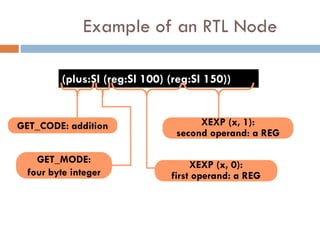
Example of an RTL Node
(plus:SI (reg:SI 100) (reg:SI 150))
GET_CODE: addition
GET_MODE:
four byte integer
XEXP (x, 0):
first operand: a REG
XEXP (x, 1):
second operand: a REG
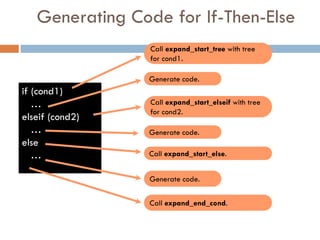
Generating Code for If-Then-Else
if (cond1)
…
elseif (cond2)
…
else
…
Call expand_start_tree with tree
for cond1.
Generate code.
Call expand_start_elseif with tree
for cond2.
Generate code.
Call expand_start_else.
Generate code.
Call expand_end_cond.
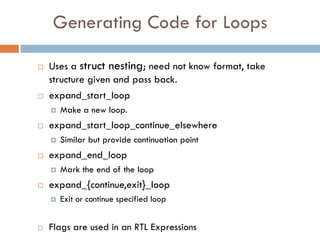
Generating Code for Loops
 Uses a struct nesting; need not know format, take
structure given and pass back.
 expand_start_loop
 Make a new loop.
 expand_start_loop_continue_elsewhere
 Similar but provide continuation point
 expand_end_loop
 Mark the end of the loop
 expand_{continue,exit}_loop
 Exit or continue specified loop
 Flags are used in an RTL Expressions
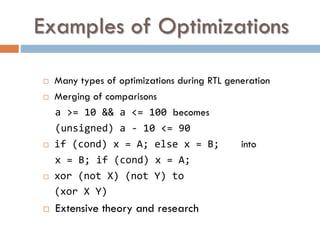
Examples of Optimizations
 Many types of optimizations during RTL generation
 Merging of comparisons
a >= 10 && a <= 100 becomes
(unsigned) a - 10 <= 90
 if (cond) x = A; else x = B; into
x = B; if (cond) x = A;
 xor (not X) (not Y) to
(xor X Y)
 Extensive theory and research
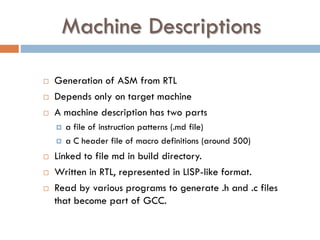
Machine Descriptions
 Generation of ASM from RTL
 Depends only on target machine
 A machine description has two parts
 a file of instruction patterns (.md file)
 a C header file of macro definitions (around 500)
 Linked to file md in build directory.
 Written in RTL, represented in LISP-like format.
 Read by various programs to generate .h and .c files
that become part of GCC.
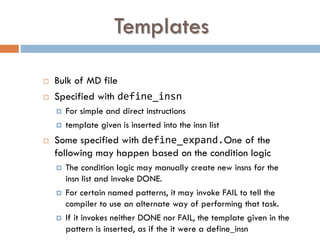
Templates
 Bulk of MD file
 Specified with define_insn
 For simple and direct instructions
 template given is inserted into the insn list
 Some specified with define_expand.One of the
following may happen based on the condition logic
 The condition logic may manually create new insns for the
insn list and invoke DONE.
 For certain named patterns, it may invoke FAIL to tell the
compiler to use an alternate way of performing that task.
 If it invokes neither DONE nor FAIL, the template given in the
pattern is inserted, as if the it were a define_insn
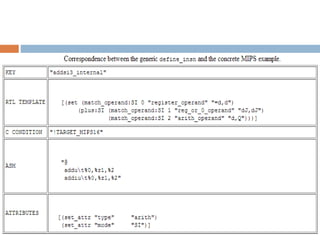
define_insn
(define_insn "addsi3_internal"
[(set (match_operand:SI 0 "register_operand"
"=d,d")(plus:SI (match_operand:SI 1 "reg_or_0_operand"
"dJ,dJ")(match_operand:SI 2 "arith_operand" "d,Q")))]
"!TARGET_MIPS16"
"@
addut%0,%z1,%2
addiut%0,%z1,%2"
[(set_attr "type" "arith")
(set_attr "mode" "SI")] )
Syntax
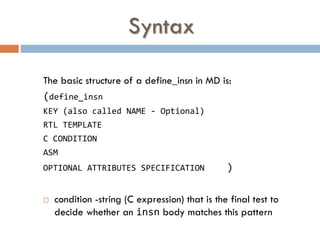
The basic structure of a define_insn in MD is:
(define_insn
KEY (also called NAME - Optional)
RTL TEMPLATE
C CONDITION
ASM
OPTIONAL ATTRIBUTES SPECIFICATION )
 condition -string (C expression) that is the final test to
decide whether an insn body matches this pattern
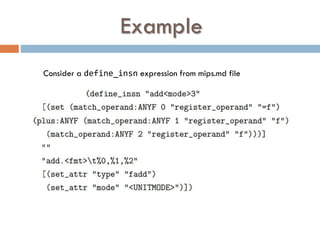
Example
Consider a define_insn expression from mips.md file
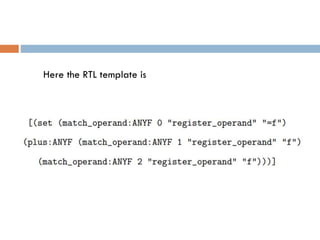
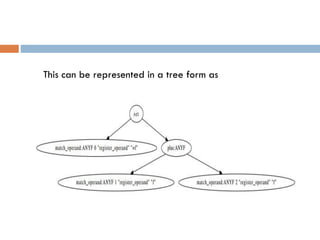
Here the RTL template is
This can be represented in a tree form as
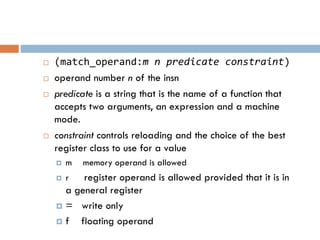
 (match_operand:m n predicate constraint)
 operand number n of the insn
 predicate is a string that is the name of a function that
accepts two arguments, an expression and a machine
mode.
 constraint controls reloading and the choice of the best
register class to use for a value
 m memory operand is allowed
 r register operand is allowed provided that it is in
a general register
 = write only
 f floating operand
Another Example
 (define_insn "tstsi"
[(set (cc0)
(match_operand:SI 0 "general_operand" "rm"))]
""
{
if (TARGET_68020 || !ADDRESS_REG_P (operands[0]))
return "tstl %0";
return "cmpl #0,%0";
})
 Sets the condition codes based on the value of a general operand.
 The name `tstsi' means "test a SImode value" - when it is necessary to test
such a value, an insn to do so can be constructed using this pattern.
 Based on the kind of operand and the specific type of CPU for which
code is being generated, Output is generated.
 (define_insn "addsi3"
[(set (match_operand:SI 0 "general_operand" "=r,m")
(plus:SI (match_operand:SI 1 "general_operand" "0,0")
(match_operand:SI 2 "general_operand" "g,r")))]
""
"@
addr %2,%0
addm %2,%0")
 What deos it do?
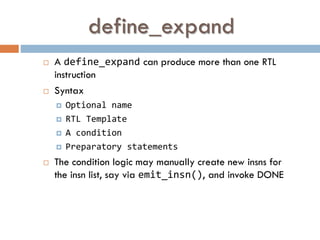
define_expand
 A define_expand can produce more than one RTL
instruction
 Syntax
 Optional name
 RTL Template
 A condition
 Preparatory statements
 The condition logic may manually create new insns for
the insn list, say via emit_insn(), and invoke DONE
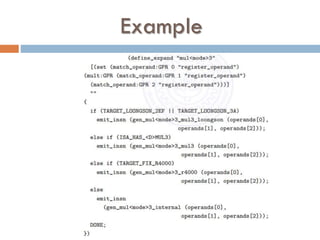
Example
Jump Instructions
 The machine description should define a single pattern,
usually a define_expand, which expands to all the
required insns.
 Usually, this would be a comparison insn to set the
condition code and a separate branch insn testing the
condition code and branching or not according to its
value. For many machines, however, separating
compares and branches is limiting
 So define_expand is used in GCC
 Widely used in conditional and looping constructs
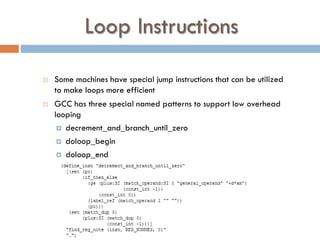
Loop Instructions
 Some machines have special jump instructions that can be utilized
to make loops more efficient
 GCC has three special named patterns to support low overhead
looping
 decrement_and_branch_until_zero
 doloop_begin
 doloop_end
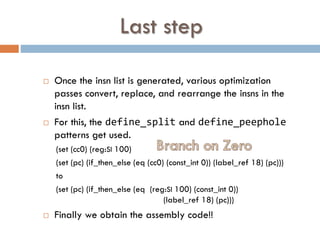
Last step
 Once the insn list is generated, various optimization
passes convert, replace, and rearrange the insns in the
insn list.
 For this, the define_split and define_peephole
patterns get used.
(set (cc0) (reg:SI 100)
(set (pc) (if_then_else (eq (cc0) (const_int 0)) (label_ref 18) (pc)))
to
(set (pc) (if_then_else (eq (reg:SI 100) (const_int 0))
(label_ref 18) (pc)))
 Finally we obtain the assembly code!!
Facts
 This is just a tiny whisk of hair on tip of the iceberg. The
GCC documentation is huge!!
Size of GCC
 Machine Descriptions : 421,741 lines
 *.md: 155,244
 *.h: 135,778
 *.c: 126,872
 Makefile insertions: 3,847
 Distributed front ends: 357,744 lines
 Base compiler: 328,297 lines
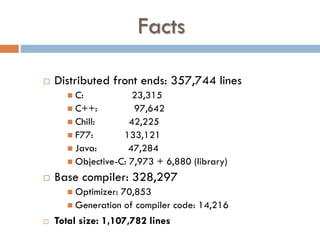
Facts
 Distributed front ends: 357,744 lines
 C: 23,315
 C++: 97,642
 Chill: 42,225
 F77: 133,121
 Java: 47,284
 Objective-C: 7,973 + 6,880 (library)
 Base compiler: 328,297
 Optimizer: 70,853
 Generation of compiler code: 14,216
 Total size: 1,107,782 lines
References
 http://www.wikipedia.org/
 http://gcc.gnu.org/onlinedocs/gccint/
 http://www.gnat.com/~kenner/gcctut.ppt
 http://www.cse.iitb.ac.in/~uday/
GCC RTL and Machine Description

GCC RTL and Machine Description

  • 1.
    GCC RTL & MACHINEDESCRIPTION By Priyatham Bollimpalli
  • 2.
    Little review ofbasics What are the stages of a compiler?
  • 3.
    Compilation Stage-1:Preprocessing  Performedby a program called the preprocessor  Modifies the source code (in RAM) according to preprocessor directives (preprocessor commands) embedded in the source code  Strips comments and white space from the code  The source code as stored on disk is not modified
  • 4.
    Compilation Stage-2:Compilation  Performedby a program called the compiler  Translates the preprocessor-modified source code into object code  Checks for syntax errors and warnings  Saves the object code to a disk file, if instructed to do  If any compiler errors are received, no object code file will be generated  An object code file will be generated if only warnings, not errors, are received
  • 5.
    Compilation Stage-3:Linking  Combinesthe program object code with other object code to produce the executable file  The other object code can come from the Run-Time Library, other libraries, or object files that you have created  Saves the executable code to a disk file. On the Linux system, that file is called a.out  If any linker errors are received, no executable file will be generated
  • 6.
    Compiler Phases • Youknow about front end and some back end phases
  • 7.
    Why Front End? Machine Independent  Can be written in a high level language  Re-use Oriented Programming  Lessens Time Required to Generate New Compilers  Makes developing new programming languages simpler
  • 8.
    After Front End? All language compilers  Read source code  Output assembly code  Language compilers have different front ends  Each front end parses input and produces an abstract syntax tree  AST is converted to a common middle-end format  GENERIC or GIMPLE  Next these are converted to RTL (Register Transfer Language)
  • 9.
    “Middle-End”  GENERIC isan intermediate representation language used as a "middle-end" while compiling source code into executable binaries.  A subset, called GIMPLE, is targeted by all the front-ends of GCC  The middle stage of GCC does all the code analysis and optimization, working independently of both the compiled language and the target architecture, starting from the GENERIC representation and expanding it to Register Transfer Language.
  • 10.
    Why “Middle-End”?  Intransforming the source code to GIMPLE, complex expressions are split into a three address code using temporary variables  This is for simplifying the analysis and optimization of imperative programs  In GCC, RTL is generated from the GIMPLE representation  Important to know about RTL to get an idea of how assembly code is generated from RTL with the help of templates
  • 11.
    RTL  Register transferlanguage (RTL) : A Scheme-like language based on virtual registers  Sometimes, initial RTL is generated with hints about the target machine  RTL is refined through many (58) passes. Details at http://gcc.gnu.org/onlinedocs/gccint/RTL-passes.html  Final passes use target machine registers and instructions  From there, conversion to machine-specific assembly language is very easy
  • 12.
    An Example  GCC’sRTL is usually written in a form which looks like a Lisp S-expression. For example: (set (reg:SI 140) (plus:SI (reg:SI 138) (reg:SI 139)))  It says "add the contents of register 138 to the contents of register 139 and store the result in register 140".  The SI specifies the access mode for each registers. Here it is "SImode", i.e. "access the register as 32-bit integer"
  • 13.
    Example of anRTL Node (plus:SI (reg:SI 100) (reg:SI 150)) GET_CODE: addition GET_MODE: four byte integer XEXP (x, 0): first operand: a REG XEXP (x, 1): second operand: a REG
  • 14.
    Generating Code forIf-Then-Else if (cond1) … elseif (cond2) … else … Call expand_start_tree with tree for cond1. Generate code. Call expand_start_elseif with tree for cond2. Generate code. Call expand_start_else. Generate code. Call expand_end_cond.
  • 15.
    Generating Code forLoops  Uses a struct nesting; need not know format, take structure given and pass back.  expand_start_loop  Make a new loop.  expand_start_loop_continue_elsewhere  Similar but provide continuation point  expand_end_loop  Mark the end of the loop  expand_{continue,exit}_loop  Exit or continue specified loop  Flags are used in an RTL Expressions
  • 16.
    Examples of Optimizations Many types of optimizations during RTL generation  Merging of comparisons a >= 10 && a <= 100 becomes (unsigned) a - 10 <= 90  if (cond) x = A; else x = B; into x = B; if (cond) x = A;  xor (not X) (not Y) to (xor X Y)  Extensive theory and research
  • 17.
    Machine Descriptions  Generationof ASM from RTL  Depends only on target machine  A machine description has two parts  a file of instruction patterns (.md file)  a C header file of macro definitions (around 500)  Linked to file md in build directory.  Written in RTL, represented in LISP-like format.  Read by various programs to generate .h and .c files that become part of GCC.
  • 18.
    Templates  Bulk ofMD file  Specified with define_insn  For simple and direct instructions  template given is inserted into the insn list  Some specified with define_expand.One of the following may happen based on the condition logic  The condition logic may manually create new insns for the insn list and invoke DONE.  For certain named patterns, it may invoke FAIL to tell the compiler to use an alternate way of performing that task.  If it invokes neither DONE nor FAIL, the template given in the pattern is inserted, as if the it were a define_insn
  • 19.
    define_insn (define_insn "addsi3_internal" [(set (match_operand:SI0 "register_operand" "=d,d")(plus:SI (match_operand:SI 1 "reg_or_0_operand" "dJ,dJ")(match_operand:SI 2 "arith_operand" "d,Q")))] "!TARGET_MIPS16" "@ addut%0,%z1,%2 addiut%0,%z1,%2" [(set_attr "type" "arith") (set_attr "mode" "SI")] )
  • 20.
    Syntax The basic structureof a define_insn in MD is: (define_insn KEY (also called NAME - Optional) RTL TEMPLATE C CONDITION ASM OPTIONAL ATTRIBUTES SPECIFICATION )  condition -string (C expression) that is the final test to decide whether an insn body matches this pattern
  • 22.
    Example Consider a define_insnexpression from mips.md file
  • 23.
    Here the RTLtemplate is
  • 24.
    This can berepresented in a tree form as
  • 25.
     (match_operand:m npredicate constraint)  operand number n of the insn  predicate is a string that is the name of a function that accepts two arguments, an expression and a machine mode.  constraint controls reloading and the choice of the best register class to use for a value  m memory operand is allowed  r register operand is allowed provided that it is in a general register  = write only  f floating operand
  • 26.
    Another Example  (define_insn"tstsi" [(set (cc0) (match_operand:SI 0 "general_operand" "rm"))] "" { if (TARGET_68020 || !ADDRESS_REG_P (operands[0])) return "tstl %0"; return "cmpl #0,%0"; })  Sets the condition codes based on the value of a general operand.  The name `tstsi' means "test a SImode value" - when it is necessary to test such a value, an insn to do so can be constructed using this pattern.  Based on the kind of operand and the specific type of CPU for which code is being generated, Output is generated.
  • 27.
     (define_insn "addsi3" [(set(match_operand:SI 0 "general_operand" "=r,m") (plus:SI (match_operand:SI 1 "general_operand" "0,0") (match_operand:SI 2 "general_operand" "g,r")))] "" "@ addr %2,%0 addm %2,%0")  What deos it do?
  • 28.
    define_expand  A define_expandcan produce more than one RTL instruction  Syntax  Optional name  RTL Template  A condition  Preparatory statements  The condition logic may manually create new insns for the insn list, say via emit_insn(), and invoke DONE
  • 29.
  • 30.
    Jump Instructions  Themachine description should define a single pattern, usually a define_expand, which expands to all the required insns.  Usually, this would be a comparison insn to set the condition code and a separate branch insn testing the condition code and branching or not according to its value. For many machines, however, separating compares and branches is limiting  So define_expand is used in GCC  Widely used in conditional and looping constructs
  • 31.
    Loop Instructions  Somemachines have special jump instructions that can be utilized to make loops more efficient  GCC has three special named patterns to support low overhead looping  decrement_and_branch_until_zero  doloop_begin  doloop_end
  • 32.
    Last step  Oncethe insn list is generated, various optimization passes convert, replace, and rearrange the insns in the insn list.  For this, the define_split and define_peephole patterns get used. (set (cc0) (reg:SI 100) (set (pc) (if_then_else (eq (cc0) (const_int 0)) (label_ref 18) (pc))) to (set (pc) (if_then_else (eq (reg:SI 100) (const_int 0)) (label_ref 18) (pc)))  Finally we obtain the assembly code!!
  • 33.
    Facts  This isjust a tiny whisk of hair on tip of the iceberg. The GCC documentation is huge!! Size of GCC  Machine Descriptions : 421,741 lines  *.md: 155,244  *.h: 135,778  *.c: 126,872  Makefile insertions: 3,847  Distributed front ends: 357,744 lines  Base compiler: 328,297 lines
  • 34.
    Facts  Distributed frontends: 357,744 lines  C: 23,315  C++: 97,642  Chill: 42,225  F77: 133,121  Java: 47,284  Objective-C: 7,973 + 6,880 (library)  Base compiler: 328,297  Optimizer: 70,853  Generation of compiler code: 14,216  Total size: 1,107,782 lines
  • 35.
    References  http://www.wikipedia.org/  http://gcc.gnu.org/onlinedocs/gccint/ http://www.gnat.com/~kenner/gcctut.ppt  http://www.cse.iitb.ac.in/~uday/