Virtual Organisations
Ligo Koshy, Assistant Professor,
MACFAST
Virtual Organisation(VO)- Meaning
• Virtual organization (VO) can be defined as a temporary
network of goal-oriented enterprise composed of multiple
members (independent companies, suppliers, employees
etc.) who reside in geographically dispersed locations and use
ICT (information and Communication Technology) technology
to communicate and coordinate the fulfilment of a defined
objective or task.
• Its goal is to deliver highest-quality product at the lowest
possible cost in a timely manner.
• Eg: Amazon, Nike, Dell, Wikipedia
Ligo Koshy, Assistant Professor, MACFAST
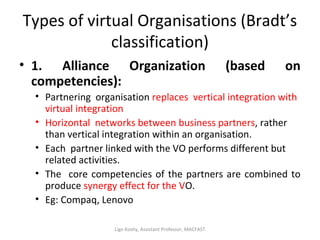
Core Competence A
Core Competence B
Core Competence Core Competence
Core Competence
Core Competence
Alliance Partner 1
Alliance Partner 3 Alliance Partner 4
Lead Corporation
Alliance Partner 2
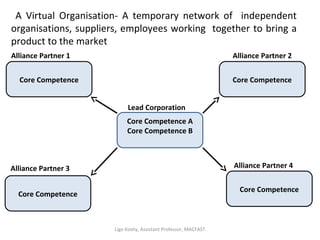
A Virtual Organisation- A temporary network of independent
organisations, suppliers, employees working together to bring a
product to the market
Ligo Koshy, Assistant Professor, MACFAST
Features of Virtual Organisation
Small Sized Partners
Extensive use of Information and Communication Technology
Virtual Organisation Has Its Own Identity
No Organizational Chart
Semi-Stable Relations
Dependent On Opportunism
Based On Trust
Shared Ownership
Shared Leadership and Loyalty
Geographically Dispersed
Customer Based and Mass Customization
Flexibility and Quick Response
Ligo Koshy, Assistant Professor, MACFAST
Differences between Traditional
Virtual Organisation
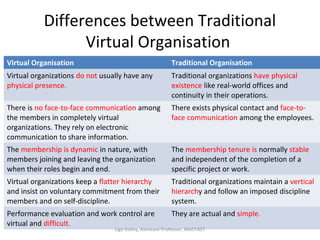
Virtual Organisation Traditional Organisation
Virtual organizations do not usually have any
physical presence.
Traditional organizations have physical
existence like real-world offices and
continuity in their operations.
There is no face-to-face communication among
the members in completely virtual
organizations. They rely on electronic
communication to share information.
There exists physical contact and face-to-
face communication among the employees.
The membership is dynamic in nature, with
members joining and leaving the organization
when their roles begin and end.
The membership tenure is normally stable
and independent of the completion of a
specific project or work.
Virtual organizations keep a flatter hierarchy
and insist on voluntary commitment from their
members and on self-discipline.
Traditional organizations maintain a vertical
hierarchy and follow an imposed discipline
system.
Performance evaluation and work control are
virtual and difficult.
They are actual and simple.
Ligo Koshy, Assistant Professor, MACFAST
Differences between Traditional
Virtual Organisation
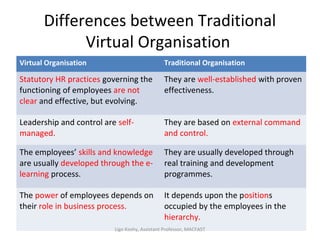
Virtual Organisation Traditional Organisation
Statutory HR practices governing the
functioning of employees are not
clear and effective, but evolving.
They are well-established with proven
effectiveness.
Leadership and control are self-
managed.
They are based on external command
and control.
The employees’ skills and knowledge
are usually developed through the e-
learning process.
They are usually developed through
real training and development
programmes.
The power of employees depends on
their role in business process.
It depends upon the positions
occupied by the employees in the
hierarchy.
Ligo Koshy, Assistant Professor, MACFAST
Type of virtual Organisations (Bradt’s
classification)
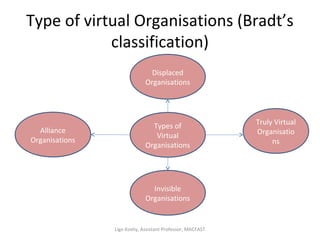
Types of
Virtual
Organisations
Truly Virtual
Organisatio
ns
Invisible
Organisations
Displaced
Organisations
Alliance
Organisations
Ligo Koshy, Assistant Professor, MACFAST
Types of virtual Organisations (Bradt’s
classification)
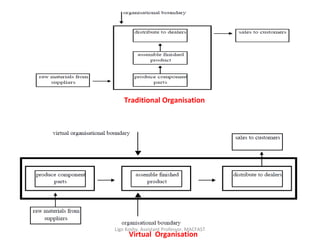
• 1. Alliance Organization (based on
competencies):
• Partnering organisation replaces vertical integration with
virtual integration
• Horizontal networks between business partners, rather
than vertical integration within an organisation.
• Each partner linked with the VO performs different but
related activities.
• The core competencies of the partners are combined to
produce synergy effect for the VO.
• Eg: Compaq, Lenovo
Ligo Koshy, Assistant Professor, MACFAST
Traditional Organisation
Virtual Organisation
Ligo Koshy, Assistant Professor, MACFAST
Types of virtual Organisations (Bradt’s
classification)
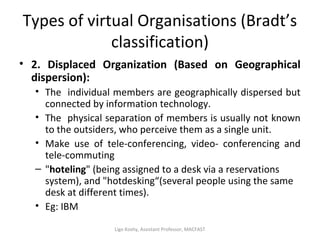
• 2. Displaced Organization (Based on Geographical
dispersion):
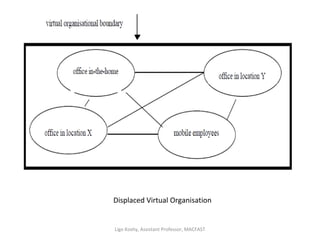
• The individual members are geographically dispersed but
connected by information technology.
• The physical separation of members is usually not known
to the outsiders, who perceive them as a single unit.
• Make use of tele-conferencing, video- conferencing and
tele-commuting
– "hoteling" (being assigned to a desk via a reservations
system), and "hotdesking“(several people using the same
desk at different times).
• Eg: IBM
Ligo Koshy, Assistant Professor, MACFAST
Displaced Virtual Organisation
Ligo Koshy, Assistant Professor, MACFAST
Types of virtual Organisation (Bradt’s
classification)
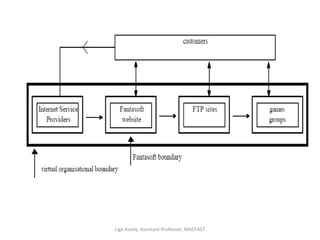
• 3. Invisible Organization ( Telephonically) :
• Will not have a physical structure as such, except
that a small place will be used as an office for a
few employees.
• The products of such an organization are mostly
virtual and directly downloadable from computer
• Operates through a network of call-centers and
back offices.
• Eg: Fantasoft( Online game developer)
Ligo Koshy, Assistant Professor, MACFAST
Types of virtual Organisation (Bradt’s
classification)
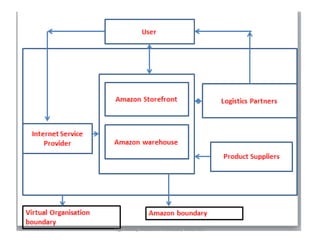
• 4. Truly Virtual
Organization(mixed/blended):
• is a mixture of the characteristics of alliance,
displaced and invisible organizations.
• The Internet is the major platform for offering its
products or services to the customers.
• Eg: Amazon
Ligo Koshy, Assistant Professor, MACFAST
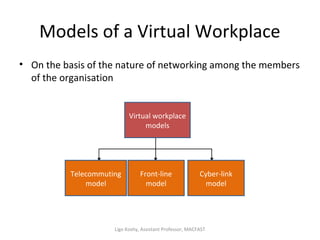
Models of a Virtual Workplace
• On the basis of the nature of networking among the members
of the organisation
Virtual workplace
models
Front-line
model
Telecommuting
model
Cyber-link
model
Ligo Koshy, Assistant Professor, MACFAST
Models of a Virtual Workplace
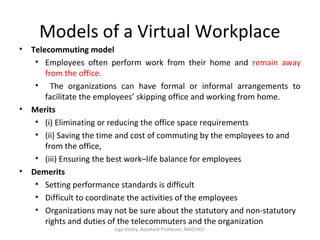
• Telecommuting model
• Employees often perform work from their home and remain away
from the office.
• The organizations can have formal or informal arrangements to
facilitate the employees’ skipping office and working from home.
• Merits
• (i) Eliminating or reducing the office space requirements
• (ii) Saving the time and cost of commuting by the employees to and
from the office,
• (iii) Ensuring the best work–life balance for employees
• Demerits
• Setting performance standards is difficult
• Difficult to coordinate the activities of the employees
• Organizations may not be sure about the statutory and non-statutory
rights and duties of the telecommuters and the organization
Ligo Koshy, Assistant Professor, MACFAST
Models of a Virtual Workplace
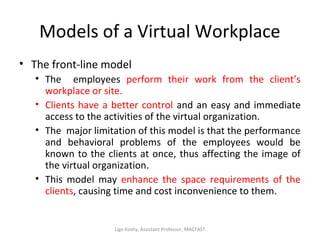
• The front-line model
• The employees perform their work from the client’s
workplace or site.
• Clients have a better control and an easy and immediate
access to the activities of the virtual organization.
• The major limitation of this model is that the performance
and behavioral problems of the employees would be
known to the clients at once, thus affecting the image of
the virtual organization.
• This model may enhance the space requirements of the
clients, causing time and cost inconvenience to them.
Ligo Koshy, Assistant Professor, MACFAST
Models of a Virtual Workplace
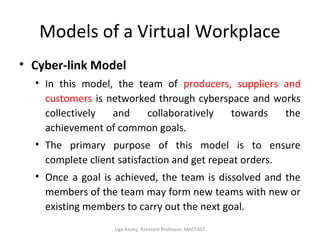
• Cyber-link Model
• In this model, the team of producers, suppliers and
customers is networked through cyberspace and works
collectively and collaboratively towards the
achievement of common goals.
• The primary purpose of this model is to ensure
complete client satisfaction and get repeat orders.
• Once a goal is achieved, the team is dissolved and the
members of the team may form new teams with new or
existing members to carry out the next goal.
Ligo Koshy, Assistant Professor, MACFAST
Advantages and disadvantages of
Virtual Organisation
• Advantages/ Benefits
• Absence of Distance Barrier
• Reduction of Overhead costs
• Faster response
• Saving in space cost
• Round-the clock Service
• Customer driven
• Competitive edge
• Exploiting Labour Market
Imbalance
• Avoiding Man-Hour Losses
• Reduced Work stress and fatigue
• Maintaining the Work-Life Balance
• Disadvantages/ Limitations
• Absence of Managerial
Control
• Technology – related
Problems
• Misuse of electronic
instruments and consumables
of organisation
• High Maintenance Cost
• Absence of Involvement and
commitment
• Aloofness and Boredom
Ligo Koshy, Assistant Professor, MACFAST
Managing HR In Virtual Organisation
• Virtual organisations composed of experts who work on
time-bound projects and are geographically divided and
connected by informational and communication tools.
• The HR management in virtual organizations is mostly
performed through E-HRM.
• E-HRM may be defined as a network-based structure built on
partnerships and typically mediated by information
technologies to help the organisation acquire, develop, and
deploy intellectual capital.” (D. P. Lepak and S. A. Snell)
Ligo Koshy, Assistant Professor, MACFAST
Managing HR In Virtual Organisation
• Recruitment and Selection
• Make the optimum use of technology for recruiting
candidates.
• Web -based e-recruiting effectively for building their
applicant pool.
• Selection process is unique- rare opportunity for a face to
face contact with future employees.
• Ensure team compatibility and the selected members gel
well with the team to which they are assigned.
• Online assessment
• Online interviewing
Ligo Koshy, Assistant Professor, MACFAST
Managing HR In Virtual Organisation
• Training and Development
• Provide e-learning facilities for skills enhancement and
knowledge acquisition.
• Three forms of e- learning platforms
– Computer -based training
– Web -based training
– Technology-based instruction
• E-learning activities of a virtual organization also include
activities like live workshops, virtual discussion and
conferences, simulation, e-assessment, and e-mentoring (like
coaching and e-mail exchanges) through electronic mode
• Virtual training should also enable employees to plan,
prioritize and schedule their activities in their own way with
little guidance Ligo Koshy, Assistant Professor, MACFAST
Managing HR In Virtual Organisation
• Compensation
– Employees are judged only by the results.
– compensating the skills, knowledge and ability of the
virtual employees.
– ‘Person-based’ system for determining the compensation
of - primarily considers the job holder as the unit of
analysis and not the job.
Ligo Koshy, Assistant Professor, MACFAST
Managing HR In Virtual Organisation
• Performance Management
• No face-to-face contact between the superiors and the
subordinates.
• Need to depend only on the end results produced by the
virtual employees for performance measurement.
• clear performance objectives and set measurable
standards for performance evaluation.
• Use electronic modes of communication for conducting
evaluation and sharing the results.
• the performance evaluators must possess an adequate
knowledge about the employee to be evaluated by them.
Ligo Koshy, Assistant Professor, MACFAST
Managing HR In Virtual Organisation
• Communication
• Employees would be missing face-to-face informal communication like
grapevine with their superiors and co-employees.
• “Communication training” Programmes to enhance trust and understanding.
• Information channels of communication need to be supplemented to keep
the two-way communication channels open.(telephonic conversation, e-mail
communication and periodic face-to-face meetings)
• Control Process
• Set performance standards, then measure actual performance critically, and
finally compare the actual performance with the standard performance.
• Coordination
• coordination among the team members is critical
• Use electronic media to enhance the coordination among the employees.
Ligo Koshy, Assistant Professor, MACFAST
Prerequisites for the Success of
Virtual Enterprises
• Make efforts to create a discussion forum for virtual
workers so that they can meet their colleagues face to
face to discuss the events and matters of common
interest.
• Provide information on role expectations clearly.
• Support mechanisms, like updated technology, to
enable them to work from anywhere.
• Recognition of cultural diversity among the workforce.
• Ensure that the team members have a core IT
capability and are adequately familiar with technology
to solve recurring problems associated with software
and hardware.
Ligo Koshy, Assistant Professor, MACFAST

Virtual organisations

  • 1.
    Virtual Organisations Ligo Koshy,Assistant Professor, MACFAST
  • 2.
    Virtual Organisation(VO)- Meaning •Virtual organization (VO) can be defined as a temporary network of goal-oriented enterprise composed of multiple members (independent companies, suppliers, employees etc.) who reside in geographically dispersed locations and use ICT (information and Communication Technology) technology to communicate and coordinate the fulfilment of a defined objective or task. • Its goal is to deliver highest-quality product at the lowest possible cost in a timely manner. • Eg: Amazon, Nike, Dell, Wikipedia Ligo Koshy, Assistant Professor, MACFAST
  • 3.
    Core Competence A CoreCompetence B Core Competence Core Competence Core Competence Core Competence Alliance Partner 1 Alliance Partner 3 Alliance Partner 4 Lead Corporation Alliance Partner 2 A Virtual Organisation- A temporary network of independent organisations, suppliers, employees working together to bring a product to the market Ligo Koshy, Assistant Professor, MACFAST
  • 4.
    Ligo Koshy, AssistantProfessor, MACFAST
  • 5.
    Features of VirtualOrganisation Small Sized Partners Extensive use of Information and Communication Technology Virtual Organisation Has Its Own Identity No Organizational Chart Semi-Stable Relations Dependent On Opportunism Based On Trust Shared Ownership Shared Leadership and Loyalty Geographically Dispersed Customer Based and Mass Customization Flexibility and Quick Response Ligo Koshy, Assistant Professor, MACFAST
  • 6.
    Differences between Traditional VirtualOrganisation Virtual Organisation Traditional Organisation Virtual organizations do not usually have any physical presence. Traditional organizations have physical existence like real-world offices and continuity in their operations. There is no face-to-face communication among the members in completely virtual organizations. They rely on electronic communication to share information. There exists physical contact and face-to- face communication among the employees. The membership is dynamic in nature, with members joining and leaving the organization when their roles begin and end. The membership tenure is normally stable and independent of the completion of a specific project or work. Virtual organizations keep a flatter hierarchy and insist on voluntary commitment from their members and on self-discipline. Traditional organizations maintain a vertical hierarchy and follow an imposed discipline system. Performance evaluation and work control are virtual and difficult. They are actual and simple. Ligo Koshy, Assistant Professor, MACFAST
  • 7.
    Differences between Traditional VirtualOrganisation Virtual Organisation Traditional Organisation Statutory HR practices governing the functioning of employees are not clear and effective, but evolving. They are well-established with proven effectiveness. Leadership and control are self- managed. They are based on external command and control. The employees’ skills and knowledge are usually developed through the e- learning process. They are usually developed through real training and development programmes. The power of employees depends on their role in business process. It depends upon the positions occupied by the employees in the hierarchy. Ligo Koshy, Assistant Professor, MACFAST
  • 8.
    Type of virtualOrganisations (Bradt’s classification) Types of Virtual Organisations Truly Virtual Organisatio ns Invisible Organisations Displaced Organisations Alliance Organisations Ligo Koshy, Assistant Professor, MACFAST
  • 9.
    Types of virtualOrganisations (Bradt’s classification) • 1. Alliance Organization (based on competencies): • Partnering organisation replaces vertical integration with virtual integration • Horizontal networks between business partners, rather than vertical integration within an organisation. • Each partner linked with the VO performs different but related activities. • The core competencies of the partners are combined to produce synergy effect for the VO. • Eg: Compaq, Lenovo Ligo Koshy, Assistant Professor, MACFAST
  • 10.
    Traditional Organisation Virtual Organisation LigoKoshy, Assistant Professor, MACFAST
  • 11.
    Types of virtualOrganisations (Bradt’s classification) • 2. Displaced Organization (Based on Geographical dispersion): • The individual members are geographically dispersed but connected by information technology. • The physical separation of members is usually not known to the outsiders, who perceive them as a single unit. • Make use of tele-conferencing, video- conferencing and tele-commuting – "hoteling" (being assigned to a desk via a reservations system), and "hotdesking“(several people using the same desk at different times). • Eg: IBM Ligo Koshy, Assistant Professor, MACFAST
  • 12.
    Displaced Virtual Organisation LigoKoshy, Assistant Professor, MACFAST
  • 13.
    Types of virtualOrganisation (Bradt’s classification) • 3. Invisible Organization ( Telephonically) : • Will not have a physical structure as such, except that a small place will be used as an office for a few employees. • The products of such an organization are mostly virtual and directly downloadable from computer • Operates through a network of call-centers and back offices. • Eg: Fantasoft( Online game developer) Ligo Koshy, Assistant Professor, MACFAST
  • 14.
    Ligo Koshy, AssistantProfessor, MACFAST
  • 15.
    Types of virtualOrganisation (Bradt’s classification) • 4. Truly Virtual Organization(mixed/blended): • is a mixture of the characteristics of alliance, displaced and invisible organizations. • The Internet is the major platform for offering its products or services to the customers. • Eg: Amazon Ligo Koshy, Assistant Professor, MACFAST
  • 16.
    Ligo Koshy, AssistantProfessor, MACFAST
  • 17.
    Models of aVirtual Workplace • On the basis of the nature of networking among the members of the organisation Virtual workplace models Front-line model Telecommuting model Cyber-link model Ligo Koshy, Assistant Professor, MACFAST
  • 18.
    Models of aVirtual Workplace • Telecommuting model • Employees often perform work from their home and remain away from the office. • The organizations can have formal or informal arrangements to facilitate the employees’ skipping office and working from home. • Merits • (i) Eliminating or reducing the office space requirements • (ii) Saving the time and cost of commuting by the employees to and from the office, • (iii) Ensuring the best work–life balance for employees • Demerits • Setting performance standards is difficult • Difficult to coordinate the activities of the employees • Organizations may not be sure about the statutory and non-statutory rights and duties of the telecommuters and the organization Ligo Koshy, Assistant Professor, MACFAST
  • 19.
    Models of aVirtual Workplace • The front-line model • The employees perform their work from the client’s workplace or site. • Clients have a better control and an easy and immediate access to the activities of the virtual organization. • The major limitation of this model is that the performance and behavioral problems of the employees would be known to the clients at once, thus affecting the image of the virtual organization. • This model may enhance the space requirements of the clients, causing time and cost inconvenience to them. Ligo Koshy, Assistant Professor, MACFAST
  • 20.
    Models of aVirtual Workplace • Cyber-link Model • In this model, the team of producers, suppliers and customers is networked through cyberspace and works collectively and collaboratively towards the achievement of common goals. • The primary purpose of this model is to ensure complete client satisfaction and get repeat orders. • Once a goal is achieved, the team is dissolved and the members of the team may form new teams with new or existing members to carry out the next goal. Ligo Koshy, Assistant Professor, MACFAST
  • 21.
    Advantages and disadvantagesof Virtual Organisation • Advantages/ Benefits • Absence of Distance Barrier • Reduction of Overhead costs • Faster response • Saving in space cost • Round-the clock Service • Customer driven • Competitive edge • Exploiting Labour Market Imbalance • Avoiding Man-Hour Losses • Reduced Work stress and fatigue • Maintaining the Work-Life Balance • Disadvantages/ Limitations • Absence of Managerial Control • Technology – related Problems • Misuse of electronic instruments and consumables of organisation • High Maintenance Cost • Absence of Involvement and commitment • Aloofness and Boredom Ligo Koshy, Assistant Professor, MACFAST
  • 22.
    Managing HR InVirtual Organisation • Virtual organisations composed of experts who work on time-bound projects and are geographically divided and connected by informational and communication tools. • The HR management in virtual organizations is mostly performed through E-HRM. • E-HRM may be defined as a network-based structure built on partnerships and typically mediated by information technologies to help the organisation acquire, develop, and deploy intellectual capital.” (D. P. Lepak and S. A. Snell) Ligo Koshy, Assistant Professor, MACFAST
  • 23.
    Managing HR InVirtual Organisation • Recruitment and Selection • Make the optimum use of technology for recruiting candidates. • Web -based e-recruiting effectively for building their applicant pool. • Selection process is unique- rare opportunity for a face to face contact with future employees. • Ensure team compatibility and the selected members gel well with the team to which they are assigned. • Online assessment • Online interviewing Ligo Koshy, Assistant Professor, MACFAST
  • 24.
    Managing HR InVirtual Organisation • Training and Development • Provide e-learning facilities for skills enhancement and knowledge acquisition. • Three forms of e- learning platforms – Computer -based training – Web -based training – Technology-based instruction • E-learning activities of a virtual organization also include activities like live workshops, virtual discussion and conferences, simulation, e-assessment, and e-mentoring (like coaching and e-mail exchanges) through electronic mode • Virtual training should also enable employees to plan, prioritize and schedule their activities in their own way with little guidance Ligo Koshy, Assistant Professor, MACFAST
  • 25.
    Managing HR InVirtual Organisation • Compensation – Employees are judged only by the results. – compensating the skills, knowledge and ability of the virtual employees. – ‘Person-based’ system for determining the compensation of - primarily considers the job holder as the unit of analysis and not the job. Ligo Koshy, Assistant Professor, MACFAST
  • 26.
    Managing HR InVirtual Organisation • Performance Management • No face-to-face contact between the superiors and the subordinates. • Need to depend only on the end results produced by the virtual employees for performance measurement. • clear performance objectives and set measurable standards for performance evaluation. • Use electronic modes of communication for conducting evaluation and sharing the results. • the performance evaluators must possess an adequate knowledge about the employee to be evaluated by them. Ligo Koshy, Assistant Professor, MACFAST
  • 27.
    Managing HR InVirtual Organisation • Communication • Employees would be missing face-to-face informal communication like grapevine with their superiors and co-employees. • “Communication training” Programmes to enhance trust and understanding. • Information channels of communication need to be supplemented to keep the two-way communication channels open.(telephonic conversation, e-mail communication and periodic face-to-face meetings) • Control Process • Set performance standards, then measure actual performance critically, and finally compare the actual performance with the standard performance. • Coordination • coordination among the team members is critical • Use electronic media to enhance the coordination among the employees. Ligo Koshy, Assistant Professor, MACFAST
  • 28.
    Prerequisites for theSuccess of Virtual Enterprises • Make efforts to create a discussion forum for virtual workers so that they can meet their colleagues face to face to discuss the events and matters of common interest. • Provide information on role expectations clearly. • Support mechanisms, like updated technology, to enable them to work from anywhere. • Recognition of cultural diversity among the workforce. • Ensure that the team members have a core IT capability and are adequately familiar with technology to solve recurring problems associated with software and hardware. Ligo Koshy, Assistant Professor, MACFAST

Editor's Notes

  • #6 Small Sized Partners Initially VOs are based on core competencies, which mean that VO partners determine what is best for the business process in relation to the complementary skills of each partner. We should note that the smaller the size of partners the more flexible the organization is, and the better opportunity the organization has in the market. The overall effect of this feature is known as the "synergy effect" (Lau & Wong, 2010; Jacobsen, 2004 & Durai, 2011). 2. VO Has Its Own Identity Actually it has a hard identity. VOs are an open organizational system, so it doesn't have a fixed internal structure or hierarchy nor does it have a product or a brand name. It's mainly based on electronic linkage and featured by loose coupling (Lau & Wong, 2010; Jacobsen, 2004 & Durai, 2011). 3. No Organizational Chart VOs are based on information technology and is known as a meta-organization which means that the partners come and go based on whether their goals have been accomplished or not. Hence their presence or absence doesn't affect the organization (Lau & Wong, 2010; Jacobsen, 2004 & Durai, 2011). 4. Semi-Stable Relations There is dependency among partners, so the relation is not too formal or too permanent. As we mentioned before the existence of the partners or absence doesn't really affect the VO (Lau & Wong, 2010; Jacobsen, 2004 & Durai, 2011). 5. Dependent On Opportunism VO partners work together to meet a specific market opportunity and try to enlarge their scope to take place in the market and share the risk (Lau & Wong, 2010; Jacobsen, 2004 & Durai, 2011). 6. Based On Trust Since VOs are based on sharing information and knowledge, trust must be present among partners (Lau & Wong, 2010; Jacobsen, 2004 & Durai, 2011). 7. Shared Ownership Since every partner has his own interest in the VO, therefore the VO can be owned by different partners. Once a partners' interest have been accomplished, he can walk out and it will not affect the other parties (Lau & Wong, 2010; Jacobsen, 2004 & Durai, 2011). 8. Shared Leadership and Loyalty Each partner controls his own resources not the VO resources. Workers of VO are different whether culture or language, therefore workers need to identify themselves that would help the workers grasp the feeling of respect and sharing time and space (Lau & Wong, 2010; Jacobsen, 2004 & Durai, 2011). 9. Geographical Dispersed Since VOs don't have a physical location. VOs based on technology; therefore companies collaborate autonomously of time and location. This gives the partners a sense of presence even though they are far apart (Lau & Wong, 2010; Jacobsen, 2004 & Durai, 2011). 10. Customer Based and Mass Customization As the VO product is mainly based on customer interaction (Lau & Wong, 2010; Jacobsen, 2004 & Durai, 2011). 11. Flexibility and Quick Response The collaboration of workers on a specific task makes it easier to manage resources based on market demand (Lau & Wong, 2010; Jacobsen, 2004 & Durai, 2011).
  • #19 In the telecommuting model, employees often perform work from their home and remain away from the office. The organizations can have formal or informal arrangements to facilitate the employees’ skipping office and working from home. A virtual employee of this nature need not attend office for a specified number of days in a week. Depending upon its policies and facilities, the organization may choose any number of employees as telecommuters. However, in reality, it normally permits the senior employees to be telecommuters so that they can save their precious time for performing the job. The telecommuting model of a virtual workplace has its own merits and challenges. Telecommuting is capable of (i) eliminating or reducing the office space requirements, (ii) saving the time and cost of commuting by the employees to and from the office, (iii) ensuring the best work–life balance for employees, and (iv) helping the special cases among employees, like women employees during pre- and post-natal stages. However, it also has several challenges to surmount. These are: • Unlike traditional organizations, setting performance standards for employees in measurable standards is difficult. The evaluation of employee progress in work and in quality of performance and the extent of goal accomplishments may pose challenge to the management of virtual organizations. • Team unity may become a casualty of telecommuting workplaces. The organizations may find it difficult to coordinate the activities of the employees, who may perform their work at their own convenient time. • Organizations may not be sure about the statutory and non-statutory rights and duties of the telecommuters and the organization. This may cause confusion in labour issues concerning the telecommuting employees. • Determining the criteria for identifying employees to be covered under telecommuting may become a contentious issue for the organization, affecting the cordiality between employer and employee and also between employee and employee. • The development and maintenance of dedicated channels of communication may also be a challenge in a telecommuting workplace. The organization needs to ensure a hassle-free operation of the electronic instruments on a sustained basis.
  • #22 Absence of Distance Barrier The physical distance of members is no longer an important factor in establishing an organization. When everyone can access everyone else wherever they might be, distance cannot be a hurdle. Reduction of Overhead Costs The need to reduce costs is the driving force behind the formation of a virtual organization. The usual establishment expenses can be reduced vastly. Faster Response Virtual organizations save time as they are able to respond quickly to customer requests, and to process or present information in the desired form. Savings in Space Cost A virtual organization capitalizes on the telecommunications infrastructure to overcome the constraints of space. The cost of space is reduced considerably in this form of organization. Round-the-clock Service Virtual organizations facilitate the distribution of work across time zones. This makes them work for nearly 24 hours a day. Better Managerial Efficiency Virtual organizations, through an improved utilization of the electronic equipment for communication, supervision and control, can enhance the efficiency of the managerial personnel. Customer-driven Virtual organizations are mostly customer-dependent and -driven enterprises. As such, there is a greater emphasis on enhancing customer satisfaction and getting repeat business. Precise Performance Measurement In a virtual organization, an accurate measurement of productivity and efficiency is possible with the help of electronic devices. This can assist the management in the proper allocation of staff to work tasks. Competitive Edge Organizations adopt virtual working as part of a long-term strategy to transform the entire business processes eventually in order to face the intensified national and international competitive challenges. Exploiting the Labour Market Imbalance Geographic labour shortage and surplus can be neutralized as virtual organizations cover labour markets of different regions and countries. Avoiding Man-hour Losses The loss of productivity arising out of absenteeism and sick leave can be prevented when employees are hooked to their offices through electronic devices from their home even when they are ill. Reduced Work Stress and Fatigue Since the time and duration of work are determined by the employees, work-related stress and fatigue can be reduced considerably. Maintaining the Work–Life Balance The work–life balance can be well maintained by the employees in virtual organizations as the time is judiciously shared between work and personal activities like child caring and parent caring. In other words, virtual corporations can reap the benefits of interdependence—reduced overhead, increased profits, and greater commitment from members and customers. 25 In fact, virtual organizations provide an increased array of opportunities for future business collaborations. 26 However, for the virtual organizations to be really effective, there should be a reciprocal loyalty in the relationship between the management and the workforce. Limitations of Virtual Organizations Although virtual organizations have several benefits to their credit, they also have their own limitations, which retard the faster growth of these organizations. We shall now see the weaknesses of the virtual organizations, which follow systems like telecommuting and cyber link. Absence of Managerial Control The major problem of virtual organizations is their inability to ensure adequate supervision and managerial control over the activities of the virtual employees, who work away from the management. Technology-related Problems When there is a mechanical or technological failure while performing a piece of work, it may not be possible to make alternate arrangements immediately. In such a situation, the work may get affected and there could also be deadline problems for the individual employees and the organization both. Misuse of Electronic Instruments and Consumables of the Organization There is a scope for dishonest and unscrupulous employees to use the company properties for purposes other than those for which these instruments have been given to them. Limited Application Virtual organizations are not suitable for all types of business operations. As such, they have very limited utilities and are mostly confined to the creation of virtual products and services. High Maintenance Cost In addition to the equipment and installation cost, virtual organizations may have to spend huge sums of money on routine maintenance costs like the one related to network. Aloofness(state of being withdrawn) and Job Boredom In the absence of emotional and social support, virtual employees may find it difficult to perform their job all alone. Working with non-living beings for long hours is bound to cause job boredom to the employees. Absence of Involvement and Commitment Since the employees mostly remain away from the office and keep only a formal and irregular contact with their superiors and colleagues, they may not develop any affinity towards their organizations. Consequently, their level of involvement and organizational loyalty would not be high and the organization may eventually suffer in the form of high labour turnover . Durai_
  • #24 While framing the HR policies and procedures of virtual organizations, it should be ensured that the rules are simple, easy to understand, and self-explanatory in nature. HR department must ensure that the recruitment process is faster and time-bound, as employment in virtual organizations is goal-centred and temporary. Prior to recruiting members for virtual organizations, the HR department must set upper and lower limits for the organization’s expectations from potential applicants. The successful candidates must be able to fulfil high-performance expectations and derive satisfaction and motivation from the task itself. Besides, the HR department must ensure that the recruitment process is faster and time-bound, as employment in virtual organizations is goal-centred and temporary. Therefore, the organizations must make the optimum use of technology for recruiting candidates. Many virtual organizations are using web-based e-recruiting effectively for building their applicant pool. E-recruitment facilitates target-oriented and focused recruitment campaigns and ensures a faster processing of applications. The selection process should also be unique in a virtual organization, because it provides a rare and precious opportunity for a face-to-face contact with the future employees. The HR people must use this opportunity for building a relationship with and creating a lasting impression on the employee about the organization, since the work would be done mostly in the non-face mode. As team-based performance is the essence of a virtual organization, the HR department must ensure that there is team compatibility and the selected members gel well with the team to which they are assigned.
  • #25 (i) computer-based training, where the course information is provided on the computer without any link to external learning resources (ii) web-based training, where information is presented through the Internet, intranet and extranet with necessary links with outside learning resources; (iii) technology-based instruction, where audio-visual tools, including computer and TV, are used extensively for training the virtual employees.
  • #26 The reward system should be distinct and appropriate for virtual organizations, where employees are judged only by results. Unlike in the traditional organizations, the compensation packages of virtual organizations should consider the flexibility and goal achievement ability of the employees. In this regard, the organization can adopt a ‘person-based’ system for determining the compensation of each employee. As such, this type of compensation model primarily considers the job holder as the unit of analysis and not the job. 23 Obviously, the focus of compensation in virtual organizations should be on compensating the skills, knowledge and ability of the virtual employees.
  • #27 Since there is no face-to-face contact between the superiors and the subordinates in virtual organizations, the HR department must depend only on the end results produced by the virtual employees for performance measurement. It must have clear performance objectives and criteria for evaluating the virtual employees. It must set measurable standards for performance evaluation. The performance standards may be expressed in terms of quality standards, goal accomplishment and speed of performance. The HR department may use electronic modes of communication like e-mail, telephone and fax for conducting evaluation and sharing the results. Similarly, the performance evaluators, like the supervisors, must possess an adequate technical knowledge about the employee to be evaluated by them. In case the supervisor does not have adequate technical competency to evaluate the subordinates, the performance evaluation might not be effective and justifiable.
  • #28 Virtual employees should be encouraged to increase their level of explicit communication so that their grievances are recognized expeditiously and addressed appropriately. The HR managers can implement “communication training” programmes for virtual employees to enhance trust and understanding. In virtual organizations, the employees would also be missing face-to-face informal communication like grapevine with their superiors and co-employees. 24 In this regard, the HR department must ensure that the information channelsof communication are supplemented with telephonic conversation, e-mail communication and periodic face-to-face meetings to keep the two-way communication channels open. Control process Virtual organizations call for new kinds of control process that ensure greater involvement of employees and self-imposed discipline. As part of the control process, the organization must first set scientific performance standards, then measure actual performance critically, and finally compare the actual performance with the standard performance. In case of performance deficiency, the HR department can organize skills acquisition trainings. Through training and counselling, the HR managers can also enhance the individual’s feeling of selfefficacy and the proactive approach necessary for success in virtual work programmes. The employees can also be trained to structure their behaviour and work by keeping to-do lists and developing routines.