

National Consultative Workshop on Virtual Open Schooling
                        in India


Virtual Open Schooling in India
                     Ramesh C. Sharma
                                 Organized by
             National Institute of Open Schooling (NIOS), Noida
                                      &
      Commonwealth Educational Media Centre for Asia, (CEMCA), New Delhi

                           16 October 2012
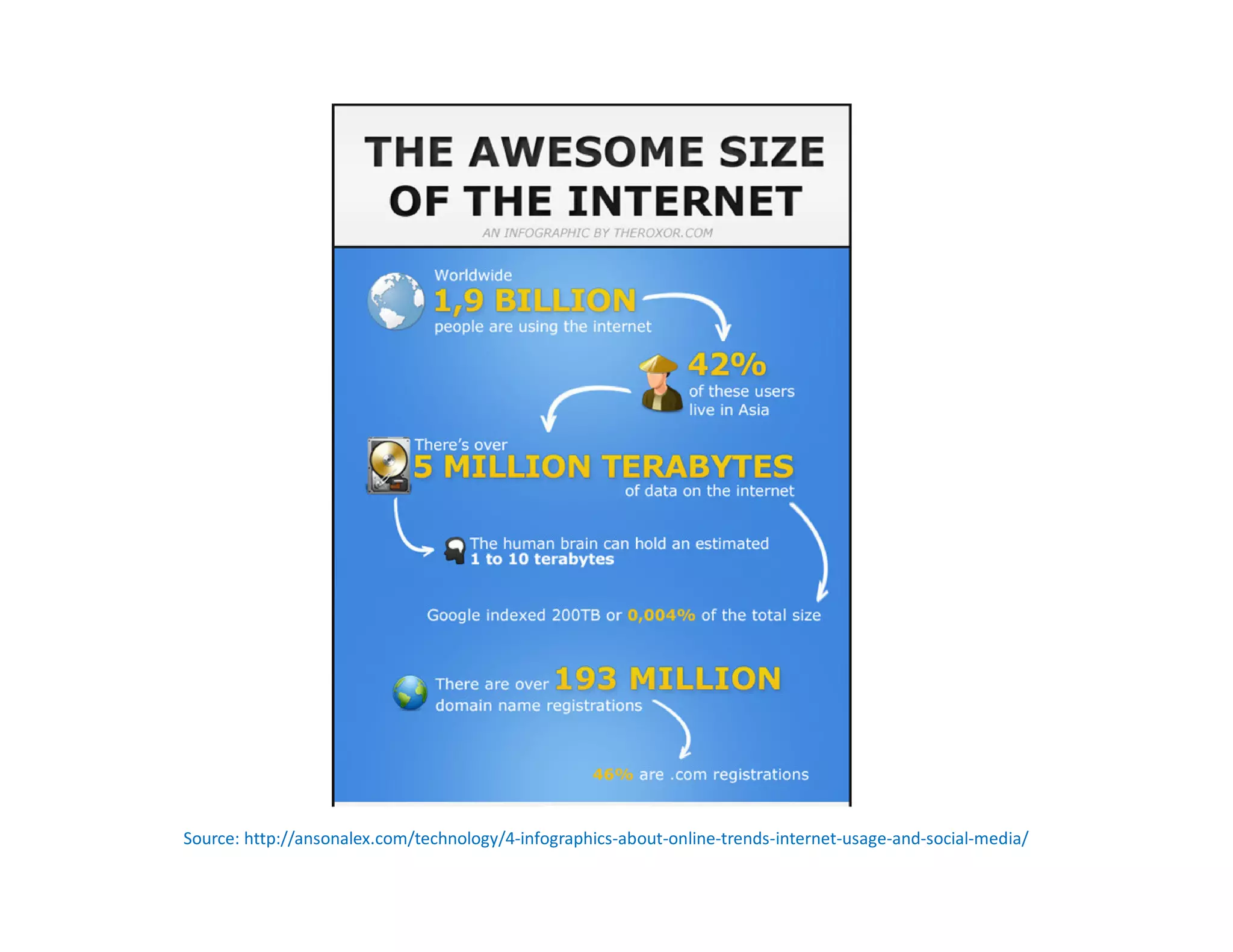
Source: http://ansonalex.com/technology/4-infographics-about-online-trends-internet-usage-and-social-media/
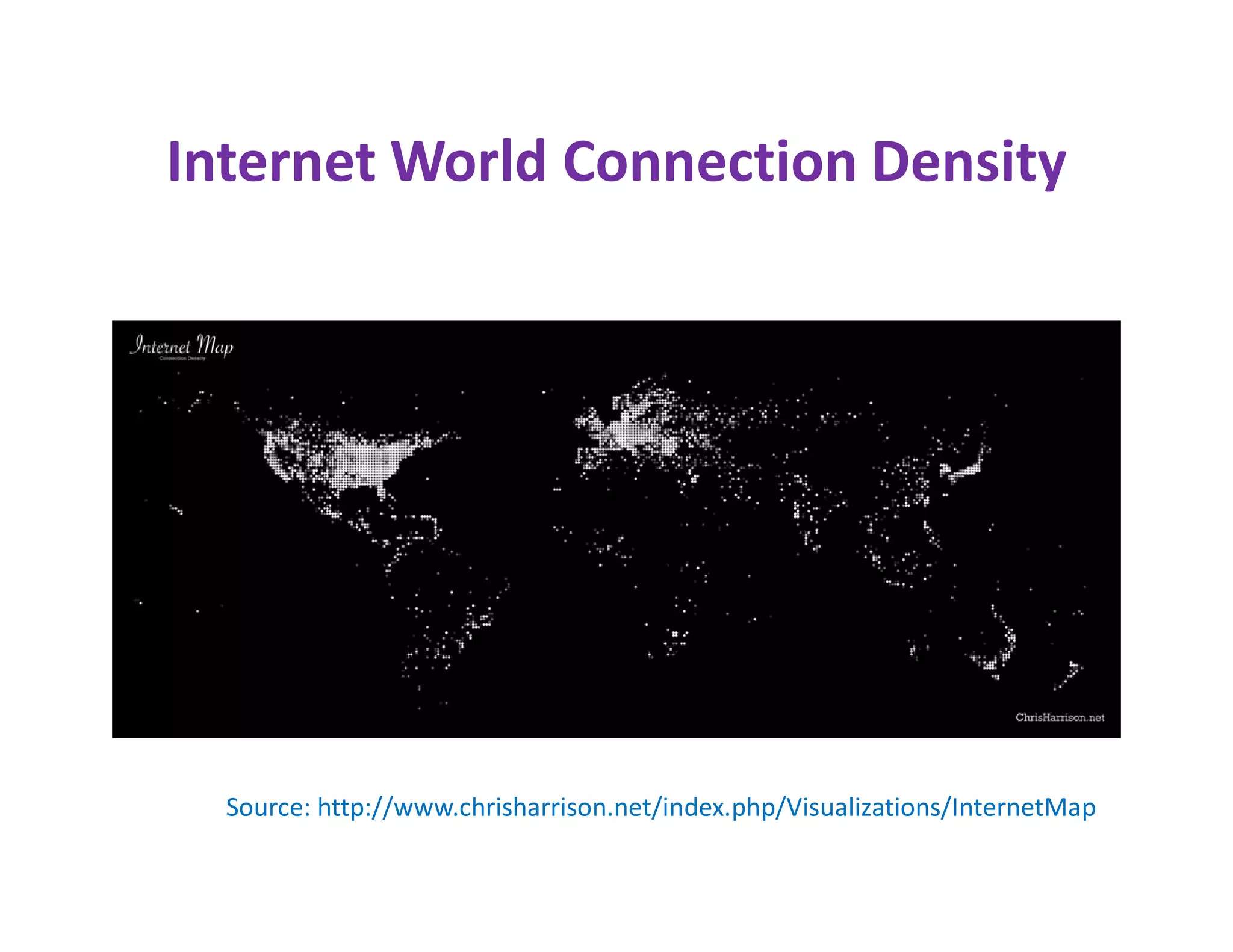
Internet World Connection Density


  Source: http://www.chrisharrison.net/index.php/Visualizations/InternetMap
NMC Horizon Report - 2012 K-12
              Edition

                     Identifies top emerging technologies, trends, and challenges
                     that will have a major impact on teaching, learning, and
                     creative inquiry in pre-college education over the next five
                     years.

                     Most important key driver is that the education paradigms
                     are shifting to include online learning, hybrid learning and
                     collaborative models.


Source: http://www.nmc.org/publications/2012-horizon-report-k12
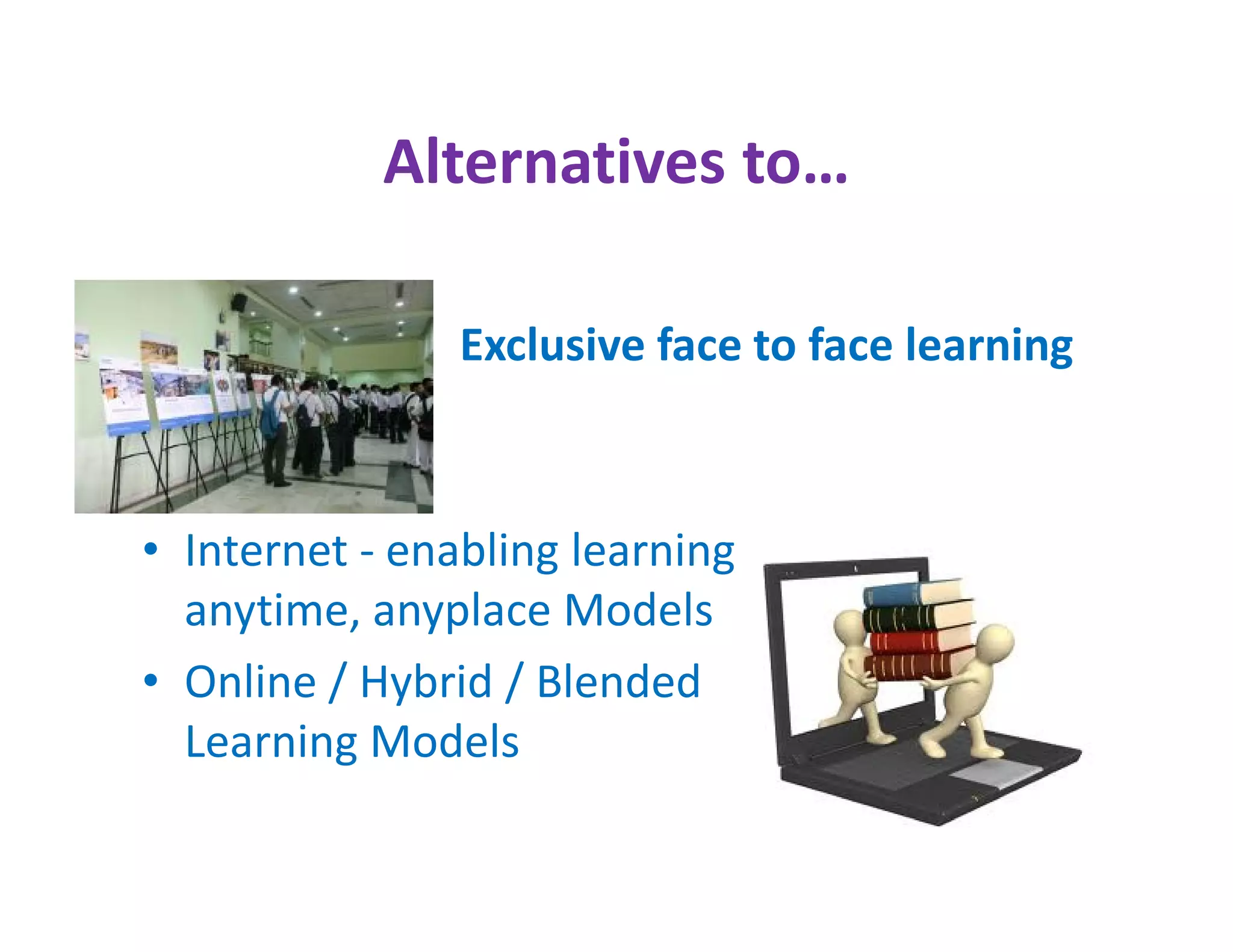
Alternatives to…

                Exclusive face to face learning


• Internet - enabling learning
  anytime, anyplace Models
• Online / Hybrid / Blended
  Learning Models
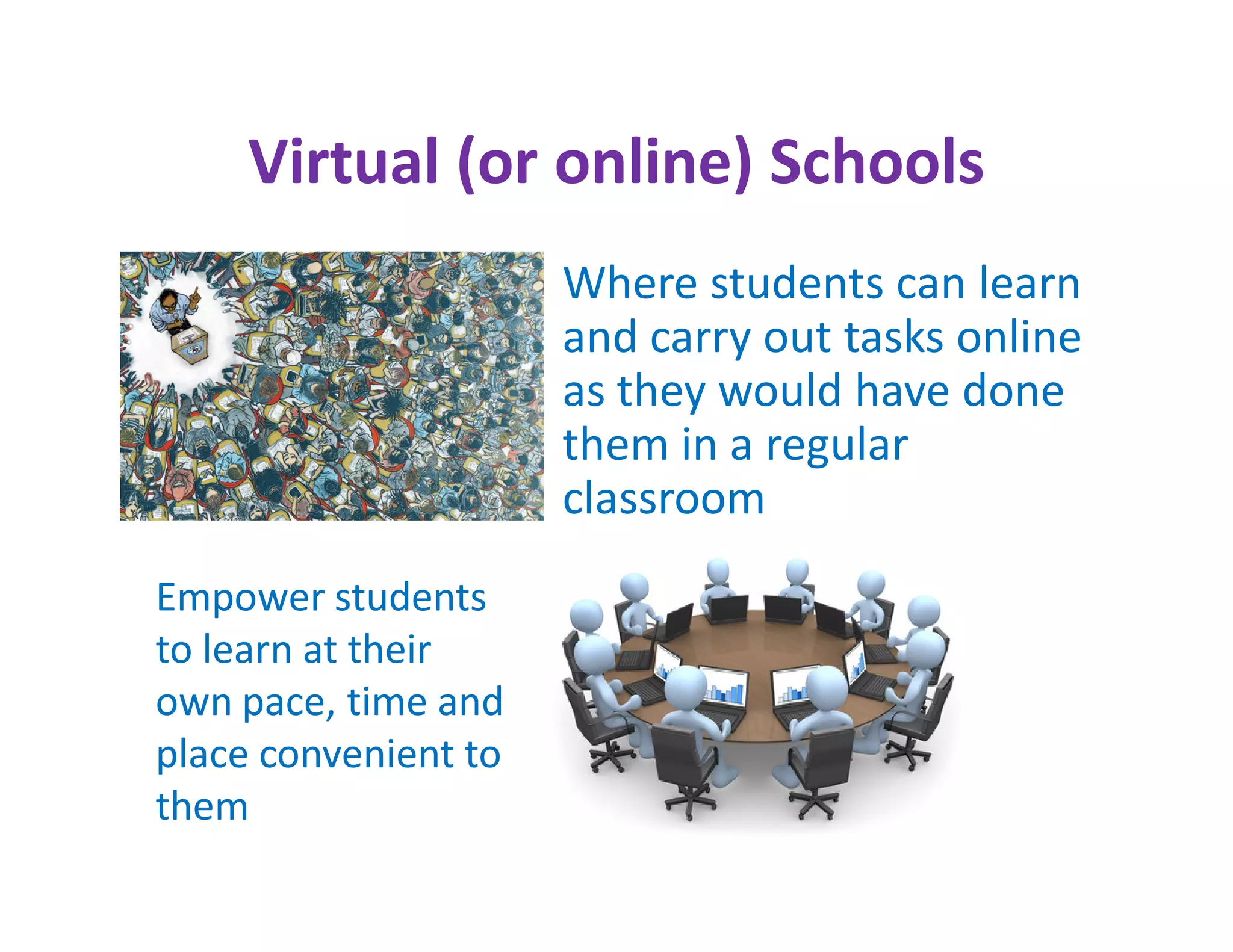
Virtual (or online) Schools
                      Where students can learn
                      and carry out tasks online
                      as they would have done
                      them in a regular
                      classroom
Empower students
to learn at their
own pace, time and
place convenient to
them
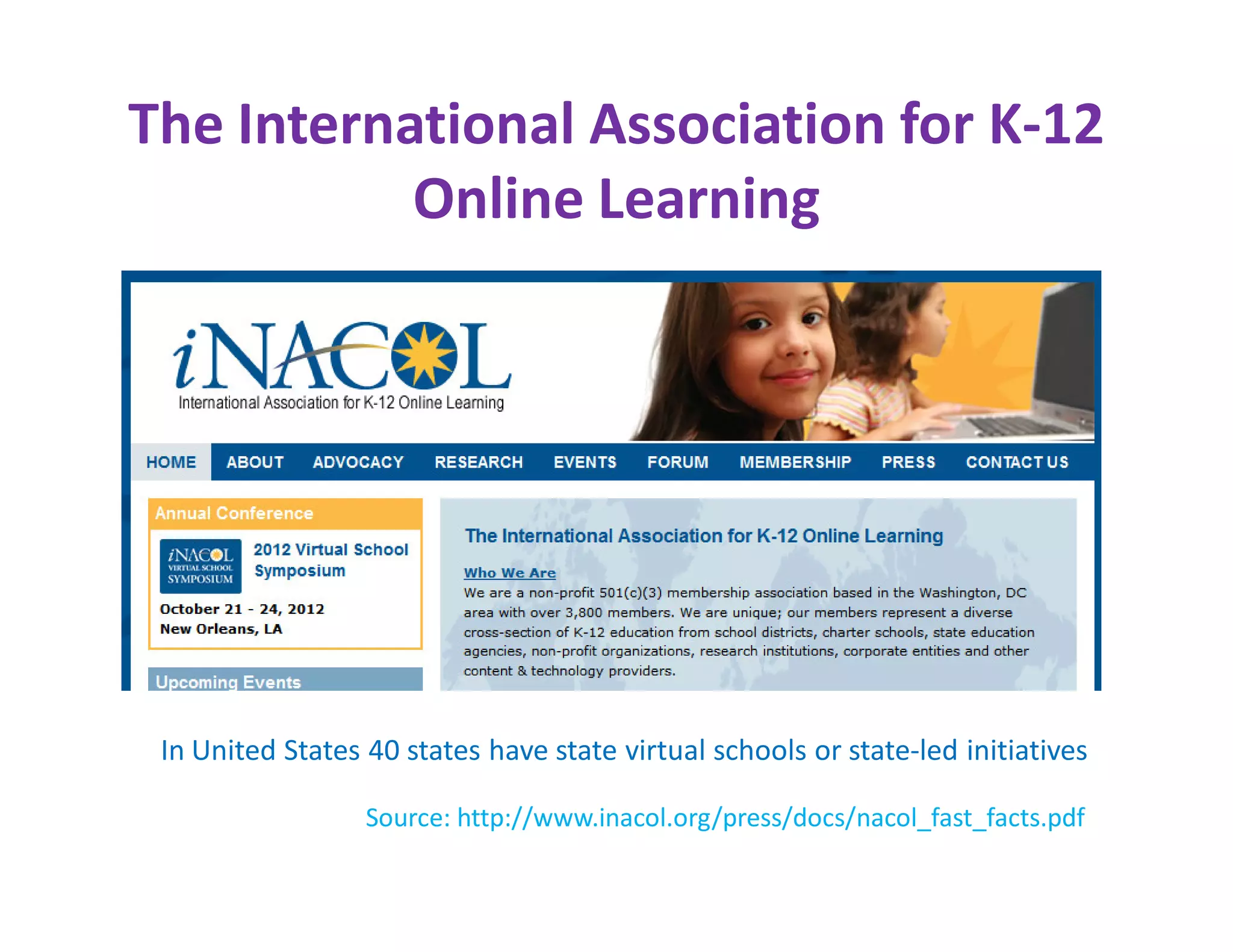
The International Association for K-12
           Online Learning


 In United States 40 states have state virtual schools or state-led initiatives

                  Source: http://www.inacol.org/press/docs/nacol_fast_facts.pdf
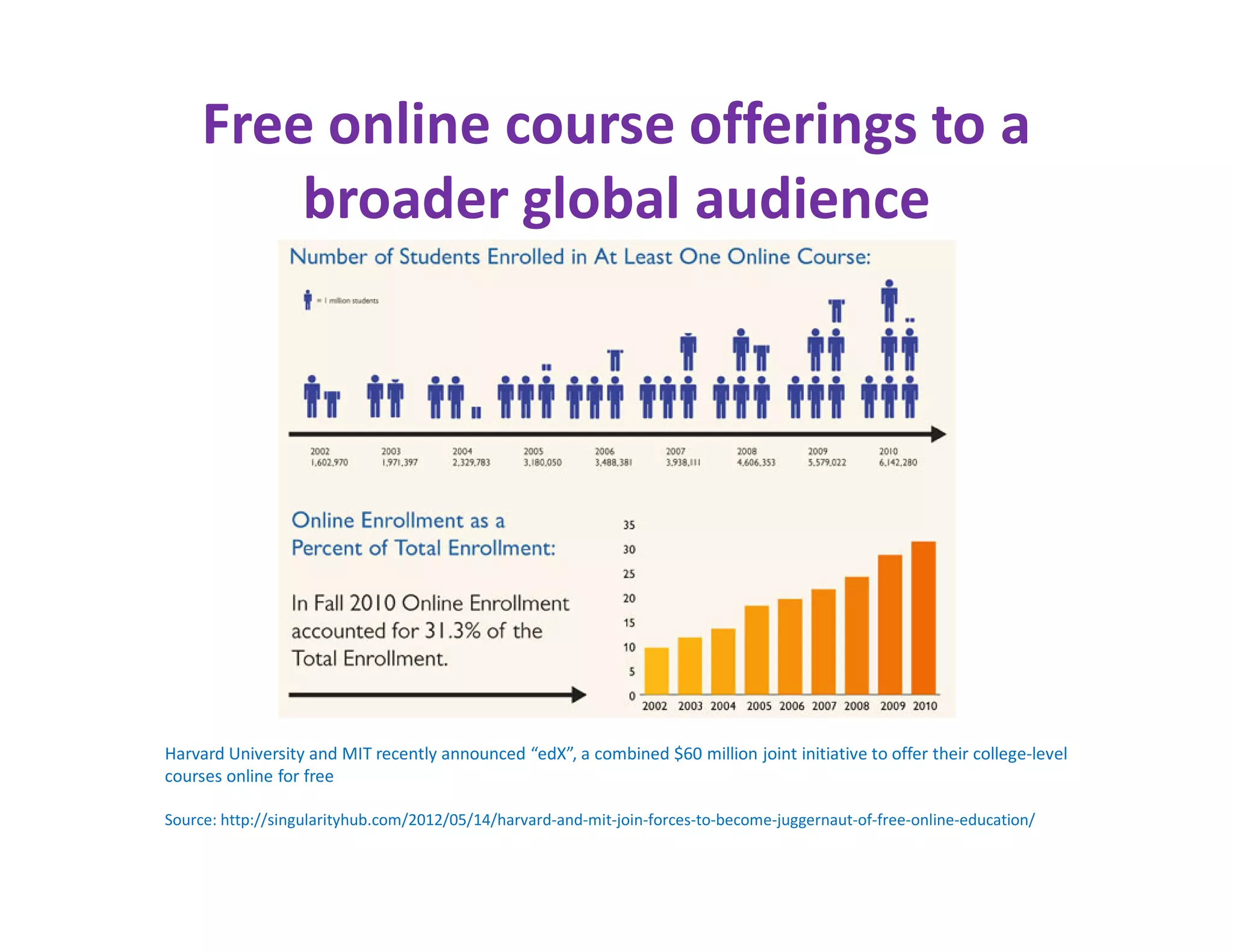
Free online course offerings to a
         broader global audience


Harvard University and MIT recently announced “edX”, a combined $60 million joint initiative to offer their college-level
courses online for free

Source: http://singularityhub.com/2012/05/14/harvard-and-mit-join-forces-to-become-juggernaut-of-free-online-education/
Reasons for success
of such online learning opportunities lies in the
attempt by school districts in providing courses
which are otherwise not available at their
schools.


Further the students can recover course credits
from classes missed or failed.
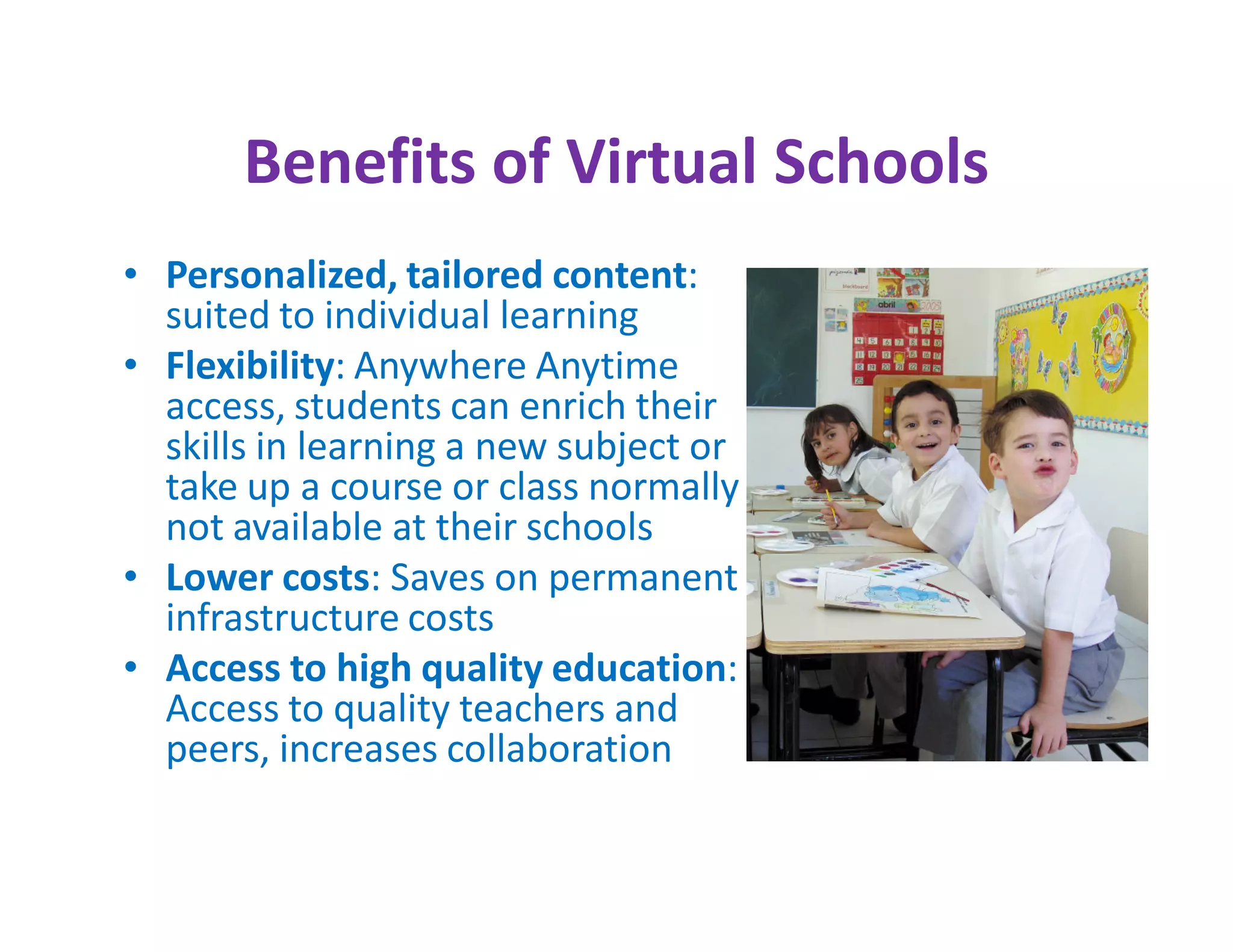
Benefits of Virtual Schools
• Personalized, tailored content:
  suited to individual learning
• Flexibility: Anywhere Anytime
  access, students can enrich their
  skills in learning a new subject or
  take up a course or class normally
  not available at their schools
• Lower costs: Saves on permanent
  infrastructure costs
• Access to high quality education:
  Access to quality teachers and
  peers, increases collaboration
Cases of virtual schools
  around the world
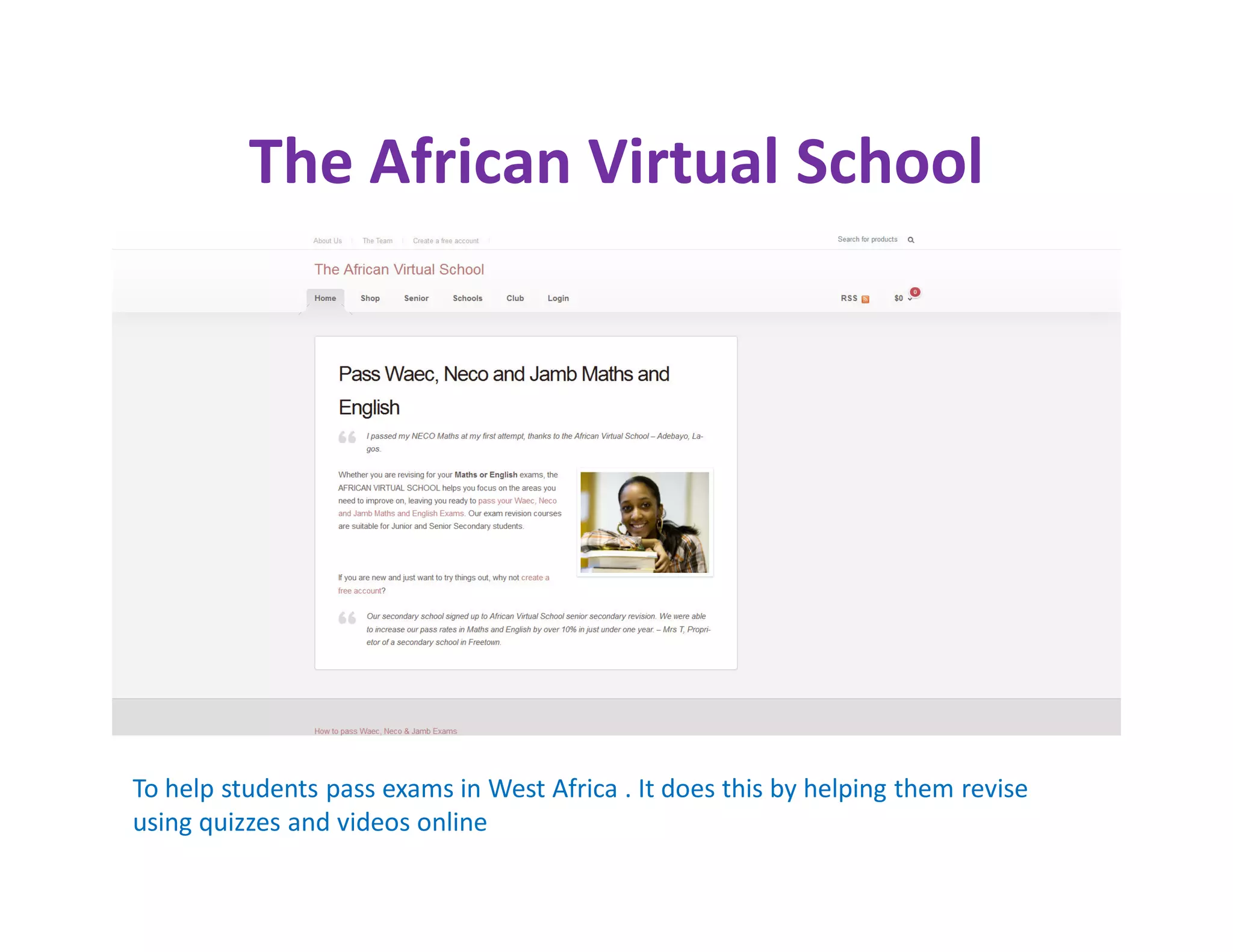
The African Virtual School


To help students pass exams in West Africa . It does this by helping them revise
using quizzes and videos online
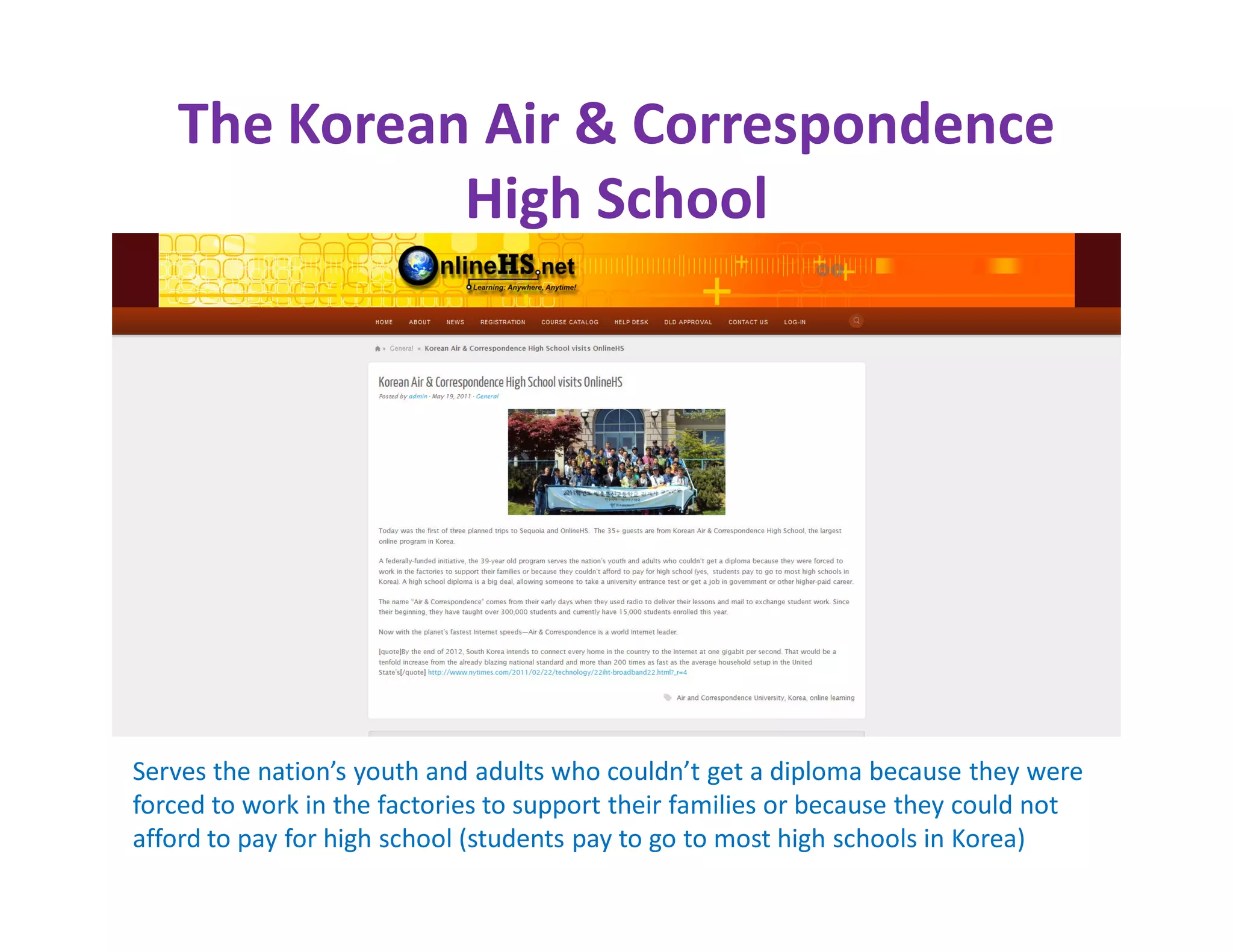
The Korean Air & Correspondence
             High School


Serves the nation’s youth and adults who couldn’t get a diploma because they were
forced to work in the factories to support their families or because they could not
afford to pay for high school (students pay to go to most high schools in Korea)
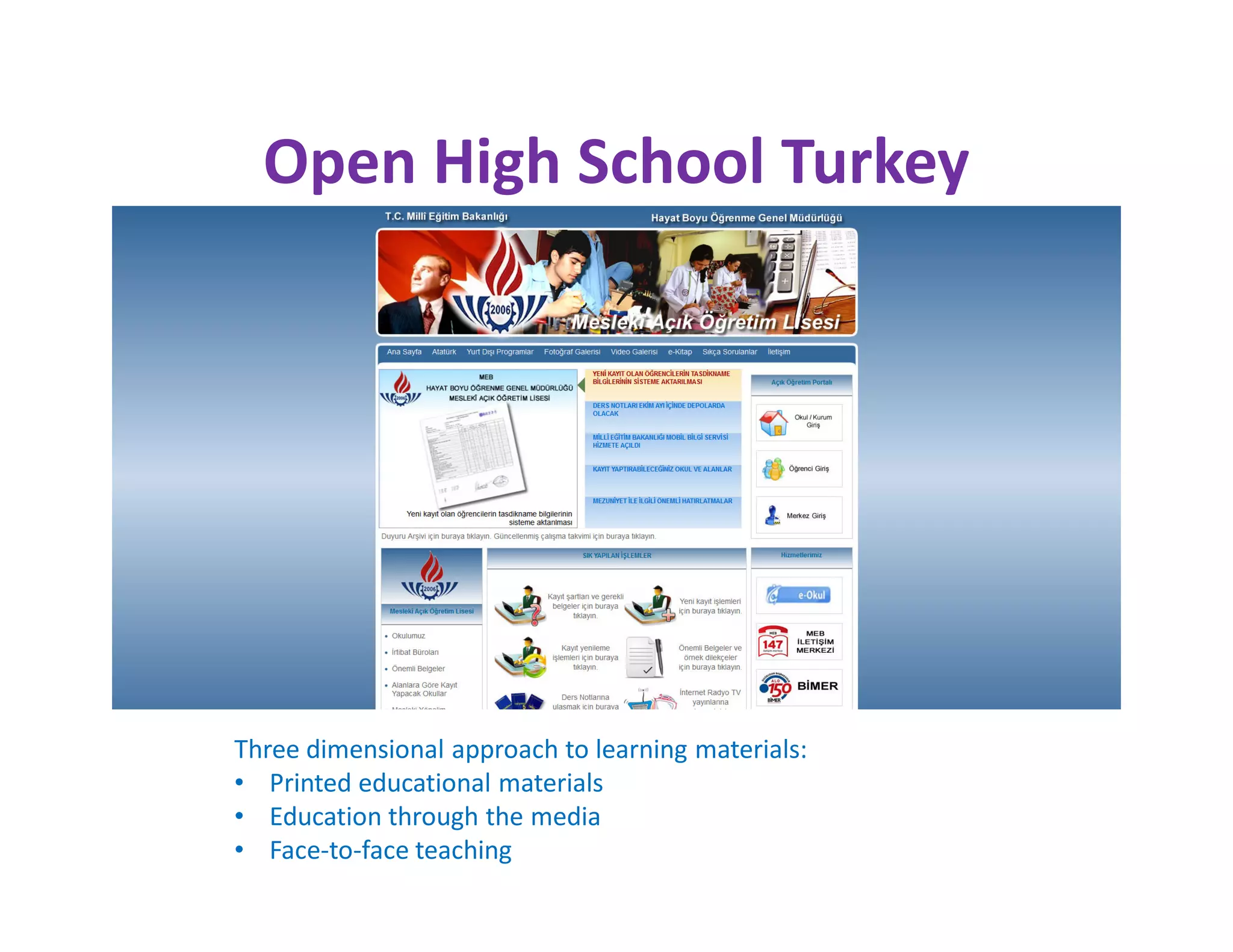
Open High School Turkey


Three dimensional approach to learning materials:
• Printed educational materials
• Education through the media
• Face-to-face teaching
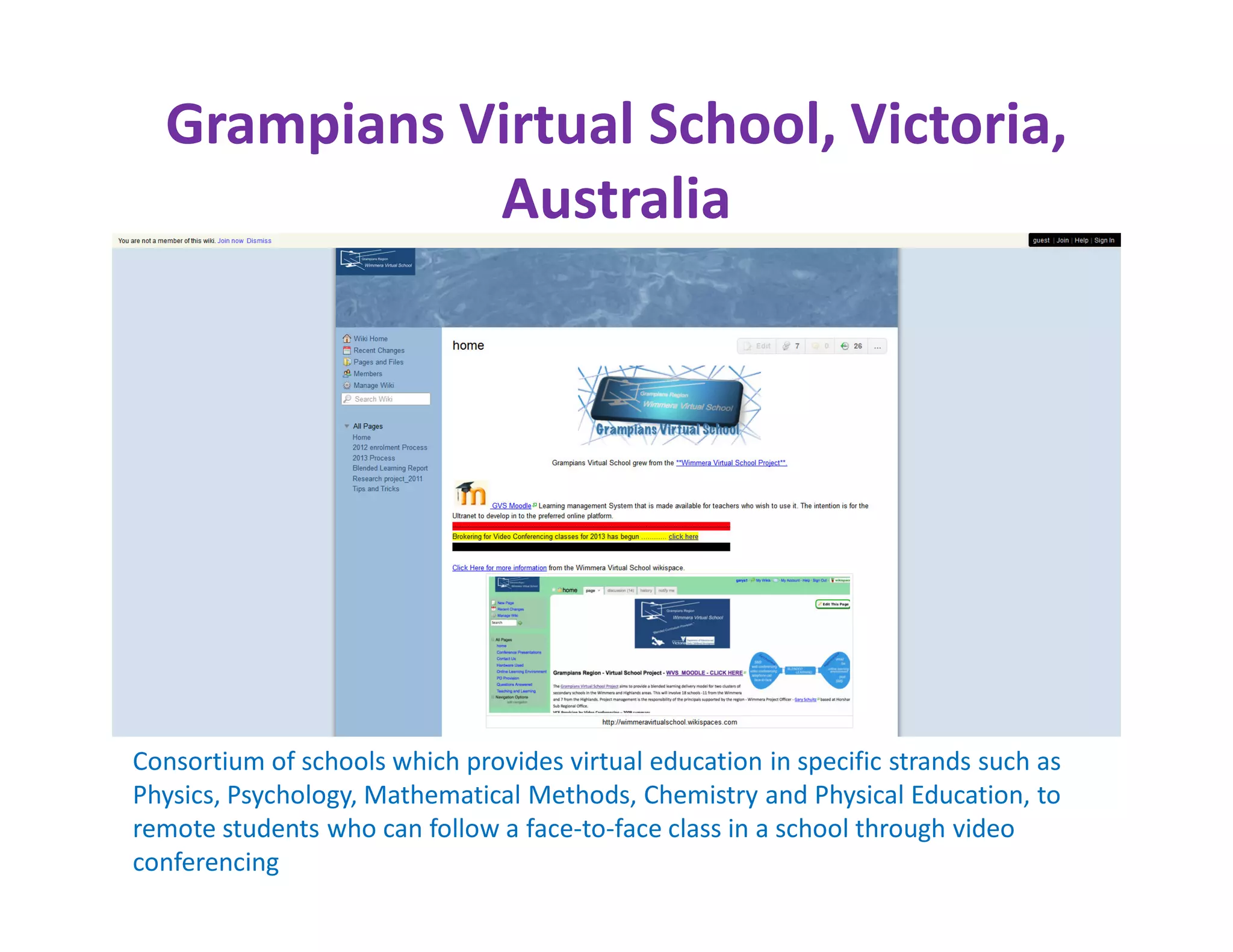
Grampians Virtual School, Victoria,
             Australia


Consortium of schools which provides virtual education in specific strands such as
Physics, Psychology, Mathematical Methods, Chemistry and Physical Education, to
remote students who can follow a face-to-face class in a school through video
conferencing
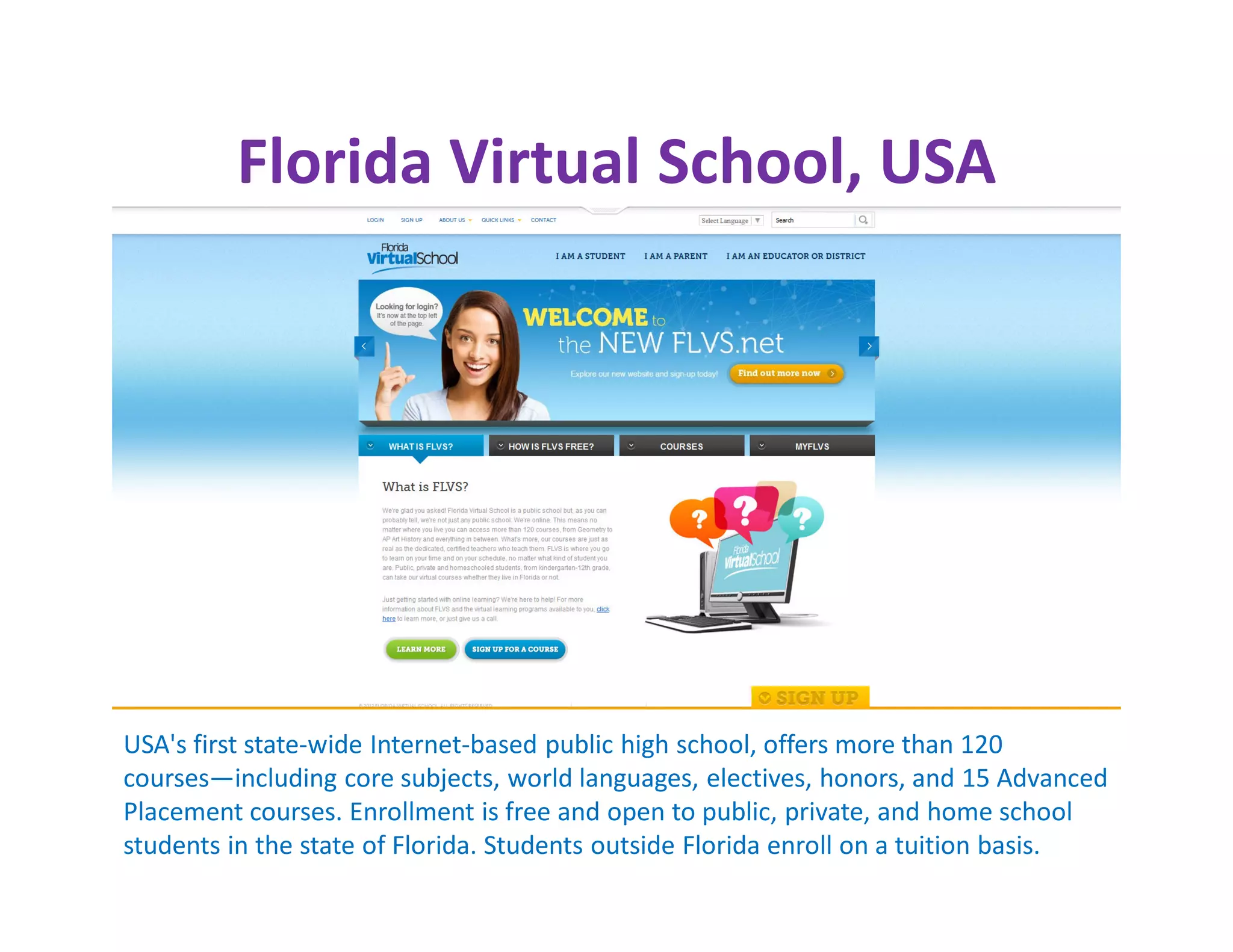
Florida Virtual School, USA


USA's first state-wide Internet-based public high school, offers more than 120
courses—including core subjects, world languages, electives, honors, and 15 Advanced
Placement courses. Enrollment is free and open to public, private, and home school
students in the state of Florida. Students outside Florida enroll on a tuition basis.
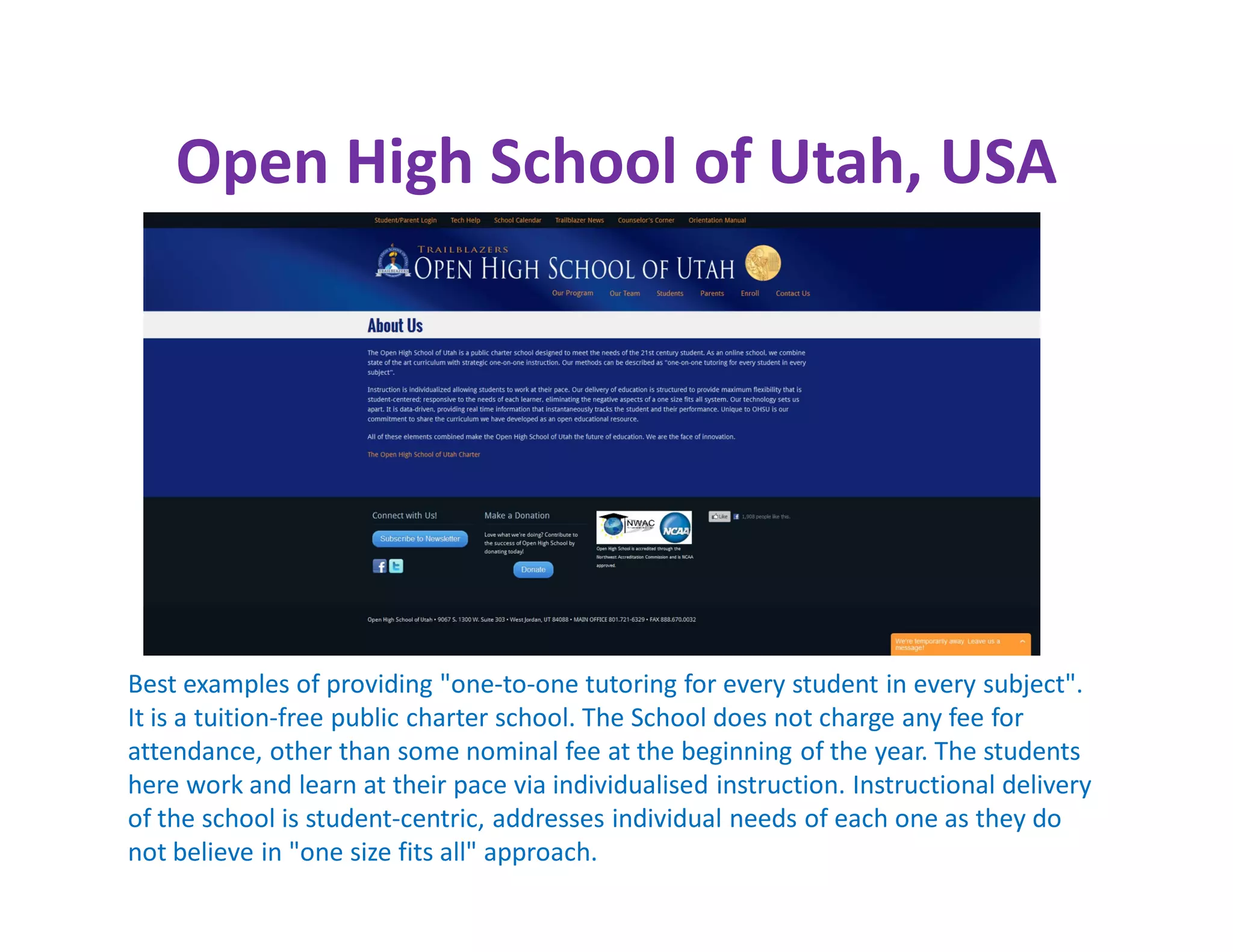
Open High School of Utah, USA


Best examples of providing "one-to-one tutoring for every student in every subject".
It is a tuition-free public charter school. The School does not charge any fee for
attendance, other than some nominal fee at the beginning of the year. The students
here work and learn at their pace via individualised instruction. Instructional delivery
of the school is student-centric, addresses individual needs of each one as they do
not believe in "one size fits all" approach.
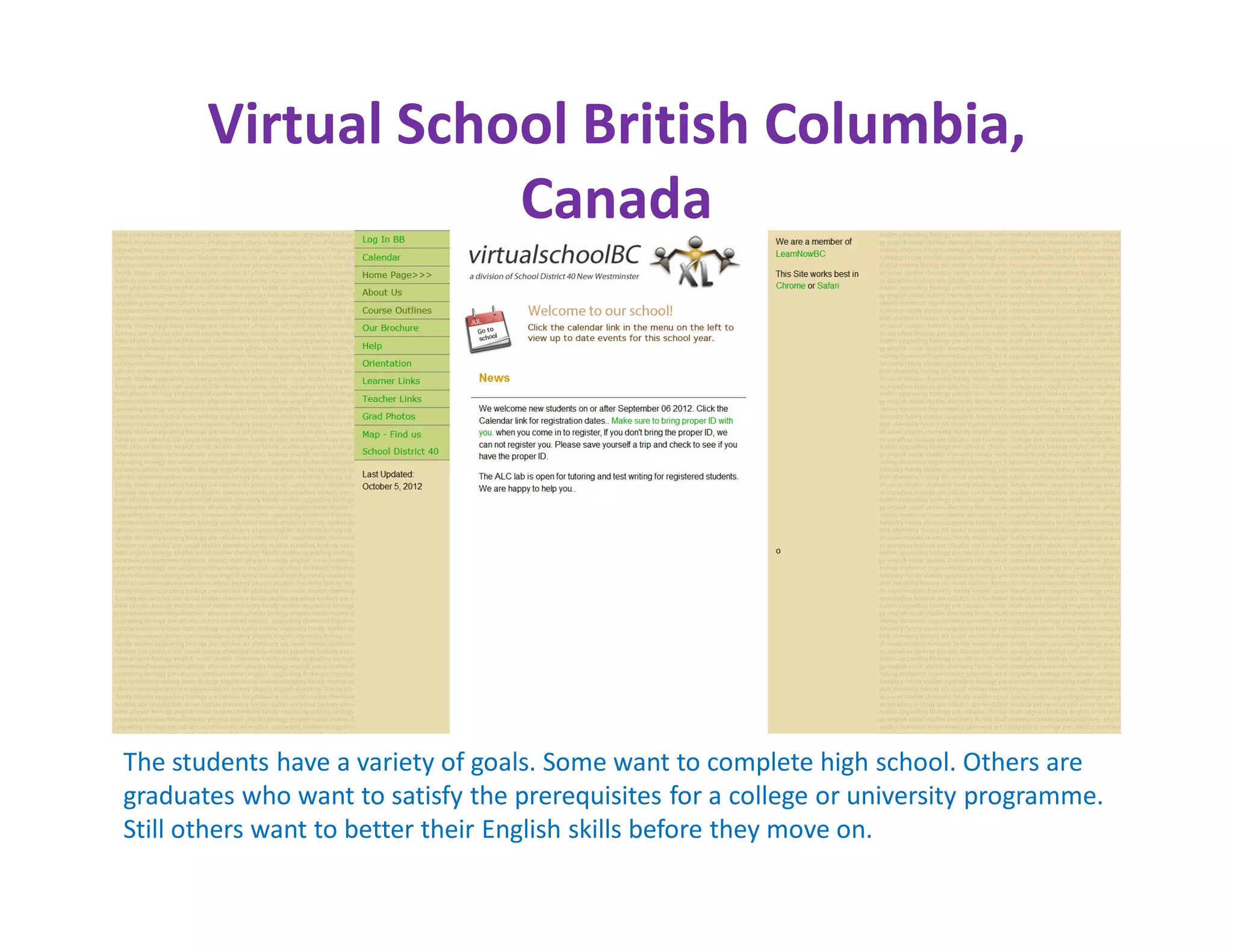
Virtual School British Columbia,
                   Canada


The students have a variety of goals. Some want to complete high school. Others are
graduates who want to satisfy the prerequisites for a college or university programme.
Still others want to better their English skills before they move on.
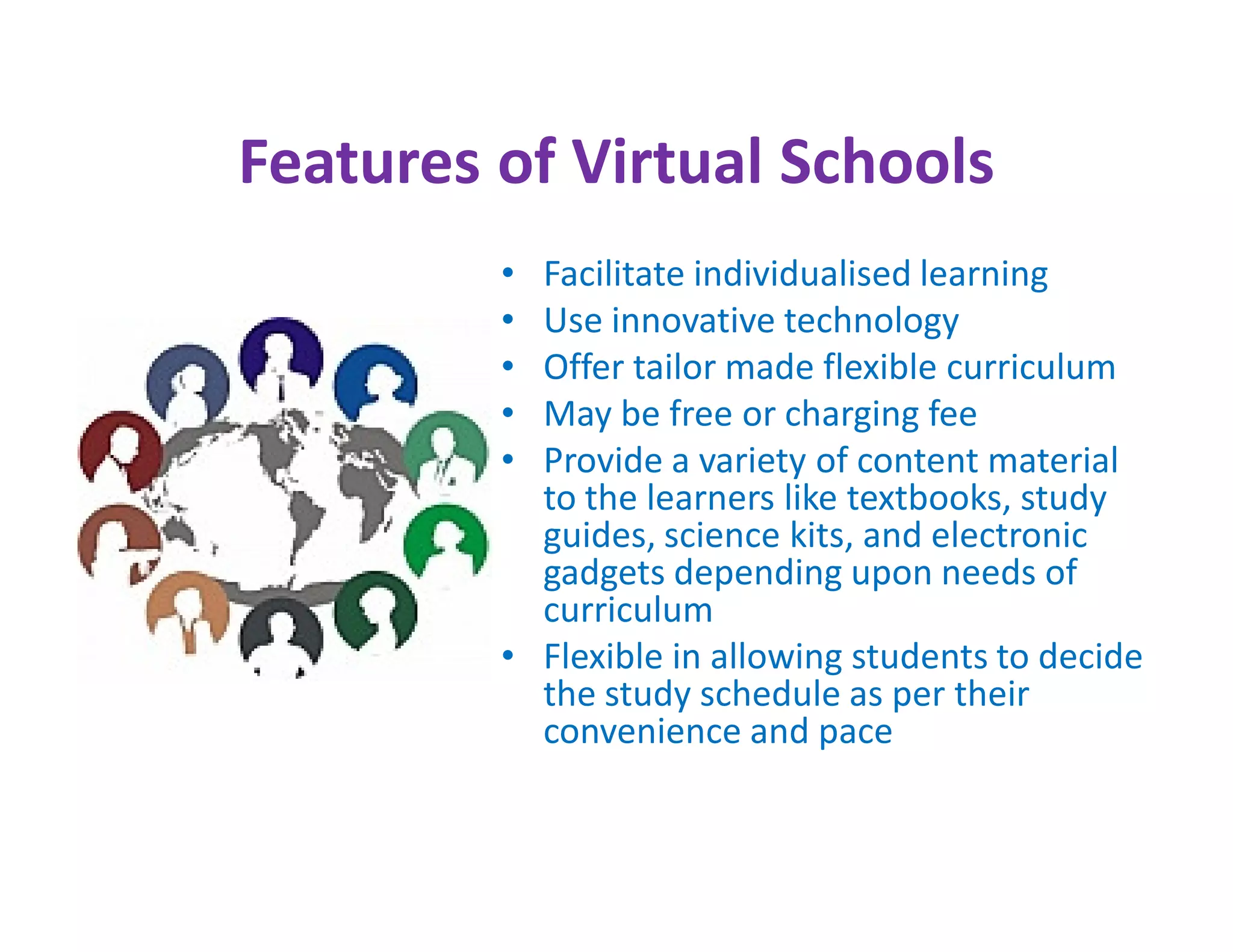
Features of Virtual Schools
         • Facilitate individualised learning
         • Use innovative technology
         • Offer tailor made flexible curriculum
         • May be free or charging fee
         • Provide a variety of content material
           to the learners like textbooks, study
           guides, science kits, and electronic
           gadgets depending upon needs of
           curriculum
         • Flexible in allowing students to decide
           the study schedule as per their
           convenience and pace
Management of Virtual Schools
Operations wise virtual schools may be:
• State owned
• College or university based,
• Consortium based,
• Public charter schools,
• Local education agency based,
• Private virtual schools, and
• For-profit virtual schools etc.
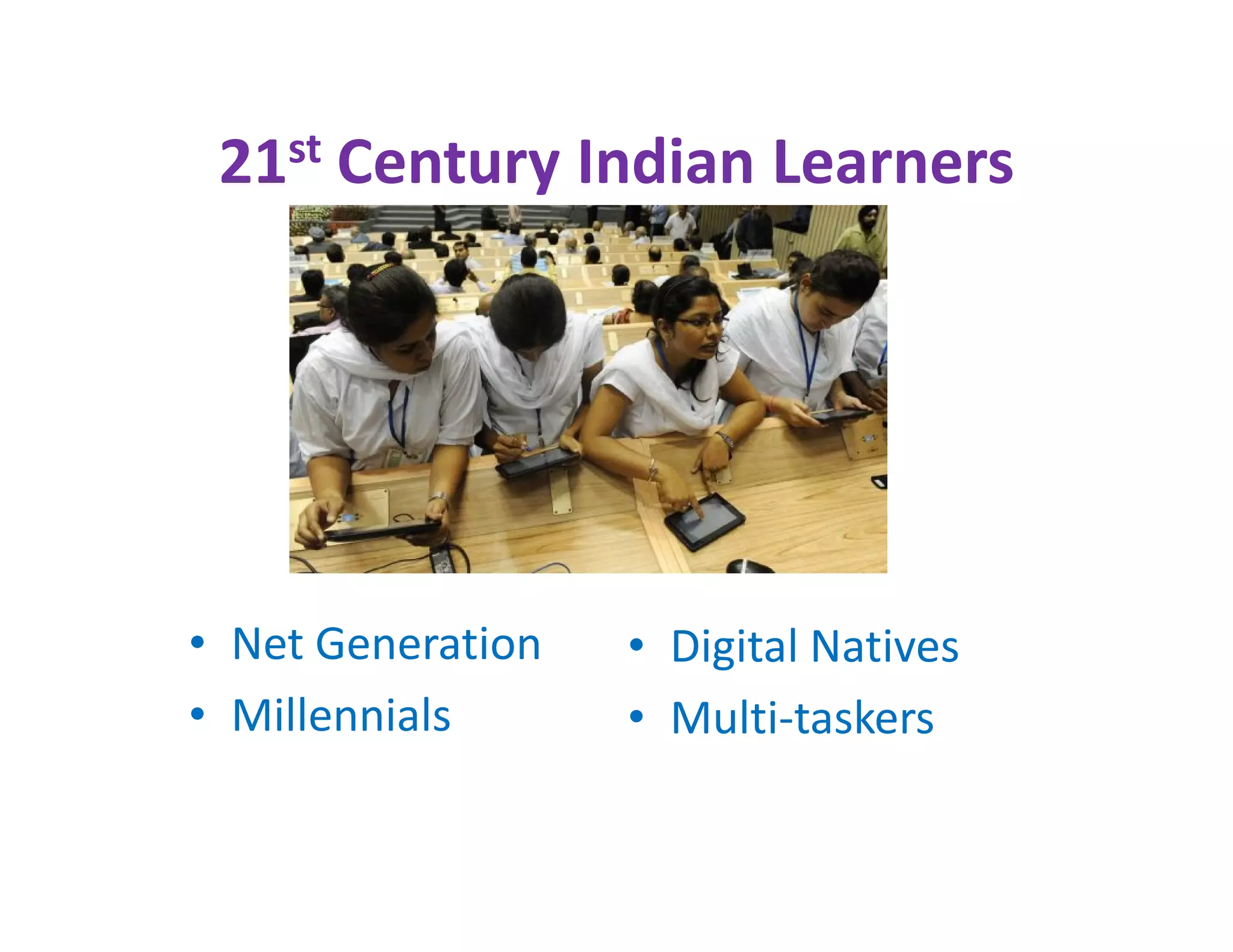
21st Century Indian Learners


• Net Generation   • Digital Natives
• Millennials      • Multi-taskers
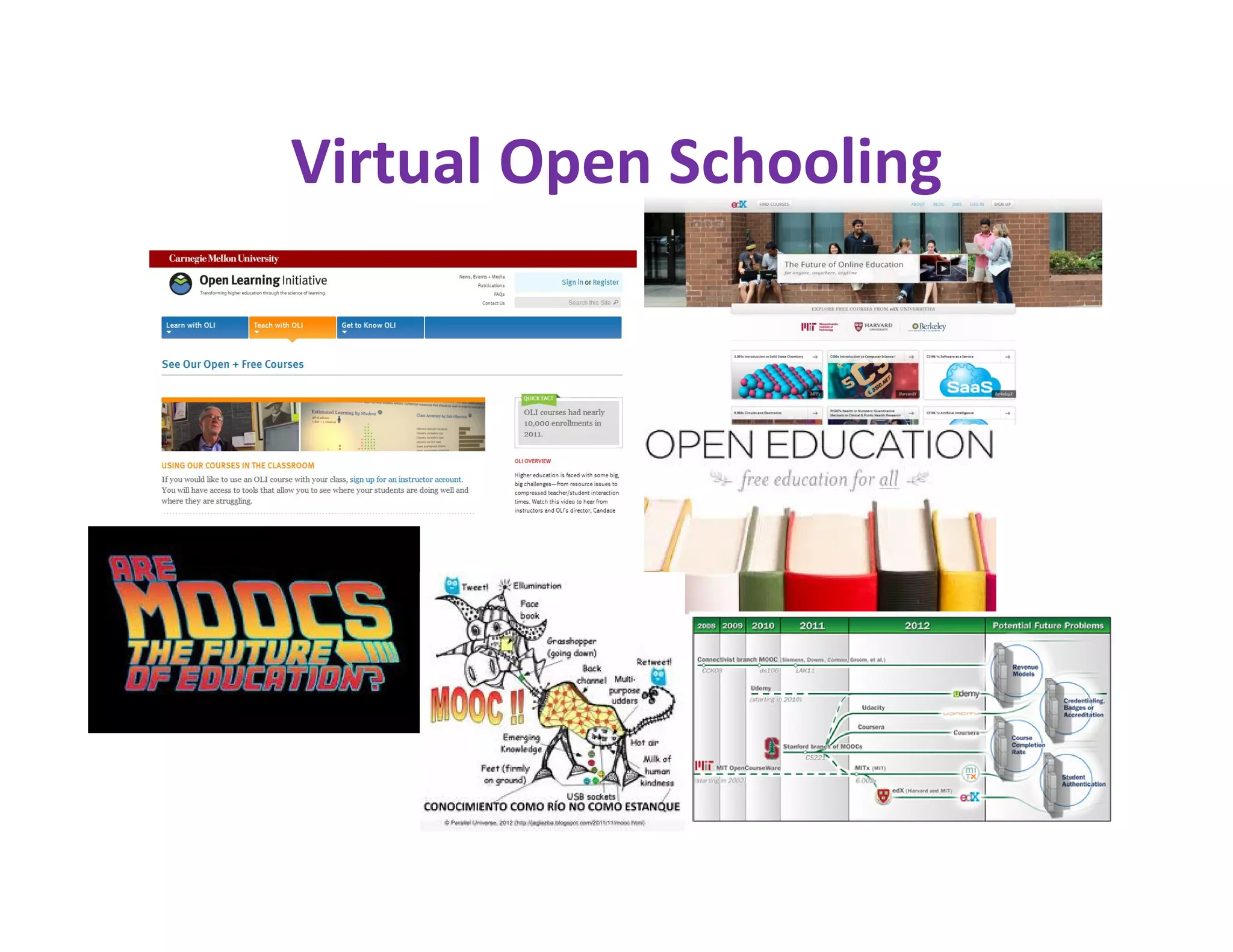
Virtual Open Schooling
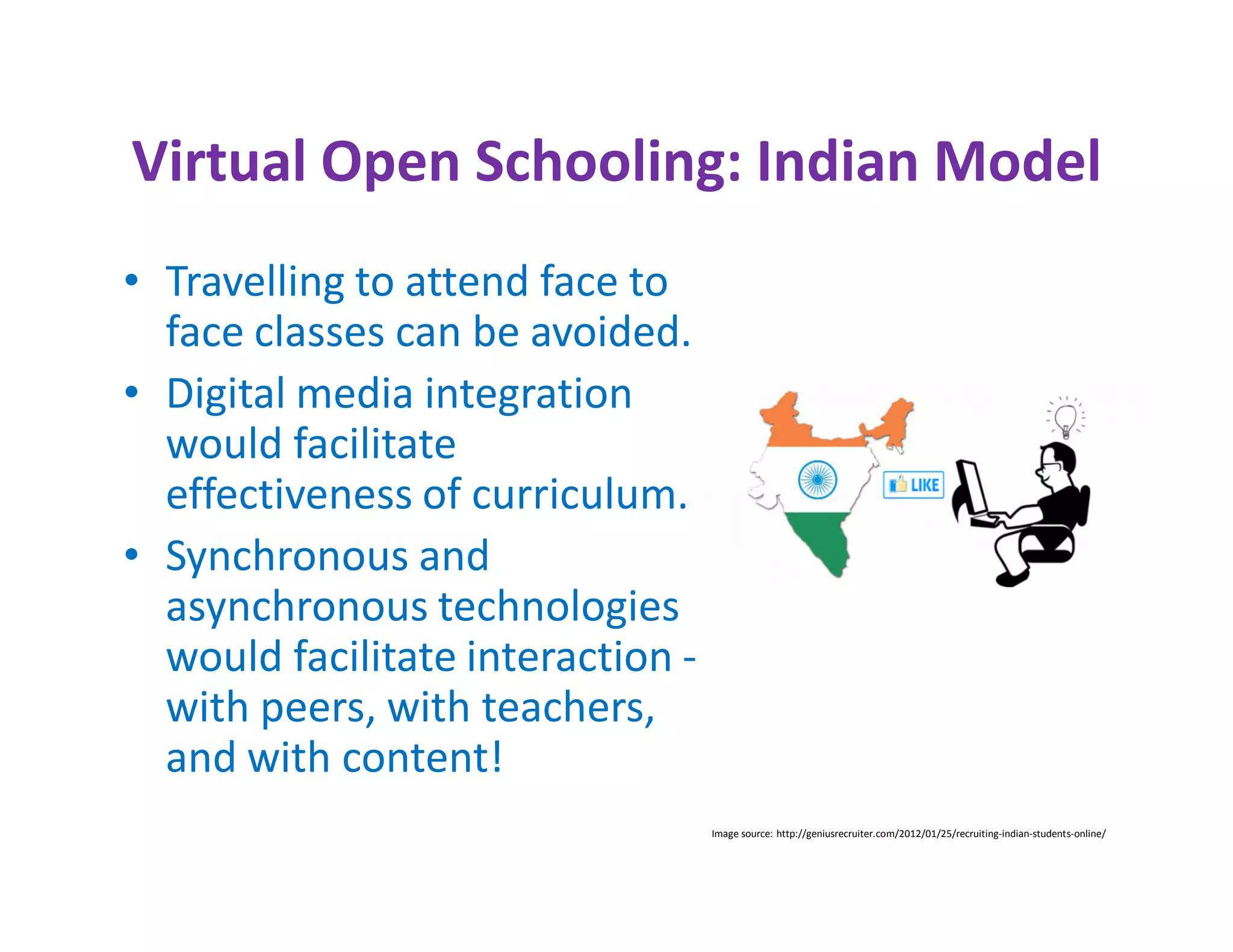
Virtual Open Schooling: Indian Model
• Travelling to attend face to
  face classes can be avoided.
• Digital media integration
  would facilitate
  effectiveness of curriculum.
• Synchronous and
  asynchronous technologies
  would facilitate interaction -
  with peers, with teachers,
  and with content!
                                   Image source: http://geniusrecruiter.com/2012/01/25/recruiting-indian-students-online/
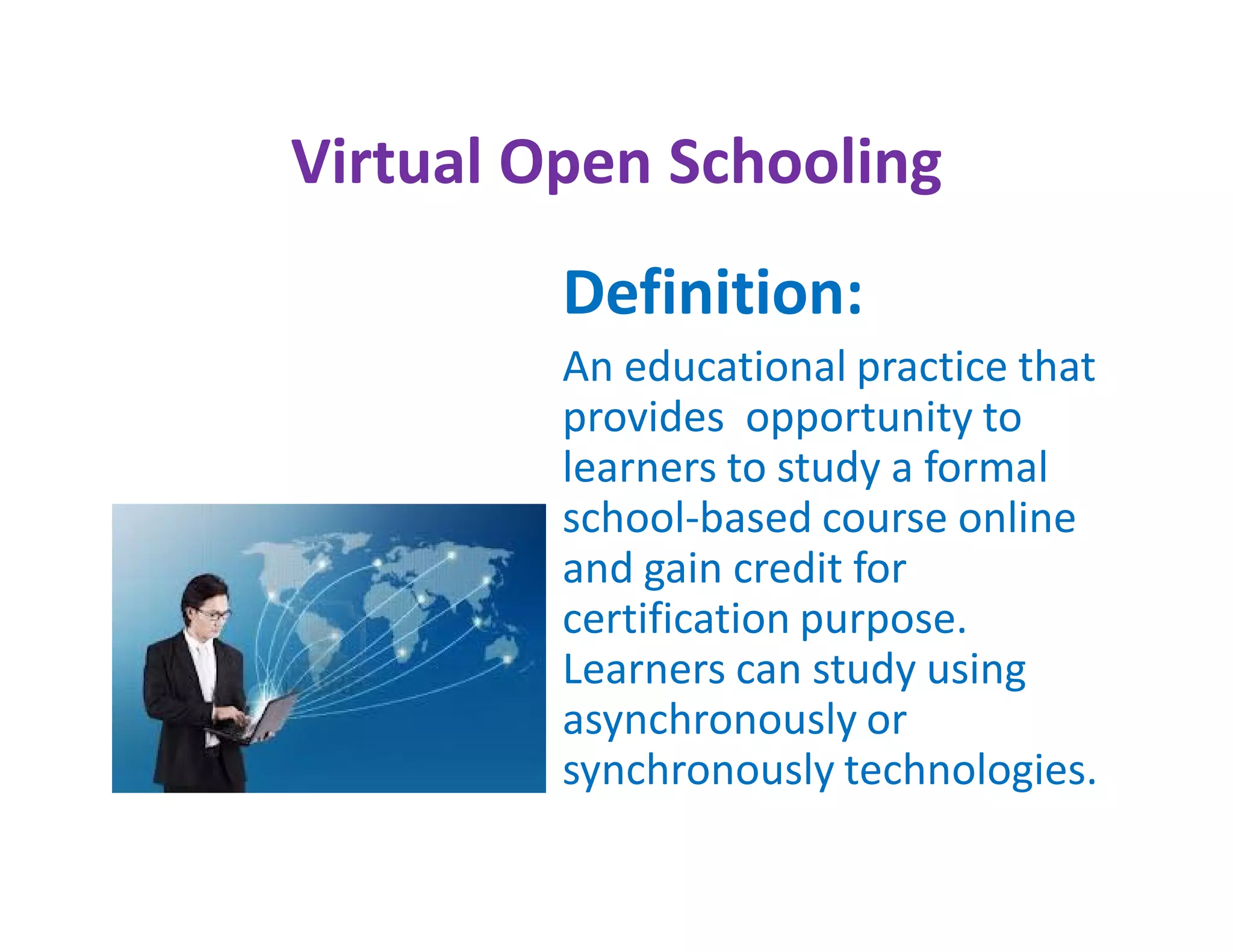
Virtual Open Schooling
         Definition:
         An educational practice that
         provides opportunity to
         learners to study a formal
         school-based course online
         and gain credit for
         certification purpose.
         Learners can study using
         asynchronously or
         synchronously technologies.
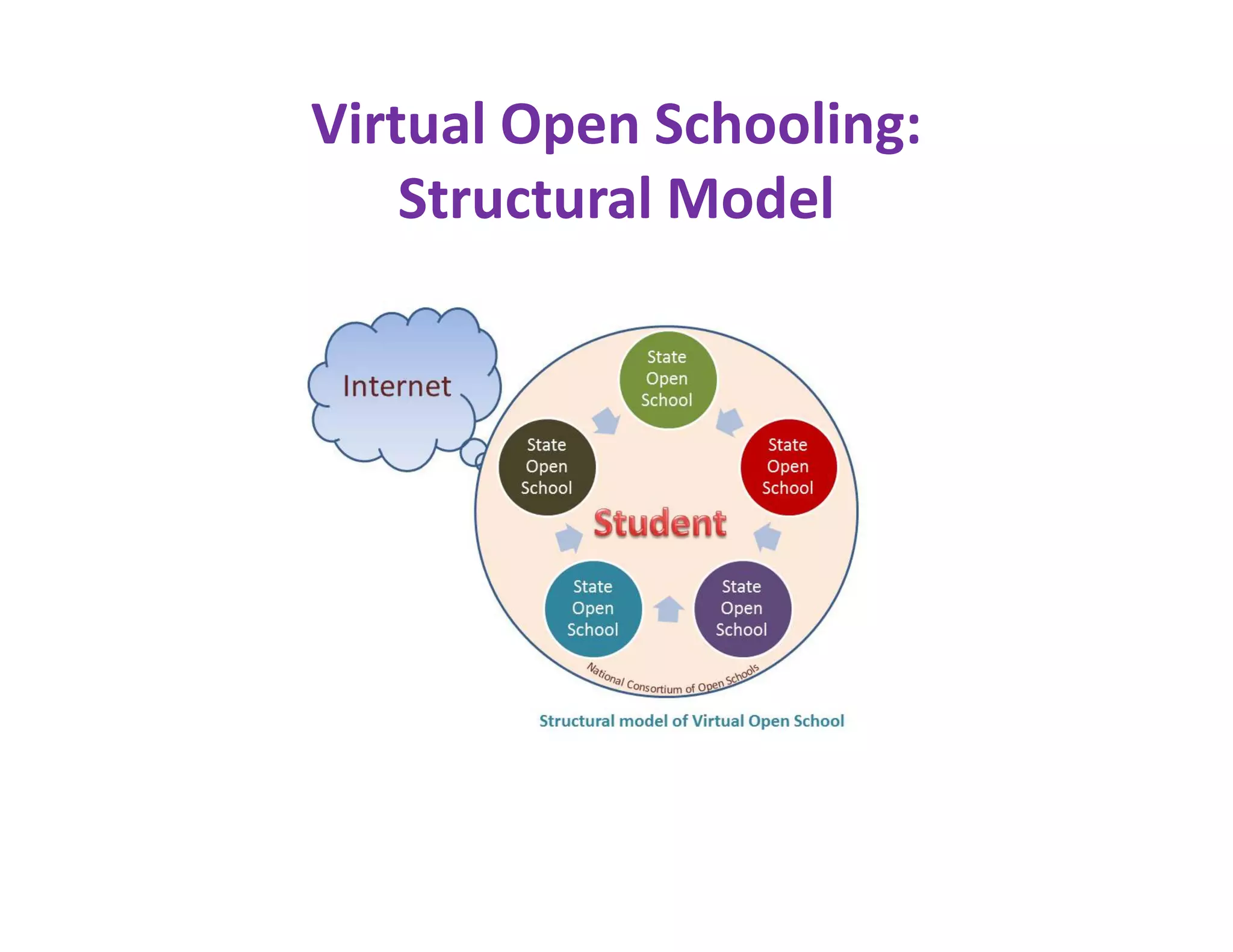
Virtual Open Schooling:
    Structural Model
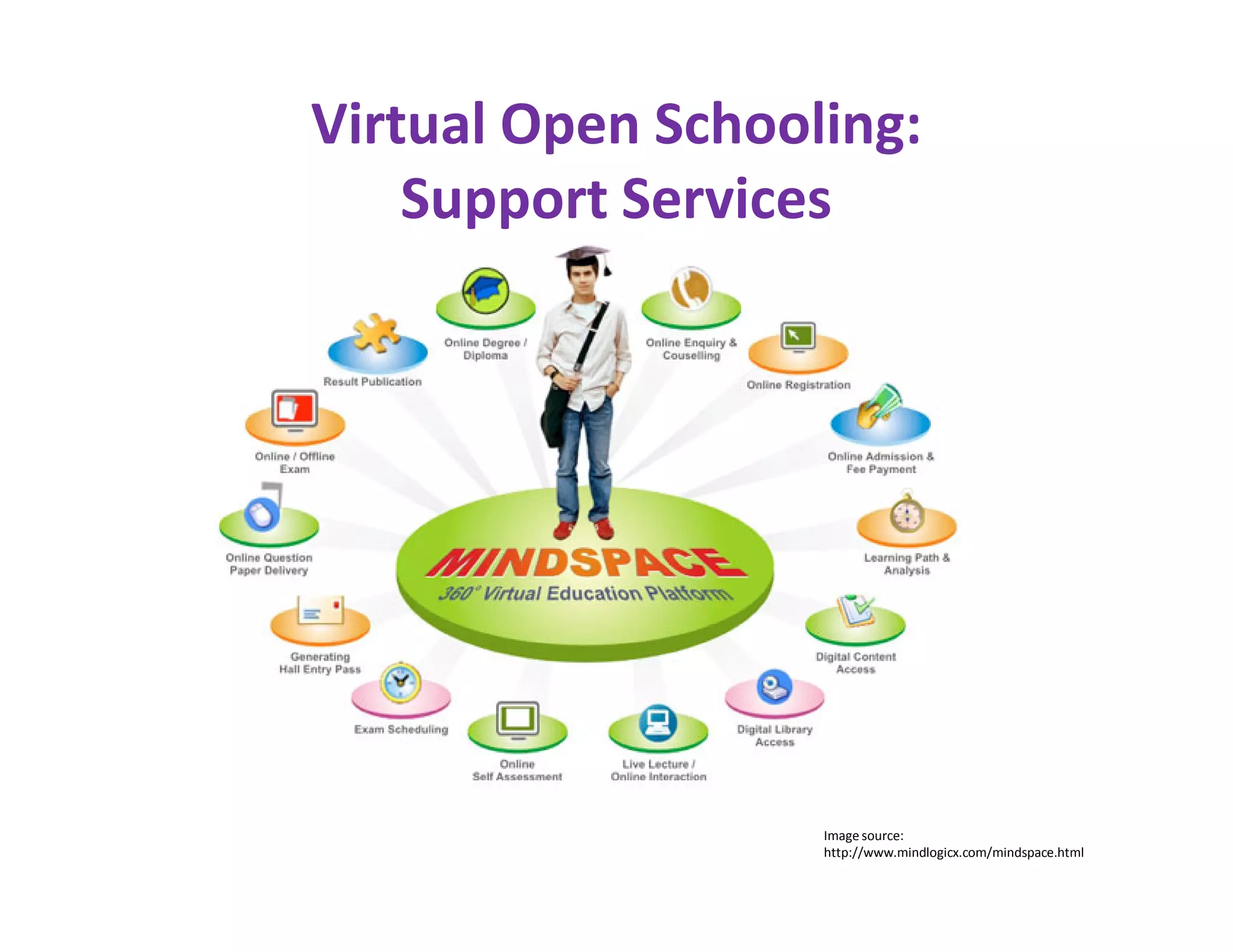
Virtual Open Schooling:
    Support Services


                   Image source:
                   http://www.mindlogicx.com/mindspace.html
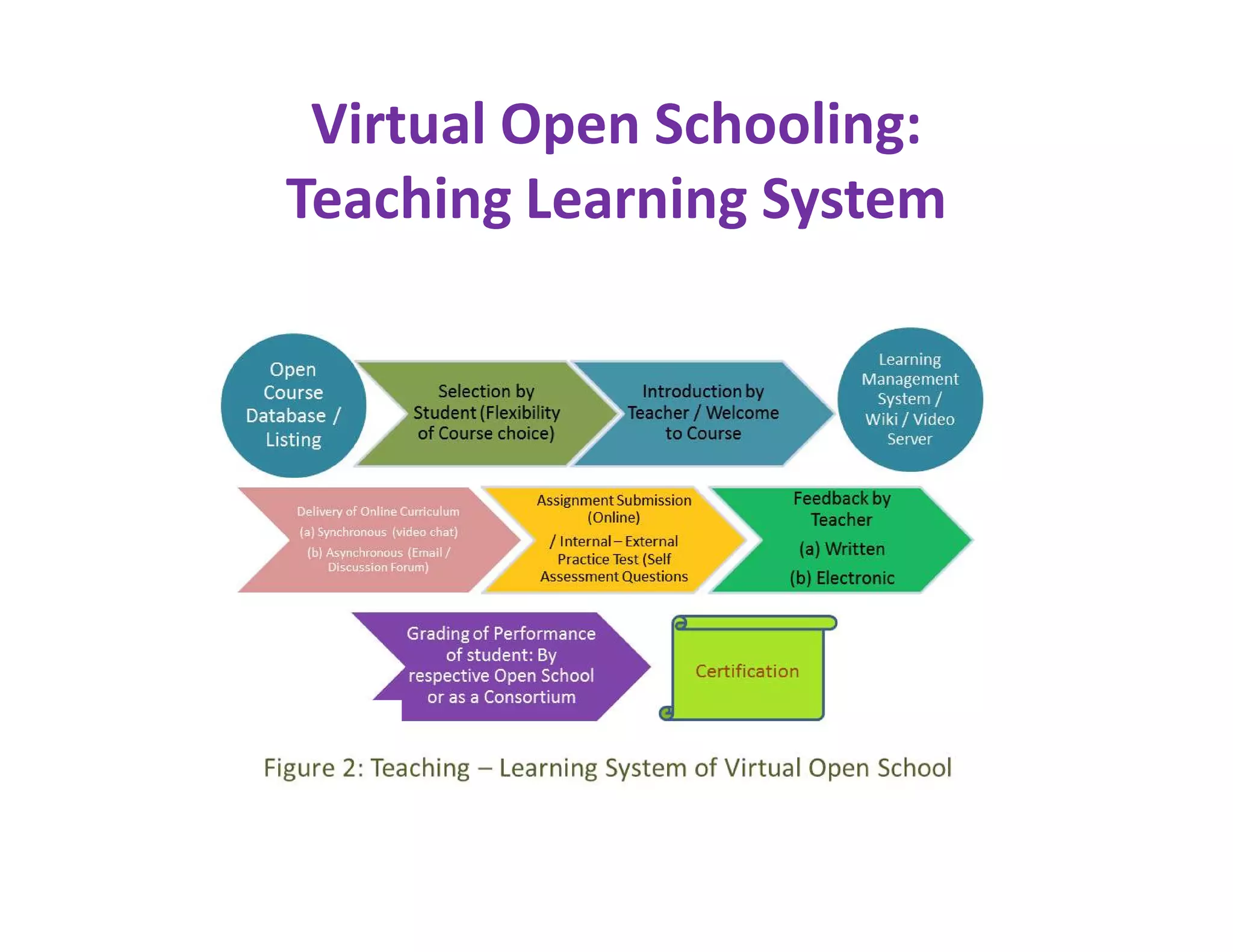
Virtual Open Schooling:
Teaching Learning System
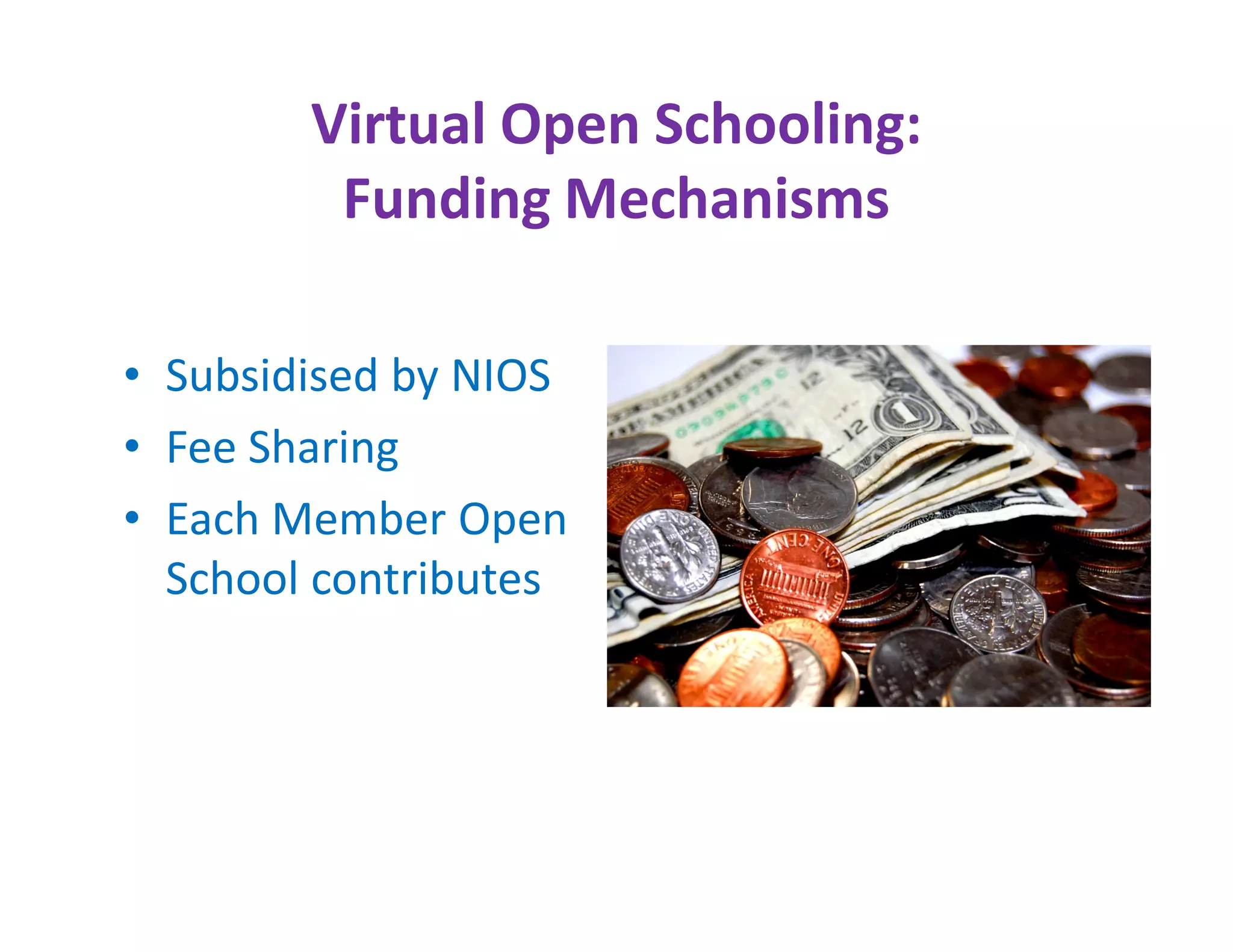
Virtual Open Schooling:
         Funding Mechanisms

• Subsidised by NIOS
• Fee Sharing
• Each Member Open
  School contributes
Technologies:
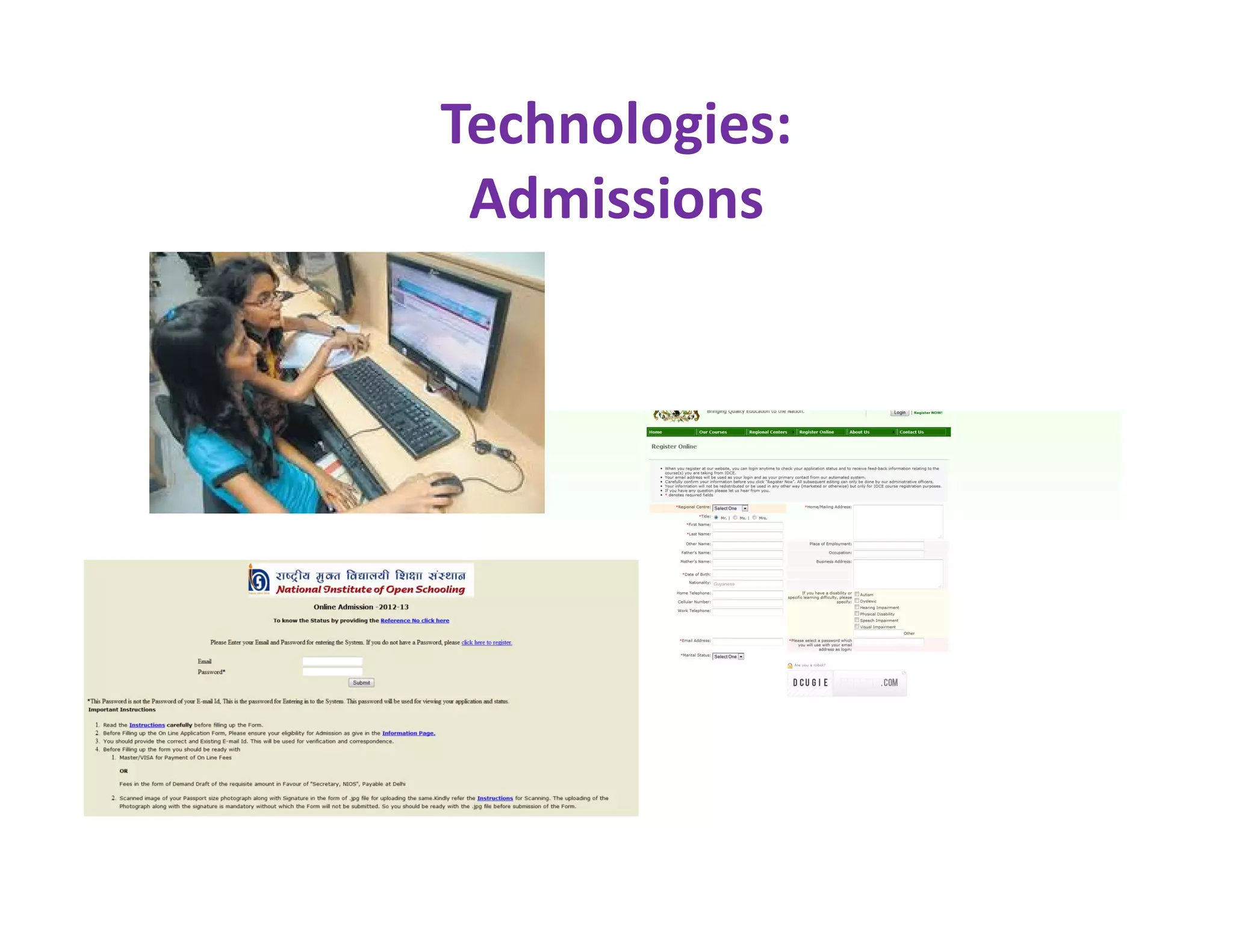
 Admissions
Technologies:
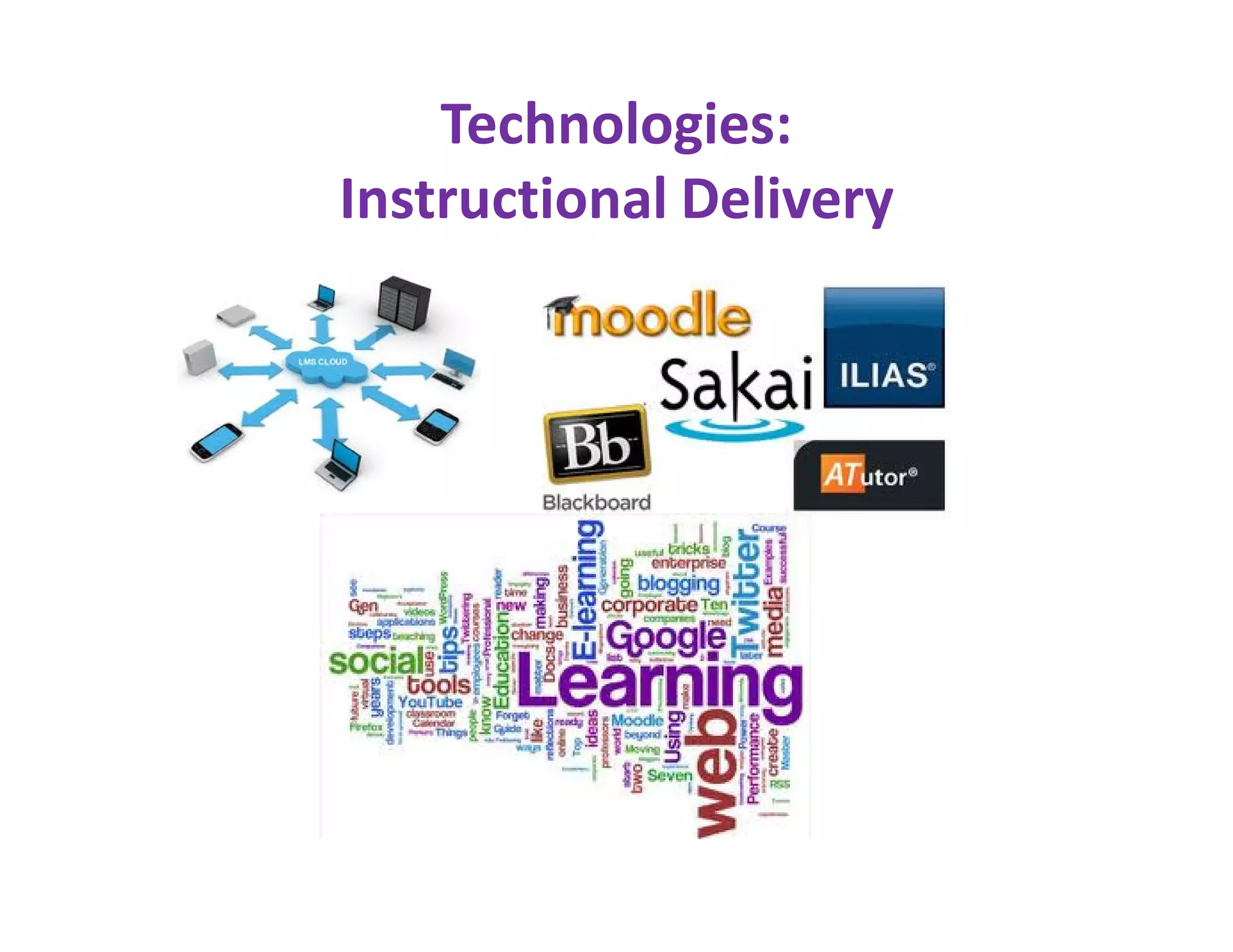
Instructional Delivery
Virtual Open Schooling:
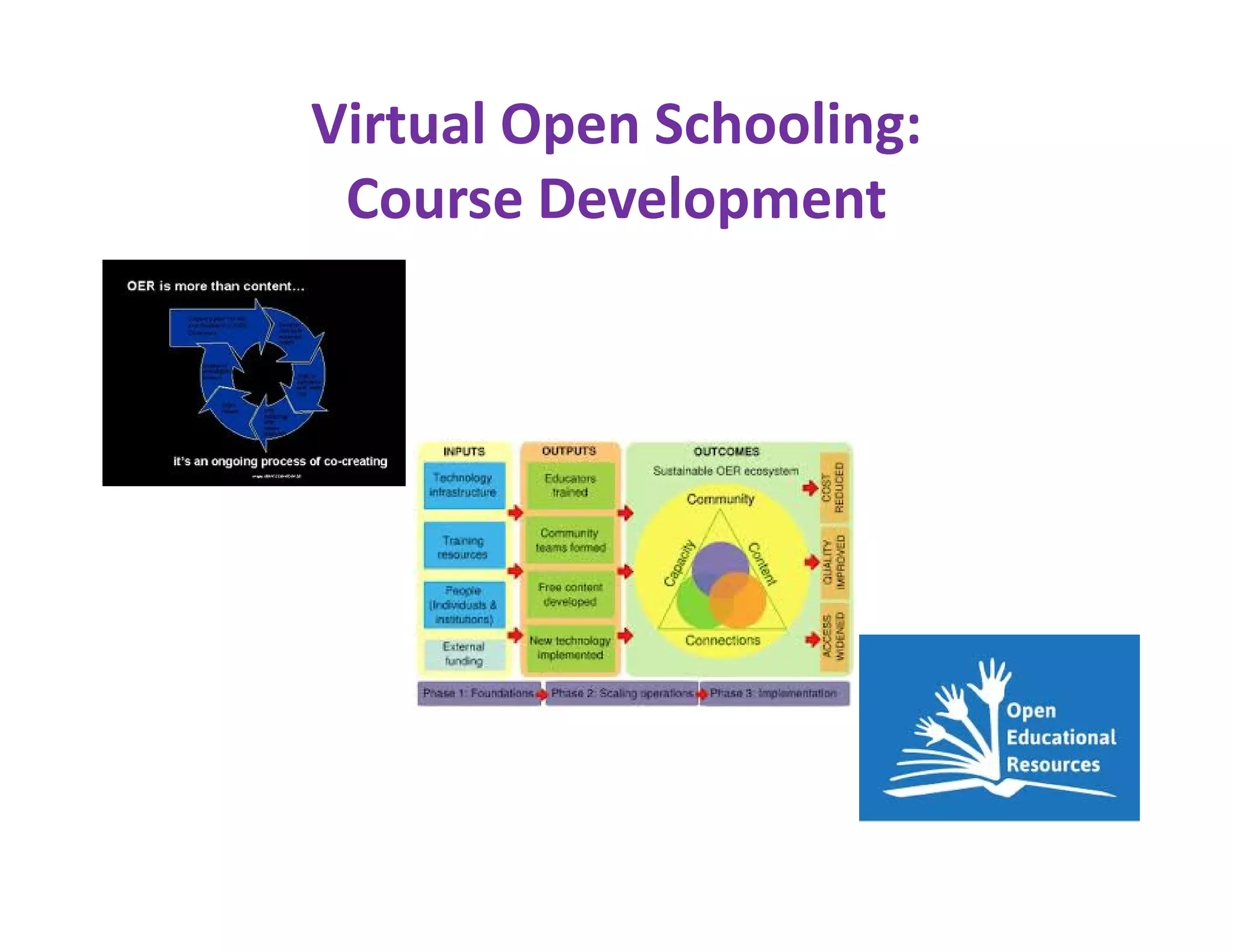
 Course Development
Virtual Open Schooling:
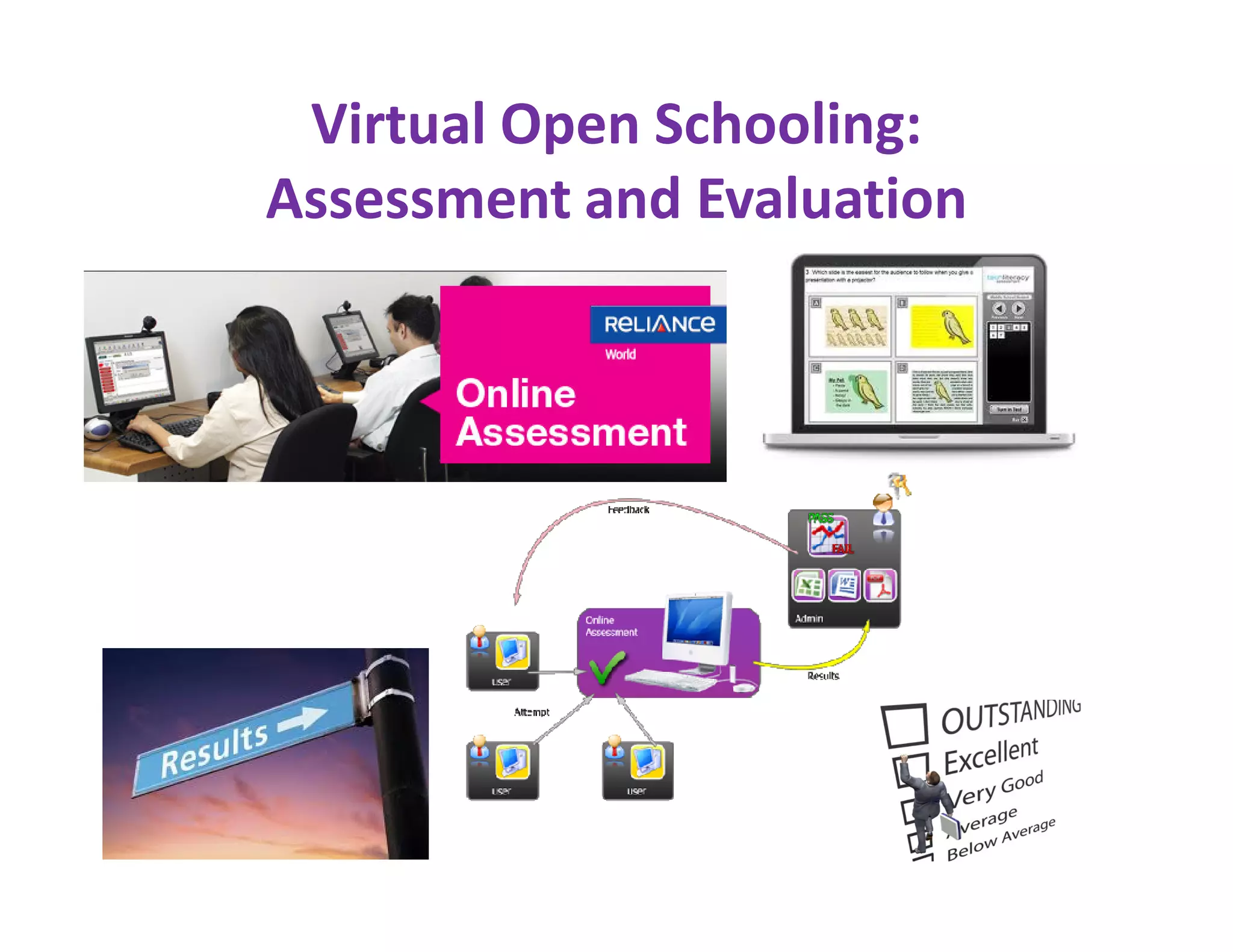
Assessment and Evaluation
Further Issues…
•   Development of ICT competencies in teachers
    and students
•   Pedagogical models suiting to different groups of
    students
•   Quality assurance of the e-learning courses
•   To anchor the work of the consortium and
    integrate it with overall VOS management
    strategies
•   Skepticism of teachers and management towards
    eLearning and technology based learning
•   Intellectual property rights and copyright
    pertaining to e-learning material
•   Research into e-learning pedagogies
Feedback session…
Virtual Open Schooling in India

Virtual Open Schooling in India

  • 1.
    National Consultative Workshopon Virtual Open Schooling in India Virtual Open Schooling in India Ramesh C. Sharma Organized by National Institute of Open Schooling (NIOS), Noida & Commonwealth Educational Media Centre for Asia, (CEMCA), New Delhi 16 October 2012
  • 2.
  • 3.
    Internet World ConnectionDensity Source: http://www.chrisharrison.net/index.php/Visualizations/InternetMap
  • 4.
    NMC Horizon Report- 2012 K-12 Edition Identifies top emerging technologies, trends, and challenges that will have a major impact on teaching, learning, and creative inquiry in pre-college education over the next five years. Most important key driver is that the education paradigms are shifting to include online learning, hybrid learning and collaborative models. Source: http://www.nmc.org/publications/2012-horizon-report-k12
  • 5.
    Alternatives to… Exclusive face to face learning • Internet - enabling learning anytime, anyplace Models • Online / Hybrid / Blended Learning Models
  • 6.
    Virtual (or online)Schools Where students can learn and carry out tasks online as they would have done them in a regular classroom Empower students to learn at their own pace, time and place convenient to them
  • 7.
    The International Associationfor K-12 Online Learning In United States 40 states have state virtual schools or state-led initiatives Source: http://www.inacol.org/press/docs/nacol_fast_facts.pdf
  • 8.
    Free online courseofferings to a broader global audience Harvard University and MIT recently announced “edX”, a combined $60 million joint initiative to offer their college-level courses online for free Source: http://singularityhub.com/2012/05/14/harvard-and-mit-join-forces-to-become-juggernaut-of-free-online-education/
  • 9.
    Reasons for success ofsuch online learning opportunities lies in the attempt by school districts in providing courses which are otherwise not available at their schools. Further the students can recover course credits from classes missed or failed.
  • 10.
    Benefits of VirtualSchools • Personalized, tailored content: suited to individual learning • Flexibility: Anywhere Anytime access, students can enrich their skills in learning a new subject or take up a course or class normally not available at their schools • Lower costs: Saves on permanent infrastructure costs • Access to high quality education: Access to quality teachers and peers, increases collaboration
  • 11.
    Cases of virtualschools around the world
  • 12.
    The African VirtualSchool To help students pass exams in West Africa . It does this by helping them revise using quizzes and videos online
  • 13.
    The Korean Air& Correspondence High School Serves the nation’s youth and adults who couldn’t get a diploma because they were forced to work in the factories to support their families or because they could not afford to pay for high school (students pay to go to most high schools in Korea)
  • 14.
    Open High SchoolTurkey Three dimensional approach to learning materials: • Printed educational materials • Education through the media • Face-to-face teaching
  • 15.
    Grampians Virtual School,Victoria, Australia Consortium of schools which provides virtual education in specific strands such as Physics, Psychology, Mathematical Methods, Chemistry and Physical Education, to remote students who can follow a face-to-face class in a school through video conferencing
  • 16.
    Florida Virtual School,USA USA's first state-wide Internet-based public high school, offers more than 120 courses—including core subjects, world languages, electives, honors, and 15 Advanced Placement courses. Enrollment is free and open to public, private, and home school students in the state of Florida. Students outside Florida enroll on a tuition basis.
  • 17.
    Open High Schoolof Utah, USA Best examples of providing "one-to-one tutoring for every student in every subject". It is a tuition-free public charter school. The School does not charge any fee for attendance, other than some nominal fee at the beginning of the year. The students here work and learn at their pace via individualised instruction. Instructional delivery of the school is student-centric, addresses individual needs of each one as they do not believe in "one size fits all" approach.
  • 18.
    Virtual School BritishColumbia, Canada The students have a variety of goals. Some want to complete high school. Others are graduates who want to satisfy the prerequisites for a college or university programme. Still others want to better their English skills before they move on.
  • 19.
    Features of VirtualSchools • Facilitate individualised learning • Use innovative technology • Offer tailor made flexible curriculum • May be free or charging fee • Provide a variety of content material to the learners like textbooks, study guides, science kits, and electronic gadgets depending upon needs of curriculum • Flexible in allowing students to decide the study schedule as per their convenience and pace
  • 20.
    Management of VirtualSchools Operations wise virtual schools may be: • State owned • College or university based, • Consortium based, • Public charter schools, • Local education agency based, • Private virtual schools, and • For-profit virtual schools etc.
  • 21.
    21st Century IndianLearners • Net Generation • Digital Natives • Millennials • Multi-taskers
  • 22.
  • 23.
    Virtual Open Schooling:Indian Model • Travelling to attend face to face classes can be avoided. • Digital media integration would facilitate effectiveness of curriculum. • Synchronous and asynchronous technologies would facilitate interaction - with peers, with teachers, and with content! Image source: http://geniusrecruiter.com/2012/01/25/recruiting-indian-students-online/
  • 24.
    Virtual Open Schooling Definition: An educational practice that provides opportunity to learners to study a formal school-based course online and gain credit for certification purpose. Learners can study using asynchronously or synchronously technologies.
  • 25.
    Virtual Open Schooling: Structural Model
  • 26.
    Virtual Open Schooling: Support Services Image source: http://www.mindlogicx.com/mindspace.html
  • 27.
  • 28.
    Virtual Open Schooling: Funding Mechanisms • Subsidised by NIOS • Fee Sharing • Each Member Open School contributes
  • 29.
  • 30.
  • 31.
    Virtual Open Schooling: Course Development
  • 32.
  • 33.
    Further Issues… • Development of ICT competencies in teachers and students • Pedagogical models suiting to different groups of students • Quality assurance of the e-learning courses • To anchor the work of the consortium and integrate it with overall VOS management strategies • Skepticism of teachers and management towards eLearning and technology based learning • Intellectual property rights and copyright pertaining to e-learning material • Research into e-learning pedagogies
  • 34.