9/14/2018 1
AREAS of
CONCERN in
CEP
Arlyn F.Perin
Discussant
Distance Education
Online Education(Degree and certificate Programs)
CEP for 21st Century Education
• Interactive and Interdependent Learning
• Aunthentic Vs artificial learning
• Learning environment for millenials
9/14/2018 3
Open Learning/Distance Education
• alternative system of education which emphasize the
opening of opportunities by overcoming barriers that
result from geographical isolation, personal or work
commitments or conventional course structures which
have often prevented people from realizing their
educational goal.
● philosophy of learning that is learner- centered and
flexible, enabling learners to learn at a time, place and
pace which satisfies their circumstances and
requirements.
9/14/2018 4
Distance Education
• any educational or learning procedure in which the
guide and the student are separated by time and space.
●It involves acquiring information from methods other
then the traditional way of gaining knowledge – attending
institutions.
●influenced a lot by computer and electronics technology.
The technology has now made it possible for the guide
and student to connect almost immediately. Study
resources can be delivered instantly through computers,
satellites, internet, cable television, interactive video etc
All subjects offered in distance education shall
adhere to the following guiding principles
• Learner-Centeredness. Distance education program shall
focus on the needs of the learner and the goal of facilitating
independent learning. These program shall not be driven
merely by available technologies but rather by the need to
enable demonstrable learning in an accessible
environment.
• Rigorous and Sound Instructional Design. Distance
education shall be equivalent in challenge and depth to
conventional program .Academically qualified individuals
must take instructional design decisions in the
analysis, design, development, implementation and
evaluation of distance education course.
9/14/2018 5
All subjects offered in distance education shall
adhere to the following guiding principles
• Transparency and Peer Review to Guide Informed
Choice.
Distance education implementers shall make information
about their programs, particularly in the curriculum delivery system,
instructional materials development, delivery mode strategies,
student support services, and other relevant information available to
accrediting bodies, academic peers, regulators, students. Updates
information shall be available through media such as world wide web.
• Public Responsibility and Accountability. Implementers
shall take heed of the public impact on DE programs and
shall always exercise due diligence in avoiding harm to
program stakeholders specially students. Consumer
protection shall be priority because of high value that
Filipinos put on education.
9/14/2018 6
All subjects offered in distance education shall
adhere to the following guiding principles
• Quality and Continuous Improvement
Implementers shall embed in their program framework the
proactive identification of students and stakeholder needs and the
monitoring of student and stakeholder satisfaction in order to
continuously improve all aspects of development and delivery.
9/14/2018 7
What is the basis of Distance
Education in the Philippines?
• It is mandated by Republic Act No. 10650, also known
as the Open and Distance Learning Act of 2014 to assist
the Commission on Higher Education (CHED) and
the Technical Education and Skills Development
Authority (TESDA) on their open distance learning
functions.
9/14/2018 8
Specialized Academic Program
of Distance Education
• Open University/Online Education
• Non-Traditional Study Program
• ETTEAP
• CONTINUING EDUATIONAL
PROGRAM
9/14/2018 9
OPEN UNIVERSITY SYSTEM
• Open universities offer distance education
using specific didactics and media.
• The goal of open universities is to offer
everyone equal opportunities to develop their
competences, to raise their level of education
and to receive retraining.
• it is also a way of attracting potential students
that at one point, would like to enrol and
pursue a degree.
9/14/2018 10
9/14/2018 11
Schools, Colleges, and Universities in the
Philippines That Offer Online Education
• University of the Philippines Open University
• Polytechnic University of the Philippines Open University
• Central Luzon State University Open University
• Pangasinan State University Open University Systems
• University of Northern Philippines
• Mariano Marcos State University
• CAP College Foundation
• Cebu Technological University
• New Era University
• John B. Lacson Foundation Maritime University
• Holy Angel University
• Asian Institute of Journalism and Communication
• Philippine Stock Exchange
• Undergraduate Programs
Associate in Arts
Bachelor of Arts in Multimedia Studies
Bachelor of Education Studies
• Graduate Certificate Program
Graduate Certificate in ASEAN Studies
Graduate Certificate in Distance Education (within the Master of
Distance Education)
9/14/2018 12
University of the Philippines Open University
• Post-Baccalaureate Diploma
Programs
• Diploma in Social Work
• Diploma in Computer Science
• Diploma in International Health
• Diploma in Research and Development Management
• Diploma in Environment and Natural Resources
Management
• Diploma in Land Valuation and Management
• Diploma in Science Teaching
• Diploma in Math Teaching
• Diploma in Language and Literacy Education for
Teachers
• Diploma in Social Studies Education
9/14/2018 13
Master’s
– Master of Distance Education
– Master of Arts in Language and Literacy Education
– Master of Arts in Social Studies Education
– Master of Development Communication
– Master of Information Systems
– Master of ASEAN Studies
– Master of International Health
– Master of Land Valuation & Management
– Master of Social Work
– Master of Arts in Nursing
– Master of Public Management
– Master of Environment and Natural Resources
Management
9/14/2018 14
DOCTORAL
- Doctor of Philosophy
in Education
(Biology
Education, Chemistry
Education, Physics
Education, Mathematics
Education)
– Doctor of
Communication
(DComm)
9/14/2018 15
●Non-formal Courses
• Caring for the Special Child
• Caring for the Elderly
• Community Mental Health
• Health Research Methods
• New Enterprise Planning
• Online Teaching and Learning
• Organic Agriculture
• Personal Entrepreneurial
Development
• Introduction to E-Commerce
• Professional Teaching
Certification
• Simplified Accounting for
Entrepreneurs
• Continuing Professional
Education Program on Land
Valuation
Expanded Tertiary Education Equivalency and
Accreditation Program (ETEEAP)
• Is an alternative education program in the Philippines
that allows working professionals who were not able to
finish their college education or were completely unable
to step into college to earn a bachelor’s degree without
going through traditional schooling methods.
9/14/2018 16
• Under this program, professionals with five or more
years of working experience can use the knowledge,
experiences, and achievements they obtained through
their jobs to earn school credits that are then deducted
from the total number of units that they are required to
earn before they graduate.
• This way, the more professional experience the ETEEAP
student demonstrates, the sooner he or she can earn his
or her bachelor’s degree.
9/14/2018 17
Legitimacy of the Program
• ETEEAP operates by virtue of Executive Order Number
330 signed by former President Fidel V. Ramos on May
10, 1996.
• It is currently administered by the Commission on
Higher Education (CHED) and colleges or universities
that wish to offer it as part of their academic programs
must gain CHED’s approval first.
9/14/2018 18
Differences Between ETEEAP
and Traditional Schooling
• With ETEEAP, the basic concept is the same. The more
units you can complete at a given time, the faster you’re
going to graduate; however, compared with traditional
schooling where you can, at most, graduate several
months in advance if you were able to take up and
complete more units than the regular school curriculum
imposes, ETEEAP allows professionals to complete
their degree in about a year or so by having their
professional experiences evaluated and used in
exchange for academic credits.
• Also, most of the colleges and universities that
implement ETEEAP also offer the program online, so
anyone can take the course from anywhere in the world
as long as they have a computer and access to the
internet.
9/14/2018 19
What is the classroom setting
of ETEEAP Classes
• ETEAAP classes are mostly conducted like traditional
college classes — students gather in a room, listen to
discussion, participate in recitation, do some seat work,
submit assignments, and the like.
• The only major difference is things you would normally
study in four to five years will be tackled in about a year,
so the lessons are very fast-paced and straightforward.
• Also, project studies or theses are done individually as
opposed to traditional schooling where they can be done
in groups.
9/14/2018 20
• As for students studying overseas, classes are usually
done through e-mail exchanges, instant messaging (YM,
FB Chat, Google Chat), and video calls (YM, Skype)
while project studies are sometimes submitted through
courier.
9/14/2018 21
Do ETTEAP class has
Graduation too?
• ETEEAP graduates are awarded corresponding degrees
upon their successful completion of the program. They
then go through graduation rites like traditional college
graduates, although it is up to them whether they want to
march onstage or they want to skip the event altogether.
• If you enrolled in a course or program that has a
licensure examination, you will have the option to take
the board exam for additional leverage in seeking
employment or more advanced career opportunities.
9/14/2018 22
What are the qualifications
to enroll?
An ETEEAP candidate must meet the following
qualifications: Filipino, at least high school graduate or must
have PEPT equivalent to first year college.
• Has at least five (5) years of work-related experience.
• Must be at least twenty-two (22) years old; and
• Able to show evidence of capability and thorough
knowledge through the following evidences:
• Certificate of Proficiency issued by the government
regulatory board.
• Certificate of Proficiency issued by the employer(s).
• Certificate of Proficiency issued by a licensed practitioner
in the field.
9/14/2018 23
Non-Traditional Study
Program
• NTSP is a self-study program wherein the student’s
educational background, work experiences, and
achievements are evaluated and accredited through a
rating system that leads to the completion of an
undergraduate and graduate degree.
• A self-paced study program wherein
modules, independent researches and other
instructional materials are laid down by the college
and administered by learning facilitators who help
enhance the knowledge, skills, and attitudes of the
students.
• The final requirement is a paper presentation based
on the field of specialization of the student.
9/14/2018 24
What are the Qualifications?
For undergraduate programs..
• Practitioners or administrators with at least supervisory
work experience or individuals with exceptional
achievements
• Those with two (2) years of relevant college work or its
equivalent, 25 years of age
• Those with at least five (5) years supervisory work
experience relevant to the desired course
• For Applicants abroad, have someone with your issued
Special Power of Attorney (SPA) to represent you here.
9/14/2018 25
For Graduate Programs
• Practitioners or executives who have shown top-caliber
abilities, broad experience or outstanding performance in
their respective fields,
• Those who earned a bachelor's degree in the master's
course applied for or a degree in a related course, and
• Managers or executives with at least five years of
relevant work experience.
• For Applicants abroad, have someone with your issued
Special Power of Attorney (SPA) to represent you here.
9/14/2018 26
CEP/CPD
• Involves maintaining and enhancing the knowledge,
skills, and experiences related to your professional
activities
• Should be a lifelong, systematic, and planned process to
maintain and develop professional competence,
creativity, and innovation.
9/14/2018 27
●The e-TESDA program is a program that was developed
to ensure that all Filipinos would be able to benefit from the
wide array of courses that are currently being offered by
TESDA.
●By compiling lessons into comprehensive but easy to
understand modules then uploading them on the internet,
the program allows users from all over the country and all
over the world to access these files wherever they are and
whenever they want — for free.
9/14/2018 28
What is the e -TESDA Program?
TESDA online-AVAILABLE COURSES
• Computer Systems Servicing
Basic Computer Operation
Web Development using HTML5 and
CSS3 1
CAD / CAM Operation
Animation (3D DIGITAL)
Microsoft Online Courses
Game Development
Game Production Basics
Developing 2D Games with HTML5
Developing 2D & 3D Games with Unity
Software Development Fundamentals
C# Fundamentals for Beginners
• Tourism
Food and Beverage Servicing
Waiter Servicing
Room Attendant Servicing
Bus Boy Servicing
Housekeeping
Guest Room Attendant Servicing
Valet Servicing
Public Area Attendant Servicing
Laundry Servicing
Cookery
Preparing Sandwiches
9/14/2018 29
TESDA AVAILABLE COURSES
• ELectronics
Cellphone Servicing
Solar Night Light Assembly
• Agriculture
Fruit Grower
Automotive
Diesel Engine Tune Up
Automotive Battery Servicing
Heating, Ventilation and Air
Condition
Packaged Air Conditioner Unit
Servicing
Trainers Methodology I
Facilitate Learning Session 1
Conduct Competency Assessment
4
TrainersMethodologyII
Curriculum Development 1
Health, Social and other
Community Development
Services
Massage Therapy
Swedish Massage
Thai Massage
9/14/2018 30
Advantages of Distance
Learning
1. Ability to combine work with existing commitments
2. Cheaper- Not only is it time saving, but money saving
too, as it reduces the amount of travel to and fro
3. No deadlines
4. Less pressure
5. No set start date
6. You can decide your time of and place of study.
7. No matter where you live – you can still achieve a degree
from anywhere in the world.
8. convenient and easy access in terms
of study, making it a timesaving venture for the student
9/14/2018 31
Disadvantages of Distance
Learning
1. Distance learning requires self-motivation.
2. Lack of face-to-face time in virtual learning
3. Distance learning does not offer immediate feedback.
4. Distance learning must be accredited.
5 Distance learning does not give students the
opportunity to work on oral communication skills
6. Distance learning does not always offer all the
necessary courses online.
7. Distance learning requires you to have constant,
reliable access to technology.
8. Students may not develop the necessary social skills that
are usually seen in the traditional setting
9.Teachers are concerned with how efficient they can
monitor their students’ progress online.
9/14/2018 32
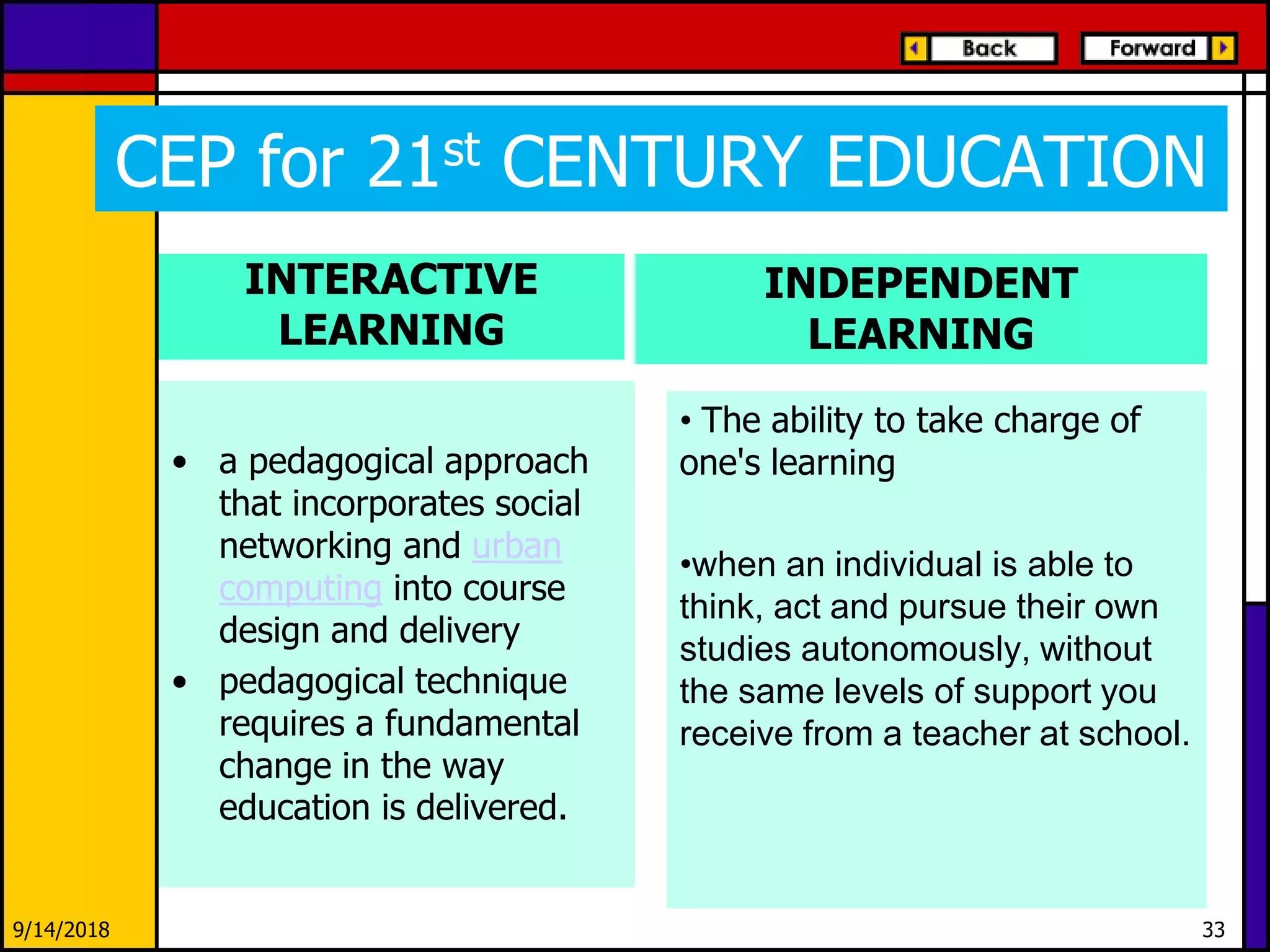
CEP for 21st CENTURY EDUCATION
INTERACTIVE
LEARNING
• a pedagogical approach
that incorporates social
networking and urban
computing into course
design and delivery
• pedagogical technique
requires a fundamental
change in the way
education is delivered.
INDEPENDENT
LEARNING
• The ability to take charge of
one's learning
•when an individual is able to
think, act and pursue their own
studies autonomously, without
the same levels of support you
receive from a teacher at school.
9/14/2018 33
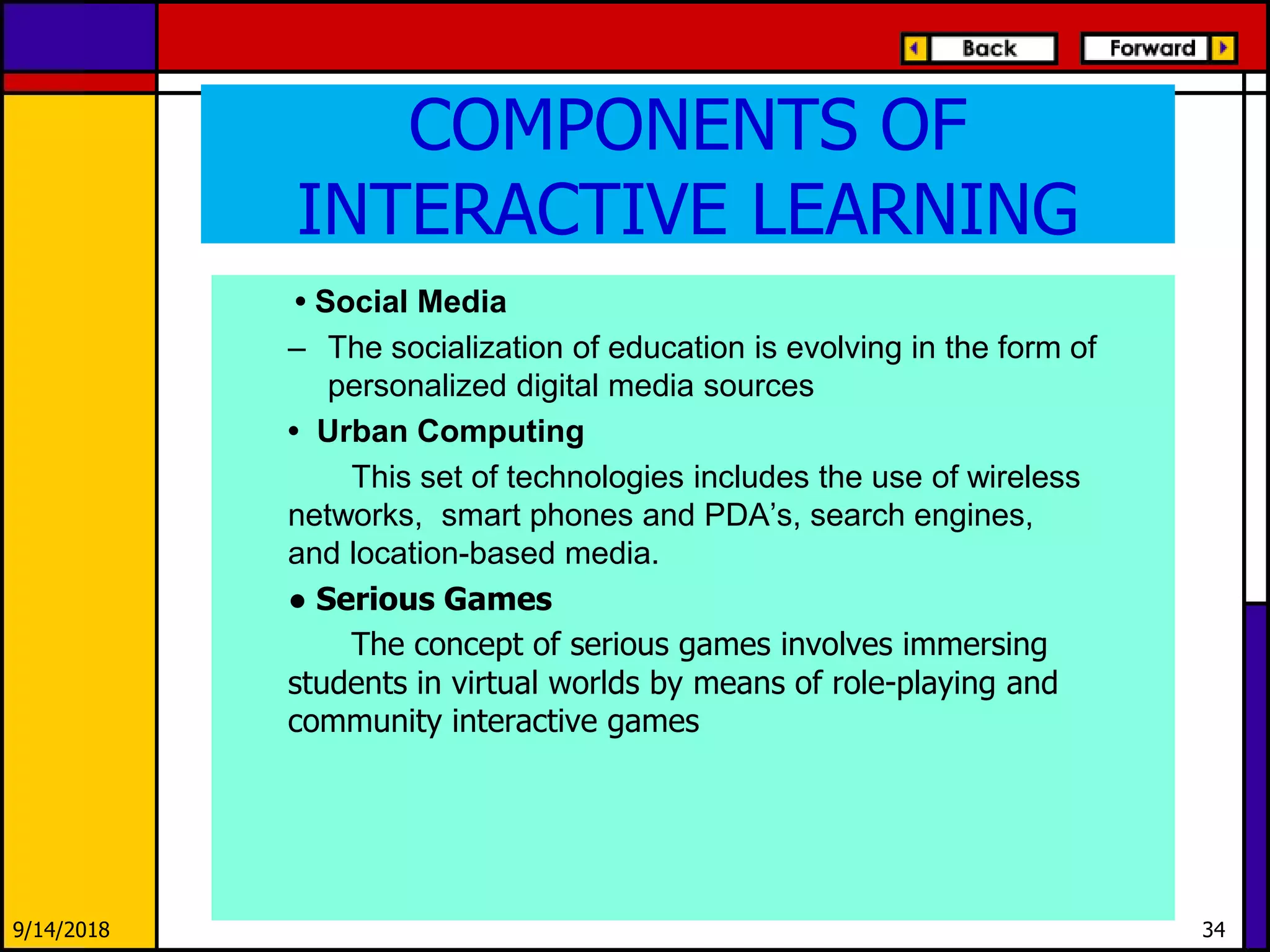
COMPONENTS OF
INTERACTIVE LEARNING
• Social Media
– The socialization of education is evolving in the form of
personalized digital media sources
• Urban Computing
This set of technologies includes the use of wireless
networks, smart phones and PDA’s, search engines,
and location-based media.
● Serious Games
The concept of serious games involves immersing
students in virtual worlds by means of role-playing and
community interactive games
9/14/2018 34
Applying Interactive Learning
• In order to be effective, learning institutions must see
computers and associated technology as an essential
part of the student
• the purpose of the instructor is to help facilitate the
absorption of knowledge through both real-world and
virtual learning experiences
• Whereas students often lose interest during lecture-style
teaching, interactive teaching styles promote an
atmosphere of attention and participation. Make it
interesting. Make it exciting. Make it fun. As you well
know, telling is not teaching and listening is not learning.
9/14/2018 35
IN THE CLASSROOM
• Education seems to be constantly changing. Students
are no longer expected to sit at a desk and take notes on
a lecture. Lessons are much more engaging and
interactive.
• It reinvigorates the classroom for both students and
faculty. Lectures are changed into discussions, and
students and teachers become partners in the journey of
knowledge acquisition.'
9/14/2018 36
With Technology
• As schools advance and add technology to the
classroom, lessons also become more engaging for
students.
• Technology has brought the world into the classroom.
Interactive lessons are at a student's, parent's or
teacher's fingertips
9/14/2018 37
5 interactive teaching styles that make a
difference
1. Brainstorming — various techniques
Interactive brainstorming is typically performed in group
sessions. The process is useful for generating creative
thoughts and ideas.
2. Think, pair, and share
Establish a problem or a question, then pair your students.
Give each pair sufficient time to form a conclusion, and
permit each participant to define the conclusion in his or
her personal voice.
3. Buzz session
Participants come together in session groups that focus on
a single topic. Within each group, every student contributes
thoughts and ideas.
9/14/2018 38
4. Incident process
This teaching style involves a case study format, but the
process is not so rigid as a full case study training session.
The focus is on learning how to solve real problems that
involve real people—preparing your students for life beyond
your classroom.
5. Q&A sessions
9/14/2018 Free template from www.brainybetty.com 39
Why is independent learning important?
Independent learning is not just important to become a
good student. The skills you gain are transferrable to most
jobs. These include:
• Motivation
• Independence
• Initiative
• Time Management
• Organization and multi-tasking
• Strong reading and writing skills
9/14/2018 40
9/14/2018 41
Read Actively
Skim Read
Different
Sources
Effective time
Management
Authentic vs Artificial Learning
Authentic Learning
• real life learning
• a style of learning that encourages students
to create a tangible, useful product to be
shared with their world
9/14/2018 42
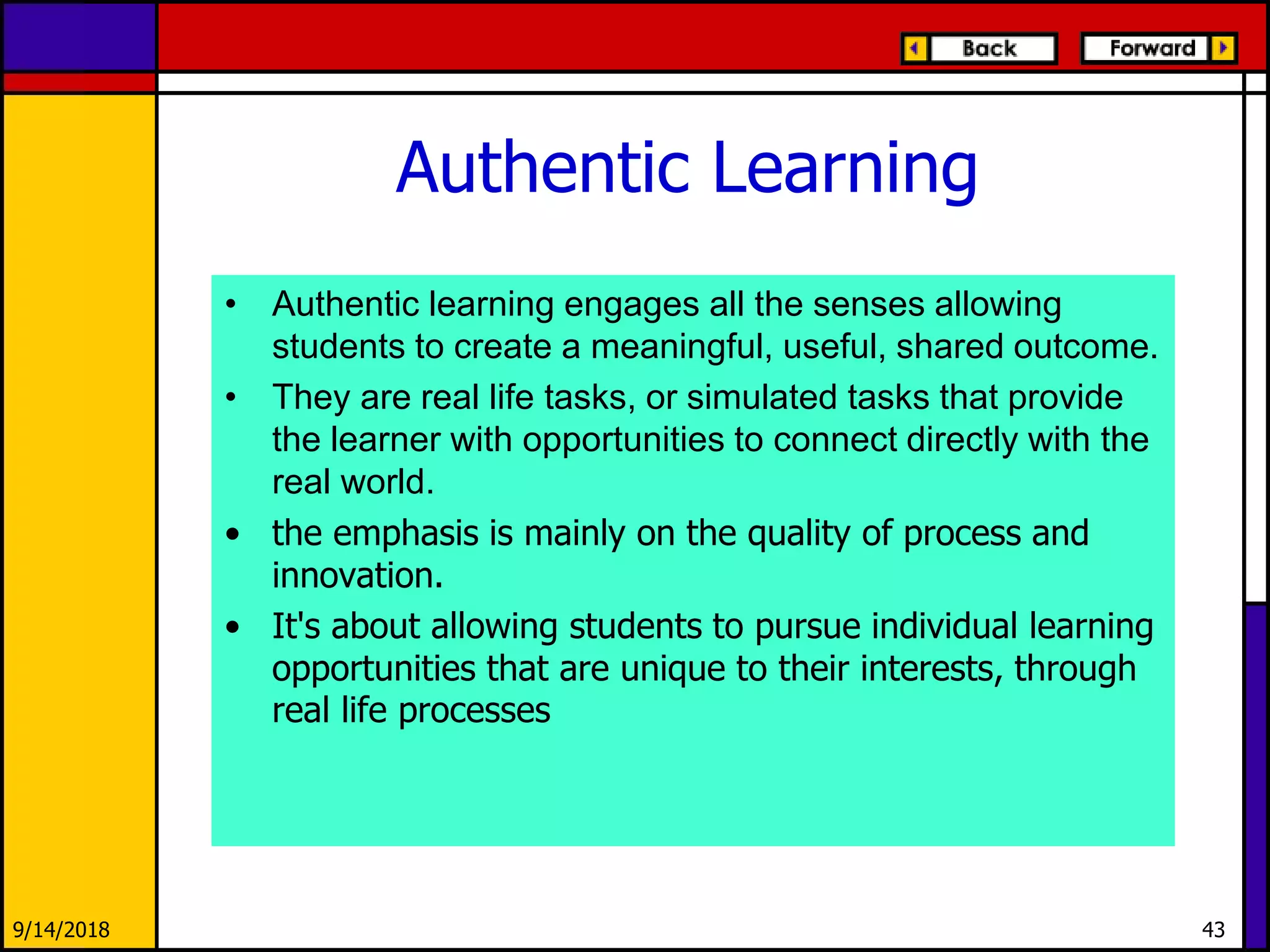
Authentic Learning
• Authentic learning engages all the senses allowing
students to create a meaningful, useful, shared outcome.
• They are real life tasks, or simulated tasks that provide
the learner with opportunities to connect directly with the
real world.
• the emphasis is mainly on the quality of process and
innovation.
• It's about allowing students to pursue individual learning
opportunities that are unique to their interests, through
real life processes
9/14/2018 43
9/14/2018 Free template from www.brainybetty.com 44
9/14/2018 Free template from www.brainybetty.com 45
Artificial Intelligence
9/14/2018 46
the capability of a computer system to perform
tasks that require human intelligence.
Such tasks involve “visual perception, speech
recognition, and decision-making.”
The Importance of AI
• Like it or not, AI is now
a part of our lives. We
may not know it, but
each of us may have
used or seen one
already. Besides, it’s a
given that AI makes
living easy, hastens
systems, and delivers
quick and precise
outcomes.
9/14/2018 47
The Advantages of AI
• AI’s arrival made humans view an easy life and a perfect
world. Ideyatech says, aside from improving, AI
continues to “increase in competency; thus, making it
capable of handling more complex tasks for humans. It
can also act as a catalyst to create scientific and
technological discovery.”
• Artificial intelligence “helps humans save time and
resources; therefore, freeing up work hours” to let them
do more important tasks. As a result, many firms now
use it to their advantage -investing and taking over retail.
9/14/2018 48
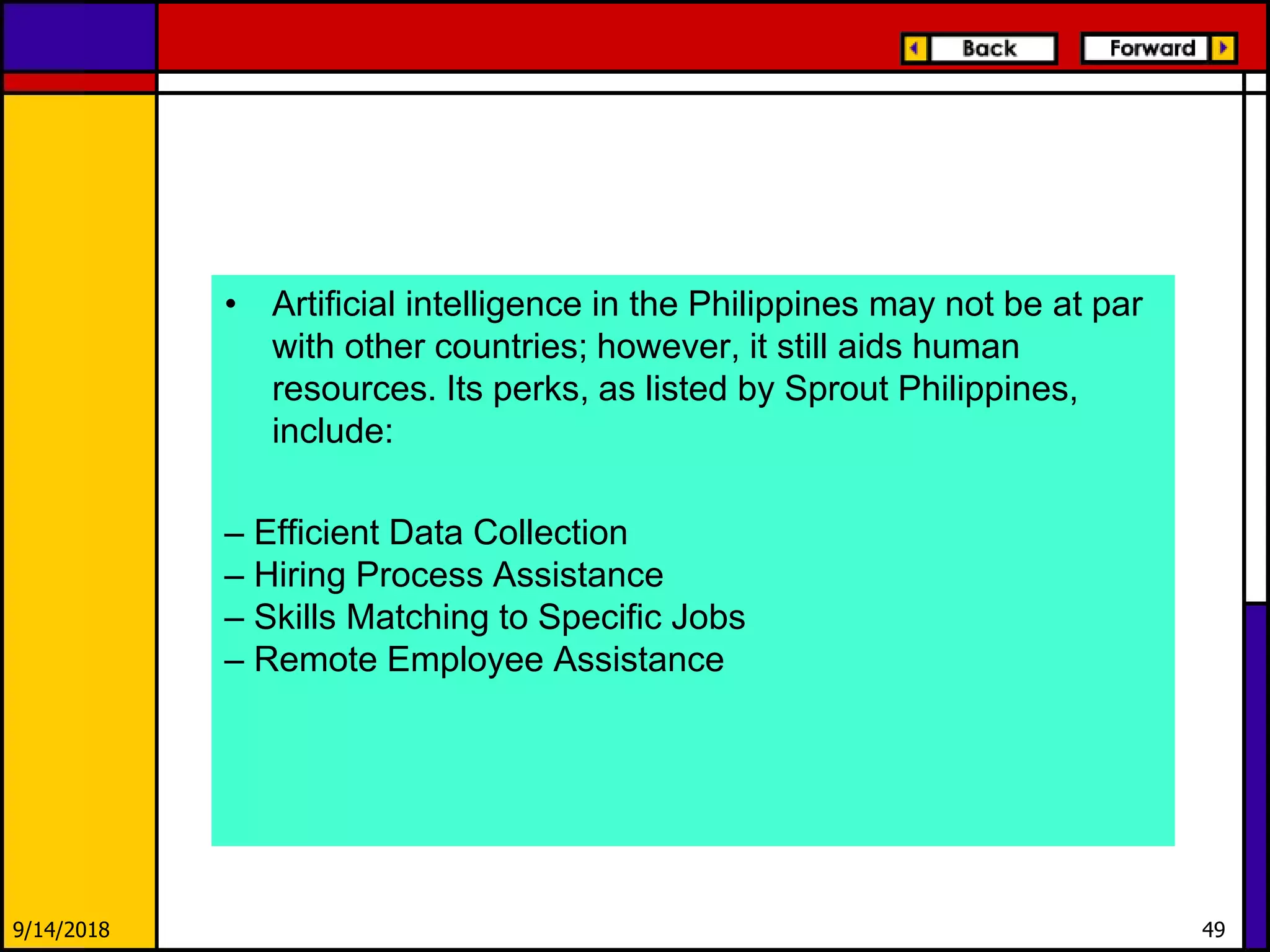
• Artificial intelligence in the Philippines may not be at par
with other countries; however, it still aids human
resources. Its perks, as listed by Sprout Philippines,
include:
– Efficient Data Collection
– Hiring Process Assistance
– Skills Matching to Specific Jobs
– Remote Employee Assistance
9/14/2018 49
Learning Environment for
Millenials
9/14/2018 50
Who are the millenials?
9/14/2018 51
Characteristics of Millenials
9/14/2018 52
• Students of the Millennial Generation are accustomed
– to using keyboards rather than pens or pencils to
write notes and papers
– to reading information from computer screens or
Personal Digital Assistants (PDAs) rather than from
printed texts
– to being connected with friends in social networking
computer sites rather than in physical meeting places
on college campuses, and are used to multitasking in
digital environments
– They are
• interested in group activities
• intuitive visual communicators
9/14/2018 53
• learn better through discovery and experiential learning
rather than by being told
• have the ability to shift their attention rapidly from one task
to another and may choose not to pay attention to things
that don’t interest them — attentional deployment
• believe multitasking is a way of life and are comfortable when
engaged in multiple activities simultaneously
• believe staying connected is essential and they want a fast
response time
– (Howe & Strauss, 2000
TOP FOUR WAYS TO ENGAGE MILLENNIALS
IN LEARNING ENVIRONMENTS
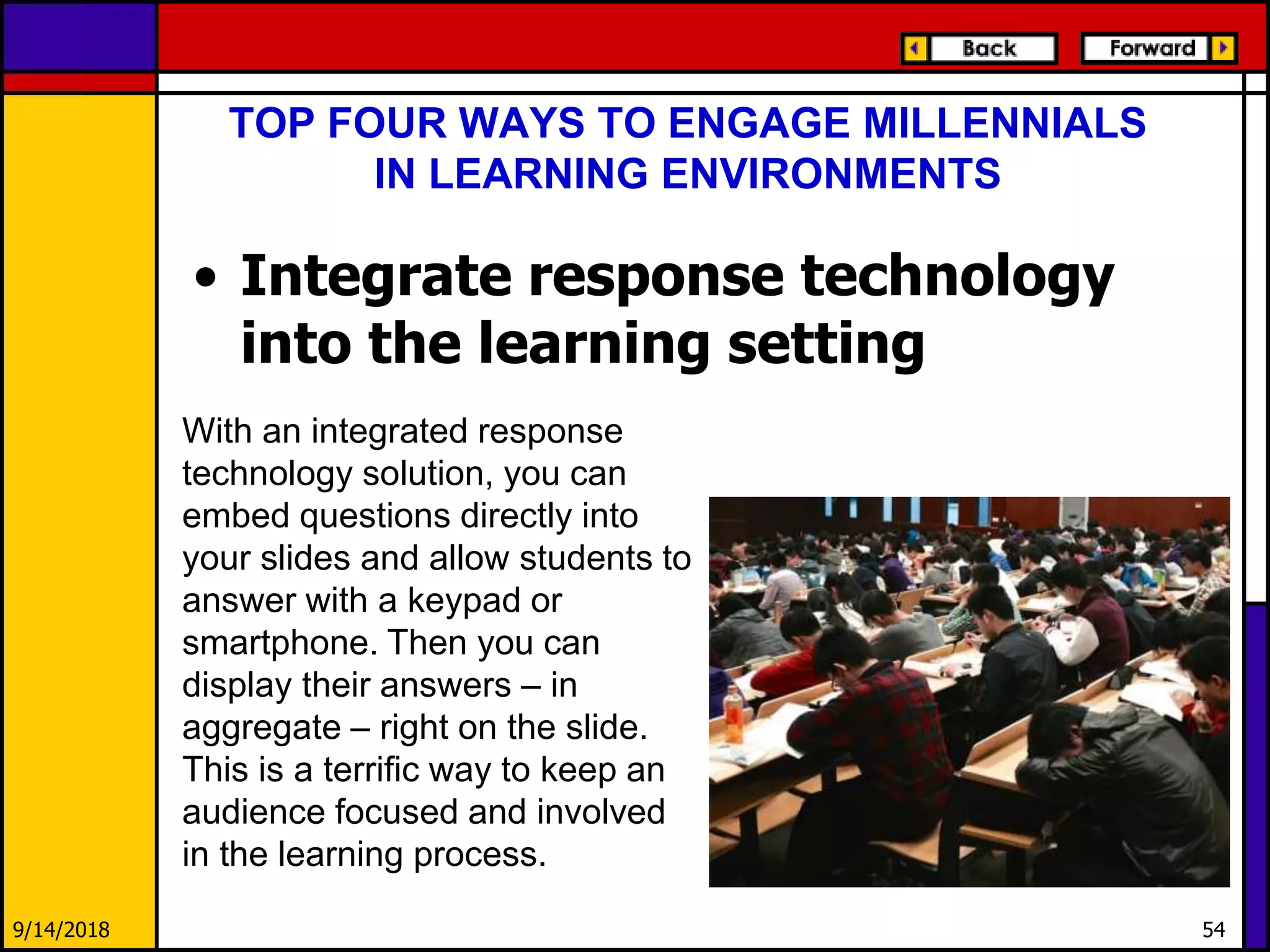
• Integrate response technology
into the learning setting
9/14/2018 54
With an integrated response
technology solution, you can
embed questions directly into
your slides and allow students to
answer with a keypad or
smartphone. Then you can
display their answers – in
aggregate – right on the slide.
This is a terrific way to keep an
audience focused and involved
in the learning process.
• Define objectives up front
– Clearly outlining your goals for the session is a great
tactic no matter who is in your audience, but
millennials in particular tend to expect open,
transparent communication. State your goals for the
session, and periodically measure knowledge levels
to see how students are progressing during the
training to make sure they are meeting learning
objectives.
9/14/2018 55
TOP FOUR WAYS TO ENGAGE MILLENNIALS
IN LEARNING ENVIRONMENTS
• Keep slides simple
– Like a well-designed website, slides should be clean
and simple. When you have a lot to say, it’s tough to
resist the temptation to include as much information
as you can on a slide, but remember that the bulk of
the knowledge transfer will occur during the
discussion about the topic, not from the slide itself.
9/14/2018 56
TOP FOUR WAYS TO ENGAGE MILLENNIALS
IN LEARNING ENVIRONMENTS
• Keep your presentation
interactive throughout
– As digital natives who grew up with the Internet and
in constant contact with friends, millennials expect a
greater level of interactivity.
9/14/2018 57
TOP FOUR WAYS TO ENGAGE MILLENNIALS
IN LEARNING ENVIRONMENTS

Distance education

  • 1.
    9/14/2018 1 AREAS of CONCERNin CEP Arlyn F.Perin Discussant
  • 2.
    Distance Education Online Education(Degreeand certificate Programs) CEP for 21st Century Education • Interactive and Interdependent Learning • Aunthentic Vs artificial learning • Learning environment for millenials
  • 3.
    9/14/2018 3 Open Learning/DistanceEducation • alternative system of education which emphasize the opening of opportunities by overcoming barriers that result from geographical isolation, personal or work commitments or conventional course structures which have often prevented people from realizing their educational goal. ● philosophy of learning that is learner- centered and flexible, enabling learners to learn at a time, place and pace which satisfies their circumstances and requirements.
  • 4.
    9/14/2018 4 Distance Education •any educational or learning procedure in which the guide and the student are separated by time and space. ●It involves acquiring information from methods other then the traditional way of gaining knowledge – attending institutions. ●influenced a lot by computer and electronics technology. The technology has now made it possible for the guide and student to connect almost immediately. Study resources can be delivered instantly through computers, satellites, internet, cable television, interactive video etc
  • 5.
    All subjects offeredin distance education shall adhere to the following guiding principles • Learner-Centeredness. Distance education program shall focus on the needs of the learner and the goal of facilitating independent learning. These program shall not be driven merely by available technologies but rather by the need to enable demonstrable learning in an accessible environment. • Rigorous and Sound Instructional Design. Distance education shall be equivalent in challenge and depth to conventional program .Academically qualified individuals must take instructional design decisions in the analysis, design, development, implementation and evaluation of distance education course. 9/14/2018 5
  • 6.
    All subjects offeredin distance education shall adhere to the following guiding principles • Transparency and Peer Review to Guide Informed Choice. Distance education implementers shall make information about their programs, particularly in the curriculum delivery system, instructional materials development, delivery mode strategies, student support services, and other relevant information available to accrediting bodies, academic peers, regulators, students. Updates information shall be available through media such as world wide web. • Public Responsibility and Accountability. Implementers shall take heed of the public impact on DE programs and shall always exercise due diligence in avoiding harm to program stakeholders specially students. Consumer protection shall be priority because of high value that Filipinos put on education. 9/14/2018 6
  • 7.
    All subjects offeredin distance education shall adhere to the following guiding principles • Quality and Continuous Improvement Implementers shall embed in their program framework the proactive identification of students and stakeholder needs and the monitoring of student and stakeholder satisfaction in order to continuously improve all aspects of development and delivery. 9/14/2018 7
  • 8.
    What is thebasis of Distance Education in the Philippines? • It is mandated by Republic Act No. 10650, also known as the Open and Distance Learning Act of 2014 to assist the Commission on Higher Education (CHED) and the Technical Education and Skills Development Authority (TESDA) on their open distance learning functions. 9/14/2018 8
  • 9.
    Specialized Academic Program ofDistance Education • Open University/Online Education • Non-Traditional Study Program • ETTEAP • CONTINUING EDUATIONAL PROGRAM 9/14/2018 9
  • 10.
    OPEN UNIVERSITY SYSTEM •Open universities offer distance education using specific didactics and media. • The goal of open universities is to offer everyone equal opportunities to develop their competences, to raise their level of education and to receive retraining. • it is also a way of attracting potential students that at one point, would like to enrol and pursue a degree. 9/14/2018 10
  • 11.
    9/14/2018 11 Schools, Colleges,and Universities in the Philippines That Offer Online Education • University of the Philippines Open University • Polytechnic University of the Philippines Open University • Central Luzon State University Open University • Pangasinan State University Open University Systems • University of Northern Philippines • Mariano Marcos State University • CAP College Foundation • Cebu Technological University • New Era University • John B. Lacson Foundation Maritime University • Holy Angel University • Asian Institute of Journalism and Communication • Philippine Stock Exchange
  • 12.
    • Undergraduate Programs Associatein Arts Bachelor of Arts in Multimedia Studies Bachelor of Education Studies • Graduate Certificate Program Graduate Certificate in ASEAN Studies Graduate Certificate in Distance Education (within the Master of Distance Education) 9/14/2018 12 University of the Philippines Open University
  • 13.
    • Post-Baccalaureate Diploma Programs •Diploma in Social Work • Diploma in Computer Science • Diploma in International Health • Diploma in Research and Development Management • Diploma in Environment and Natural Resources Management • Diploma in Land Valuation and Management • Diploma in Science Teaching • Diploma in Math Teaching • Diploma in Language and Literacy Education for Teachers • Diploma in Social Studies Education 9/14/2018 13
  • 14.
    Master’s – Master ofDistance Education – Master of Arts in Language and Literacy Education – Master of Arts in Social Studies Education – Master of Development Communication – Master of Information Systems – Master of ASEAN Studies – Master of International Health – Master of Land Valuation & Management – Master of Social Work – Master of Arts in Nursing – Master of Public Management – Master of Environment and Natural Resources Management 9/14/2018 14
  • 15.
    DOCTORAL - Doctor ofPhilosophy in Education (Biology Education, Chemistry Education, Physics Education, Mathematics Education) – Doctor of Communication (DComm) 9/14/2018 15 ●Non-formal Courses • Caring for the Special Child • Caring for the Elderly • Community Mental Health • Health Research Methods • New Enterprise Planning • Online Teaching and Learning • Organic Agriculture • Personal Entrepreneurial Development • Introduction to E-Commerce • Professional Teaching Certification • Simplified Accounting for Entrepreneurs • Continuing Professional Education Program on Land Valuation
  • 16.
    Expanded Tertiary EducationEquivalency and Accreditation Program (ETEEAP) • Is an alternative education program in the Philippines that allows working professionals who were not able to finish their college education or were completely unable to step into college to earn a bachelor’s degree without going through traditional schooling methods. 9/14/2018 16
  • 17.
    • Under thisprogram, professionals with five or more years of working experience can use the knowledge, experiences, and achievements they obtained through their jobs to earn school credits that are then deducted from the total number of units that they are required to earn before they graduate. • This way, the more professional experience the ETEEAP student demonstrates, the sooner he or she can earn his or her bachelor’s degree. 9/14/2018 17
  • 18.
    Legitimacy of theProgram • ETEEAP operates by virtue of Executive Order Number 330 signed by former President Fidel V. Ramos on May 10, 1996. • It is currently administered by the Commission on Higher Education (CHED) and colleges or universities that wish to offer it as part of their academic programs must gain CHED’s approval first. 9/14/2018 18
  • 19.
    Differences Between ETEEAP andTraditional Schooling • With ETEEAP, the basic concept is the same. The more units you can complete at a given time, the faster you’re going to graduate; however, compared with traditional schooling where you can, at most, graduate several months in advance if you were able to take up and complete more units than the regular school curriculum imposes, ETEEAP allows professionals to complete their degree in about a year or so by having their professional experiences evaluated and used in exchange for academic credits. • Also, most of the colleges and universities that implement ETEEAP also offer the program online, so anyone can take the course from anywhere in the world as long as they have a computer and access to the internet. 9/14/2018 19
  • 20.
    What is theclassroom setting of ETEEAP Classes • ETEAAP classes are mostly conducted like traditional college classes — students gather in a room, listen to discussion, participate in recitation, do some seat work, submit assignments, and the like. • The only major difference is things you would normally study in four to five years will be tackled in about a year, so the lessons are very fast-paced and straightforward. • Also, project studies or theses are done individually as opposed to traditional schooling where they can be done in groups. 9/14/2018 20
  • 21.
    • As forstudents studying overseas, classes are usually done through e-mail exchanges, instant messaging (YM, FB Chat, Google Chat), and video calls (YM, Skype) while project studies are sometimes submitted through courier. 9/14/2018 21
  • 22.
    Do ETTEAP classhas Graduation too? • ETEEAP graduates are awarded corresponding degrees upon their successful completion of the program. They then go through graduation rites like traditional college graduates, although it is up to them whether they want to march onstage or they want to skip the event altogether. • If you enrolled in a course or program that has a licensure examination, you will have the option to take the board exam for additional leverage in seeking employment or more advanced career opportunities. 9/14/2018 22
  • 23.
    What are thequalifications to enroll? An ETEEAP candidate must meet the following qualifications: Filipino, at least high school graduate or must have PEPT equivalent to first year college. • Has at least five (5) years of work-related experience. • Must be at least twenty-two (22) years old; and • Able to show evidence of capability and thorough knowledge through the following evidences: • Certificate of Proficiency issued by the government regulatory board. • Certificate of Proficiency issued by the employer(s). • Certificate of Proficiency issued by a licensed practitioner in the field. 9/14/2018 23
  • 24.
    Non-Traditional Study Program • NTSPis a self-study program wherein the student’s educational background, work experiences, and achievements are evaluated and accredited through a rating system that leads to the completion of an undergraduate and graduate degree. • A self-paced study program wherein modules, independent researches and other instructional materials are laid down by the college and administered by learning facilitators who help enhance the knowledge, skills, and attitudes of the students. • The final requirement is a paper presentation based on the field of specialization of the student. 9/14/2018 24
  • 25.
    What are theQualifications? For undergraduate programs.. • Practitioners or administrators with at least supervisory work experience or individuals with exceptional achievements • Those with two (2) years of relevant college work or its equivalent, 25 years of age • Those with at least five (5) years supervisory work experience relevant to the desired course • For Applicants abroad, have someone with your issued Special Power of Attorney (SPA) to represent you here. 9/14/2018 25
  • 26.
    For Graduate Programs •Practitioners or executives who have shown top-caliber abilities, broad experience or outstanding performance in their respective fields, • Those who earned a bachelor's degree in the master's course applied for or a degree in a related course, and • Managers or executives with at least five years of relevant work experience. • For Applicants abroad, have someone with your issued Special Power of Attorney (SPA) to represent you here. 9/14/2018 26
  • 27.
    CEP/CPD • Involves maintainingand enhancing the knowledge, skills, and experiences related to your professional activities • Should be a lifelong, systematic, and planned process to maintain and develop professional competence, creativity, and innovation. 9/14/2018 27
  • 28.
    ●The e-TESDA programis a program that was developed to ensure that all Filipinos would be able to benefit from the wide array of courses that are currently being offered by TESDA. ●By compiling lessons into comprehensive but easy to understand modules then uploading them on the internet, the program allows users from all over the country and all over the world to access these files wherever they are and whenever they want — for free. 9/14/2018 28 What is the e -TESDA Program?
  • 29.
    TESDA online-AVAILABLE COURSES •Computer Systems Servicing Basic Computer Operation Web Development using HTML5 and CSS3 1 CAD / CAM Operation Animation (3D DIGITAL) Microsoft Online Courses Game Development Game Production Basics Developing 2D Games with HTML5 Developing 2D & 3D Games with Unity Software Development Fundamentals C# Fundamentals for Beginners • Tourism Food and Beverage Servicing Waiter Servicing Room Attendant Servicing Bus Boy Servicing Housekeeping Guest Room Attendant Servicing Valet Servicing Public Area Attendant Servicing Laundry Servicing Cookery Preparing Sandwiches 9/14/2018 29
  • 30.
    TESDA AVAILABLE COURSES •ELectronics Cellphone Servicing Solar Night Light Assembly • Agriculture Fruit Grower Automotive Diesel Engine Tune Up Automotive Battery Servicing Heating, Ventilation and Air Condition Packaged Air Conditioner Unit Servicing Trainers Methodology I Facilitate Learning Session 1 Conduct Competency Assessment 4 TrainersMethodologyII Curriculum Development 1 Health, Social and other Community Development Services Massage Therapy Swedish Massage Thai Massage 9/14/2018 30
  • 31.
    Advantages of Distance Learning 1.Ability to combine work with existing commitments 2. Cheaper- Not only is it time saving, but money saving too, as it reduces the amount of travel to and fro 3. No deadlines 4. Less pressure 5. No set start date 6. You can decide your time of and place of study. 7. No matter where you live – you can still achieve a degree from anywhere in the world. 8. convenient and easy access in terms of study, making it a timesaving venture for the student 9/14/2018 31
  • 32.
    Disadvantages of Distance Learning 1.Distance learning requires self-motivation. 2. Lack of face-to-face time in virtual learning 3. Distance learning does not offer immediate feedback. 4. Distance learning must be accredited. 5 Distance learning does not give students the opportunity to work on oral communication skills 6. Distance learning does not always offer all the necessary courses online. 7. Distance learning requires you to have constant, reliable access to technology. 8. Students may not develop the necessary social skills that are usually seen in the traditional setting 9.Teachers are concerned with how efficient they can monitor their students’ progress online. 9/14/2018 32
  • 33.
    CEP for 21stCENTURY EDUCATION INTERACTIVE LEARNING • a pedagogical approach that incorporates social networking and urban computing into course design and delivery • pedagogical technique requires a fundamental change in the way education is delivered. INDEPENDENT LEARNING • The ability to take charge of one's learning •when an individual is able to think, act and pursue their own studies autonomously, without the same levels of support you receive from a teacher at school. 9/14/2018 33
  • 34.
    COMPONENTS OF INTERACTIVE LEARNING •Social Media – The socialization of education is evolving in the form of personalized digital media sources • Urban Computing This set of technologies includes the use of wireless networks, smart phones and PDA’s, search engines, and location-based media. ● Serious Games The concept of serious games involves immersing students in virtual worlds by means of role-playing and community interactive games 9/14/2018 34
  • 35.
    Applying Interactive Learning •In order to be effective, learning institutions must see computers and associated technology as an essential part of the student • the purpose of the instructor is to help facilitate the absorption of knowledge through both real-world and virtual learning experiences • Whereas students often lose interest during lecture-style teaching, interactive teaching styles promote an atmosphere of attention and participation. Make it interesting. Make it exciting. Make it fun. As you well know, telling is not teaching and listening is not learning. 9/14/2018 35
  • 36.
    IN THE CLASSROOM •Education seems to be constantly changing. Students are no longer expected to sit at a desk and take notes on a lecture. Lessons are much more engaging and interactive. • It reinvigorates the classroom for both students and faculty. Lectures are changed into discussions, and students and teachers become partners in the journey of knowledge acquisition.' 9/14/2018 36
  • 37.
    With Technology • Asschools advance and add technology to the classroom, lessons also become more engaging for students. • Technology has brought the world into the classroom. Interactive lessons are at a student's, parent's or teacher's fingertips 9/14/2018 37
  • 38.
    5 interactive teachingstyles that make a difference 1. Brainstorming — various techniques Interactive brainstorming is typically performed in group sessions. The process is useful for generating creative thoughts and ideas. 2. Think, pair, and share Establish a problem or a question, then pair your students. Give each pair sufficient time to form a conclusion, and permit each participant to define the conclusion in his or her personal voice. 3. Buzz session Participants come together in session groups that focus on a single topic. Within each group, every student contributes thoughts and ideas. 9/14/2018 38
  • 39.
    4. Incident process Thisteaching style involves a case study format, but the process is not so rigid as a full case study training session. The focus is on learning how to solve real problems that involve real people—preparing your students for life beyond your classroom. 5. Q&A sessions 9/14/2018 Free template from www.brainybetty.com 39
  • 40.
    Why is independentlearning important? Independent learning is not just important to become a good student. The skills you gain are transferrable to most jobs. These include: • Motivation • Independence • Initiative • Time Management • Organization and multi-tasking • Strong reading and writing skills 9/14/2018 40
  • 41.
    9/14/2018 41 Read Actively SkimRead Different Sources Effective time Management
  • 42.
    Authentic vs ArtificialLearning Authentic Learning • real life learning • a style of learning that encourages students to create a tangible, useful product to be shared with their world 9/14/2018 42
  • 43.
    Authentic Learning • Authenticlearning engages all the senses allowing students to create a meaningful, useful, shared outcome. • They are real life tasks, or simulated tasks that provide the learner with opportunities to connect directly with the real world. • the emphasis is mainly on the quality of process and innovation. • It's about allowing students to pursue individual learning opportunities that are unique to their interests, through real life processes 9/14/2018 43
  • 44.
    9/14/2018 Free templatefrom www.brainybetty.com 44
  • 45.
    9/14/2018 Free templatefrom www.brainybetty.com 45
  • 46.
    Artificial Intelligence 9/14/2018 46 thecapability of a computer system to perform tasks that require human intelligence. Such tasks involve “visual perception, speech recognition, and decision-making.”
  • 47.
    The Importance ofAI • Like it or not, AI is now a part of our lives. We may not know it, but each of us may have used or seen one already. Besides, it’s a given that AI makes living easy, hastens systems, and delivers quick and precise outcomes. 9/14/2018 47
  • 48.
    The Advantages ofAI • AI’s arrival made humans view an easy life and a perfect world. Ideyatech says, aside from improving, AI continues to “increase in competency; thus, making it capable of handling more complex tasks for humans. It can also act as a catalyst to create scientific and technological discovery.” • Artificial intelligence “helps humans save time and resources; therefore, freeing up work hours” to let them do more important tasks. As a result, many firms now use it to their advantage -investing and taking over retail. 9/14/2018 48
  • 49.
    • Artificial intelligencein the Philippines may not be at par with other countries; however, it still aids human resources. Its perks, as listed by Sprout Philippines, include: – Efficient Data Collection – Hiring Process Assistance – Skills Matching to Specific Jobs – Remote Employee Assistance 9/14/2018 49
  • 50.
  • 51.
  • 52.
    Characteristics of Millenials 9/14/201852 • Students of the Millennial Generation are accustomed – to using keyboards rather than pens or pencils to write notes and papers – to reading information from computer screens or Personal Digital Assistants (PDAs) rather than from printed texts – to being connected with friends in social networking computer sites rather than in physical meeting places on college campuses, and are used to multitasking in digital environments – They are • interested in group activities • intuitive visual communicators
  • 53.
    9/14/2018 53 • learnbetter through discovery and experiential learning rather than by being told • have the ability to shift their attention rapidly from one task to another and may choose not to pay attention to things that don’t interest them — attentional deployment • believe multitasking is a way of life and are comfortable when engaged in multiple activities simultaneously • believe staying connected is essential and they want a fast response time – (Howe & Strauss, 2000
  • 54.
    TOP FOUR WAYSTO ENGAGE MILLENNIALS IN LEARNING ENVIRONMENTS • Integrate response technology into the learning setting 9/14/2018 54 With an integrated response technology solution, you can embed questions directly into your slides and allow students to answer with a keypad or smartphone. Then you can display their answers – in aggregate – right on the slide. This is a terrific way to keep an audience focused and involved in the learning process.
  • 55.
    • Define objectivesup front – Clearly outlining your goals for the session is a great tactic no matter who is in your audience, but millennials in particular tend to expect open, transparent communication. State your goals for the session, and periodically measure knowledge levels to see how students are progressing during the training to make sure they are meeting learning objectives. 9/14/2018 55 TOP FOUR WAYS TO ENGAGE MILLENNIALS IN LEARNING ENVIRONMENTS
  • 56.
    • Keep slidessimple – Like a well-designed website, slides should be clean and simple. When you have a lot to say, it’s tough to resist the temptation to include as much information as you can on a slide, but remember that the bulk of the knowledge transfer will occur during the discussion about the topic, not from the slide itself. 9/14/2018 56 TOP FOUR WAYS TO ENGAGE MILLENNIALS IN LEARNING ENVIRONMENTS
  • 57.
    • Keep yourpresentation interactive throughout – As digital natives who grew up with the Internet and in constant contact with friends, millennials expect a greater level of interactivity. 9/14/2018 57 TOP FOUR WAYS TO ENGAGE MILLENNIALS IN LEARNING ENVIRONMENTS

Editor's Notes

  • #11 Most open universities award undergraduate and postgraduate degrees, as well as non-degree qualifications such as diplomas and certificates, or continuing education units.
  • #20 Students aiming for a bachelor’s degree through the traditional method usually complete their college education in four or five years time, depending on the curriculum and the number of units they complete per term.
  • #34 hgfr
  • #37 education