Current Trend in Education-
Online Schooling
Violeta G. Cordova
Reality bites. Many learners who may be
successful academically prior to pandemic,
might also be struggling with the new hybrid
and new methods of online teaching in
remote distance learning. The learners who
are considered the last, the least and the lost
have greater challenges with their peers
because of socio-economic factors. Video
fatigue is real. The lack of social interaction
with classmates is real. Technology
challenges are real. Teachers who are thrown
and unprepared in new modalities in
teaching is also real. These realities and
challenges are all experienced by learners,
teachers not only in our country but across
the globe.
1) face to face, (2)
distance learning- which
may be in the form of
modular distance learning,
online distance learning,
and TV/Radio-based
Instruction, (3) blended
learning- a combination of
modalities,
(4)Homeschooling.
In our country, per
DepEd Order No. 12, s.
2020, there are
different modalities in
remote distance
learning:
WHATEVER THE MODALITY THE SCHOOLS UTILIZE,
THERE WOULD ALWAYS BE ISSUES AND CHALLENGES.
IN SDO PAMPANGA, HAVING HEARD THE CHIEF OF THE
CURRICULUM, EMPHASIZING THAT LAST SCHOOL YEAR,
MAJORITY OF THE SCHOOLS EMBRACED THE MODULAR
DISTANCE LEARNING WHICH LED TO THE POOR
PERFORMANCE OF LEARNERS, AND MANY FAILED
ACROSS GRADE LEVELS, THE CID ISSUED THE LOCAL
POLICY ON BLENDED LEARNING AND THAT NO
SCHOOLS SHALL BE ALLOWED TO USE ONLY ONE (1)
LEARNING DELIVERY MODALITY.
Embracing online distance learning is a big
challenge for parents who may not have
access into internet connectivity, and
gadgets like computers, laptops, cell phones
and Android tablets.
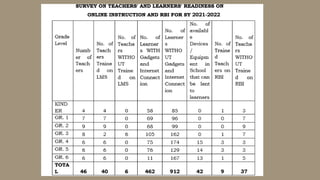
In our school based on the survey conducted,
during our data gathering for BE-LCOP, the
following were reflected:
It can be gleaned in the table that 40 out of the 46
teachers have been trained on LMS and there are only 6
who will be rained if the school pursued online
instruction. Whereas, among the learners, 462 have
gadgets and internet connection but 912, have no
access to gadgets and internet connectivity. Thus, online
distance learning as modality for all can’t be really
pursued. It can’t be one shoe fits all for the learners
given their family background and socio-economic
status.
San Juan Bano ES is located at the outskirt of Mt. Arayat,
and the community is considered relatively poor. Some
are working parents, others who stayed at home are not
academically prepared to handle homeschooling, to coach
their kids in different lessons with varying complexities. It
is in this light, why for SY 2020-2021, the Learners’
Achievement Rate average was 79.59%. This academic
performance led me to believe that modular distance
learning was not effective learning modality in SY 2020-
2021-2021, or there may be other extraneous factors for
the poor performance of learners like mal-adjustment to
new normal set up in education, or the lack of engagement
with peers for collaboration in learning.
Reflection
Better academic performance or learning
outcomes is the dream of DepED to all the
learners even prior to pandemic. But this goal
during the new or now normal is a far-fetched
reality if the parents, learners, community
stakeholders and the School Head will not rally
together to make learning happens at home for
the learners.
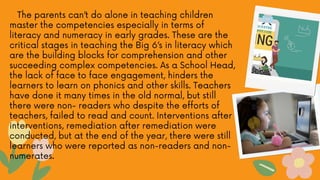
The parents can’t do alone in teaching children
master the competencies especially in terms of
literacy and numeracy in early grades. These are the
critical stages in teaching the Big 6’s in literacy which
are the building blocks for comprehension and other
succeeding complex competencies. As a School Head,
the lack of face to face engagement, hinders the
learners to learn on phonics and other skills. Teachers
have done it many times in the old normal, but still
there were non- readers who despite the efforts of
teachers, failed to read and count. Interventions after
interventions, remediation after remediation were
conducted, but at the end of the year, there were still
learners who were reported as non-readers and non-
numerates.
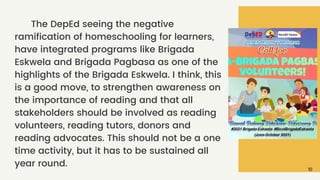
The DepEd seeing the negative
ramification of homeschooling for learners,
have integrated programs like Brigada
Eskwela and Brigada Pagbasa as one of the
highlights of the Brigada Eskwela. I think, this
is a good move, to strengthen awareness on
the importance of reading and that all
stakeholders should be involved as reading
volunteers, reading tutors, donors and
reading advocates. This should not be a one
time activity, but it has to be sustained all
year round.
10
Another scheme that I think is laudable is
infusing other modality like online
komustahan weekly to assess learners and
parents difficulty in order to address it
immediately. When unmastered
competencies are left alone, this will lead to
learning gaps and the more learners will
have difficulty in coping up with higher and
more complex competencies.
Online learning, if only all learners have the
capacity to it, is I think better off than another
modality because learners are seen in online
platforms and engagements can happen between the
teacher and learners to learners. In here, there is a
need for parents and learners to be oriented on the
use of different Google platforms so teaching and
learning will be more interactive in nature. Break out
rooms can be interwoven in a meeting class so
learners have time to meet with other learners to
brainstorm on their activities.
This cooperative learning strategy would lead to
pupils’ building self-confidence as other brighter
learners lead the group. Thus would greatly affect
academic achievement as learners build positive
relationship among peers, creating a learning
community that value diversity, develop both learning
and social skills. Cooperative learning strategies in
online activity can also develop students’ leadership
skills and decision-making, acquiring conflict
management skills, enhancing communications skills,
develop personal responsibility among others.
Proposed
Solutions
The following are the suggested
solutions in the issues raised on online
instruction:
1.Identification of learners with
gadgets and internet connectivity.
Learners with gadgets and internet
connectivity may be the 1st batch to be
offered online distance learning, while
the school is looking for ways on how
to address those without the learning
resources. Teachers who are adept in
technology will be assigned to teach
this modality.
2. Donors and other stakeholders may be tapped for ODL.
Teachers can look for donors, particularly the successful
alumni of the school. During conference with parents, this
modality can also be pursued with enough evidences for
learning.
3. Barangay hall gadgets can be shared. Learners
without access can visit the barangay court and hall
where strong connectivity to internet can also be
accessed.
4. Radio based instruction/TV based lessons can
be downloaded and shared for asynchronous
lessons. These lessons can be shared offline and
will become augmentation to learning of students
to maximize DepED TV utilization.
Thank You!

Current Trend in Education - Online Schooling

  • 1.
    Current Trend inEducation- Online Schooling Violeta G. Cordova
  • 2.
    Reality bites. Manylearners who may be successful academically prior to pandemic, might also be struggling with the new hybrid and new methods of online teaching in remote distance learning. The learners who are considered the last, the least and the lost have greater challenges with their peers because of socio-economic factors. Video fatigue is real. The lack of social interaction with classmates is real. Technology challenges are real. Teachers who are thrown and unprepared in new modalities in teaching is also real. These realities and challenges are all experienced by learners, teachers not only in our country but across the globe.
  • 3.
    1) face toface, (2) distance learning- which may be in the form of modular distance learning, online distance learning, and TV/Radio-based Instruction, (3) blended learning- a combination of modalities, (4)Homeschooling. In our country, per DepEd Order No. 12, s. 2020, there are different modalities in remote distance learning:
  • 4.
    WHATEVER THE MODALITYTHE SCHOOLS UTILIZE, THERE WOULD ALWAYS BE ISSUES AND CHALLENGES. IN SDO PAMPANGA, HAVING HEARD THE CHIEF OF THE CURRICULUM, EMPHASIZING THAT LAST SCHOOL YEAR, MAJORITY OF THE SCHOOLS EMBRACED THE MODULAR DISTANCE LEARNING WHICH LED TO THE POOR PERFORMANCE OF LEARNERS, AND MANY FAILED ACROSS GRADE LEVELS, THE CID ISSUED THE LOCAL POLICY ON BLENDED LEARNING AND THAT NO SCHOOLS SHALL BE ALLOWED TO USE ONLY ONE (1) LEARNING DELIVERY MODALITY.
  • 5.
    Embracing online distancelearning is a big challenge for parents who may not have access into internet connectivity, and gadgets like computers, laptops, cell phones and Android tablets. In our school based on the survey conducted, during our data gathering for BE-LCOP, the following were reflected:
  • 7.
    It can begleaned in the table that 40 out of the 46 teachers have been trained on LMS and there are only 6 who will be rained if the school pursued online instruction. Whereas, among the learners, 462 have gadgets and internet connection but 912, have no access to gadgets and internet connectivity. Thus, online distance learning as modality for all can’t be really pursued. It can’t be one shoe fits all for the learners given their family background and socio-economic status.
  • 8.
    San Juan BanoES is located at the outskirt of Mt. Arayat, and the community is considered relatively poor. Some are working parents, others who stayed at home are not academically prepared to handle homeschooling, to coach their kids in different lessons with varying complexities. It is in this light, why for SY 2020-2021, the Learners’ Achievement Rate average was 79.59%. This academic performance led me to believe that modular distance learning was not effective learning modality in SY 2020- 2021-2021, or there may be other extraneous factors for the poor performance of learners like mal-adjustment to new normal set up in education, or the lack of engagement with peers for collaboration in learning.
  • 9.
  • 10.
    Better academic performanceor learning outcomes is the dream of DepED to all the learners even prior to pandemic. But this goal during the new or now normal is a far-fetched reality if the parents, learners, community stakeholders and the School Head will not rally together to make learning happens at home for the learners.
  • 11.
    The parents can’tdo alone in teaching children master the competencies especially in terms of literacy and numeracy in early grades. These are the critical stages in teaching the Big 6’s in literacy which are the building blocks for comprehension and other succeeding complex competencies. As a School Head, the lack of face to face engagement, hinders the learners to learn on phonics and other skills. Teachers have done it many times in the old normal, but still there were non- readers who despite the efforts of teachers, failed to read and count. Interventions after interventions, remediation after remediation were conducted, but at the end of the year, there were still learners who were reported as non-readers and non- numerates.
  • 12.
    The DepEd seeingthe negative ramification of homeschooling for learners, have integrated programs like Brigada Eskwela and Brigada Pagbasa as one of the highlights of the Brigada Eskwela. I think, this is a good move, to strengthen awareness on the importance of reading and that all stakeholders should be involved as reading volunteers, reading tutors, donors and reading advocates. This should not be a one time activity, but it has to be sustained all year round. 10
  • 13.
    Another scheme thatI think is laudable is infusing other modality like online komustahan weekly to assess learners and parents difficulty in order to address it immediately. When unmastered competencies are left alone, this will lead to learning gaps and the more learners will have difficulty in coping up with higher and more complex competencies.
  • 14.
    Online learning, ifonly all learners have the capacity to it, is I think better off than another modality because learners are seen in online platforms and engagements can happen between the teacher and learners to learners. In here, there is a need for parents and learners to be oriented on the use of different Google platforms so teaching and learning will be more interactive in nature. Break out rooms can be interwoven in a meeting class so learners have time to meet with other learners to brainstorm on their activities.
  • 15.
    This cooperative learningstrategy would lead to pupils’ building self-confidence as other brighter learners lead the group. Thus would greatly affect academic achievement as learners build positive relationship among peers, creating a learning community that value diversity, develop both learning and social skills. Cooperative learning strategies in online activity can also develop students’ leadership skills and decision-making, acquiring conflict management skills, enhancing communications skills, develop personal responsibility among others.
  • 16.
  • 17.
    The following arethe suggested solutions in the issues raised on online instruction: 1.Identification of learners with gadgets and internet connectivity. Learners with gadgets and internet connectivity may be the 1st batch to be offered online distance learning, while the school is looking for ways on how to address those without the learning resources. Teachers who are adept in technology will be assigned to teach this modality.
  • 18.
    2. Donors andother stakeholders may be tapped for ODL. Teachers can look for donors, particularly the successful alumni of the school. During conference with parents, this modality can also be pursued with enough evidences for learning.
  • 19.
    3. Barangay hallgadgets can be shared. Learners without access can visit the barangay court and hall where strong connectivity to internet can also be accessed. 4. Radio based instruction/TV based lessons can be downloaded and shared for asynchronous lessons. These lessons can be shared offline and will become augmentation to learning of students to maximize DepED TV utilization.
  • 20.