Virtual vs. Local Teams:
Communication Success
       and Failure

       Kathy Moore
       STC Summit
       May 22, 2012
        ©2012 K. Moore
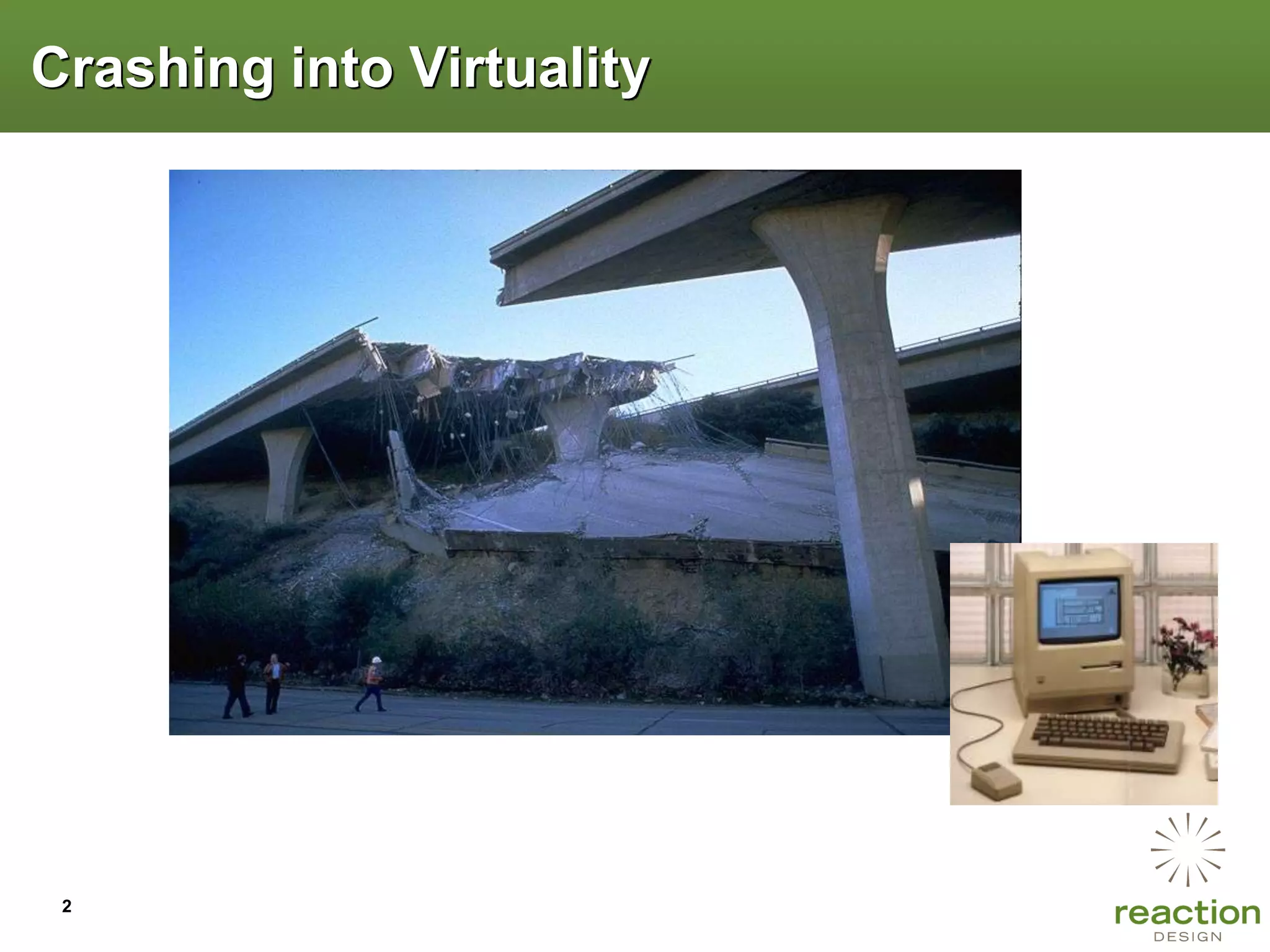
Crashing into Virtuality


 2
Preview

     ● Employers assign web-savvy workers to
       virtual teams with no qualms
       – Smooth communication is assumed
       – Multiple factors at play on virtual teams
     ● Online ubiquity does not guarantee
       communication success on virtual teams


 3
Agenda

    1.   Meet Kathy
    2.   Virtual team characteristics
    3.   Challenges and strategies
    4.   Communication is key
    5.   Social! media
    6.   Who is joining our teams?
    7.   Summary and bibliography


4
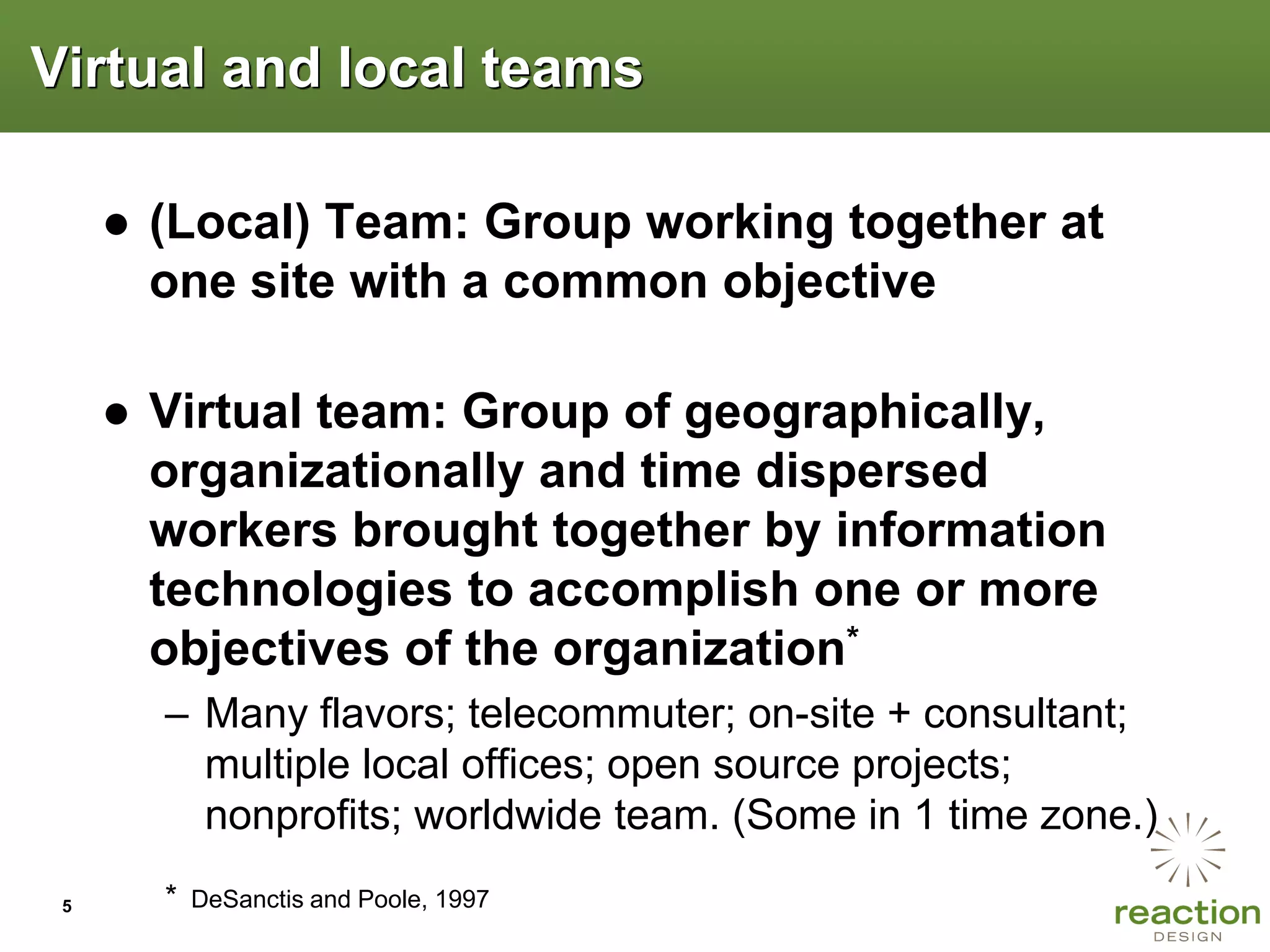
Virtual and local teams

     ● (Local) Team: Group working together at
       one site with a common objective

     ● Virtual team: Group of geographically,
       organizationally and time dispersed
       workers brought together by information
       technologies to accomplish one or more
       objectives of the organization*
       – Many flavors; telecommuter; on-site + consultant;
         multiple local offices; open source projects;
         nonprofits; worldwide team. (Some in 1 time zone.)
 5     *   DeSanctis and Poole, 1997
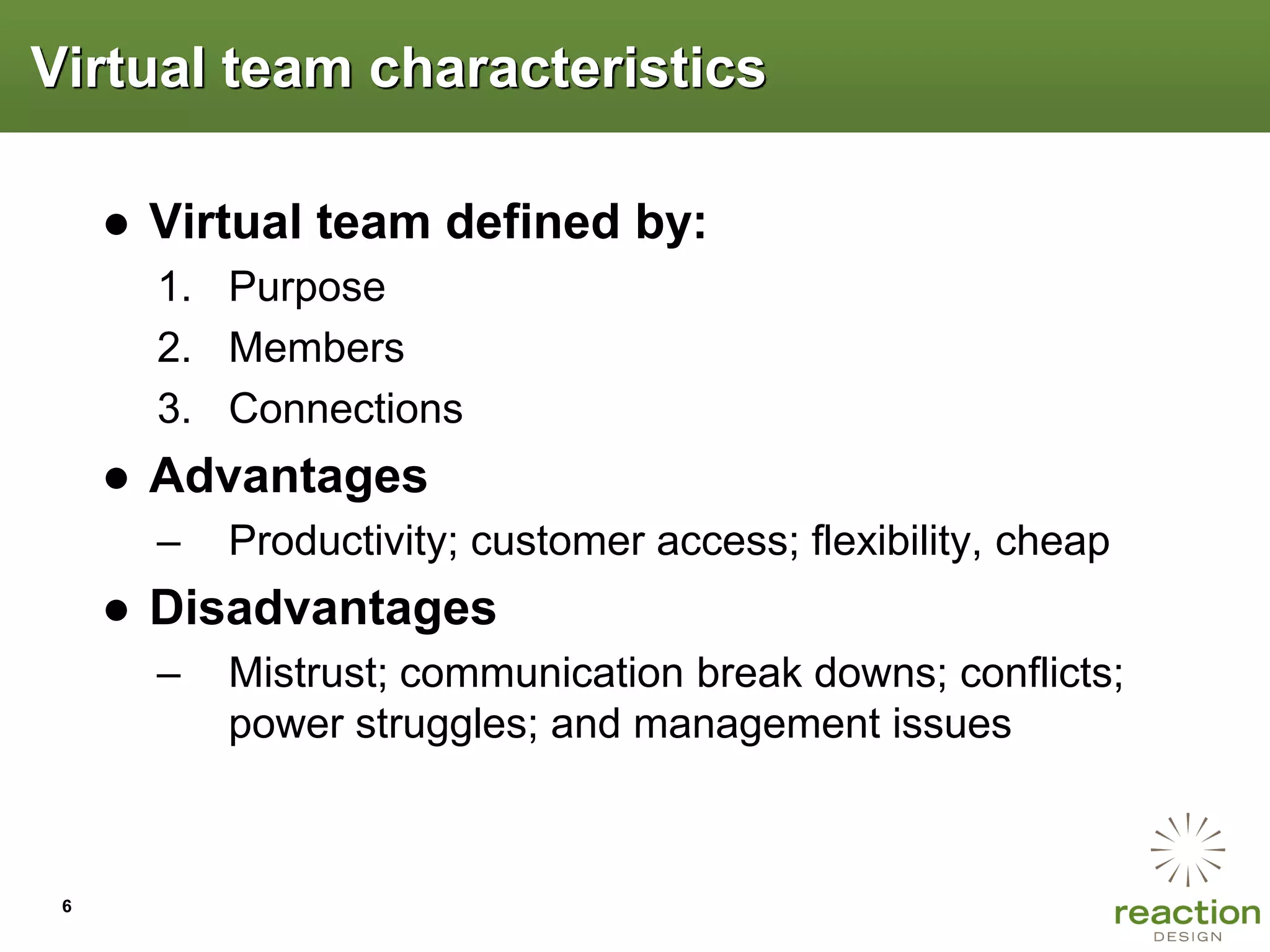
Virtual team characteristics

     ● Virtual team defined by:
       1. Purpose
       2. Members
       3. Connections
     ● Advantages
       –   Productivity; customer access; flexibility, cheap
     ● Disadvantages
       –   Mistrust; communication break downs; conflicts;
           power struggles; and management issues


 6
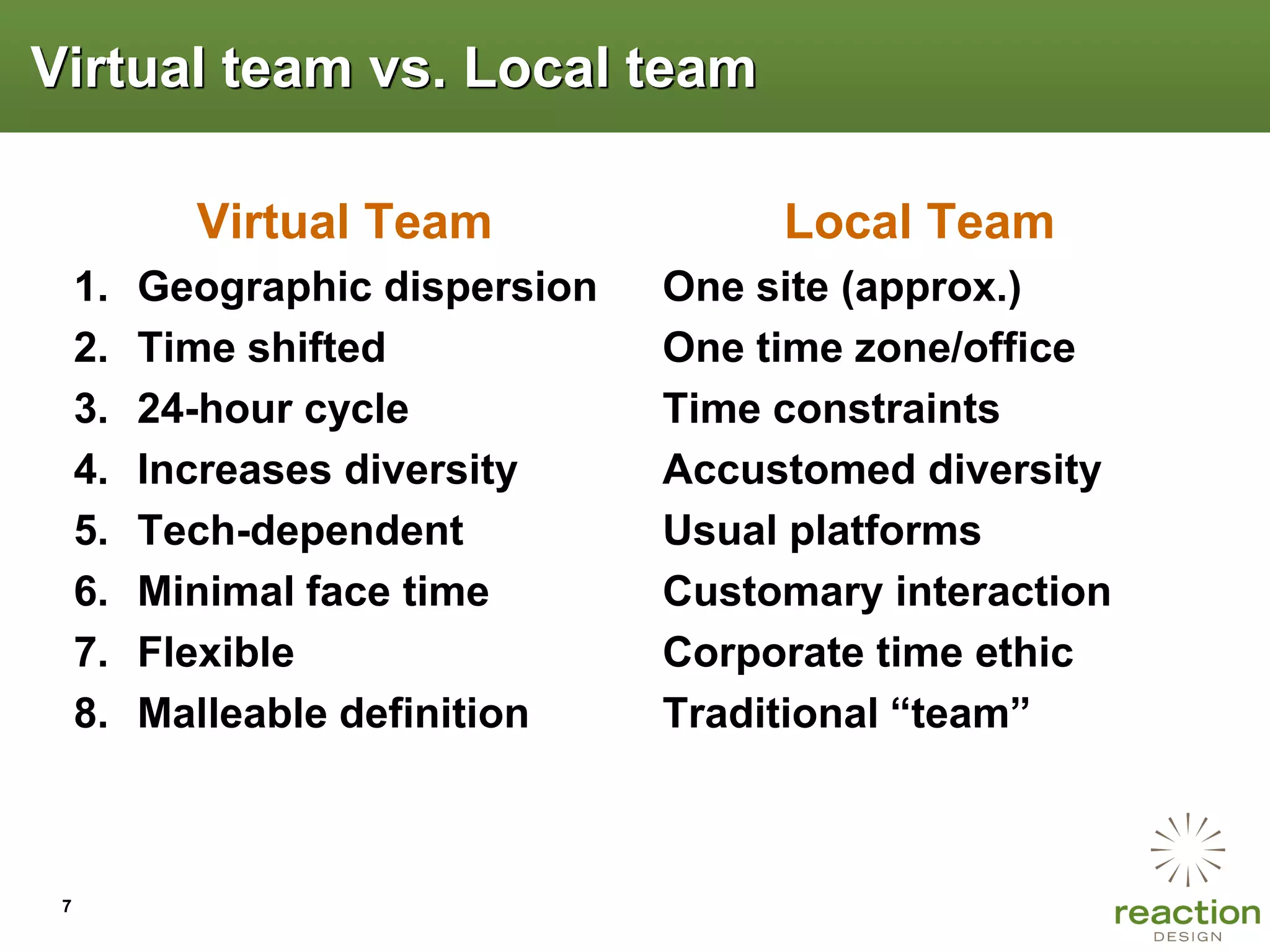
Virtual team vs. Local team

            Virtual Team               Local Team
     1.   Geographic dispersion   One site (approx.)
     2.   Time shifted            One time zone/office
     3.   24-hour cycle           Time constraints
     4.   Increases diversity     Accustomed diversity
     5.   Tech-dependent          Usual platforms
     6.   Minimal face time       Customary interaction
     7.   Flexible                Corporate time ethic
     8.   Malleable definition    Traditional “team”


 7
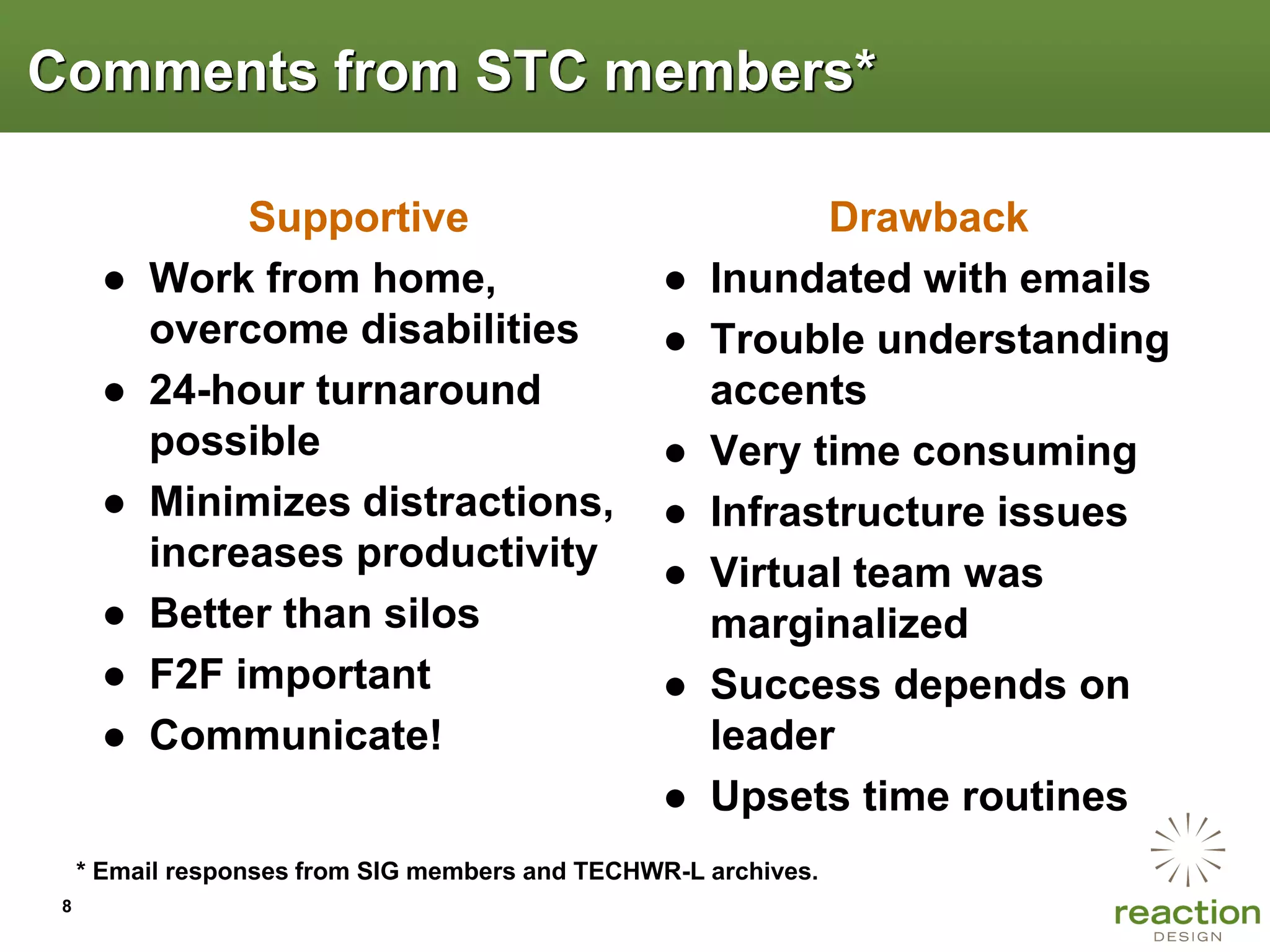
Comments from STC members*

               Supportive                                   Drawback
      ●   Work from home,                         ●   Inundated with emails
          overcome disabilities                   ●   Trouble understanding
      ●   24-hour turnaround                          accents
          possible                                ●   Very time consuming
      ●   Minimizes distractions,                 ●   Infrastructure issues
          increases productivity                  ●   Virtual team was
      ●   Better than silos                           marginalized
      ●   F2F important                           ●   Success depends on
      ●   Communicate!                                leader
                                                  ●   Upsets time routines
     * Email responses from SIG members and TECHWR-L archives.
 8
Agenda

    1.   Meet Kathy
    2.   Virtual team characteristics
    3.   Challenges and strategies
    4.   Communication is key
    5.   Social! media
    6.   Who is joining our teams?
    7.   Summary and bibliography


9
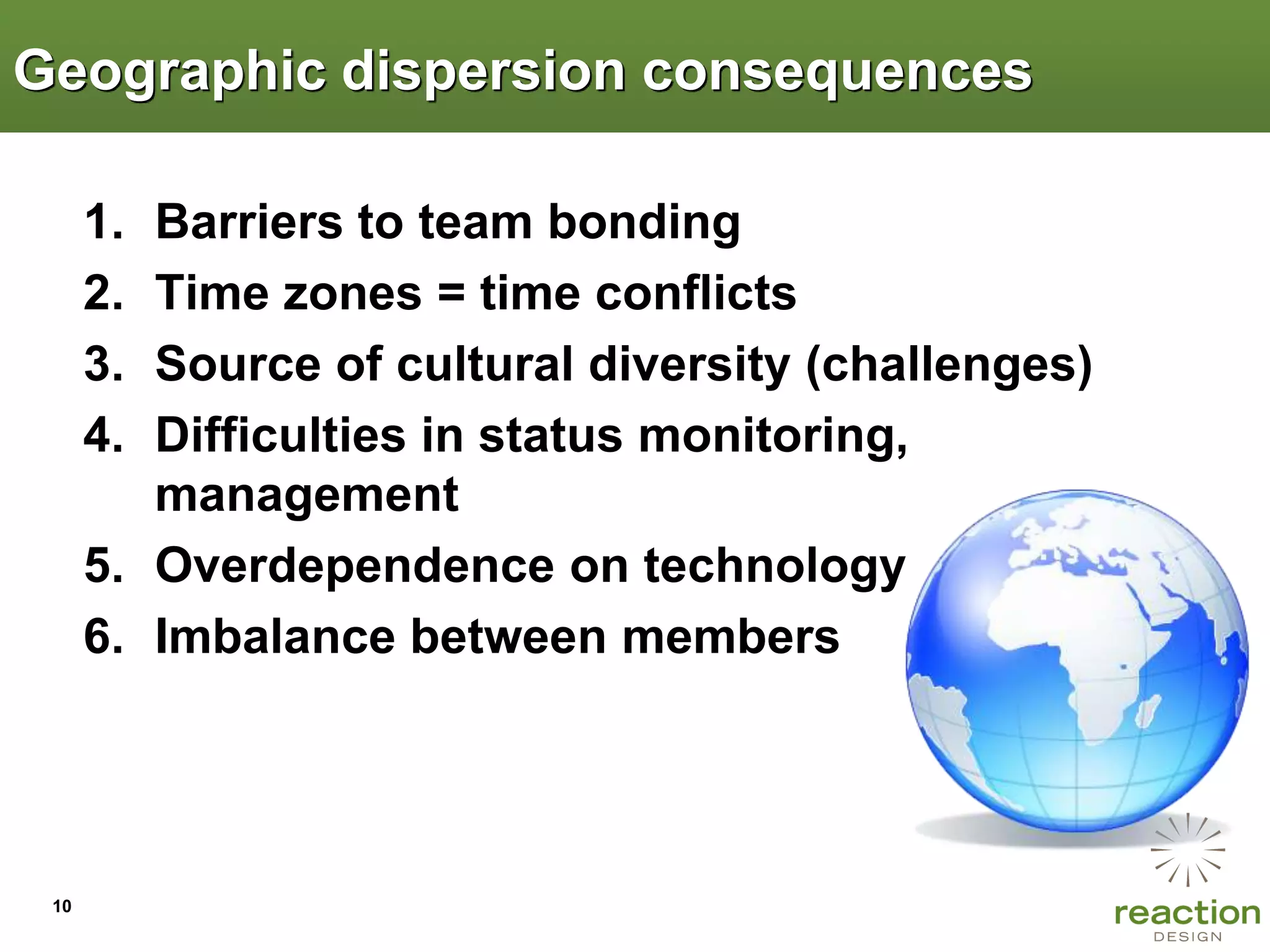
Geographic dispersion consequences

      1. Barriers to team bonding
      2. Time zones = time conflicts
      3. Source of cultural diversity (challenges)
      4. Difficulties in status monitoring,
         management
      5. Overdependence on technology
      6. Imbalance between members


 10
Challenges and strategies

     ● Barriers to team bonding and trust:
       – Face to face meetings
       – Ongoing team activities
     ● Time spread:
       –   #1 issue for virtual team managers!
       –   Site awareness
       –   Rotate discomfort
       –   Personal policy


11
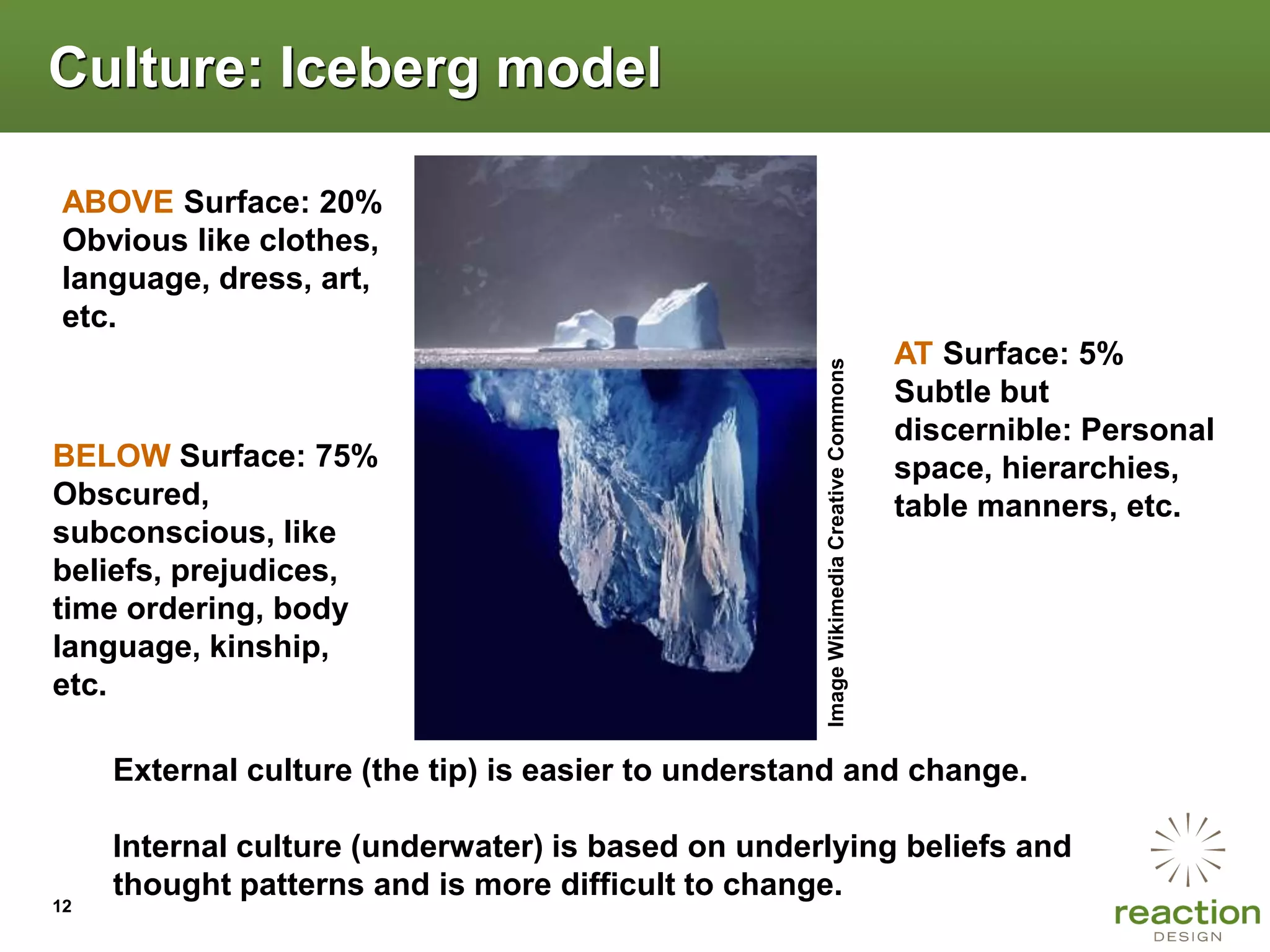
Culture: Iceberg model

 ABOVE Surface: 20%
 Obvious like clothes,
 language, dress, art,
 etc.
                                                                                          AT Surface: 5%


                                                       Image Wikimedia Creative Commons
                                                                                          Subtle but
                                                                                          discernible: Personal
BELOW Surface: 75%                                                                        space, hierarchies,
Obscured,                                                                                 table manners, etc.
subconscious, like
beliefs, prejudices,
time ordering, body
language, kinship,
etc.

     • External culture (the tip) is easier to understand and change.

     • Internal culture (underwater) is based on underlying beliefs and
       thought patterns and is more difficult to change.
12
Example: Cultural challenges

     ● Manager gives mildly worded instructions,
       such as “Why don‟t you…”
     ● Team members elsewhere hear a mild
       suggestion, not an order
       – Chaos on team if orders are not received
       – Resentment between manager and member


13
Overcoming: Cultural diversity challenges

     Culture is #2 challenge for vTeam leaders.
     Nationality, regional, generational, religious,
     socioeconomic, corporate
     ● Keep your mind open. Think before
       (e-)speaking
     ● Learn about team members
     ● Be aware of your own cultural conditioning
     ● Study cultural effects
     ● Consider personality profiles (MBTI, etc.)

14
Culture defines members‟ responses

     ● Individualist: Personal initiative, success,
       advancement, independence, are valued.
     ● Collectivist: Group harmony, agreement,
       cooperation, are valued; disagreement is
       avoided.
     ● Gender Perception: Fluid or rigid roles
     ● Uncertainty factor: Accepting or avoiding
        – From Dutch anthropologist Geert Hofstede*


     * Geert-hofstede.com
15
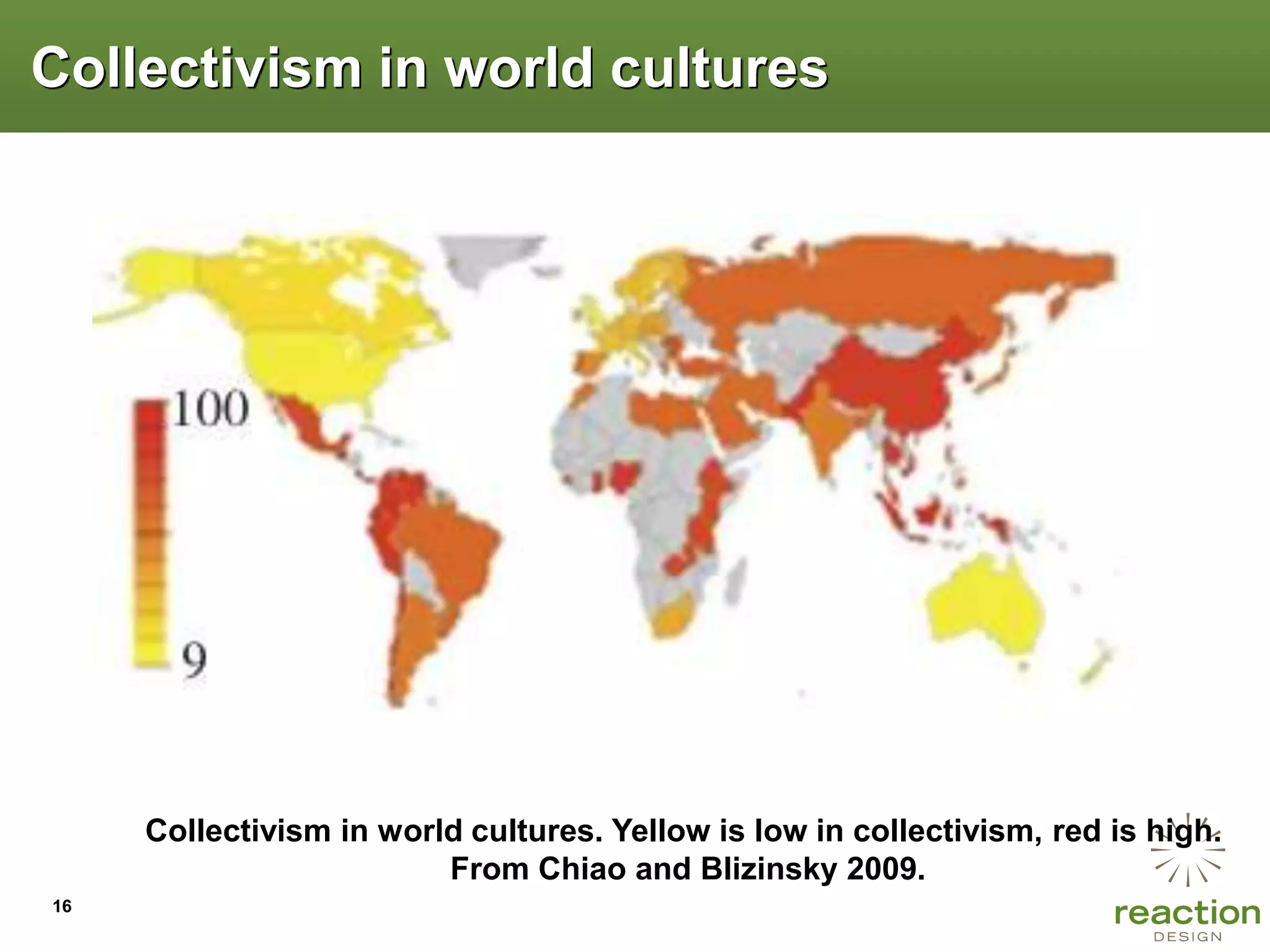
Collectivism in world cultures


     Collectivism in world cultures. Yellow is low in collectivism, red is high.
                         From Chiao and Blizinsky 2009.
16
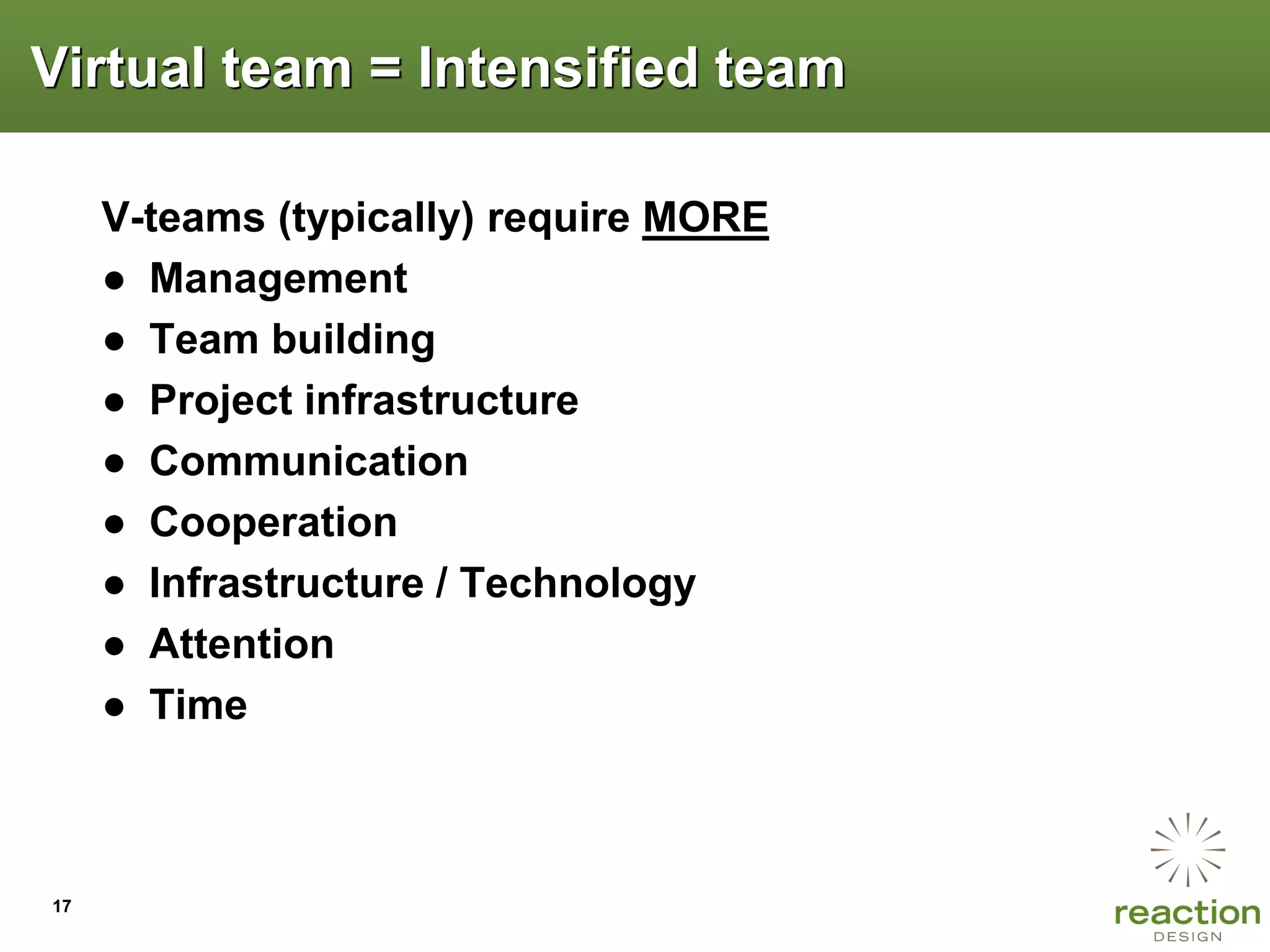
Virtual team = Intensified team

     V-teams (typically) require MORE
     ● Management
     ● Team building
     ● Project infrastructure
     ● Communication
     ● Cooperation
     ● Infrastructure / Technology
     ● Attention
     ● Time


17
Agenda

     1.   Meet Kathy
     2.   Virtual team characteristics
     3.   Challenges and strategies
     4.   Communication is key
     5.   Social! media
     6.   Who is joining our teams?
     7.   Summary and bibliography


18
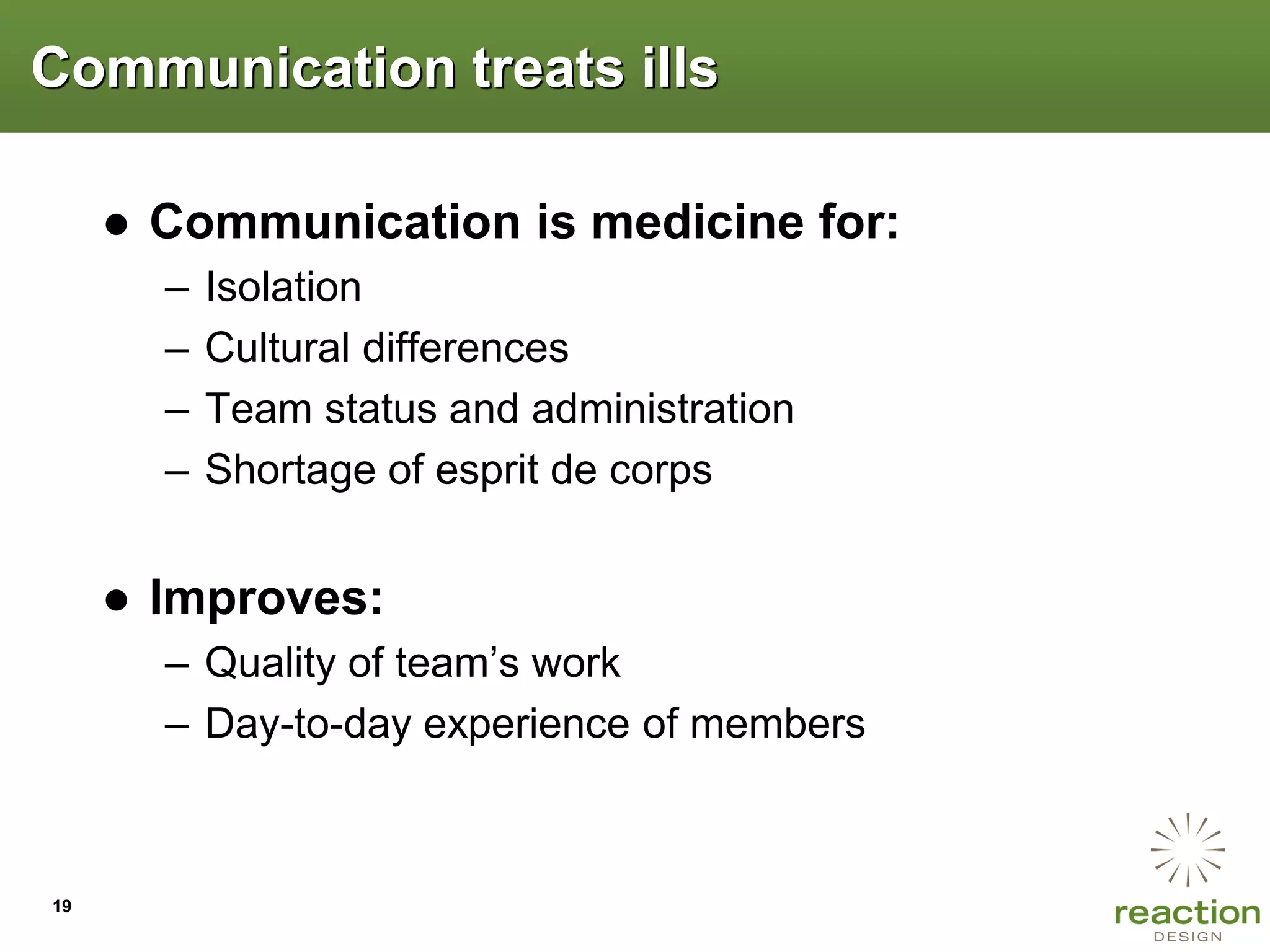
Communication treats ills

     ● Communication is medicine for:
       –   Isolation
       –   Cultural differences
       –   Team status and administration
       –   Shortage of esprit de corps


     ● Improves:
       – Quality of team’s work
       – Day-to-day experience of members


19
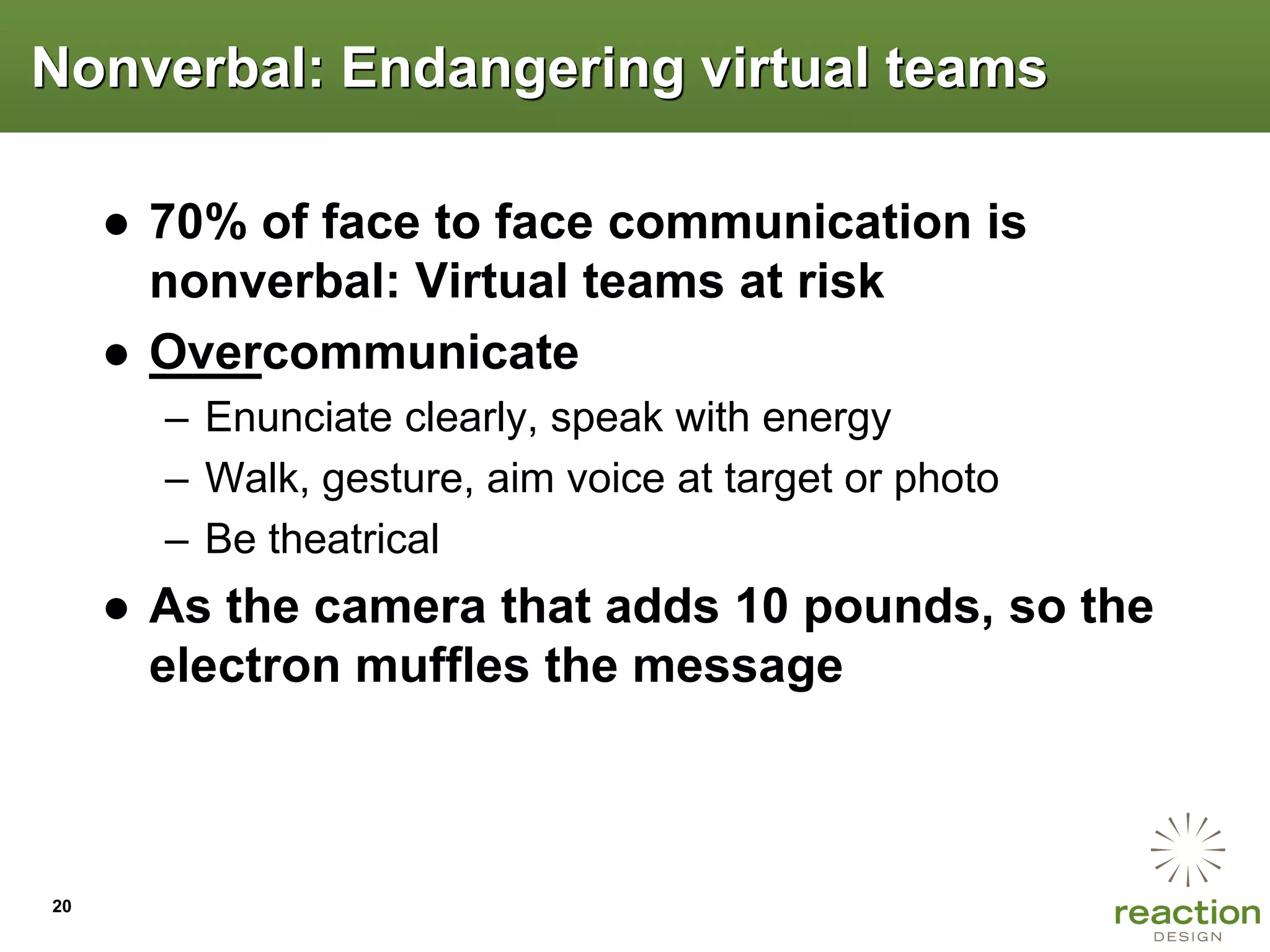
Nonverbal: Endangering virtual teams

     ● 70% of face to face communication is
       nonverbal: Virtual teams at risk
     ● Overcommunicate
       – Enunciate clearly, speak with energy
       – Walk, gesture, aim voice at target or photo
       – Be theatrical
     ● As the camera that adds 10 pounds, so the
       electron muffles the message


20
Define team communication protocols

     ● #1 complaint from virtual teams relates to
       communication flaws
     ● Clearly define team communication
       protocols, early
     ● Explicit discussion of email turnaround, cc
       policy, out-of-office messages, etc.
     ● Team-building:
       – Include communication exercises


21
Virtual teams have extra issues

     ● On local teams, 70% avoiding a crucial
       conversation
     ● Of 14 all-team issues, 13 much more
       frequent with virtual teams
     ● Handled by:
        1. Avoidance, screening calls, ignoring calls and
           emails, leaving other out of the loop
        2. Undermining by gossip, criticism, complaints
     ● Remote problems significantly more
       difficult to solve and last longer
      Long-Distance Loathing: The Hidden Dangers of Virtual Teams, March 2009
22
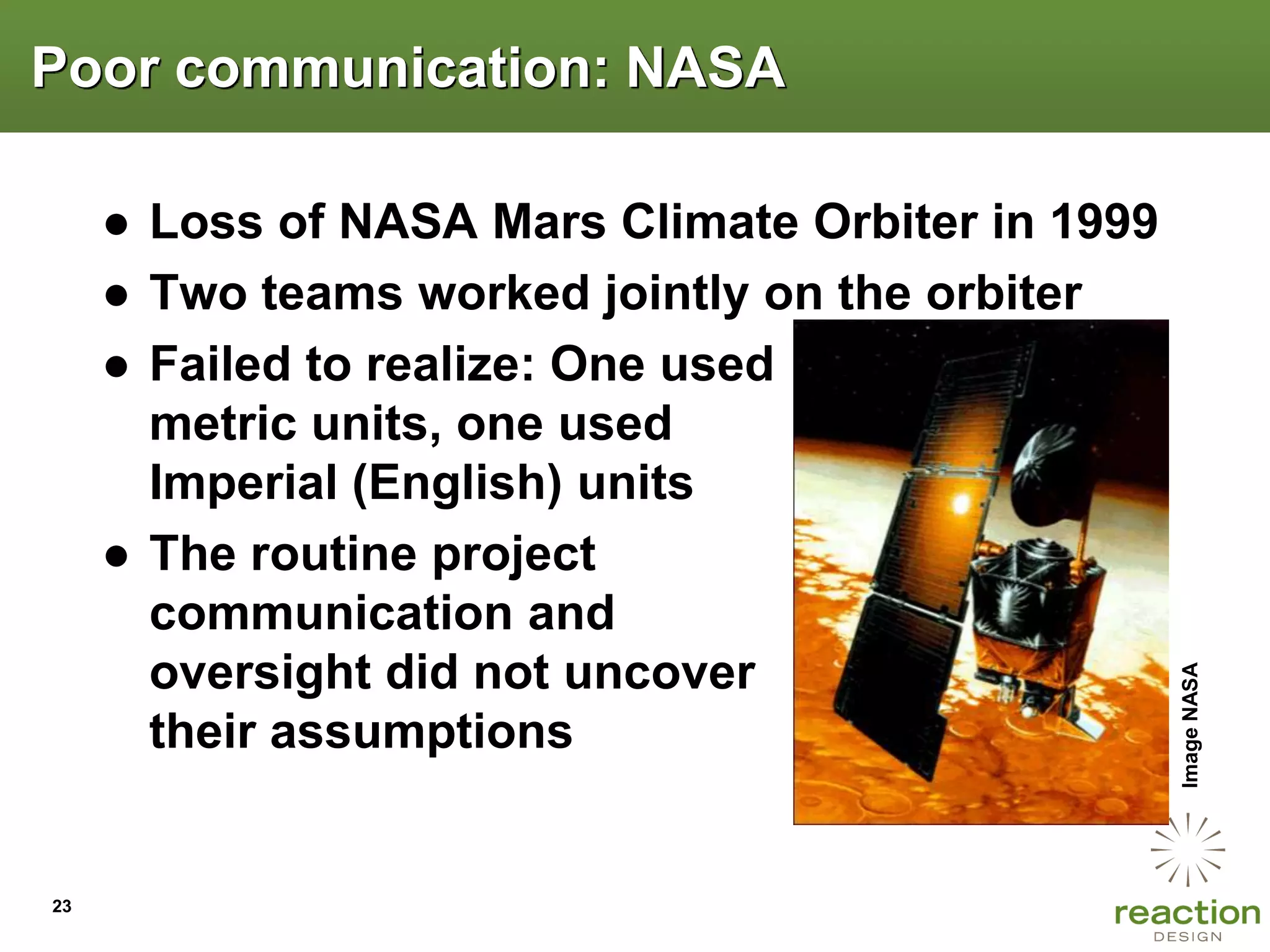
Poor communication: NASA

     ● Loss of NASA Mars Climate Orbiter in 1999
     ● Two teams worked jointly on the orbiter
     ● Failed to realize: One used
       metric units, one used
       Imperial (English) units
     ● The routine project
       communication and
       oversight did not uncover


                                                   Image NASA
       their assumptions


23
Agenda

     1.   Meet Kathy
     2.   Virtual team characteristics
     3.   Challenges and strategies
     4.   Communication is key
     5.   Social! media
     6.   Who is joining our teams?
     7.   Summary and bibliography


24
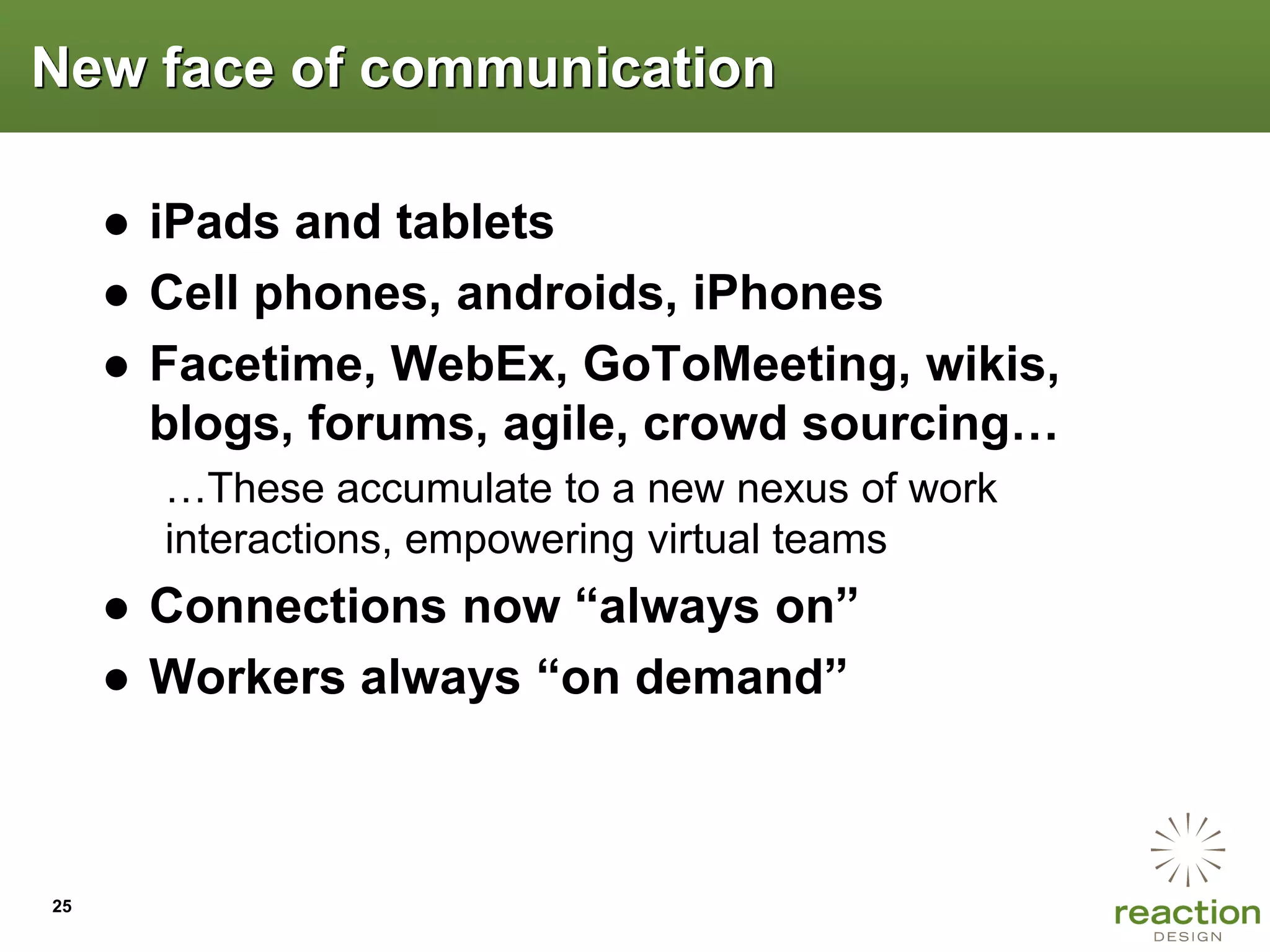
New face of communication

     ● iPads and tablets
     ● Cell phones, androids, iPhones
     ● Facetime, WebEx, GoToMeeting, wikis,
       blogs, forums, agile, crowd sourcing…
       …These accumulate to a new nexus of work
       interactions, empowering virtual teams
     ● Connections now “always on”
     ● Workers always “on demand”


25
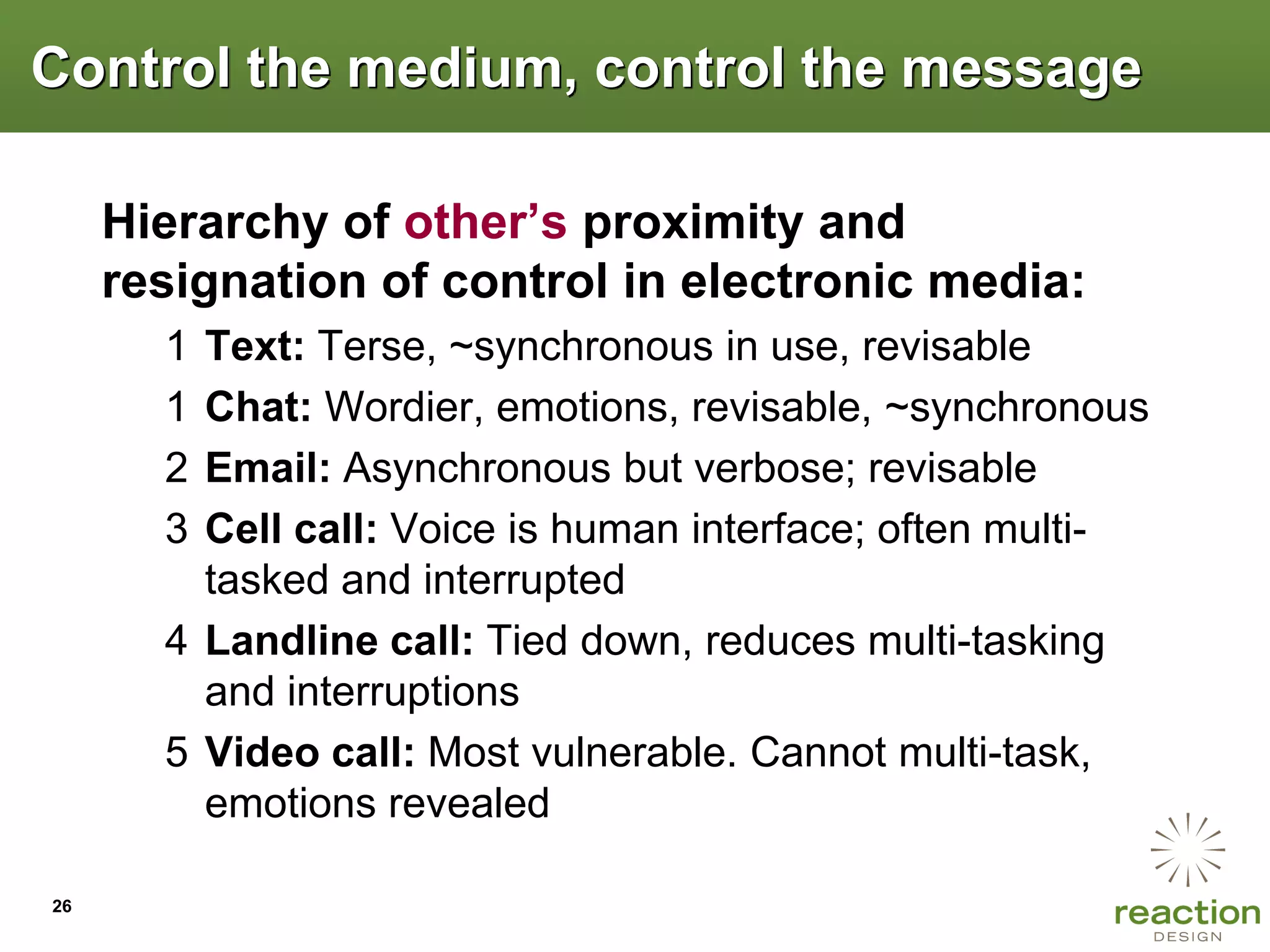
Control the medium, control the message

     Hierarchy of other‟s proximity and
     resignation of control in electronic media:
       1 Text: Terse, ~synchronous in use, revisable
       1 Chat: Wordier, emotions, revisable, ~synchronous
       2 Email: Asynchronous but verbose; revisable
       3 Cell call: Voice is human interface; often multi-
         tasked and interrupted
       4 Landline call: Tied down, reduces multi-tasking
         and interruptions
       5 Video call: Most vulnerable. Cannot multi-task,
         emotions revealed

26
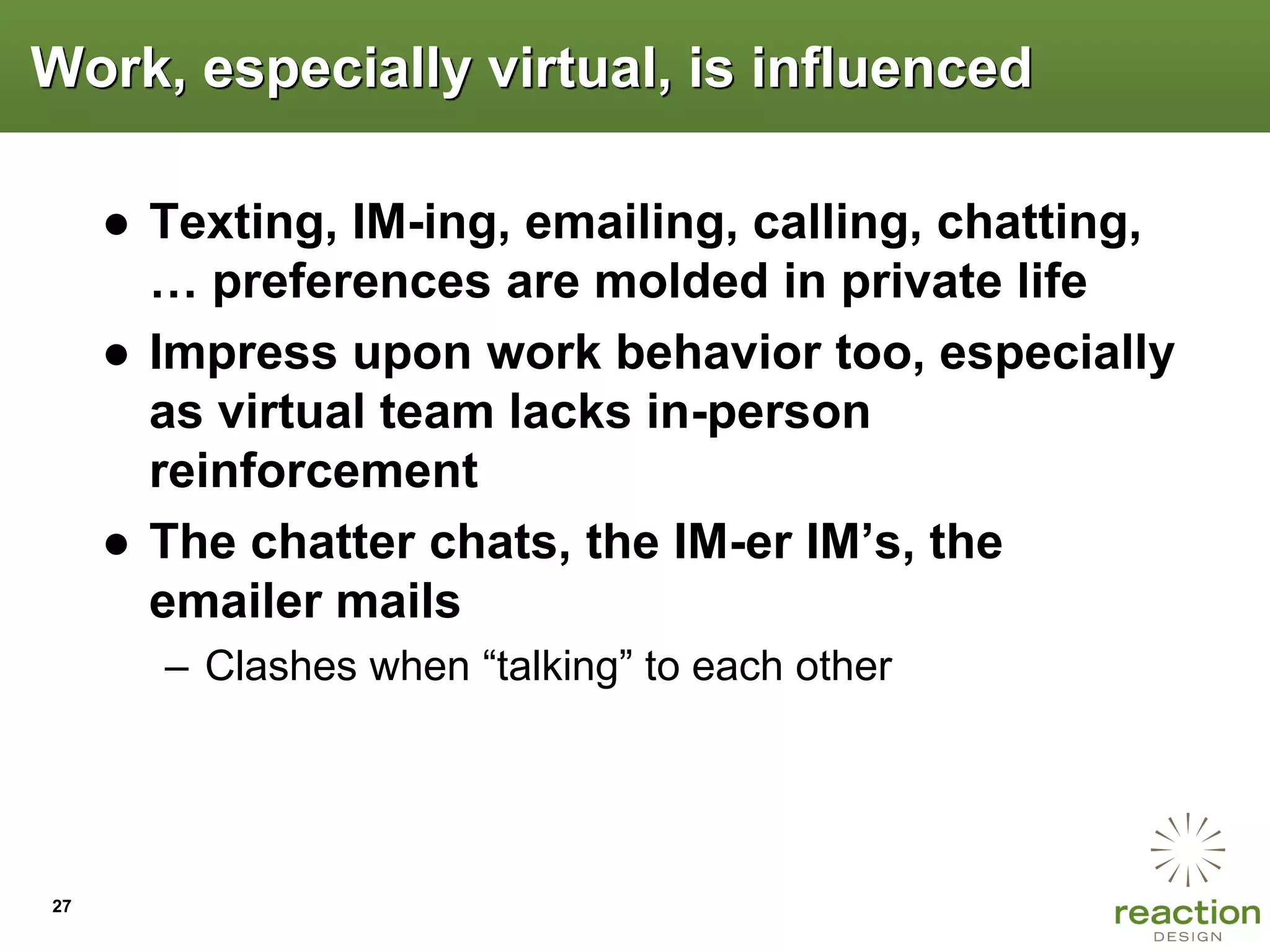
Work, especially virtual, is influenced

     ● Texting, IM-ing, emailing, calling, chatting,
       … preferences are molded in private life
     ● Impress upon work behavior too, especially
       as virtual team lacks in-person
       reinforcement
     ● The chatter chats, the IM-er IM‟s, the
       emailer mails
       – Clashes when “talking” to each other


27
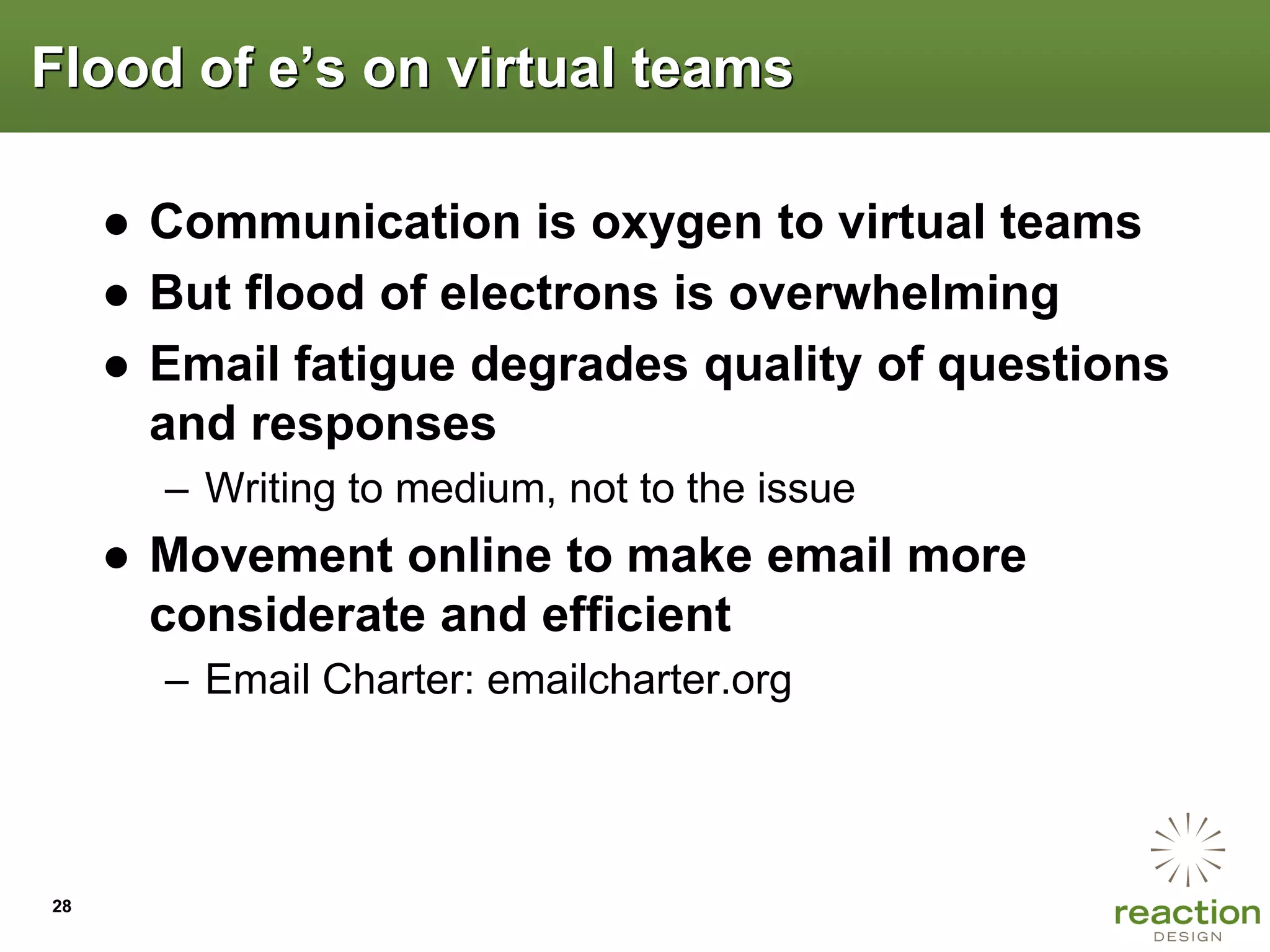
Flood of e‟s on virtual teams

     ● Communication is oxygen to virtual teams
     ● But flood of electrons is overwhelming
     ● Email fatigue degrades quality of questions
       and responses
       – Writing to medium, not to the issue
     ● Movement online to make email more
       considerate and efficient
       – Email Charter: emailcharter.org


28
Meet my avatar

     ● Worker controls virtual persona
     ● Worker may control virtual personas
     ● Missing:
       –   Body language
       –   Serendipity of real life
       –   Negotiation and surrender of control
       –   Synchronicity
       –   Full attention


29
Virtual teams are theatrical


     ● Virtual teams = writing, editing, revising:
                      Performance
     ● Harder to “know” the team members: as
       people, as competencies, as potential, as
       other than what they choose to present
     ● Easier to hide sub-optimum work


30
Electronic media impinge on virtual work

     “„It was almost surprising that no one
     seemed to notice [how much time I spent
     reading the site]. But you could say in a
     sense it was cutting down my productivity,
     because I could have been experimenting
     with stuff and improving them a bit more. But
     everything was working fine.‟ As Joseph
     began to think of Slashdot as an addiction,
     he began to think about his unrealized
     potential. He was functioning „fine‟ at his real
     job, but falling down on his idealized one.”
                  Chan, A.S. The Inner History of Devices 2008.
31
Disconnecting?

     ● Some hyperconnected people crave “down
       time” and sign off Facebook or chat
       – Some try―yet fall back to their “old” ways
     ● Pulled away from real-life accomplishments
     ● Some find it easier to be unkind, rude, or
       unethical to online connections, even
       knowing this phenomenon is occurring


32
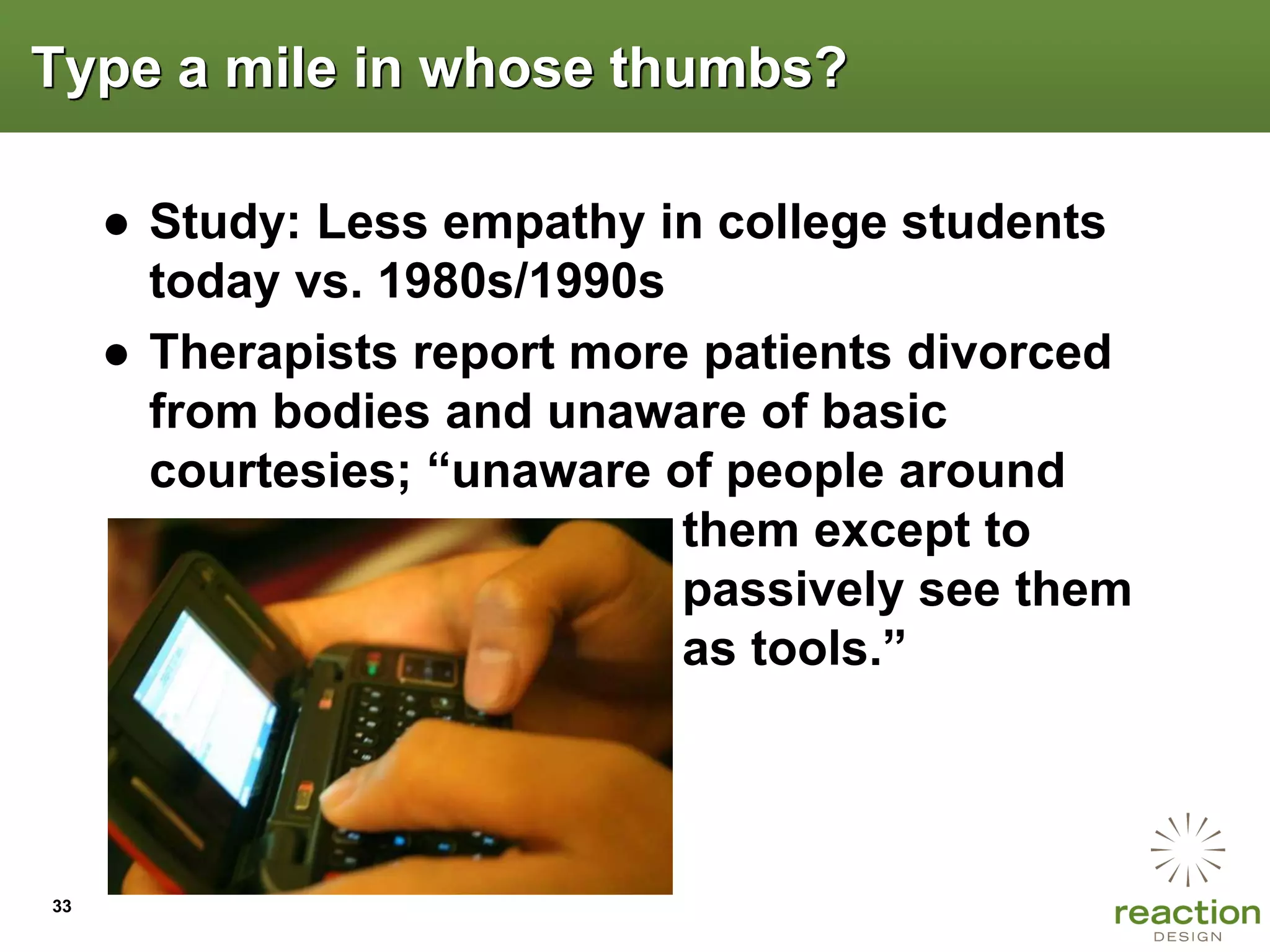
Type a mile in whose thumbs?

     ● Study: Less empathy in college students
       today vs. 1980s/1990s
     ● Therapists report more patients divorced
       from bodies and unaware of basic
       courtesies; “unaware of people around
                             them except to
                             passively see them
                             as tools.”


33
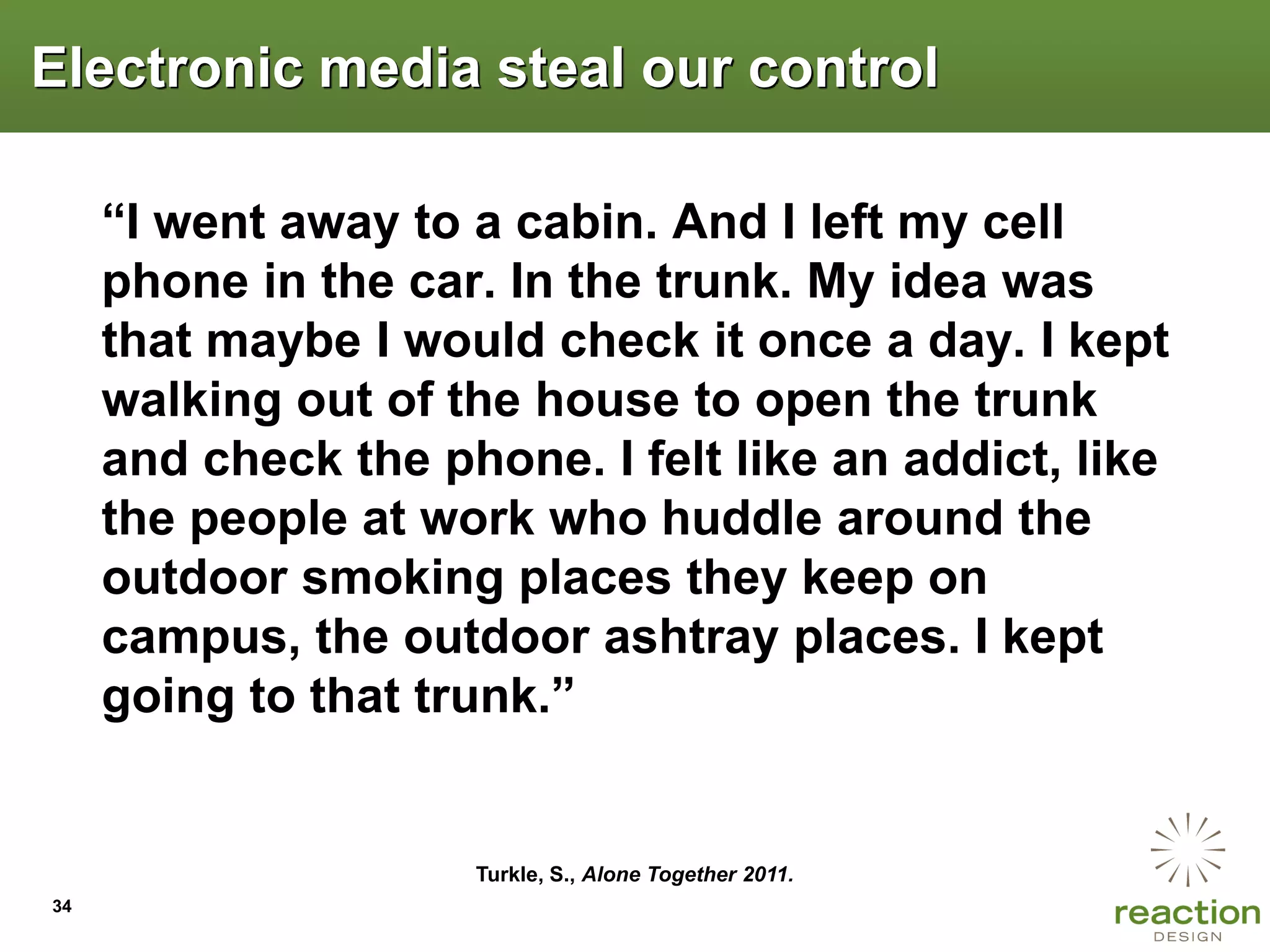
Electronic media steal our control

     “I went away to a cabin. And I left my cell
     phone in the car. In the trunk. My idea was
     that maybe I would check it once a day. I kept
     walking out of the house to open the trunk
     and check the phone. I felt like an addict, like
     the people at work who huddle around the
     outdoor smoking places they keep on
     campus, the outdoor ashtray places. I kept
     going to that trunk.”


                     Turkle, S., Alone Together 2011.
34
Agenda

     1.   Meet Kathy
     2.   Virtual team characteristics
     3.   Challenges and strategies
     4.   Communication is key
     5.   Social! media
     6.   Who is joining our teams?
     7.   Summary and bibliography


35
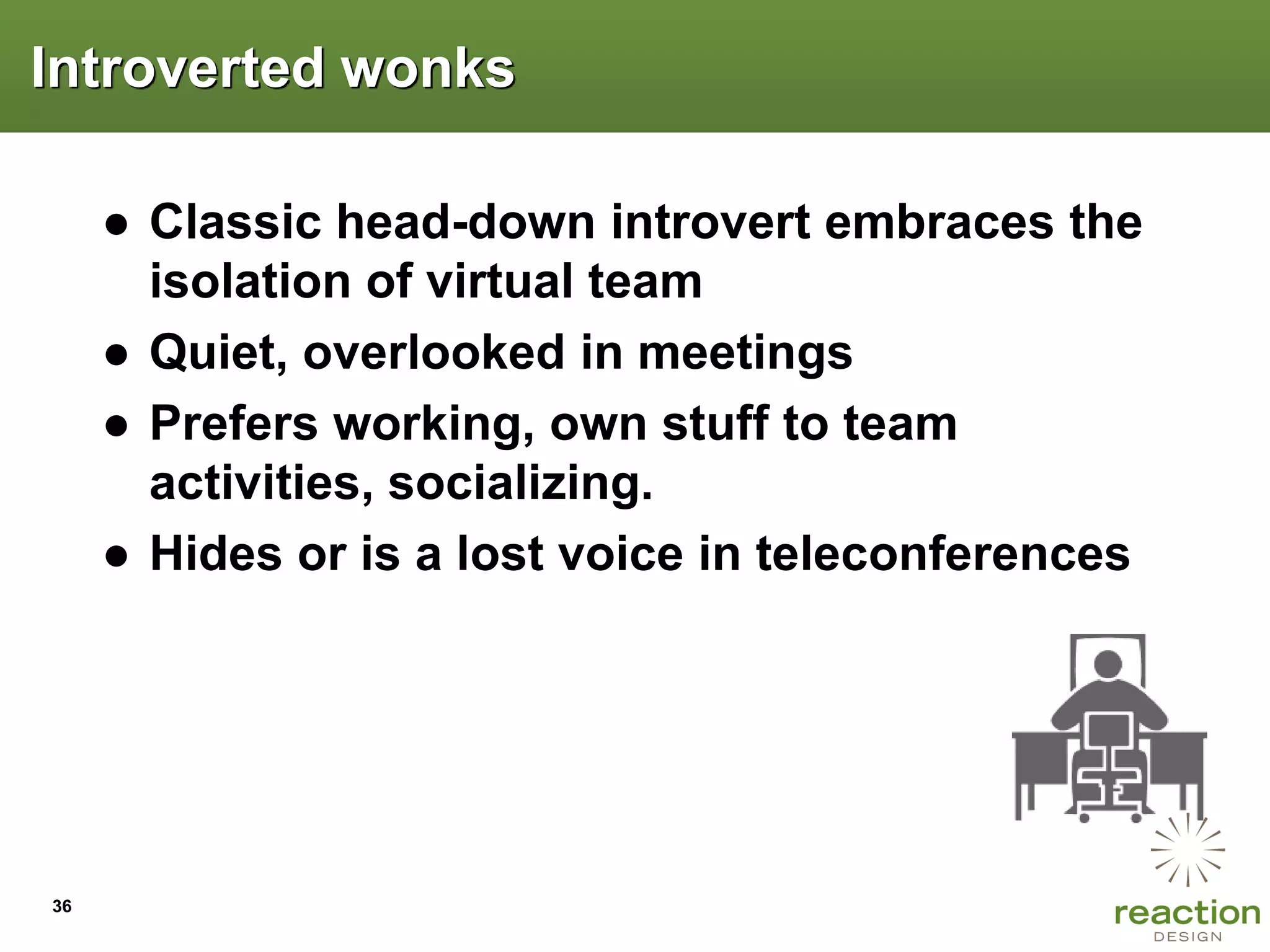
Introverted wonks

     ● Classic head-down introvert embraces the
       isolation of virtual team
     ● Quiet, overlooked in meetings
     ● Prefers working, own stuff to team
       activities, socializing.
     ● Hides or is a lost voice in teleconferences


36
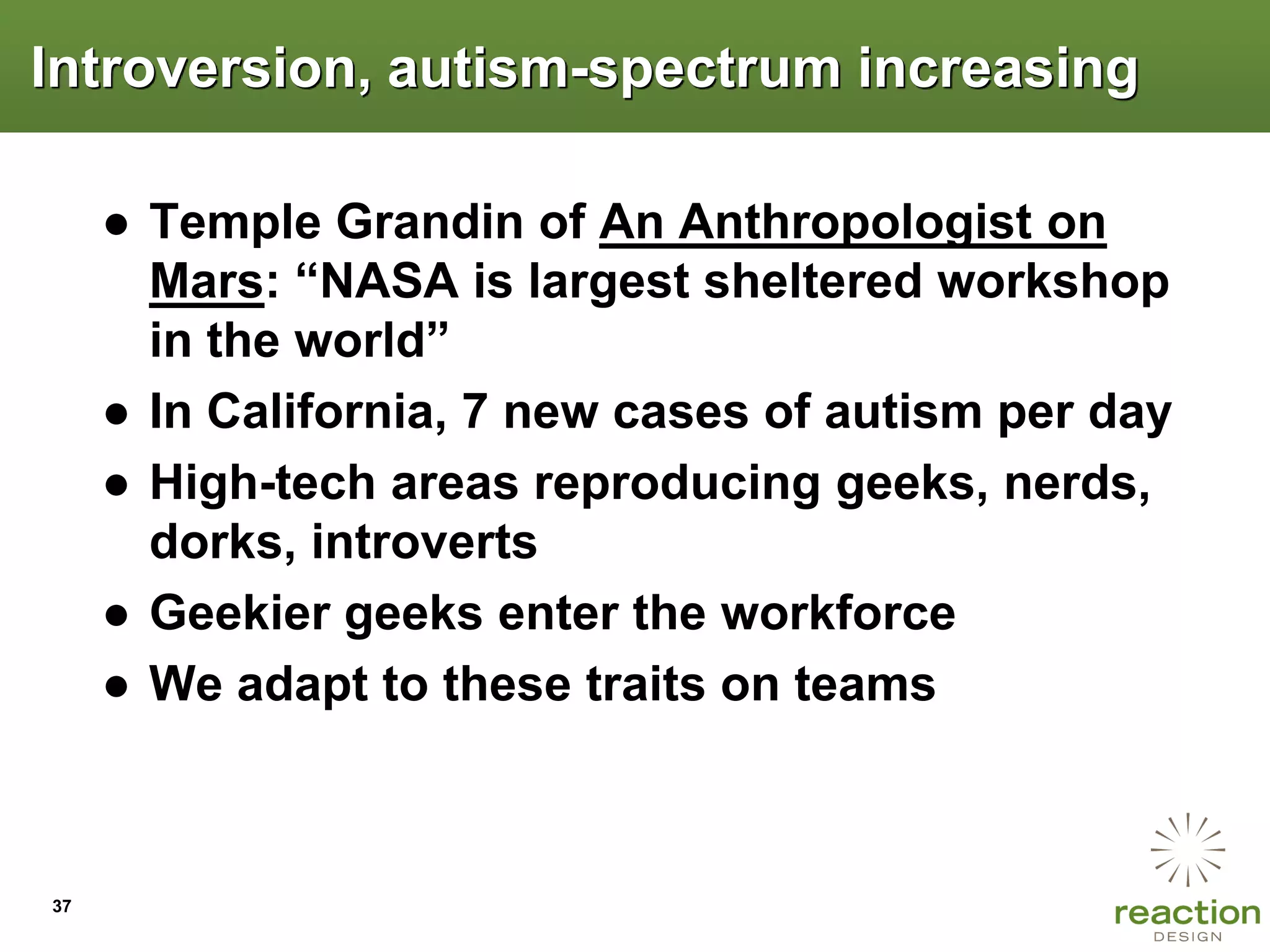
Introversion, autism-spectrum increasing

     ● Temple Grandin of An Anthropologist on
       Mars: “NASA is largest sheltered workshop
       in the world”
     ● In California, 7 new cases of autism per day
     ● High-tech areas reproducing geeks, nerds,
       dorks, introverts
     ● Geekier geeks enter the workforce
     ● We adapt to these traits on teams


37
Welcoming the introverts

     ● Get good voice technology for low talkers
     ● Pause, query, rotate, roll call
     ● Discover introverts‟ personal goals,
       hobbies: Weave into team doings
     ● Ping for their progress
     ● Actively, repeatedly seek their opinions
     ● …Or, leave them in their solitude and check
       in as needed


38
Welcoming Gen Y tsunami

     ● Gen Y workers (1980s - 90s) are flooding
       into our teams
     ● Approximately 80 million Millennials
       – 44 - 50 million Gen Xers (1965 - 1980)
       – 76 million Baby Boomers (1946 - 1964)


     ● Teams likely to expand with Gen Y‟s


39
Gen Y traits

     ●   Confident but seeking feedback
     ●   Self-absorbed but philanthropic
     ●   Job-hopping entrepreneurs
     ●   Collaborative crowd-sourcers
     ●   Friendly to diversity and inclusion
     ●   Techno-savvy data mining info-seekers
     ●   Comfortable getting authority figures‟ tips

     These are good traits for virtual teams

40
Agenda

     1.   Meet Kathy
     2.   Virtual team characteristics
     3.   Challenges and strategies
     4.   Communication is key
     5.   Social! media
     6.   Who is joining our teams?
     7.   Summary and bibliography


41
Discussion

     ● Survey
       – How did you react?
       – Results


42
Future

     ● Virtual tools are trending into the local
       office
     ● Building our skills as virtual teammates will
       make us more effective, efficient, humane
       team members
     ● We can be the “just right” connected
       colleague, prepared both to contribute and
       to assist others


43
Summary

     ● Virtual teams are intensified teams
     ● Communication is key
     ● New media are everywhere, everywhen
     ● Media can distance us from our teams
     ● Help your teammates by recognizing and
       adapting to their quirks
     ● Know your own quirks; be adaptable
     ● Social changes may affect team make-up


44
Bibliography

     Arnison, L. and P. Miller (2002).     Brown, M. K., B. Huettner, et al.
     "Virtual teams: a virtue for the      (2007). Managing virtual teams:
     conventional team." Journal of        getting the most from wikis,
     Workplace Learning 14(4): 166-        blogs, and other collaborative
     173.                                  tools. Sudbury, MA, Jones and
     Brewer, P. E. (2010).                 Bartlett: 6327.
     Communication and                     Economist Intelligence Unit
     Miscommunication in Virtual           (2009). Managing virtual teams:
     Workplaces.                           Taking a more strategic
     Brown, M. K. (2004). Building an      approach.
     Effective Multi-Site, Multicultural   Email Charter. (2011). "Email
     Team. Management SIG News,            Charter." Retrieved February 12,
     Society for Technical                 2012, from emailcharter.net.
     Communication. 8: 3-4.                Fisher, K. and M. Fisher (2011).
                                           Manager's Guide to Virtual
                                           Teams. Briefcase Books. New
                                           York, McGraw-Hill: 4412.
45
Bibliography

     Pongolini, M., J. Lundin, et al.     TECHWR-L archives. (2002).
     (2011). "Global Online Meetings in   "Virtual Teams thread."
     Virtual Teams - from Media           Retrieved Feb. 17, 2012, from
     Choice to Interaction                http://www.techwr-
     Negotiation." C&T'11(29 June - 2     l.com/archives/0201/techwhirl-
     July 2011): 108-117.                 0201-01172.html.
     Skill Soft. (2008, Dec. 13, 2011).   Turkle, S., Ed. (2008). Inner
     "Leading Teams: Managing             History of Devices. Cambridge
     Virtual Teams" from                  MA, MIT Press.
     http://learning.acm.org/courses/c    Turkle, S. (2011). Alone Together:
     ourse_detail.cfm?course_id=1257      Why We Expect More From
     22.                                  Technology and Less From Each
                                          Other. New York, Basic Books:
                                          7517.


46
Thank You


47

Virtual & Local Teams: Communication Success and Failure

  • 1.
    Virtual vs. LocalTeams: Communication Success and Failure Kathy Moore STC Summit May 22, 2012 ©2012 K. Moore
  • 2.
  • 3.
    Preview ● Employers assign web-savvy workers to virtual teams with no qualms – Smooth communication is assumed – Multiple factors at play on virtual teams ● Online ubiquity does not guarantee communication success on virtual teams 3
  • 4.
    Agenda 1. Meet Kathy 2. Virtual team characteristics 3. Challenges and strategies 4. Communication is key 5. Social! media 6. Who is joining our teams? 7. Summary and bibliography 4
  • 5.
    Virtual and localteams ● (Local) Team: Group working together at one site with a common objective ● Virtual team: Group of geographically, organizationally and time dispersed workers brought together by information technologies to accomplish one or more objectives of the organization* – Many flavors; telecommuter; on-site + consultant; multiple local offices; open source projects; nonprofits; worldwide team. (Some in 1 time zone.) 5 * DeSanctis and Poole, 1997
  • 6.
    Virtual team characteristics ● Virtual team defined by: 1. Purpose 2. Members 3. Connections ● Advantages – Productivity; customer access; flexibility, cheap ● Disadvantages – Mistrust; communication break downs; conflicts; power struggles; and management issues 6
  • 7.
    Virtual team vs.Local team Virtual Team Local Team 1. Geographic dispersion One site (approx.) 2. Time shifted One time zone/office 3. 24-hour cycle Time constraints 4. Increases diversity Accustomed diversity 5. Tech-dependent Usual platforms 6. Minimal face time Customary interaction 7. Flexible Corporate time ethic 8. Malleable definition Traditional “team” 7
  • 8.
    Comments from STCmembers* Supportive Drawback ● Work from home, ● Inundated with emails overcome disabilities ● Trouble understanding ● 24-hour turnaround accents possible ● Very time consuming ● Minimizes distractions, ● Infrastructure issues increases productivity ● Virtual team was ● Better than silos marginalized ● F2F important ● Success depends on ● Communicate! leader ● Upsets time routines * Email responses from SIG members and TECHWR-L archives. 8
  • 9.
    Agenda 1. Meet Kathy 2. Virtual team characteristics 3. Challenges and strategies 4. Communication is key 5. Social! media 6. Who is joining our teams? 7. Summary and bibliography 9
  • 10.
    Geographic dispersion consequences 1. Barriers to team bonding 2. Time zones = time conflicts 3. Source of cultural diversity (challenges) 4. Difficulties in status monitoring, management 5. Overdependence on technology 6. Imbalance between members 10
  • 11.
    Challenges and strategies ● Barriers to team bonding and trust: – Face to face meetings – Ongoing team activities ● Time spread: – #1 issue for virtual team managers! – Site awareness – Rotate discomfort – Personal policy 11
  • 12.
    Culture: Iceberg model ABOVE Surface: 20% Obvious like clothes, language, dress, art, etc. AT Surface: 5% Image Wikimedia Creative Commons Subtle but discernible: Personal BELOW Surface: 75% space, hierarchies, Obscured, table manners, etc. subconscious, like beliefs, prejudices, time ordering, body language, kinship, etc. • External culture (the tip) is easier to understand and change. • Internal culture (underwater) is based on underlying beliefs and thought patterns and is more difficult to change. 12
  • 13.
    Example: Cultural challenges ● Manager gives mildly worded instructions, such as “Why don‟t you…” ● Team members elsewhere hear a mild suggestion, not an order – Chaos on team if orders are not received – Resentment between manager and member 13
  • 14.
    Overcoming: Cultural diversitychallenges Culture is #2 challenge for vTeam leaders. Nationality, regional, generational, religious, socioeconomic, corporate ● Keep your mind open. Think before (e-)speaking ● Learn about team members ● Be aware of your own cultural conditioning ● Study cultural effects ● Consider personality profiles (MBTI, etc.) 14
  • 15.
    Culture defines members‟responses ● Individualist: Personal initiative, success, advancement, independence, are valued. ● Collectivist: Group harmony, agreement, cooperation, are valued; disagreement is avoided. ● Gender Perception: Fluid or rigid roles ● Uncertainty factor: Accepting or avoiding – From Dutch anthropologist Geert Hofstede* * Geert-hofstede.com 15
  • 16.
    Collectivism in worldcultures Collectivism in world cultures. Yellow is low in collectivism, red is high. From Chiao and Blizinsky 2009. 16
  • 17.
    Virtual team =Intensified team V-teams (typically) require MORE ● Management ● Team building ● Project infrastructure ● Communication ● Cooperation ● Infrastructure / Technology ● Attention ● Time 17
  • 18.
    Agenda 1. Meet Kathy 2. Virtual team characteristics 3. Challenges and strategies 4. Communication is key 5. Social! media 6. Who is joining our teams? 7. Summary and bibliography 18
  • 19.
    Communication treats ills ● Communication is medicine for: – Isolation – Cultural differences – Team status and administration – Shortage of esprit de corps ● Improves: – Quality of team’s work – Day-to-day experience of members 19
  • 20.
    Nonverbal: Endangering virtualteams ● 70% of face to face communication is nonverbal: Virtual teams at risk ● Overcommunicate – Enunciate clearly, speak with energy – Walk, gesture, aim voice at target or photo – Be theatrical ● As the camera that adds 10 pounds, so the electron muffles the message 20
  • 21.
    Define team communicationprotocols ● #1 complaint from virtual teams relates to communication flaws ● Clearly define team communication protocols, early ● Explicit discussion of email turnaround, cc policy, out-of-office messages, etc. ● Team-building: – Include communication exercises 21
  • 22.
    Virtual teams haveextra issues ● On local teams, 70% avoiding a crucial conversation ● Of 14 all-team issues, 13 much more frequent with virtual teams ● Handled by: 1. Avoidance, screening calls, ignoring calls and emails, leaving other out of the loop 2. Undermining by gossip, criticism, complaints ● Remote problems significantly more difficult to solve and last longer Long-Distance Loathing: The Hidden Dangers of Virtual Teams, March 2009 22
  • 23.
    Poor communication: NASA ● Loss of NASA Mars Climate Orbiter in 1999 ● Two teams worked jointly on the orbiter ● Failed to realize: One used metric units, one used Imperial (English) units ● The routine project communication and oversight did not uncover Image NASA their assumptions 23
  • 24.
    Agenda 1. Meet Kathy 2. Virtual team characteristics 3. Challenges and strategies 4. Communication is key 5. Social! media 6. Who is joining our teams? 7. Summary and bibliography 24
  • 25.
    New face ofcommunication ● iPads and tablets ● Cell phones, androids, iPhones ● Facetime, WebEx, GoToMeeting, wikis, blogs, forums, agile, crowd sourcing… …These accumulate to a new nexus of work interactions, empowering virtual teams ● Connections now “always on” ● Workers always “on demand” 25
  • 26.
    Control the medium,control the message Hierarchy of other‟s proximity and resignation of control in electronic media: 1 Text: Terse, ~synchronous in use, revisable 1 Chat: Wordier, emotions, revisable, ~synchronous 2 Email: Asynchronous but verbose; revisable 3 Cell call: Voice is human interface; often multi- tasked and interrupted 4 Landline call: Tied down, reduces multi-tasking and interruptions 5 Video call: Most vulnerable. Cannot multi-task, emotions revealed 26
  • 27.
    Work, especially virtual,is influenced ● Texting, IM-ing, emailing, calling, chatting, … preferences are molded in private life ● Impress upon work behavior too, especially as virtual team lacks in-person reinforcement ● The chatter chats, the IM-er IM‟s, the emailer mails – Clashes when “talking” to each other 27
  • 28.
    Flood of e‟son virtual teams ● Communication is oxygen to virtual teams ● But flood of electrons is overwhelming ● Email fatigue degrades quality of questions and responses – Writing to medium, not to the issue ● Movement online to make email more considerate and efficient – Email Charter: emailcharter.org 28
  • 29.
    Meet my avatar ● Worker controls virtual persona ● Worker may control virtual personas ● Missing: – Body language – Serendipity of real life – Negotiation and surrender of control – Synchronicity – Full attention 29
  • 30.
    Virtual teams aretheatrical ● Virtual teams = writing, editing, revising: Performance ● Harder to “know” the team members: as people, as competencies, as potential, as other than what they choose to present ● Easier to hide sub-optimum work 30
  • 31.
    Electronic media impingeon virtual work “„It was almost surprising that no one seemed to notice [how much time I spent reading the site]. But you could say in a sense it was cutting down my productivity, because I could have been experimenting with stuff and improving them a bit more. But everything was working fine.‟ As Joseph began to think of Slashdot as an addiction, he began to think about his unrealized potential. He was functioning „fine‟ at his real job, but falling down on his idealized one.” Chan, A.S. The Inner History of Devices 2008. 31
  • 32.
    Disconnecting? ● Some hyperconnected people crave “down time” and sign off Facebook or chat – Some try―yet fall back to their “old” ways ● Pulled away from real-life accomplishments ● Some find it easier to be unkind, rude, or unethical to online connections, even knowing this phenomenon is occurring 32
  • 33.
    Type a milein whose thumbs? ● Study: Less empathy in college students today vs. 1980s/1990s ● Therapists report more patients divorced from bodies and unaware of basic courtesies; “unaware of people around them except to passively see them as tools.” 33
  • 34.
    Electronic media stealour control “I went away to a cabin. And I left my cell phone in the car. In the trunk. My idea was that maybe I would check it once a day. I kept walking out of the house to open the trunk and check the phone. I felt like an addict, like the people at work who huddle around the outdoor smoking places they keep on campus, the outdoor ashtray places. I kept going to that trunk.” Turkle, S., Alone Together 2011. 34
  • 35.
    Agenda 1. Meet Kathy 2. Virtual team characteristics 3. Challenges and strategies 4. Communication is key 5. Social! media 6. Who is joining our teams? 7. Summary and bibliography 35
  • 36.
    Introverted wonks ● Classic head-down introvert embraces the isolation of virtual team ● Quiet, overlooked in meetings ● Prefers working, own stuff to team activities, socializing. ● Hides or is a lost voice in teleconferences 36
  • 37.
    Introversion, autism-spectrum increasing ● Temple Grandin of An Anthropologist on Mars: “NASA is largest sheltered workshop in the world” ● In California, 7 new cases of autism per day ● High-tech areas reproducing geeks, nerds, dorks, introverts ● Geekier geeks enter the workforce ● We adapt to these traits on teams 37
  • 38.
    Welcoming the introverts ● Get good voice technology for low talkers ● Pause, query, rotate, roll call ● Discover introverts‟ personal goals, hobbies: Weave into team doings ● Ping for their progress ● Actively, repeatedly seek their opinions ● …Or, leave them in their solitude and check in as needed 38
  • 39.
    Welcoming Gen Ytsunami ● Gen Y workers (1980s - 90s) are flooding into our teams ● Approximately 80 million Millennials – 44 - 50 million Gen Xers (1965 - 1980) – 76 million Baby Boomers (1946 - 1964) ● Teams likely to expand with Gen Y‟s 39
  • 40.
    Gen Y traits ● Confident but seeking feedback ● Self-absorbed but philanthropic ● Job-hopping entrepreneurs ● Collaborative crowd-sourcers ● Friendly to diversity and inclusion ● Techno-savvy data mining info-seekers ● Comfortable getting authority figures‟ tips These are good traits for virtual teams 40
  • 41.
    Agenda 1. Meet Kathy 2. Virtual team characteristics 3. Challenges and strategies 4. Communication is key 5. Social! media 6. Who is joining our teams? 7. Summary and bibliography 41
  • 42.
    Discussion ● Survey – How did you react? – Results 42
  • 43.
    Future ● Virtual tools are trending into the local office ● Building our skills as virtual teammates will make us more effective, efficient, humane team members ● We can be the “just right” connected colleague, prepared both to contribute and to assist others 43
  • 44.
    Summary ● Virtual teams are intensified teams ● Communication is key ● New media are everywhere, everywhen ● Media can distance us from our teams ● Help your teammates by recognizing and adapting to their quirks ● Know your own quirks; be adaptable ● Social changes may affect team make-up 44
  • 45.
    Bibliography Arnison, L. and P. Miller (2002). Brown, M. K., B. Huettner, et al. "Virtual teams: a virtue for the (2007). Managing virtual teams: conventional team." Journal of getting the most from wikis, Workplace Learning 14(4): 166- blogs, and other collaborative 173. tools. Sudbury, MA, Jones and Brewer, P. E. (2010). Bartlett: 6327. Communication and Economist Intelligence Unit Miscommunication in Virtual (2009). Managing virtual teams: Workplaces. Taking a more strategic Brown, M. K. (2004). Building an approach. Effective Multi-Site, Multicultural Email Charter. (2011). "Email Team. Management SIG News, Charter." Retrieved February 12, Society for Technical 2012, from emailcharter.net. Communication. 8: 3-4. Fisher, K. and M. Fisher (2011). Manager's Guide to Virtual Teams. Briefcase Books. New York, McGraw-Hill: 4412. 45
  • 46.
    Bibliography Pongolini, M., J. Lundin, et al. TECHWR-L archives. (2002). (2011). "Global Online Meetings in "Virtual Teams thread." Virtual Teams - from Media Retrieved Feb. 17, 2012, from Choice to Interaction http://www.techwr- Negotiation." C&T'11(29 June - 2 l.com/archives/0201/techwhirl- July 2011): 108-117. 0201-01172.html. Skill Soft. (2008, Dec. 13, 2011). Turkle, S., Ed. (2008). Inner "Leading Teams: Managing History of Devices. Cambridge Virtual Teams" from MA, MIT Press. http://learning.acm.org/courses/c Turkle, S. (2011). Alone Together: ourse_detail.cfm?course_id=1257 Why We Expect More From 22. Technology and Less From Each Other. New York, Basic Books: 7517. 46
  • 47.