
More Related Content


Similar to Virginia woolf


Virginia woolf
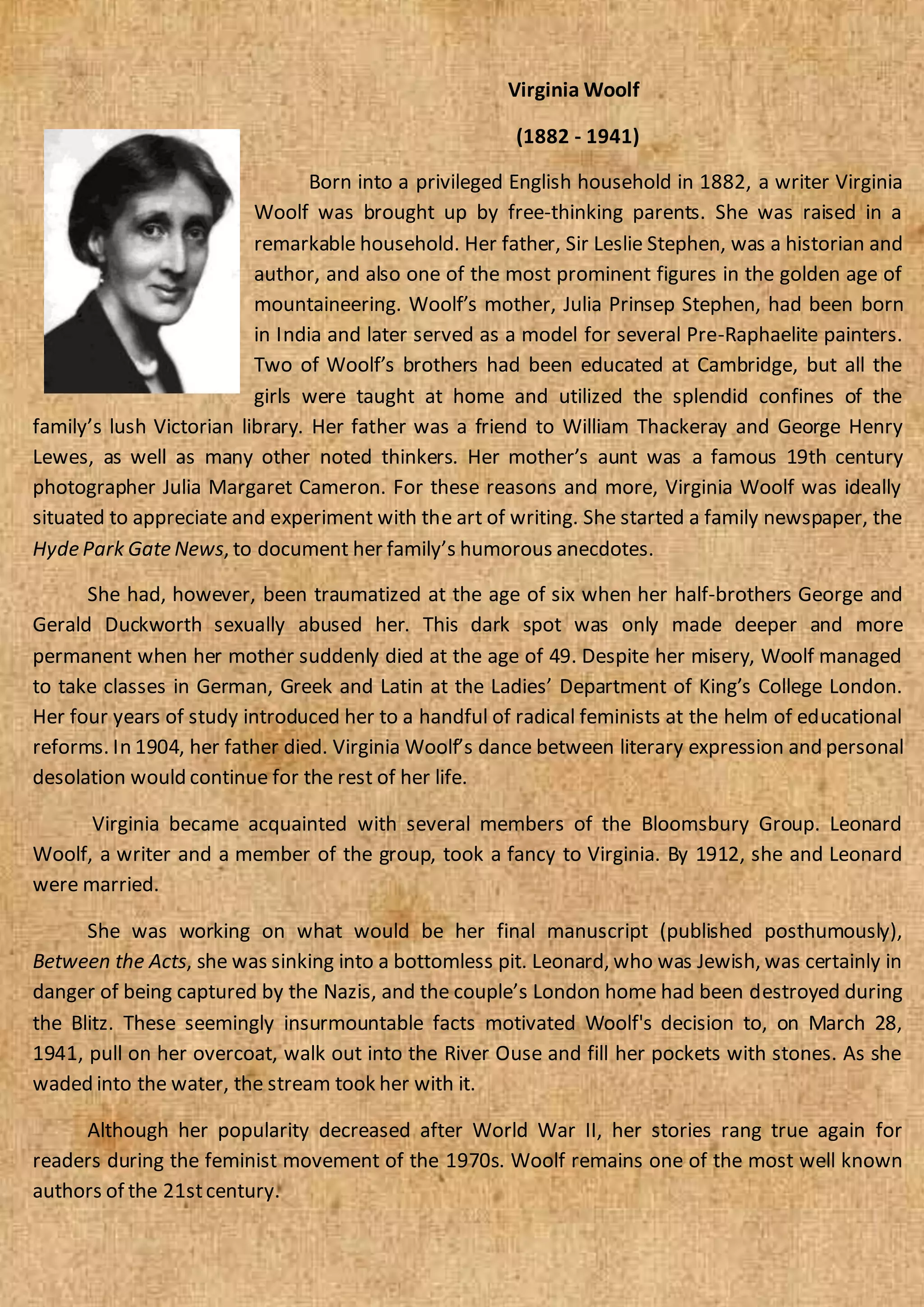
- 1. Virginia Woolf (1882 -1941) Born into a privileged English household in 1882, a writer Virginia Woolf was brought up by free-thinking parents. She was raised in a remarkable household. Her father, Sir Leslie Stephen, was a historian and author, and also one of the most prominent figures in the golden age of mountaineering. Woolf’s mother, Julia Prinsep Stephen, had been born in India and later served as a model for several Pre-Raphaelite painters. Two of Woolf’s brothers had been educated at Cambridge, but all the girls were taught at home and utilized the splendid confines of the family’s lush Victorian library. Her father was a friend to William Thackeray and George Henry Lewes, as well as many other noted thinkers. Her mother’s aunt was a famous 19th century photographer Julia Margaret Cameron. For these reasons and more, Virginia Woolf was ideally situated to appreciate and experiment with the art of writing. She started a family newspaper, the Hyde Park Gate News, to document her family’s humorous anecdotes. She had, however, been traumatized at the age of six when her half-brothers George and Gerald Duckworth sexually abused her. This dark spot was only made deeper and more permanent when her mother suddenly died at the age of 49. Despite her misery, Woolf managed to take classes in German, Greek and Latin at the Ladies’ Department of King’s College London. Her four years of study introduced her to a handful of radical feminists at the helm of educational reforms. In 1904, her father died. Virginia Woolf’s dance between literary expression and personal desolation would continue for the rest of her life. Virginia became acquainted with several members of the Bloomsbury Group. Leonard Woolf, a writer and a member of the group, took a fancy to Virginia. By 1912, she and Leonard were married. She was working on what would be her final manuscript (published posthumously), Between the Acts, she was sinking into a bottomless pit. Leonard, who was Jewish, was certainly in danger of being captured by the Nazis, and the couple’s London home had been destroyed during the Blitz. These seemingly insurmountable facts motivated Woolf's decision to, on March 28, 1941, pull on her overcoat, walk out into the River Ouse and fill her pockets with stones. As she waded into the water, the stream took her with it. Although her popularity decreased after World War II, her stories rang true again for readers during the feminist movement of the 1970s. Woolf remains one of the most well known authors of the 21stcentury.