Subject: N. Hawthorn. “The Scarlet Letter”
Objective:
a) to acquaint ps with life and works of the author;
b) to develop ps’ critical thinking on the basis of
the novel;
c) to analyze the test;
d) to widen ps’ outlook and to raise ps’ interest to
American Literature.
Steps:
I. 1. Org. moment.
2. The analysis of the characteristic mistakes with the references for the
revision of the material.
II. 3. N. Hawthorn. (T’s Power Point Presentation + Lecture)
a) Listen to the T’s presentation and make notes concerning the
works of the author (genres and main themes):
Nathaniel Hawthorne (1804 - 1864)
Nathaniel Hawthorne (born Hathorne), an American
novelist and short story writer, was born on the 4-th of July
1804 in Salem, Massachusetts. He later changed his name
adding “w” to dissociate from relatives including John
Hathorne, a judge during the Salem Witch Trials (a series of
hearings in court on people accused of witchcraft in Essex and other counties of
Massachusetts. Over 150 people were arrested and imprisoned. Many of them died
in prison. 29 people were convicted in witchcraft, 19 of them were hung).
When Hawthorne was 4 his father, a sea captain, died. In 1813 a young
Hawthorne was hit on the leg while playing and became lame and bedridden for a
year. In 1819 he was sent to Salem to school and soon complained of
homesickness and being far from his mother and sisters. For fun he distributed to
his family 7 issues of “The Spectator” in 1820. The homemade newspaper was
written by hand and included essays, poems and news.
His uncle insisted, despite of Hawthorne’s protest, that the boy attend
college. So, Hawthorne was sent to Bowdoin College in 1821 and graduated in
1825. His classmates included the future president Franklin Pierce and the
future poet Henry Longfellow. Hawthorne anonymously published his first
work, a novel “Fanshawe” («Феншо»), in 1828. He published several short
stories in various periodicals which he collected in 1837 as “Twice-Told
Tales”.
While at Bowdoin Hawthorne had bet his friend a bottle of wine that he
would not be married in 12 years. By 1836 he had won the wager, but didn’t
remain single for life. He married Sophia Peabody in 1842 and moved to the Old
Manse. They had 3 children in their long marriage.
In April 1846 Hawthorne was appointed an Inspector for the Port of
Salem. He had difficulties writing during this period. He lost his job due to the
change of administration and wrote a letter of protest to the Boston Daily
Advertiser which made his dismissal a much talked-about event. In 1848
Hawthorne was appointed a correspondent secretary of the Salem Lyceum.
He returned to writing and published “The Scarlet Letter” («Ала літера»)
in March 1850. One of the first mass-produced books in America, it was sold
2500 volumes within 10 days and brought its author 1500$ over 14 years. The
book became an immediate best-seller.
“The House of the Seven Gables” (1851) («Будинок о семі
фронтонах»)
“The Blithedale Romance” (1852) («Блітдейл») – his only work written
in the first person
“A Wonder-Book for Boys and Girls” (1851) – a collection of short
stories retelling myths
In 1852 Hawthorne moved to Concord. He wrote the campaign biography
of his friend “The Life of Franklin Pierce”. With Pierce election as a president
Hawthorne was awarded with the position of the US Consul in Liverpool in 1853
shortly after the publication of “Tanglewood Tales” («Тенглвудські
оповідання»). In 1857 his appointment ended at the close of the Pierce
administration, and the family toured around France and Italy. They returned in
1860 and the first book in seven years, “The Marble Faun” («Мармуровий
фавн»), was published.
Failing health prevented Hawthorne from completing several more
romances. He died in sleep on May 19, 1864.
Hawthorne’s works belong to romanticism or, more specifically, dark
romanticism. He suggested that guilt, sin and evil were the most inherent
natural qualities of humanity. He wrote essentially as a moralist. Hawthorne
was interested in what happened in the minds and hearts of men and women when
they knew they had done something wrong. He focused his examination on the
moral and psychological consequences that manifested themselves in human
beings as a result of their hatred, egoism, ambition and pride.
b) Summing up of the information.
4. “The Scarlet Letter”
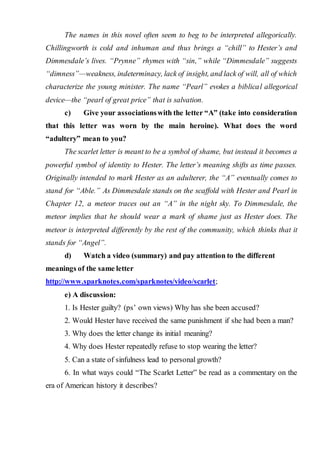
a) Look at the pictures of the main characters and their names and try
to predict their character:
b) Listen to the p’s presentation (the main characters) and compare
the descriptions with your predictions. Are the names of the characters
symbolic? Why?
The names in this novel often seem to beg to be interpreted allegorically.
Chillingworth is cold and inhuman and thus brings a “chill” to Hester’s and
Dimmesdale’s lives. “Prynne” rhymes with “sin,” while “Dimmesdale” suggests
“dimness”—weakness, indeterminacy, lack of insight, and lack of will, all of which
characterize the young minister. The name “Pearl” evokes a biblical allegorical
device—the “pearl of great price” that is salvation.
c) Give your associationswith the letter “A” (take into consideration
that this letter was worn by the main heroine). What does the word
“adultery” mean to you?
The scarlet letter is meant to be a symbol of shame, but instead it becomes a
powerful symbol of identity to Hester. The letter’s meaning shifts as time passes.
Originally intended to mark Hester as an adulterer, the “A” eventually comes to
stand for “Able.” As Dimmesdale stands on the scaffold with Hester and Pearl in
Chapter 12, a meteor traces out an “A” in the night sky. To Dimmesdale, the
meteor implies that he should wear a mark of shame just as Hester does. The
meteor is interpreted differently by the rest of the community, which thinks that it
stands for “Angel”.
d) Watch а video (summary) and pay attention to the different
meanings of the same letter
http://www.sparknotes.com/sparknotes/video/scarlet;
e) A discussion:
1. Is Hester guilty? (ps’ own views) Why has she been accused?
2. Would Hester have received the same punishment if she had been a man?
3. Why does the letter change its initial meaning?
4. Why does Hester repeatedly refuse to stop wearing the letter?
5. Can a state of sinfulness lead to personal growth?
6. In what ways could “The Scarlet Letter” be read as a commentary on the
era of American history it describes?
5. Conclusions: the main theme and the symbols.
III. Explanation of the h/t
Summing up of the results
H/t: how would you behave if you were Hester / Dimmesdale /
Chillingworth (10-12 sentences); individual tasks (H. Melville; “Moby Dick”)

Subject3

  • 1.
    Subject: N. Hawthorn.“The Scarlet Letter” Objective: a) to acquaint ps with life and works of the author; b) to develop ps’ critical thinking on the basis of the novel; c) to analyze the test; d) to widen ps’ outlook and to raise ps’ interest to American Literature. Steps: I. 1. Org. moment. 2. The analysis of the characteristic mistakes with the references for the revision of the material. II. 3. N. Hawthorn. (T’s Power Point Presentation + Lecture) a) Listen to the T’s presentation and make notes concerning the works of the author (genres and main themes): Nathaniel Hawthorne (1804 - 1864) Nathaniel Hawthorne (born Hathorne), an American novelist and short story writer, was born on the 4-th of July 1804 in Salem, Massachusetts. He later changed his name adding “w” to dissociate from relatives including John Hathorne, a judge during the Salem Witch Trials (a series of hearings in court on people accused of witchcraft in Essex and other counties of Massachusetts. Over 150 people were arrested and imprisoned. Many of them died in prison. 29 people were convicted in witchcraft, 19 of them were hung). When Hawthorne was 4 his father, a sea captain, died. In 1813 a young Hawthorne was hit on the leg while playing and became lame and bedridden for a year. In 1819 he was sent to Salem to school and soon complained of homesickness and being far from his mother and sisters. For fun he distributed to
  • 2.
    his family 7issues of “The Spectator” in 1820. The homemade newspaper was written by hand and included essays, poems and news. His uncle insisted, despite of Hawthorne’s protest, that the boy attend college. So, Hawthorne was sent to Bowdoin College in 1821 and graduated in 1825. His classmates included the future president Franklin Pierce and the future poet Henry Longfellow. Hawthorne anonymously published his first work, a novel “Fanshawe” («Феншо»), in 1828. He published several short stories in various periodicals which he collected in 1837 as “Twice-Told Tales”. While at Bowdoin Hawthorne had bet his friend a bottle of wine that he would not be married in 12 years. By 1836 he had won the wager, but didn’t remain single for life. He married Sophia Peabody in 1842 and moved to the Old Manse. They had 3 children in their long marriage. In April 1846 Hawthorne was appointed an Inspector for the Port of Salem. He had difficulties writing during this period. He lost his job due to the change of administration and wrote a letter of protest to the Boston Daily Advertiser which made his dismissal a much talked-about event. In 1848 Hawthorne was appointed a correspondent secretary of the Salem Lyceum. He returned to writing and published “The Scarlet Letter” («Ала літера») in March 1850. One of the first mass-produced books in America, it was sold 2500 volumes within 10 days and brought its author 1500$ over 14 years. The book became an immediate best-seller. “The House of the Seven Gables” (1851) («Будинок о семі фронтонах») “The Blithedale Romance” (1852) («Блітдейл») – his only work written in the first person “A Wonder-Book for Boys and Girls” (1851) – a collection of short stories retelling myths In 1852 Hawthorne moved to Concord. He wrote the campaign biography of his friend “The Life of Franklin Pierce”. With Pierce election as a president
  • 3.
    Hawthorne was awardedwith the position of the US Consul in Liverpool in 1853 shortly after the publication of “Tanglewood Tales” («Тенглвудські оповідання»). In 1857 his appointment ended at the close of the Pierce administration, and the family toured around France and Italy. They returned in 1860 and the first book in seven years, “The Marble Faun” («Мармуровий фавн»), was published. Failing health prevented Hawthorne from completing several more romances. He died in sleep on May 19, 1864. Hawthorne’s works belong to romanticism or, more specifically, dark romanticism. He suggested that guilt, sin and evil were the most inherent natural qualities of humanity. He wrote essentially as a moralist. Hawthorne was interested in what happened in the minds and hearts of men and women when they knew they had done something wrong. He focused his examination on the moral and psychological consequences that manifested themselves in human beings as a result of their hatred, egoism, ambition and pride. b) Summing up of the information. 4. “The Scarlet Letter” a) Look at the pictures of the main characters and their names and try to predict their character: b) Listen to the p’s presentation (the main characters) and compare the descriptions with your predictions. Are the names of the characters symbolic? Why?
  • 4.
    The names inthis novel often seem to beg to be interpreted allegorically. Chillingworth is cold and inhuman and thus brings a “chill” to Hester’s and Dimmesdale’s lives. “Prynne” rhymes with “sin,” while “Dimmesdale” suggests “dimness”—weakness, indeterminacy, lack of insight, and lack of will, all of which characterize the young minister. The name “Pearl” evokes a biblical allegorical device—the “pearl of great price” that is salvation. c) Give your associationswith the letter “A” (take into consideration that this letter was worn by the main heroine). What does the word “adultery” mean to you? The scarlet letter is meant to be a symbol of shame, but instead it becomes a powerful symbol of identity to Hester. The letter’s meaning shifts as time passes. Originally intended to mark Hester as an adulterer, the “A” eventually comes to stand for “Able.” As Dimmesdale stands on the scaffold with Hester and Pearl in Chapter 12, a meteor traces out an “A” in the night sky. To Dimmesdale, the meteor implies that he should wear a mark of shame just as Hester does. The meteor is interpreted differently by the rest of the community, which thinks that it stands for “Angel”. d) Watch а video (summary) and pay attention to the different meanings of the same letter http://www.sparknotes.com/sparknotes/video/scarlet; e) A discussion: 1. Is Hester guilty? (ps’ own views) Why has she been accused? 2. Would Hester have received the same punishment if she had been a man? 3. Why does the letter change its initial meaning? 4. Why does Hester repeatedly refuse to stop wearing the letter? 5. Can a state of sinfulness lead to personal growth? 6. In what ways could “The Scarlet Letter” be read as a commentary on the era of American history it describes?
  • 5.
    5. Conclusions: themain theme and the symbols. III. Explanation of the h/t Summing up of the results H/t: how would you behave if you were Hester / Dimmesdale / Chillingworth (10-12 sentences); individual tasks (H. Melville; “Moby Dick”)