Video Standards – key
insights
Chetan Manchanda
Principal Engineer, C-DAC
Technical Session Presentation during World Standards Day Celebrations
by Bureau of Indian Standards, Chandigarh
Presentation Outline
• Why do we require Standards?
• Video Coding Standards-Evolution, Present Status & IPRs
Technology enhanced services for masses
• Technology Enhanced Learning
• Telehealth
Unique Opportunities
A World without Standards
• Products might not perform as expected
• Incompatible with other equipment
• Risk from Non-standardized products
• Restrictive Market & Diffusion
• Inferior quality products
Non-Interoperability has a huge impact on
sound functioning of future services esp. in
Industry 4.0
Standards facilitate
• Interoperability
• Inclusivity
• Innovation
• Integration of services
• Increased market
• Trustworthiness
• Development
• Increase awareness of
technical developments
and initiatives
“Standards should facilitate
interoperability, support fair
trade and fair competition,
increase user, consumer and
government confidence and
stimulate innovation”
-Karen Bartleson in ‘The Ten
Commandments for Effective
Standards – Practical Insights for
Creating Technical Standards
Technical Standards
• standardization enable in:
• mobile communication technology and its
successors (3G, 4G,5G...),
• IEEE 802 LAN standards, including 802.11
WLAN standards (WiFi)
• ITU-T H.261 digital video coding standard and
its successors (H.263, H.264, H.265, …)
• JPEG
Video Standards creates a
Global Stage
•Video accounts 80 per cent of all
consumer Internet traffic.
•World’s three leading standards
bodies viz. IEC, ISO and ITU.
https://www.cisco.com/c/en/us/solutions/collateral/service-provider/visual-networking-index-vni/white-paper-c11-741490.html
Annual global IP traffic will reach 4.8 ZB
per year by 2022, or 396 exabytes (EB)
per month.
Video Standards creates a
Global Stage
• Growth of Social Media Networks, Handheld
smart devices with high processing capabilities
and high resolution cameras
• YouTube, Facebook, Instagram, etc.
• Netflix, Amazon Prime Video, Hotstar, etc.
• Next few years, the era of 4K and 8K devices, will
see the newer video coding standards with even
higher compression rate
UHD (or 4K) video will
account for 22 percent of
global IP Video traffic by
2022
400 hours of video are
uploaded to YouTube every
minute
Video Format
•Container (AVI and Quicktime MOV etc.)
•Video and audio signal
•Codec: encode and decode the video & audio
signal
•Metadata
One of the most versatile codec families in use today is
H.264. (H.264 is also called MPEG-4 Part 10 and AVC)
Videos
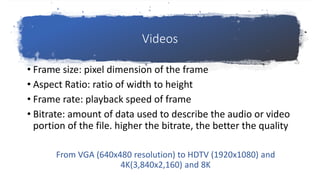
• Frame size: pixel dimension of the frame
• Aspect Ratio: ratio of width to height
• Frame rate: playback speed of frame
• Bitrate: amount of data used to describe the audio or video
portion of the file. higher the bitrate, the better the quality
From VGA (640x480 resolution) to HDTV (1920x1080) and
4K(3,840x2,160) and 8K
Videos
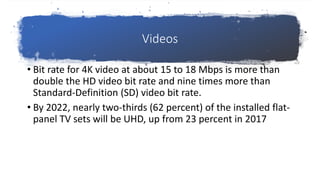
• Bit rate for 4K video at about 15 to 18 Mbps is more than
double the HD video bit rate and nine times more than
Standard-Definition (SD) video bit rate.
• By 2022, nearly two-thirds (62 percent) of the installed flat-
panel TV sets will be UHD, up from 23 percent in 2017
Video Coding Standards - Evolution
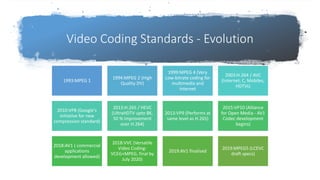
1993:MPEG 1
1994:MPEG 2 (High
Quality DV)
1999:MPEG 4 (Very
Low-bitrate coding for
multimedia and
internet
2003:H.264 / AVC
(Internet, C, Mobiles,
HDTVs)
2010:VP8 (Google's
initiative for new
compression standard)
2013:H.265 / HEVC
(UltraHDTV upto 8K,
50 % improvement
over H.264)
2013:VP9 (Performs at
same level as H.265)
2015:VP10 (Alliance
for Open Media - AV1
Codec development
begins)
2018:AV1 ( commercial
applications
development allowed)
2018:VVC (Versatile
Video Coding-
VCEG+MPEG, final by
July 2020)
2019:AV1 finalised
2019:MPEG5 (LCEVC
draft specs)
Video Coding Standards-Latest Work
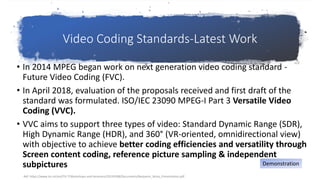
• In 2014 MPEG began work on next generation video coding standard -
Future Video Coding (FVC).
• In April 2018, evaluation of the proposals received and first draft of the
standard was formulated. ISO/IEC 23090 MPEG-I Part 3 Versatile Video
Coding (VVC).
• VVC aims to support three types of video: Standard Dynamic Range (SDR),
High Dynamic Range (HDR), and 360° (VR-oriented, omnidirectional view)
with objective to achieve better coding efficiencies and versatility through
Screen content coding, reference picture sampling & independent
subpictures
Ref: https://www.itu.int/en/ITU-T/Workshops-and-Seminars/20191008/Documents/Benjamin_Bross_Presentation.pdf
Demonstration
Video Coding - Royalty Bearing & Royalty Free
• Royalty-bearing codecs (e.g. MPEG) have always been the gold
standard
• The Alliance for Open Media (AOM), founded by Google, Cisco,
Amazon, Netflix, Intel, Microsoft, and Mozilla, aims to combine
their technological and legal strength to ensure the development
of a next-generation compression technology (for royalty-free
video codec ) that will be both superior in performance over
HEVC and free of charge
Video Coding – Latest Work
To Address the Problem of HEVC royalties, delayed deployment
• Alliance for Open media took initiative
• Came out with AV1: Royalty free codec, applicable for broadcast
& Optimized for OTT
• HQ and real time delivery modes
• Compression gains of ~25% over current codecs
• Low to High Res (UHD, HDR, WCG)
Ref: Ian Trow talk on Youtube
Video Coding Standards- IPR - Standard-
Essential patent
•A Patent that protects the technology essential to a
Standard is called a Standard-Essential patent (SEP)
•Licensing pools - A common way to License the SEPs e.g.
MPEG-LA , HEVC Advance, Via
Video Coding Standards- IPR - Standard-
Essential patent
• Standard setting organisations(SSO) ensure that the exclusive rights are
granted in their standards only to companies that warrant them and
need RoI to develop next generation technologies
• Licensing on Fair, Reasonable and Non-Discriminatory (FRAND)Terms
Technology enhanced
services for masses
• Technology Enhanced Learning
• TeleHealth
• Web RTC
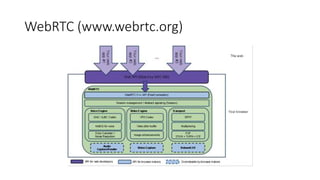
WebRTC (www.webrtc.org)
• WebRTC offers web application developers the ability to write
rich, realtime multimedia applications (think video chat) on the
web, without requiring plugins, downloads or installs.
• Includes the fundamental building blocks for high-quality
communications on the web, such as network, audio and video
components used in voice and video chat applications.
• These components, when implemented in a browser, can be
accessed through a JavaScript API, enabling developers to easily
implement their own RTC web app.
WebRTC (www.webrtc.org)
Unique Opportunities
• Challenge is to achieve compression efficiency by keeping in
mind the computational efficiency also.
• Surveillance Applications
• Video Analytics
• Machine Learning
Thank You

Video Standards - Key Insights

  • 1.
    Video Standards –key insights Chetan Manchanda Principal Engineer, C-DAC Technical Session Presentation during World Standards Day Celebrations by Bureau of Indian Standards, Chandigarh
  • 2.
    Presentation Outline • Whydo we require Standards? • Video Coding Standards-Evolution, Present Status & IPRs Technology enhanced services for masses • Technology Enhanced Learning • Telehealth Unique Opportunities
  • 3.
    A World withoutStandards • Products might not perform as expected • Incompatible with other equipment • Risk from Non-standardized products • Restrictive Market & Diffusion • Inferior quality products Non-Interoperability has a huge impact on sound functioning of future services esp. in Industry 4.0
  • 4.
    Standards facilitate • Interoperability •Inclusivity • Innovation • Integration of services • Increased market • Trustworthiness • Development • Increase awareness of technical developments and initiatives “Standards should facilitate interoperability, support fair trade and fair competition, increase user, consumer and government confidence and stimulate innovation” -Karen Bartleson in ‘The Ten Commandments for Effective Standards – Practical Insights for Creating Technical Standards
  • 5.
    Technical Standards • standardizationenable in: • mobile communication technology and its successors (3G, 4G,5G...), • IEEE 802 LAN standards, including 802.11 WLAN standards (WiFi) • ITU-T H.261 digital video coding standard and its successors (H.263, H.264, H.265, …) • JPEG
  • 6.
    Video Standards createsa Global Stage •Video accounts 80 per cent of all consumer Internet traffic. •World’s three leading standards bodies viz. IEC, ISO and ITU. https://www.cisco.com/c/en/us/solutions/collateral/service-provider/visual-networking-index-vni/white-paper-c11-741490.html Annual global IP traffic will reach 4.8 ZB per year by 2022, or 396 exabytes (EB) per month.
  • 7.
    Video Standards createsa Global Stage • Growth of Social Media Networks, Handheld smart devices with high processing capabilities and high resolution cameras • YouTube, Facebook, Instagram, etc. • Netflix, Amazon Prime Video, Hotstar, etc. • Next few years, the era of 4K and 8K devices, will see the newer video coding standards with even higher compression rate UHD (or 4K) video will account for 22 percent of global IP Video traffic by 2022 400 hours of video are uploaded to YouTube every minute
  • 8.
    Video Format •Container (AVIand Quicktime MOV etc.) •Video and audio signal •Codec: encode and decode the video & audio signal •Metadata One of the most versatile codec families in use today is H.264. (H.264 is also called MPEG-4 Part 10 and AVC)
  • 9.
    Videos • Frame size:pixel dimension of the frame • Aspect Ratio: ratio of width to height • Frame rate: playback speed of frame • Bitrate: amount of data used to describe the audio or video portion of the file. higher the bitrate, the better the quality From VGA (640x480 resolution) to HDTV (1920x1080) and 4K(3,840x2,160) and 8K
  • 10.
    Videos • Bit ratefor 4K video at about 15 to 18 Mbps is more than double the HD video bit rate and nine times more than Standard-Definition (SD) video bit rate. • By 2022, nearly two-thirds (62 percent) of the installed flat- panel TV sets will be UHD, up from 23 percent in 2017
  • 11.
    Video Coding Standards- Evolution 1993:MPEG 1 1994:MPEG 2 (High Quality DV) 1999:MPEG 4 (Very Low-bitrate coding for multimedia and internet 2003:H.264 / AVC (Internet, C, Mobiles, HDTVs) 2010:VP8 (Google's initiative for new compression standard) 2013:H.265 / HEVC (UltraHDTV upto 8K, 50 % improvement over H.264) 2013:VP9 (Performs at same level as H.265) 2015:VP10 (Alliance for Open Media - AV1 Codec development begins) 2018:AV1 ( commercial applications development allowed) 2018:VVC (Versatile Video Coding- VCEG+MPEG, final by July 2020) 2019:AV1 finalised 2019:MPEG5 (LCEVC draft specs)
  • 12.
    Video Coding Standards-LatestWork • In 2014 MPEG began work on next generation video coding standard - Future Video Coding (FVC). • In April 2018, evaluation of the proposals received and first draft of the standard was formulated. ISO/IEC 23090 MPEG-I Part 3 Versatile Video Coding (VVC). • VVC aims to support three types of video: Standard Dynamic Range (SDR), High Dynamic Range (HDR), and 360° (VR-oriented, omnidirectional view) with objective to achieve better coding efficiencies and versatility through Screen content coding, reference picture sampling & independent subpictures Ref: https://www.itu.int/en/ITU-T/Workshops-and-Seminars/20191008/Documents/Benjamin_Bross_Presentation.pdf Demonstration
  • 13.
    Video Coding -Royalty Bearing & Royalty Free • Royalty-bearing codecs (e.g. MPEG) have always been the gold standard • The Alliance for Open Media (AOM), founded by Google, Cisco, Amazon, Netflix, Intel, Microsoft, and Mozilla, aims to combine their technological and legal strength to ensure the development of a next-generation compression technology (for royalty-free video codec ) that will be both superior in performance over HEVC and free of charge
  • 14.
    Video Coding –Latest Work To Address the Problem of HEVC royalties, delayed deployment • Alliance for Open media took initiative • Came out with AV1: Royalty free codec, applicable for broadcast & Optimized for OTT • HQ and real time delivery modes • Compression gains of ~25% over current codecs • Low to High Res (UHD, HDR, WCG) Ref: Ian Trow talk on Youtube
  • 15.
    Video Coding Standards-IPR - Standard- Essential patent •A Patent that protects the technology essential to a Standard is called a Standard-Essential patent (SEP) •Licensing pools - A common way to License the SEPs e.g. MPEG-LA , HEVC Advance, Via
  • 16.
    Video Coding Standards-IPR - Standard- Essential patent • Standard setting organisations(SSO) ensure that the exclusive rights are granted in their standards only to companies that warrant them and need RoI to develop next generation technologies • Licensing on Fair, Reasonable and Non-Discriminatory (FRAND)Terms
  • 17.
    Technology enhanced services formasses • Technology Enhanced Learning • TeleHealth • Web RTC
  • 18.
    WebRTC (www.webrtc.org) • WebRTCoffers web application developers the ability to write rich, realtime multimedia applications (think video chat) on the web, without requiring plugins, downloads or installs. • Includes the fundamental building blocks for high-quality communications on the web, such as network, audio and video components used in voice and video chat applications. • These components, when implemented in a browser, can be accessed through a JavaScript API, enabling developers to easily implement their own RTC web app.
  • 19.
  • 20.
    Unique Opportunities • Challengeis to achieve compression efficiency by keeping in mind the computational efficiency also. • Surveillance Applications • Video Analytics • Machine Learning
  • 21.