1
At the end of this class, you should be able to ..
• Describe skeletal muscle
• Classify skeletal muscles
• Understand concepts: motor point, motor unit
• Describe Laws of innervation
• Appreciate importance of skeletal muscles in
clinical practice
• A male child born to healthy parents with
normal pregnancy
– Walking was delayed … 4 years
– Calf muscles grew unusually large
– Couldnot walk after 11 years
– Died at the age of 20 – respiratory failure
– His elder brother was fine
• What went wrong?
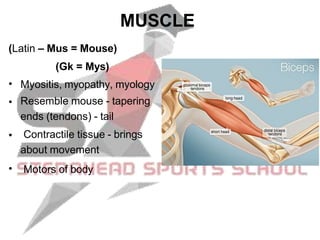
MUSCLE
(Latin – Mus = Mouse)
(Gk = Mys)
•
•
Myositis, myopathy, myology
Resemble mouse - tapering
ends (tendons) - tail
Contractile tissue - brings
about movement
Motors of body
•
•
Properties
• Excitability – nerve impulse stimulates contraction
• Contractility – Long cells shorten & generate pulling force
• Elasticity – Can recoil after being stretched
Muscle tissue: types
▪ Skeletal
▪ Striated & voluntary
▪ Cardiac
▪ Striated & involuntary
▪ Smooth
▪ Nonstriated & involuntary
Skeletal muscle: features
•
•
•
•
Striped / Striated / Somatic / Voluntary
Most abundant
Attached to skeleton
Supplied by somatic nerves; voluntary control
Responds quickly to stimuli
Capable of rapid contraction; easily fatigued
Help in adjusting to external environment
•
•
•
• Under highest nervous control of cerebral cortex
Skeletal muscles: microscopy
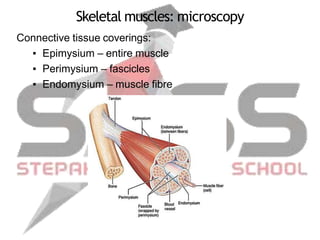
Connective tissue coverings:
▪ Epimysium – entire muscle
▪ Perimysium – fascicles
▪ Endomysium – muscle fibre
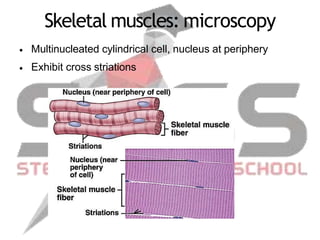
Skeletal muscles: microscopy
•
•
Multinucleated cylindrical cell, nucleus at periphery
Exhibit cross striations
SKELETAL MUSCLE: PARTS
•
•
Fleshy, Contractile - Belly
Fibrous, Non contractile
– Tendon (cord like)
– Aponeurosis (flattened sheet)
Origin: relatively fixed during
contraction
Insertion: moves during
contraction
Origin & insertion / attachments
•
•
•
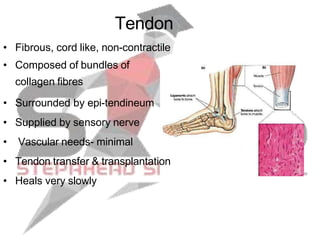
Tendon
• Fibrous, cord like, non-contractile
• Composed of bundles of
collagen fibres
• Surrounded by epi-tendineum
• Supplied by sensory nerve
• Vascular needs- minimal
• Tendon transfer & transplantation
• Heals very slowly
Aponeurosis
• Attachment of muscle by thin,
broad sheet
Composed of parallel bundles of
collagen fibres
E.g. External oblique
aponeurosis
•
•
Raphe
• Fibrous band; interdigitating
fibres of aponeurosis
Stretchable
E.g. Mylohyoid raphe
•
•
Nomenclature of skeletal muscles
•
•
•
•
•
•
•
•
Shape: Trapezius, Rhomboideus, Deltoid
Number of heads: Biceps, Triceps, Quadriceps
Structure: Semimembranosus, Semitendinosus
Location: Temporalis, Supraspinatus
Attachments: Stylohyoid, Cricothyroid
Action: Adductor longus, Flexor carpi ulnaris
Direction of fibres: Rectus abdominis, Transversus abdominis
Relative position: Medial & lateral pterygoids
Nerve supply
•
•
Nerve supplying a muscle - motor nerve
Motor point
– Site where motor nerve enters muscle
– May be one or more
– Electrical stimulation at this point is more effective
Sensory supply: proprioception
•
•
•
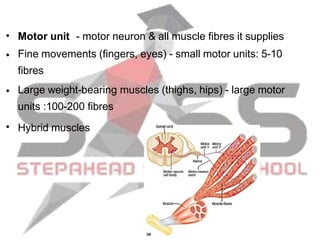
Motor unit - motor neuron & all muscle fibres it supplies
Fine movements (fingers, eyes) - small motor units: 5-10
fibres
Large weight-bearing muscles (thighs, hips) - large motor
units :100-200 fibres
Hybrid muscles
•
•
Classification of skeletal muscle
• Based on
– Architecture of fasciculi
– Action
Fascicular architecture
• Force - directly proportional to number & size of
muscle fibres
• Range - directly proportional to length of fibres
• Classified: According to arrangement of fasciculi
– Parallel
– Oblique
– Spiral
– Cruciate
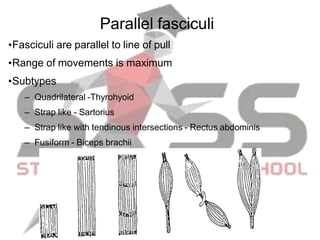
Parallel fasciculi
•Fasciculi are parallel to line of pull
•Range of movements is maximum
•Subtypes
– Quadrilateral -Thyrohyoid
– Strap like - Sartorius
– Strap like with tendinous intersections - Rectus abdominis
– Fusiform - Biceps brachii
• Fasciculi oblique to line of pull
• Power increased, range decreased
• Subtypes
– Triangular - Temporalis
– Unipennate - Flexor pollicis longus
– Bipennate - Rectus femoris
– Multipennate – Deltoid (middle fibres)
– Circumpennate - Tibialis anterior
Oblique fasciculi
Spiral / twisted fasciculi
– Trapezius
– Lattisimus dorsi
– Pectoralis major
CRUCIATE FASCICULI
• Fasciculi are crossed
– Sternocleidomastoid (SCM)
– Masseter
Classification :action of muscle
• Prime mover
• Antagonist
• Fixator
• Synergist
Prime mover
• Muscle or group of muscles
that bring about a desired
movement
Gravity may also assist
E.g. Brachialis as flexor at
elbow joint
•
•
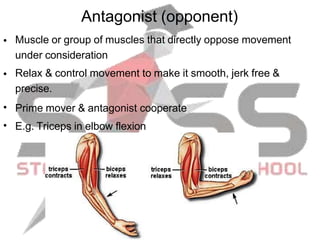
Antagonist (opponent)
• Muscle or group of muscles that directly oppose movement
under consideration
Relax & control movement to make it smooth, jerk free &
precise.
Prime mover & antagonist cooperate
E.g. Triceps in elbow flexion
•
•
•
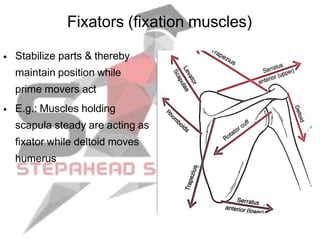
Fixators (fixation muscles)
• Stabilize parts & thereby
maintain position while
prime movers act
E.g.: Muscles holding
scapula steady are acting as
fixator while deltoid moves
humerus
•
Synergists
•
•
•
Special fixation muscles
Partial antagonist to prime mover
When a prime mover crosses two or more joints, synergists
prevent undesired actions at intermediate joints
Laws of innervation
• Hilton’s law: “the nerve supplying the muscles
extending directly across and acting at a given joint
also innervate the joint & skin overlying the joint
“Only actions are represented in cortex”
“Spinal segments supplying the antagonists are in a
sequence”
“Spinal segments supplying immediately distal group of
muscles are in sequence”
•
•
•
Applied anatomy
Paralysis / paresis
• Loss of power of movement
• Muscles are unable to contract
• Damage to motor neural pathways
– Upper motor neuron (UMN)
– Lower motor neuron (LMN)
• Muscular spasm – spontaneous / involuntary
contraction
• May be
– Localized – commonly caused by a “muscle pull”
– Generalized – seen in Tetanus & Epilepsy
Applied anatomy
• Disuse atrophy
– Muscles not used for long time, become thin & weak
– Reduction in size (muscular wasting)
– Seen in paralysis & generalized debility
• Hypertrophy
– Excessive use of a particular muscle results in better
development or hypertrophy (Body builders & Athletes)
Applied anatomy
• Regeneration
– Capable of limited regeneration
– Large regions damaged- regeneration does
not occur & replaced by CT
• Muscular dystrophy
– Inherent defect in cell membrane of muscle
– Rupture of muscle fibers
– X- linked recessive
– Duchene’s & Baker’s
muscle-160227130405.pptx

muscle-160227130405.pptx

  • 1.
  • 2.
    At the endof this class, you should be able to .. • Describe skeletal muscle • Classify skeletal muscles • Understand concepts: motor point, motor unit • Describe Laws of innervation • Appreciate importance of skeletal muscles in clinical practice
  • 3.
    • A malechild born to healthy parents with normal pregnancy – Walking was delayed … 4 years – Calf muscles grew unusually large – Couldnot walk after 11 years – Died at the age of 20 – respiratory failure – His elder brother was fine • What went wrong?
  • 4.
    MUSCLE (Latin – Mus= Mouse) (Gk = Mys) • • Myositis, myopathy, myology Resemble mouse - tapering ends (tendons) - tail Contractile tissue - brings about movement Motors of body • •
  • 5.
    Properties • Excitability –nerve impulse stimulates contraction • Contractility – Long cells shorten & generate pulling force • Elasticity – Can recoil after being stretched
  • 6.
    Muscle tissue: types ▪Skeletal ▪ Striated & voluntary ▪ Cardiac ▪ Striated & involuntary ▪ Smooth ▪ Nonstriated & involuntary
  • 7.
    Skeletal muscle: features • • • • Striped/ Striated / Somatic / Voluntary Most abundant Attached to skeleton Supplied by somatic nerves; voluntary control Responds quickly to stimuli Capable of rapid contraction; easily fatigued Help in adjusting to external environment • • • • Under highest nervous control of cerebral cortex
  • 8.
    Skeletal muscles: microscopy Connectivetissue coverings: ▪ Epimysium – entire muscle ▪ Perimysium – fascicles ▪ Endomysium – muscle fibre
  • 9.
    Skeletal muscles: microscopy • • Multinucleatedcylindrical cell, nucleus at periphery Exhibit cross striations
  • 10.
    SKELETAL MUSCLE: PARTS • • Fleshy,Contractile - Belly Fibrous, Non contractile – Tendon (cord like) – Aponeurosis (flattened sheet) Origin: relatively fixed during contraction Insertion: moves during contraction Origin & insertion / attachments • • •
  • 11.
    Tendon • Fibrous, cordlike, non-contractile • Composed of bundles of collagen fibres • Surrounded by epi-tendineum • Supplied by sensory nerve • Vascular needs- minimal • Tendon transfer & transplantation • Heals very slowly
  • 12.
    Aponeurosis • Attachment ofmuscle by thin, broad sheet Composed of parallel bundles of collagen fibres E.g. External oblique aponeurosis • •
  • 13.
    Raphe • Fibrous band;interdigitating fibres of aponeurosis Stretchable E.g. Mylohyoid raphe • •
  • 14.
    Nomenclature of skeletalmuscles • • • • • • • • Shape: Trapezius, Rhomboideus, Deltoid Number of heads: Biceps, Triceps, Quadriceps Structure: Semimembranosus, Semitendinosus Location: Temporalis, Supraspinatus Attachments: Stylohyoid, Cricothyroid Action: Adductor longus, Flexor carpi ulnaris Direction of fibres: Rectus abdominis, Transversus abdominis Relative position: Medial & lateral pterygoids
  • 15.
    Nerve supply • • Nerve supplyinga muscle - motor nerve Motor point – Site where motor nerve enters muscle – May be one or more – Electrical stimulation at this point is more effective Sensory supply: proprioception •
  • 16.
    • • Motor unit -motor neuron & all muscle fibres it supplies Fine movements (fingers, eyes) - small motor units: 5-10 fibres Large weight-bearing muscles (thighs, hips) - large motor units :100-200 fibres Hybrid muscles • •
  • 17.
    Classification of skeletalmuscle • Based on – Architecture of fasciculi – Action
  • 18.
    Fascicular architecture • Force- directly proportional to number & size of muscle fibres • Range - directly proportional to length of fibres • Classified: According to arrangement of fasciculi – Parallel – Oblique – Spiral – Cruciate
  • 19.
    Parallel fasciculi •Fasciculi areparallel to line of pull •Range of movements is maximum •Subtypes – Quadrilateral -Thyrohyoid – Strap like - Sartorius – Strap like with tendinous intersections - Rectus abdominis – Fusiform - Biceps brachii
  • 20.
    • Fasciculi obliqueto line of pull • Power increased, range decreased • Subtypes – Triangular - Temporalis – Unipennate - Flexor pollicis longus – Bipennate - Rectus femoris – Multipennate – Deltoid (middle fibres) – Circumpennate - Tibialis anterior Oblique fasciculi
  • 21.
    Spiral / twistedfasciculi – Trapezius – Lattisimus dorsi – Pectoralis major
  • 22.
    CRUCIATE FASCICULI • Fasciculiare crossed – Sternocleidomastoid (SCM) – Masseter
  • 23.
    Classification :action ofmuscle • Prime mover • Antagonist • Fixator • Synergist
  • 24.
    Prime mover • Muscleor group of muscles that bring about a desired movement Gravity may also assist E.g. Brachialis as flexor at elbow joint • •
  • 25.
    Antagonist (opponent) • Muscleor group of muscles that directly oppose movement under consideration Relax & control movement to make it smooth, jerk free & precise. Prime mover & antagonist cooperate E.g. Triceps in elbow flexion • • •
  • 26.
    Fixators (fixation muscles) •Stabilize parts & thereby maintain position while prime movers act E.g.: Muscles holding scapula steady are acting as fixator while deltoid moves humerus •
  • 27.
    Synergists • • • Special fixation muscles Partialantagonist to prime mover When a prime mover crosses two or more joints, synergists prevent undesired actions at intermediate joints
  • 28.
    Laws of innervation •Hilton’s law: “the nerve supplying the muscles extending directly across and acting at a given joint also innervate the joint & skin overlying the joint “Only actions are represented in cortex” “Spinal segments supplying the antagonists are in a sequence” “Spinal segments supplying immediately distal group of muscles are in sequence” • • •
  • 29.
    Applied anatomy Paralysis /paresis • Loss of power of movement • Muscles are unable to contract • Damage to motor neural pathways – Upper motor neuron (UMN) – Lower motor neuron (LMN)
  • 30.
    • Muscular spasm– spontaneous / involuntary contraction • May be – Localized – commonly caused by a “muscle pull” – Generalized – seen in Tetanus & Epilepsy Applied anatomy
  • 31.
    • Disuse atrophy –Muscles not used for long time, become thin & weak – Reduction in size (muscular wasting) – Seen in paralysis & generalized debility • Hypertrophy – Excessive use of a particular muscle results in better development or hypertrophy (Body builders & Athletes) Applied anatomy
  • 32.
    • Regeneration – Capableof limited regeneration – Large regions damaged- regeneration does not occur & replaced by CT • Muscular dystrophy – Inherent defect in cell membrane of muscle – Rupture of muscle fibers – X- linked recessive – Duchene’s & Baker’s