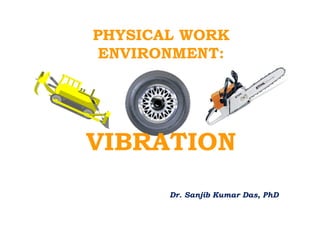
PHYSICAL WORK
ENVIRONMENT:
VIBRATION
Dr. Sanjib Kumar Das, PhD
Definition
• Vibration is the physical movement or oscillation of a
mechanical part about a reference position.
• Example: Motion of a Simple Pendulum, Machine
tool vibrations, tuning fork , vibrations of strings of
musical instruments.
Why do we care about vibration?
Vibration is:
 Wasted energy
 Cause of aircraft noise which contributes to crew and
passenger discomfort
Who’s at risk?
• Anyone who absorbs machine vibration through their
hands and arms while working a fast-moving hand
tool --
• Or through the buttocks and the soles of the feet
while riding in or standing near vibrating, heavy
machinery--
• Runs the risk.
How many exposed?
• Approximately 1.2 million exposed
• 50 -- 60 % of worker population have symptoms
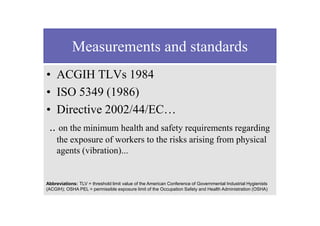
Measurements and standards
• ACGIH TLVs 1984
• ISO 5349 (1986)
• Directive 2002/44/EC…
.. on the minimum health and safety requirements regarding
the exposure of workers to the risks arising from physical
agents (vibration)...
Abbreviations: TLV = threshold limit value of the American Conference of Governmental Industrial Hygienists
(ACGIH); OSHA PEL = permissible exposure limit of the Occupation Safety and Health Administration (OSHA)
Measurements and standards
• ACGIH TLVs 1984
• 4 m/s2 < 8 hours a day
• 6 m/s2 < 6 hours a day
• 8 m/s2 < 2 hours a day
• 12 m/s2 < 1 hour a day
• ISO 5349 (1986)
– Standard for measurements over frequencies from 5 to
1500 Hz
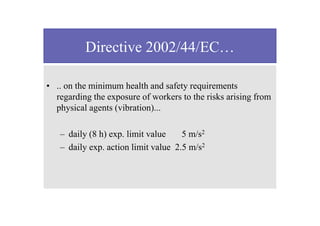
Directive 2002/44/EC…
• .. on the minimum health and safety requirements
regarding the exposure of workers to the risks arising from
physical agents (vibration)...
– daily (8 h) exp. limit value 5 m/s2
– daily exp. action limit value 2.5 m/s2
Magnitude is influenced by:
• Type, weight, and condition of tool
• Acceleration and frequency produced by tool
– Tool type, anti-vibration material
– Operating speed,
• Gripping forces- Orientation and posture of the
hands, arms, and body during work
• Parts of hands in direct contact with the
vibrating surface
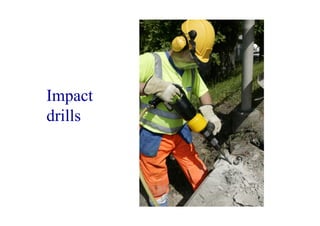
Tools most commonly associated:
Impact
drills
Grinding tools
Bolt wrenchers
Three vulnerable nerves
Ulnar Sciatic
Median
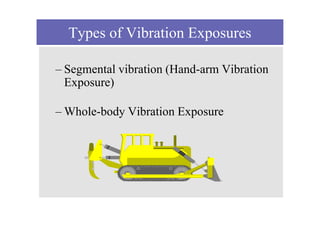
Types of Vibration Exposures
– Segmental vibration (Hand-arm Vibration
Exposure)
– Whole-body Vibration Exposure
Vibration by transmission point
• Segmental (e.g. hand or arm):
– powered hand tools
– vibrating surfaces such as conveyors that are
leaned against or touched
• Whole body:
– vehicles
– vibrating work surfaces.
How can HAV affect my health?
Regular exposure to HAV
can cause a range of
permanent injuries to your
hands and arms which are
known as hand-arm
vibration syndrome
(HAVS). The injuries you
could suffer include damage
to your:
Blood circulatory system (white finger)
Sensory nerves
Muscles
Bones
Joints
severe pain and numbness
loss of sense
of touch
pins and
needles
loss of grip
strength painful wrist
What are the symptoms?
Vibration white finger:
The symptoms of VWF are usually triggered by exposure to cold
or wet environments. Early symptoms can be mild. The first sign
is often an occasional attack where your fingertips become white.
Continued exposure to vibrating tools, will cause the symptoms
to persist and worsen. During an attack your fingers may become
numb and tingle (like ‘pins and needles)’. An attack may end
with the whiteness in your fingers changing to a deep red flush
which is often painful.
What are the symptoms?
Sensory nerve damage:
Damage to the nerves in your fingers will affect your sense of
touch and temperature perception. You may also experience
permanent numbness or tingling in your fingers.
Damage to muscles, bones and joints:
You may notice less strength in your hands and pain in your
wrists and arms.
Carpal tunnel syndrome and epicondylitis coexist
often
Pathophysiology
• Local oedema in nerve and perineural tissue
• Local damage in non-myelinated nerve fibers 
changes in blood vessels vasoconstriction in
cold
– Mechanism: adrenergic receptor damage in
vessel wallsalfa-2-receptor predominance
How will the symptoms affect what I
can do?
HAVS could limit your ability to work. For example you may not
be able to:
 Continue working with vibrating equipment (which would
make symptoms worse)
 Work in cold or wet conditions (which could trigger painful
attacks)
 Do work requiring finger manipulations (ex handling
screws or nails)
How will the symptoms affect what I
can do?
They may also affect your family and leisure activities for the
same reasons, for example:
 Fishing
 Swimming
 Golf
 Washing the car
 Gardening
 Fastening buttons or sorting out coins
Whole body vibration illness
• Vibration that is transmitted through the body may
lead to…
– abdominal pain
– loss of equilibrium
– nausea
– chest pain
– shortness of breath
– loss of visual acuity
– And other long term health problems
Whole body vibration
• May increase the risk of low back pain, disc
protrusion and joint arthritis
• May increase the risk of spontaneous abortions
and premature births
• Difficult to diagnose at individual level
• Directive 2002/44/EC
– 8 hour limit 1.15 m/s2
– 8 hour action limit 0.5 m/s2
Treatment and prevention
• Calcium antagonists may help
• Carpal tunnel operation may help, but may also
worsen symptoms
• Stop smoking, reduce risk factors of polyneuropathy
• Stop or decrease exposure to minimum
– technical improvements of tools
– minimum exposure time
– gloves etc.
• Increase temperature
• Periodic health examinations
Vibration and performance
• Visual performance is impaired in ranges of 10-25Hz,
especially for characters of less than 10 min of visual
angle
• Motor performance is impaired also, especially for
tracking tasks (6-10 Hz in upper body)
• Cognitive performance seems to be mostly resistant
to vibration at most frequencies one could encounter
Hand-arm
vibration
Whole body
vibration
• Choose tools with less vibration (look for vibration rating)
• Reduce amount of vibrating surface:
– reduce overall dimensions
– perforate surface
• Reduce vibrating efficiency of surface:
– add damping
– improve bracing
– increase stiffness
– add springs
– replace worn parts
– use different materials
Controlling vibration at the source
• Add vibration isolation systems between the
source and the human
– Gloves
– Damping system
Controlling vibration along the path
• Administrative controls
– Rest breaks
– Job rotation
Controlling vibration along the person
What causes the problem?
Many common tools and processes such as soil compactors
and jack hammers produce high levels of vibration which can
cause permanent damage to your hands and arms. The risk of
permanent damage depends on a number of things:
 How high the vibration levels are
 How long you use the equipment for
 How awkward is the equipment to use
 How tightly you grip the equipment
 How cold and wet the environment is
What can I do to reduce risk?
 Tell your supervisor about tools or processes which produce
high or increased levels of vibration.
 Co-operate with new ways of working introduced to reduce
risk. Give new work methods and tools a try, especially when
the goal is to reduce risk.
 Help maintain all tools and report tool problems.
What can I do to reduce risk?
It is important to keep your blood circulating while working
so:
 Keep warm at work, especially your hands. Wear warm
gloves and extra clothing if you work in the cold, because
your blood circulation slows down when you are cold.
 Don’t smoke! Or at least cut down just before and while
you are at work, because smoking affects blood flow.
 Exercise your hands and fingers to improve blood flow.
What can I do to reduce risk?
 Use the right tool for the job. Making do with the wrong
tool can mean more vibration.
 Don’t use any more force than necessary when using tools
or machines
 Try to avoid long periods of equipment use without a break
– short bursts of activity with mini-breaks are better
 Keep your tools and machines in good working order –
badly maintained or repaired tools may produce more
vibration, so ask your supervisor to make sure they are
properly serviced and repaired quickly
 Take an active part in the heath and safety program
 Talk to your health and safety representative
 DON’T IGNORE SYMPTOMS - REPORT EARLY
What can I do to reduce risk?
Control strategies:
• Engineering and work practices
• Anti-vibration clothing, equipment, and training
• Goals:
– Reduce the intensity
– Reduce the exposure duration
– Identify the early signs and symptoms
Engineering controls:
• Reduction at source
• Reduction of transmission
• Process modification
Reduction at source
• Reduce speed of tool
• Reduce weight and power needed to drive the
tool
• Change type of tool
– e.g. Reciprocating engine to rotary or electric
motor
• Tool maintenance
• Mount equipment on springs or compression
pads
• Use materials that generate less vibration
Reduction at transmission
• Provide cushion to act as a vibration isolator in a
seated task
• Provide anti-fatigue mats for standing operation
• Design tools to reduce vibration transmitted to the
hands,
• Counterweight tools to minimize gripping required to
operate them
– Dampening materials and gloves are usually more
effective for higher frequencies.
Process modification
• Changes in any aspect of process to eliminate need
for vibrating tools or equipment
• Using mechanical aids (chucks, clamps) to hold
material
– Reduces time or intensity of exposure
• Robotics
• Automation
• Substitution of materials
– Plastics for hard metal
Work modification approaches
• Limit numbers of hours
• Reduce number of days per week
• Rotate between vibrating and non-vibrating
tool tasks
• Schedule maintenance breaks
Work practices
• Length of work day
• Job rotation
• Select low vibration tools
• Reduce grip force applied
• Reduce force applied
• Ergonomic work postures
Administrative controls
• PPE
• Reduce transmission of vibrating energy to the hand
• Protect against exposure to cold and trauma
• Training
– Source of vibration
– Adverse health and safety effects
– Early signs and symptoms
– Use and availability of vibration protective clothing
– Anti-vibration devices
– Value of good tool maintenance
– Work practice procedures
THANK YOU
Dr. Sanjib Kumar Das,
MPT(Musculoskeletal), P.G.D Hospital Management,
Fellow Doctoral, NITIE-Ergonomics and Human Factors,
P.P. Savani University, Surat, India
Mail: sanjib_bpt@yahoo.co.in
Contact No. :+91 8879485847

Vibration

  • 1.
  • 2.
    Definition • Vibration isthe physical movement or oscillation of a mechanical part about a reference position. • Example: Motion of a Simple Pendulum, Machine tool vibrations, tuning fork , vibrations of strings of musical instruments.
  • 3.
    Why do wecare about vibration? Vibration is:  Wasted energy  Cause of aircraft noise which contributes to crew and passenger discomfort
  • 4.
    Who’s at risk? •Anyone who absorbs machine vibration through their hands and arms while working a fast-moving hand tool -- • Or through the buttocks and the soles of the feet while riding in or standing near vibrating, heavy machinery-- • Runs the risk.
  • 5.
    How many exposed? •Approximately 1.2 million exposed • 50 -- 60 % of worker population have symptoms
  • 6.
    Measurements and standards •ACGIH TLVs 1984 • ISO 5349 (1986) • Directive 2002/44/EC… .. on the minimum health and safety requirements regarding the exposure of workers to the risks arising from physical agents (vibration)... Abbreviations: TLV = threshold limit value of the American Conference of Governmental Industrial Hygienists (ACGIH); OSHA PEL = permissible exposure limit of the Occupation Safety and Health Administration (OSHA)
  • 7.
    Measurements and standards •ACGIH TLVs 1984 • 4 m/s2 < 8 hours a day • 6 m/s2 < 6 hours a day • 8 m/s2 < 2 hours a day • 12 m/s2 < 1 hour a day • ISO 5349 (1986) – Standard for measurements over frequencies from 5 to 1500 Hz
  • 8.
    Directive 2002/44/EC… • ..on the minimum health and safety requirements regarding the exposure of workers to the risks arising from physical agents (vibration)... – daily (8 h) exp. limit value 5 m/s2 – daily exp. action limit value 2.5 m/s2
  • 9.
    Magnitude is influencedby: • Type, weight, and condition of tool • Acceleration and frequency produced by tool – Tool type, anti-vibration material – Operating speed, • Gripping forces- Orientation and posture of the hands, arms, and body during work • Parts of hands in direct contact with the vibrating surface
  • 10.
  • 11.
  • 12.
  • 13.
  • 14.
  • 15.
    Types of VibrationExposures – Segmental vibration (Hand-arm Vibration Exposure) – Whole-body Vibration Exposure
  • 16.
    Vibration by transmissionpoint • Segmental (e.g. hand or arm): – powered hand tools – vibrating surfaces such as conveyors that are leaned against or touched • Whole body: – vehicles – vibrating work surfaces.
  • 17.
    How can HAVaffect my health? Regular exposure to HAV can cause a range of permanent injuries to your hands and arms which are known as hand-arm vibration syndrome (HAVS). The injuries you could suffer include damage to your: Blood circulatory system (white finger) Sensory nerves Muscles Bones Joints severe pain and numbness loss of sense of touch pins and needles loss of grip strength painful wrist
  • 18.
    What are thesymptoms? Vibration white finger: The symptoms of VWF are usually triggered by exposure to cold or wet environments. Early symptoms can be mild. The first sign is often an occasional attack where your fingertips become white. Continued exposure to vibrating tools, will cause the symptoms to persist and worsen. During an attack your fingers may become numb and tingle (like ‘pins and needles)’. An attack may end with the whiteness in your fingers changing to a deep red flush which is often painful.
  • 19.
    What are thesymptoms? Sensory nerve damage: Damage to the nerves in your fingers will affect your sense of touch and temperature perception. You may also experience permanent numbness or tingling in your fingers. Damage to muscles, bones and joints: You may notice less strength in your hands and pain in your wrists and arms. Carpal tunnel syndrome and epicondylitis coexist often
  • 20.
    Pathophysiology • Local oedemain nerve and perineural tissue • Local damage in non-myelinated nerve fibers  changes in blood vessels vasoconstriction in cold – Mechanism: adrenergic receptor damage in vessel wallsalfa-2-receptor predominance
  • 21.
    How will thesymptoms affect what I can do? HAVS could limit your ability to work. For example you may not be able to:  Continue working with vibrating equipment (which would make symptoms worse)  Work in cold or wet conditions (which could trigger painful attacks)  Do work requiring finger manipulations (ex handling screws or nails)
  • 22.
    How will thesymptoms affect what I can do? They may also affect your family and leisure activities for the same reasons, for example:  Fishing  Swimming  Golf  Washing the car  Gardening  Fastening buttons or sorting out coins
  • 23.
    Whole body vibrationillness • Vibration that is transmitted through the body may lead to… – abdominal pain – loss of equilibrium – nausea – chest pain – shortness of breath – loss of visual acuity – And other long term health problems
  • 24.
    Whole body vibration •May increase the risk of low back pain, disc protrusion and joint arthritis • May increase the risk of spontaneous abortions and premature births • Difficult to diagnose at individual level • Directive 2002/44/EC – 8 hour limit 1.15 m/s2 – 8 hour action limit 0.5 m/s2
  • 25.
    Treatment and prevention •Calcium antagonists may help • Carpal tunnel operation may help, but may also worsen symptoms • Stop smoking, reduce risk factors of polyneuropathy • Stop or decrease exposure to minimum – technical improvements of tools – minimum exposure time – gloves etc. • Increase temperature • Periodic health examinations
  • 26.
    Vibration and performance •Visual performance is impaired in ranges of 10-25Hz, especially for characters of less than 10 min of visual angle • Motor performance is impaired also, especially for tracking tasks (6-10 Hz in upper body) • Cognitive performance seems to be mostly resistant to vibration at most frequencies one could encounter
  • 27.
  • 28.
    • Choose toolswith less vibration (look for vibration rating) • Reduce amount of vibrating surface: – reduce overall dimensions – perforate surface • Reduce vibrating efficiency of surface: – add damping – improve bracing – increase stiffness – add springs – replace worn parts – use different materials Controlling vibration at the source
  • 29.
    • Add vibrationisolation systems between the source and the human – Gloves – Damping system Controlling vibration along the path
  • 30.
    • Administrative controls –Rest breaks – Job rotation Controlling vibration along the person
  • 31.
    What causes theproblem? Many common tools and processes such as soil compactors and jack hammers produce high levels of vibration which can cause permanent damage to your hands and arms. The risk of permanent damage depends on a number of things:  How high the vibration levels are  How long you use the equipment for  How awkward is the equipment to use  How tightly you grip the equipment  How cold and wet the environment is
  • 32.
    What can Ido to reduce risk?  Tell your supervisor about tools or processes which produce high or increased levels of vibration.  Co-operate with new ways of working introduced to reduce risk. Give new work methods and tools a try, especially when the goal is to reduce risk.  Help maintain all tools and report tool problems.
  • 33.
    What can Ido to reduce risk? It is important to keep your blood circulating while working so:  Keep warm at work, especially your hands. Wear warm gloves and extra clothing if you work in the cold, because your blood circulation slows down when you are cold.  Don’t smoke! Or at least cut down just before and while you are at work, because smoking affects blood flow.  Exercise your hands and fingers to improve blood flow.
  • 34.
    What can Ido to reduce risk?  Use the right tool for the job. Making do with the wrong tool can mean more vibration.  Don’t use any more force than necessary when using tools or machines  Try to avoid long periods of equipment use without a break – short bursts of activity with mini-breaks are better
  • 35.
     Keep yourtools and machines in good working order – badly maintained or repaired tools may produce more vibration, so ask your supervisor to make sure they are properly serviced and repaired quickly  Take an active part in the heath and safety program  Talk to your health and safety representative  DON’T IGNORE SYMPTOMS - REPORT EARLY What can I do to reduce risk?
  • 36.
    Control strategies: • Engineeringand work practices • Anti-vibration clothing, equipment, and training • Goals: – Reduce the intensity – Reduce the exposure duration – Identify the early signs and symptoms
  • 37.
    Engineering controls: • Reductionat source • Reduction of transmission • Process modification
  • 38.
    Reduction at source •Reduce speed of tool • Reduce weight and power needed to drive the tool • Change type of tool – e.g. Reciprocating engine to rotary or electric motor • Tool maintenance • Mount equipment on springs or compression pads • Use materials that generate less vibration
  • 39.
    Reduction at transmission •Provide cushion to act as a vibration isolator in a seated task • Provide anti-fatigue mats for standing operation • Design tools to reduce vibration transmitted to the hands, • Counterweight tools to minimize gripping required to operate them – Dampening materials and gloves are usually more effective for higher frequencies.
  • 40.
    Process modification • Changesin any aspect of process to eliminate need for vibrating tools or equipment • Using mechanical aids (chucks, clamps) to hold material – Reduces time or intensity of exposure • Robotics • Automation • Substitution of materials – Plastics for hard metal
  • 41.
    Work modification approaches •Limit numbers of hours • Reduce number of days per week • Rotate between vibrating and non-vibrating tool tasks • Schedule maintenance breaks
  • 42.
    Work practices • Lengthof work day • Job rotation • Select low vibration tools • Reduce grip force applied • Reduce force applied • Ergonomic work postures
  • 43.
    Administrative controls • PPE •Reduce transmission of vibrating energy to the hand • Protect against exposure to cold and trauma • Training – Source of vibration – Adverse health and safety effects – Early signs and symptoms – Use and availability of vibration protective clothing – Anti-vibration devices – Value of good tool maintenance – Work practice procedures
  • 44.
    THANK YOU Dr. SanjibKumar Das, MPT(Musculoskeletal), P.G.D Hospital Management, Fellow Doctoral, NITIE-Ergonomics and Human Factors, P.P. Savani University, Surat, India Mail: sanjib_bpt@yahoo.co.in Contact No. :+91 8879485847