Recommended
PDF
Vibration_safety_.pdf Vibration_safety_.pdf
PPTX
PDF
PPTX
PDF
Risks to health from exposure to vibration-.pdf
PPT
PDF
Dover ALS Safety Moment of the Week 27-Jun-2016
PPTX
Hand Arm Vibration Surveillance
PPTX
PPTX
Hand Arm Vibration Syndrome
PPTX
CS_Project-_HAVS[1]-1 (1).pptx
PPTX
Vibration hazards - OH & S
PPT
Hand, Arm, Vibration Syndrome By J Mc Cann
PDF
whole body and hand arm vibration.pptx.pdf
PPTX
Vibrationdisordersoccupationphysical.pptx
PDF
HAV Risk Management Best Practice - Myths and Reality
PPTX
PPTX
PPT
PDF
PDF
PPTX
IDipOSH 2B11 v2 160514. trainingggggggpptx
PDF
Advice for employees hand arm vibration
PDF
PPTX
AUE 6447 UNIT -VII Presentation.pptx AE1
PPTX
Hand arm vibration testing and health and safety
PDF
12 Devine - Technical Note
PDF
Proceedings _ Part II _ Collection of Abstracts - 09-30-2015
PPTX
software define network authentication .pptx
PDF
Data+Security+Masterclass Presentation.pdf
More Related Content
PDF
Vibration_safety_.pdf Vibration_safety_.pdf
PPTX
PDF
PPTX
PDF
Risks to health from exposure to vibration-.pdf
PPT
PDF
Dover ALS Safety Moment of the Week 27-Jun-2016
PPTX
Hand Arm Vibration Surveillance
Similar to Vibration_types and definition presentation.ppt
PPTX
PPTX
Hand Arm Vibration Syndrome
PPTX
CS_Project-_HAVS[1]-1 (1).pptx
PPTX
Vibration hazards - OH & S
PPT
Hand, Arm, Vibration Syndrome By J Mc Cann
PDF
whole body and hand arm vibration.pptx.pdf
PPTX
Vibrationdisordersoccupationphysical.pptx
PDF
HAV Risk Management Best Practice - Myths and Reality
PPTX
PPTX
PPT
PDF
PDF
PPTX
IDipOSH 2B11 v2 160514. trainingggggggpptx
PDF
Advice for employees hand arm vibration
PDF
PPTX
AUE 6447 UNIT -VII Presentation.pptx AE1
PPTX
Hand arm vibration testing and health and safety
PDF
12 Devine - Technical Note
PDF
Proceedings _ Part II _ Collection of Abstracts - 09-30-2015
Recently uploaded
PPTX
software define network authentication .pptx
PDF
Data+Security+Masterclass Presentation.pdf
PPTX
[DSC Europe 25] Hans Kleinsman - The Compliance Gearbox: How Tax Tech Mediate...
PPTX
[DSC Europe 25] Jovan Bogicevic - Legacy to AI-Driven Defense: Transforming D...
PPTX
[DSC Europe 25] Marko Krstic - Understanding the AI Threat Landscape - Risks,...
PDF
2024 0831 AI-UMUM kampus merdeka AI TODAY.pdf
PPTX
Data Science in IOT which is utilized by .pptx
PPTX
NeuroRights-in-India-Guarding-Minds-in-the-Digital-Age.pptx
PDF
[DSC Europe 25] Imai Jen-La Plante - The New Generation: AI and the Future of...
PDF
Breadth first search algorithm presentation
PDF
DiaryofaWebSDKImplemenation-LaunchDebugging.pdf
PPTX
Talk on Artificial Intelligence_AI Usap Tayo.pptx
PPTX
[DSC Europe 25] Milan Zdravkovic - The road less traveled in District Heating...
PPTX
Deep Learning The Next Frontier (AI).pptx
PPTX
[DSC Europe 25] Ivan Peric - Intelligence Swarm Logic and Techno-Functional M...
PPTX
(Research Methodology & Proposal Writing In PH).pptx
PDF
The Future of Data Governance Presentation
PPTX
Data-Pre-Processing-and-Visualization-for-Machine-Learning.pptx
PPTX
Orientation-on-ARAL-Check-in-Assessment.pptx
PPSX
[DSC Europe 25] Milan Sekuloski - Data, Defence, and Development: Cybersecuri...
Vibration_types and definition presentation.ppt 1. Consultnet Limited © 1
Hand Arm Vibration
Hand Arm Vibration
Awareness Training Programme
Awareness Training Programme
2. Consultnet Limited © 2
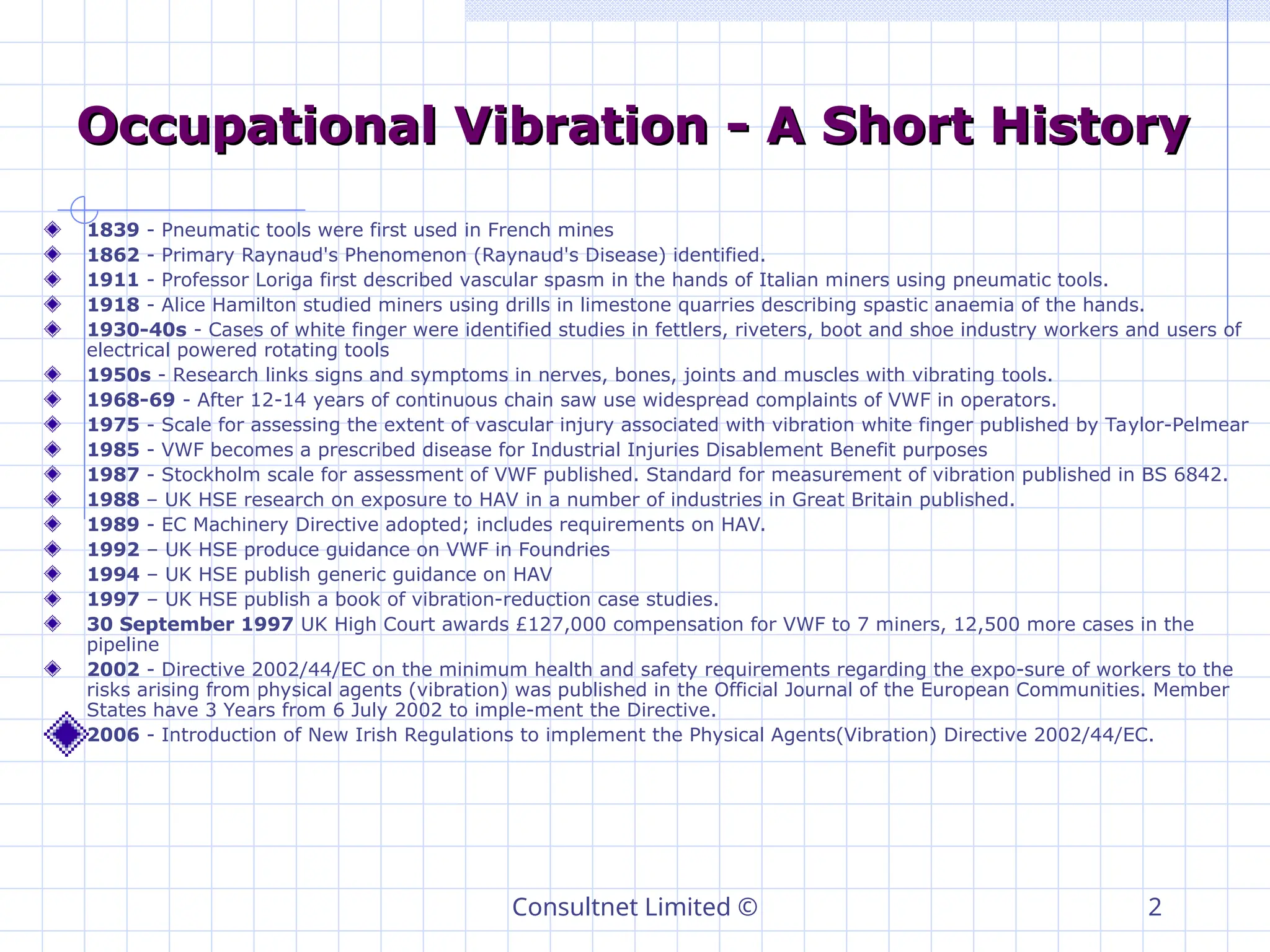
Occupational Vibration - A Short History
Occupational Vibration - A Short History
1839 - Pneumatic tools were first used in French mines
1862 - Primary Raynaud's Phenomenon (Raynaud's Disease) identified.
1911 - Professor Loriga first described vascular spasm in the hands of Italian miners using pneumatic tools.
1918 - Alice Hamilton studied miners using drills in limestone quarries describing spastic anaemia of the hands.
1930-40s - Cases of white finger were identified studies in fettlers, riveters, boot and shoe industry workers and users of
electrical powered rotating tools
1950s - Research links signs and symptoms in nerves, bones, joints and muscles with vibrating tools.
1968-69 - After 12-14 years of continuous chain saw use widespread complaints of VWF in operators.
1975 - Scale for assessing the extent of vascular injury associated with vibration white finger published by Taylor-Pelmear
1985 - VWF becomes a prescribed disease for Industrial Injuries Disablement Benefit purposes
1987 - Stockholm scale for assessment of VWF published. Standard for measurement of vibration published in BS 6842.
1988 – UK HSE research on exposure to HAV in a number of industries in Great Britain published.
1989 - EC Machinery Directive adopted; includes requirements on HAV.
1992 – UK HSE produce guidance on VWF in Foundries
1994 – UK HSE publish generic guidance on HAV
1997 – UK HSE publish a book of vibration-reduction case studies.
30 September 1997 UK High Court awards £127,000 compensation for VWF to 7 miners, 12,500 more cases in the
pipeline
2002 - Directive 2002/44/EC on the minimum health and safety requirements regarding the expo-sure of workers to the
risks arising from physical agents (vibration) was published in the Official Journal of the European Communities. Member
States have 3 Years from 6 July 2002 to imple-ment the Directive.
2006 - Introduction of New Irish Regulations to implement the Physical Agents(Vibration) Directive 2002/44/EC.
3. 4. Consultnet Limited © 4
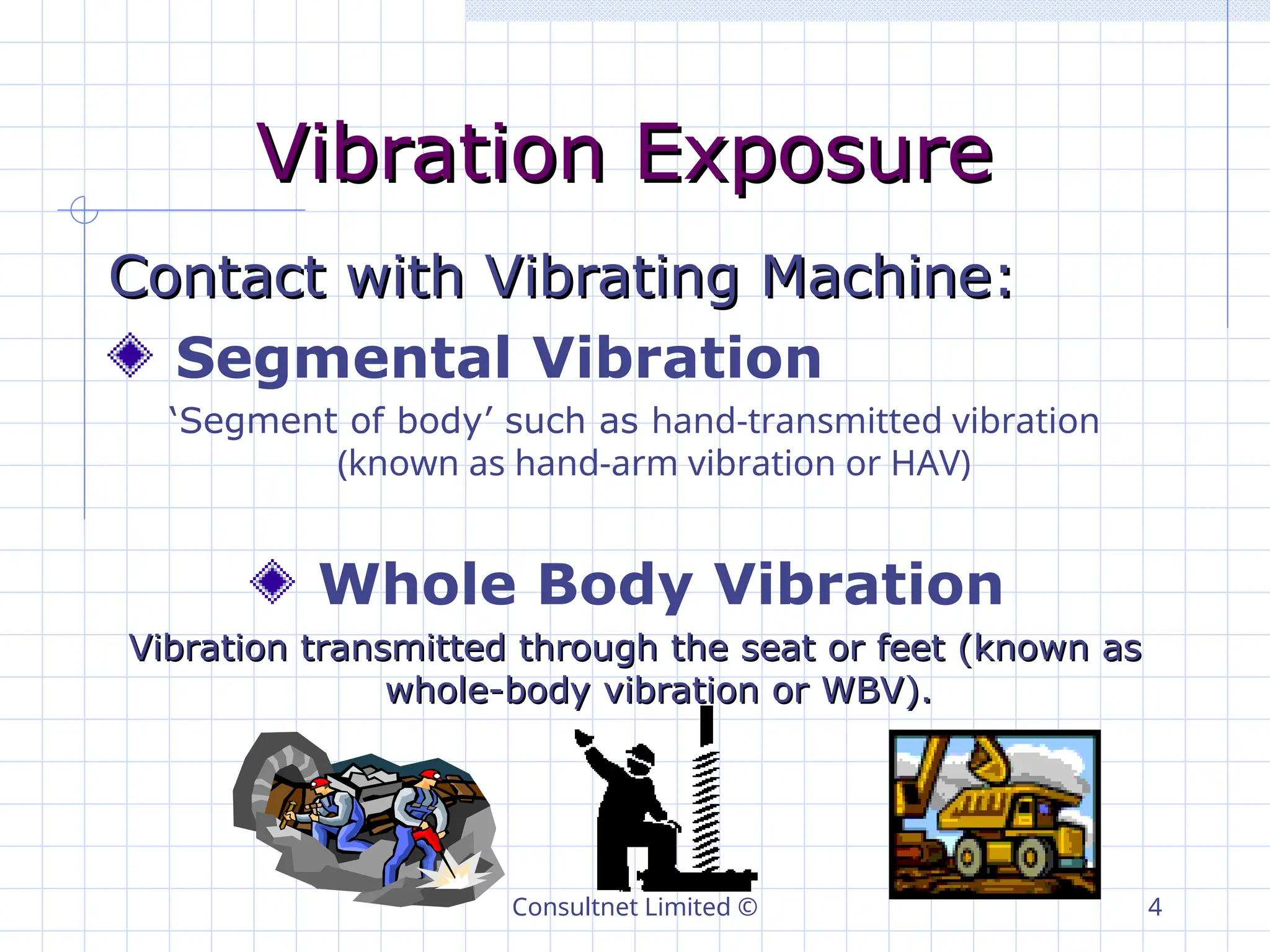
Vibration Exposure
Vibration Exposure
Contact with Vibrating Machine:
Contact with Vibrating Machine:
Segmental Vibration
‘Segment of body’ such as hand-transmitted vibration
(known as hand-arm vibration or HAV)
Whole Body Vibration
Vibration transmitted through the seat or feet (known as
Vibration transmitted through the seat or feet (known as
whole-body vibration or WBV).
whole-body vibration or WBV).
5. Consultnet Limited © 5
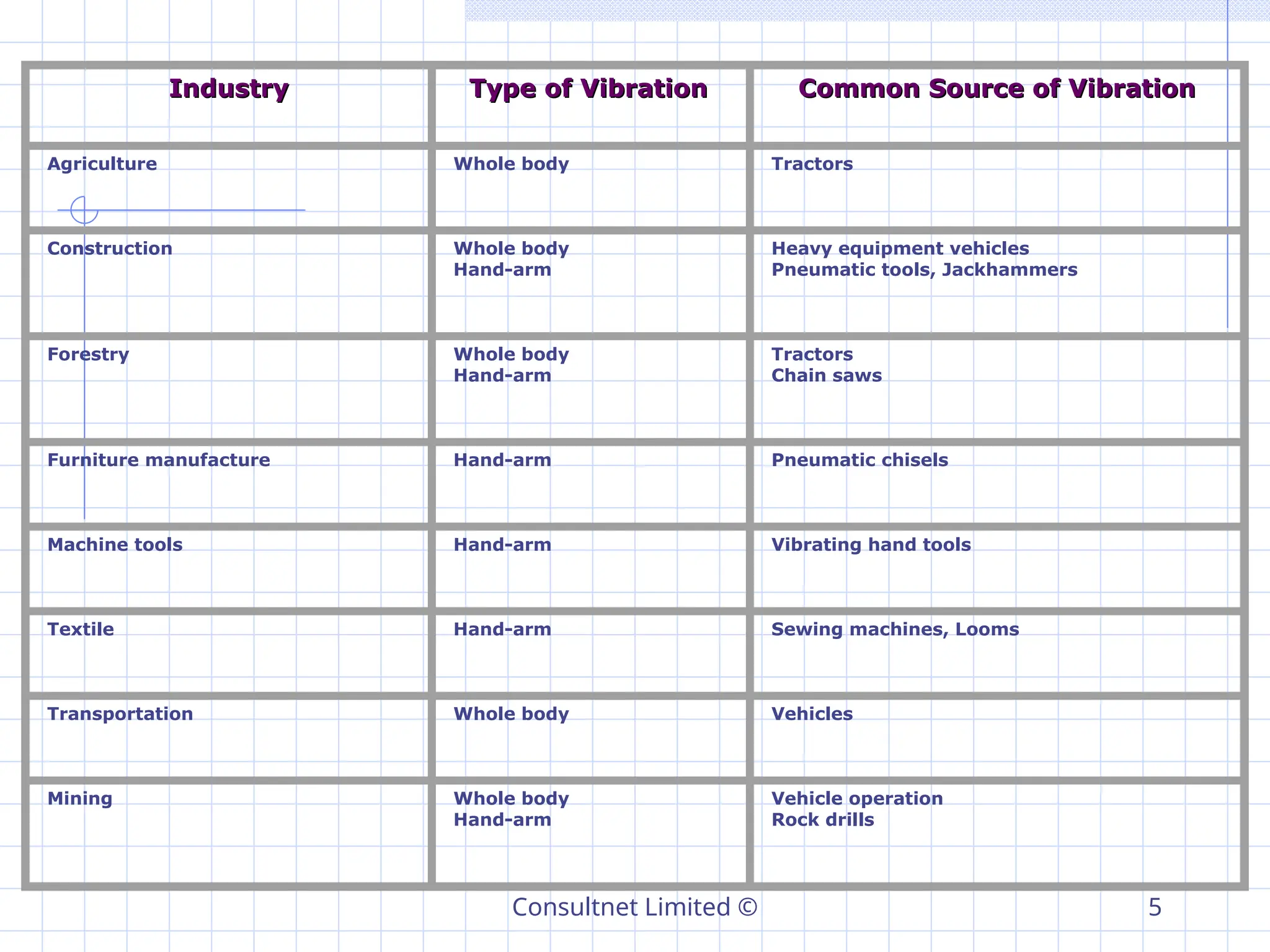
Industry
Industry Type of Vibration
Type of Vibration Common Source of Vibration
Common Source of Vibration
Agriculture Whole body Tractors
Construction Whole body
Hand-arm
Heavy equipment vehicles
Pneumatic tools, Jackhammers
Forestry Whole body
Hand-arm
Tractors
Chain saws
Furniture manufacture Hand-arm Pneumatic chisels
Machine tools Hand-arm Vibrating hand tools
Textile Hand-arm Sewing machines, Looms
Transportation Whole body Vehicles
Mining Whole body
Hand-arm
Vehicle operation
Rock drills
6. Consultnet Limited © 6
Occupational Vibration
Occupational Vibration
Legal Aspects
Legal Aspects
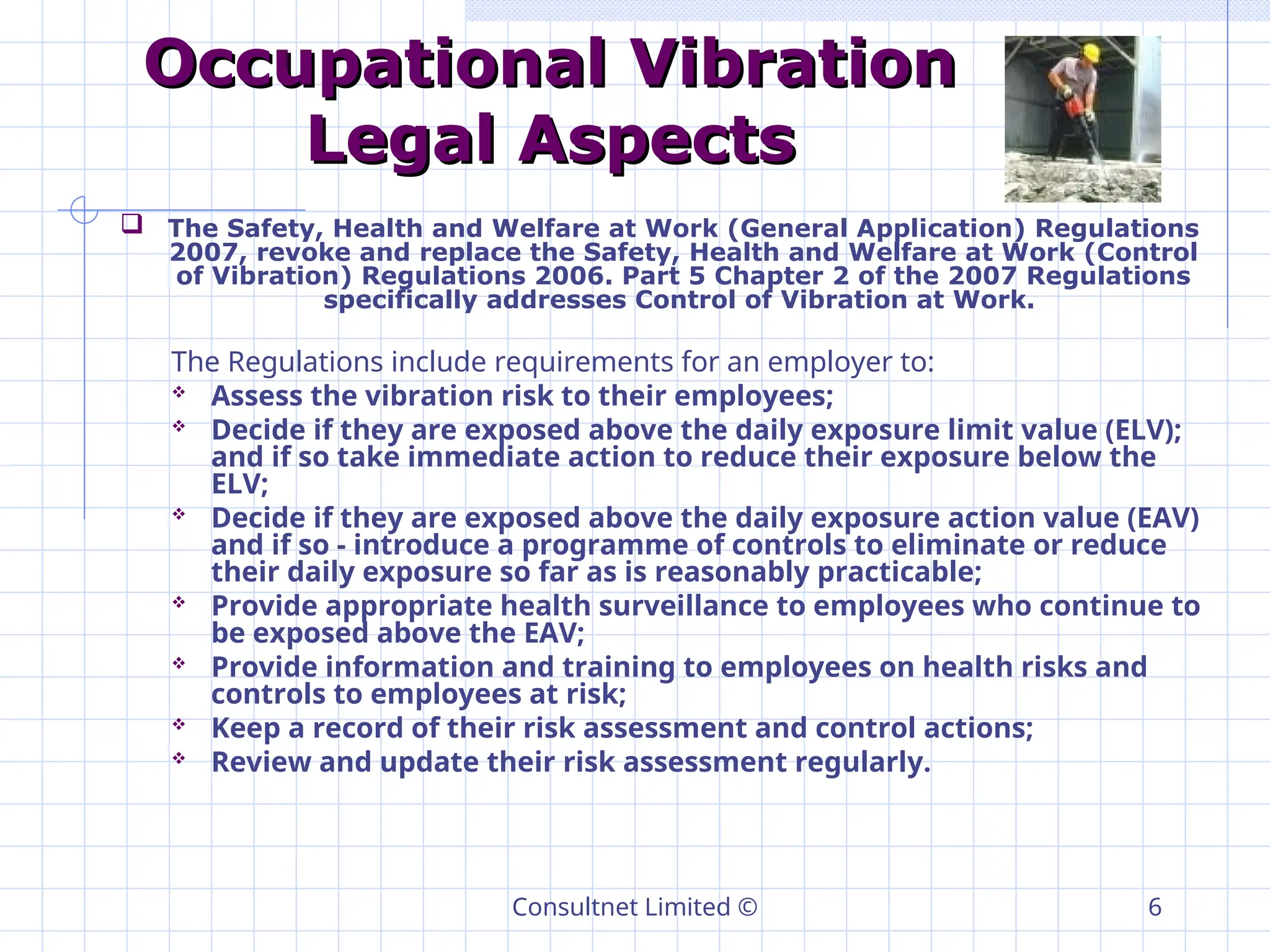
The Safety, Health and Welfare at Work (General Application) Regulations
2007, revoke and replace the Safety, Health and Welfare at Work (Control
of Vibration) Regulations 2006. Part 5 Chapter 2 of the 2007 Regulations
specifically addresses Control of Vibration at Work.
The Regulations include requirements for an employer to:
Assess the vibration risk to their employees;
Decide if they are exposed above the daily exposure limit value (ELV);
and if so take immediate action to reduce their exposure below the
ELV;
Decide if they are exposed above the daily exposure action value (EAV)
and if so - introduce a programme of controls to eliminate or reduce
their daily exposure so far as is reasonably practicable;
Provide appropriate health surveillance to employees who continue to
be exposed above the EAV;
Provide information and training to employees on health risks and
controls to employees at risk;
Keep a record of their risk assessment and control actions;
Review and update their risk assessment regularly.
7. 8. Consultnet Limited © 8
Hand Arm Vibration
Hand Arm Vibration
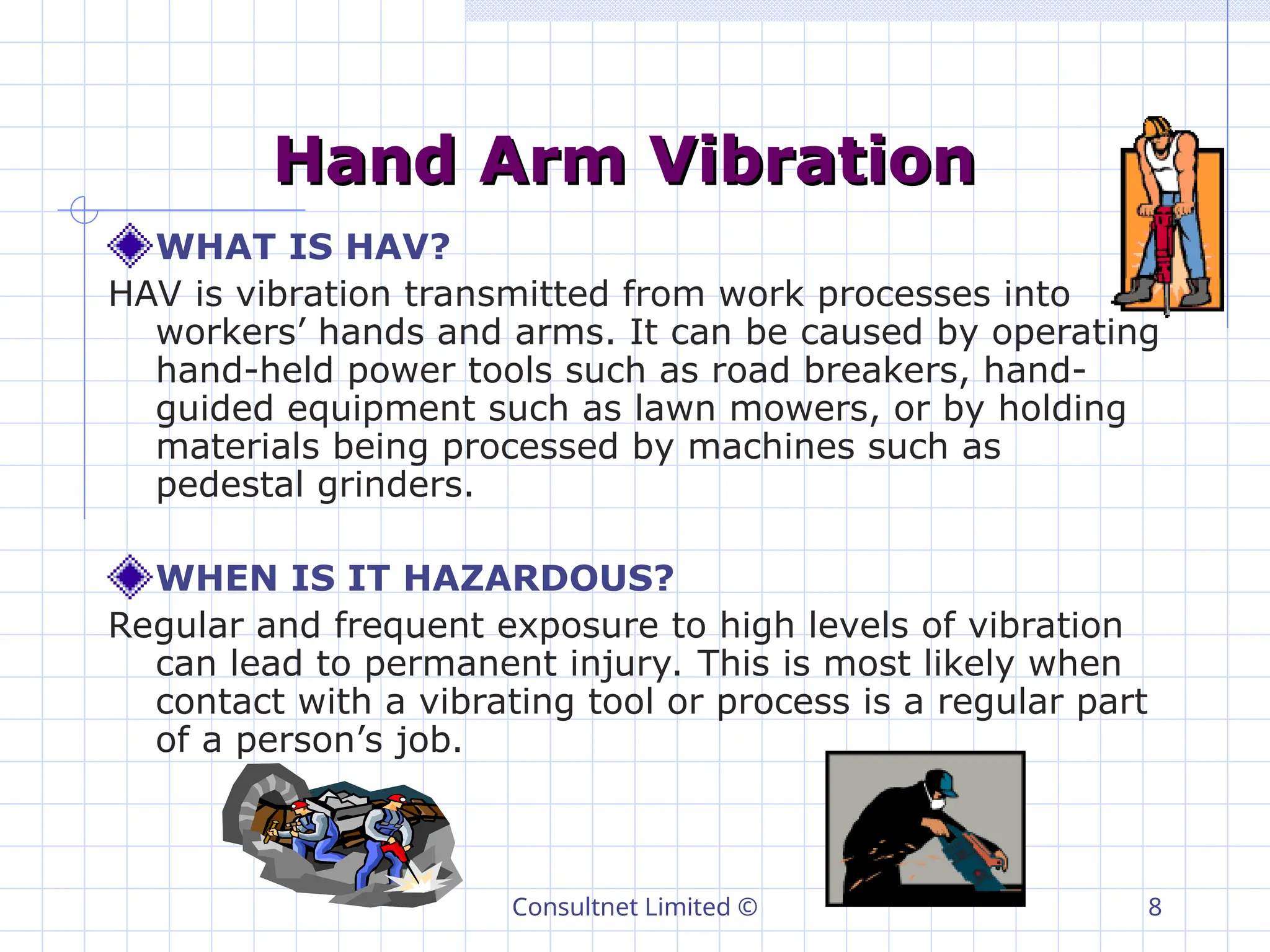
WHAT IS HAV?
HAV is vibration transmitted from work processes into
workers’ hands and arms. It can be caused by operating
hand-held power tools such as road breakers, hand-
guided equipment such as lawn mowers, or by holding
materials being processed by machines such as
pedestal grinders.
WHEN IS IT HAZARDOUS?
Regular and frequent exposure to high levels of vibration
can lead to permanent injury. This is most likely when
contact with a vibrating tool or process is a regular part
of a person’s job.
9. Consultnet Limited © 9
Hand Arm Vibration
Hand Arm Vibration
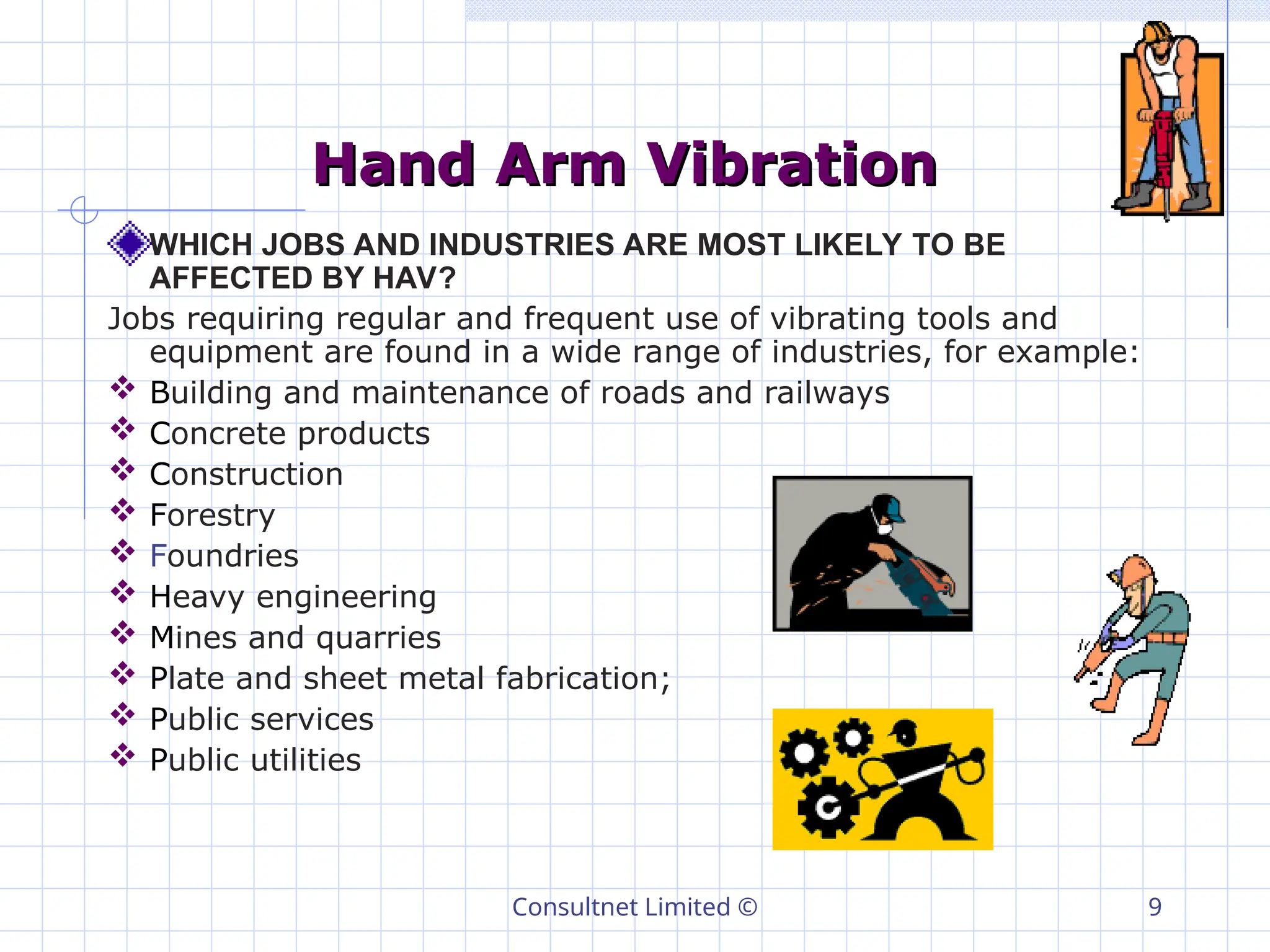
WHICH JOBS AND INDUSTRIES ARE MOST LIKELY TO BE
AFFECTED BY HAV?
Jobs requiring regular and frequent use of vibrating tools and
equipment are found in a wide range of industries, for example:
Building and maintenance of roads and railways
Concrete products
Construction
Forestry
Foundries
Heavy engineering
Mines and quarries
Plate and sheet metal fabrication;
Public services
Public utilities
10. Consultnet Limited © 10
Hand Arm Vibration
Hand Arm Vibration
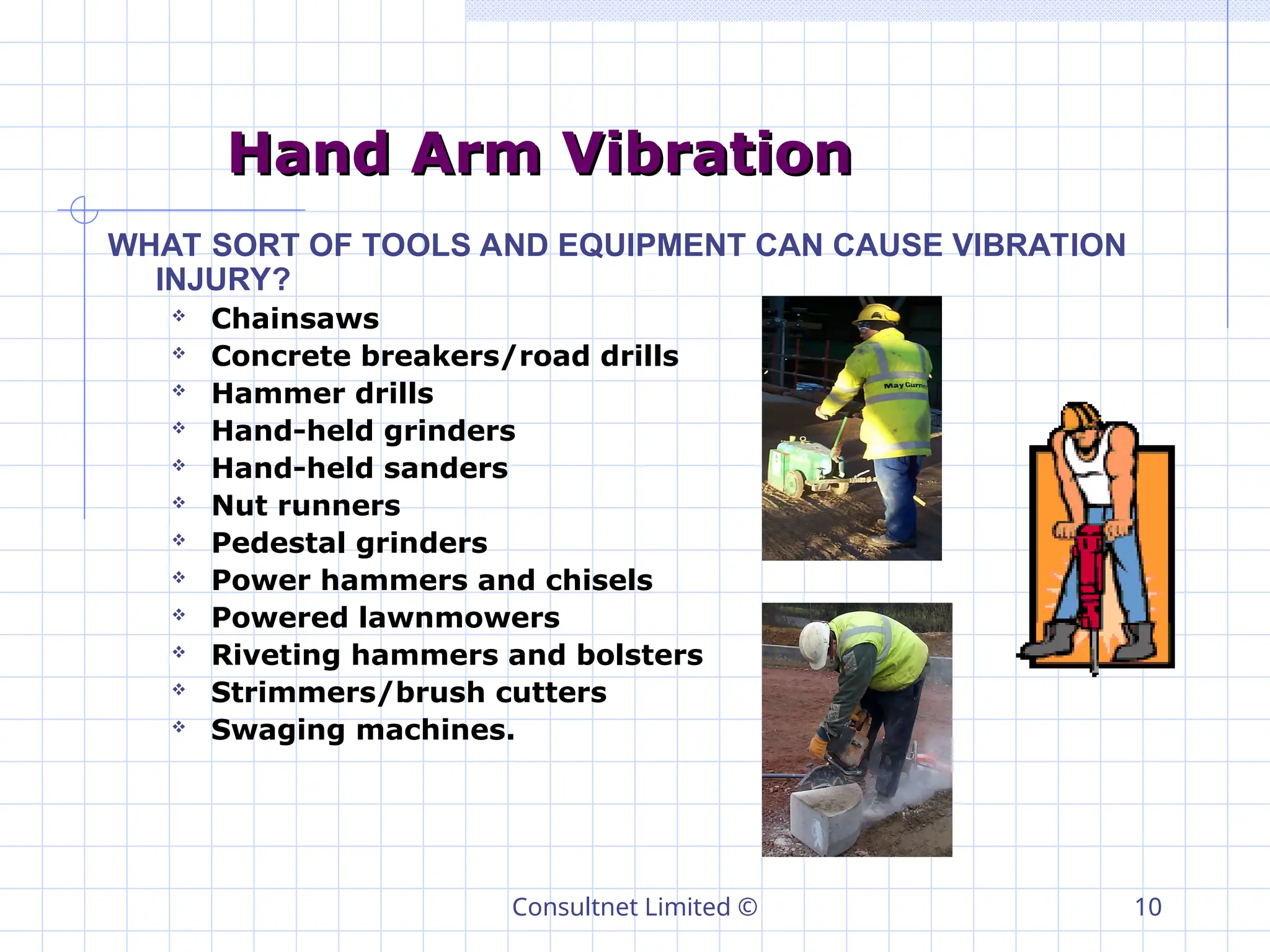
WHAT SORT OF TOOLS AND EQUIPMENT CAN CAUSE VIBRATION
INJURY?
Chainsaws
Concrete breakers/road drills
Hammer drills
Hand-held grinders
Hand-held sanders
Nut runners
Pedestal grinders
Power hammers and chisels
Powered lawnmowers
Riveting hammers and bolsters
Strimmers/brush cutters
Swaging machines.
11. Consultnet Limited © 11
Hand Arm Vibration
Hand Arm Vibration
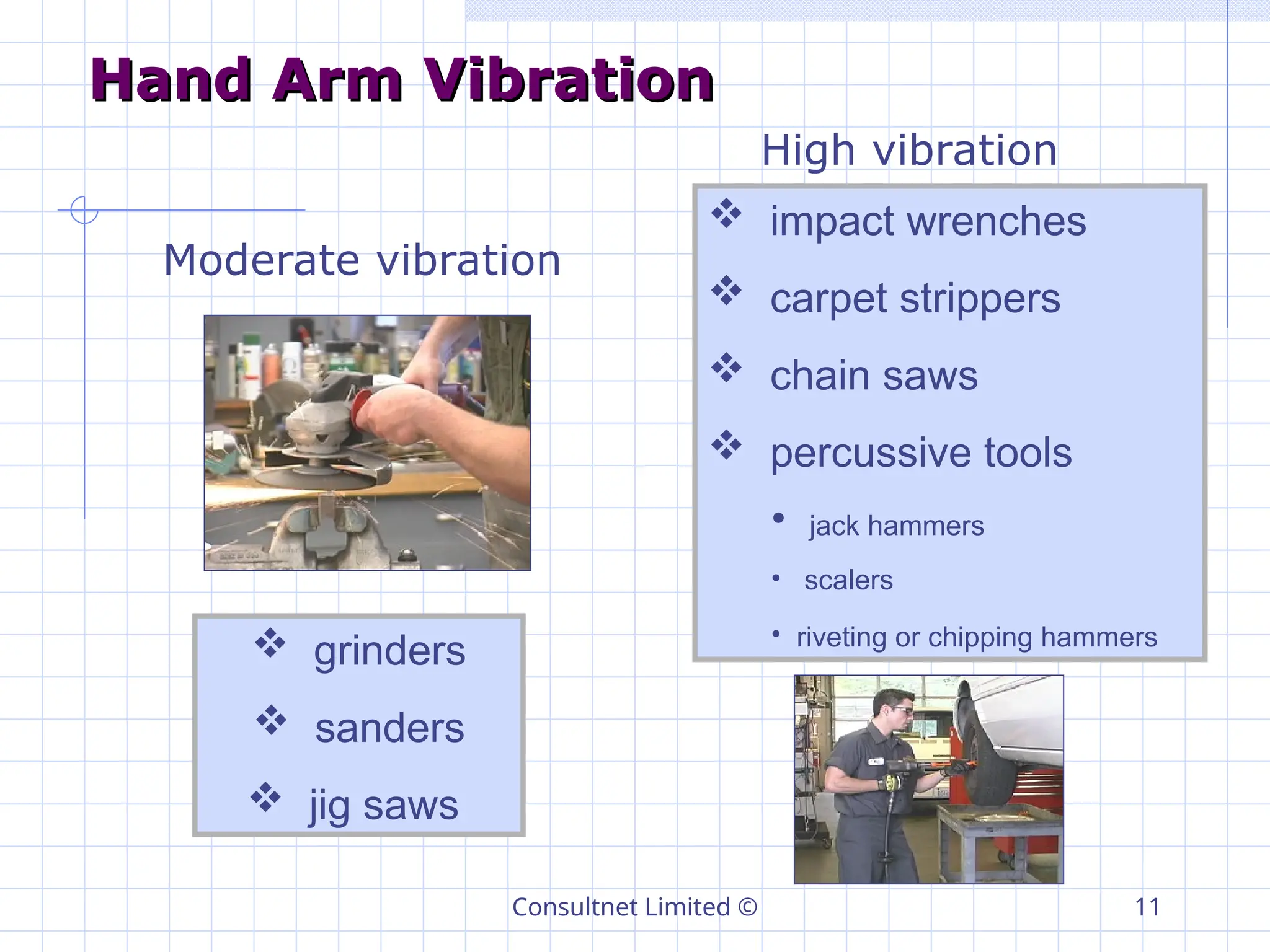
Moderate vibration
High vibration
impact wrenches
carpet strippers
chain saws
percussive tools
• jack hammers
• scalers
• riveting or chipping hammers
grinders
sanders
jig saws
12. Consultnet Limited © 12
Hand Arm Vibration
Hand Arm Vibration
Hand Arm Vibration
Hand Arm Vibration
Causes & Effects
Causes & Effects
13. Consultnet Limited © 13
Hand Arm Vibration - Causes &
Hand Arm Vibration - Causes &
Effects
Effects
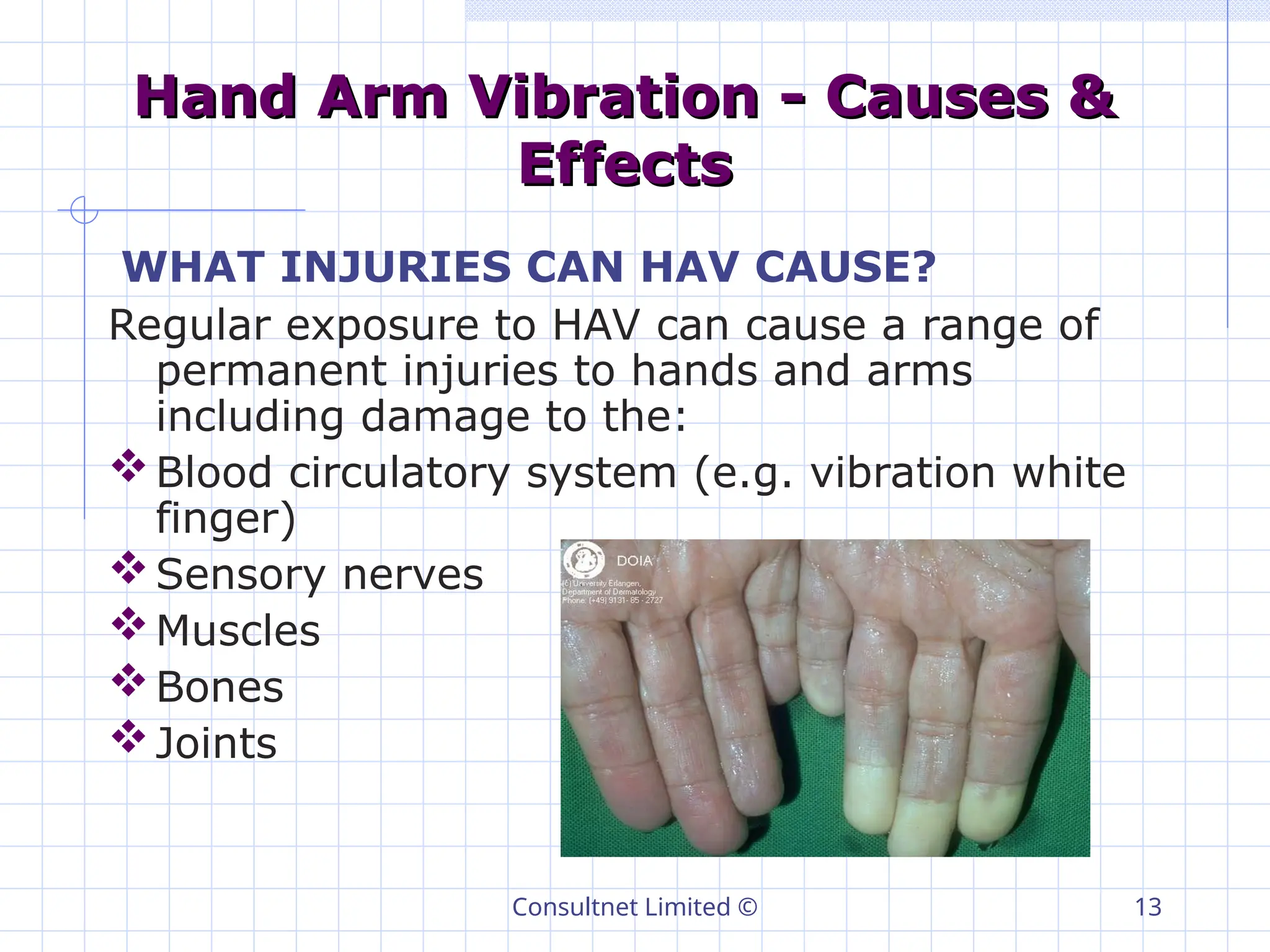
WHAT INJURIES CAN HAV CAUSE?
Regular exposure to HAV can cause a range of
permanent injuries to hands and arms
including damage to the:
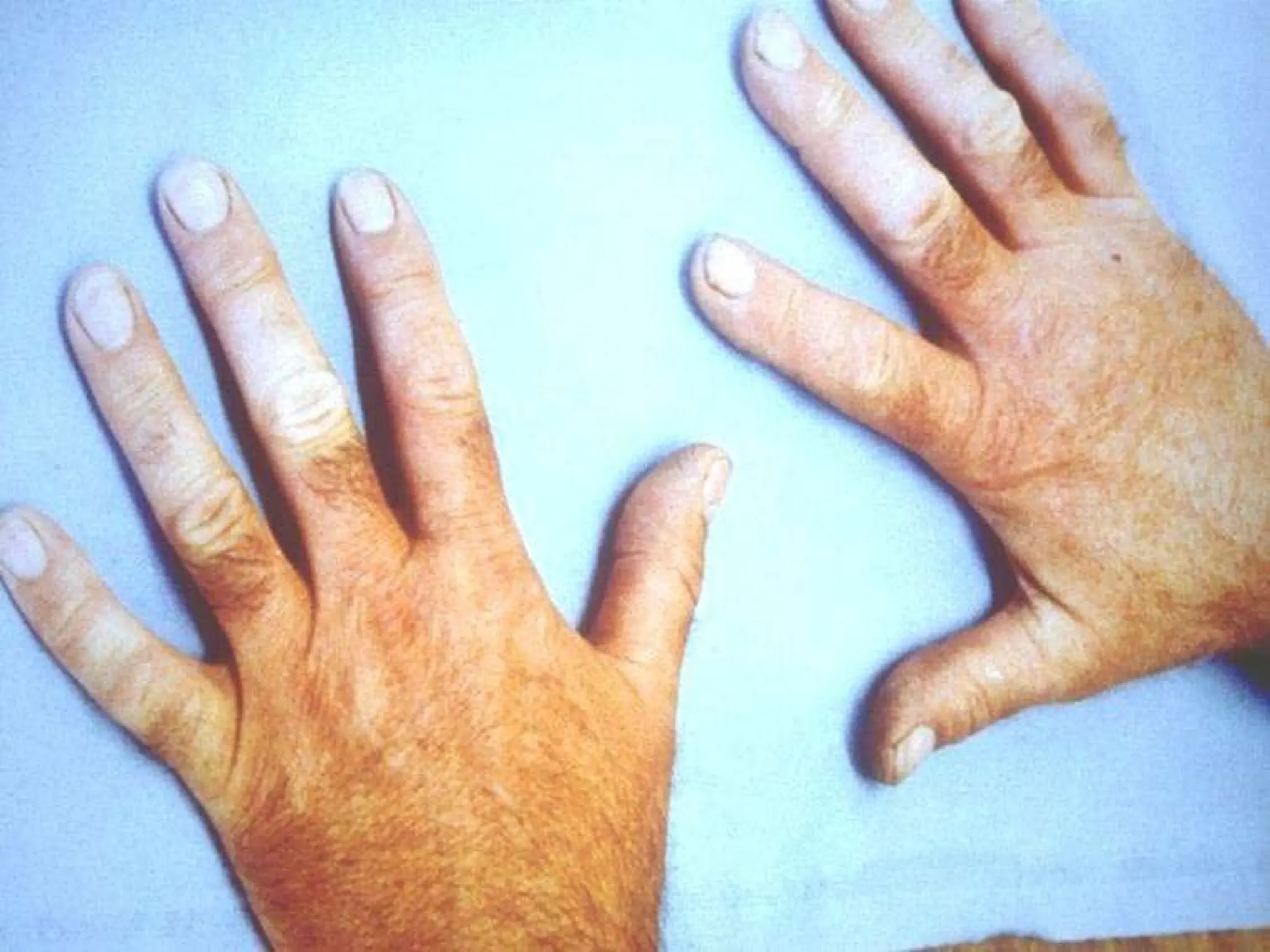
Blood circulatory system (e.g. vibration white
finger)
Sensory nerves
Muscles
Bones
Joints
14. 15. Consultnet Limited © 15
Hand Arm Vibration - Causes &
Hand Arm Vibration - Causes &
Effects
Effects
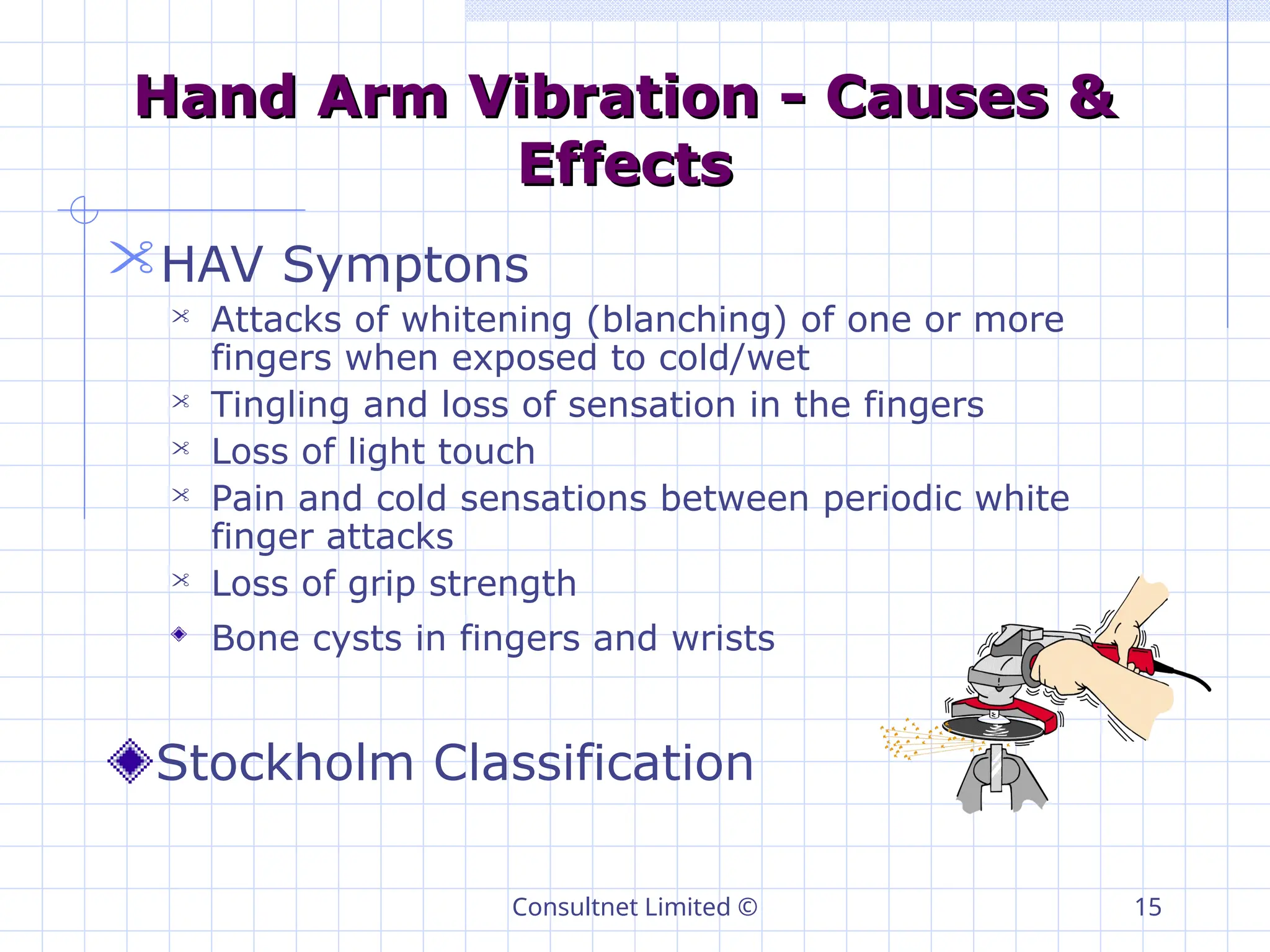
HAV Symptons
Attacks of whitening (blanching) of one or more
fingers when exposed to cold/wet
Tingling and loss of sensation in the fingers
Loss of light touch
Pain and cold sensations between periodic white
finger attacks
Loss of grip strength
Bone cysts in fingers and wrists
Stockholm Classification
16. Consultnet Limited © 16
Factors that
Factors that I
Influence the
nfluence the E
Effect of
ffect of V
Vibration on the
ibration on the H
Hand
and
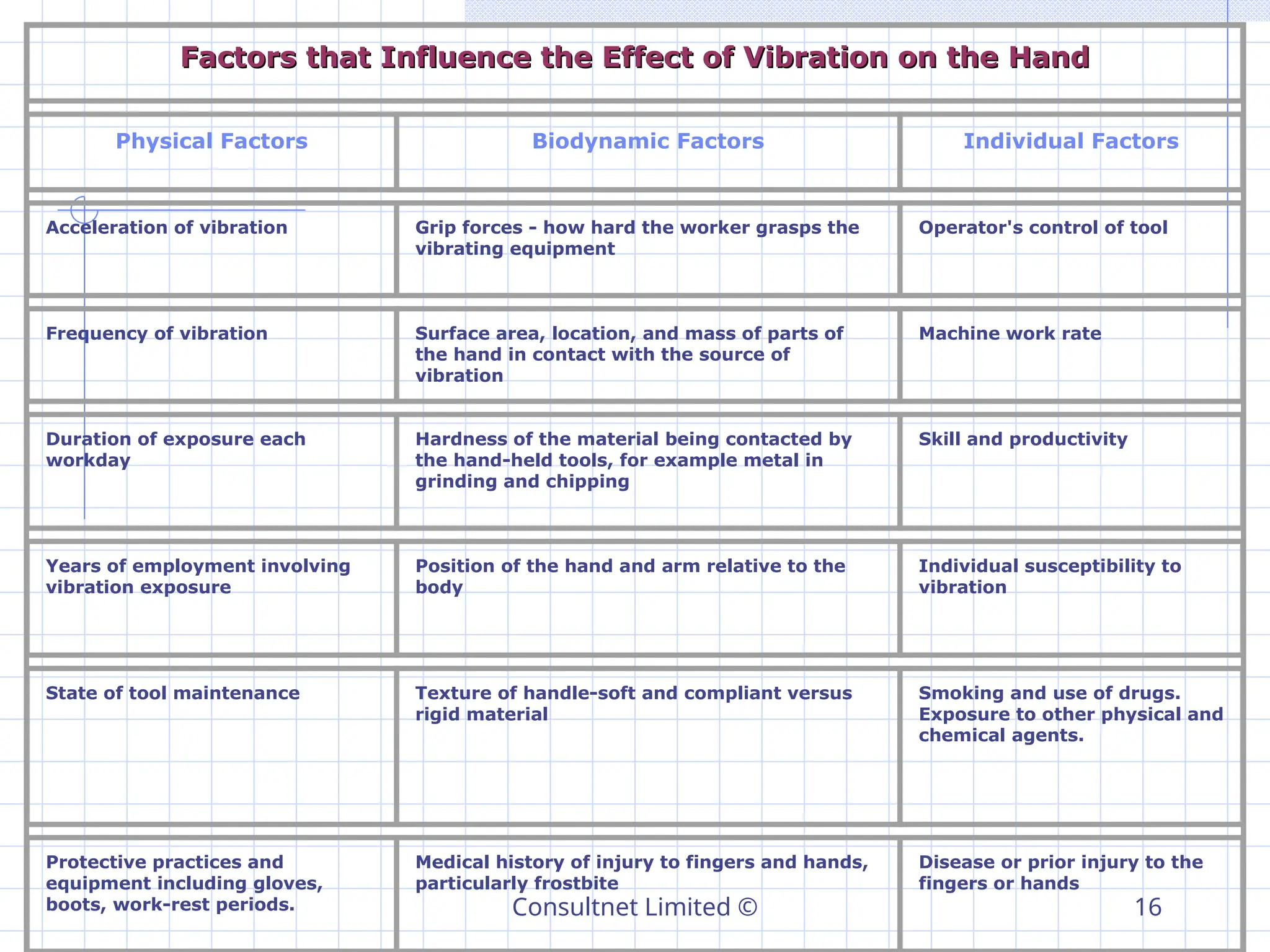
Physical Factors Biodynamic Factors Individual Factors
Acceleration of vibration Grip forces - how hard the worker grasps the
vibrating equipment
Operator's control of tool
Frequency of vibration Surface area, location, and mass of parts of
the hand in contact with the source of
vibration
Machine work rate
Duration of exposure each
workday
Hardness of the material being contacted by
the hand-held tools, for example metal in
grinding and chipping
Skill and productivity
Years of employment involving
vibration exposure
Position of the hand and arm relative to the
body
Individual susceptibility to
vibration
State of tool maintenance Texture of handle-soft and compliant versus
rigid material
Smoking and use of drugs.
Exposure to other physical and
chemical agents.
Protective practices and
equipment including gloves,
boots, work-rest periods.
Medical history of injury to fingers and hands,
particularly frostbite
Disease or prior injury to the
fingers or hands
17. Consultnet Limited © 17
Hand Arm Vibration - Causes &
Hand Arm Vibration - Causes &
Effects
Effects
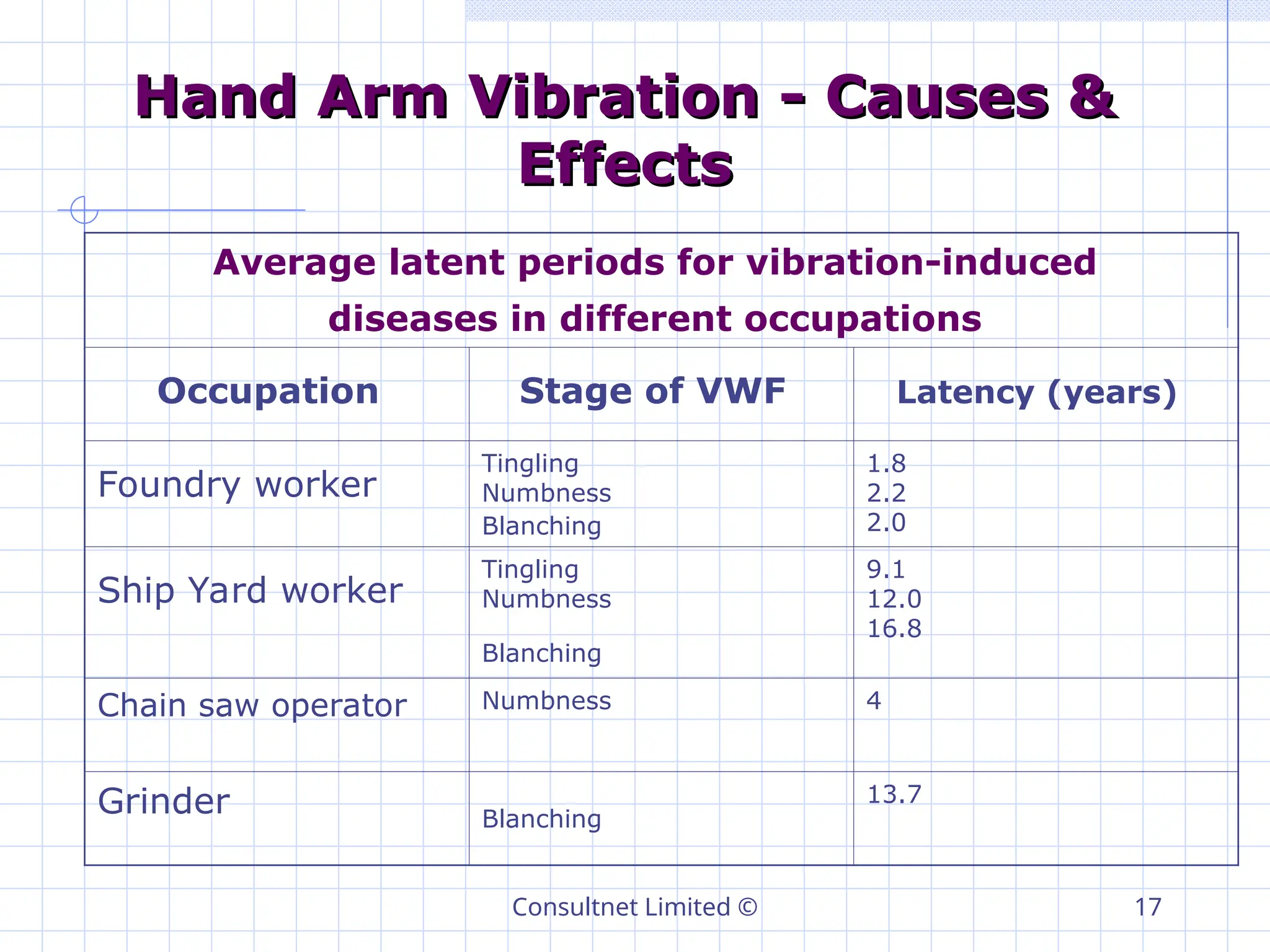
Average latent periods for vibration-induced
diseases in different occupations
Occupation Stage of VWF Latency (years)
Foundry worker
Tingling
Numbness
Blanching
1.8
2.2
2.0
Ship Yard worker
Tingling
Numbness
Blanching
9.1
12.0
16.8
Chain saw operator Numbness 4
Grinder Blanching
13.7
18. Consultnet Limited © 18
Hand Arm Vibration - Causes &
Hand Arm Vibration - Causes &
Effects
Effects
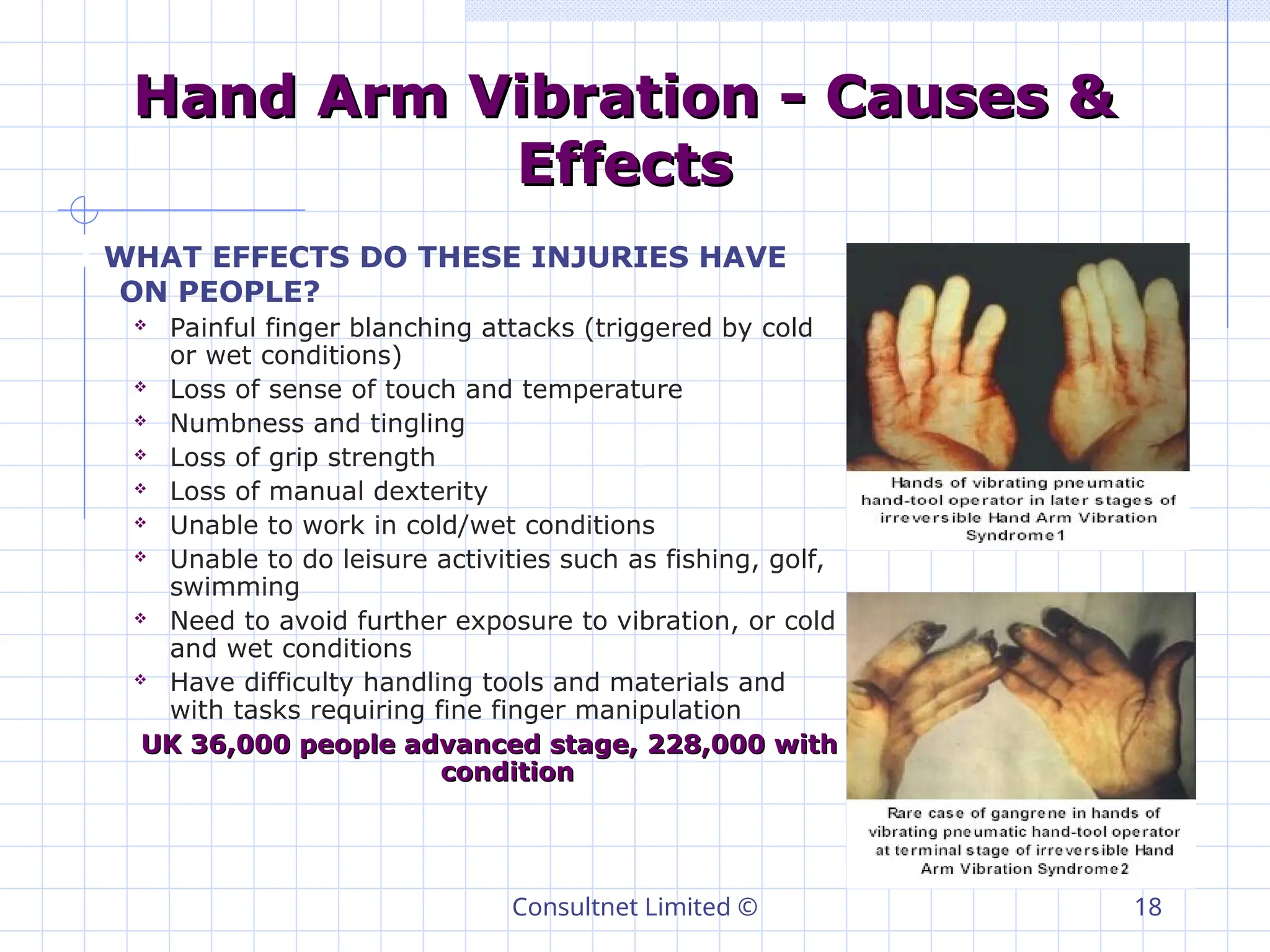
) WHAT EFFECTS DO THESE INJURIES HAVE
ON PEOPLE?
Painful finger blanching attacks (triggered by cold
or wet conditions)
Loss of sense of touch and temperature
Numbness and tingling
Loss of grip strength
Loss of manual dexterity
Unable to work in cold/wet conditions
Unable to do leisure activities such as fishing, golf,
swimming
Need to avoid further exposure to vibration, or cold
and wet conditions
Have difficulty handling tools and materials and
with tasks requiring fine finger manipulation
UK 36,000 people advanced stage, 228,000 with
UK 36,000 people advanced stage, 228,000 with
condition
condition
19. Consultnet Limited © 19
Hand Arm & Whole
Hand Arm & Whole
Body Vibration
Body Vibration
Hand Arm Vibration
Hand Arm Vibration
Management & Control
Management & Control
20. Consultnet Limited © 20
Hand Arm Vibration
Hand Arm Vibration
Management & Control
Management & Control
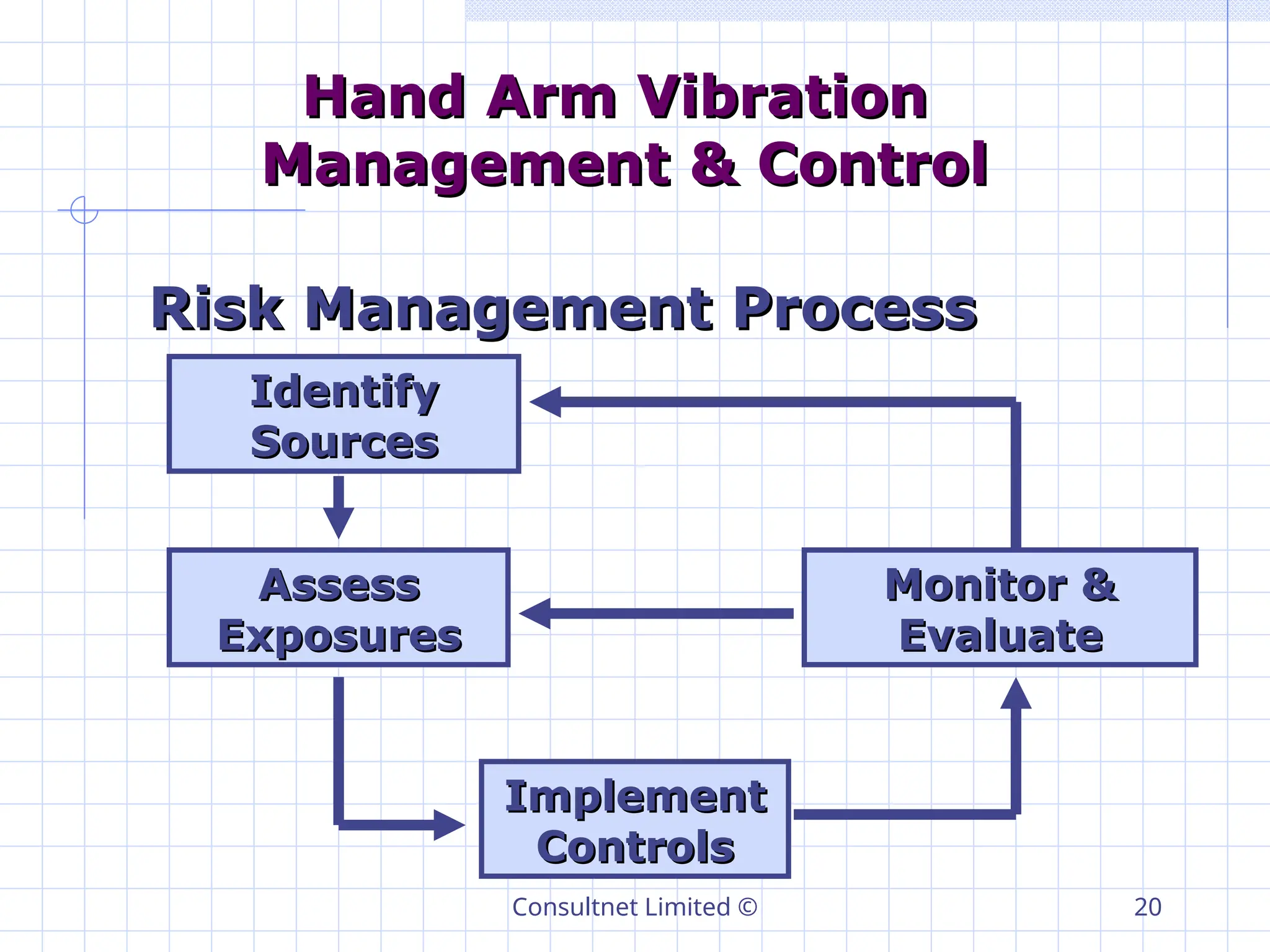
Risk Management Process
Risk Management Process
Identify
Identify
Sources
Sources
Monitor &
Monitor &
Evaluate
Evaluate
Implement
Implement
Controls
Controls
Assess
Assess
Exposures
Exposures
21. Consultnet Limited © 21
Hand Arm Vibration
Hand Arm Vibration
Management & Control
Management & Control
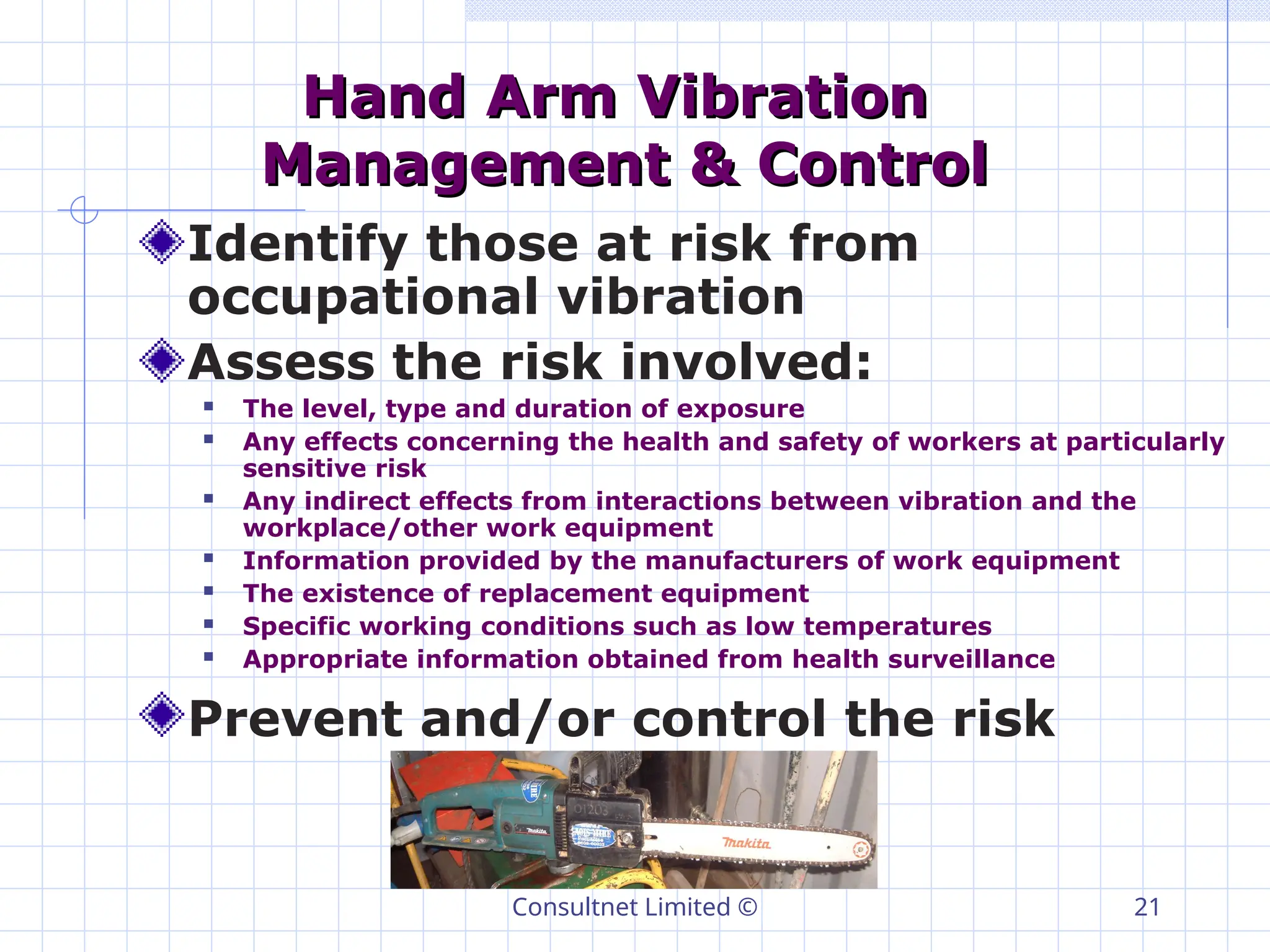
Identify those at risk from
occupational vibration
Assess the risk involved:
The level, type and duration of exposure
Any effects concerning the health and safety of workers at particularly
sensitive risk
Any indirect effects from interactions between vibration and the
workplace/other work equipment
Information provided by the manufacturers of work equipment
The existence of replacement equipment
Specific working conditions such as low temperatures
Appropriate information obtained from health surveillance
Prevent and/or control the risk
22. Consultnet Limited © 22
Hand Arm Vibration –
Hand Arm Vibration –
Management & Control
Management & Control
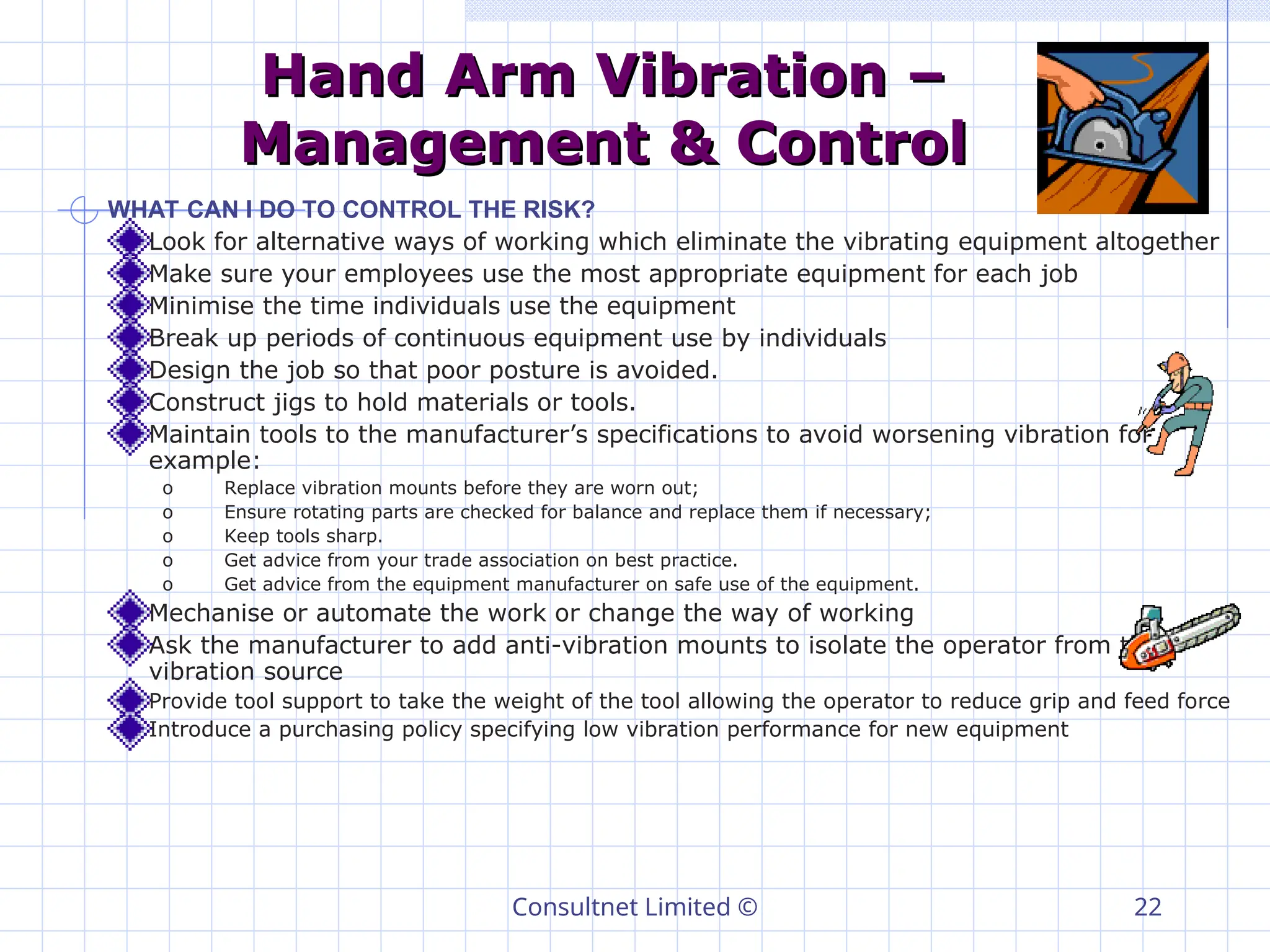
WHAT CAN I DO TO CONTROL THE RISK?
Look for alternative ways of working which eliminate the vibrating equipment altogether
Make sure your employees use the most appropriate equipment for each job
Minimise the time individuals use the equipment
Break up periods of continuous equipment use by individuals
Design the job so that poor posture is avoided.
Construct jigs to hold materials or tools.
Maintain tools to the manufacturer’s specifications to avoid worsening vibration for
example:
o Replace vibration mounts before they are worn out;
o Ensure rotating parts are checked for balance and replace them if necessary;
o Keep tools sharp.
o Get advice from your trade association on best practice.
o Get advice from the equipment manufacturer on safe use of the equipment.
Mechanise or automate the work or change the way of working
Ask the manufacturer to add anti-vibration mounts to isolate the operator from the
vibration source
Provide tool support to take the weight of the tool allowing the operator to reduce grip and feed force
Introduce a purchasing policy specifying low vibration performance for new equipment
23. Consultnet Limited © 23
Hand Arm Vibration –
Hand Arm Vibration –
Management & Control
Management & Control
Workers can reduce the risk of hand-arm vibration
syndrome (HAVS) by following safe work practices
safe work practices:
Employ a minimum hand grip consistent with safe
operation of the tool or process.
Wear sufficient clothing, including gloves, to keep
warm.
Avoid continuous exposure by taking rest periods.
Rest the tool on the work piece whenever practical.
Refrain from using faulty tools.
Maintain properly sharpened cutting tools.
Consult a doctor at the first sign of vibration disease
and ask about the possibility of changing to a job with
less exposure
24. Consultnet Limited © 24
Hand Arm Vibration –
Hand Arm Vibration –
Management & Control
Management & Control
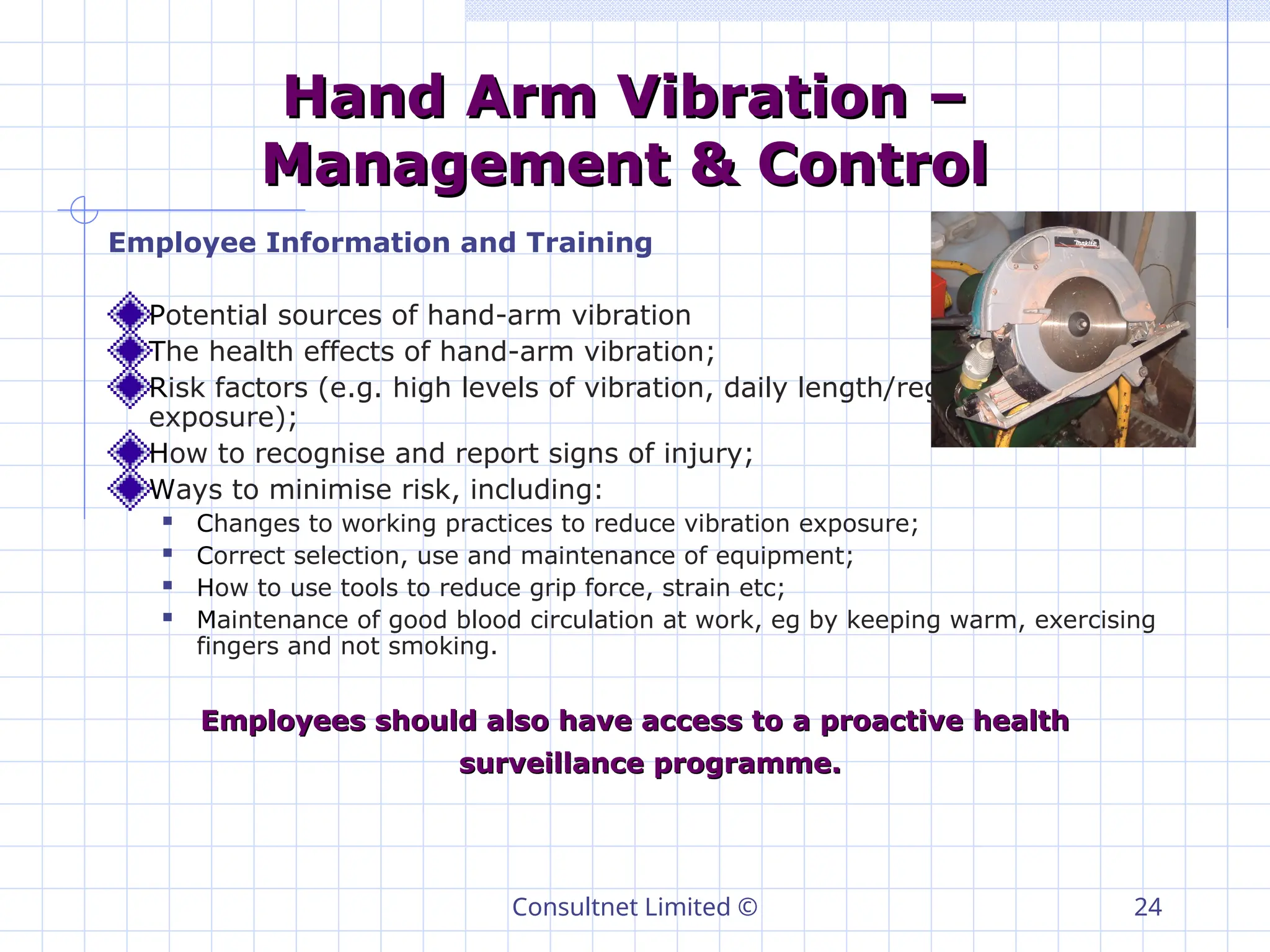
Employee Information and Training
Potential sources of hand-arm vibration
The health effects of hand-arm vibration;
Risk factors (e.g. high levels of vibration, daily length/regularity of
exposure);
How to recognise and report signs of injury;
Ways to minimise risk, including:
Changes to working practices to reduce vibration exposure;
Correct selection, use and maintenance of equipment;
How to use tools to reduce grip force, strain etc;
Maintenance of good blood circulation at work, eg by keeping warm, exercising
fingers and not smoking.
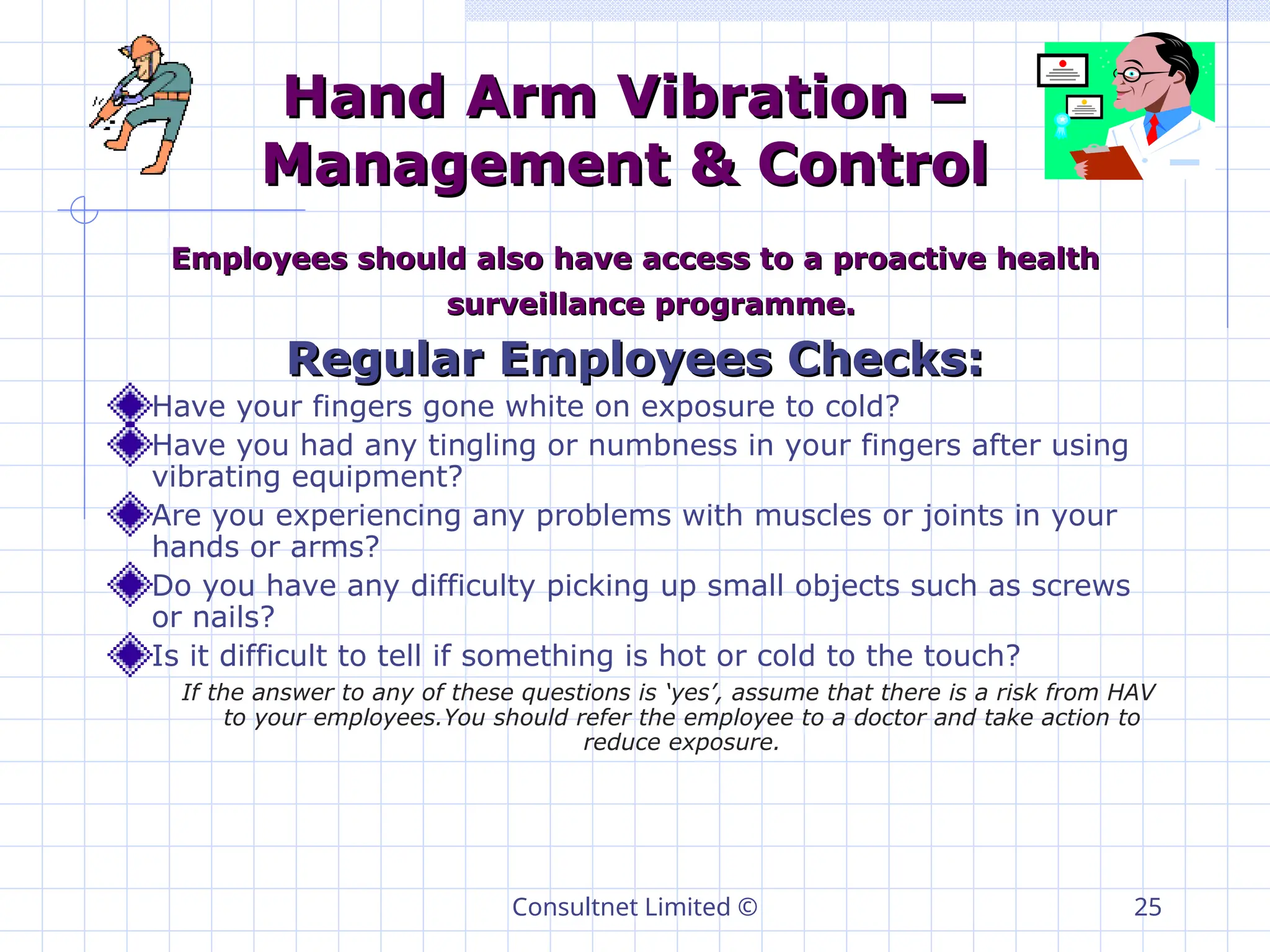
Employees should also have access to a proactive health
Employees should also have access to a proactive health
surveillance programme.
surveillance programme.
25. Consultnet Limited © 25
Hand Arm Vibration –
Hand Arm Vibration –
Management & Control
Management & Control
Employees should also have access to a proactive health
Employees should also have access to a proactive health
surveillance programme.
surveillance programme.
Regular Employees Checks:
Regular Employees Checks:
Have your fingers gone white on exposure to cold?
Have you had any tingling or numbness in your fingers after using
vibrating equipment?
Are you experiencing any problems with muscles or joints in your
hands or arms?
Do you have any difficulty picking up small objects such as screws
or nails?
Is it difficult to tell if something is hot or cold to the touch?
If the answer to any of these questions is ‘yes’, assume that there is a risk from HAV
to your employees.You should refer the employee to a doctor and take action to
reduce exposure.
26. Consultnet Limited © 26
Hand Arm Vibration –
Hand Arm Vibration –
Management & Control
Management & Control
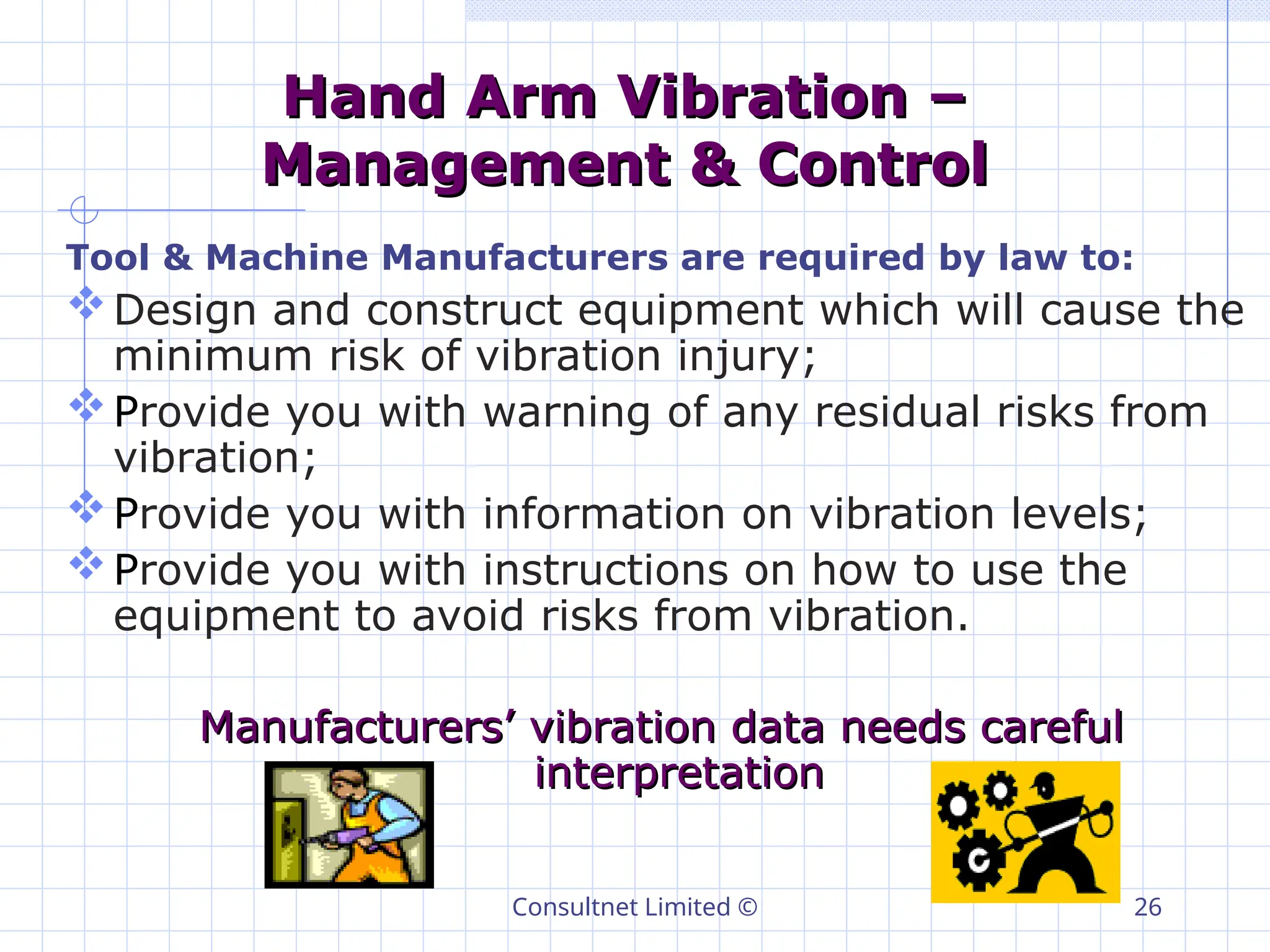
Tool & Machine Manufacturers are required by law to:
Design and construct equipment which will cause the
minimum risk of vibration injury;
Provide you with warning of any residual risks from
vibration;
Provide you with information on vibration levels;
Provide you with instructions on how to use the
equipment to avoid risks from vibration.
Manufacturers’ vibration data needs careful
Manufacturers’ vibration data needs careful
interpretation
interpretation
27. 28. Consultnet Limited © 28
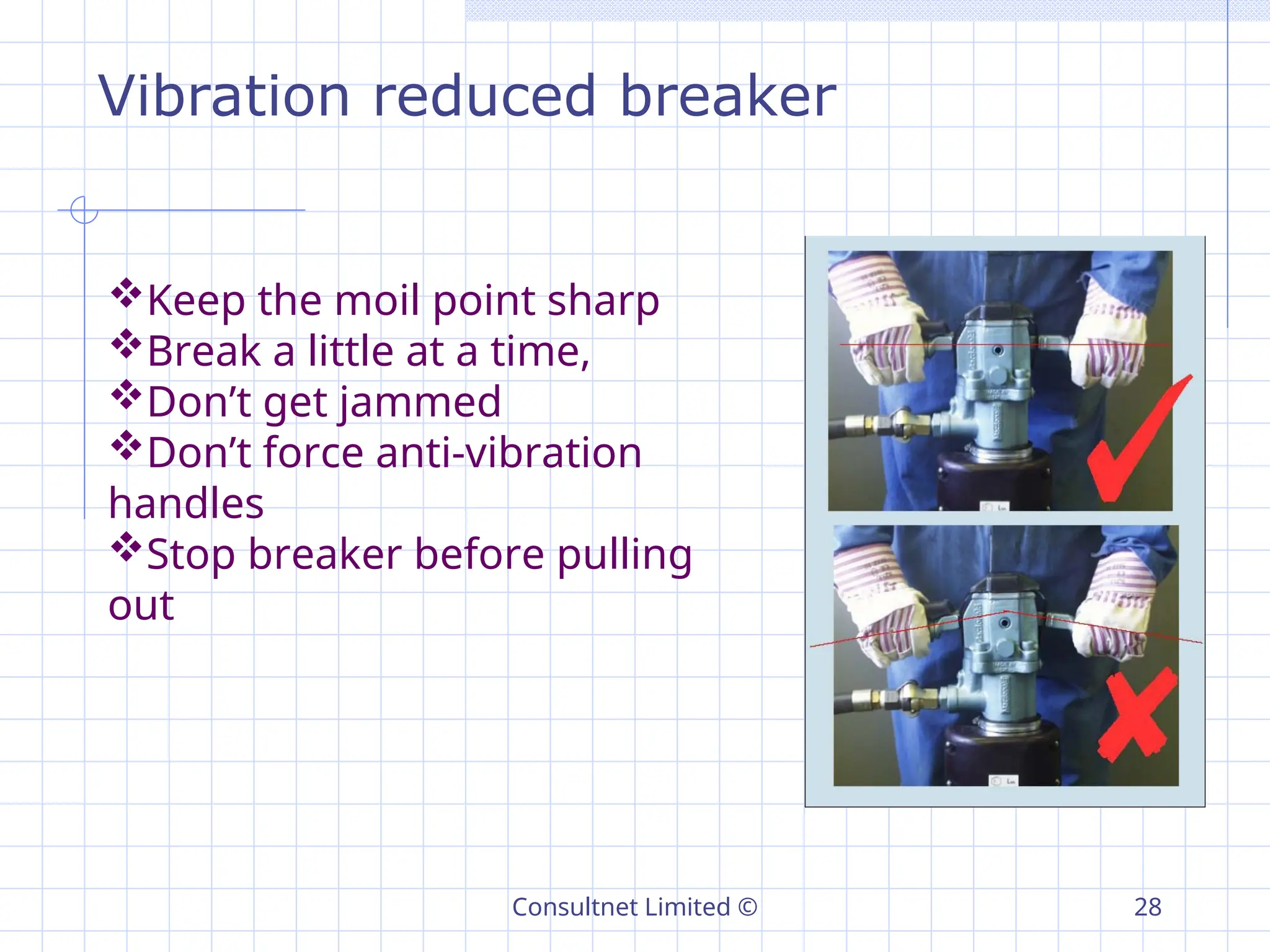
Vibration reduced breaker
Keep the moil point sharp
Break a little at a time,
Don’t get jammed
Don’t force anti-vibration
handles
Stop breaker before pulling
out
29. Consultnet Limited © 29
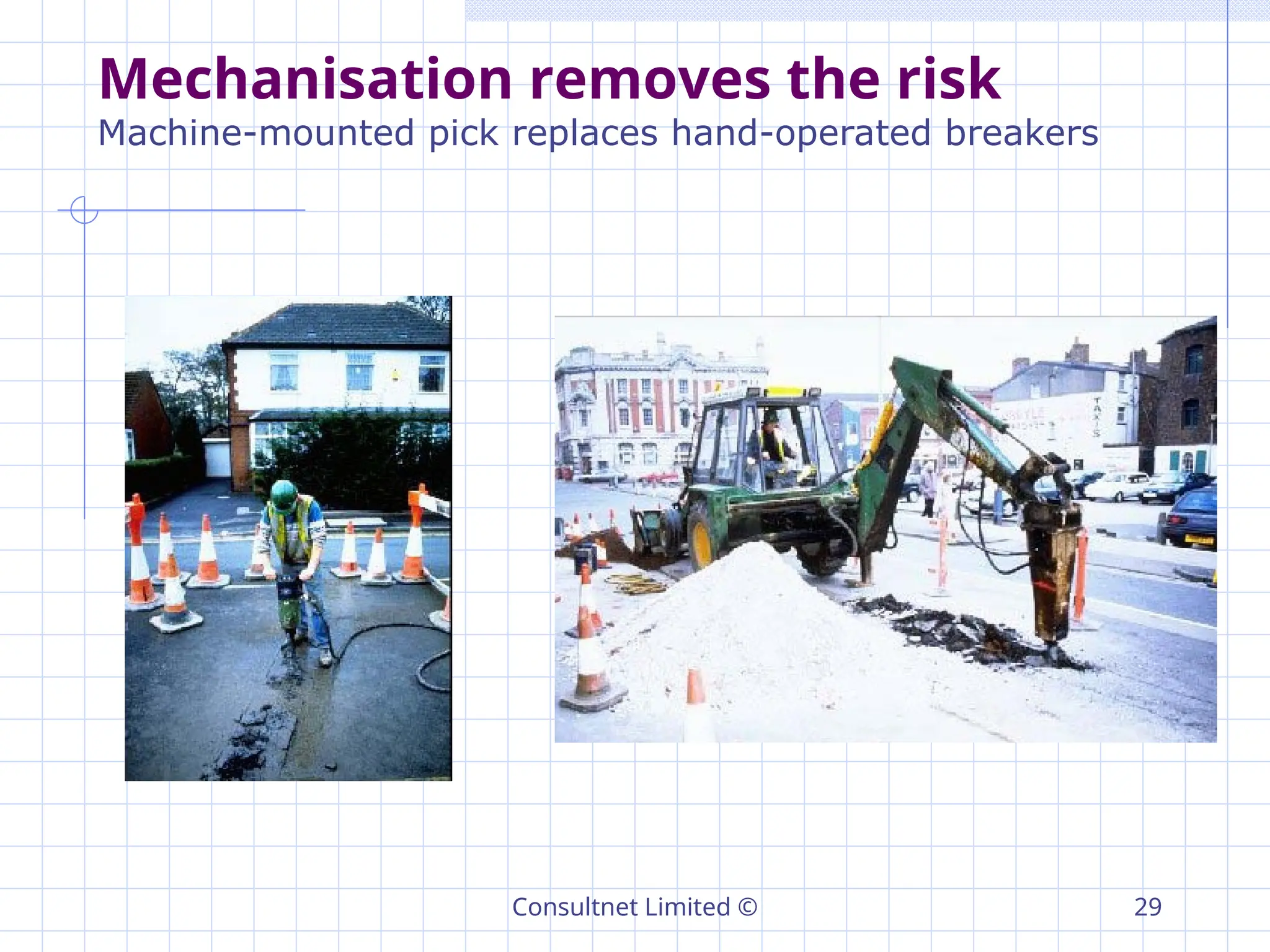
Mechanisation removes the risk
Machine-mounted pick replaces hand-operated breakers
30. Consultnet Limited © 30
Demolition without vibration
Use hydraulic crushers instead of demolition
hammers
31. Consultnet Limited © 31
Occupational Vibration
Occupational Vibration
Control Standards
Control Standards
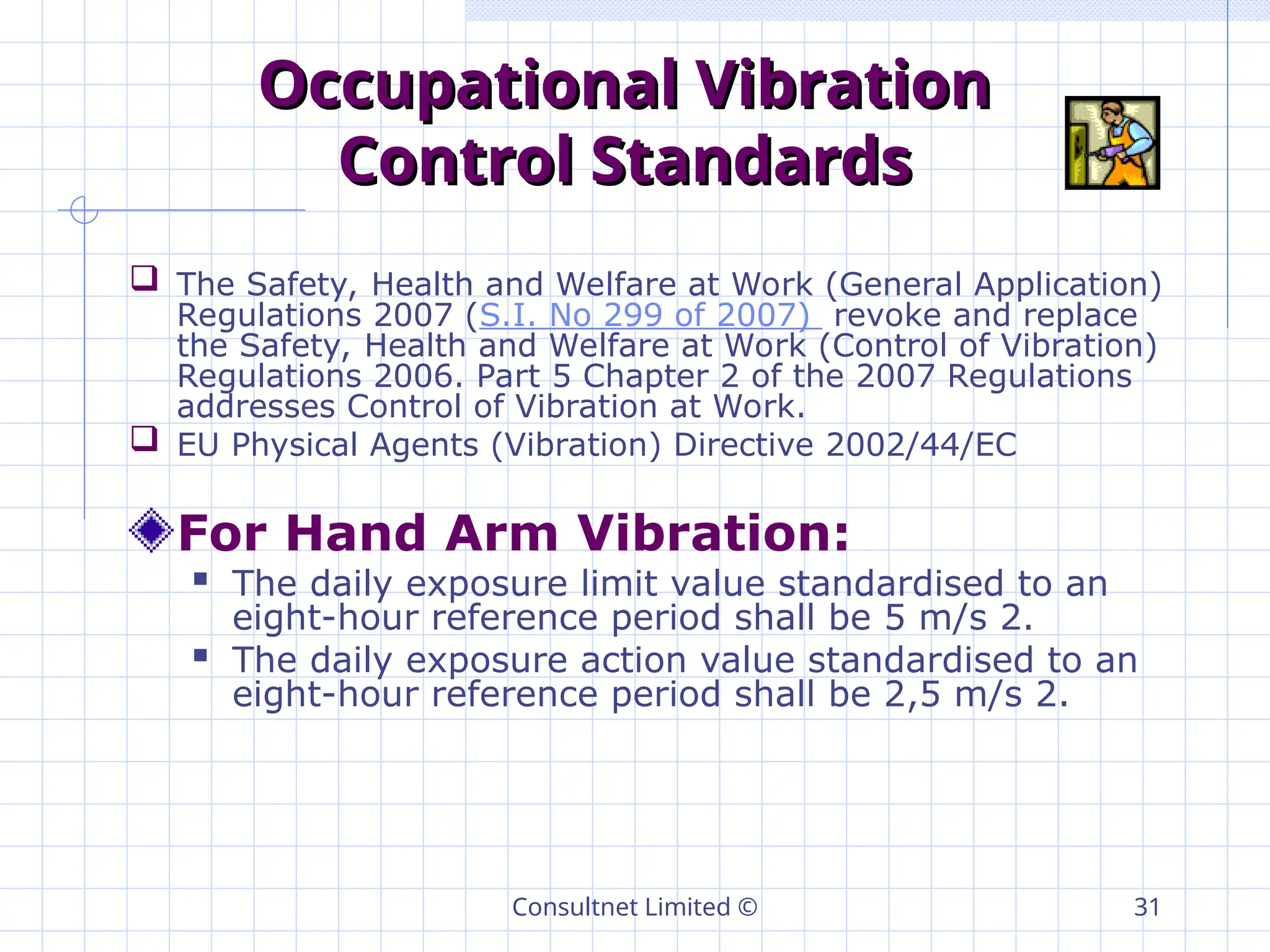
The Safety, Health and Welfare at Work (General Application)
Regulations 2007 (S.I. No 299 of 2007) revoke and replace
the Safety, Health and Welfare at Work (Control of Vibration)
Regulations 2006. Part 5 Chapter 2 of the 2007 Regulations
addresses Control of Vibration at Work.
EU Physical Agents (Vibration) Directive 2002/44/EC
For Hand Arm Vibration:
The daily exposure limit value standardised to an
eight-hour reference period shall be 5 m/s 2.
The daily exposure action value standardised to an
eight-hour reference period shall be 2,5 m/s 2.
32. Consultnet Limited © 32
Occupational Vibration
Occupational Vibration
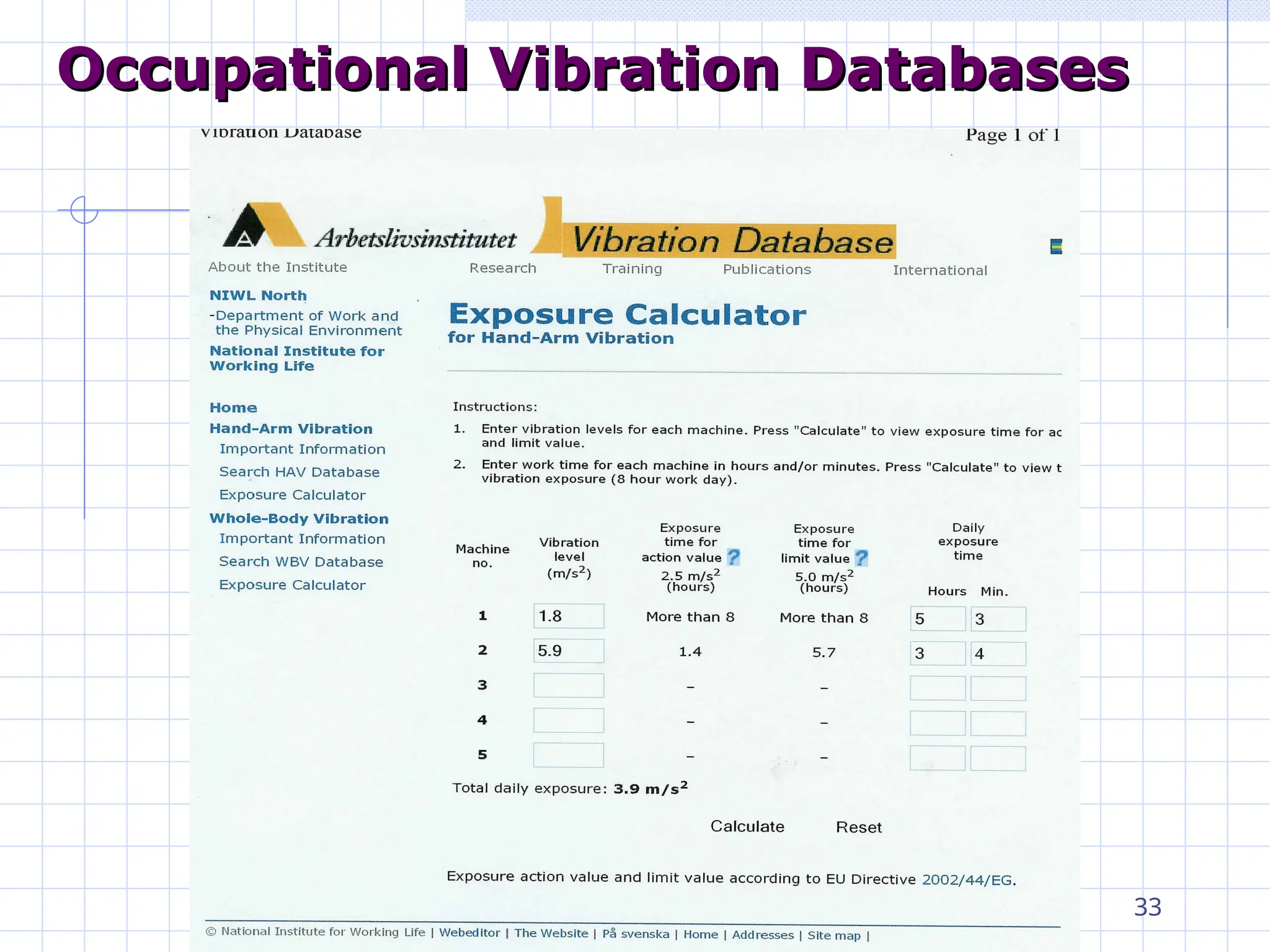
Databases
Databases
The Centralised
European Database
is available at:
http://umetech.niwl.se/English
http://umetech.niwl.se/English
Also includes a
Vibration Exposure
Vibration Exposure
Calculator
Calculator
33. 34. 35. Consultnet Limited © 35
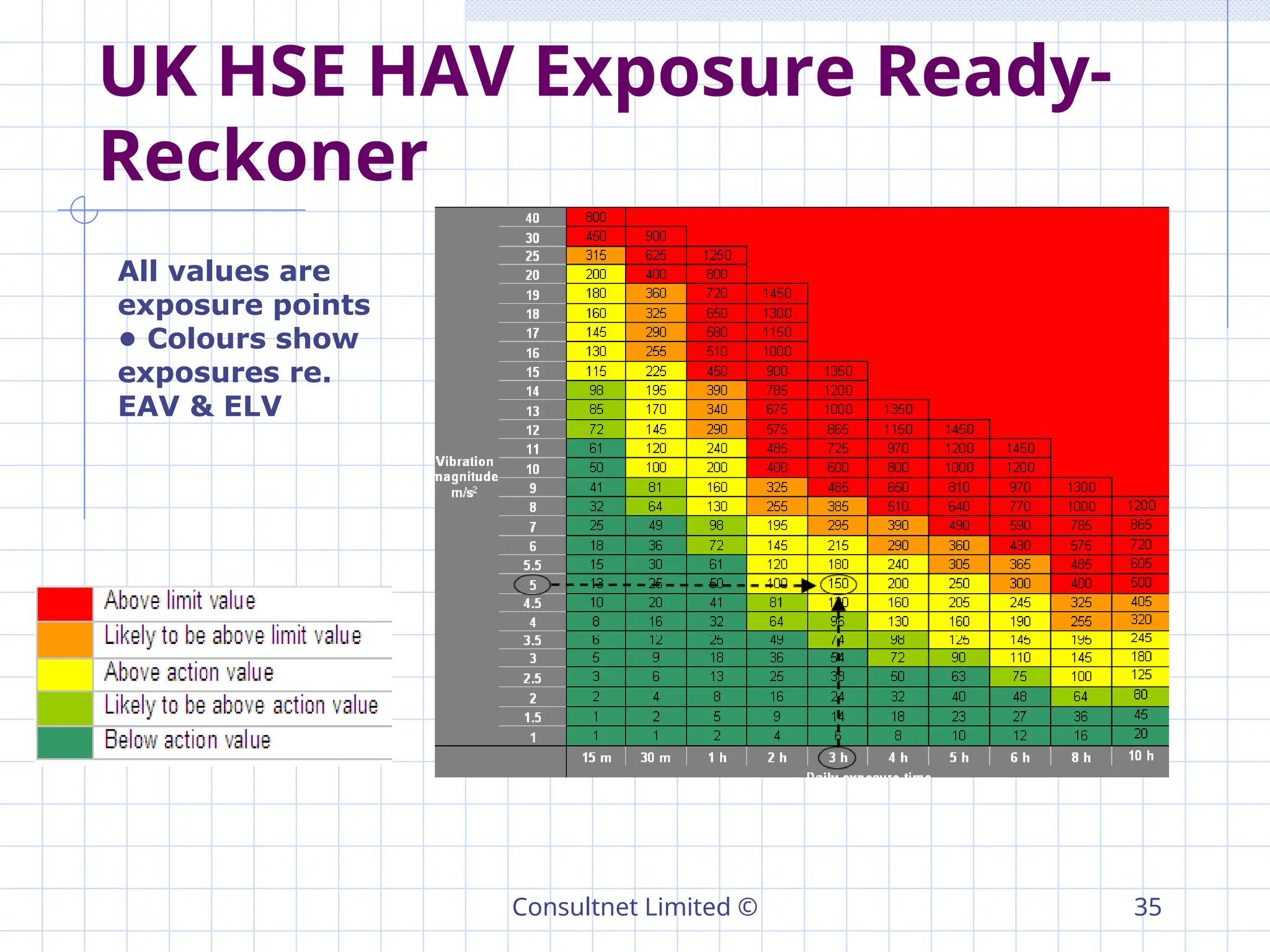
UK HSE HAV Exposure Ready-
Reckoner
All values are
exposure points
• Colours show
exposures re.
EAV & ELV
36. 37. Consultnet Limited © 37
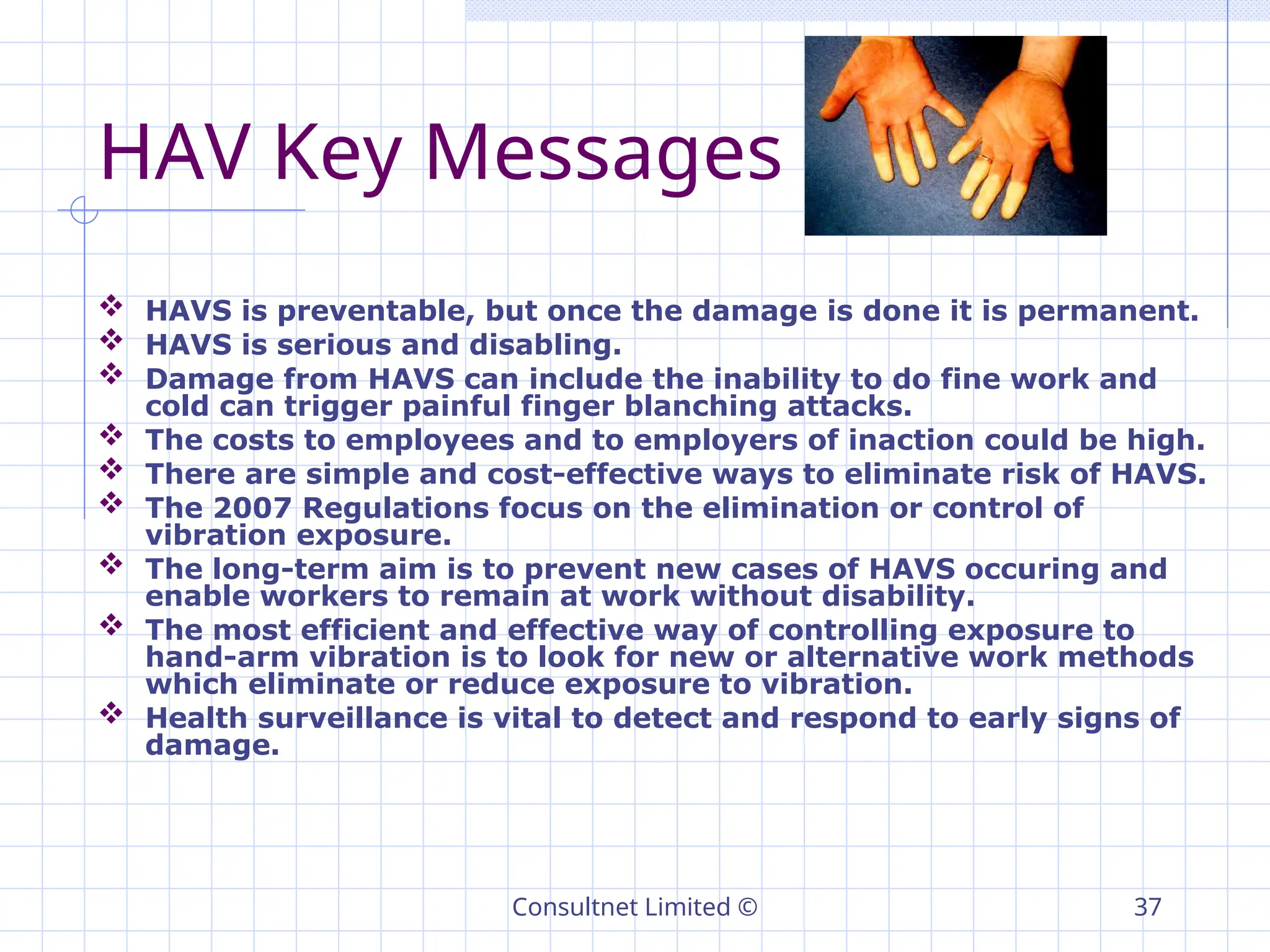
HAV Key Messages
HAVS is preventable, but once the damage is done it is permanent.
HAVS is serious and disabling.
Damage from HAVS can include the inability to do fine work and
cold can trigger painful finger blanching attacks.
The costs to employees and to employers of inaction could be high.
There are simple and cost-effective ways to eliminate risk of HAVS.
The 2007 Regulations focus on the elimination or control of
vibration exposure.
The long-term aim is to prevent new cases of HAVS occuring and
enable workers to remain at work without disability.
The most efficient and effective way of controlling exposure to
hand-arm vibration is to look for new or alternative work methods
which eliminate or reduce exposure to vibration.
Health surveillance is vital to detect and respond to early signs of
damage.
38. Consultnet Limited © 38
Any questions?
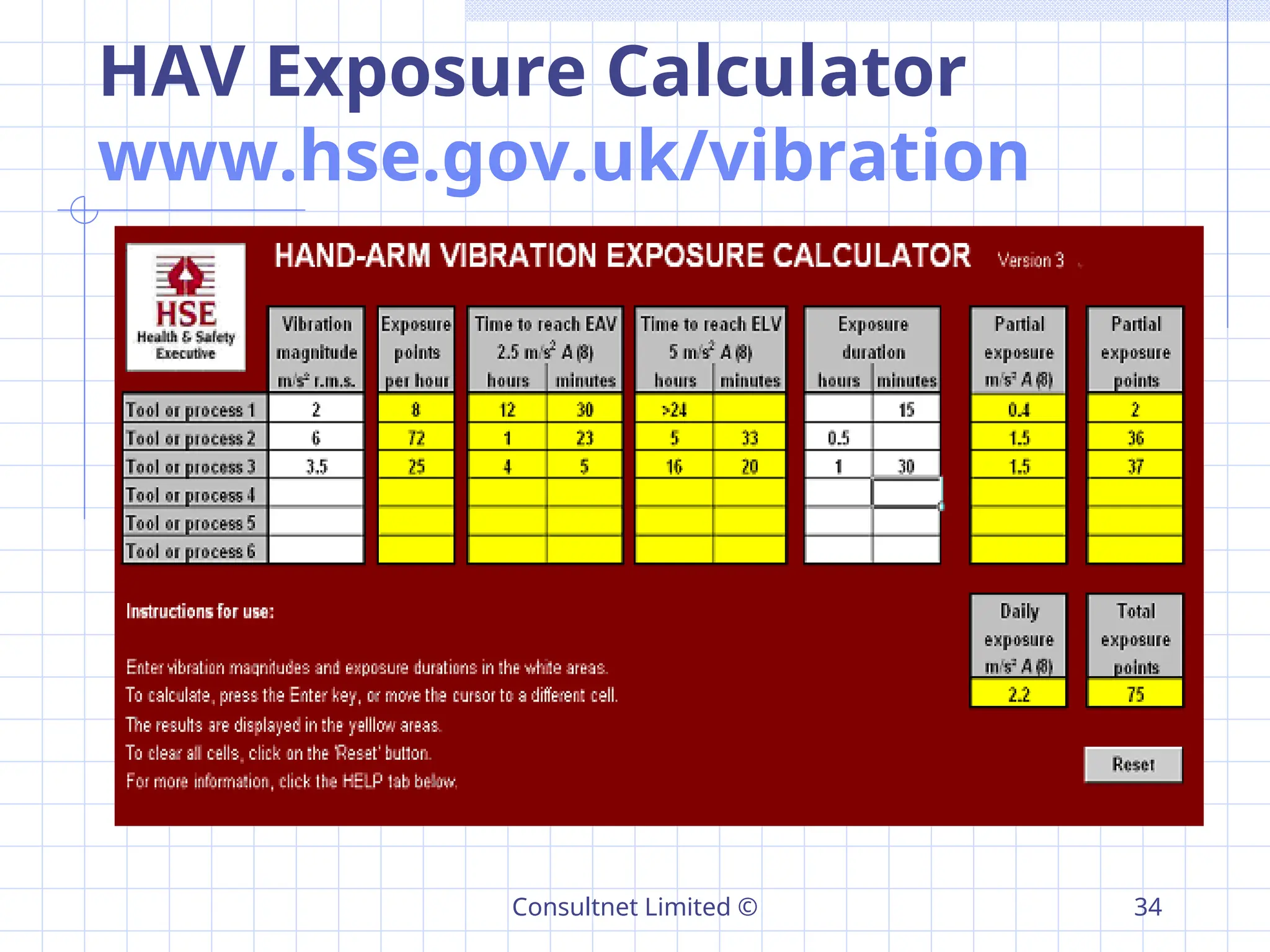
Also for guidance & solutions see: www.hse.gov.uk/vibration
Links to
Links to information
information including vibration databases on occupational
including vibration databases on occupational
vibration available at:
vibration available at: http://www.consultnet.ie/vibration.htm
Editor's Notes #6 The Safety, Health and Welfare at Work (General Application) Regulations 2007 (S.I. No 299 of 2007) revoke and replace the Safety, Health and Welfare at Work (Control of Vibration) Regulations 2006. Part 5 Chapter 2 of the 2007 Regulations specifically addresses Control of Vibration at Work.
The Regulations cover risks posed by exposure to excessive levels of vibration from machinery and will be enforced by the Health and Safety Authority. the regulations contain a minimum level of protection for employees and are made under the Safety, Health and Welfare at Work Act 2005.
The regulations set what are termed as ‘exposure action values’ i.e. the level of exposure which if exceeded requires specific action to be taken to reduce risk. Also ‘exposure limit values’ which are the levels of daily exposure which must not be exceeded for any employee. An employer must ensure that the risk arising from exposure of his or her employees to noise or vibration is either eliminated at source or reduced to a minimum. Where employees are likely to be exposed at or above a lower action value an employer must make a suitable and appropriate assessment of risk.
#11 Power tools can transmit vibration to the hands and arms, and this has a number of effects on the body. If you’re exposed to enough vibration, it can cause damage to the nerves and blood vessels in your hands and arms. Vibration also tends to make the muscles tighten up. The tighter you grip the tool, the more vibration gets transmitted to your hands and arms, and this makes injury more likely.
Some tools put out a high level of vibration, and this can start to have these effects on your body in as little as half an hour of use per day. Among them are:
Concrete breakers and road drills
Hammer drills
Nut Runners
Pedestal Grinders
Power hammers and chisels
Riveting hammers and bolsters
Brush cutters





![CS_Project-_HAVS[1]-1 (1).pptx](https://cdn.slidesharecdn.com/ss_thumbnails/csproject-havs1-11-221122184114-79ddb73c-thumbnail.jpg?width=640&height=640&fit=bounds)


![[DSC Europe 25] Hans Kleinsman - The Compliance Gearbox: How Tax Tech Mediate...](https://cdn.slidesharecdn.com/ss_thumbnails/dxdytie1toel0hr90bjs-2-251212103250-174fdbe7-thumbnail.jpg?width=640&height=640&fit=bounds)
![[DSC Europe 25] Jovan Bogicevic - Legacy to AI-Driven Defense: Transforming D...](https://cdn.slidesharecdn.com/ss_thumbnails/rsarluadt563hntyfc8q-3-251211083849-3e7bc4c0-thumbnail.jpg?width=640&height=640&fit=bounds)
![[DSC Europe 25] Marko Krstic - Understanding the AI Threat Landscape - Risks,...](https://cdn.slidesharecdn.com/ss_thumbnails/tiyim1ins5jvbrvzpzla-2-251209104645-c69d3553-thumbnail.jpg?width=640&height=640&fit=bounds)


![[DSC Europe 25] Imai Jen-La Plante - The New Generation: AI and the Future of...](https://cdn.slidesharecdn.com/ss_thumbnails/kxi8t2l5rggivgcenyba-1-jenlaplante-dsc-251208152532-d1e076c2-thumbnail.jpg?width=640&height=640&fit=bounds)


![[DSC Europe 25] Milan Zdravkovic - The road less traveled in District Heating...](https://cdn.slidesharecdn.com/ss_thumbnails/nfaboniqwsz4ucyctnmy-2-milan-zdravkovic-dsc2025-the-road-less-traveled-in-district-heating-operation-251208151905-f56388a5-thumbnail.jpg?width=640&height=640&fit=bounds)

![[DSC Europe 25] Ivan Peric - Intelligence Swarm Logic and Techno-Functional M...](https://cdn.slidesharecdn.com/ss_thumbnails/7my7c97fsduiccadgavw-2-251212103249-5a03f7c6-thumbnail.jpg?width=640&height=640&fit=bounds)


![[DSC Europe 25] Milan Sekuloski - Data, Defence, and Development: Cybersecuri...](https://cdn.slidesharecdn.com/ss_thumbnails/dfrkwwx4qly6atqpbl4z-4-251209104645-c3d4b0ca-thumbnail.jpg?width=640&height=640&fit=bounds)