Vertical Gardening &
Green Walls
Gil Lopez
GreenBridge Seasonal Outreach Assistant & Instructor
Brooklyn Botanic Garden
Spring 2015
Lesson Plan
• Why Vertical Gardens?
• Types of Vertical Gardens
• Vertical Gardening Systems
• Plants for Vertical Gardens
• Other Vertical Growing Methods & D.I.Y. Inspiration
• Resources
Why Vertical Gardens?
Aesthetics
Create living
works of art.
Indoor Air Quality
Purify your air.
LEED® Credits
Gain points.
Building
Protection
Shield from sun,
rain and thermal
fluctuations.
Energy Savings
Cut electricity bills
by up to 20%.
Health &
Wellness
Reduce stress and
enhance wellbeing.
Property Value
Marketable green
feature.
Acoustics
Dampen noise
pollution.
Sustainability
Make your
world greener.
http://www.greenovergrey.com/green-wall-benefits/overview.php
Space Saving!!!
We live in one of the most densely
populated cities in the world. NYC residents
have little access to private green space so
we must make the most of very square inch
we can. One way to do this is to reconsider
the vertical spaces in the urban environment.
Form walls and fences to fire escapes and
stair railings. What vertical spaces do you
have access to that could be a little greener?
Types of Vertical Gardens
• Living Walls
• Green Veneers
• Indoor
• Outdoor
Living Walls
Living walls (AKA green walls) are self
sufficient vertical gardens found on exterior
or interior walls or other vertical elements.
The plants are rooted in a structural support
which is fastened to the wall itself. The
plants receive water and nutrients from
within the vertical support instead of from
the ground.
Green Veneer
A support structure that allows vines to row
up or onto a vertical element to screen it.
Roots and soil are not housed in the wall but
rather on the ground or in separate planters.
Living Wall/Green Veneer
Hybrid
This product by Turnesol demonstrates how
the two vertical garden typologies can be
effectively blended.
Indoor Vertical Gardens
Living Wall (Wooly Pocket) Green Veneer (Jakob Wire)
Outdoor Vertical Gardens
Living Wall (FloraFelt) Green Veneer (Greenscreen)
Living Wall Systems
• Wooly Pocket
• FloraFelt
• Optigreen Wall Garden
• Gsky Plant Systems
• Hydroponic
Wooly Pocket
Our Living Wall Planter are totally modular. Create living
walls of almost any size, indoors and out. Calculate how
many wall planters you’ll need by dividing the width of
your wall area by 18” and height by 13”. Use our box as a
horizontal template to help you mark holes. Example: Four
planters cover a 36” W and 26” H wall area.
Living Wall Planter dimensions are 13” H x 18” W x 8” D.
Each planter holds 0.50 ft3 of soil volume with a maximum
weight of 50lbs. Planter hooks to back of Water Tank for
easy plant exchange. Planters come with hardware: self
tapping #8 screw & poly ribbed insert.
http://www.woollypocket.com
FloraFelt
Create Custom Vertical Gardens
Explore the 2-layer Cut and Staple method made famous by
Patrick Blanc.
Use Grow Felt by the yard to make custom sized pockets
and free-form shapes.
Use 7-inch Grow Strip with custom 6 x 6 inch wire grids to
create extremely robust vertical gardens.
Or use the pre-assembled Florafelt Pro System Modular
Unit to make any size living wall.
Engineer mega-scale plant walls.
http://www.florafelt.com/
Optigreen Wall Garden
The “Wall Garden” system solution is a facade-
mounted greening system on a substrate basis
without ground connection. The core unit of
the Optigreen “Wall Garden” system solution is
a high-grade, substrate-filled aluminum cassette
system (Optigreen Facade Element) that can be
delivered filled and, upon request, ready-
planted. The horizontal suspension rails must
be bolted onto the substructure before the
prepared facade element can be attached to
them.
http://www.optigreen.co.uk
GSky Plant Systems
GSky’s three Green Wall systems are the Pro
Wall System, Versa Wall System and the
Basic Wall System. Each product is unique in
terms of design flexibility, installation
location versatility, plant selection variety,
desired size, cost, coverage time-line, and
system components.
http://gsky.com/
Stacked Hydroponic Systems
Hydroponic growing systems are a way of
growing plants without soil using nutrient
solutions applied directly to the roots of
plants. These systems have may variations.
There are several which accomplish the look
feel and other virtues of vertical gardens as
discussed in this presentation.
WindowFarms
Indoor R&D.I.Y.
hydroponic growing system
NFT Hydroponic
(Nutrient Film Technique)
Outdoor installation
Green Veneer Systems
• Trellising
• Masonry and Wood Walls
• GreenScreen
• Jacob Wire
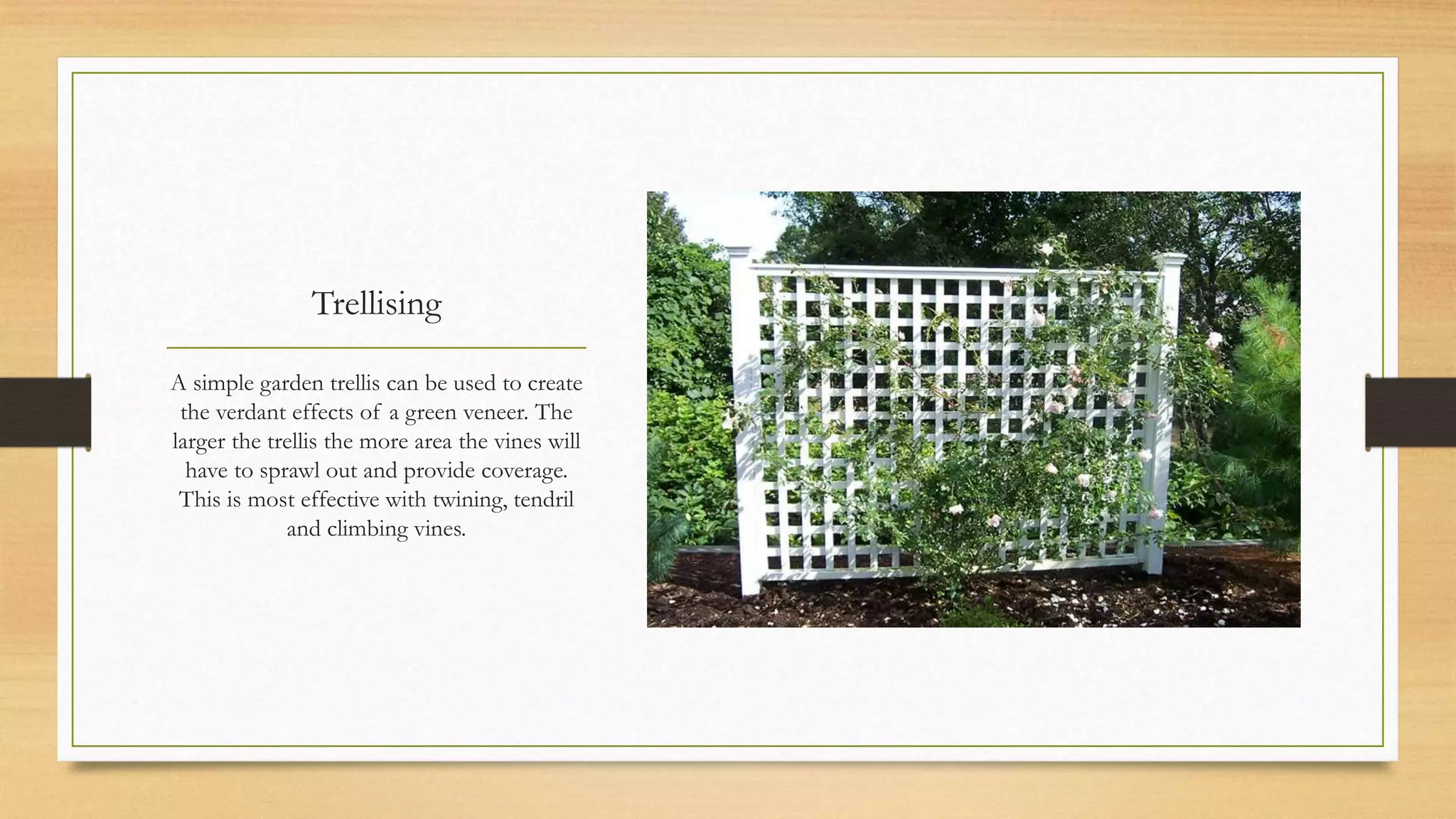
Trellising
A simple garden trellis can be used to create
the verdant effects of a green veneer. The
larger the trellis the more area the vines will
have to sprawl out and provide coverage.
This is most effective with twining, tendril
and climbing vines.
Greenscreen
greenscreen® is a three dimensional, welded
wire trellising system. The distinctive
modular trellis panel is the building block of
the greenscreen® system. Rigid and
lightweight standard 3" thick panels are 4'
wide x 6', 8', 10',12’, or 14' tall.
http://www.greenscreen.com
Jakob Wire
Specializes in the manufacture of stainless
steel wire ropes from 2 mm to 28 mm.
Webnet and Wire Rope products are often
used to create both indoor and outdoor
green veneers.
https://www.jakob-usa.com/
Masonry & Wood Walls
Natural walls can be a perfect place for
suckering vines to unfurl their leafy
coverings. Be careful to maintain the walls
on a regular basis and don’t let the vines
overtake the structure.
Plants for Vertical Gardening
• Tropical Understory Plants for
Interior Living Walls
• Air Filtering Plants
• Alpine Plants for Exterior Living
Walls
• Vines for Green Veneers
• Annuals vs Perennials
• Native, Naturalized & Invasive Plants
• Espaliered Trees
Tropical Understory Plants
for
Interior Living Walls
The Understory layer, or strata, of tropical
rainforest vegetation lies between the
Canopy layer, where there is plenty of
sunlight, and the Forest Floor layer, where
there is almost none. This layer of the
rainforest produces many popular house
plants. Zebra plants, Ferns, Philodendrons
and Prayer plants are among some of house
plants from this layer that do well in dimly lit
conditions.
http://www.tropical-rainforest-facts.com/Tropical-Rainforest-Layer-Facts/Tropical-Rainforest-Understory-Layer-Facts.shtml
Plant Selections for
Improved Indoor Air Quality
& Interior Living Walls
A NASA study has demonstrated that some
plants have the ability to improve indoor air
quality by removing volatile organic
compounds (VOCs). This is known as
phytoremediation of the air. These plants
employ a range of techniques to accomplish
this feat including: Phytosequestration,
Phytoextraction, Phytostabilization,
Phytotransformation, Phytostimulation,
Phytovolatilization, and Rhizofiltration
https://en.wikipedia.org/wiki/NASA_Clean_Air_Study
Alpine Plants for
Exterior Living Walls
Alpine plants are plants that grow in the alpine
climate, which occurs at high elevation and above
the tree line. Many different plant species live in
the alpine environment. These include perennial
grasses, sedges, forbs, cushion plants, mosses, and
lichens. Alpine plants must adapt to the harsh
conditions of the alpine environment, which
include low temperatures, dryness, ultraviolet
radiation, and a short growing season.
Adaptations include: Low to the Ground,
Cushions and Mats, Evergreen Foliage, Red
Leaves, Thick, Waxy Leaves, Fuzzy, Curled Leaves,
Slow Growth.
http://en.wikipedia.org/wiki/Alpine_plant
Delosperma Yellow Ice, Iberis Snowflake
Phlox Candy Stripes, Sedum Dragon's Blood
Mazus Reptans, Veronica Christy
Vines for Green Veneers
• Twining
• Tendril
• Clinging
• Running
• Evergreen
• Deciduous
• Flowering
• Fruiting
Vines for Green Veneers
Twining Vines Tendril Vines
• Twiners, such as
honeysuckle,
climb by winding
around supports.
These can quickly
cover a trellis,
arbor or wall
screen.
http://www.finegardening.com/types-climbing-vines#ixzz3c1pcOrlQ
• Some vines, such as
sweet peas, have
tendrils that twist
around a support.
They also grow quickly
and support
themselves given a
structure to cling to.
Vines for Green Veneers
Clinging Vines Running Vines
• Some plants such as
English ivy (Hedera
helix) climb by aerial
rootlets. These can
grow without any
support on masonry,
wood and other
natural surfaces.
http://www.finegardening.com/types-climbing-vines#ixzz3c1pcOrlQ
• Some plants use
hooks to grab
toeholds on a
support and climb
skyward. Others
like tomato have no
way of holding on.
You’ll want to
weave them
through a trellis
occasionally or tie
them to a support.
Evergreen
(& semi-evergreen) Vines
Evergreen plants retain their foliage throughout
the entire year. Evergreen vines are problem
solvers in the garden and can be used for vertical
gardening for year round foliage. Some other uses
include: Green winter color, for spring or summer
flower color, food for birds and butterflies, to
mask or soften unsightly structures or views, for a
privacy screen, to decorate a trellis, fence, arbor or
pergola, to help prevent erosion on a slope, as a
fast-growing ground cover, to create shade.
Unfortunately there are not many evergreen vines
that grow in our climate zone. Lonicera sempervirens
Trumpet honeysuckle
Native, semi-evergreen, twining,
flowering vine
Hedera helix
English Ivy
Evergreen, non-native, clinging vine
Deciduous Vines
Deciduous plants lose their leaves seasonally
(most commonly during autumn). There are
many deciduous vines that are suitable for
exterior green veneers.
Parthenocissus tricuspidata
Boston Ivy
Native, deciduous, clinging vine
Wisteria frutescens
American Wisteria
Native, deciduous, flowering, twining vine
Flowering Vines
Flowering vines, whether evergreen or
deciduous, can add a colorful pop to your
vertical garden, drawing the eye up and
attract pollinators.
Morning glory
Annual
Growing on chain link fence
Clematis
Native, perennial vine
Growing on an arbor
Fruiting Vines
Fruiting vines, whether evergreen or
deciduous, can add utility to your garden by
producing food for yourself or for birds and
other fauna.
Tomato
Annual, fruiting, running vine.
Grape
Deciduous, perennial,
fruiting, tendril vine.
Annuals & Perennials
Annual Plants
• An annual plant is a plant that completes
its life cycle, from germination to the
production of seed, within one year, and
then dies. Summer annuals germinate
during spring or early summer and mature
by autumn of the same year. Winter
annuals germinate during the autumn and
mature during the spring or summer of
the following calendar year.[
Perennial Plants
• A perennial plant or simply perennial
(from Latin per, meaning "through", and
annus, meaning "year") is a plant that lives
for more than two years. The term is often
used to differentiate a plant from shorter-
lived annuals and biennials. The term is
also widely used to distinguish plants with
little or no woody growth from trees and
shrubs, which are also technically
perennials
Native, Naturalized & Invasive Plants
Native Plants Invasive PlantsNaturalized Plants
A plant that is a part of the balance
of nature that has developed over
hundreds or thousands of years in
a particular region or ecosystem.
Note: The word native should
always be used with a geographic
qualifier (that is, native to New
England [for example]). Only plants
found in this country before
European settlement are
considered to be native to the
United States.
A plant introduced with human
help (intentionally or accidentally)
to a new place or new type of
habitat where it was not previously
found. Note: Not all non-native
plants are invasive. In fact, when
many non-native plants are
introduced to new places, they
cannot reproduce or spread readily
without continued human help (for
example, many ornamental plants).
http://www.nrcs.usda.gov/wps/portal/nrcs/detail/ct/technical/ecoscience/invasive/?cid=nrcs142p2_011124
A plant that is both non-native and able to establish
on many sites, grow quickly, and spread to the point
of disrupting plant communities or ecosystems.
Note: From the Presidential Executive Order 13112
(February 1999): 'An invasive species is defined as a
species that is 1) non-native (or alien) to the
ecosystem under consideration and 2) whose
introduction causes or is likely to cause economic or
environmental harm or harm to human health.' In
contrast to item 2) of the Executive Order, which
includes plants invasive in agricultural settings, the
Connecticut Invasive Plant Working Group lists
non-native plants as invasive only if they invade
minimally managed (natural) areas.
Espaliered Trees
There are several varieties of trees that take
well to shaping in this way. Espalier requires
annual pruning and care to maintain proper
form.
Other Vertical Growing
& D.I.Y. Ideas
• Hydroponics (indoor and outdoor)
• Planted Pallet Walls
• DIY Wooly Pockets
• Planter/Container Wall
• Green Cloaking
DIY Vertical Garden Ideas
Gutter Garden Retaining Walls
• Storm gutters, PVC
pipe or other
horizontal troughs
can be hung on a
wall and planted in
to achieve vertical
interest on an
otherwise blank
wall.
http://www.finegardening.com/types-climbing-vines#ixzz3c1pcOrlQ
• Some garden
designs incorporate
retaining walls.
These often have
nooks and crannies
where alpine and
succulent plants
can be tucked in to
soften the edge in
your garden space.
DIY Vertical Garden Ideas
Conglomerate Green Wall Milk Crate Innovations
• Many size and shapes can come together to create a
impressive display
• These readily available containers can be lined with a landscape
fabric, stacked and planted for an interesting garden-on-the-go.
DIY Vertical Garden Ideas
Pallet Garden Wall Soda Bottle Garden Wall
Walls of Pots
Using many pots or other containers
Moss Graffiti
By mixing a slurry of moss material…
Ingredients:
One or two clumps (about a small handful)
of moss
2 cups of buttermilk
(You can substitute with yogurt or beer)
2 cups of water
1/2 tsp. sugar
Corn syrup (optional)
Green Cloaking
This is a fairly new idea which suggests that
a vine covered support suspended above a
roof can act as a light weight, inexpensive,
quick and easy alternative to an extensive
green roof.
Algae Skin
A very new green
building innovation
Cloaking Lab Study
Researchers test the vines ability to
capture rainwater, reduce interior
building temperatures and clean the air.
Resource Pages
• Plant lists:
• Definitions: http://www.nrcs.usda.gov/wps/portal/nrcs/detail/ct/technical/ecoscience/invasive/?cid=nrcs142p2_011124
• http://www.scotscapelivingwalls.net/plant-list.html
• http://www.greenscreen.com/Plants_main.html
• http://www.florafelt.com/plants/
• Alpine Plants - http://northernwoodlands.org/articles/article/flowers-adaptations-alpine
• Benefits
• http://www.greenovergrey.com/green-wall-benefits/overview.php
• Considerations for Advanced Green Façade Design:
• http://www.greenscreen.com/direct/Considerations/AdvancedGreenFacadeDesign_CEU_F12.pdf

Vertical Gardens & Green Walls

  • 1.
    Vertical Gardening & GreenWalls Gil Lopez GreenBridge Seasonal Outreach Assistant & Instructor Brooklyn Botanic Garden Spring 2015
  • 2.
    Lesson Plan • WhyVertical Gardens? • Types of Vertical Gardens • Vertical Gardening Systems • Plants for Vertical Gardens • Other Vertical Growing Methods & D.I.Y. Inspiration • Resources
  • 3.
    Why Vertical Gardens? Aesthetics Createliving works of art. Indoor Air Quality Purify your air. LEED® Credits Gain points. Building Protection Shield from sun, rain and thermal fluctuations. Energy Savings Cut electricity bills by up to 20%. Health & Wellness Reduce stress and enhance wellbeing. Property Value Marketable green feature. Acoustics Dampen noise pollution. Sustainability Make your world greener. http://www.greenovergrey.com/green-wall-benefits/overview.php
  • 4.
    Space Saving!!! We livein one of the most densely populated cities in the world. NYC residents have little access to private green space so we must make the most of very square inch we can. One way to do this is to reconsider the vertical spaces in the urban environment. Form walls and fences to fire escapes and stair railings. What vertical spaces do you have access to that could be a little greener?
  • 5.
    Types of VerticalGardens • Living Walls • Green Veneers • Indoor • Outdoor
  • 6.
    Living Walls Living walls(AKA green walls) are self sufficient vertical gardens found on exterior or interior walls or other vertical elements. The plants are rooted in a structural support which is fastened to the wall itself. The plants receive water and nutrients from within the vertical support instead of from the ground.
  • 7.
    Green Veneer A supportstructure that allows vines to row up or onto a vertical element to screen it. Roots and soil are not housed in the wall but rather on the ground or in separate planters.
  • 8.
    Living Wall/Green Veneer Hybrid Thisproduct by Turnesol demonstrates how the two vertical garden typologies can be effectively blended.
  • 9.
    Indoor Vertical Gardens LivingWall (Wooly Pocket) Green Veneer (Jakob Wire)
  • 10.
    Outdoor Vertical Gardens LivingWall (FloraFelt) Green Veneer (Greenscreen)
  • 11.
    Living Wall Systems •Wooly Pocket • FloraFelt • Optigreen Wall Garden • Gsky Plant Systems • Hydroponic
  • 12.
    Wooly Pocket Our LivingWall Planter are totally modular. Create living walls of almost any size, indoors and out. Calculate how many wall planters you’ll need by dividing the width of your wall area by 18” and height by 13”. Use our box as a horizontal template to help you mark holes. Example: Four planters cover a 36” W and 26” H wall area. Living Wall Planter dimensions are 13” H x 18” W x 8” D. Each planter holds 0.50 ft3 of soil volume with a maximum weight of 50lbs. Planter hooks to back of Water Tank for easy plant exchange. Planters come with hardware: self tapping #8 screw & poly ribbed insert. http://www.woollypocket.com
  • 13.
    FloraFelt Create Custom VerticalGardens Explore the 2-layer Cut and Staple method made famous by Patrick Blanc. Use Grow Felt by the yard to make custom sized pockets and free-form shapes. Use 7-inch Grow Strip with custom 6 x 6 inch wire grids to create extremely robust vertical gardens. Or use the pre-assembled Florafelt Pro System Modular Unit to make any size living wall. Engineer mega-scale plant walls. http://www.florafelt.com/
  • 14.
    Optigreen Wall Garden The“Wall Garden” system solution is a facade- mounted greening system on a substrate basis without ground connection. The core unit of the Optigreen “Wall Garden” system solution is a high-grade, substrate-filled aluminum cassette system (Optigreen Facade Element) that can be delivered filled and, upon request, ready- planted. The horizontal suspension rails must be bolted onto the substructure before the prepared facade element can be attached to them. http://www.optigreen.co.uk
  • 15.
    GSky Plant Systems GSky’sthree Green Wall systems are the Pro Wall System, Versa Wall System and the Basic Wall System. Each product is unique in terms of design flexibility, installation location versatility, plant selection variety, desired size, cost, coverage time-line, and system components. http://gsky.com/
  • 16.
    Stacked Hydroponic Systems Hydroponicgrowing systems are a way of growing plants without soil using nutrient solutions applied directly to the roots of plants. These systems have may variations. There are several which accomplish the look feel and other virtues of vertical gardens as discussed in this presentation. WindowFarms Indoor R&D.I.Y. hydroponic growing system NFT Hydroponic (Nutrient Film Technique) Outdoor installation
  • 17.
    Green Veneer Systems •Trellising • Masonry and Wood Walls • GreenScreen • Jacob Wire
  • 18.
    Trellising A simple gardentrellis can be used to create the verdant effects of a green veneer. The larger the trellis the more area the vines will have to sprawl out and provide coverage. This is most effective with twining, tendril and climbing vines.
  • 19.
    Greenscreen greenscreen® is athree dimensional, welded wire trellising system. The distinctive modular trellis panel is the building block of the greenscreen® system. Rigid and lightweight standard 3" thick panels are 4' wide x 6', 8', 10',12’, or 14' tall. http://www.greenscreen.com
  • 20.
    Jakob Wire Specializes inthe manufacture of stainless steel wire ropes from 2 mm to 28 mm. Webnet and Wire Rope products are often used to create both indoor and outdoor green veneers. https://www.jakob-usa.com/
  • 21.
    Masonry & WoodWalls Natural walls can be a perfect place for suckering vines to unfurl their leafy coverings. Be careful to maintain the walls on a regular basis and don’t let the vines overtake the structure.
  • 22.
    Plants for VerticalGardening • Tropical Understory Plants for Interior Living Walls • Air Filtering Plants • Alpine Plants for Exterior Living Walls • Vines for Green Veneers • Annuals vs Perennials • Native, Naturalized & Invasive Plants • Espaliered Trees
  • 23.
    Tropical Understory Plants for InteriorLiving Walls The Understory layer, or strata, of tropical rainforest vegetation lies between the Canopy layer, where there is plenty of sunlight, and the Forest Floor layer, where there is almost none. This layer of the rainforest produces many popular house plants. Zebra plants, Ferns, Philodendrons and Prayer plants are among some of house plants from this layer that do well in dimly lit conditions. http://www.tropical-rainforest-facts.com/Tropical-Rainforest-Layer-Facts/Tropical-Rainforest-Understory-Layer-Facts.shtml
  • 24.
    Plant Selections for ImprovedIndoor Air Quality & Interior Living Walls A NASA study has demonstrated that some plants have the ability to improve indoor air quality by removing volatile organic compounds (VOCs). This is known as phytoremediation of the air. These plants employ a range of techniques to accomplish this feat including: Phytosequestration, Phytoextraction, Phytostabilization, Phytotransformation, Phytostimulation, Phytovolatilization, and Rhizofiltration https://en.wikipedia.org/wiki/NASA_Clean_Air_Study
  • 25.
    Alpine Plants for ExteriorLiving Walls Alpine plants are plants that grow in the alpine climate, which occurs at high elevation and above the tree line. Many different plant species live in the alpine environment. These include perennial grasses, sedges, forbs, cushion plants, mosses, and lichens. Alpine plants must adapt to the harsh conditions of the alpine environment, which include low temperatures, dryness, ultraviolet radiation, and a short growing season. Adaptations include: Low to the Ground, Cushions and Mats, Evergreen Foliage, Red Leaves, Thick, Waxy Leaves, Fuzzy, Curled Leaves, Slow Growth. http://en.wikipedia.org/wiki/Alpine_plant Delosperma Yellow Ice, Iberis Snowflake Phlox Candy Stripes, Sedum Dragon's Blood Mazus Reptans, Veronica Christy
  • 26.
    Vines for GreenVeneers • Twining • Tendril • Clinging • Running • Evergreen • Deciduous • Flowering • Fruiting
  • 27.
    Vines for GreenVeneers Twining Vines Tendril Vines • Twiners, such as honeysuckle, climb by winding around supports. These can quickly cover a trellis, arbor or wall screen. http://www.finegardening.com/types-climbing-vines#ixzz3c1pcOrlQ • Some vines, such as sweet peas, have tendrils that twist around a support. They also grow quickly and support themselves given a structure to cling to.
  • 28.
    Vines for GreenVeneers Clinging Vines Running Vines • Some plants such as English ivy (Hedera helix) climb by aerial rootlets. These can grow without any support on masonry, wood and other natural surfaces. http://www.finegardening.com/types-climbing-vines#ixzz3c1pcOrlQ • Some plants use hooks to grab toeholds on a support and climb skyward. Others like tomato have no way of holding on. You’ll want to weave them through a trellis occasionally or tie them to a support.
  • 29.
    Evergreen (& semi-evergreen) Vines Evergreenplants retain their foliage throughout the entire year. Evergreen vines are problem solvers in the garden and can be used for vertical gardening for year round foliage. Some other uses include: Green winter color, for spring or summer flower color, food for birds and butterflies, to mask or soften unsightly structures or views, for a privacy screen, to decorate a trellis, fence, arbor or pergola, to help prevent erosion on a slope, as a fast-growing ground cover, to create shade. Unfortunately there are not many evergreen vines that grow in our climate zone. Lonicera sempervirens Trumpet honeysuckle Native, semi-evergreen, twining, flowering vine Hedera helix English Ivy Evergreen, non-native, clinging vine
  • 30.
    Deciduous Vines Deciduous plantslose their leaves seasonally (most commonly during autumn). There are many deciduous vines that are suitable for exterior green veneers. Parthenocissus tricuspidata Boston Ivy Native, deciduous, clinging vine Wisteria frutescens American Wisteria Native, deciduous, flowering, twining vine
  • 31.
    Flowering Vines Flowering vines,whether evergreen or deciduous, can add a colorful pop to your vertical garden, drawing the eye up and attract pollinators. Morning glory Annual Growing on chain link fence Clematis Native, perennial vine Growing on an arbor
  • 32.
    Fruiting Vines Fruiting vines,whether evergreen or deciduous, can add utility to your garden by producing food for yourself or for birds and other fauna. Tomato Annual, fruiting, running vine. Grape Deciduous, perennial, fruiting, tendril vine.
  • 33.
    Annuals & Perennials AnnualPlants • An annual plant is a plant that completes its life cycle, from germination to the production of seed, within one year, and then dies. Summer annuals germinate during spring or early summer and mature by autumn of the same year. Winter annuals germinate during the autumn and mature during the spring or summer of the following calendar year.[ Perennial Plants • A perennial plant or simply perennial (from Latin per, meaning "through", and annus, meaning "year") is a plant that lives for more than two years. The term is often used to differentiate a plant from shorter- lived annuals and biennials. The term is also widely used to distinguish plants with little or no woody growth from trees and shrubs, which are also technically perennials
  • 34.
    Native, Naturalized &Invasive Plants Native Plants Invasive PlantsNaturalized Plants A plant that is a part of the balance of nature that has developed over hundreds or thousands of years in a particular region or ecosystem. Note: The word native should always be used with a geographic qualifier (that is, native to New England [for example]). Only plants found in this country before European settlement are considered to be native to the United States. A plant introduced with human help (intentionally or accidentally) to a new place or new type of habitat where it was not previously found. Note: Not all non-native plants are invasive. In fact, when many non-native plants are introduced to new places, they cannot reproduce or spread readily without continued human help (for example, many ornamental plants). http://www.nrcs.usda.gov/wps/portal/nrcs/detail/ct/technical/ecoscience/invasive/?cid=nrcs142p2_011124 A plant that is both non-native and able to establish on many sites, grow quickly, and spread to the point of disrupting plant communities or ecosystems. Note: From the Presidential Executive Order 13112 (February 1999): 'An invasive species is defined as a species that is 1) non-native (or alien) to the ecosystem under consideration and 2) whose introduction causes or is likely to cause economic or environmental harm or harm to human health.' In contrast to item 2) of the Executive Order, which includes plants invasive in agricultural settings, the Connecticut Invasive Plant Working Group lists non-native plants as invasive only if they invade minimally managed (natural) areas.
  • 35.
    Espaliered Trees There areseveral varieties of trees that take well to shaping in this way. Espalier requires annual pruning and care to maintain proper form.
  • 36.
    Other Vertical Growing &D.I.Y. Ideas • Hydroponics (indoor and outdoor) • Planted Pallet Walls • DIY Wooly Pockets • Planter/Container Wall • Green Cloaking
  • 37.
    DIY Vertical GardenIdeas Gutter Garden Retaining Walls • Storm gutters, PVC pipe or other horizontal troughs can be hung on a wall and planted in to achieve vertical interest on an otherwise blank wall. http://www.finegardening.com/types-climbing-vines#ixzz3c1pcOrlQ • Some garden designs incorporate retaining walls. These often have nooks and crannies where alpine and succulent plants can be tucked in to soften the edge in your garden space.
  • 38.
    DIY Vertical GardenIdeas Conglomerate Green Wall Milk Crate Innovations • Many size and shapes can come together to create a impressive display • These readily available containers can be lined with a landscape fabric, stacked and planted for an interesting garden-on-the-go.
  • 39.
    DIY Vertical GardenIdeas Pallet Garden Wall Soda Bottle Garden Wall
  • 40.
    Walls of Pots Usingmany pots or other containers
  • 41.
    Moss Graffiti By mixinga slurry of moss material… Ingredients: One or two clumps (about a small handful) of moss 2 cups of buttermilk (You can substitute with yogurt or beer) 2 cups of water 1/2 tsp. sugar Corn syrup (optional)
  • 42.
    Green Cloaking This isa fairly new idea which suggests that a vine covered support suspended above a roof can act as a light weight, inexpensive, quick and easy alternative to an extensive green roof. Algae Skin A very new green building innovation Cloaking Lab Study Researchers test the vines ability to capture rainwater, reduce interior building temperatures and clean the air.
  • 43.
    Resource Pages • Plantlists: • Definitions: http://www.nrcs.usda.gov/wps/portal/nrcs/detail/ct/technical/ecoscience/invasive/?cid=nrcs142p2_011124 • http://www.scotscapelivingwalls.net/plant-list.html • http://www.greenscreen.com/Plants_main.html • http://www.florafelt.com/plants/ • Alpine Plants - http://northernwoodlands.org/articles/article/flowers-adaptations-alpine • Benefits • http://www.greenovergrey.com/green-wall-benefits/overview.php • Considerations for Advanced Green Façade Design: • http://www.greenscreen.com/direct/Considerations/AdvancedGreenFacadeDesign_CEU_F12.pdf