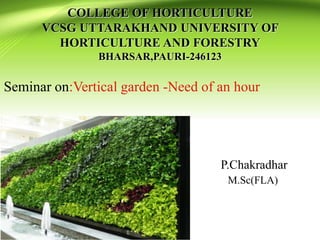
COLLEGE OF HORTICULTURE
VCSG UTTARAKHAND UNIVERSITY OF
HORTICULTURE AND FORESTRY
BHARSAR,PAURI-246123
Seminar on:Vertical garden -Need of an hour
P.Chakradhar
M.Sc(FLA)
15236
Introduction
Vertical garden also known as ''Green wall''
Any kind of construction and support structure for growing
plants in an upwards direction.
Efficient and productive use of the existing
space.
Father of modern vertical gardening-
Patrick blanc
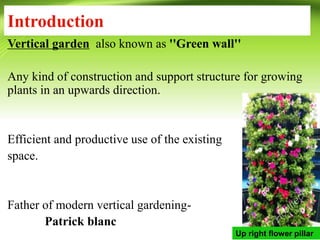
Up right flower pillar
History
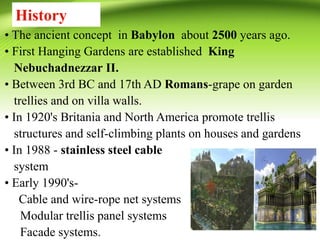
• The ancient concept in Babylon about 2500 years ago.
• First Hanging Gardens are established King
Nebuchadnezzar II.
• Between 3rd BC and 17th AD Romans-grape on garden
trellies and on villa walls.
• In 1920's Britania and North America promote trellis
structures and self-climbing plants on houses and gardens
• In 1988 - stainless steel cable
system
• Early 1990's-
Cable and wire-rope net systems
Modular trellis panel systems
Facade systems.
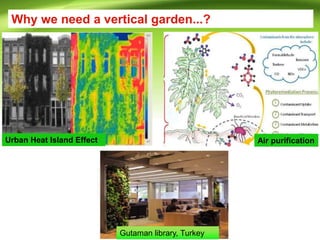
Why we need a vertical garden...?
Gutaman library, Turkey
Air purification
Urban Heat Island Effect
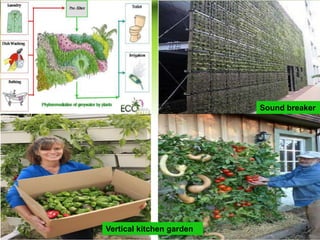
Vertical kitchen garden
Sound breaker
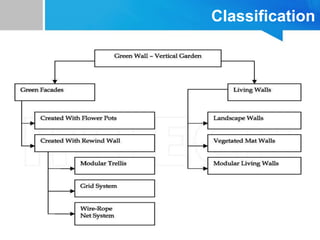
Classification
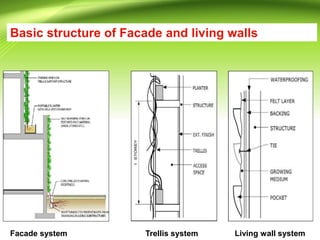
Basic structure of Facade and living walls
Living wall system
Trellis system
Facade system
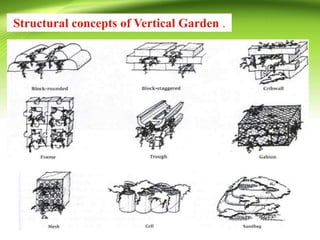
Structural concepts of Vertical Garden .
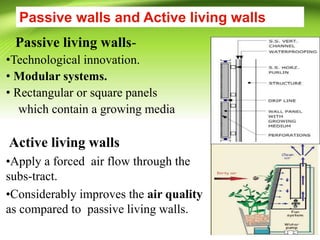
Passive walls and Active living walls
Active living walls
•Apply a forced air flow through the
subs-tract.
•Considerably improves the air quality
as compared to passive living walls.
Passive living walls-
•Technological innovation.
• Modular systems.
• Rectangular or square panels
which contain a growing media
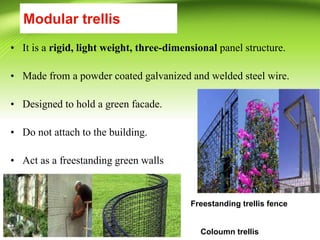
Modular trellis
• It is a rigid, light weight, three-dimensional panel structure.
• Made from a powder coated galvanized and welded steel wire.
• Designed to hold a green facade.
• Do not attach to the building.
• Act as a freestanding green walls
Freestanding trellis fence
Coloumn trellis
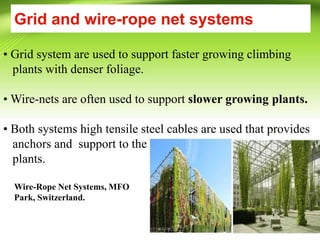
• Grid system are used to support faster growing climbing
plants with denser foliage.
• Wire-nets are often used to support slower growing plants.
• Both systems high tensile steel cables are used that provides
anchors and support to the
plants.
Grid and wire-rope net systems
Wire-Rope Net Systems, MFO
Park, Switzerland.
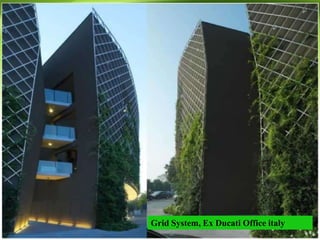
Grid System, Ex Ducati Office italy
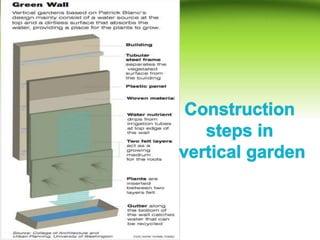
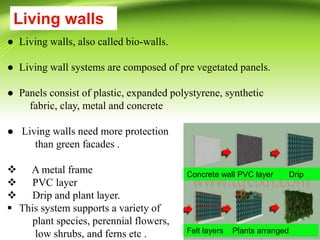
● Living walls, also called bio-walls.
● Living wall systems are composed of pre vegetated panels.
● Panels consist of plastic, expanded polystyrene, synthetic
fabric, clay, metal and concrete
● Living walls need more protection
than green facades .
 A metal frame
 PVC layer
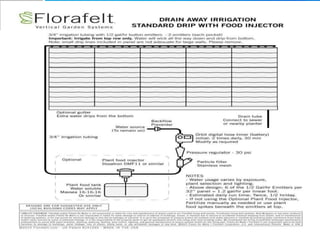
 Drip and plant layer.
 This system supports a variety of
plant species, perennial flowers,
low shrubs, and ferns etc .
Living walls
Concrete wall PVC layer Drip
Felt layers Plants arranged
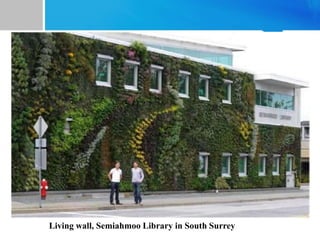
Living wall, Semiahmoo Library in South Surrey
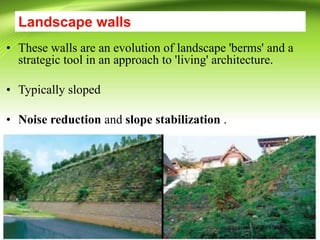
Landscape walls
• These walls are an evolution of landscape 'berms' and a
strategic tool in an approach to 'living' architecture.
• Typically sloped
• Noise reduction and slope stabilization .
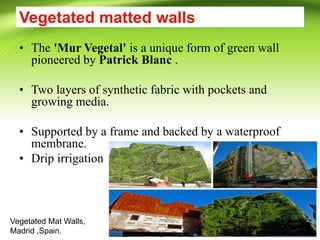
Vegetated matted walls
• The 'Mur Vegetal' is a unique form of green wall
pioneered by Patrick Blanc .
• Two layers of synthetic fabric with pockets and
growing media.
• Supported by a frame and backed by a waterproof
membrane.
• Drip irrigation
Vegetated Mat Walls,
Madrid ,Spain.
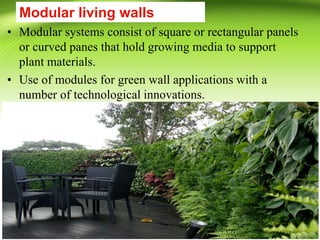
Modular living walls
• Modular systems consist of square or rectangular panels
or curved panes that hold growing media to support
plant materials.
• Use of modules for green wall applications with a
number of technological innovations.
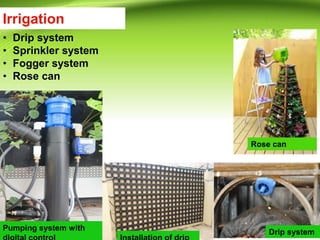
Irrigation
Drip system
Pumping system with
• Drip system
• Sprinkler system
• Fogger system
• Rose can
Rose can
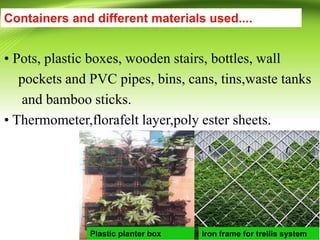
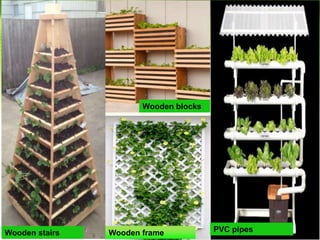
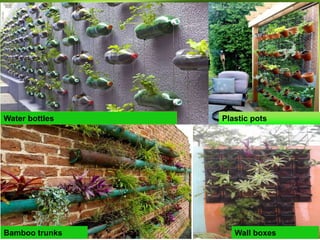
• Pots, plastic boxes, wooden stairs, bottles, wall
pockets and PVC pipes, bins, cans, tins,waste tanks
and bamboo sticks.
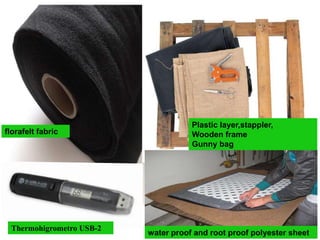
• Thermometer,florafelt layer,poly ester sheets.
Iron frame for trellis system
Plastic planter box
Containers and different materials used....
Wooden frame
Wooden blocks
Wooden stairs PVC pipes
Water bottles
Bamboo trunks Wall boxes
Plastic pots
florafelt fabric
Plastic layer,stappler,
Wooden frame
Gunny bag
water proof and root proof polyester sheet
Thermohigrometro USB-2
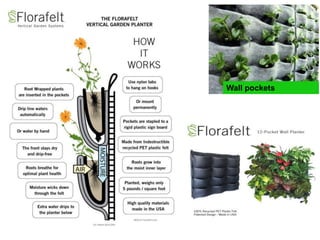
Wall pockets
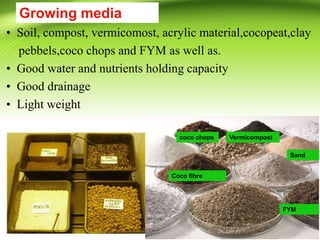
Growing media
• Soil, compost, vermicomost, acrylic material,cocopeat,clay
pebbels,coco chops and FYM as well as.
• Good water and nutrients holding capacity
• Good drainage
• Light weight
Vermicompost
FYM
Sand
Coco fibre
coco chops
Suitable plants for vertical gardens
• There are around 15000 plants
• Nearly 150 different species are arranged in the Caixa
Forum vertical garden who has designed by Patrick
Blanc.
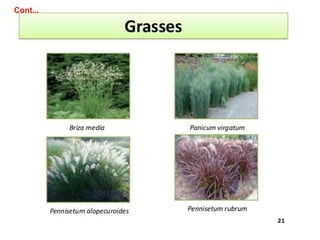
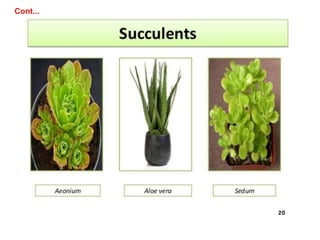
• Grasses, succulents, medium height shrubs, ferns,
climbers,rambling shrub type plants and Cactus spp
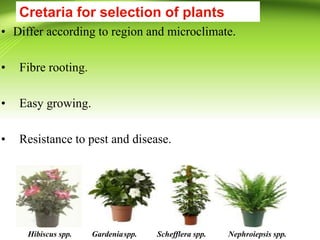
• Differ according to region and microclimate.
• Fibre rooting.
• Easy growing.
• Resistance to pest and disease.
Cretaria for selection of plants
Hibiscus spp. Gardeniaspp. Schefflera spp. Nephroiepsis spp.
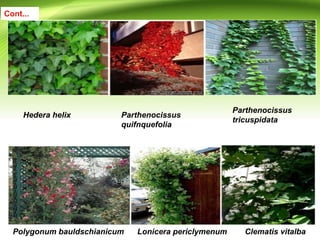
Hedera helix
Parthenocissus
tricuspidata
Parthenocissus
quifnquefolia
Polygonum bauldschianicum Lonicera periclymenum Clematis vitalba
Cont...
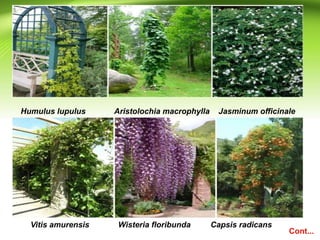
Humulus lupulus Aristolochia macrophylla Jasminum officinale
Vitis amurensis Wisteria floribunda Capsis radicans
Cont...
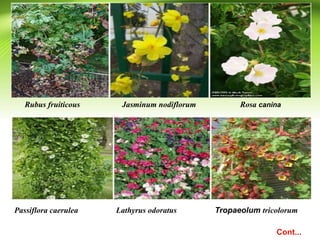
Rubus fruiticous Jasminum nodiflorum Rosa canina
Passiflora caerulea Lathyrus odoratus Tropaeolum tricolorum
Cont...
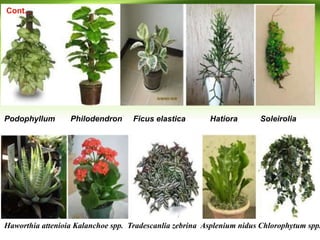
Podophyllum Philodendron Ficus elastica Hatiora Soleirolia
Haworthia attenioia Kalanchoe spp. Tradescanlia zebrina Asplenium nidus Chlorophytum spp.
Cont...
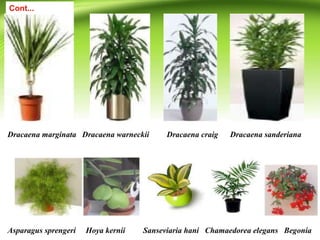
Dracaena marginata Dracaena warneckii Dracaena craig Dracaena sanderiana
Asparagus sprengeri Hoya kernii Sanseviaria hani Chamaedorea elegans Begonia
Cont...
Cont...
Cont...
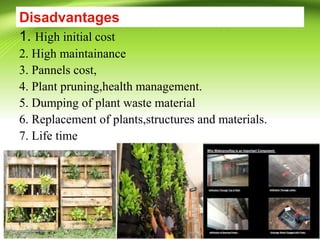
Disadvantages
1. High initial cost
2. High maintainance
3. Pannels cost,
4. Plant pruning,health management.
5. Dumping of plant waste material
6. Replacement of plants,structures and materials.
7. Life time
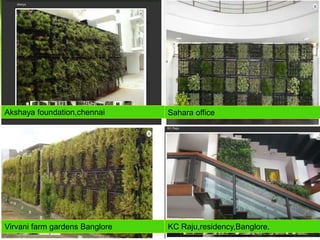
Sahara office
Virvani farm gardens Banglore
Akshaya foundation,chennai
KC Raju,residency,Banglore.
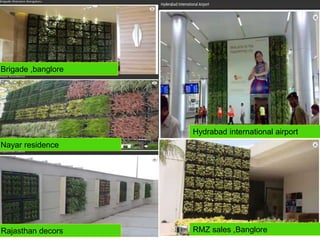
Hydrabad international airport
Brigade ,banglore
Nayar residence
Rajasthan decors RMZ sales ,Banglore
Some companies in india working on vertical
gardens
• Alpha solutions,(Amritsar).
• Bhoomi engineers&consultancy,(Ghaziabad).
• Green one landscape,(Pune).
• Green globe enterprises,(Chennai).
• Kunal gardens,(Delhi).
• Shree enterprises,(Ahmedabad).
• Sarvodaya carpets,(Ghaziabad).
• Shine green agriculture pvt ltd,(Mumbai).
• Unique industries,(Ahmedabad).
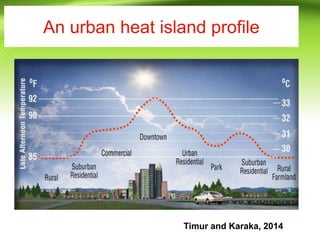
An urban heat island profile
Timur and Karaka, 2014
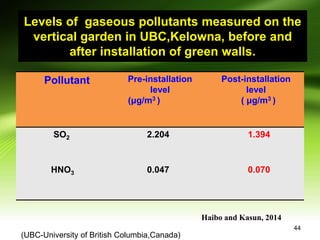
Levels of gaseous pollutants measured on the
vertical garden in UBC,Kelowna, before and
after installation of green walls.
Pollutant Pre-installation
level
(μg/m3 )
Post-installation
level
( μg/m3 )
SO2 2.204 1.394
HNO3 0.047 0.070
44
(UBC-University of British Columbia,Canada)
Haibo and Kasun, 2014
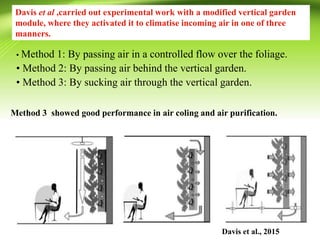
• Method 1: By passing air in a controlled flow over the foliage.
• Method 2: By passing air behind the vertical garden.
• Method 3: By sucking air through the vertical garden.
Davis et al., 2015
Davis et al ,carried out experimental work with a modified vertical garden
module, where they activated it to climatise incoming air in one of three
manners.
Method 3 showed good performance in air coling and air purification.
In Hong Kong, both walls and roofs were covered with
vegetation to a building and measured on a typical day of
the hottest month for that city - in this case, with a diurnal
air temperature range of 27°C minimum and 32 °C
maximum. Usual temperature is 400c.
Timur and Karaka, 2014.
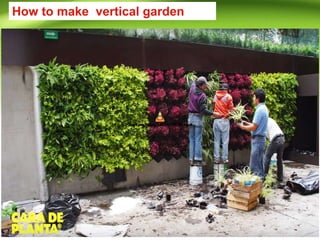
How to make vertical garden
Vertical garden concept and establishment

Vertical garden concept and establishment

  • 2.
    COLLEGE OF HORTICULTURE VCSGUTTARAKHAND UNIVERSITY OF HORTICULTURE AND FORESTRY BHARSAR,PAURI-246123 Seminar on:Vertical garden -Need of an hour P.Chakradhar M.Sc(FLA) 15236
  • 4.
    Introduction Vertical garden alsoknown as ''Green wall'' Any kind of construction and support structure for growing plants in an upwards direction. Efficient and productive use of the existing space. Father of modern vertical gardening- Patrick blanc Up right flower pillar
  • 5.
    History • The ancientconcept in Babylon about 2500 years ago. • First Hanging Gardens are established King Nebuchadnezzar II. • Between 3rd BC and 17th AD Romans-grape on garden trellies and on villa walls. • In 1920's Britania and North America promote trellis structures and self-climbing plants on houses and gardens • In 1988 - stainless steel cable system • Early 1990's- Cable and wire-rope net systems Modular trellis panel systems Facade systems.
  • 6.
    Why we needa vertical garden...? Gutaman library, Turkey Air purification Urban Heat Island Effect
  • 7.
  • 9.
  • 10.
    Basic structure ofFacade and living walls Living wall system Trellis system Facade system
  • 11.
    Structural concepts ofVertical Garden .
  • 12.
    Passive walls andActive living walls Active living walls •Apply a forced air flow through the subs-tract. •Considerably improves the air quality as compared to passive living walls. Passive living walls- •Technological innovation. • Modular systems. • Rectangular or square panels which contain a growing media
  • 13.
    Modular trellis • Itis a rigid, light weight, three-dimensional panel structure. • Made from a powder coated galvanized and welded steel wire. • Designed to hold a green facade. • Do not attach to the building. • Act as a freestanding green walls Freestanding trellis fence Coloumn trellis
  • 14.
    • Grid systemare used to support faster growing climbing plants with denser foliage. • Wire-nets are often used to support slower growing plants. • Both systems high tensile steel cables are used that provides anchors and support to the plants. Grid and wire-rope net systems Wire-Rope Net Systems, MFO Park, Switzerland.
  • 15.
    Grid System, ExDucati Office italy
  • 16.
    ● Living walls,also called bio-walls. ● Living wall systems are composed of pre vegetated panels. ● Panels consist of plastic, expanded polystyrene, synthetic fabric, clay, metal and concrete ● Living walls need more protection than green facades .  A metal frame  PVC layer  Drip and plant layer.  This system supports a variety of plant species, perennial flowers, low shrubs, and ferns etc . Living walls Concrete wall PVC layer Drip Felt layers Plants arranged
  • 17.
    Living wall, SemiahmooLibrary in South Surrey
  • 18.
    Landscape walls • Thesewalls are an evolution of landscape 'berms' and a strategic tool in an approach to 'living' architecture. • Typically sloped • Noise reduction and slope stabilization .
  • 19.
    Vegetated matted walls •The 'Mur Vegetal' is a unique form of green wall pioneered by Patrick Blanc . • Two layers of synthetic fabric with pockets and growing media. • Supported by a frame and backed by a waterproof membrane. • Drip irrigation Vegetated Mat Walls, Madrid ,Spain.
  • 20.
    Modular living walls •Modular systems consist of square or rectangular panels or curved panes that hold growing media to support plant materials. • Use of modules for green wall applications with a number of technological innovations.
  • 21.
    Irrigation Drip system Pumping systemwith • Drip system • Sprinkler system • Fogger system • Rose can Rose can
  • 23.
    • Pots, plasticboxes, wooden stairs, bottles, wall pockets and PVC pipes, bins, cans, tins,waste tanks and bamboo sticks. • Thermometer,florafelt layer,poly ester sheets. Iron frame for trellis system Plastic planter box Containers and different materials used....
  • 24.
  • 25.
    Water bottles Bamboo trunksWall boxes Plastic pots
  • 26.
    florafelt fabric Plastic layer,stappler, Woodenframe Gunny bag water proof and root proof polyester sheet Thermohigrometro USB-2
  • 27.
  • 28.
    Growing media • Soil,compost, vermicomost, acrylic material,cocopeat,clay pebbels,coco chops and FYM as well as. • Good water and nutrients holding capacity • Good drainage • Light weight Vermicompost FYM Sand Coco fibre coco chops
  • 29.
    Suitable plants forvertical gardens • There are around 15000 plants • Nearly 150 different species are arranged in the Caixa Forum vertical garden who has designed by Patrick Blanc. • Grasses, succulents, medium height shrubs, ferns, climbers,rambling shrub type plants and Cactus spp
  • 30.
    • Differ accordingto region and microclimate. • Fibre rooting. • Easy growing. • Resistance to pest and disease. Cretaria for selection of plants Hibiscus spp. Gardeniaspp. Schefflera spp. Nephroiepsis spp.
  • 31.
  • 32.
    Humulus lupulus Aristolochiamacrophylla Jasminum officinale Vitis amurensis Wisteria floribunda Capsis radicans Cont...
  • 33.
    Rubus fruiticous Jasminumnodiflorum Rosa canina Passiflora caerulea Lathyrus odoratus Tropaeolum tricolorum Cont...
  • 34.
    Podophyllum Philodendron Ficuselastica Hatiora Soleirolia Haworthia attenioia Kalanchoe spp. Tradescanlia zebrina Asplenium nidus Chlorophytum spp. Cont...
  • 35.
    Dracaena marginata Dracaenawarneckii Dracaena craig Dracaena sanderiana Asparagus sprengeri Hoya kernii Sanseviaria hani Chamaedorea elegans Begonia Cont...
  • 36.
  • 37.
  • 38.
    Disadvantages 1. High initialcost 2. High maintainance 3. Pannels cost, 4. Plant pruning,health management. 5. Dumping of plant waste material 6. Replacement of plants,structures and materials. 7. Life time
  • 39.
    Sahara office Virvani farmgardens Banglore Akshaya foundation,chennai KC Raju,residency,Banglore.
  • 40.
    Hydrabad international airport Brigade,banglore Nayar residence Rajasthan decors RMZ sales ,Banglore
  • 41.
    Some companies inindia working on vertical gardens • Alpha solutions,(Amritsar). • Bhoomi engineers&consultancy,(Ghaziabad). • Green one landscape,(Pune). • Green globe enterprises,(Chennai). • Kunal gardens,(Delhi). • Shree enterprises,(Ahmedabad). • Sarvodaya carpets,(Ghaziabad). • Shine green agriculture pvt ltd,(Mumbai). • Unique industries,(Ahmedabad).
  • 43.
    An urban heatisland profile Timur and Karaka, 2014
  • 44.
    Levels of gaseouspollutants measured on the vertical garden in UBC,Kelowna, before and after installation of green walls. Pollutant Pre-installation level (μg/m3 ) Post-installation level ( μg/m3 ) SO2 2.204 1.394 HNO3 0.047 0.070 44 (UBC-University of British Columbia,Canada) Haibo and Kasun, 2014
  • 45.
    • Method 1:By passing air in a controlled flow over the foliage. • Method 2: By passing air behind the vertical garden. • Method 3: By sucking air through the vertical garden. Davis et al., 2015 Davis et al ,carried out experimental work with a modified vertical garden module, where they activated it to climatise incoming air in one of three manners. Method 3 showed good performance in air coling and air purification.
  • 46.
    In Hong Kong,both walls and roofs were covered with vegetation to a building and measured on a typical day of the hottest month for that city - in this case, with a diurnal air temperature range of 27°C minimum and 32 °C maximum. Usual temperature is 400c. Timur and Karaka, 2014.
  • 47.
    How to makevertical garden

Editor's Notes

  • #5 not only on social and aesthetical value but also on well-being in and around the buildings. The result of integration of vegetation and building, improve the ecological and environmental efficiency with positive influence. Since 2000 years ago in traditional architecture, climbing plants have been planted at the base of the buildings facades or planter boxes have been manipulated on the main elevations.The result of integration of vegetation. Improve the ecological and environmental efficiency with positive influence. Since 2000 years ago. First introduced in Switzerland.
  • #6 Between 3rd BC and 17th AD Romans train grape on garden trellies and on villa walls. In 1920's Britania and North America promote trellis structures and self-climbing plants on houses and gardens In 1988 started to use stainless steel cable system Early 1990's cable and wire-rope net systems and modular trellis panel systems enter the North American marketplace.
  • #7 A huge variety of different designs and concepts are available. The design of vertical garden depends on the available material, space and local preferences as well as on the creativity and imagination of the users.They may be utilized as a remarkable outdoor system, or may be applied indoor in different climatic environments.
  • #12 Block : Engineered with gaps where plants root through the wall Crib Wall : In this system, elements of like tile, concrete, wood stacked log cabin style Frame : In this system, interlocking flor coverings stacked like massonry Trough : Used soil filled tubs Gabion : Used wire baskets filled with Stones to provide strong Mesh : Like mini gabions Cell : Used flexible and strong honeycombs which filled with soil Sandbag : Make with geotextiles wrapped around soil. This systems formally called “vegetated geogrid
  • #13 It is intended to be integrated into a building’s infrastructure and designed to act as bio-filters indoor air and ecological air conditioning systems.Passive living wall emerged from the usage of green roof applications, with a number of technological innovations. It is mostly applied in modular systems which are made up of rectangular or square panels which contain a growing media and keep plant material. As modular systems are usually pre-grown, providing an immediate green effect upon completion of the installation is possible (Fig. 2). The necessity nutrient requirements are prepared in the growing media. Irrigation which applies gravity to transfer water through the growing media is supplied with this equipment along the wall at different heights. A waterproof substance insulates the system from the building wall in order to prevent wetting problems, furthermore emitters, fertilizers, irrigation and lighting systems may be required [5], Fig. 3 illustrates living walls’ usual components.
  • #14 Available in different shapes and curvesThe building block of this modular system is a rigid, light weight, three-dimensional panel made from a powder coated galvanized and welded steel wire that supports plants with both a face grid and a panel depth. This system is designed to hold a green facade off the wall surface so that plant materials do not attach to the building, provides a "captive" growing environment for the plant with multiple supports for the tendrils, and helps to maintain the integrity of a building membrane. Panels can be stacked and joined to cover large areas, or formed to create shapes and curves, are made from recycledcontent steel and are recyclable (fig3, fig4). Because the panels are rigid, they can span between structures and can also be used for freestanding green walls (Gren roof organization 2008).
  • #15 Grids are employed on green facades that are designed to support faster growing climbing plants with denser foliage. Wire-nets are often used to support slower growing plants that need the added support these systems provide at closer intervals. Both systems use high tensile steel cables, anchors and supplementary equipment. Various sizes and patterns can be accommodated as flexible vertical and horizontal wire-ropes are connected
  • #17 Living wall systems are composed of pre vegetated panels. These panels can be made of plastic, expanded polystyrene, synthetic fabric, clay, metal, and concrete, and support agreat diversity and density of plant species. Living walls need more protection than green facades because of its diversity and density of vegetationLiving walls, also called bio-walls or vertical gardens. Living wall systems are composed of pre vegetated panels, vertical modules or planted blankets These panels can be made of plastic, expanded polystyrene, synthetic fabric, clay, metal, and concrete, and support a great diversity and density of plant species. Living walls need more protection than green facades because of its diversity and density of vegetation. Living Walls are made with three parts: a metal frame, a PVC layer and an air layer (do not need soil). This system supports a variety of plant species, such as a mixture of vegetation, perennial flowers, low shrubs, and ferns etc (fig 7). It performs well in various climate environments. However, the selection of better species may adapt to the prevailing climatic condition, so that the maintenance of the system be made easy. Generally is used self-automated watering and nutrition system, to make maintenance of the living walls easy (Gren roof organization 2008, Yeh 2012).. Living Wall : a metal frame, a PVC layer and an air layer (do not need soil). This system supports a variety of plant species, such as a mixture of vegetation, perennial flowers, low shrubs, and ferns etc .It performs well in various climate environments. However, the selection of better species may adapt to the prevailing climatic condition, so that the maintenance of the system be made easy. Generally is used self-automated watering and nutrition system, to make maintenance of the living walls easy
  • #19 These walls are an evolution of landscape 'berms' and a strategic tool in an approach to 'living' architecture. Landscape walls are typically sloped as opposed to vertical and have the primary function of noise reduction and slope stabilization . They usually are structured from some form of stacking material made of plastic or concrete with room for growing media and plants These walls are an evolution of landscape 'berms' and a strategic tool in an approach to 'living' architecture. Landscape walls are typically sloped as opposed to vertical and have the primary function of noise reduction and slope stabilization (fig 8). They usually are structured from some form of stacking material made of plastic or concrete with room for growing media and plants (Gren roof organization 2008).
  • #20 It is composed of two layers of synthetic fabric with pockets that physically support plants and growing media. The fabric walls are supported by a frame and backed by a waterproof membrane against the building wall because of its high moisture content. Nutrients are primarily distributed through an irrigation system that cycles water from the top of the system dow
  • #24 There are so many different containers are using in vertical gardens.
  • #29 Vertical Gardens utilize soil, compost, vermicomost, acrylic material as well as aquaponic and aeroponic solutions as growing media thereby maximizing the use of the resources while compromising the degradation of nutrients by using various planting medium.
  • #30 Several plants that have thrived in living walls in Australia for the past few years include epiphytes, lithophytes, bromeliads, ferns, succulents, climbers and grasses. Native plants as well as ornamental species have also been successfully used. Most of the plant species that have been tested for their phytoremedial qualities have been indoor plants.
  • #31 Selected plants root in the ground, in modular panels attached to the facade or in the wall material itself, with the purpose of covering the buildings with plant foliage.Fibre rooting
  • #44 kairo egypt Samar Sheweka and Nourhan Magdy Engin EROGLU1 and Sinem OZDEDE1
  • #46 More recently , carried out experimental work with a modified vertical garden module, where they activated it to climatise incoming air in one of three manners . where the air was to be cooled in a manner similar to atraditional swamp cooler.
  • #47 Green Walls provide a noise buffer which significantly reduces outside noise and vibration (up to 40dB) inside our homes and workplaces. A small indoor hedge placed around a workspace will reduce noise by 5 dB
  • #49 4.4Maintenance Designing a building with an early understanding of living walls can greatly reduce maintenance costs. With the exception of access and regular watering issues, local suppliers state that maintenance of a living wall should be no more onerous than that of landscape planting. Designing the living wall as a pivoting or removable screen can reduce the use of lift equipment to maintain living walls that are placed high on a building. The usual requirements of pruning, feeding and watering still apply though in a different way. Establishing a well-understood maintenance regime with facilities management personnel, especially at the specification stage, will greatly improve the likelihood of survival of the wall.