


MAR 204: ENERGY SIMULATION
GREEN ROOFS & GREEN WALLS
MOHAMMAD ANAS
MOHAMMAD FAHAD ASLAM
MOHAMMAD WASEEM REZA
SUHEB ASGHAR
M.ARCH. (BUILDING SERVICES)
2
GREEN ROOFS
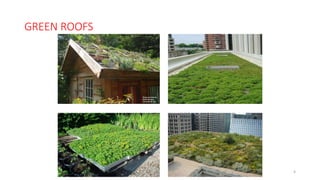
GREEN ROOFS
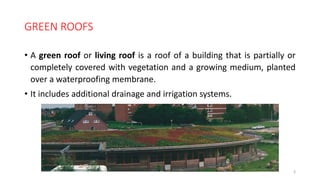
• A green roof or living roof is a roof of a building that is partially or
completely covered with vegetation and a growing medium, planted
over a waterproofing membrane.
• It includes additional drainage and irrigation systems.
3
GREEN ROOFS
4
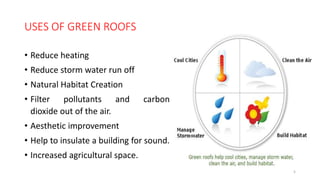
USES OF GREEN ROOFS
• Reduce heating
• Reduce storm water run off
• Natural Habitat Creation
• Filter pollutants and carbon
dioxide out of the air.
• Aesthetic improvement
• Help to insulate a building for sound.
• Increased agricultural space.
5
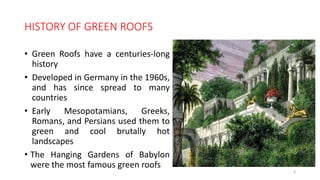
HISTORY OF GREEN ROOFS
• Green Roofs have a centuries-long
history
• Developed in Germany in the 1960s,
and has since spread to many
countries
• Early Mesopotamians, Greeks,
Romans, and Persians used them to
green and cool brutally hot
landscapes
• The Hanging Gardens of Babylon
were the most famous green roofs
6
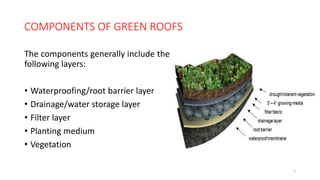
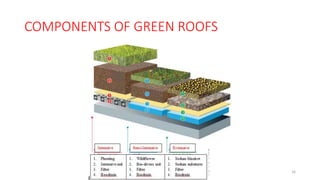
COMPONENTS OF GREEN ROOFS
The components generally include the
following layers:
• Waterproofing/root barrier layer
• Drainage/water storage layer
• Filter layer
• Planting medium
• Vegetation
7
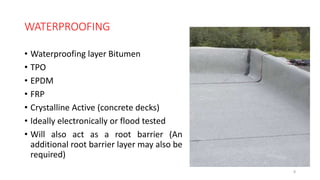
WATERPROOFING
• Waterproofing layer Bitumen
• TPO
• EPDM
• FRP
• Crystalline Active (concrete decks)
• Ideally electronically or flood tested
• Will also act as a root barrier (An
additional root barrier layer may also be
required)
8
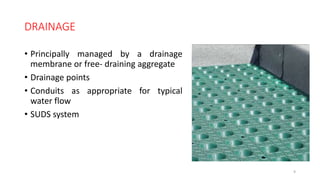
DRAINAGE
• Principally managed by a drainage
membrane or free- draining aggregate
• Drainage points
• Conduits as appropriate for typical
water flow
• SUDS system
9
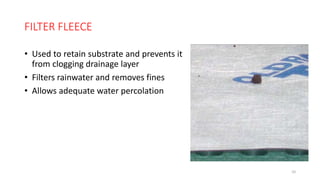
FILTER FLEECE
• Used to retain substrate and prevents it
from clogging drainage layer
• Filters rainwater and removes fines
• Allows adequate water percolation
10
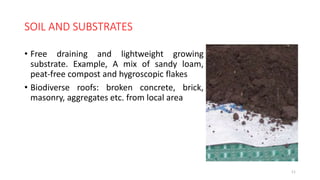
SOIL AND SUBSTRATES
• Free draining and lightweight growing
substrate. Example, A mix of sandy loam,
peat-free compost and hygroscopic flakes
• Biodiverse roofs: broken concrete, brick,
masonry, aggregates etc. from local area
11
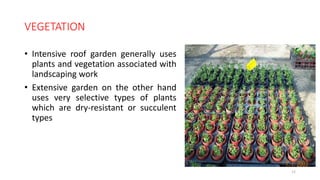
VEGETATION
• Intensive roof garden generally uses
plants and vegetation associated with
landscaping work
• Extensive garden on the other hand
uses very selective types of plants
which are dry-resistant or succulent
types
12
TYPES OF GREEN ROOFS
Classification of Green Roofs can be done on the following basis:
13
14
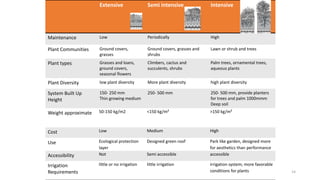
Extensive Semi intensive Intensive
Maintenance Low Periodically High
Plant Communities Ground covers,
grasses
Ground covers, grasses and
shrubs
Lawn or shrub and trees
Plant types Grasses and loans,
ground covers,
seasonal flowers
Climbers, cactus and
succulents, shrubs
Palm trees, ornamental trees,
aqueous plants
Plant Diversity low plant diversity More plant diversity high plant diversity
System Built Up
Height
150- 250 mm
Thin growing medium
250- 500 mm 250- 500 mm, provide planters
for trees and palm 1000mmm
Deep soil
Weight approximate 50-150 kg/m2 <150 kg/m² >150 kg/m²
Cost Low Medium High
Use Ecological protection
layer
Designed green roof Park like garden, designed more
for aesthetics than performance
Accessibility Not Semi accessible accessible
Irrigation
Requirements
little or no irrigation little irrigation irrigation system; more favorable
conditions for plants
15
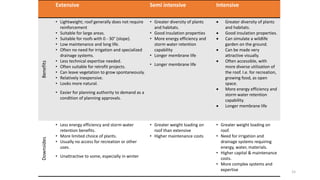
Extensive Semi intensive Intensive
Benefits
• Lightweight; roof generally does not require
reinforcement
• Suitable for large areas.
• Suitable for roofs with 0 - 30° (slope).
• Low maintenance and long life.
• Often no need for irrigation and specialized
drainage systems.
• Less technical expertise needed.
• Often suitable for retrofit projects.
• Can leave vegetation to grow spontaneously.
• Relatively inexpensive.
• Looks more natural.
• Easier for planning authority to demand as a
condition of planning approvals.
• Greater diversity of plants
and habitats.
• Good insulation properties
• More energy efficiency and
storm water retention
capability
• Longer membrane life
 Greater diversity of plants
and habitats.
 Good insulation properties.
 Can simulate a wildlife
garden on the ground.
 Can be made very
attractive visually.
 Often accessible, with
more diverse utilization of
the roof. I.e. for recreation,
growing food, as open
space.
 More energy efficiency and
storm water retention
capability.
 Longer membrane life
Downsides
• Less energy efficiency and storm water
retention benefits.
• More limited choice of plants.
• Usually no access for recreation or other
uses.
• Unattractive to some, especially in winter
• Greater weight loading on
roof than extensive
• Higher maintenance costs
• Greater weight loading on
roof.
• Need for irrigation and
drainage systems requiring
energy, water, materials.
• Higher capital & maintenance
costs.
• More complex systems and
expertise
COMPONENTS OF GREEN ROOFS
16
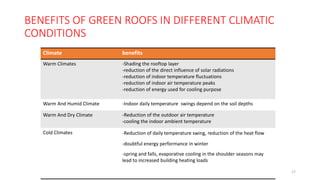
BENEFITS OF GREEN ROOFS IN DIFFERENT CLIMATIC
CONDITIONS
17
Climate benefits
Warm Climates -Shading the rooftop layer
-reduction of the direct influence of solar radiations
-reduction of indoor temperature fluctuations
-reduction of indoor air temperature peaks
-reduction of energy used for cooling purpose
Warm And Humid Climate -Indoor daily temperature swings depend on the soil depths
Warm And Dry Climate -Reduction of the outdoor air temperature
-cooling the indoor ambient temperature
Cold Climates -Reduction of daily temperature swing, reduction of the heat flow
-doubtful energy performance in winter
-spring and falls, evaporative cooling in the shoulder seasons may
lead to increased building heating loads
18
GREEN WALLS
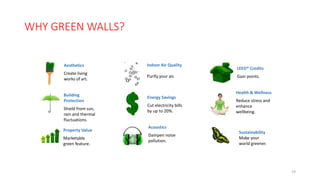
WHY GREEN WALLS?
19
Aesthetics
Create living
works of art.
Indoor Air Quality
Purify your air.
LEED® Credits
Gain points.
Building
Protection
Shield from sun,
rain and thermal
fluctuations.
Energy Savings
Cut electricity bills
by up to 20%.
Health & Wellness
Reduce stress and
enhance
wellbeing.
Property Value
Marketable
green feature.
Acoustics
Dampen noise
pollution.
Sustainability
Make your
world greener.
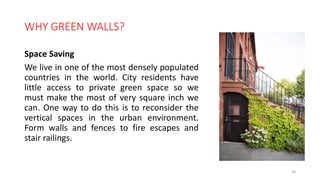
WHY GREEN WALLS?
Space Saving
We live in one of the most densely populated
countries in the world. City residents have
little access to private green space so we
must make the most of very square inch we
can. One way to do this is to reconsider the
vertical spaces in the urban environment.
Form walls and fences to fire escapes and
stair railings.
20
TYPES OF VERTICAL GARDENS
• Living Walls
• Green Veneers
• Indoor
• Outdoor
21
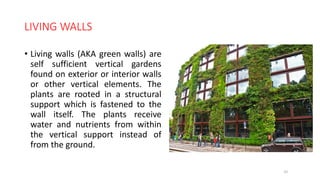
LIVING WALLS
• Living walls (AKA green walls) are
self sufficient vertical gardens
found on exterior or interior walls
or other vertical elements. The
plants are rooted in a structural
support which is fastened to the
wall itself. The plants receive
water and nutrients from within
the vertical support instead of
from the ground.
22
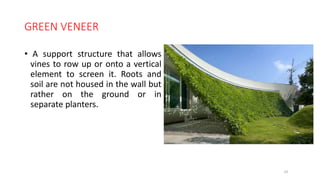
GREEN VENEER
• A support structure that allows
vines to row up or onto a vertical
element to screen it. Roots and
soil are not housed in the wall but
rather on the ground or in
separate planters.
23
GREEN VENEER SYSTEMS
• Trellising
• Green Screen
• Jacob Wire
• Masonry and Wood Walls
24
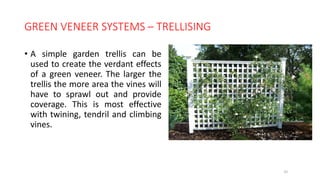
GREEN VENEER SYSTEMS – TRELLISING
• A simple garden trellis can be
used to create the verdant effects
of a green veneer. The larger the
trellis the more area the vines will
have to sprawl out and provide
coverage. This is most effective
with twining, tendril and climbing
vines.
25
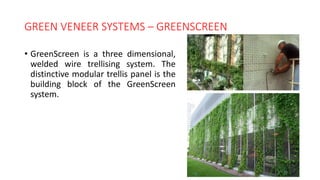
GREEN VENEER SYSTEMS – GREENSCREEN
• GreenScreen is a three dimensional,
welded wire trellising system. The
distinctive modular trellis panel is the
building block of the GreenScreen
system.
26
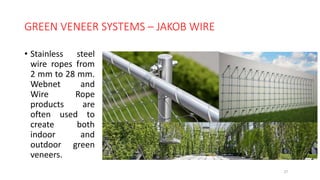
GREEN VENEER SYSTEMS – JAKOB WIRE
• Stainless steel
wire ropes from
2 mm to 28 mm.
Webnet and
Wire Rope
products are
often used to
create both
indoor and
outdoor green
veneers.
27
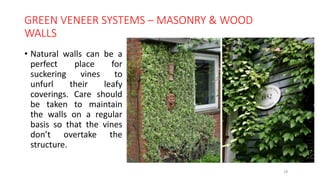
GREEN VENEER SYSTEMS – MASONRY & WOOD
WALLS
• Natural walls can be a
perfect place for
suckering vines to
unfurl their leafy
coverings. Care should
be taken to maintain
the walls on a regular
basis so that the vines
don’t overtake the
structure.
28
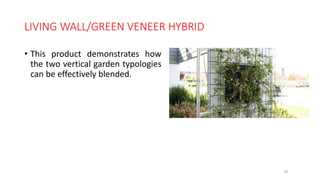
LIVING WALL/GREEN VENEER HYBRID
• This product demonstrates how
the two vertical garden typologies
can be effectively blended.
29
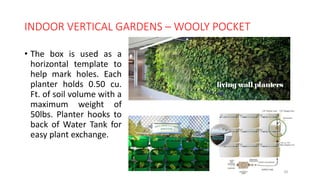
INDOOR VERTICAL GARDENS – WOOLY POCKET
• The box is used as a
horizontal template to
help mark holes. Each
planter holds 0.50 cu.
Ft. of soil volume with a
maximum weight of
50lbs. Planter hooks to
back of Water Tank for
easy plant exchange.
30
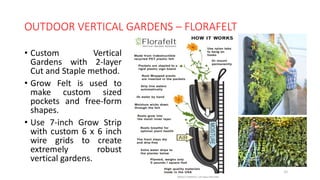
OUTDOOR VERTICAL GARDENS – FLORAFELT
• Custom Vertical
Gardens with 2-layer
Cut and Staple method.
• Grow Felt is used to
make custom sized
pockets and free-form
shapes.
• Use 7-inch Grow Strip
with custom 6 x 6 inch
wire grids to create
extremely robust
vertical gardens.
31
PLANTS FOR GREEN WALLS
• Tropical Understory Plants for Interior Living Walls
• Air Filtering Plants
• Alpine Plants for Exterior Living Walls
• Vines for Green Veneers
• Annuals vs Perennials
• Native, Naturalized & Invasive Plants
• Espaliered Trees
32
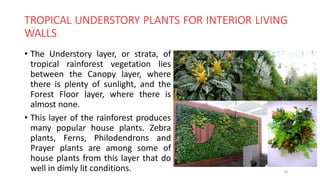
TROPICAL UNDERSTORY PLANTS FOR INTERIOR LIVING
WALLS
• The Understory layer, or strata, of
tropical rainforest vegetation lies
between the Canopy layer, where
there is plenty of sunlight, and the
Forest Floor layer, where there is
almost none.
• This layer of the rainforest produces
many popular house plants. Zebra
plants, Ferns, Philodendrons and
Prayer plants are among some of
house plants from this layer that do
well in dimly lit conditions. 33
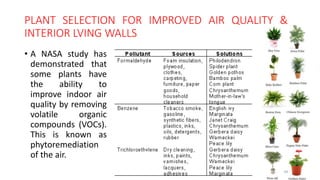
PLANT SELECTION FOR IMPROVED AIR QUALITY &
INTERIOR LVING WALLS
• A NASA study has
demonstrated that
some plants have
the ability to
improve indoor air
quality by removing
volatile organic
compounds (VOCs).
This is known as
phytoremediation
of the air.
34
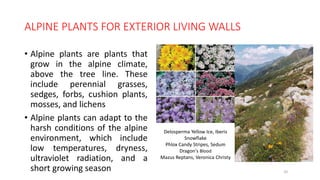
ALPINE PLANTS FOR EXTERIOR LIVING WALLS
• Alpine plants are plants that
grow in the alpine climate,
above the tree line. These
include perennial grasses,
sedges, forbs, cushion plants,
mosses, and lichens
• Alpine plants can adapt to the
harsh conditions of the alpine
environment, which include
low temperatures, dryness,
ultraviolet radiation, and a
short growing season 35
Delosperma Yellow Ice, Iberis
Snowflake
Phlox Candy Stripes, Sedum
Dragon's Blood
Mazus Reptans, Veronica Christy
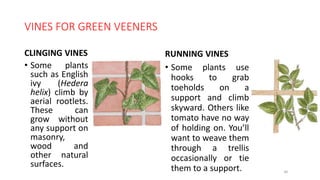
VINES FOR GREEN VEENERS
CLINGING VINES
• Some plants
such as English
ivy (Hedera
helix) climb by
aerial rootlets.
These can
grow without
any support on
masonry,
wood and
other natural
surfaces.
36
RUNNING VINES
• Some plants use
hooks to grab
toeholds on a
support and climb
skyward. Others like
tomato have no way
of holding on. You’ll
want to weave them
through a trellis
occasionally or tie
them to a support.
THANK YOU
37

Green roofs & green walls

  • 1.
    MAR 204: ENERGYSIMULATION GREEN ROOFS & GREEN WALLS MOHAMMAD ANAS MOHAMMAD FAHAD ASLAM MOHAMMAD WASEEM REZA SUHEB ASGHAR M.ARCH. (BUILDING SERVICES)
  • 2.
  • 3.
    GREEN ROOFS • Agreen roof or living roof is a roof of a building that is partially or completely covered with vegetation and a growing medium, planted over a waterproofing membrane. • It includes additional drainage and irrigation systems. 3
  • 4.
  • 5.
    USES OF GREENROOFS • Reduce heating • Reduce storm water run off • Natural Habitat Creation • Filter pollutants and carbon dioxide out of the air. • Aesthetic improvement • Help to insulate a building for sound. • Increased agricultural space. 5
  • 6.
    HISTORY OF GREENROOFS • Green Roofs have a centuries-long history • Developed in Germany in the 1960s, and has since spread to many countries • Early Mesopotamians, Greeks, Romans, and Persians used them to green and cool brutally hot landscapes • The Hanging Gardens of Babylon were the most famous green roofs 6
  • 7.
    COMPONENTS OF GREENROOFS The components generally include the following layers: • Waterproofing/root barrier layer • Drainage/water storage layer • Filter layer • Planting medium • Vegetation 7
  • 8.
    WATERPROOFING • Waterproofing layerBitumen • TPO • EPDM • FRP • Crystalline Active (concrete decks) • Ideally electronically or flood tested • Will also act as a root barrier (An additional root barrier layer may also be required) 8
  • 9.
    DRAINAGE • Principally managedby a drainage membrane or free- draining aggregate • Drainage points • Conduits as appropriate for typical water flow • SUDS system 9
  • 10.
    FILTER FLEECE • Usedto retain substrate and prevents it from clogging drainage layer • Filters rainwater and removes fines • Allows adequate water percolation 10
  • 11.
    SOIL AND SUBSTRATES •Free draining and lightweight growing substrate. Example, A mix of sandy loam, peat-free compost and hygroscopic flakes • Biodiverse roofs: broken concrete, brick, masonry, aggregates etc. from local area 11
  • 12.
    VEGETATION • Intensive roofgarden generally uses plants and vegetation associated with landscaping work • Extensive garden on the other hand uses very selective types of plants which are dry-resistant or succulent types 12
  • 13.
    TYPES OF GREENROOFS Classification of Green Roofs can be done on the following basis: 13
  • 14.
    14 Extensive Semi intensiveIntensive Maintenance Low Periodically High Plant Communities Ground covers, grasses Ground covers, grasses and shrubs Lawn or shrub and trees Plant types Grasses and loans, ground covers, seasonal flowers Climbers, cactus and succulents, shrubs Palm trees, ornamental trees, aqueous plants Plant Diversity low plant diversity More plant diversity high plant diversity System Built Up Height 150- 250 mm Thin growing medium 250- 500 mm 250- 500 mm, provide planters for trees and palm 1000mmm Deep soil Weight approximate 50-150 kg/m2 <150 kg/m² >150 kg/m² Cost Low Medium High Use Ecological protection layer Designed green roof Park like garden, designed more for aesthetics than performance Accessibility Not Semi accessible accessible Irrigation Requirements little or no irrigation little irrigation irrigation system; more favorable conditions for plants
  • 15.
    15 Extensive Semi intensiveIntensive Benefits • Lightweight; roof generally does not require reinforcement • Suitable for large areas. • Suitable for roofs with 0 - 30° (slope). • Low maintenance and long life. • Often no need for irrigation and specialized drainage systems. • Less technical expertise needed. • Often suitable for retrofit projects. • Can leave vegetation to grow spontaneously. • Relatively inexpensive. • Looks more natural. • Easier for planning authority to demand as a condition of planning approvals. • Greater diversity of plants and habitats. • Good insulation properties • More energy efficiency and storm water retention capability • Longer membrane life • Longer membrane life  Greater diversity of plants and habitats.  Good insulation properties.  Can simulate a wildlife garden on the ground.  Can be made very attractive visually.  Often accessible, with more diverse utilization of the roof. I.e. for recreation, growing food, as open space.  More energy efficiency and storm water retention capability.  Longer membrane life Downsides • Less energy efficiency and storm water retention benefits. • More limited choice of plants. • Usually no access for recreation or other uses. • Unattractive to some, especially in winter • Greater weight loading on roof than extensive • Higher maintenance costs • Greater weight loading on roof. • Need for irrigation and drainage systems requiring energy, water, materials. • Higher capital & maintenance costs. • More complex systems and expertise
  • 16.
  • 17.
    BENEFITS OF GREENROOFS IN DIFFERENT CLIMATIC CONDITIONS 17 Climate benefits Warm Climates -Shading the rooftop layer -reduction of the direct influence of solar radiations -reduction of indoor temperature fluctuations -reduction of indoor air temperature peaks -reduction of energy used for cooling purpose Warm And Humid Climate -Indoor daily temperature swings depend on the soil depths Warm And Dry Climate -Reduction of the outdoor air temperature -cooling the indoor ambient temperature Cold Climates -Reduction of daily temperature swing, reduction of the heat flow -doubtful energy performance in winter -spring and falls, evaporative cooling in the shoulder seasons may lead to increased building heating loads
  • 18.
  • 19.
    WHY GREEN WALLS? 19 Aesthetics Createliving works of art. Indoor Air Quality Purify your air. LEED® Credits Gain points. Building Protection Shield from sun, rain and thermal fluctuations. Energy Savings Cut electricity bills by up to 20%. Health & Wellness Reduce stress and enhance wellbeing. Property Value Marketable green feature. Acoustics Dampen noise pollution. Sustainability Make your world greener.
  • 20.
    WHY GREEN WALLS? SpaceSaving We live in one of the most densely populated countries in the world. City residents have little access to private green space so we must make the most of very square inch we can. One way to do this is to reconsider the vertical spaces in the urban environment. Form walls and fences to fire escapes and stair railings. 20
  • 21.
    TYPES OF VERTICALGARDENS • Living Walls • Green Veneers • Indoor • Outdoor 21
  • 22.
    LIVING WALLS • Livingwalls (AKA green walls) are self sufficient vertical gardens found on exterior or interior walls or other vertical elements. The plants are rooted in a structural support which is fastened to the wall itself. The plants receive water and nutrients from within the vertical support instead of from the ground. 22
  • 23.
    GREEN VENEER • Asupport structure that allows vines to row up or onto a vertical element to screen it. Roots and soil are not housed in the wall but rather on the ground or in separate planters. 23
  • 24.
    GREEN VENEER SYSTEMS •Trellising • Green Screen • Jacob Wire • Masonry and Wood Walls 24
  • 25.
    GREEN VENEER SYSTEMS– TRELLISING • A simple garden trellis can be used to create the verdant effects of a green veneer. The larger the trellis the more area the vines will have to sprawl out and provide coverage. This is most effective with twining, tendril and climbing vines. 25
  • 26.
    GREEN VENEER SYSTEMS– GREENSCREEN • GreenScreen is a three dimensional, welded wire trellising system. The distinctive modular trellis panel is the building block of the GreenScreen system. 26
  • 27.
    GREEN VENEER SYSTEMS– JAKOB WIRE • Stainless steel wire ropes from 2 mm to 28 mm. Webnet and Wire Rope products are often used to create both indoor and outdoor green veneers. 27
  • 28.
    GREEN VENEER SYSTEMS– MASONRY & WOOD WALLS • Natural walls can be a perfect place for suckering vines to unfurl their leafy coverings. Care should be taken to maintain the walls on a regular basis so that the vines don’t overtake the structure. 28
  • 29.
    LIVING WALL/GREEN VENEERHYBRID • This product demonstrates how the two vertical garden typologies can be effectively blended. 29
  • 30.
    INDOOR VERTICAL GARDENS– WOOLY POCKET • The box is used as a horizontal template to help mark holes. Each planter holds 0.50 cu. Ft. of soil volume with a maximum weight of 50lbs. Planter hooks to back of Water Tank for easy plant exchange. 30
  • 31.
    OUTDOOR VERTICAL GARDENS– FLORAFELT • Custom Vertical Gardens with 2-layer Cut and Staple method. • Grow Felt is used to make custom sized pockets and free-form shapes. • Use 7-inch Grow Strip with custom 6 x 6 inch wire grids to create extremely robust vertical gardens. 31
  • 32.
    PLANTS FOR GREENWALLS • Tropical Understory Plants for Interior Living Walls • Air Filtering Plants • Alpine Plants for Exterior Living Walls • Vines for Green Veneers • Annuals vs Perennials • Native, Naturalized & Invasive Plants • Espaliered Trees 32
  • 33.
    TROPICAL UNDERSTORY PLANTSFOR INTERIOR LIVING WALLS • The Understory layer, or strata, of tropical rainforest vegetation lies between the Canopy layer, where there is plenty of sunlight, and the Forest Floor layer, where there is almost none. • This layer of the rainforest produces many popular house plants. Zebra plants, Ferns, Philodendrons and Prayer plants are among some of house plants from this layer that do well in dimly lit conditions. 33
  • 34.
    PLANT SELECTION FORIMPROVED AIR QUALITY & INTERIOR LVING WALLS • A NASA study has demonstrated that some plants have the ability to improve indoor air quality by removing volatile organic compounds (VOCs). This is known as phytoremediation of the air. 34
  • 35.
    ALPINE PLANTS FOREXTERIOR LIVING WALLS • Alpine plants are plants that grow in the alpine climate, above the tree line. These include perennial grasses, sedges, forbs, cushion plants, mosses, and lichens • Alpine plants can adapt to the harsh conditions of the alpine environment, which include low temperatures, dryness, ultraviolet radiation, and a short growing season 35 Delosperma Yellow Ice, Iberis Snowflake Phlox Candy Stripes, Sedum Dragon's Blood Mazus Reptans, Veronica Christy
  • 36.
    VINES FOR GREENVEENERS CLINGING VINES • Some plants such as English ivy (Hedera helix) climb by aerial rootlets. These can grow without any support on masonry, wood and other natural surfaces. 36 RUNNING VINES • Some plants use hooks to grab toeholds on a support and climb skyward. Others like tomato have no way of holding on. You’ll want to weave them through a trellis occasionally or tie them to a support.
  • 37.