Landscaping : A Tool For
Beautification, Recreation and
Ecological Balance
Division of Floriculture & Landscaping
Indian Agricultural Research Institute
New Delhi-110012
BABITA SINGH
LANDSCAPING
It is an aesthetic branch of horticulture which
deals with the planting of ornamental plant in
such a way that it creates a picturesque effect.
Or
It is decoration of tract of land with plants and
other garden material so as to produce a
picturesque and naturalistic effect in a limited
space.
PRINCIPLES OF LANDSCAPING
 It is ideal like painting which express some single
thought or feeling.(Joy,bold,retired,quiet etc.)
 Beauty and utility should be harmoniously
combined.
 Area should be divided into different parts and
plan should be conceived for each area.
 Let the garden and building merge into each
other.
 Simplicity of design should be aimed
 It should have open space.
 Over crowding of plant and object should be
avoided.
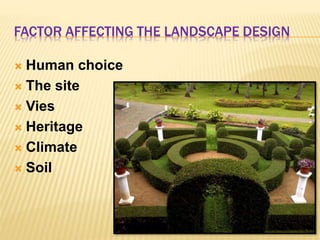
FACTOR AFFECTING THE LANDSCAPE DESIGN
 Human choice
 The site
 Vies
 Heritage
 Climate
 Soil
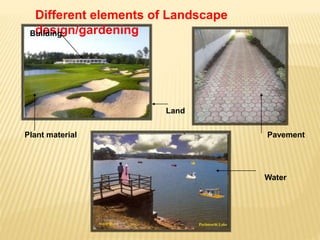
Different elements of Landscape
design/gardening
Water
Pavement
Building
Plant material
Land
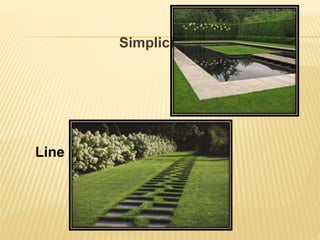
Simplicity
Line
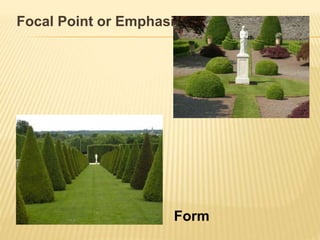
Focal Point or Emphasis
Form
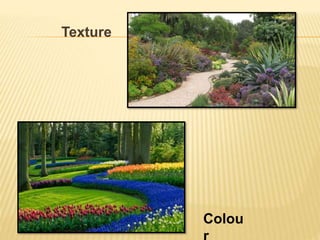
Texture
Colou
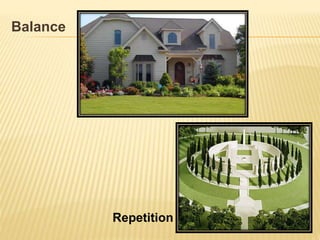
Balance
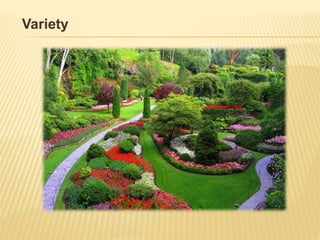
Repetition
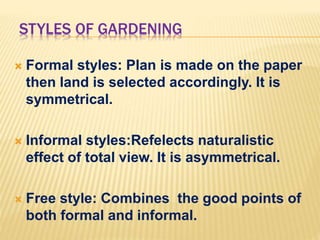
Variety
STYLES OF GARDENING
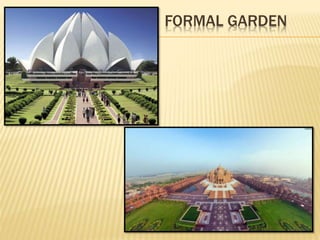
 Formal styles: Plan is made on the paper
then land is selected accordingly. It is
symmetrical.
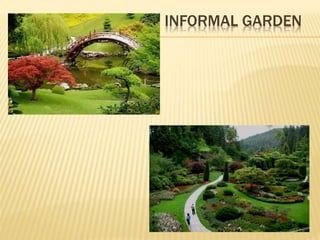
 Informal styles:Refelects naturalistic
effect of total view. It is asymmetrical.
 Free style: Combines the good points of
both formal and informal.
FORMAL GARDEN
INFORMAL GARDEN
SOME FACTORS THAT INFLUENCE LANDSCAPES
 Topography
 Soil structure
 The climate
 The homes
 Buildings
 Other Physical Structures
 Intended Use of the property
 Clients Wants
 Surrounding
 Irrigation facilities
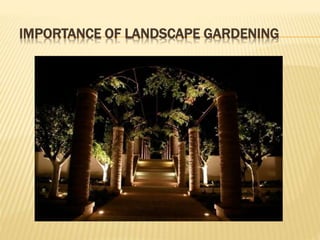
IMPORTANCE OF LANDSCAPE GARDENING
Beautification Aesthetic Benefits
Trees and other life forms supported by them have
a positive value in scenic quality. Trees change
skyline, add variety of form, colour and texture to
otherwise dull and monotonous cities.
They soften the harshness of concrete structures,
complement architectural lines and provide
background settings to buildings.
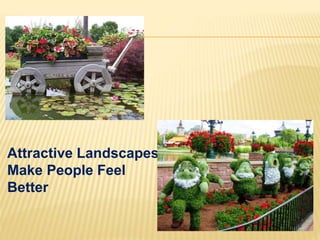
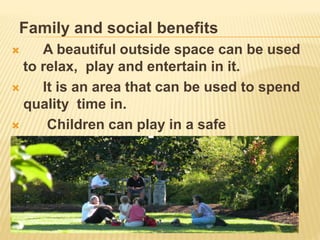
Attractive Landscapes
Make People Feel
Better
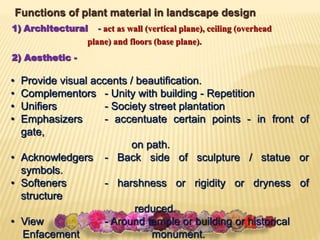
Family and social benefits
 A beautiful outside space can be used
to relax, play and entertain in it.
 It is an area that can be used to spend
quality time in.
 Children can play in a safe
environment.
INCREASE PROPERTY VALUE
Estate agents and property experts are
quick to point out that a well-
landscaped garden can increase the
value of home dramatically as well as
to attract the business opportunities
and appreciation in the real estate
value.
Functions of plant material in landscape design
1) Architectural - act as wall (vertical plane), ceiling (overhead
plane) and floors (base plane).
2) Aesthetic -
• Provide visual accents / beautification.
• Complementors - Unity with building - Repetition
• Unifiers - Society street plantation
• Emphasizers - accentuate certain points - in front of
gate,
on path.
• Acknowledgers - Back side of sculpture / statue or
symbols.
• Softeners - harshness or rigidity or dryness of
structure
reduced.
• View - Around temple or building or historical
Enfacement monument.
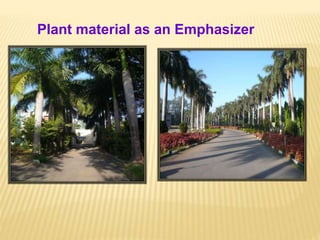
Plant material as an Emphasizer
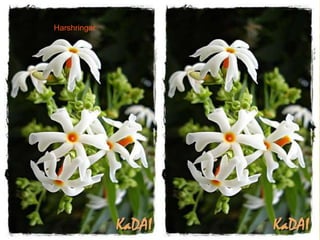
FRAGRANCE IN THE GARDEN-
IS A SOFT & SWEET
AESTHETIC TOUCH TO THE
HUMAN MIND
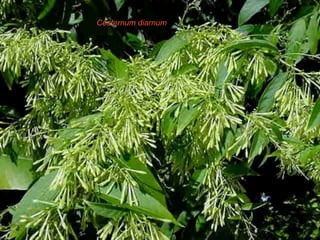
Cesternum diarnum
Harshringar
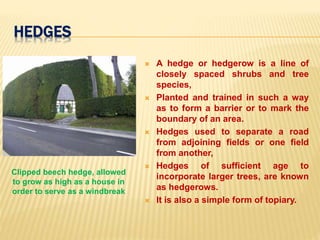
HEDGES
Clipped beech hedge, allowed
to grow as high as a house in
order to serve as a windbreak
 A hedge or hedgerow is a line of
closely spaced shrubs and tree
species,
 Planted and trained in such a way
as to form a barrier or to mark the
boundary of an area.
 Hedges used to separate a road
from adjoining fields or one field
from another,
 Hedges of sufficient age to
incorporate larger trees, are known
as hedgerows.
 It is also a simple form of topiary.
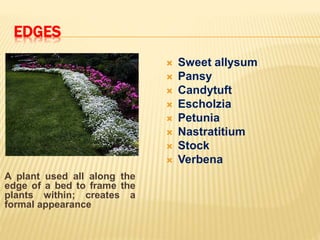
EDGES
A plant used all along the
edge of a bed to frame the
plants within; creates a
formal appearance
 Sweet allysum
 Pansy
 Candytuft
 Escholzia
 Petunia
 Nastratitium
 Stock
 Verbena
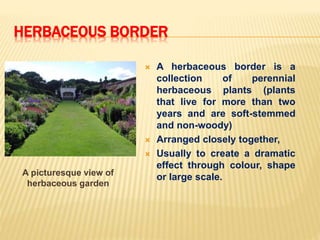
HERBACEOUS BORDER
A picturesque view of
herbaceous garden
 A herbaceous border is a
collection of perennial
herbaceous plants (plants
that live for more than two
years and are soft-stemmed
and non-woody)
 Arranged closely together,
 Usually to create a dramatic
effect through colour, shape
or large scale.
BOWER & PERGOLA
Pergola covered in
Bougainvillea.
 A pergola is a garden feature
forming a shaded walk or
passageway of pillars that support
cross beams and a sturdy open
lattice, upon which woody vines
are trained.
 As a type of gazebo, it may also be
an extension of a building,
 As protection for an open terrace
or a link between pavilions.
TOPIARY
It may be true, as I believe it is, that the natural form of a tree is the
most beautiful possible for that tree, but it may happen that we do not
want the most beautiful form, but one of our own designing, and
expressive of our ingenuity" (James Shirley Hibberd).
 Topiary is the art of creating
sculptures in the medium of
clipped trees, shrubs and sub-
shrubs.
 The shrubs and sub-shrubs
used in topiary are evergreen,
have small leaves or needles,
produce dense foliage, and
have compact and/or columnar
(e.g. fastigiated) growth habits.
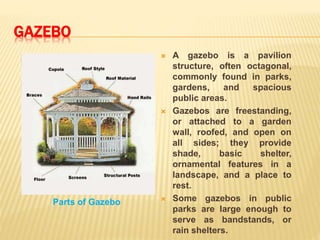
GAZEBO
Parts of Gazebo
 A gazebo is a pavilion
structure, often octagonal,
commonly found in parks,
gardens, and spacious
public areas.
 Gazebos are freestanding,
or attached to a garden
wall, roofed, and open on
all sides; they provide
shade, basic shelter,
ornamental features in a
landscape, and a place to
rest.
 Some gazebos in public
parks are large enough to
serve as bandstands, or
rain shelters.
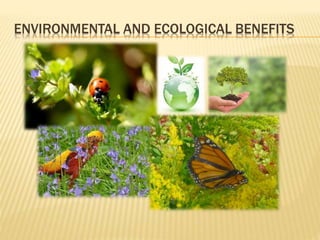
ENVIRONMENTAL AND ECOLOGICAL BENEFITS
TEMPERATURE
 Plants can be successfully used to mitigate
heat.
 Their leaves intercept, reflect, absorb and
transmit solar radiation.
 Trees are called nature's air conditioners,
because they lower air temperature, shade
buildings in the summer and block winter
winds.
 A single large tree can produce the cooling
effect of 10 room size air conditioners
operating 24 hours/day.
 Dew and frost are less common under trees,
because less radiant energy is released from
the soil in those areas at night.
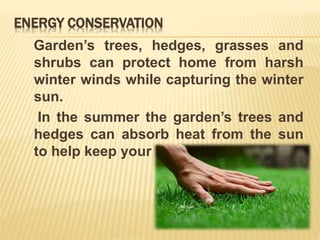
ENERGY CONSERVATION
Garden’s trees, hedges, grasses and
shrubs can protect home from harsh
winter winds while capturing the winter
sun.
In the summer the garden’s trees and
hedges can absorb heat from the sun
to help keep your home cooler.
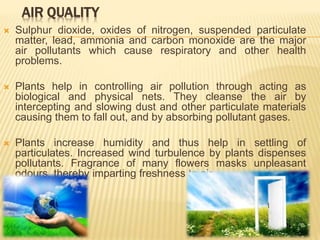
AIR QUALITY
 Sulphur dioxide, oxides of nitrogen, suspended particulate
matter, lead, ammonia and carbon monoxide are the major
air pollutants which cause respiratory and other health
problems.
 Plants help in controlling air pollution through acting as
biological and physical nets. They cleanse the air by
intercepting and slowing dust and other particulate materials
causing them to fall out, and by absorbing pollutant gases.
 Plants increase humidity and thus help in settling of
particulates. Increased wind turbulence by plants dispenses
pollutants. Fragrance of many flowers masks unpleasant
odours, thereby imparting freshness to air.
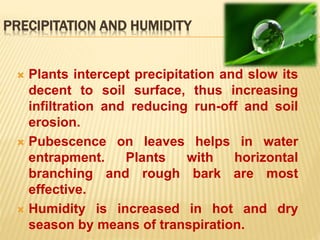
PRECIPITATION AND HUMIDITY
 Plants intercept precipitation and slow its
decent to soil surface, thus increasing
infiltration and reducing run-off and soil
erosion.
 Pubescence on leaves helps in water
entrapment. Plants with horizontal
branching and rough bark are most
effective.
 Humidity is increased in hot and dry
season by means of transpiration.
NOISE ABATEMENT
 Vegetation along the highways can screen
vehicular noise from reaching the
adjoining habitations.
 Plants also create “background” noise of
rustling of leaves and wind through the
branches that can help muffle other
noises.
 Plants having thick and fleshy leaves with
petioles which allow higher degree of
flexibility and vibration are best suited for
use as noise screens.
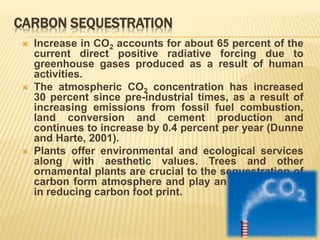
CARBON SEQUESTRATION
 Increase in CO2 accounts for about 65 percent of the
current direct positive radiative forcing due to
greenhouse gases produced as a result of human
activities.
 The atmospheric CO2 concentration has increased
30 percent since pre-industrial times, as a result of
increasing emissions from fossil fuel combustion,
land conversion and cement production and
continues to increase by 0.4 percent per year (Dunne
and Harte, 2001).
 Plants offer environmental and ecological services
along with aesthetic values. Trees and other
ornamental plants are crucial to the sequestration of
carbon form atmosphere and play an important role
in reducing carbon foot print.
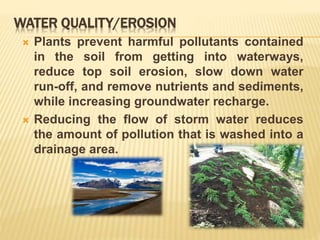
WATER QUALITY/EROSION
 Plants prevent harmful pollutants contained
in the soil from getting into waterways,
reduce top soil erosion, slow down water
run-off, and remove nutrients and sediments,
while increasing groundwater recharge.
 Reducing the flow of storm water reduces
the amount of pollution that is washed into a
drainage area.
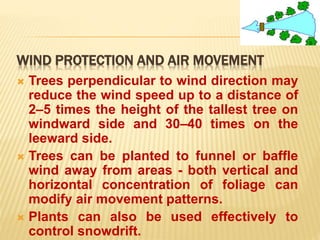
WIND PROTECTION AND AIR MOVEMENT
 Trees perpendicular to wind direction may
reduce the wind speed up to a distance of
2–5 times the height of the tallest tree on
windward side and 30–40 times on the
leeward side.
 Trees can be planted to funnel or baffle
wind away from areas - both vertical and
horizontal concentration of foliage can
modify air movement patterns.
 Plants can also be used effectively to
control snowdrift.
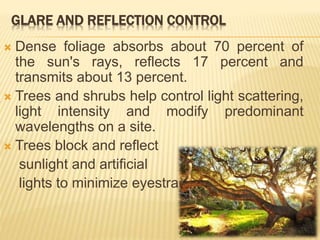
GLARE AND REFLECTION CONTROL
 Dense foliage absorbs about 70 percent of
the sun's rays, reflects 17 percent and
transmits about 13 percent.
 Trees and shrubs help control light scattering,
light intensity and modify predominant
wavelengths on a site.
 Trees block and reflect
sunlight and artificial
lights to minimize eyestrain.
ECOLOGICAL BALANCE
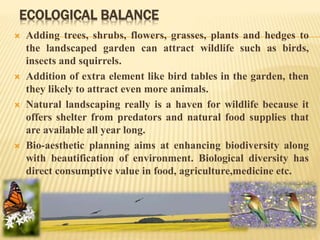
 Adding trees, shrubs, flowers, grasses, plants and hedges to
the landscaped garden can attract wildlife such as birds,
insects and squirrels.
 Addition of extra element like bird tables in the garden, then
they likely to attract even more animals.
 Natural landscaping really is a haven for wildlife because it
offers shelter from predators and natural food supplies that
are available all year long.
 Bio-aesthetic planning aims at enhancing biodiversity along
with beautification of environment. Biological diversity has
direct consumptive value in food, agriculture,medicine etc.
RECREATION
 Gardens and landscaped areas enhance the quality of life.
 Providing beautiful areas for recreation and relaxation, open
spaces in dense urban environments, appropriate spaces for
people of all ages and abilities, and facilities that support
community activity and cohesion.
 According to the American Journal of Preventive Medicine,
the “creation of or enhanced access to places for physical
activity combined with informational outreach” produced a
48.4% increase in frequency of physical activity in addition
to a 5.1 percent median increase in aerobic capacity, reduced
body fat, weight loss, improved flexibility and an increase in
perceived energy( Sherer, 2006).
CONTD….
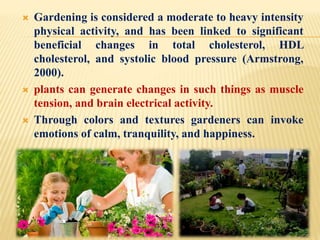
 Gardening is considered a moderate to heavy intensity
physical activity, and has been linked to significant
beneficial changes in total cholesterol, HDL
cholesterol, and systolic blood pressure (Armstrong,
2000).
 plants can generate changes in such things as muscle
tension, and brain electrical activity.
 Through colors and textures gardeners can invoke
emotions of calm, tranquility, and happiness.
 Concept & Planning
 Designing
 Development
 Maintenance
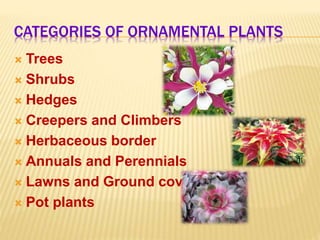
CATEGORIES OF ORNAMENTAL PLANTS
 Trees
 Shrubs
 Hedges
 Creepers and Climbers
 Herbaceous border
 Annuals and Perennials
 Lawns and Ground covers
 Pot plants
MAINTENANCE & GARDEN OPERATIONS
 Seasonal & Herbaceous plants
 Transplanting
 Potting & repotting
 Defoliation
 Disbudding & Pinching
 Tree works, Shrubs & Hedges
 Training
 Pruning
 Lopping
 Trimming
 Lawn Maintenance
 Mowing
 Rolling
 Aeration
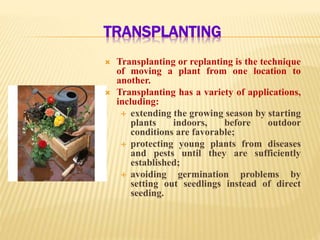
TRANSPLANTING
 Transplanting or replanting is the technique
of moving a plant from one location to
another.
 Transplanting has a variety of applications,
including:
 extending the growing season by starting
plants indoors, before outdoor
conditions are favorable;
 protecting young plants from diseases
and pests until they are sufficiently
established;
 avoiding germination problems by
setting out seedlings instead of direct
seeding.
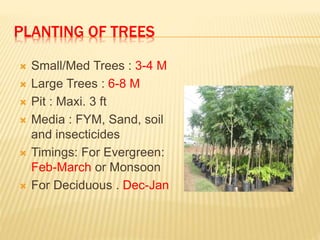
PLANTING OF TREES
 Small/Med Trees : 3-4 M
 Large Trees : 6-8 M
 Pit : Maxi. 3 ft
 Media : FYM, Sand, soil
and insecticides
 Timings: For Evergreen:
Feb-March or Monsoon
 For Deciduous . Dec-Jan
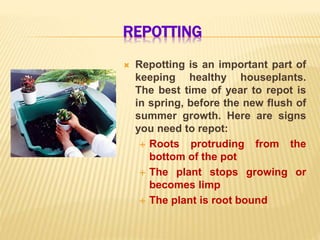
REPOTTING
 Repotting is an important part of
keeping healthy houseplants.
The best time of year to repot is
in spring, before the new flush of
summer growth. Here are signs
you need to repot:
 Roots protruding from the
bottom of the pot
 The plant stops growing or
becomes limp
 The plant is root bound
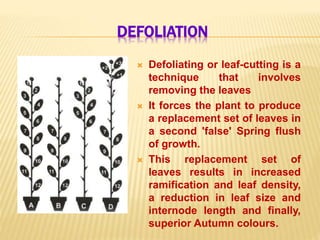
DEFOLIATION
 Defoliating or leaf-cutting is a
technique that involves
removing the leaves
 It forces the plant to produce
a replacement set of leaves in
a second 'false' Spring flush
of growth.
 This replacement set of
leaves results in increased
ramification and leaf density,
a reduction in leaf size and
internode length and finally,
superior Autumn colours.
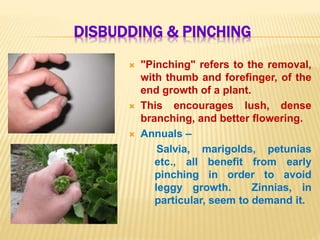
DISBUDDING & PINCHING
 "Pinching" refers to the removal,
with thumb and forefinger, of the
end growth of a plant.
 This encourages lush, dense
branching, and better flowering.
 Annuals –
Salvia, marigolds, petunias
etc., all benefit from early
pinching in order to avoid
leggy growth. Zinnias, in
particular, seem to demand it.
TRAINING
 A primary objective of training and
pruning is to develop a strong tree
framework that will support fruit
production.
 Improperly trained trees generally
have very upright branch angles,
which result in serious limb
breakage under a heavy fruit load.
 Another goal of annual training
and pruning is to remove dead,
diseased, or broken limbs.
PRUNING
 Pruning is the process of
removing certain above-ground
elements from a plant; in
landscaping this process
usually involves removal of
diseased, non-productive, or
otherwise unwanted portions
from a plant.
 The purpose is to shape the
plant by controlling or directing
plant growth, to maintain the
health of the plant, or to
increase the yield or quality of
flowers and fruits.
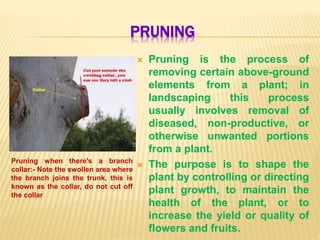
Pruning when there's a branch
collar:- Note the swollen area where
the branch joins the trunk, this is
known as the collar, do not cut off
the collar
LOPPING
 Lopping is a very severe form of
pruning which involves
removing all branches and
growths down to a few large
branches or to the trunk of the
tree.
 When performed correctly it is
used on very young trees, and
can be used to begin training
younger trees for pollarding or
for trellising to form an espalier.
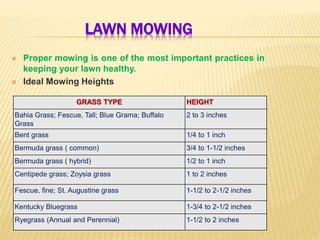
LAWN MOWING
GRASS TYPE HEIGHT
Bahia Grass; Fescue, Tall; Blue Grama; Buffalo
Grass
2 to 3 inches
Bent grass 1/4 to 1 inch
Bermuda grass ( common) 3/4 to 1-1/2 inches
Bermuda grass ( hybrid) 1/2 to 1 inch
Centipede grass; Zoysia grass 1 to 2 inches
Fescue, fine; St. Augustine grass 1-1/2 to 2-1/2 inches
Kentucky Bluegrass 1-3/4 to 2-1/2 inches
Ryegrass (Annual and Perennial) 1-1/2 to 2 inches
 Proper mowing is one of the most important practices in
keeping your lawn healthy.
 Ideal Mowing Heights
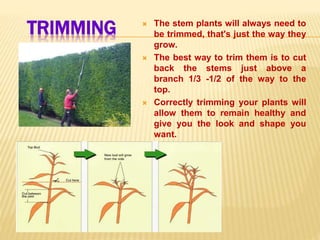
TRIMMING  The stem plants will always need to
be trimmed, that's just the way they
grow.
 The best way to trim them is to cut
back the stems just above a
branch 1/3 -1/2 of the way to the
top.
 Correctly trimming your plants will
allow them to remain healthy and
give you the look and shape you
want.
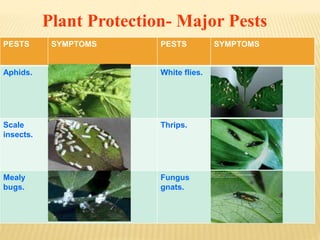
PESTS SYMPTOMS PESTS SYMPTOMS
Aphids. White flies.
Scale
insects.
Thrips.
Mealy
bugs.
Fungus
gnats.
Plant Protection- Major Pests
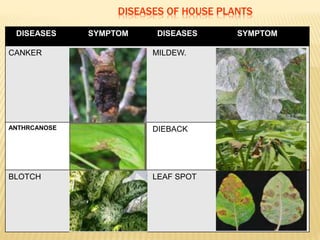
DISEASES SYMPTOM DISEASES SYMPTOM
CANKER MILDEW.
ANTHRCANOSE DIEBACK
BLOTCH LEAF SPOT
DISEASES OF HOUSE PLANTS
Thanks

Landscape gardening

  • 1.
    Landscaping : ATool For Beautification, Recreation and Ecological Balance Division of Floriculture & Landscaping Indian Agricultural Research Institute New Delhi-110012 BABITA SINGH
  • 2.
    LANDSCAPING It is anaesthetic branch of horticulture which deals with the planting of ornamental plant in such a way that it creates a picturesque effect. Or It is decoration of tract of land with plants and other garden material so as to produce a picturesque and naturalistic effect in a limited space.
  • 3.
    PRINCIPLES OF LANDSCAPING It is ideal like painting which express some single thought or feeling.(Joy,bold,retired,quiet etc.)  Beauty and utility should be harmoniously combined.  Area should be divided into different parts and plan should be conceived for each area.  Let the garden and building merge into each other.  Simplicity of design should be aimed  It should have open space.  Over crowding of plant and object should be avoided.
  • 4.
    FACTOR AFFECTING THELANDSCAPE DESIGN  Human choice  The site  Vies  Heritage  Climate  Soil
  • 5.
    Different elements ofLandscape design/gardening Water Pavement Building Plant material Land
  • 6.
  • 7.
    Focal Point orEmphasis Form
  • 8.
  • 9.
  • 10.
  • 11.
    STYLES OF GARDENING Formal styles: Plan is made on the paper then land is selected accordingly. It is symmetrical.  Informal styles:Refelects naturalistic effect of total view. It is asymmetrical.  Free style: Combines the good points of both formal and informal.
  • 12.
  • 13.
  • 14.
    SOME FACTORS THATINFLUENCE LANDSCAPES  Topography  Soil structure  The climate  The homes  Buildings  Other Physical Structures  Intended Use of the property  Clients Wants  Surrounding  Irrigation facilities
  • 15.
  • 16.
    Beautification Aesthetic Benefits Treesand other life forms supported by them have a positive value in scenic quality. Trees change skyline, add variety of form, colour and texture to otherwise dull and monotonous cities. They soften the harshness of concrete structures, complement architectural lines and provide background settings to buildings.
  • 18.
  • 19.
    Family and socialbenefits  A beautiful outside space can be used to relax, play and entertain in it.  It is an area that can be used to spend quality time in.  Children can play in a safe environment.
  • 20.
    INCREASE PROPERTY VALUE Estateagents and property experts are quick to point out that a well- landscaped garden can increase the value of home dramatically as well as to attract the business opportunities and appreciation in the real estate value.
  • 21.
    Functions of plantmaterial in landscape design 1) Architectural - act as wall (vertical plane), ceiling (overhead plane) and floors (base plane). 2) Aesthetic - • Provide visual accents / beautification. • Complementors - Unity with building - Repetition • Unifiers - Society street plantation • Emphasizers - accentuate certain points - in front of gate, on path. • Acknowledgers - Back side of sculpture / statue or symbols. • Softeners - harshness or rigidity or dryness of structure reduced. • View - Around temple or building or historical Enfacement monument.
  • 22.
    Plant material asan Emphasizer
  • 23.
    FRAGRANCE IN THEGARDEN- IS A SOFT & SWEET AESTHETIC TOUCH TO THE HUMAN MIND
  • 24.
  • 25.
  • 26.
    HEDGES Clipped beech hedge,allowed to grow as high as a house in order to serve as a windbreak  A hedge or hedgerow is a line of closely spaced shrubs and tree species,  Planted and trained in such a way as to form a barrier or to mark the boundary of an area.  Hedges used to separate a road from adjoining fields or one field from another,  Hedges of sufficient age to incorporate larger trees, are known as hedgerows.  It is also a simple form of topiary.
  • 27.
    EDGES A plant usedall along the edge of a bed to frame the plants within; creates a formal appearance  Sweet allysum  Pansy  Candytuft  Escholzia  Petunia  Nastratitium  Stock  Verbena
  • 28.
    HERBACEOUS BORDER A picturesqueview of herbaceous garden  A herbaceous border is a collection of perennial herbaceous plants (plants that live for more than two years and are soft-stemmed and non-woody)  Arranged closely together,  Usually to create a dramatic effect through colour, shape or large scale.
  • 29.
    BOWER & PERGOLA Pergolacovered in Bougainvillea.  A pergola is a garden feature forming a shaded walk or passageway of pillars that support cross beams and a sturdy open lattice, upon which woody vines are trained.  As a type of gazebo, it may also be an extension of a building,  As protection for an open terrace or a link between pavilions.
  • 30.
    TOPIARY It may betrue, as I believe it is, that the natural form of a tree is the most beautiful possible for that tree, but it may happen that we do not want the most beautiful form, but one of our own designing, and expressive of our ingenuity" (James Shirley Hibberd).  Topiary is the art of creating sculptures in the medium of clipped trees, shrubs and sub- shrubs.  The shrubs and sub-shrubs used in topiary are evergreen, have small leaves or needles, produce dense foliage, and have compact and/or columnar (e.g. fastigiated) growth habits.
  • 31.
    GAZEBO Parts of Gazebo A gazebo is a pavilion structure, often octagonal, commonly found in parks, gardens, and spacious public areas.  Gazebos are freestanding, or attached to a garden wall, roofed, and open on all sides; they provide shade, basic shelter, ornamental features in a landscape, and a place to rest.  Some gazebos in public parks are large enough to serve as bandstands, or rain shelters.
  • 32.
  • 33.
    TEMPERATURE  Plants canbe successfully used to mitigate heat.  Their leaves intercept, reflect, absorb and transmit solar radiation.  Trees are called nature's air conditioners, because they lower air temperature, shade buildings in the summer and block winter winds.  A single large tree can produce the cooling effect of 10 room size air conditioners operating 24 hours/day.  Dew and frost are less common under trees, because less radiant energy is released from the soil in those areas at night.
  • 34.
    ENERGY CONSERVATION Garden’s trees,hedges, grasses and shrubs can protect home from harsh winter winds while capturing the winter sun. In the summer the garden’s trees and hedges can absorb heat from the sun to help keep your home cooler.
  • 35.
    AIR QUALITY  Sulphurdioxide, oxides of nitrogen, suspended particulate matter, lead, ammonia and carbon monoxide are the major air pollutants which cause respiratory and other health problems.  Plants help in controlling air pollution through acting as biological and physical nets. They cleanse the air by intercepting and slowing dust and other particulate materials causing them to fall out, and by absorbing pollutant gases.  Plants increase humidity and thus help in settling of particulates. Increased wind turbulence by plants dispenses pollutants. Fragrance of many flowers masks unpleasant odours, thereby imparting freshness to air.
  • 36.
    PRECIPITATION AND HUMIDITY Plants intercept precipitation and slow its decent to soil surface, thus increasing infiltration and reducing run-off and soil erosion.  Pubescence on leaves helps in water entrapment. Plants with horizontal branching and rough bark are most effective.  Humidity is increased in hot and dry season by means of transpiration.
  • 37.
    NOISE ABATEMENT  Vegetationalong the highways can screen vehicular noise from reaching the adjoining habitations.  Plants also create “background” noise of rustling of leaves and wind through the branches that can help muffle other noises.  Plants having thick and fleshy leaves with petioles which allow higher degree of flexibility and vibration are best suited for use as noise screens.
  • 38.
    CARBON SEQUESTRATION  Increasein CO2 accounts for about 65 percent of the current direct positive radiative forcing due to greenhouse gases produced as a result of human activities.  The atmospheric CO2 concentration has increased 30 percent since pre-industrial times, as a result of increasing emissions from fossil fuel combustion, land conversion and cement production and continues to increase by 0.4 percent per year (Dunne and Harte, 2001).  Plants offer environmental and ecological services along with aesthetic values. Trees and other ornamental plants are crucial to the sequestration of carbon form atmosphere and play an important role in reducing carbon foot print.
  • 39.
    WATER QUALITY/EROSION  Plantsprevent harmful pollutants contained in the soil from getting into waterways, reduce top soil erosion, slow down water run-off, and remove nutrients and sediments, while increasing groundwater recharge.  Reducing the flow of storm water reduces the amount of pollution that is washed into a drainage area.
  • 40.
    WIND PROTECTION ANDAIR MOVEMENT  Trees perpendicular to wind direction may reduce the wind speed up to a distance of 2–5 times the height of the tallest tree on windward side and 30–40 times on the leeward side.  Trees can be planted to funnel or baffle wind away from areas - both vertical and horizontal concentration of foliage can modify air movement patterns.  Plants can also be used effectively to control snowdrift.
  • 41.
    GLARE AND REFLECTIONCONTROL  Dense foliage absorbs about 70 percent of the sun's rays, reflects 17 percent and transmits about 13 percent.  Trees and shrubs help control light scattering, light intensity and modify predominant wavelengths on a site.  Trees block and reflect sunlight and artificial lights to minimize eyestrain.
  • 42.
    ECOLOGICAL BALANCE  Addingtrees, shrubs, flowers, grasses, plants and hedges to the landscaped garden can attract wildlife such as birds, insects and squirrels.  Addition of extra element like bird tables in the garden, then they likely to attract even more animals.  Natural landscaping really is a haven for wildlife because it offers shelter from predators and natural food supplies that are available all year long.  Bio-aesthetic planning aims at enhancing biodiversity along with beautification of environment. Biological diversity has direct consumptive value in food, agriculture,medicine etc.
  • 43.
    RECREATION  Gardens andlandscaped areas enhance the quality of life.  Providing beautiful areas for recreation and relaxation, open spaces in dense urban environments, appropriate spaces for people of all ages and abilities, and facilities that support community activity and cohesion.  According to the American Journal of Preventive Medicine, the “creation of or enhanced access to places for physical activity combined with informational outreach” produced a 48.4% increase in frequency of physical activity in addition to a 5.1 percent median increase in aerobic capacity, reduced body fat, weight loss, improved flexibility and an increase in perceived energy( Sherer, 2006). CONTD….
  • 44.
     Gardening isconsidered a moderate to heavy intensity physical activity, and has been linked to significant beneficial changes in total cholesterol, HDL cholesterol, and systolic blood pressure (Armstrong, 2000).  plants can generate changes in such things as muscle tension, and brain electrical activity.  Through colors and textures gardeners can invoke emotions of calm, tranquility, and happiness.
  • 45.
     Concept &Planning  Designing  Development  Maintenance
  • 46.
    CATEGORIES OF ORNAMENTALPLANTS  Trees  Shrubs  Hedges  Creepers and Climbers  Herbaceous border  Annuals and Perennials  Lawns and Ground covers  Pot plants
  • 47.
    MAINTENANCE & GARDENOPERATIONS  Seasonal & Herbaceous plants  Transplanting  Potting & repotting  Defoliation  Disbudding & Pinching  Tree works, Shrubs & Hedges  Training  Pruning  Lopping  Trimming  Lawn Maintenance  Mowing  Rolling  Aeration
  • 48.
    TRANSPLANTING  Transplanting orreplanting is the technique of moving a plant from one location to another.  Transplanting has a variety of applications, including:  extending the growing season by starting plants indoors, before outdoor conditions are favorable;  protecting young plants from diseases and pests until they are sufficiently established;  avoiding germination problems by setting out seedlings instead of direct seeding.
  • 49.
    PLANTING OF TREES Small/Med Trees : 3-4 M  Large Trees : 6-8 M  Pit : Maxi. 3 ft  Media : FYM, Sand, soil and insecticides  Timings: For Evergreen: Feb-March or Monsoon  For Deciduous . Dec-Jan
  • 50.
    REPOTTING  Repotting isan important part of keeping healthy houseplants. The best time of year to repot is in spring, before the new flush of summer growth. Here are signs you need to repot:  Roots protruding from the bottom of the pot  The plant stops growing or becomes limp  The plant is root bound
  • 51.
    DEFOLIATION  Defoliating orleaf-cutting is a technique that involves removing the leaves  It forces the plant to produce a replacement set of leaves in a second 'false' Spring flush of growth.  This replacement set of leaves results in increased ramification and leaf density, a reduction in leaf size and internode length and finally, superior Autumn colours.
  • 52.
    DISBUDDING & PINCHING "Pinching" refers to the removal, with thumb and forefinger, of the end growth of a plant.  This encourages lush, dense branching, and better flowering.  Annuals – Salvia, marigolds, petunias etc., all benefit from early pinching in order to avoid leggy growth. Zinnias, in particular, seem to demand it.
  • 53.
    TRAINING  A primaryobjective of training and pruning is to develop a strong tree framework that will support fruit production.  Improperly trained trees generally have very upright branch angles, which result in serious limb breakage under a heavy fruit load.  Another goal of annual training and pruning is to remove dead, diseased, or broken limbs.
  • 54.
    PRUNING  Pruning isthe process of removing certain above-ground elements from a plant; in landscaping this process usually involves removal of diseased, non-productive, or otherwise unwanted portions from a plant.  The purpose is to shape the plant by controlling or directing plant growth, to maintain the health of the plant, or to increase the yield or quality of flowers and fruits. Pruning when there's a branch collar:- Note the swollen area where the branch joins the trunk, this is known as the collar, do not cut off the collar
  • 55.
    LOPPING  Lopping isa very severe form of pruning which involves removing all branches and growths down to a few large branches or to the trunk of the tree.  When performed correctly it is used on very young trees, and can be used to begin training younger trees for pollarding or for trellising to form an espalier.
  • 56.
    LAWN MOWING GRASS TYPEHEIGHT Bahia Grass; Fescue, Tall; Blue Grama; Buffalo Grass 2 to 3 inches Bent grass 1/4 to 1 inch Bermuda grass ( common) 3/4 to 1-1/2 inches Bermuda grass ( hybrid) 1/2 to 1 inch Centipede grass; Zoysia grass 1 to 2 inches Fescue, fine; St. Augustine grass 1-1/2 to 2-1/2 inches Kentucky Bluegrass 1-3/4 to 2-1/2 inches Ryegrass (Annual and Perennial) 1-1/2 to 2 inches  Proper mowing is one of the most important practices in keeping your lawn healthy.  Ideal Mowing Heights
  • 57.
    TRIMMING  Thestem plants will always need to be trimmed, that's just the way they grow.  The best way to trim them is to cut back the stems just above a branch 1/3 -1/2 of the way to the top.  Correctly trimming your plants will allow them to remain healthy and give you the look and shape you want.
  • 58.
    PESTS SYMPTOMS PESTSSYMPTOMS Aphids. White flies. Scale insects. Thrips. Mealy bugs. Fungus gnats. Plant Protection- Major Pests
  • 59.
    DISEASES SYMPTOM DISEASESSYMPTOM CANKER MILDEW. ANTHRCANOSE DIEBACK BLOTCH LEAF SPOT DISEASES OF HOUSE PLANTS
  • 60.