Vermi-Compost
&

Phospho-Compost
Dr. P. K. Mani

Bidhan Chandra Krishi Viswavidyalaya
E-mail: pabitramani@gmail.com
Website: www.bckv.edu.in
The word ‘vermi’ is coined from Latin word which means
worm, so vermicompost is the compost mediated by the
worm (earthworm).
Charles Darwin(1881)
Obsn:
How Lime+ charcoal go down to lower layer
from soil surface?
Materials were taken from surface to lower layers by Earthworms

 Book “Formation of vegetable mould”
(= humified soil layer) with the activities of Earth Worm)
A.A.Yarilov (1930) endorsed it
“Charles Darwin-the founder of soil science”(Book)
Earthworms: (“r” and “K” selections) (M.B.Bouche,1977)
Epigeic: Small size, colour uniform, surface dweller,
best thrive in 4-30°C, 50-60 % moisture,
phytophagous, short life cycle, good
biodegradators but do not re-distribute nutrients.
(“r” selected spp. have high metabolic rate, small
body size, high reproduction rate)
Endogeic : Small to medium size, weak pigmentation,
geophagous, life cycle is intermediate, high
efficiency in energy utilsation from poor
soil(“r”)
 Aneciques: bigger size, pigmentation in both end,
nocturnal, deep burrowing, phytogeophagous
(“k” selected spp. Have low metabolic rate, long
body size with long life span)
Earthworms suitable for Vermi-Composting:
 Surface feeder

High reproductive rate
High growth rate
High organic content in the dietary requirement
High metabolic activity
Low retention in body
Capacity to adjust under adverse condition
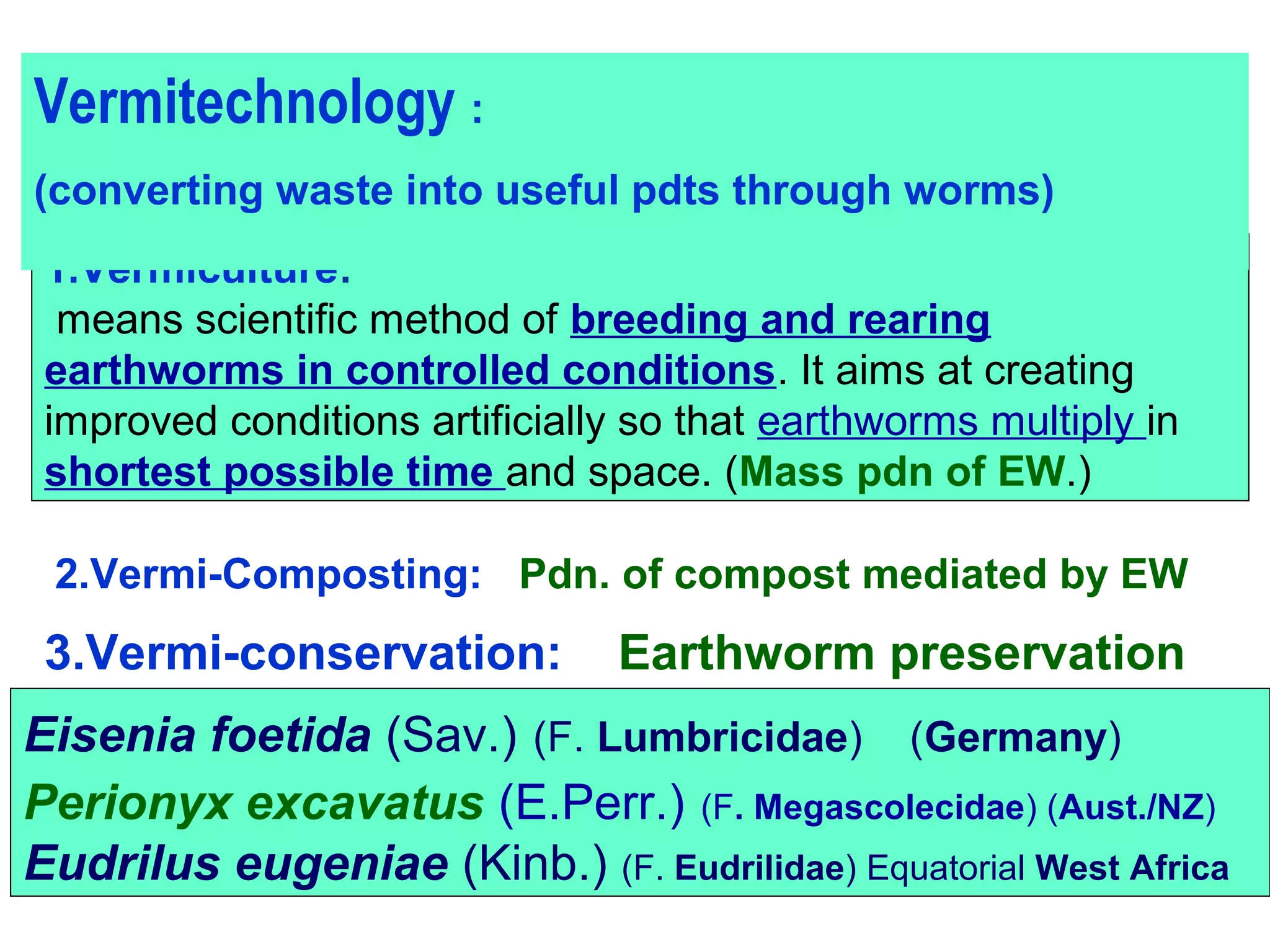
Vermitechnology :
(converting waste into useful pdts through worms)
1.Vermiculture:
means scientific method of breeding and rearing
earthworms in controlled conditions. It aims at creating
improved conditions artificially so that earthworms multiply in
shortest possible time and space. (Mass pdn of EW.)
2.Vermi-Composting: Pdn. of compost mediated by EW

3.Vermi-conservation:

Earthworm preservation

Eisenia foetida (Sav.) (F. Lumbricidae) (Germany)
Perionyx excavatus (E.Perr.) (F. Megascolecidae) (Aust./NZ)
Eudrilus eugeniae (Kinb.) (F. Eudrilidae) Equatorial West Africa
Worms are part of the animal kingdom
These are called

Eisenia foetida but you may know them as

 Red Worm
 Tiger Worm
 Red Wiggler
A Worm Is Born!

Each cocoon can have 1-5 worms. If conditions are not right for
hatching, such as dryness, many cocoons can be dormant for years
and hatch when conditions are right.
Method of Vermicompost Making

Organic wastes are mixed with cow dung, live soil and farmyard manure
at the ratio of 6: 3: 0.5: 0.5 on dry weight basis.
A compost heap is constructed by using above mentioned materials
and allowed to decompose at least 15 days.
For commercial purpose or large scale productions, composting is done
in a trench. Generally, a trench is prepared under a shade
Stop watering 2-3 days before harvest
Keep it for 60-70 days without
disturbance
Spread moist gunny bag Add Sufficient water so that
Earthworm @ 10/kg waste moisture becomes 50-60%
shade

3-3.5ft

1.5ft

Partial decomposed waste pdt.
unchopped straw
layer of sand
stone chips
Length(10ft)
Method of Vermicompost Making
Few steps are followed for making compost.
1st step: Organic wastes are mixed with cow dung, live soil and farmyard manure
at the ratio of 6: 3: 0.5: 0.5 on dry weight basis. A compost heap is
constructed by using above mentioned materials and allowed to decompose
least 15 days.
2nd step: For commercial purpose or large scale productions, composting is done
in a trench. Generally, a trench having 10ft long, 3ft width and 1.5ft deep
with a shade is followed.
3rd step: Entire bottom of is trench is covered with stone chips(2″). A layer of sand is
spread over it to facilitate percolation of excess water. A permanent bed with
unchopped straw is constructed above which the partial decomposed materials
obtained from first step is to be laded.
4th step: Pre-decomposed material in the trench is watered sufficiently so that
moisture content may be maintained around 50-60%.
5th step: Adult earthworms @10/kg composting material are generally released in the
trench.
6th step: Entire surface has to be covered with moist gunny bag. The earthworms are
allowed to multiply and digest the materials in an undisturbed condition for at
least 60 days.
7th step: If black to brown granules are appeared just below the gunny bag then it is
considered that composting is completed. (appeared like CTC Tea)
8th step: Watering is withheld for 3-4 days before harvest.
9th step: The compost is harvested from the surface(7″) after removing the gunny bag.
10th step: Reload the trench with decomposed materials.
Pits below the ground
Pits made for vermicomposting are 1 m deep and 1.5 m wide. The length varies as
required.

Heaping above the ground
The waste material is spread on a polythene sheet placed on the ground and then
covered with cattle dung.
Sunitha et al. (1997) compared the efficacy of pit and heap methods of preparing
vermicompost under field conditions and found that the heap method of preparing
vermicompost was better than the pit method.
(i) Earthworm population was high in the heap method, with a 21-fold increase in
Eudrilus eugenae as compared to 17-fold increase in the pit method.
(ii) Biomass production was also higher in the heap method (46-fold increase)
than in the pit method (31-fold).
(iii) production of vermicompost was also higher in the heap method (51 kg) than
in the pit method (40 kg).

Tanks above the ground
Tanks made up of different materials such as normal bricks, hollow bricks, shabaz
stones, asbestos sheets and locally available rocks were evaluated for VC prepn.
Tanks can be constructed with the dimensions suitable for operations. At
ICRISATconstructed tanks with dimensions of 1.5 m (5 feet) width, 4.5 m (15 feet)
length and 0.9 m (3 feet) height. The commercial biodigester contains a partition wall
with small holes to facilitate easy movement of earthworms from one tank to the other.
Cement rings
Vermicompost can also be prepared above the ground by using cement rings
(ICRISAT and APRLP 2003). The size of the cement ring should be 90 cm in
diameter and 30 cm in height. The details of preparing vermicompost by this
method have been described in a later section.

Conversion rates:
1000 earth worms may convert 5 kg waste material per day
1000 worms weighs about a kilogram

Commercial model
The commercial model for vermicomposting developed by ICRISAT
consists of 4 chambers enclosed by a wall (1.5 m width, 4.5 m length and
0.9 m height) (Fig. 2). The walls are made up of different materials such as
normal bricks, hollow bricks, shabaz stones, asbestos sheets and locally
available rocks. This model contains partition walls with small holes to
facilitate easy movement of earthworms from one chamber to another.
Providing an outlet at one corner of each chamber with a slight slope
facilitates collection of excess water, which is reused later or used as
earthworm leachate on crop. (The outline of the commercial model is given
in Fig.3).
The four components of a tank are filled with plant residues
one after another. The 1st chamber is filled layer by layer along
with cow dung and then earthworms are released. Then the 2nd
chamber is filled layer by layer. Once the contents in the 1st
chamber are processed the earthworms move to chamber 2,
which is already filled and ready for earthworms. This facilitates
harvesting of decomposed material from the 1st chamber and also
saves labor for harvesting and introducing earthworms. This
technology reduces labor cost and saves water as well as time.
Precautions during the process
• The African species of earthworms, Eisenia fetida and Eudrilus
eugenae are ideal for the preparation of vermicompost. Most Indian
species are not suitable for the purpose.
• Only plant-based materials such as grass, leaves or vegetable
peelings should be utilized in preparing vermicompost.
• Materials of animal origin such as eggshells, meat, bone, chicken
droppings, etc are not suitable for preparing vermicompost.
• Gliricidia loppings and tobacco leaves are not suitable for rearing
earthworms.
 The earthworms should be protected against birds, termites, ants
and rats.
(100g

Chilli dust + 100g turmeric powder + 100g salt + surf
in 20L water, for red ant control)
(Rat control, mix 50g dry fish +2g Zinc phosphide, kept in 5-6

place of the shade)

• Adequate moisture should be maintained during the process. Either
stagnant water or lack of moisture could kill the earthworms.
•
Characteristics of Good Vermicompost
Fully decomposed and matured org. manure with C: N = 15: 1
Granulated
 Contains essential plant nutrients

Rich in secondary minerals especially Ca
 Rich in millions of beneficial bacteria, particularly N-fixer
Rich in humus (Humic acid)
Rich in vitamins and growth regulators (Gibberalic acid)
Enzymes : Protease ,Lipase ,Amylase , Cellulose

 Nutrients In assimilable form and suitable for any type of soil
Non-toxic, environmental friendly and ecologically compatible
Benefits of Vermicompost
Increases growth, flowering and fruiting.(Gn, Cn, Auxin)
 Develops soil structure for better root alteration.
 Helps root elongation for better uptake.
 Free from weed seeds and harmful pathogens.
 Helps to fix atmospheric nitrogen (Aztb. Azosp)
 Helps phosphate solubilization by bacteria.
Fresh vermicompost increases worm population and
ensures longer sustenance of soil fertility.
 Improves water retention capacity, aeration status
Contributes to better marketable products by improving quality.
Releases nutrients slowly.
Nutrient profile of Vermicompost and farmyard manure
Nutrient

Vermicompost

Farmyard Manure

1-1.6

0.5-0.75

Phosphorus

1.2-1.45

0.25-0.27

Potassium

0.8-1.1

0.3-0.5

Calcium

0.5

0.9

Magnesium

0.2

0.2

Iron

175.0

146.5

Manganese

96.5

69.0

Zinc

24.5

14.5

Copper

5.0

2.8

C: N ratio

25.5

31.3

Major nutrient (%)

Nitrogen

Micronutrient (ppm)

pH (1: 5) water suspension

7.50

CEC (cmole (p+) kg-1

110.3

Organic Carbon (g kg-1)

115.8
Vermicompost can be used for all crops: agricultural, horticultural,
ornamental and vegetables at any stage of the crop

Microbes present in the Vermicompost Pit

Microbes
Bacteria

No./ g wet compost

Actinomycetes

105-108

Fingi, Yeast
Protozoa

104-106
104-105

108-109

Dose of Vermicompost :
For Field crops: 2-5 t/ha
For flowers: Vermicompost is applied at 750–1000 kg ha-1.
For vegetables: 7.5 t/ha
Fruit Tree: 200-500g/ plant depending on tree and age of tree
Vermi-Wash
Vermiwash is a watery extract of compost, the wash of
earthworms present in the medium. Earthworm body is
filled up with Celomic fluid. Celomic fluid is always
secreted from the body of earthworms and always keeps
the body of wet. We can collect Celomic fluid of
earthworms and this is called vermiwash.

Vermi-Compost
Vermicompost is the product or process of composting
utilizing various species of worms, to create a
heterogeneous mixture of decomposing vegetable or food
waste, bedding materials, and vermicast

Vermi-Castings
Vermicast, similarly known as worm castings, worm
humus or worm manure, is the end-product of the
breakdown of organic matter by a species of earthworm.
Worm Castings

Benefit the Soil &

Produce Healthier Plants

Tomato Seedlings with (on left) and without worm castings
resulted in a 50% higher germination
Worm Castings Benefit the Soil & Produce Healthier Plants

Use of vermicompost produced shoots that were 41%
longer than commercial potting medium & 48.5%
heavier
Worm Castings
Benefit the Soil &
Produce Healthier Plants

Vermicompost Increased total # of flowers by 19% as well
as flower size
One teaspoon of good garden soil to which
compost has been added contains:

• 100 million bacteria
• 800 feet of fungal threads
Vermiculture industry or vermicompost preparation:
1. Basic raw material : Any organic material generated in the farm like
bhusa ,leaf fall
etc.,
2. Starter : Cow dung ,Biogas slurry , or urine of cattle
3. Soil animal : Earth worms (Species: Eisenia foetida )
Favourable conditions of earth worms in the composting material:
A. pH : Range between 6.5 and 7.5
B. Moisture : 60-70 % of the moisture below and above range moderately of
worms taking place
C. Aeration : 50 % aeration from the total pore space
D. Temperature: Range between 18 0C to 35 0C
Phosphocompost
Principles of phospho-composting
Phospho-composting is based on sound scientific
principles. During the decomposition of organic
materials, intense microbial activity occurs. As a
result a large number of organic acids and humic
substances are produced.
Some of the most commonly produced organic
acids are: citric, malic, fumaric, succinic, pyruvic,
tartaric, oxaloacetic, 2-ketogluconic, lacticoxalic,
propionic and butyric (Stevenson, 1967).
Phospho-compost is a compost prepared by addition
of low grade rock phosphate and phosphate
solubilizing micro-organisms with organic wastes.
Rock phosphate, as a cheaper source of P
In the process of decomposition many organic
acids are liberated.
Due to this acidic condition, P from rock
phosphate gets solubilized and compost
becomes enriched.
PHOSPHOCOMPOST
Ingredients:
Oragnic wastes
Raw Cow dung
Compost
Soil
Total
Rockphosphate
Pyrite
Urea
Cultures

: 80 kg (60 kg dry+20 kg green)
: 10 kg
:
5 kg
:
5 kg
: 100 kg
: 20 kg
: 10 kg
: 2.2 kg
: 0.05 kg

Dry organic wastes: Straw, husk, waste from cattle shed, stems of
mustard , sesame, etc.
Green : Waterhyacinth, legumes, weeds, vegetable clippngs, leaves,
grasses
Nitrogen required for Stimulating the microbial activity
Pyrites are added due to acidification of the mixture during
composting to prevent volatilization loss of N and
also to increase P solubilization

Phosphate Rocks
Cellulose decomposer: Aspergillus awamori (fungi)
(500g mycelial mat / ton of materials)
P-solubilizers:

Bacillus megatherium.
Bacillus polymyxa,
Pseudomonas striata

(50 ml/kg of materials having 108 viable cell)
Divide entire Organic and inorganic component in 10 equal parts

Preparation of 1st Layer

I part Phosphate Rock and I part Pyrite
Urea + microbial Cultures make it a slurry
I part cowdung + compost + Soil make slurry in water

9-12//

Dry organic wastes

Covered with Polythene sheet
g
dun
w
+ co
il
h so
it
ud w
fm
er o
Lay

4th Layer
3rd Layer
2nd Layer
1st Layer

Keep it for 3 months , yielding 65-70 kg PhosphoCompost
Method of Phosphocompost Making
•Select a suitable upland place, sufficient sunlight, free from water stagnation
•Prepare a base with either brick floor or spread the polythene sheet on the floor
•Collect all the ingredients (organic and inorganic) as per proper ratio for the
desired pdn level.
•Divide the entire ingredients into 10 parts
•Step-1:Take one bucket and add Raw Cow dung- 1kg, Compost- 0.5 kg,
Soil -0. 5 kg and small water, stir the material and make a slurry.
•Step-2: Take 2nd bucket and add urea-200g, cultures-5g and add water small,
make another slurry
•Step-3:Spread dry wastes followed by green wastes and make it 12″ height
•Step-4:Now add slurry from 1st bucket (cow dung etc slurry), next add slurry
from 2nd bucket and spread evenly.
•Step-5: Now spread 2 kg Rock phosphate and1 kg Pyrite
•Repeat the process Step-1 to step 5 and repeat until 10 layers is formed.
• covered the top and side portion of the heap with Layer of mud (soil+
cowdung) and subsequently cover with poly thene sheet to prevent water
•1st turnings after 4 weeks and 2nd turnings after 8 weeks
• Water is added to the heap so that moisture remains between 60 to 70%.
•Add water at each turning to maintain the moisture content between 60 and 70%.
•The compost becomes ready for field application within 90-100 days period.
Nutrient composition of phosphocompost

Manure
Phosphocompost

Total N
(%)

Total P
(%)

S

C: N
ratio

1.2-1.4

2.00-3.50

1.5-2.0

17.018.0

Phospho-compost application increased the PUE
of greengram (12.90%) and wheat (20.48%) over
SSP
(Mishra et al. 1982).
How to Use Vermicompost?
• Fruit trees:
The amount of vermicompost ranges from 5 to 10 kg per tree
depending on the age of the plant. For efficient application, a ring
(15–18 cm deep) is made around the plant. A thin layer of dry cow
dung and bone meal is spread along with 2–5 kg of vermicompost
and water is sprayed on the surface after covering with soil.
• Vegetables:
For raising seedlings to be transplanted, vermicompost at 1 t ha-1 is
applied in the nursery bed. This results in healthy and vigorous
seedlings. But for transplants, vermicompost at the rate of 400–500 g
per plant is applied initially at the time of planting and 45 days after
planting (before irrigation).
• For vegetable and flower crops vermicompost is applied around the
base of the plant. It is then covered with soil and watered regularly.

Vermi composting, phosphhocompost, pk mani

  • 1.
    Vermi-Compost & Phospho-Compost Dr. P. K.Mani Bidhan Chandra Krishi Viswavidyalaya E-mail: pabitramani@gmail.com Website: www.bckv.edu.in
  • 2.
    The word ‘vermi’is coined from Latin word which means worm, so vermicompost is the compost mediated by the worm (earthworm). Charles Darwin(1881) Obsn: How Lime+ charcoal go down to lower layer from soil surface? Materials were taken from surface to lower layers by Earthworms  Book “Formation of vegetable mould” (= humified soil layer) with the activities of Earth Worm) A.A.Yarilov (1930) endorsed it “Charles Darwin-the founder of soil science”(Book)
  • 3.
    Earthworms: (“r” and“K” selections) (M.B.Bouche,1977) Epigeic: Small size, colour uniform, surface dweller, best thrive in 4-30°C, 50-60 % moisture, phytophagous, short life cycle, good biodegradators but do not re-distribute nutrients. (“r” selected spp. have high metabolic rate, small body size, high reproduction rate) Endogeic : Small to medium size, weak pigmentation, geophagous, life cycle is intermediate, high efficiency in energy utilsation from poor soil(“r”)  Aneciques: bigger size, pigmentation in both end, nocturnal, deep burrowing, phytogeophagous (“k” selected spp. Have low metabolic rate, long body size with long life span)
  • 4.
    Earthworms suitable forVermi-Composting:  Surface feeder High reproductive rate High growth rate High organic content in the dietary requirement High metabolic activity Low retention in body Capacity to adjust under adverse condition
  • 5.
    Vermitechnology : (converting wasteinto useful pdts through worms) 1.Vermiculture: means scientific method of breeding and rearing earthworms in controlled conditions. It aims at creating improved conditions artificially so that earthworms multiply in shortest possible time and space. (Mass pdn of EW.) 2.Vermi-Composting: Pdn. of compost mediated by EW 3.Vermi-conservation: Earthworm preservation Eisenia foetida (Sav.) (F. Lumbricidae) (Germany) Perionyx excavatus (E.Perr.) (F. Megascolecidae) (Aust./NZ) Eudrilus eugeniae (Kinb.) (F. Eudrilidae) Equatorial West Africa
  • 6.
    Worms are partof the animal kingdom These are called Eisenia foetida but you may know them as  Red Worm  Tiger Worm  Red Wiggler
  • 7.
    A Worm IsBorn! Each cocoon can have 1-5 worms. If conditions are not right for hatching, such as dryness, many cocoons can be dormant for years and hatch when conditions are right.
  • 8.
    Method of VermicompostMaking Organic wastes are mixed with cow dung, live soil and farmyard manure at the ratio of 6: 3: 0.5: 0.5 on dry weight basis. A compost heap is constructed by using above mentioned materials and allowed to decompose at least 15 days. For commercial purpose or large scale productions, composting is done in a trench. Generally, a trench is prepared under a shade Stop watering 2-3 days before harvest Keep it for 60-70 days without disturbance Spread moist gunny bag Add Sufficient water so that Earthworm @ 10/kg waste moisture becomes 50-60% shade 3-3.5ft 1.5ft Partial decomposed waste pdt. unchopped straw layer of sand stone chips Length(10ft)
  • 9.
    Method of VermicompostMaking Few steps are followed for making compost. 1st step: Organic wastes are mixed with cow dung, live soil and farmyard manure at the ratio of 6: 3: 0.5: 0.5 on dry weight basis. A compost heap is constructed by using above mentioned materials and allowed to decompose least 15 days. 2nd step: For commercial purpose or large scale productions, composting is done in a trench. Generally, a trench having 10ft long, 3ft width and 1.5ft deep with a shade is followed. 3rd step: Entire bottom of is trench is covered with stone chips(2″). A layer of sand is spread over it to facilitate percolation of excess water. A permanent bed with unchopped straw is constructed above which the partial decomposed materials obtained from first step is to be laded. 4th step: Pre-decomposed material in the trench is watered sufficiently so that moisture content may be maintained around 50-60%. 5th step: Adult earthworms @10/kg composting material are generally released in the trench. 6th step: Entire surface has to be covered with moist gunny bag. The earthworms are allowed to multiply and digest the materials in an undisturbed condition for at least 60 days. 7th step: If black to brown granules are appeared just below the gunny bag then it is considered that composting is completed. (appeared like CTC Tea) 8th step: Watering is withheld for 3-4 days before harvest. 9th step: The compost is harvested from the surface(7″) after removing the gunny bag. 10th step: Reload the trench with decomposed materials.
  • 10.
    Pits below theground Pits made for vermicomposting are 1 m deep and 1.5 m wide. The length varies as required. Heaping above the ground The waste material is spread on a polythene sheet placed on the ground and then covered with cattle dung. Sunitha et al. (1997) compared the efficacy of pit and heap methods of preparing vermicompost under field conditions and found that the heap method of preparing vermicompost was better than the pit method. (i) Earthworm population was high in the heap method, with a 21-fold increase in Eudrilus eugenae as compared to 17-fold increase in the pit method. (ii) Biomass production was also higher in the heap method (46-fold increase) than in the pit method (31-fold). (iii) production of vermicompost was also higher in the heap method (51 kg) than in the pit method (40 kg). Tanks above the ground Tanks made up of different materials such as normal bricks, hollow bricks, shabaz stones, asbestos sheets and locally available rocks were evaluated for VC prepn. Tanks can be constructed with the dimensions suitable for operations. At ICRISATconstructed tanks with dimensions of 1.5 m (5 feet) width, 4.5 m (15 feet) length and 0.9 m (3 feet) height. The commercial biodigester contains a partition wall with small holes to facilitate easy movement of earthworms from one tank to the other.
  • 11.
    Cement rings Vermicompost canalso be prepared above the ground by using cement rings (ICRISAT and APRLP 2003). The size of the cement ring should be 90 cm in diameter and 30 cm in height. The details of preparing vermicompost by this method have been described in a later section. Conversion rates: 1000 earth worms may convert 5 kg waste material per day 1000 worms weighs about a kilogram Commercial model The commercial model for vermicomposting developed by ICRISAT consists of 4 chambers enclosed by a wall (1.5 m width, 4.5 m length and 0.9 m height) (Fig. 2). The walls are made up of different materials such as normal bricks, hollow bricks, shabaz stones, asbestos sheets and locally available rocks. This model contains partition walls with small holes to facilitate easy movement of earthworms from one chamber to another. Providing an outlet at one corner of each chamber with a slight slope facilitates collection of excess water, which is reused later or used as earthworm leachate on crop. (The outline of the commercial model is given in Fig.3).
  • 12.
    The four componentsof a tank are filled with plant residues one after another. The 1st chamber is filled layer by layer along with cow dung and then earthworms are released. Then the 2nd chamber is filled layer by layer. Once the contents in the 1st chamber are processed the earthworms move to chamber 2, which is already filled and ready for earthworms. This facilitates harvesting of decomposed material from the 1st chamber and also saves labor for harvesting and introducing earthworms. This technology reduces labor cost and saves water as well as time.
  • 17.
    Precautions during theprocess • The African species of earthworms, Eisenia fetida and Eudrilus eugenae are ideal for the preparation of vermicompost. Most Indian species are not suitable for the purpose. • Only plant-based materials such as grass, leaves or vegetable peelings should be utilized in preparing vermicompost. • Materials of animal origin such as eggshells, meat, bone, chicken droppings, etc are not suitable for preparing vermicompost. • Gliricidia loppings and tobacco leaves are not suitable for rearing earthworms.  The earthworms should be protected against birds, termites, ants and rats. (100g Chilli dust + 100g turmeric powder + 100g salt + surf in 20L water, for red ant control) (Rat control, mix 50g dry fish +2g Zinc phosphide, kept in 5-6 place of the shade) • Adequate moisture should be maintained during the process. Either stagnant water or lack of moisture could kill the earthworms. •
  • 18.
    Characteristics of GoodVermicompost Fully decomposed and matured org. manure with C: N = 15: 1 Granulated  Contains essential plant nutrients Rich in secondary minerals especially Ca  Rich in millions of beneficial bacteria, particularly N-fixer Rich in humus (Humic acid) Rich in vitamins and growth regulators (Gibberalic acid) Enzymes : Protease ,Lipase ,Amylase , Cellulose  Nutrients In assimilable form and suitable for any type of soil Non-toxic, environmental friendly and ecologically compatible
  • 19.
    Benefits of Vermicompost Increasesgrowth, flowering and fruiting.(Gn, Cn, Auxin)  Develops soil structure for better root alteration.  Helps root elongation for better uptake.  Free from weed seeds and harmful pathogens.  Helps to fix atmospheric nitrogen (Aztb. Azosp)  Helps phosphate solubilization by bacteria. Fresh vermicompost increases worm population and ensures longer sustenance of soil fertility.  Improves water retention capacity, aeration status Contributes to better marketable products by improving quality. Releases nutrients slowly.
  • 20.
    Nutrient profile ofVermicompost and farmyard manure Nutrient Vermicompost Farmyard Manure 1-1.6 0.5-0.75 Phosphorus 1.2-1.45 0.25-0.27 Potassium 0.8-1.1 0.3-0.5 Calcium 0.5 0.9 Magnesium 0.2 0.2 Iron 175.0 146.5 Manganese 96.5 69.0 Zinc 24.5 14.5 Copper 5.0 2.8 C: N ratio 25.5 31.3 Major nutrient (%) Nitrogen Micronutrient (ppm) pH (1: 5) water suspension 7.50 CEC (cmole (p+) kg-1 110.3 Organic Carbon (g kg-1) 115.8
  • 21.
    Vermicompost can beused for all crops: agricultural, horticultural, ornamental and vegetables at any stage of the crop Microbes present in the Vermicompost Pit Microbes Bacteria No./ g wet compost Actinomycetes 105-108 Fingi, Yeast Protozoa 104-106 104-105 108-109 Dose of Vermicompost : For Field crops: 2-5 t/ha For flowers: Vermicompost is applied at 750–1000 kg ha-1. For vegetables: 7.5 t/ha Fruit Tree: 200-500g/ plant depending on tree and age of tree
  • 22.
    Vermi-Wash Vermiwash is awatery extract of compost, the wash of earthworms present in the medium. Earthworm body is filled up with Celomic fluid. Celomic fluid is always secreted from the body of earthworms and always keeps the body of wet. We can collect Celomic fluid of earthworms and this is called vermiwash. Vermi-Compost Vermicompost is the product or process of composting utilizing various species of worms, to create a heterogeneous mixture of decomposing vegetable or food waste, bedding materials, and vermicast Vermi-Castings Vermicast, similarly known as worm castings, worm humus or worm manure, is the end-product of the breakdown of organic matter by a species of earthworm.
  • 26.
    Worm Castings Benefit theSoil & Produce Healthier Plants Tomato Seedlings with (on left) and without worm castings resulted in a 50% higher germination
  • 27.
    Worm Castings Benefitthe Soil & Produce Healthier Plants Use of vermicompost produced shoots that were 41% longer than commercial potting medium & 48.5% heavier
  • 28.
    Worm Castings Benefit theSoil & Produce Healthier Plants Vermicompost Increased total # of flowers by 19% as well as flower size
  • 29.
    One teaspoon ofgood garden soil to which compost has been added contains: • 100 million bacteria • 800 feet of fungal threads
  • 30.
    Vermiculture industry orvermicompost preparation: 1. Basic raw material : Any organic material generated in the farm like bhusa ,leaf fall etc., 2. Starter : Cow dung ,Biogas slurry , or urine of cattle 3. Soil animal : Earth worms (Species: Eisenia foetida ) Favourable conditions of earth worms in the composting material: A. pH : Range between 6.5 and 7.5 B. Moisture : 60-70 % of the moisture below and above range moderately of worms taking place C. Aeration : 50 % aeration from the total pore space D. Temperature: Range between 18 0C to 35 0C
  • 34.
  • 35.
    Principles of phospho-composting Phospho-compostingis based on sound scientific principles. During the decomposition of organic materials, intense microbial activity occurs. As a result a large number of organic acids and humic substances are produced. Some of the most commonly produced organic acids are: citric, malic, fumaric, succinic, pyruvic, tartaric, oxaloacetic, 2-ketogluconic, lacticoxalic, propionic and butyric (Stevenson, 1967).
  • 36.
    Phospho-compost is acompost prepared by addition of low grade rock phosphate and phosphate solubilizing micro-organisms with organic wastes. Rock phosphate, as a cheaper source of P In the process of decomposition many organic acids are liberated. Due to this acidic condition, P from rock phosphate gets solubilized and compost becomes enriched.
  • 37.
    PHOSPHOCOMPOST Ingredients: Oragnic wastes Raw Cowdung Compost Soil Total Rockphosphate Pyrite Urea Cultures : 80 kg (60 kg dry+20 kg green) : 10 kg : 5 kg : 5 kg : 100 kg : 20 kg : 10 kg : 2.2 kg : 0.05 kg Dry organic wastes: Straw, husk, waste from cattle shed, stems of mustard , sesame, etc. Green : Waterhyacinth, legumes, weeds, vegetable clippngs, leaves, grasses
  • 38.
    Nitrogen required forStimulating the microbial activity Pyrites are added due to acidification of the mixture during composting to prevent volatilization loss of N and also to increase P solubilization Phosphate Rocks Cellulose decomposer: Aspergillus awamori (fungi) (500g mycelial mat / ton of materials) P-solubilizers: Bacillus megatherium. Bacillus polymyxa, Pseudomonas striata (50 ml/kg of materials having 108 viable cell)
  • 39.
    Divide entire Organicand inorganic component in 10 equal parts Preparation of 1st Layer I part Phosphate Rock and I part Pyrite Urea + microbial Cultures make it a slurry I part cowdung + compost + Soil make slurry in water 9-12// Dry organic wastes Covered with Polythene sheet g dun w + co il h so it ud w fm er o Lay 4th Layer 3rd Layer 2nd Layer 1st Layer Keep it for 3 months , yielding 65-70 kg PhosphoCompost
  • 40.
    Method of PhosphocompostMaking •Select a suitable upland place, sufficient sunlight, free from water stagnation •Prepare a base with either brick floor or spread the polythene sheet on the floor •Collect all the ingredients (organic and inorganic) as per proper ratio for the desired pdn level. •Divide the entire ingredients into 10 parts •Step-1:Take one bucket and add Raw Cow dung- 1kg, Compost- 0.5 kg, Soil -0. 5 kg and small water, stir the material and make a slurry. •Step-2: Take 2nd bucket and add urea-200g, cultures-5g and add water small, make another slurry •Step-3:Spread dry wastes followed by green wastes and make it 12″ height •Step-4:Now add slurry from 1st bucket (cow dung etc slurry), next add slurry from 2nd bucket and spread evenly. •Step-5: Now spread 2 kg Rock phosphate and1 kg Pyrite •Repeat the process Step-1 to step 5 and repeat until 10 layers is formed. • covered the top and side portion of the heap with Layer of mud (soil+ cowdung) and subsequently cover with poly thene sheet to prevent water •1st turnings after 4 weeks and 2nd turnings after 8 weeks • Water is added to the heap so that moisture remains between 60 to 70%. •Add water at each turning to maintain the moisture content between 60 and 70%. •The compost becomes ready for field application within 90-100 days period.
  • 41.
    Nutrient composition ofphosphocompost Manure Phosphocompost Total N (%) Total P (%) S C: N ratio 1.2-1.4 2.00-3.50 1.5-2.0 17.018.0 Phospho-compost application increased the PUE of greengram (12.90%) and wheat (20.48%) over SSP (Mishra et al. 1982).
  • 42.
    How to UseVermicompost? • Fruit trees: The amount of vermicompost ranges from 5 to 10 kg per tree depending on the age of the plant. For efficient application, a ring (15–18 cm deep) is made around the plant. A thin layer of dry cow dung and bone meal is spread along with 2–5 kg of vermicompost and water is sprayed on the surface after covering with soil. • Vegetables: For raising seedlings to be transplanted, vermicompost at 1 t ha-1 is applied in the nursery bed. This results in healthy and vigorous seedlings. But for transplants, vermicompost at the rate of 400–500 g per plant is applied initially at the time of planting and 45 days after planting (before irrigation). • For vegetable and flower crops vermicompost is applied around the base of the plant. It is then covered with soil and watered regularly.