1
PRESENTATION BY
S.R. BHARATHKUMAAR,
I M.SC BIOTECHNOLOGY 2019-
2021
BHARATHIAR UNIVERSITY.
VERMICULTURE
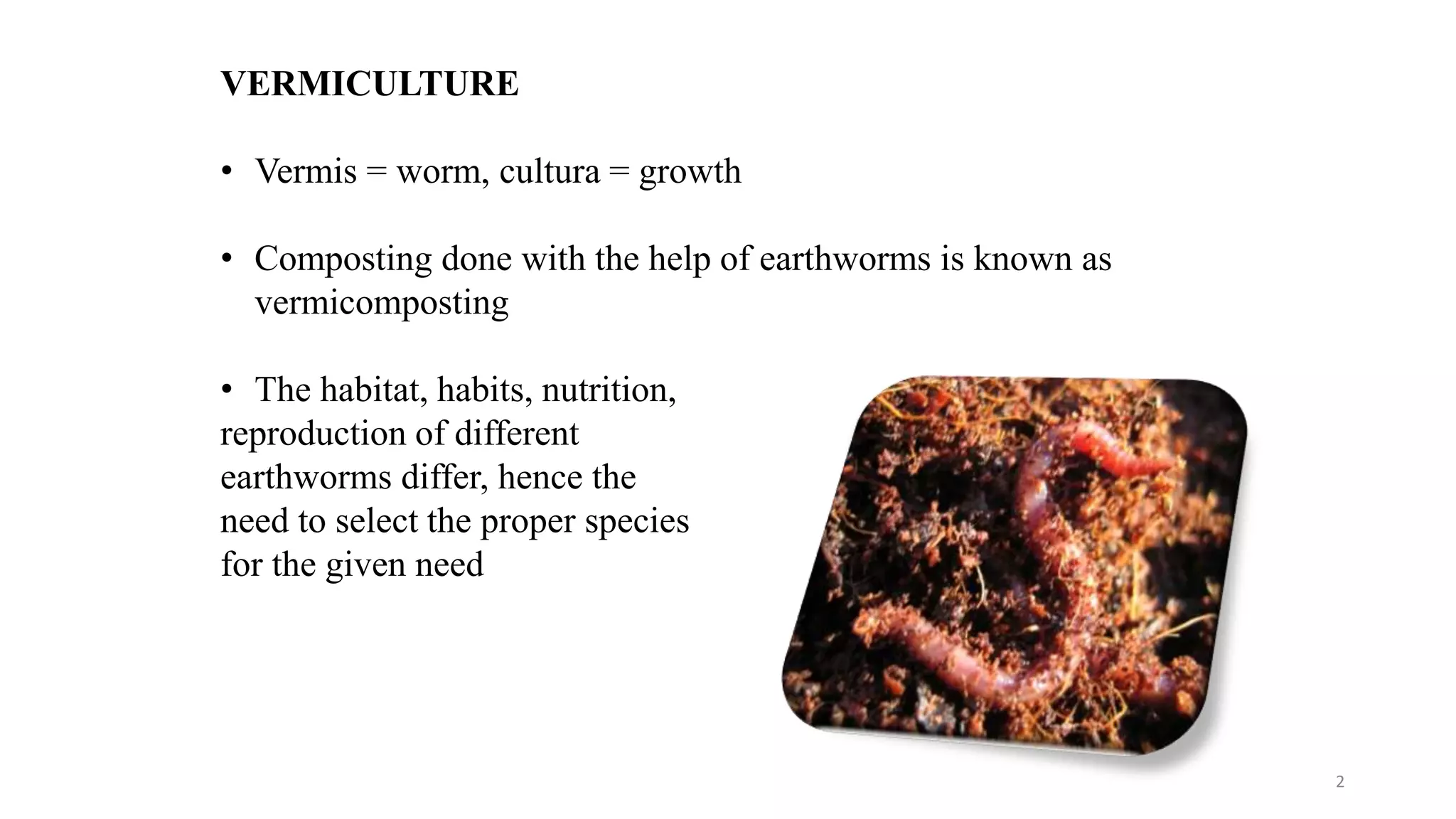
• Vermis = worm, cultura = growth
• Composting done with the help of earthworms is known as
vermicomposting
• The habitat, habits, nutrition,
reproduction of different
earthworms differ, hence the
need to select the proper species
for the given need
2
IMPORTANT ASPECTS
Habits & habitat
• Found everywhere expect sandy soil and soil deficient in humus
• Found in upper layers of slightly damp soil
• One acre of land = 50,000 earthworms on an average
3
Nutrition
• Feed on dead organic matter
• Secretions of the intestinal tract release the plant nutrients in
simple forms in the form of castings
• Castings contain 5-11 times of available N, P and K
4
• Organic wastages that is paper waste, garden waste, industrial
waste contribute negative impact on the environment.
• Vermicomposting method is fully utilized to manage the wastes
towards a more sustainable approach.
• The worms that are used in the vermicomposting are
Eisenia foetida and Eudrillus euginae.
• With the help of earthworms, organic waste is subjected to
decomposition and compost is formed and it is good manure for
growth of plant with a permissible NPK values.
5
PRINCIPLES OF COMPOSTING PROCESSES
• The organic material present in the municipal wastes can be
converted to stable from either aerobically or anaerobically.
• In case of aerobic decomposition micro-organisms oxidized
organic compounds to CO2, NO2 .& NO3.
• Here carbon is used as source of energy and nitrogen is recycled.
This is an exothermic reaction, hence temperature rises.
• In case of anaerobic decomposition organic compounds while
metabolizing nutrients breakdown by the process of reduction
where CH4 & CO2 are released with small amount of energy.
• This is an endothermic reaction where temperature doesn’t raise
much.
6
Advantages of Vermicomposting:
• Least expensive method.
• It works relatively low temperature which is helpful.
• To destroy pathogens.
• It improves the pH of the soil. Earthworm is having characteristics
of changing acidic or alkaline soil to neutral soil. Waste land can also
be converted to fertile land.
• Vermicomposting increases the soil texture, soil aeration, fertility
and soil moisture and reduces in the water requirement in long run.
• The optimal carbon/nitrogen (C/N) ratio is available in
vermicomposting, which determines the quality of compost.
7
VERMICULTURE PLANT REQUIREMENT
A)LOCATION
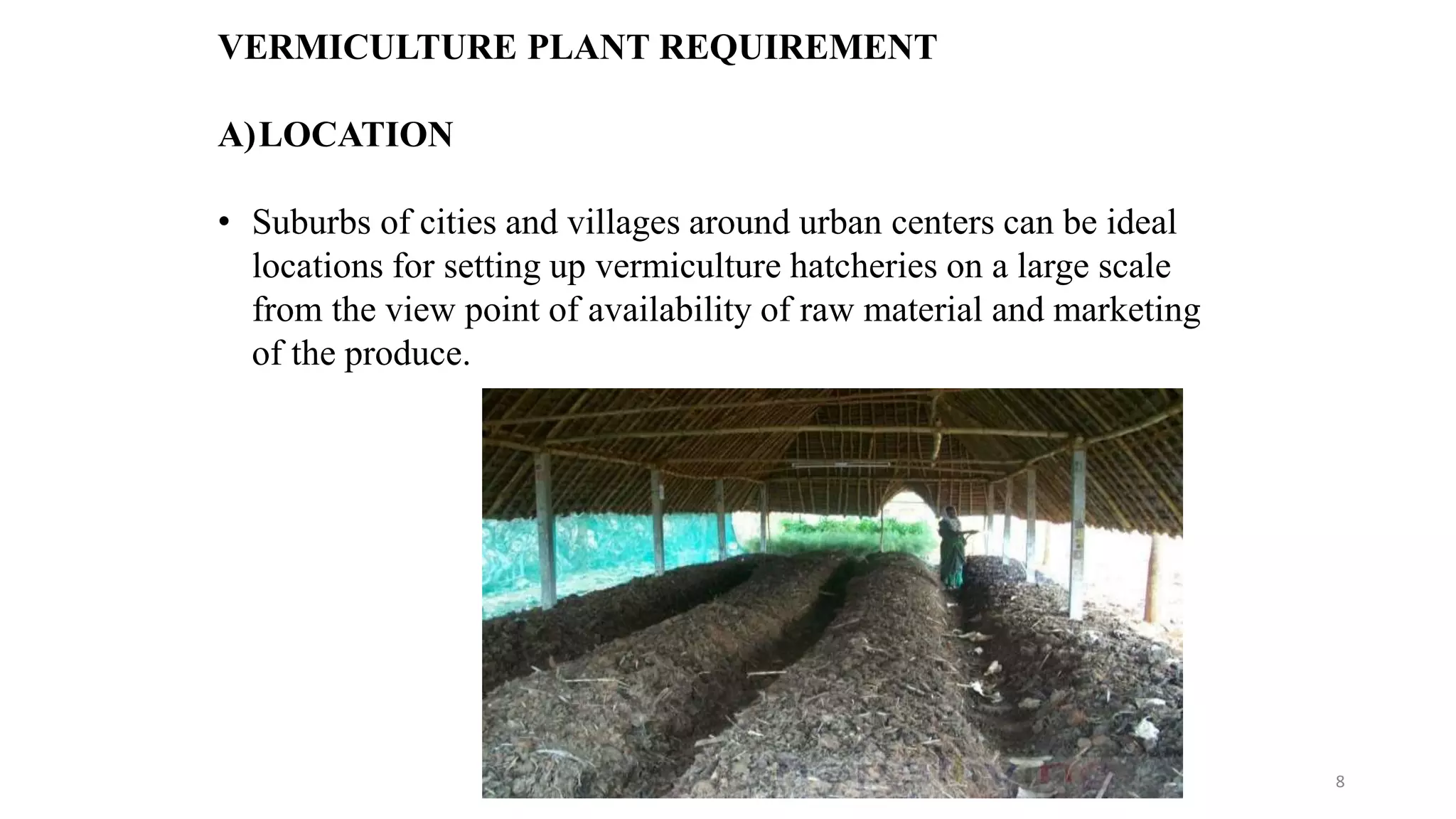
• Suburbs of cities and villages around urban centers can be ideal
locations for setting up vermiculture hatcheries on a large scale
from the view point of availability of raw material and marketing
of the produce.
8
B) OTHER REQUIREMENTS:
• Land: About 0.5 to 1 acre land which can hold 10 to 12 sheds of about 300 sq.ft.
with a bore well and watering arrangements with sub marginal space is preferred.
• Shed: Thatched roof supported bamboo rafters and purlins, wooden trusses and
stone pillars is used either adequate space around the beds and protection from
wind and rain.
• Seed Stock: This is an important requirement , though the worms multiply very
fast within a period of 6 months to a year, to start with certain seed stock is
required.
• Water Supply System: The beds are to be kept moist with about 50% moisture
content hence drippers are used round the clock for continuous supply and saving
of water.
• Machinery: Farm machinery and implements required for cutting the raw
materials, conveying them to vermin beds. Loading, unloading, collection of
compost, loosening of the beds for aeration
9
Experimental Design
• In one tank substrate mixed with paper, garden waste, milk sludge and cow
dung in ratio 3:1:1 were taken for vermicomposting and in another tank, paper
waste, garden waste, cow dung and milk sludge in the ratio of 7:2:1
respectively.
• These waste were laid in a layer wise.
• The substrate left for 15 days for precomposting by sprinkling of water after 15
days, the earthworms belonging to Eudrilus eugenia family popularly known
as night crawel are introduced in to vermi pits total after 15 days.
• The earthworms belonging to Eudrilus eugenia family popularly known as
night crawel are introduced in to vermipits totally 4 kg of earth worm are
brought in that 2kg are introduced in each pit.
• For the protection of earth worm, mulching is done with the help of coconut
leaves, gunny bags etc.
10
MATERIALS AND METHODS
Sample Processing Pre-Composting
The collected waste samples were cut into small pieces and air dried, by spreading
over a ground for 24 hours.
The air dried samples were pre-composted up to 4 days for partial decomposition
before putting in to vermin composting process.
The waste material, in this process partially decomposes aerobically by active role
of bacteria due to which temperature raised.
When the temperature of the precomposted substrate diminished, adult
earthworms with well-defined clitella belonging to the species Eudrilus eugenia
were introduced on the pre composed material filled in both tank with cow dung,
garden waste, paper waste and milk sludge of different ratio.
11
DUMPING OF WASTE IN TO VERMIPIT
•The dumping of waste in pit 1 is done by maintaining of
ratio of 3:1:1.
•In first pit waste is dumped in 5 layer in 4 layer there is 6pan of
leaves, 6pans of paper, 5pans of cow dung, 5pans of milk sludge
then in last layer only 6pans of leaves and 6pans of paper.
•The dumping of waste in in pit 2 is done by maintaining of ratio
7:2:1
•In second pit waste is dumped in 6layer in 5layer 6pans of
leaves and 6pans paper 4 pans milk sludge 2pan cow dung
in last layer only 6pans of leaves and 6pans paper.
•After dumping the waste it kept for 15to 20 days for
precomposting. 12
EFFICIENCY
•Vermicompost quickly restores natural soil fertility, improves its
structure and health..
•Vermicompost provide high seedling survival, optimum growth of
flowers, and full blossom.
•Vermicompost considerably increase yield capacity and improve
taste of the production grown.
•Vermicompost provides high sustained ecologically pure yields.
13
ECONOMICS OF VERMICULTURE AND
VERMICOMPOSTING
• Successful organic farming and no marketing problem
• Raw materials available easily and locally in abundance-
• No chance of failure
• Less investment and good
Income or more profitability-
• No sales tax and income tax
• Pollution control
14
WASTE
MANAGEMENT
CONCEPT
•REUSE
•REDUCE
•RECYCLE
15

Vermiculture and Vermicomposting ppt/ slideshare

  • 1.
    1 PRESENTATION BY S.R. BHARATHKUMAAR, IM.SC BIOTECHNOLOGY 2019- 2021 BHARATHIAR UNIVERSITY.
  • 2.
    VERMICULTURE • Vermis =worm, cultura = growth • Composting done with the help of earthworms is known as vermicomposting • The habitat, habits, nutrition, reproduction of different earthworms differ, hence the need to select the proper species for the given need 2
  • 3.
    IMPORTANT ASPECTS Habits &habitat • Found everywhere expect sandy soil and soil deficient in humus • Found in upper layers of slightly damp soil • One acre of land = 50,000 earthworms on an average 3
  • 4.
    Nutrition • Feed ondead organic matter • Secretions of the intestinal tract release the plant nutrients in simple forms in the form of castings • Castings contain 5-11 times of available N, P and K 4
  • 5.
    • Organic wastagesthat is paper waste, garden waste, industrial waste contribute negative impact on the environment. • Vermicomposting method is fully utilized to manage the wastes towards a more sustainable approach. • The worms that are used in the vermicomposting are Eisenia foetida and Eudrillus euginae. • With the help of earthworms, organic waste is subjected to decomposition and compost is formed and it is good manure for growth of plant with a permissible NPK values. 5
  • 6.
    PRINCIPLES OF COMPOSTINGPROCESSES • The organic material present in the municipal wastes can be converted to stable from either aerobically or anaerobically. • In case of aerobic decomposition micro-organisms oxidized organic compounds to CO2, NO2 .& NO3. • Here carbon is used as source of energy and nitrogen is recycled. This is an exothermic reaction, hence temperature rises. • In case of anaerobic decomposition organic compounds while metabolizing nutrients breakdown by the process of reduction where CH4 & CO2 are released with small amount of energy. • This is an endothermic reaction where temperature doesn’t raise much. 6
  • 7.
    Advantages of Vermicomposting: •Least expensive method. • It works relatively low temperature which is helpful. • To destroy pathogens. • It improves the pH of the soil. Earthworm is having characteristics of changing acidic or alkaline soil to neutral soil. Waste land can also be converted to fertile land. • Vermicomposting increases the soil texture, soil aeration, fertility and soil moisture and reduces in the water requirement in long run. • The optimal carbon/nitrogen (C/N) ratio is available in vermicomposting, which determines the quality of compost. 7
  • 8.
    VERMICULTURE PLANT REQUIREMENT A)LOCATION •Suburbs of cities and villages around urban centers can be ideal locations for setting up vermiculture hatcheries on a large scale from the view point of availability of raw material and marketing of the produce. 8
  • 9.
    B) OTHER REQUIREMENTS: •Land: About 0.5 to 1 acre land which can hold 10 to 12 sheds of about 300 sq.ft. with a bore well and watering arrangements with sub marginal space is preferred. • Shed: Thatched roof supported bamboo rafters and purlins, wooden trusses and stone pillars is used either adequate space around the beds and protection from wind and rain. • Seed Stock: This is an important requirement , though the worms multiply very fast within a period of 6 months to a year, to start with certain seed stock is required. • Water Supply System: The beds are to be kept moist with about 50% moisture content hence drippers are used round the clock for continuous supply and saving of water. • Machinery: Farm machinery and implements required for cutting the raw materials, conveying them to vermin beds. Loading, unloading, collection of compost, loosening of the beds for aeration 9
  • 10.
    Experimental Design • Inone tank substrate mixed with paper, garden waste, milk sludge and cow dung in ratio 3:1:1 were taken for vermicomposting and in another tank, paper waste, garden waste, cow dung and milk sludge in the ratio of 7:2:1 respectively. • These waste were laid in a layer wise. • The substrate left for 15 days for precomposting by sprinkling of water after 15 days, the earthworms belonging to Eudrilus eugenia family popularly known as night crawel are introduced in to vermi pits total after 15 days. • The earthworms belonging to Eudrilus eugenia family popularly known as night crawel are introduced in to vermipits totally 4 kg of earth worm are brought in that 2kg are introduced in each pit. • For the protection of earth worm, mulching is done with the help of coconut leaves, gunny bags etc. 10
  • 11.
    MATERIALS AND METHODS SampleProcessing Pre-Composting The collected waste samples were cut into small pieces and air dried, by spreading over a ground for 24 hours. The air dried samples were pre-composted up to 4 days for partial decomposition before putting in to vermin composting process. The waste material, in this process partially decomposes aerobically by active role of bacteria due to which temperature raised. When the temperature of the precomposted substrate diminished, adult earthworms with well-defined clitella belonging to the species Eudrilus eugenia were introduced on the pre composed material filled in both tank with cow dung, garden waste, paper waste and milk sludge of different ratio. 11
  • 12.
    DUMPING OF WASTEIN TO VERMIPIT •The dumping of waste in pit 1 is done by maintaining of ratio of 3:1:1. •In first pit waste is dumped in 5 layer in 4 layer there is 6pan of leaves, 6pans of paper, 5pans of cow dung, 5pans of milk sludge then in last layer only 6pans of leaves and 6pans of paper. •The dumping of waste in in pit 2 is done by maintaining of ratio 7:2:1 •In second pit waste is dumped in 6layer in 5layer 6pans of leaves and 6pans paper 4 pans milk sludge 2pan cow dung in last layer only 6pans of leaves and 6pans paper. •After dumping the waste it kept for 15to 20 days for precomposting. 12
  • 13.
    EFFICIENCY •Vermicompost quickly restoresnatural soil fertility, improves its structure and health.. •Vermicompost provide high seedling survival, optimum growth of flowers, and full blossom. •Vermicompost considerably increase yield capacity and improve taste of the production grown. •Vermicompost provides high sustained ecologically pure yields. 13
  • 14.
    ECONOMICS OF VERMICULTUREAND VERMICOMPOSTING • Successful organic farming and no marketing problem • Raw materials available easily and locally in abundance- • No chance of failure • Less investment and good Income or more profitability- • No sales tax and income tax • Pollution control 14
  • 15.